
LIFE OF ST COLUMBA
St Adomnán was born in Ireland circa 628, a descendant of St Columba’s grandfather. In 679 he became the ninth abbot of Iona. After a mission to Northumbria on behalf of Irish captives there, and a later visit to the monasteries of Wearmouth and Jarrow, he rejected the Celtic customs relative to the date of Easter and other matters. He later played an important role in persuading the northern Irish churches to adopt the Catholic date for Easter, but he was unable to persuade his own monks in Iona. At Birr in Offaly in 697 he was instrumental in the enacting of ‘Adomnan’s Law’ for the protection of women, children and clergy, especially during warfare. He was a peace-loving man, a voice of moderation in the Irish church and a notable biblical scholar. He wrote On the Holy Places, the text of which still exists, but his most famous work is the Life of St Columba, written at Iona, where he died in 704.
Richard Sharpe is Professor of Diplomatic in the Faculty of Modern History and a fellow of Wadham College, Oxford. His publications include Raasay: A Study in Island History (1977–8; 2nd edn, 1982), A Bibliography of Celtic Latin Literature 400–1200 (with Michael Lapidge, 1985), Medieval Irish Saints’ Lives (1991), and A Handlist of the Latin Writers of Great Britain and Ireland before 1540 (1997).
Adomnán of Iona
LIFE OF ST COLUMBA
Translated by RICHARD SHARPE
Et dixi, Quis dabit mihi pennas sicut Columbae:
& uolabo, & requiescam? Ps. 54:7
PENGUIN BOOKS
PENGUIN BOOKS
Published by the Penguin Group
Penguin Books Ltd, 80 Strand, London WC2R 0RL, England
Penguin Putnam Inc., 375 Hudson Street, New York, New York 10014, USA
Penguin Books Australia Ltd, 250 Camberwell Road, Camberwell, Victoria 3124, Australia
Penguin Books Canada Ltd, 10 Alcorn Avenue, Toronto, Ontario, Canada M4V 3B2
Penguin Books India (P) Ltd, 11 Community Centre, Panchsheel Park, New Delhi – 110 017, India
Penguin Books (NZ) Ltd, Cnr Rosedale and Airborne Roads, Albany, Auckland, New Zealand
Penguin Books (South Africa) (Pty) Ltd, 24 Sturdee Avenue, Rosebank 21 6, South Africa
Penguin Books Ltd, Registered Offices: 80 Strand, London WC2R 0RL, England
www.penguin.com
First published 1995
12
Copyright © Richard Sharpe, 1991
All rights reserved
The moral right of the translator has been asserted
Maps drawn by Nigel Andrews
The tailpieces throughout this volume depict some of the eighty early medieval crosses from the site of the Columban monastery in Iona. These stones, mostly grave-markers, are described in the Royal Commission on the Ancient and Historical Monuments of Scotland’s inventory, Argyll IV: Iona (Edinburgh 1982), pp. 179–92, from where these drawings are reproduced by permission. The stones depicted are No. 6, 16 (below, p. 99), 19 (p. 106), 22 (p. 108), 44 (p.153), 60 (St Columba’s pillow, p. 205 and n. 411), 37 (p. 234), 53 (p. 369). Crown copyright.
Except in the United States of America, this book is sold subject
to the condition that it shall not, by way of trade or otherwise, be lent,
re-sold, hired out, or otherwise circulated without the publisher’s
prior consent in any form of binding or cover other than that in
which it is published and without a similar condition including this
condition being imposed on the subsequent purchaser
EISBN: 978–0–141–90741–3
Contents
Preface
Maps
Genealogical tables
Introduction
St Columba, his early life. St Columba, ‘an island soldier’. St Columba and the Irish. St Columba and the Picts. St Columba’s death. His successors. Adomnán of Iona, abbot and statesman. Adomnán and the writing of the Life. The island and monastery of Iona. The Columban community after Adomnán. The later history of Iona. The medieval legend of St Columba. The modern legend of St Columba.
THE LIFE OF ST COLUMBA
The preface. The second preface. Book One. Book Two. Book Three.
Notes
Manuscripts and editions. Personal names. Peoples and dynasties. Place names. Dates. St Columba’s name. St Mochta’s prophecy. Adomnán’s informants. St Columba’s lineage. King Oswald’s baptism. St Munnu of Taghmon. The foundation of Derry. St Baithéne, second abbot of Iona. The name of Iona. The foundation of Durrow. St Cainnech of Aghaboe. St Colman Elo of Lynally. The whirlpool of Corryvreckan. Áedán mac Gabráin, king of Dalriada. Domnall mac Áedo, king of Ireland. St Lasrén, third abbot of Iona. St Columba’s servant Diarmait. The burial ground of Iona. Monasteries of Tiree. The copying of books in Iona. Dairmait mac Cerbaill, king of Ireland. The monastery of Hinba. The meeting of the kings at Druim Cett. St Comgall of Bangor. St Uinniau. The monastic office in Iona. Synods in the Irish church. Aldfrith, king of Northumbria. The list of St Columba’s companions. The royal ordination of Áedán. Cumméne’s book. The burial of St Odran. The monastic building at Iona. The church of Eigg. Fergnae, fourth abbot of Iona. St Columba’s burial place.
Bibliography
Index
Preface
A source of the first importance for the early history of Ireland and Scotland, Adomnán’s Life of St Columba is also the most engaging of the Lives of Celtic saints. It conveys a vivid sense of the holy man among the brethren of his community, often sitting in his little hut in Iona at the centre of the lives of all his monks. Adomnán wrote a century after Columba’s death, drawing on the collective memory of the community, on public declarations made in the presence of the abbot and elders over the years, and on stories recorded in writing. Most of his stories are told with circumstantial detail and most have a miracle as their point. Some are biblical miracles in which Columba imitates Christ; others are more like folk tales, occasionally quite out of keeping with a monastic context; and many are everyday miracles – events and impressions interpreted after the event as signs of Columba’s sanctity. External reality, superstition, and a theological understanding of the holy man in his relationship to God are so mixed that the Life has appealed to readers across the spectrum of Christian belief and outside it.
The text survives in a manuscript copied at Iona, probably while the author was still alive. The saint himself is presented as someone devoted to the copying of sacred books, and Adomnán gives instructions that each copy made of his work should be carefully compared with its exemplar. In this translation I tried to take such care, though I have been more concerned to express his meaning in English than to replicate his words or his sometimes contrived style. The Introduction sets the scene for Columba, for Adomnán and for the early monastery in Iona. The notes, more extensive than in previous translations, aim chiefly to explain to modern readers what Adomnán’s original audience knew, but I have not always resisted the temptation to add stories from later traditions at Derry and Iona.
The translation was based on the Latin text published in 1961 by Alan Orr Anderson and Marjorie Ogilvie Anderson. In 1989 Dr Marjorie Anderson very kindly read over my draft translation and notes, while I read in typescript the introduction to her second edition, published in 1991. I am most grateful to her for this friendly sharing of our independent work and for the improvements she contributed to this book. Other friends and colleagues read the whole book at a later stage, and I am grateful again to Professor Robert Bartlett, Dr Clare Stancliffe, Dr Alan Thacker, and Professor Charles Thomas, for their advice and comments. Help in other ways was given by Noreen Gypson, Professor Pádraig Ó Riain, Dr Paul Russell, Cornelia Starks and the Ven. Yeshe Zangmo, and for this I thank them all.
Columba, Adomnán, and his Life are all rooted in the island of Iona, and I too have returned to stay there several times during the course of my work. Anyone who has looked over the Sound from Iona to Fionnphort will call the view to mind when reading Adomnán’s stories about visitors who shouted to attract the attention of the ferryman. Little has changed in that scene of sea and sky. Although we cannot now recover the appearance of the early monastery, Iona has a powerful sense of place, which permeates much of Adomnán’s Life; while through the Life one can recapture the atmosphere of Adomnán’s and Columba’s Iona.
23 September 1994
MAPS
GENEALOGICAL TABLES
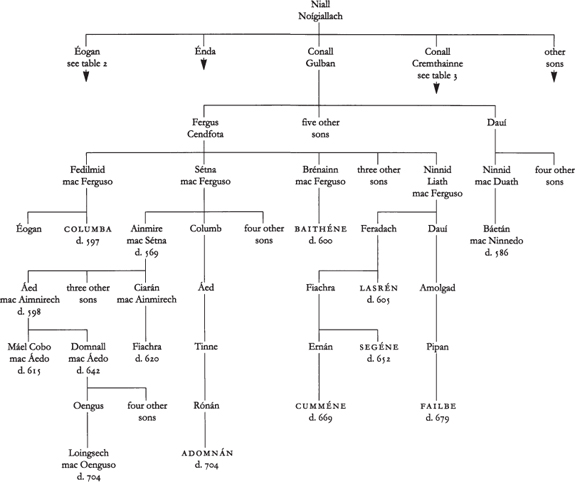
Table 1. The Northern Uí Néill: Cenél Conaill
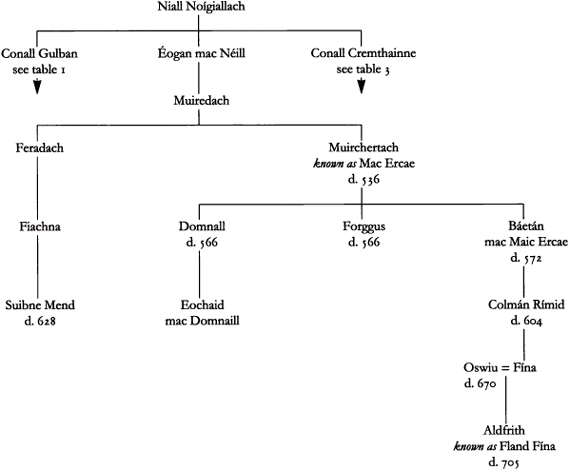
Table 2. The Northern Uí Néill: Cenél nÉogain
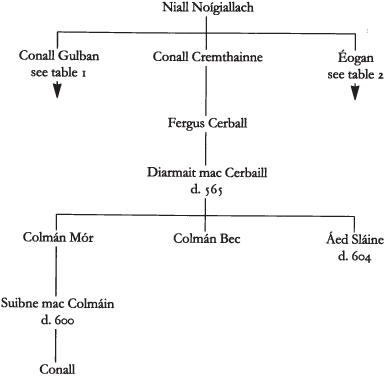
Table 3. The Soutthern Uí Néill
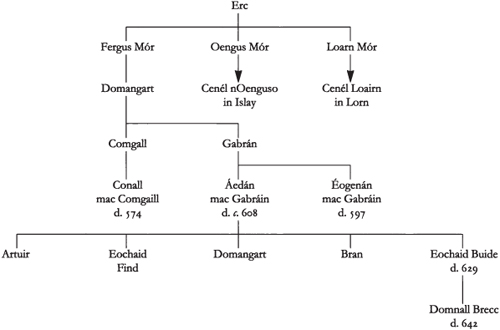
Table 4. Kings of Scottish Dalriada: Cenél nGabráin