The Mirror of the Gods
The Mirror of the Gods
Classical Mythology in Renaissance Art
ALLEN LANE
an imprint of
PENGUIN BOOKS
ALLEN LANE
Published by the Penguin Group Penguin Books Ltd, 80 Strand, London WC2R 0RL, England
Penguin Group (USA) Inc., 375 Hudson Street, New York, New York 10014, USA
Penguin Group (Canada), 10 Alcorn Avenue, Toronto, Ontario, Canada M4V 3B2
(a division of Pearson Penguin Canada Inc.)
Penguin Ireland, 25 St Stephen’s Green, Dublin 2, Ireland
(a division of Penguin Books Ltd)
Penguin Group (Australia), 250 Camberwell Road, Camberwell, Victoria 3124, Australia
(a division of Pearson Australia Group Pty Ltd)
Penguin Books India Pvt Ltd, 11 Community Centre, Panchsheel Park, New Delhi – 110 017, India
Penguin Group (NZ), cnr Airborne and Rosedale Roads, Albany, Auckland 1310, New Zealand
(a division of Pearson New Zealand Ltd)
Penguin Books (South Africa) (Pty) Ltd, 24 Sturdee Avenue, Rosebank 2196, South Africa
Penguin Books Ltd, Registered Offices: 80 Strand, London WC2R 0RL, England
www.penguin.com
First published in the USA by
First published in Grear Britain by Allen Lane 2005
1
Copyright © Malcolm Bull, 2005
The moral right of the author has been asserted
All rights reserved. Without limiting the rights under copyright
reserved above, no part of this publication may be reproduced, stored in
or introduced into a retrieval system, or transmitted, in any form or by any
means (electronic, mechanical, photocopying, recording or otherwise)
without the prior written permission of both the copyright owner
and the above publisher of this book
EISBN: 0–713–99200–7
to Jill
Acknowledgements |
Map |
Prologue |
1. Sources |
2. Objects |
3. Hercules |
4. Jupiter |
5. Venus |
6. Bacchus |
7. Diana |
8. Apollo |
9. The Mirror |
Epilogue |
Appendix: Principal Illustrated Translations of Ovid |
List of Illustrations |
Notes |
Select Bibliography |
Index |
I would like to thank the staffs of the Warburg Institute and the British Library in London, and of the Getty Research Institute in Los Angeles (especially my research assistant, Michael Schreyach). I am also greatly indebted to Elizabeth McGrath, whose detailed comments on the manuscript saved me from numerous errors; Tom Nichols, who read several chapters at an earlier stage and encouraged me to persevere; Chloe Campbell, who did the picture research, and Simon Winder, my wise and very patient editor at Penguin. The book is dedicated to Jill Foulston, without whom I could have written nothing at all.
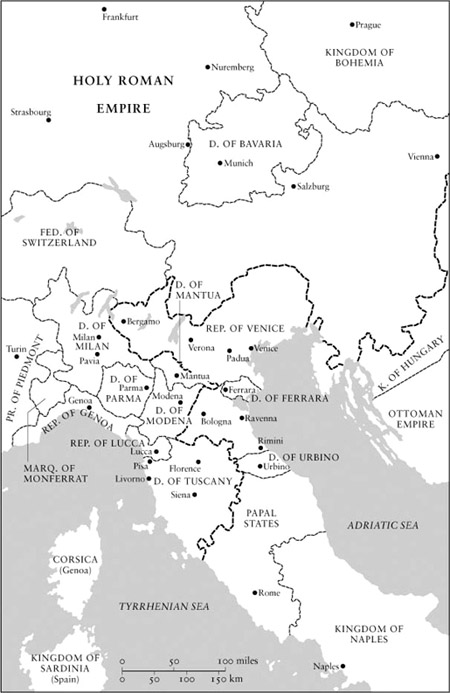
The Kingdom of Naples was under Spanish rule (as it had been since the early sixteenth century), while central Italy was governed by the popes. Rome itself was a small city, but it was also the residence of the papal court, and the villas of the cardinals eventually dotted the surrounding countryside. Within the papal states there was an independent court at Urbino ruled by the Montefeltro family until 1508 and then by the Della Rovere (who later moved to Pesaro). The Duchy of Ferrara was governed by its hereditary rulers the Este (who were also lords of neighbouring Modena) and did not come under direct papal control until 1598. Parma became papal territory in 1521, but in 1545 it was made into the independent Duchy of Parma and Piacenza under the Farnese.
The republic of Venice, which governed a large part of north-eastern Italy, maintained its independence from both the papacy and the Holy Roman Empire (ruled by the Habsburgs), but by 1559 the rest of northern Italy was under Habsburg dominion. The long struggle between the French monarchy and the Habsburgs had ended with the victory of the latter, and from 1535 Milan, formerly a Sforza duchy, was under their direct rule, passing to the Spanish branch of the family on the abdication of Charles V. Elsewhere, Habsburg dominion was mediated through local rulers – the Gonzaga in Mantua, and in Florence the Medici, whose restoration by imperial forces in 1530 put an end to the Florentine republic. Genoa remained a republic, though from 1528 it was under the control of the Doria family and allied to the Empire. As a port, Genoa had close ties with Spain and with Antwerp in the Low Countries.
The trade route north from Italy led to Augsburg, Nuremberg, and Prague. Augsburg had long been an imperial free city, dominated by rich merchant families, notably the Fuggers. In nearby Bavaria, the dukes were also significant patrons of the arts. Nuremberg was another free city, a major centre of trade and learning, sympathetic to the Lutheran reformation. It was from here that Emperor Rudolf II recruited many of the craftsmen who worked at his court in Prague, established in 1583.
From the southern coast of Turkey, you can see the island of Cyprus. It looks beautiful, and sailors often try to land there, only to run aground on the treacherous reefs. Along the shore are scattered the remains of innumerable boats, ‘some wrecked and half covered by the sand; others showing the poop and another the prow, here a keel and there the ribs’. It seems, Leonardo da Vinci continues, ‘like a day of judgement when there should be a resurrection of dead ships, so great is the number of them’.1
Leonardo had never visited Cyprus, but he knew that this was the island of Venus, the goddess of love, and that its delights and dangers were hers. On the other side of the page he describes her garden – a meadow on the top of a rock, with a lake and a small thickly wooded island, and water flowing down into vases of granite, porphyry, and serpentine. It may have been this garden, filled with scented flowers, that the doomed sailors glimpsed across the waves. An ancient epigram had pictured the shipwrecked victims of Venus ‘naked and needy… adrift in the open sea’. All desire is shipwreck, the commentators said. Clinging to their sorrows, tossed by storms, the life of unlucky lovers is a series of such disasters.2
Addressing the king of Cyprus in the prologue to his Genealogia deorum gentilium, a monumental treatise on the pagan gods written more than a century before Leonardo’s jottings, Boccaccio tried to explain what was involved in his project. Collating the remains of the gods is like collecting the fragments of a great shipwreck dispersed along a vast beach; the author himself is like a novice sailor venturing onto the deep in a little boat to bring in this strange harvest from the shores of the Mediterranean. Boccaccio charts the progress of his voyage throughout the book, as his frail prow ploughs through ’the sea of errors’ left by antiquity. Carried by the currents to the coasts of Egypt, Syria and Cyprus, he is sailing around Paphos, the city of Venus, when just as he is describing her charms a ferocious storm blows up. Amidst tumultuous waves, shattering gusts and total darkness, almost overwhelmed, he calls on Christ, who once calmed the waters and saved Peter from the storm. The tempest is stilled, and Boccaccio sails away from Cyprus to continue his journey.3 Had it not been for that desperate appeal, Boccaccio’s little boat might have been one of those that Leonardo pictured half-buried in the sand.
Boccaccio’s vision of himself saved from the treacherous waters of paganism was not new, for the imagery of shipwreck was particularly associated with idolatry. Tertullian had ended his treatise on the subject with a powerful image of the ship of Faith negotiating ’the reefs and inlets, the shallows and straits of idolatry’. The ship of Faith, her sails filled by the Spirit of God, navigates ’safe if cautious, secure if intently watchful’. But those who fall overboard are lost in a fathomless deep from which they cannot swim away; those who run aground face ’inextricable shipwreck’, and those sinking in a whirlpool will never get a gulp of air, for ’all the waves suffocate; every current sucks down into Hades’.4
It was in just such a sea that the shipwreck of antiquity had occurred, for, as Augustine made clear, God’s judgement on Rome was overwhelmingly an indictment of its idolatry and sexual immorality. So when Boccaccio presents his endeavour to his patron he deftly weaves all these strands together. Aligning the shipwreck of antiquity and the shipwreck of love, he turns the lost world of paganism into an inaccessible island as seductive and dangerous as that of the king for whom he writes.
In 1430, Poggio Bracciolini and his friend Antonio Lusco stood on the Capitoline hill in Rome and surveyed the desolate ruins around them. There was surely no better example of the mutability and cruelty of fortune. Of the ancient city that had once been the centre of the world, there remained only a few pathetic traces. The builders of Rome had probably imagined that such a great city would withstand every calamity, yet she too had become the victim of Fortune, who governs the rise and fall of kingdoms.5
Attributing the shipwreck of antiquity to Fortune subtly shifted the context within which it was viewed. Horace made Fortune ’mistress of the ocean’, for, as Cicero said, when we enjoy a favourable breeze we reach a haven, and when she blows against us we are shipwrecked.6 Petrarch and many others picked up the image, and from the mid-fifteenth century onwards Fortune is often personified as a nude woman on the sea. She looks rather like the goddess Venus herself, but she stands precariously on a boat, a ball, or even a dolphin, and holds a sail. The other common image of Fortune was derived from Boethius, who had pictured Fortune turning her wheel, deposing kings and raising up the humble. And in the Middle Ages, the variability of Fortune was often illustrated by four figures clinging to a turning wheel, or by the inscription ’I will reign, I reign, I have reigned, I am without reign.’7
In Fortuna, the first of the early sixteenth-century tapestries known as Los Honores, the two images are combined. Fortune’s wheel is in the centre, with the fortunate riding smoothly across the sea on the ascending side of the wheel, while on the other the unfortunate drown in the swirling waters of the storm, and sailors throw themselves overboard as their ships sink beneath the waves. Here, unlike the other tapestries in the series, all the figures are drawn from classical mythology and history, an indication that whereas sacred history had a direction and purpose, Fortune alone had governed the pagan world.
In the prologue to his lives of the Renaissance artists, Vasari attributes the end of Roman civilization to the turning of Fortune’s wheel. The image suggests that if the wheel turned again, the arts that had once been destroyed would be revived. His optimism was widely shared. From the fifteenth century onwards, there is a new emphasis on the capacity of individuals to control their own destinies. Alberti complains about those who think themselves tossed by the stormy waves of Fortune when they are themselves to blame; Ficino notes that sometimes both the storm and the skill of the pilot bring a ship into port, for skill and fortune are sometimes in agreement. More robustly, Machiavelli insists that Fortune is a woman who will submit to the will of those who master her.8
In the centre of the nave in Siena cathedral, there is an early sixteenth-century marble pavement designed by Pinturicchio depicting an allegory in which a group of people on an island make their way up a winding path towards the figure of Wisdom, securely seated between two ancient philosophers. Below is Fortune, standing with one foot on a ball on the island and another on a little boat whose mast has been broken by the winds that still fill the billowing sail she holds over her head (Fig. 1). Fortune appears to have brought these people to the island; now they must turn their backs on her and ascend the mountain of Wisdom. But one man turns towards her; rather than trudging uphill towards the quiet repose offered by Wisdom, he seems willing to take his chances and sail out to sea with her once more.9
Poggio and his friend were not the first to survey the ruins. There is, as Lucretius once observed, a certain pleasure to be had in viewing a shipwreck from the safety of the shore,10 and the shipwreck of antiquity was no exception. For later Christian observers there were two responses: an exquisite sense of loss at the destruction of Rome herself, and justified satisfaction in Christianity’s triumph over the forces of evil represented by paganism.
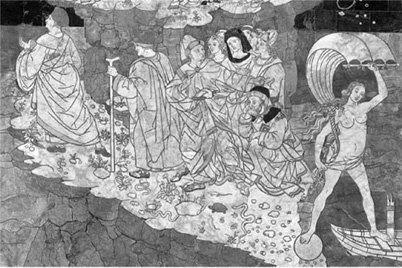
1. Fortuna (detail), floor of Siena Cathedral, after Pinturicchio
The two could coexist, as they do in two poems by Hildebert of Lavardin (c. 1200), one of which mourns the past greatness of the city, while the other celebrates the submission of the city to the true God and the exchange of earthly for heavenly dominion.11 Yet as time passed, the former sentiment began to predominate. The fourteenth-century poet Fazio degli Uberti pictured Roma, the personification of the city, lamenting the disappearance of her ’great, beautiful and noble monuments’.12
The emphasis in these early laments is as much on the loss of books and technical knowledge as on the destruction of statues – a concern reflected in Alberti’s regret that Vitruvius was the only architectural writer to have survived ’that great shipwreck’.13 But as antiquities came to be more highly valued, even the destruction of the pagan idols was seen as an understandable but disastrous mistake. Vasari complained that in the effort to extirpate everything that might give rise to error, Christianity had thrown down all the marvellous statues of the false gods, and so brought such ruin to the arts that they completely lost their direction.
The shipwreck metaphor suggests that the idols of the pagan world had perished in a single devastating storm, and in the later Middle Ages this was widely assumed to have been the case. According to the sculptor Ghiberti, the conversion of the empire to Christianity in the early fourth century had caused such a hatred of idolatry that all the statues, paintings, and libraries of the ancient world were destroyed.14 In fact, it had taken a long time. Despite the repeated sacks of Rome by northern barbarians, at the end of the fifth century most of the architectural and sculptural monuments of the ancient city, including eighty gilded and sixty-four ivory statues of the pagan gods, were still there. Many of the buildings survived for another millennium, gradually being stripped away as consecutive generations of builders reused the materials for new projects – a process accelerated by the revival of the city in the fifteenth century.15 By then, however, the statues of the gods were no longer standing. No one really knew what had happened to them, though medieval writers routinely attributed their destruction to Pope Gregory the Great at the end of the sixth century, who ’in order that the seeds of the old heresies should not multiply caused all the heads and limbs of the statues of the demons to be broken’.16
Some statues just lay where they fell and were only gradually covered with earth, but others were probably buried by zealous Christians or perhaps by pious pagans. In either case, by the late Middle Ages the idea that the ancient gods had not merely fallen but had been buried was commonplace. So when they were accidentally exhumed they were sometimes reburied for fear of the demonic power they still possessed. Ghiberti tells the story of a statue with a dolphin, probably of Venus, inscribed with the name of the Greek sculptor Lysippos, that was found in Siena. Everyone admired it, and it stood above a public fountain until the Sienese lost a battle with the Florentines. At last they realized that it was their reverence for this indecent statue that had caused their misfortune. It was broken up and reburied in Florentine soil to transfer their ill-luck to the enemy.17
There was a close connection between literal and metaphorical burial. At the end of the Genealogia, Boccaccio finally brings his boat in to shore. His untiring voyage has taken him to the rocky coasts of the great sea, and all the islands under the sun. At last he is ready to step back onto dry land. But first he has to secure the boat with ropes and anchors, and protect her from the elements. To do this he must defend his work from the critics. He has not tried to resurrect the ancient gods. They, and their vile depravities, are not asleep but dead and buried for ever, ’crushed under the immovable weight of eternal damnation’.18 A century or two later, if someone had untied Boccaccio’s boat and pushed out to sea once more, could they have been so sure?
Around 1500, Francesco Maturanzio, a Perugian humanist, wrote to his friend the banker Alfano Alfani. He boasted that he had got hold of something ’more remarkable than anything you have seen from the whole of antiquity’. It was an ancient lamp still burning inside an urn1 – a literal fulfilment of Walter Pater’s claim that ’at the Renaissance, in the midst of a frozen world, the buried fire of ancient art rose up from under the soil’.2 And why not? All over Italy bits of the ancient world were just lying about waiting to be discovered. To a discerning observer like the Byzantine scholar Manuel Chrysoloras, who walked around Rome in 1411 noting reliefs representing episodes from ancient myth,3 the litter of antiquity even made a kind of sense, yet to most people, including the educated, it did not quite add up. Although there were continuities in literature, language and custom, the religion that bound these things together had been obliterated by Christianity. The challenge of the Renaissance was not the recovery of the past, but finding the spark that had given it life. The lamp still burning was a fantasy; the flame had to be rekindled.
This involved more than just reclothing the gods and heroes of antiquity with their antique forms; it meant finding new homes for them, and giving them new identities, and inventing new ways for them to relate to each other. Just working out who was who sometimes proved difficult. Classical reliefs and statues rarely came with labels attached, and even if they did, confusion could persist for centuries. For example, a pair of heroic figures with rearing horses had stood on the Quirinal hill in Rome since at least the twelfth century, possibly since antiquity. They bore the inscriptions OPUS FIDIAE and OPUS PRAXITELIS. In the Middle Ages, they were identified as statues of two prophets who bore these names, and it was Petrarch who pointed out that they might actually be the work of the ancient Greek sculptors Phidias and Praxiteles. Mid-sixteenth-century observers wondered whether both statues might not show Alexander and his horse Bucephalus, while in the 1590s the suggestion that they were the man-eating horses of
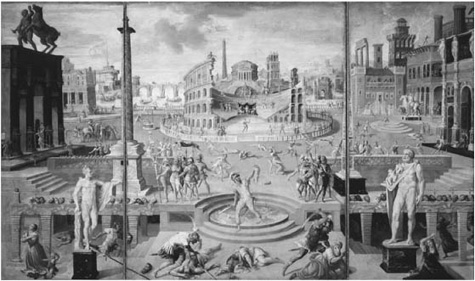
2. Massacre under the Triumvirate, Antoine Caron
Diomedes tamed by Hercules had some currency. It was not until the mid-seventeenth century that the pair were identified as the twin horsemen Castor and Pollux, the Dioscuri, or that it dawned on scholars that the statues probably were not by Phidias and Praxiteles themselves.
Some statues were recognized right away. The Laocoön group was discovered in 1506 in a Roman vineyard, and while still half-buried was identified by Sangallo and Michelangelo on the strength of a description by the Roman author Pliny. By the mid-sixteenth century there were about six to ten statues that everyone knew and admired. Benvenuto Cellini picked out the Laocoön, Cleopatra, the Apollo Belvedere, Commodus as Hercules, an unidentified Venus, and a camillus (then identified as a gypsy), and his opinion was probably fairly standard.4 Thanks to prints published by Antoine Lafréry, even artists who had never been to Rome, like Antoine Caron, knew what they looked like. Caron’s Massacre under the Triumvirate (Fig. 2) shows Hercules Commodus facing the Apollo Belvedere in the foreground, and one of the Dioscuri precariously positioned above the arch of Septimius Severus on the left. Yet many of the most famous statues, known to subsequent generations as the epitome of the classical tradition, were still undiscovered, and even those that had been were not necessarily widely known. Roman sketchbooks from the opening years of the sixteenth century mostly show reliefs rather than statues. There were a lot more statues around when Maarten van Heemskerck visited the city in 1532–6,
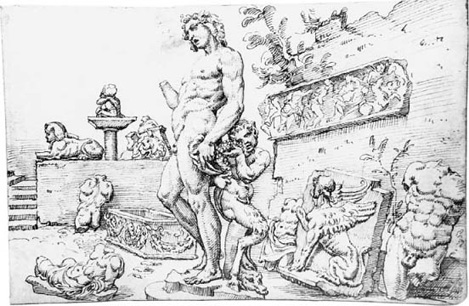
3. Michelangelo’s Bacchus in Jacopo Galli’s Garden, Maarten van Heemskerck
but they were just strewn about the courtyards and gardens of Roman palaces, and you would have had a hard job sorting them out (Fig. 3). Ulisse Aldrovandi’s Delle statue antiche (1556) was the first gazetteer of the Roman collections. And only with Cavalieri’s four books of prints published between 1561 and 1594 was there a visual record of all the most famous statues.
Of the 200 figures illustrated in Cavalieri’s books about 60 per cent are identified as pagan gods and heroes, with Hercules being the most common. This amounted to something like a comprehensive repertoire of mythological figure types. Before its publication, however, it would have been quite difficult for any one person to get a sense of the full range. Artists and antiquarians put together their own collections of drawings and prints, but no one in the sixteenth century sought to work exclusively from classical models. On the contrary, they mixed classical and non-classical types quite freely. Even Raphael, the official inspector of Rome’s antiquities, did so, and seventeenth-century classicists complained that although he might have been an angel compared with other painters, he was still an ass compared with the ancients.5
Supposing that you had classical models for every figure, how were you to put them together? Ancient reliefs provided some guidance because unlike
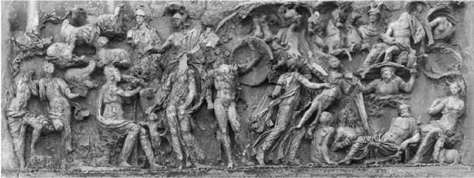
4. Judgement of Paris, Roman sarcophagus relief
statues they illustrated stories. But the range of subjects found in reliefs was limited. On the one hand there were the battle scenes and events from imperial history shown on Trajan’s column and the triumphal arches of Rome; on the other there were sarcophagus reliefs where frequently depicted subjects included Bacchic processions, Diana and Endymion, and scenes from the story of Meleager. Sarcophagi were an important source, particularly in the fifteenth century when few classical statues were known. Yet the sheer profusion of figures often rendered the subject confusing. Other than Bacchic sarcophagi, almost the only sarcophagus reliefs to have a defining influence on representations of the same subject were those of the Fall of Phaethon and the Judgement of Paris (Fig. 4). But, as Marcantonio Raimondi’s print after Raphael shows, the Judgement relief needed quite a bit of thinning out before the subject became legible (Fig. 129, p. 347).
Although fragmentary, sculpture was at least available to look at, whereas ancient painting was not. Around 1480, a series of subterranean rooms with painted ceilings and stuccoes was discovered in Rome on the site of Nero’s Domus Aurea. The style of ornament found there, known as ’grotesque’, had an immediate impact on interior and exterior decoration, although the figural panels were largely neglected until the seventeenth century. By that time, a far larger Roman work had been discovered, the Aldobrandini wedding, but almost no ancient paintings illustrating clearly identifiable mythological narratives were known until 1668. The influence of ancient painting apart from grotesques was therefore negligible. However, grotesque decoration remained popular for a century, and it was believed by some to be replete with symbolic meanings – a sort of mythological dream-world in which the stories had morphed into one another (Fig. 24, p. 82).
For both artists and antiquarians, ancient gems, medals and coins were
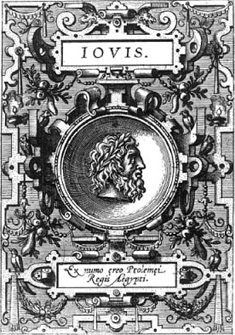
5. Jupiter, Philip Galle, from Abraham Ortelius, Deorum dearumque capita,1573
of more importance. Not only were they far more numerous, but they circulated widely among collectors in Italy and later across Europe. In many cases, coins were probably a person’s first point of contact with the material culture of antiquity. Interest focused on the portrait heads, but the reverses, depicting scenes and symbols of Roman life and religion, were eventually noted as well, and illustrated in numismatic books beginning with Enea Vico’s Imagini con tutti i riversi of 1548. Later, Abraham Ortelius, the Antwerp cartographer and collector, published Deorum dearumque capita (1573) with Philip Galle’s engravings of heads of the gods and goddesses taken from Roman coins and medals, accompanied (in the edition of 1602) by a mythographical commentary (Fig. 5). Coins were also frequently copied for decorative effect by painters, sculptors and manuscript illuminators, and in Correggio’s Camera di San Paolo in Parma they provided the source for the figures in the lunettes.
Whereas coins were relatively cheap, ancient cameos and intaglios were enormously valuable. Until the sixteenth century, they were for many people the primary source of information about what classical art had actually looked like. In Angelo Decembrio’s De politia litteraria, a dialogue set in the Ferrarese court of the 1440s, Lionello d’Este’s discussion of ancient art revolves around his gem collection.6 Many gems, including some of the most prized items in the collection of Lorenzo de’ Medici, depicted mythological scenes. Almost all were initially misidentified, but this did not prevent them from being reproduced. Ghiberti made a mount for the intaglio of Apollo and Marsyas, and a painting from Botticelli’s workshop shows a woman wearing it as a pendant (Fig. 6). Donatello and his assistants copied many of them for circular reliefs in the courtyard of the Palazzo Medici; and thanks to the dissemination of plaquettes (small metal reliefs) and prints, they were later reproduced in a variety of other media by artists throughout Europe. Eventually illustrated catalogues, like Leonardo Agostini’s Le gemme antiche figurate (1657), would reveal that a disproportionate number of the gems known in the period showed satyrs, maenads and other Bacchic figures.
Reading the works of these antiquarians, you have to wonder how the Renaissance in the arts ever happened. They are far more interested in inscriptions and coins than in statues or reliefs, and they give little indication of why an increased appreciation of the material legacy of antiquity should have produced the vibrant visual culture of the sixteenth century. In the case of mythological imagery at least, the relationship between the two is a complex one. The recovery, assimilation, and diffusion of antique art happens quite gradually, and yet at every stage the distribution of mythological imagery by subject and medium is wholly different. The fact that the Laocoön was universally admired did not make his story a popular subject for artists. Conversely, several genres in which mythological imagery is prominent, notably cassoni (painted wedding chests), illustrated editions of Ovid’s Metamorphoses and maiolica (painted pottery), rise and decline with little reference to the antique. Even sculptors rarely tried to imitate the antique statues and reliefs they admired in the same media; the pagan gods appear most frequently not in the form of monumental carvings or stone reliefs but as bronze statuettes and plaquettes. Indeed, the very fact that mythological sculpture developed in Florence rather than Rome suggests it functioned as a substitute for genuine antiquities as much as a supplement to them.
There is, however, a clear link between the collection of antique art and the spread of mythological imagery. The Roman collections were the magnet that drew artists to Rome and inspired them to treat classical themes in their own work. And it was often the most enthusiatic collectors of antiquities who were anxious to commission contemporary artists to produce mythologies, either for a studiolo (a small study) such as that of Isabella d’Este,
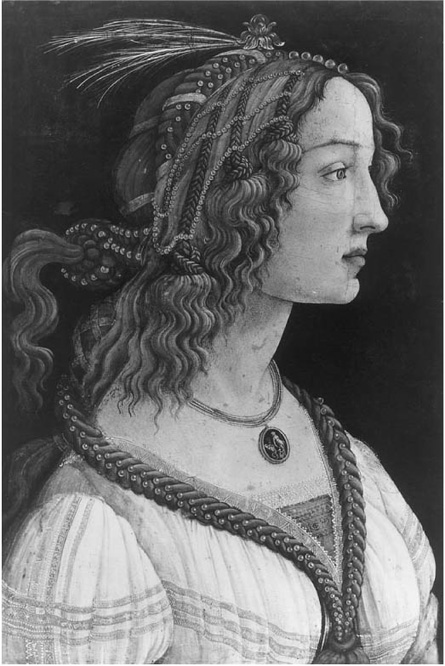
6. Portrait of a woman with intaglio of Apollo and Marsyas, School of Botticelli
or else, later in the century, to decorate a gallery (such as those at the Palazzo Rucellai and the Palazzo Farnese in Rome) in which antique sculpture would be exhibited. Similarly, where antiquities were displayed outside, a garden or grotto was more likely to be given an iconographical scheme appropriate to the works within it. Rather than imitating antique models, mythological art often just provided antiquities with a suitable setting. It helped them feel at home.
One way to do this was to recreate lost works of classical art. Along with models to imitate, the ancient world had also left numerous descriptions of works of art that either no longer existed, or were only literary conceits in the first place. The ekphrases (detailed descriptions) of Pliny, Lucian, Philostratus and others proved to be almost as influential as the material remains of classical civilization. The visible legacy of antiquity was fragmentary and difficult to interpret, but with the help of literary sources it was possible to imagine what the work of classical artists had been like. This was especially important when it came to painting, for literature allowed painters to recreate works from an invisible gallery of ancient masterpieces. The most famous example, Botticelli’s Calumny of Apelles, is the reworking of a painting described by Lucian and recommended to painters by Alberti as a model of narrative art.
Lucian’s writings had been unknown in the medieval West, and came to Italy from Byzantium. There was something about Lucian’s light-hearted fantasies that struck a chord in the Renaissance and he became a great favourite of the humanists. All the same, his influence on the choice of subject-matter was hardly comparable to that of Philostratus, whose descriptions of ancient paintings, almost all mythological, were circulating in manuscript from the beginning of the fifteenth century. Early attempts to recreate specific works described by Philostratus are difficult to identify, but Isabella d’Este’s highly literary approach to the commissions for her studiolo may have been inspired by Philostratus’s example, if not his actual descriptions, for she later commissioned an Italian translation which was consulted for the decoration of her brother’s studiolo in Ferrara. And Philostratus, like many Greek authors, found a wider readership in France, where Blaise de Vigenère’s translation and commentary appeared in 1578, with an illustrated edition in 1614 (Fig. 82, p. 226).
Pliny’s Natural History did more than provide descriptions of lost works. It enabled people to identify newly discovered antiquities, such as the Laocoön and the Niobid group, with specific works and artists. Although this could result in optimistic misattribution, it served to forge a connection between the art worlds of antiquity and the Renaissance. The fragments of antiquity were not just the relics of paganism but the products of an industry in which individual artists competed against one another in the imitation of nature and so won fame and the favour of princes. As a model for the aesthetic and social ambitions of the Renaissance artist, Pliny’s Natural History was of central importance, and its integration of mythological subjects into that account helped to take the ancient gods out of the sphere of religion into that of competitive manufacture. The fact that they were idols made by human hands may once have served to discredit them; turned around, it showed how much a craftsman could achieve.
Almost anything that served to naturalize the demonic world of paganism helped its assimilation. Ancient historians were also potentially useful in this regard, especially Diodorus Siculus. His approach to the gods was similar to that of Euhemerus, the ancient writer who had argued that the gods were merely prominent mortals who had been deified after their deaths. This euhemerist interpretation of ancient religion had been enthusiastically adopted by early Christian writers like Lactantius, who sought to discredit the supernatural claims of paganism; and it was transmitted to the Middle Ages through Isidore of Seville. By placing the ancient gods within the frame of human history they could be incorporated into the same chronology as that of sacred and contemporary history. It is in this context that they appear within medieval chronicles as kings of places remote in time and space. But the rediscovery of Diodorus provided a wealth of new material that was used by those, like Annius of Viterbo and Jean Lemaire de Belges, who sought to establish closer connections between the world of ancient myths and western European history.
Following Virgil, the Trojan War was the natural starting-point for national mythologies, and the idea that the kingdoms of western Europe had, like Rome, been founded by fleeing Trojans was widely held and created an incentive for the use of the Trojan legend in both literature and history. The story of Troy was well known, especially in northern Europe, thanks to a series of vernacular works derived not from Homer but from two narratives attributed to Dares of Phrygia and Dictys of Crete which purported to be first-hand accounts of the Trojan War written by combatants from either side. Dares’ De excidio Troiae historia, the more influential of the two in the West, began with the story of Jason and the Golden Fleece, and this pattern was passed on through a sequence of medieval imitators. Garbled and anachronistic though they often were, works like Benoît de Sainte-Maure’s Roman de Troie, and Guido delle Colonne’s thirteenth-century Historia destructionis Troiae kept the stories of the Trojan War, the Judgement of Paris, and the Voyage of the Argonauts alive throughout the medieval period. Manuscripts were frequently illustrated and Raoul Le Fèvre’s Recueil des hystoires de Troyes was printed with woodcuts (Fig. 32, p. 100). So when Jean Lemaire claimed to put the Trojan legend on a firmer historical footing in his Illustrations de Gaule et Singularitez de Troye, he mentioned inaccurate illustration as one problem his work would correct.7
Virgil’s Aeneid was known throughout the Middle Ages and only increased in popularity in the Renaissance, yet it was Servius’s fourth-century commentary rather than the poem itself that contributed most to the Renaissance understanding of mythology. Looking through Servius’s text, this may seem surprising, for the mythological material is thinly scattered. Yet if you follow a thread stretching back from the Renaissance, you often end up with Servius, and a surprising amount of the lore of the ancient world was mediated through his work. The sixth book of the Aeneid, in which Aeneas visits the underworld, received particular attention from other commentators as well.
There were also important ancient commentaries on Homer, but these were little known in the Middle Ages and not until the mid-sixteenth century were they all in print. The poems themselves were more readily available, but although there was a Spanish paraphrase of the Iliad as early as 1445, vernacular translations were slow to appear elsewhere, and even then Homer did not enjoy the prestige that his priority later gave him. Hesiod suffered still greater neglect. Of rather more importance for the understanding of mythology in the Renaissance were the works of the now almost forgotten author Statius and the late antique commentary on his work by Lactantius Placidus.
Although there was no literary parallel to the exponential increase in the knowledge of classical antiquities, there were few important classical authors of whom Renaissance scholars were unaware. Some lost Latin poets, like Lucretius (whose De rerum natura was found in a German monastery by the Florentine manuscript-hunter Poggio Bracciolini) and Catullus, were rediscovered in the fifteenth century. Greek tragedies were translated into vernacular languages from the second quarter of the sixteenth century; poets like Anacreon, Callimachus, and Pindar were also available, although better known in sixteenth-century France than in Italy; even an obscure late antique epic like Nonnos’s Dionysiaca was eventually edited and published.
Given the wealth of ancient literary sources available in the Renaissance, it is revealing that one late antique novel of dubious reputation, Apuleius’s Golden Ass, had a greater influence on the visual arts than almost any other classical text. The legend of Cupid and Psyche which lies at its centre had been known in the Middle Ages through Fulgentius, but in the fourteenth century Boccaccio got hold of a manuscript, reused a couple of stories in the Decameron, and included a discussion of Cupid and Psyche in his Genealogia deorum. Perhaps because Boccaccio had helped to popularize it, The Golden Ass was printed in Rome as early as 1469, and an Italian translation was already available in manuscript by 1481, for in that year Federico Gonzaga wrote to Ercole d’Este to ask if he could borrow it.8 (Ercole replied that he could not part with it because he read it every day, but agreed to make him a copy of his own.) Niccolò da Correggio produced a verse translation of the story of Cupid and Psyche in 1491, and other versions in both verse and prose continued to appear throughout the century.
Ovid was the most influential source for the visual arts. His work was in no sense a discovery of the Renaissance, for it had been read throughout the Middle Ages. Early vernacular editions of the Metamorphoses routinely use medieval paraphrases and commentaries, and as subsequent translations often embroider their predecessors rather than re-translate the original text, the content of a vernacular Ovid often differs significantly from that of contemporary Latin editions (or modern translations). In both Italy and France, the first illustrated edition to appear in print was also the first translation, and although illustrations for vernacular translations were sometimes reused or revised for Latin editions, it was only for vernacular translations that new illustrations were routinely commissioned (see Appendix). Even so, the tradition of illustrated editions of Ovid was conservative. The woodcuts for the first Italian edition of 1497 (Fig. 112, p. 302) provided the model for those in Niccolò Agostini’s verse translation of 1522, and indeed for every Italian edition until Lodovico Dolce’s version of 1553, and for Latin editions until the end of the century. The woodcuts of the 1497 edition also had an impact in France where they informed Bernard Salomon’s woodcuts of 1557, which in turn became enormously influential throughout Europe.
One effect of such textual and illustrative conservatism was that a single mistake could be perpetuated for centuries across a variety of contexts. According to Ovid, when Cephalus’s dog Laelaps was pursuing the Teumesian fox both he and the beast he was pursuing were metamorphosed into marble as they ran. In Colard Mansion’s Ovide moralisé (1484), marbre is given as arbre (following a mistaken caption to an earlier manuscript illustration). The error passed into the early French Ovid known as La Bible des poetes (1493), with the result that in Le Grand Olympe of 1539 – a French prose edition that reused the text but supplied new illustrations – Laelaps and his quarry are shown bounding around the countryside with trees growing out of their necks. From here the motif entered the visual repertoire quite independent of the mistranslation, and so in Salomon’s version of the death of Procris of 1557, Solis’s reworkings of 1563, and even in the print for Steinman’s Latin edition of 1582, the animals appear in the same form, save that Salomon’s appear to be sprouting poplars (Fig. 7) and Steinman’s conifers – the difference between Lyons and Leipzig.9
Nevertheless, Salomon’s series of woodcuts represented a watershed. Produced in French, Dutch and later in Italian editions for an Ovide figuré, where each woodcut was accompanied only by an eight-line verse summary, the pocket-size volume had no allegories and contained not one word of Ovid’s poem. But Salomon’s designs set a new standard of coherence and skill, and from then on illustrated editions of Ovid were often image- rather than text-led. Virgil Solis’s reworkings of Salomon’s prints (in which the designs are reversed) appeared in a similar format, and later artists like Hendrik Goltzius (Fig. 54, p. 150) and Antonio Tempesta (Plate III) often produced freestanding sets of illustrations independent of the text. At the same time, the number of illustrations to full-text translations was being reduced. Anguillara’s enduring Italian translation first appeared in 1561, and from the edition of 1584 was illustrated with fifteen full-page engravings by Giacomo Franco, each of which managed to show numerous incidents from the relevant book within a single landscape (Fig. 92, p. 251). The engravings were reused in Nicolas Renouard’s new French translation, and also provided the model for George Sandys’s English version of 1632.
If the relationship of illustrations to a particular translation is usually slight, their relevance to any moral or allegorical interpretations provided is non-existent. Unlike Homer and Virgil, Ovid had not attracted serious discussion in late antiquity. However, most Renaissance editions of the Metamorphoses were accompanied by annotation of some kind. In the case of the first vernacular editions, this was derived directly from late medieval models. Later versions frequently reuse this material, but the extent and nature of the commentary differs between countries and changes over time. The direct interpretation of stories in terms of Christian doctrine characteristic of medieval French moralized Ovids and La Bible des poetes was not sustained. In 1559, Christianized interpretations of Ovid were put on the Catholic church’s index of prohibited books, but they were already out of print in France and had never been popular in Italy or in Latin editions. All most readers of Ovid were looking for was a straightforward indication of the moral category into which each narrative fell. Antonio
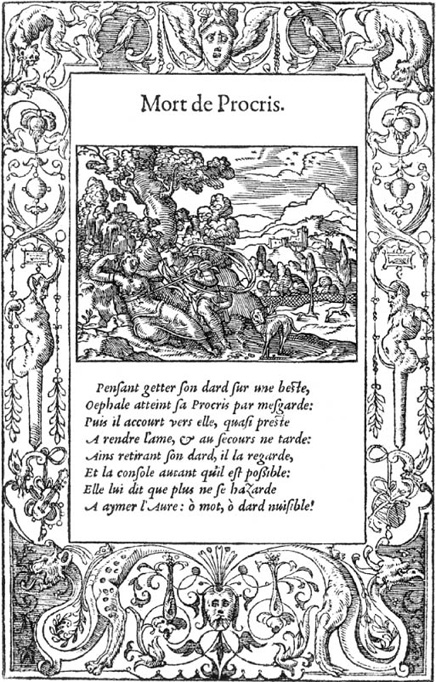
7. Death of Procris, Bernard Salomon, from Ovid, Metamorphoses, 1557
Tritonio’s Mythologia (1560) helpfully provided an index – of the women loved by gods, the impious, the proud, the chaste, the brave, and the good-looking boys (to name some of the more populous categories).
Of Ovid’s other works the most useful as mythological sources were the Fasti (based on the Roman calendar) and the Heroides (a sequence of letters from legendary women to their husbands). Both were printed with great frequency, and were illustrated with woodcuts in the early sixteenth century. But the Fasti did not appear in any vernacular language until Cartari’s version of 1551, and its impact on the arts is correspondingly slight. Although used as a literary source for Botticelli and Piero di Cosimo in Florence, the Fasti remained more accessible to the iconographical adviser than the artist.
Specific interpretations of Ovid can often be traced back to the mythographers of late antiquity, but the traditions of commentary and mythography are rather more distinct than you might imagine. For one thing, even though ancient mythographers wrote about many of the same myths, none of them commented directly on Ovid’s text. This distance was maintained. Giovanni del Virgilio’s allegories of the Metamorphoses (c. 1370, but reused in the Italian edition of 1497) and Boccaccio’s Genealogia may be contemporary but they are mutually independent. In the sixteenth century there is some overlap between the interests of Latin commentators and the mythographers, but the concerns of vernacular commentators only begin to converge with those of the mythographers in the early seventeenth century in works like van Mander’s Wtlegghingh which is in effect a freestanding mythography structured as a commentary on the Metamorphoses.
In general, however, annotators and mythographers responded to different imperatives. Commentary on Ovid was governed by what the reader needed to know, mythography by what there was to know. And as the mythographies of the ancient world demonstrated, this was potentially limitless. However, classical mythographers like Hyginus or Cornutus were not read by anyone other than scholars, and Apollodorus’s Library was little used before the mid-sixteenth century. Renaissance readers seem to have responded most readily to authors whose approach to the gods was light in tone and sceptical in approach: Palaephatus, an unknown Greek author whose On Unbelievable Tales was devoted to debunking the myths of antiquity by offering a natural explanation for everything, become popular in the mid-sixteenth century after his work was finally published in Latin. And Cicero’s De natura deorum, which had been little read in the Middle Ages, was another beneficiary.
The great exception to this general neglect was the work of Fulgentius, a Christian writer of the late fifth century, whose Mythologiarum libri tres offered brief explanations of ancient fables in terms of etymology, natural processes, and social morality. He discusses only fifty fables, but almost all of them became common subjects in Renaissance art. Whereas most mythographies include huge amounts of information that proved redundant for succeeding generations, if you look at the list of subjects he covers you cannot help being struck by his hit-rate. Why this should be so is a mystery. Was he the author of his selection’s success, or did he just happen to choose the same fables as Renaissance artists? Although more than a dozen editions of his original text appeared in the sixteenth century, it was never translated or illustrated. In fact, there is little evidence of iconographical programmes devised directly from it. His indirect influence was more important, perhaps because it was mediated both by later mythographies, and by the moralizers of Ovid. In general, mythographers and vernacular commentators drew on different sources, but Fulgentius is common to both. His was the one mythography you could not avoid.
Fulgentius’s work, along with Servius’s commentary on the Aeneid, the eighth book of Isidore of Seville’s encyclopedic Etymologiae, and Lactantius Placidus’s commentaries on Statius, provided the foundation for the earliest medieval compendia of classical myth, the so-called Vatican Mythographies. The first two of these date from the last two centuries of the first millennium, while the third is a much later work, the Liber ymaginum deorum, a twelfth-century text attributed to an unknown Albricus, perhaps the English philosopher Alexander Neckam. Albricus’s account of the ancient deities also draws on two other late-antique authors: Macrobius (also the author of a commentary on Cicero’s Somnio Scipionis), whose Saturnalia identified all the gods of the pagan world with the sun, and Martianus Capella, the author of The Marriage of Mercury and Philology, an extended allegorical fantasy the first book of which describes an assembly of the gods. Martianus was also the subject of numerous commentaries, notably that of Remigius of Auxerre.
Albricus’s work was neither translated nor illustrated, but one way or another it informed every subsequent mythography. Petrarch read it and used it in the third canto of his poem Africa, while his friend Pierre Bersuire drew on both Albricus and Petrarch in his account of the appearance of the gods in a prologue to his Ovidius moralizatus. From these descriptions a distinctive iconography developed that lasted for two centuries. Bersuire’s prologue was translated into French and published with woodcuts of the gods by Colard Mansion in his Ovide moralisé of 1484. But it also provided the basis for two late fourteenth-century works: Évrart de Conty’s commentary on Les Eschez amoureux, and the Libellus de imaginibus deorum. Although ostensibly a commentary on a recent allegorical poem, the former is an encyclopedic work in its own right, and contains the most substantial vernacular mythography of its time. The descriptions of the gods come straight from Bersuire, but the interpretations are much longer and free of his theological orientation. In the late fifteenth and early sixteenth centuries manuscripts of Évrart’s work were illustrated with miniatures of some refinement, but the commentary was not published, and its subsequent influence was minimal. In contrast, the Libellus (often confusingly attributed to Albricus himself) went through many editions. Its success was probably due to its simplicity. Beginning with the planetary deities, the Libellus offers a short paragraph on the appearance of each god, and a brief account of the twelve labours of Hercules. It was all most people needed to know.
In Italy, especially in Florence, Boccaccio’s Genealogia deorumGenealogia