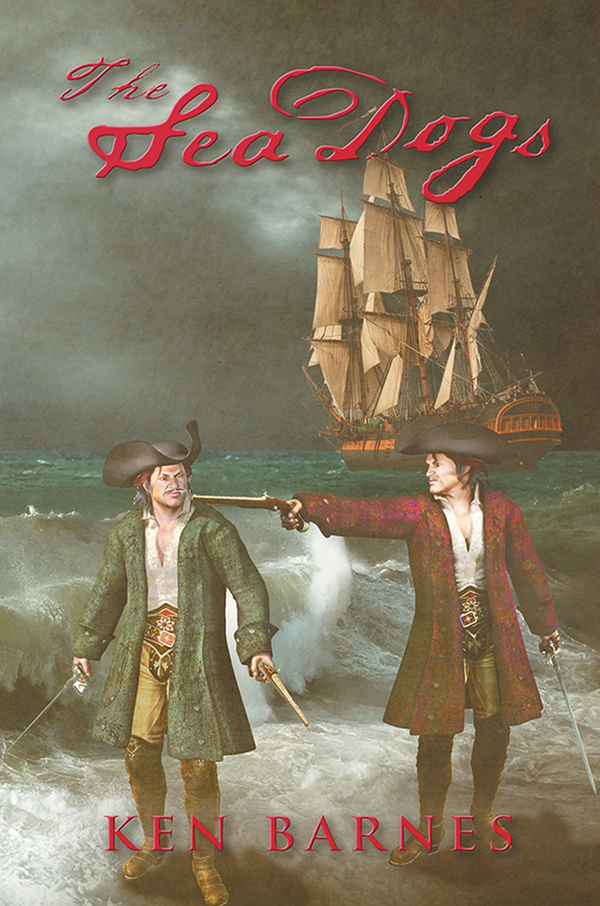
THE SEA DOGS

Strategic Book Publishing and Rights Co.
E-book Edition © 2014
Print Edition © 2014 Ken Barnes - ISBN: 978-1-62857-589-7
All rights reserved.
No part of this book may be reproduced or transmitted in any form or by any means, graphic, electronic, or mechanical, including photocopying, recording, taping, or by any information storage retrieval system, without the permission, in writing, of the publisher.
Strategic Book Publishing and Rights Co.
12620 FM 1960, Suite A4-507
Houston, TX 77065
www.sbpra.com
ISBN: 978-1-63135-082-5
Design: Dedicated Book Services, (www.netdbs.com)
They that go down to the sea in ships, that do business in great waters;
These see the works of the Lord, and his wonders in the deep.
Psalm 107:23-24
DEDICATION
To my Wife, Anne
ACKNOWLEDGEMENTS
The author would like to thank the following people and organizations for their various contributions to this work. Patrick Anderton, Daniel Barnes, Robin Davies (Square Sail Limited), Rich Little, National Maritime Museum, Greenwich, London, Portsmouth City Museum, Paul Talkington, Tony Thomas, Derek Ware and the late Roy Stevens.
TABLE OF CONTENTS
CHAPTER ONE
CHAPTER TWO
CHAPTER THREE
CHAPTER FOUR
CHAPTER FIVE
CHAPTER SIX
CHAPTER SEVEN
CHAPTER EIGHT
CHAPTER NINE
CHAPTER TEN
CHAPTER ELEVEN
CHAPTER TWELVE
CHAPTER THIRTEEN
CHAPTER FOURTEEN
CHAPTER FIFTEEN
CHAPTER SIXTEEN
CHAPTER SEVENTEEN
CHAPTER EIGHTEEN
CHAPTER NINETEEN
CHAPTER TWENTY
CHAPTER TWENTY-ONE
CHAPTER TWENTY-TWO
CHAPTER TWENTY-THREE
CHAPTER TWENTY-FOUR
CHAPTER TWENTY-FIVE
CHAPTER TWENTY-SIX
CHAPTER TWENTY-SEVEN
CHAPTER TWENTY-EIGHT
CHAPTER TWENTY-NINE
CHAPTER THIRTY
CHAPTER THIRTY-ONE
CHAPTER THIRTY-TWO
CHAPTER THIRTY-THREE
CHAPTER THIRTY-FOUR
CHAPTER THIRTY-FIVE
CHAPTER THIRTY-SIX
CHAPTER THIRTY-SEVEN
CHAPTER THIRTY-EIGHT
CHAPTER THIRTY-NINE
CHAPTER FORTY
CHAPTER FORTY-ONE
CHAPTER FORTY-TWO
CHAPTER FORTY-THREE
CHAPTER FORTY-FOUR
CHAPTER FORTY-FIVE
CHAPTER FORTY-SIX
CHAPTER FORTY-SEVEN
CHAPTER FORTY-EIGHT
CHAPTER FORTY-NINE
CHAPTER FIFTY
CHAPTER FIFTY-ONE
CHAPTER FIFTY-TWO
CHAPTER FIFTY-THREE
CHAPTER FIFTY-FOUR
CHAPTER FIFTY-FIVE
CHAPTER FIFTY-SIX
CHAPTER FIFTY-SEVEN
CHAPTER FIFTY-EIGHT
CHAPTER FIFTY-NINE
CHAPTER SIXTY
CHAPTER SIXTY-ONE
CHAPTER SIXTY-TWO
CHAPTER SIXTY-THREE
CHAPTER SIXTY-FOUR
CHAPTER SIXTY-FIVE
CHAPTER SIXTY-SIX
CHAPTER SIXTY-SEVEN
CHAPTER SIXTY-EIGHT
CHAPTER SIXTY-NINE
CHAPTER SEVENTY
CHAPTER SEVENTY-ONE
CHAPTER SEVENTY-TWO
CHAPTER ONE
Childhood dreams, boyhood ambitions, and an enquiring mind can lead a young man in many different directions. And so it was that the entire course of youthful Martin Denbow’s life was altered irrevocably within the span of a single encounter of no more than five minutes on a particular and quite extraordinary day, a day he would remember for the rest of his life.
It was a fine May morning in the year 1652 when Alexander Denbow and his wife Alice decided to spend a day by the sea, not just for their own benefit, but also for that of their two sons, Martin and David, aged fourteen and six respectively.
Although they lived little more than fifteen miles from the Kentish coastline, it was seldom that they felt inclined to leave the day-to-day chores of home life.
The Denbows were a farming family who had sunk their roots in the rich soil of Kent some seventy years earlier when Alexander’s grandfather, Stewart Denbow, had journeyed down from his native Scotland to claim an inheritance of one hundred and fifty acres of prime farming land. Old Stewart’s initial plan had been to sell off the land and immediately return to Scotland with a healthy profit. But, after taking one look at the lush, green, rolling landscape, he fell in love with it and decided to remain. He passed it on to his eldest son Robert who, in turn, left it to his son Alexander. Thus, a family tradition had been established.
In those days, large families were the order of the day, particularly amongst farming communities. Many mouths to feed meant greater dedication to business. It also meant that there would be more than one offspring to carry on the family business. And Alexander was delighted when his wife presented him with a son who, quite naturally, would grow up to continue the family tradition. But try as they did, it was all of eight years before Alice Denbow gave birth for the second and last time. To their joy, it was another boy.
Alexander and Alice had worked particularly hard during that spring of 1652, and they felt that a picnic by the sea was a good way of relaxing as well as broadening the outlook of their two boys. The clean scent of the sea air combined with his first intriguing sight of the far horizon did much more than broaden the outlook of their eldest boy. Indeed, Martin Denbow saw a whole new world entirely removed from the one in which he had been raised. The impression it made on his eager, enquiring mind was to prove indelible.
His first impulse on seeing the ocean was to get into it, to touch it, feel it, and to fill his lungs with as much of that refreshing salt air as he could stand, to fill them until they were ready to burst. So while his parents laid out rugs on the sand with the intention of settling down to a few hours of quiet sunbathing, Martin slipped off his shoes and began walking towards the water.
“And just where do you think you’re going?” called his mother.
“Down to the sea,” replied Martin without breaking his stride.
Alice Denbow turned to her husband, who had already assumed the horizontal position. “Did you hear that?” she asked sharply. “He’s going down to the sea.”
“Yes, yes. I heard,” replied Alexander, closing his eyes in the hope that the immediate conversation was over.
“Well?” asked Alice.
“Well what?”
“He’s going down to the water. Your son’s going down to the water.”
“Well, isn’t that what we came for? It’s the first time he’s seen the sea. Let the boy enjoy it.”
At this point, young Davey looked at his mother and spoke. “I’ll go and bring Martin back, if you like.”
“No,” said Alice.” Your father’s right. I’ll just keep an eye on him from here.”
It was an unusually hot day for the time of the year, and the soles of Martin’s feet seemed to be burning with each step he took across that sun-scorched sand. It would have been unbearably hot but for a cooling breeze that came blowing in from the sea, teasing the fine white sand into powdery wisps that floated playfully and refreshingly around his ankles and knees. And then finally he was there, at the water’s edge. And the first wave that swept over his feet, cold and clean, was a completely new and thrilling sensation. He walked around in a circle, kicking and splashing. Then he found himself laughing joyously, loudly, his heart pounding with a booming exhilaration the likes of which he had never before known.
By now, Alice Denbow, like her husband, was lying on her back and gently snoozing. Young Davey looked at them and then at Martin, whose distant laughter he could plainly hear, and decided that his big brother’s company was by far the more interesting. So he too ran eagerly down to the sea, still wearing his shoes. But on reaching the water’s edge, he was startled to find a wave relentlessly rushing forward to meet him. It ran over his shoes, covering his ankles, and because it was much colder than he expected, it made him scream with surprise.
At the sound of Davey’s voice, Martin turned and saw his young brother running back out of the water. He also saw something else, and it was this something else that immediately captured his full attention. It was a man sitting barefoot astride an upturned rowing boat working with strips of rope.
Martin had never seen anyone quite like this man. His trousers were rolled up to just below his knees. His shirtsleeves were rolled up to just above his elbows, revealing strong, brown, sinewy, muscular arms. He had a moustache and the beginnings of a beard, and on his head was a cream-coloured broad-brimmed hat. The man’s face was the most interesting that Martin had ever seen, tanned and creased with lines, but not old. To Martin it was the face of experience, the face of a man who had travelled to far-off lands, who had fought and won a thousand battles. It was the face of a hero. Martin knew in that moment that, more than anything else in the world, he wanted to meet that man, to meet and to talk with him.
“The water’s cold,” shouted Davey. “Why do you stand in the water when it’s so cold? I don’t like it, Martin. I don’t like it.”
“Then don’t come in,” snapped Martin, trying his best to sound authoritative and mature. As he spoke, he looked briefly from Davey to the man and was surprised, and even tentatively scared, to find that the man was now looking at him. It was just a momentary situation, and, for a few seconds, Martin didn’t know quite how to deal with it. But within a matter of seconds, he decided that if he was ever going to talk with this man, it had to be now. So, walking out of the water, he picked up his shoes and took Davey firmly by the hand. “Come on,” he said. “I’m taking you back.”
“The water doesn’t feel so cold now,” said Davey. “I think I’d like to stay.”
“Nevertheless,” said Martin, doing his best to sound masterful, “you’re going back to your mother and father.” Martin spoke in a too-loud voice that he hoped would impress the man. But instead of walking straight back to where his parents were, he made a contrived detour that would bring him and his brother to the very spot where the man was working. He stopped in front of the man and waited, not knowing what to say or do next.
The man paused at his work and looked up at Martin. “Hello, there, young fellow,” he said.
“Hello, sir,” replied Martin. “What are you doing?”
“Making a net.”
Martin looked at the man’s hands as he threaded the twine in a complicated under-and-over pattern, using a bodkin to secure the path of the net as it progressed. He was fascinated at the speed with which the man performed the task.
“Are you a sailor?” asked Martin
“Aye.”
“Where is your ship?”
The man smiled before replying. “Well, lad, at the present, I’m waitin’ for a ship. And in all likelihood, it’ll be that one there.” The man pointed out to sea. The two boys turned in the direction he was pointing and saw on the horizon a three-mast galleon.
“She’s bound for Dover,” added the man. “Should be dockin’ in about an hour.” Laying down the net, he turned to a bag at his feet from which he took a telescope.
Martin watched in admiration as the man extended the telescope and put it to his eye. After studying the ship for a few seconds, the man put the telescope back into his bag. “Aye, that’s her, right enough,” he said picking up the net to continue working. “That’s the James.”
“The James? That’s your ship?” There was an air of wonderment in Martin’s voice.
“Well, I’m not her master. That be the privilege of Sir Robert Blake. But there’s work for me aboard, enough to last me the next eighteen months, shouldn’t wonder. That is, if the pirates don’t get her or if she don’t perish in a North China typhoon.”
“Pirates? You mean robbers?”
“Aye, that’s right, lad. Robbers. Robbers of the sea. But much worse than the land variety. Much worse.”
“I don’t like it here,” said young Davey. “Let’s go back.”
“No, wait,” said Martin impatiently. “I want to hear more.” His admiration for the man was now so obvious that even the man himself was beginning to show definite signs of embarrassment. He quickly rolled up his netting, picked up his bag, and rose to his feet. He was a tall man, taller than Martin had imagined. And now he was about to leave. A look of disappointment crept across Martin’s face.
“Oh, are you leaving?” he asked.
“Aye, lad, it’s time I went. Old Mr. Cooper’ll be waitin’ for his net. And then it’s off to Dover for me.”
“What’s your name?” asked Martin.
“Flood,” replied the man, now smiling at the boy’s hero-worship. “Humility Flood.”
“Humility Flood,” as Martin spoke, he seemed to roll the name around on his tongue like it was nectar of the gods. “That’s a fine name, sir.”
“Fine it may be,” smiled Flood. “But when you’re in the company of seasoned sailors, it can be the cause of many a brawl. What be your name, lad?”
“Martin Denbow, and this is my younger brother, Davey.”
“You both have fine names. Good day to you, lad.”
Flood turned and walked away. Martin looked after him with a feeling of disappointment. “Good day to you, sir,” he replied, and as he watched the tall figure walk away, he felt that something was going out of his life that would be impossible to replace. In a sudden attempt to retain it, he shouted after the man of the sea.
“I hope we’ll meet again, Mr. Flood.”
There was no further response from the departing Flood. With each step, he seemed to walk faster and the distance between him and the boys widened with every passing second. Although Martin knew that Flood was now almost out of earshot, he shouted again. “We’ll meet again, Mr. Flood. I know we will.”
And then Martin felt a tugging at his sleeve. He looked down and saw Davey. “All right,” said Martin, “we’ll go back.”
CHAPTER TWO
For days afterward, Martin could think of little else but the sea and the sight of Humility Flood. To him the two were indivisible. After six days, he could stand it no longer. Early on the morning of May 29th, he ran to the stable and mounted the youngest and fastest of the farm’s horses and rode it bareback and nonstop to the cliffs of Dover just to look at the sea. What he hadn’t expected on his arrival was the uncommonly large crowd of people who were also looking out across the sea.
What Martin and that huge throng were witnessing at ten o’clock on that particular May morning was an incident that went into the pages of English maritime history. There before them were two converging fleets of ships, a total of fifty-six vessels. On the one hand there was the small English fleet of twelve men-of-war clawing their way up from Rye Bay against a merciless northeasterly headwind, while from the other direction came the hostile Dutch fleet of forty-four men-of-war. Two men standing near Martin were discussing the situation.
“I’ll say one thing for Blake,” said the first man, “he’s got courage.”
“Aye,” agreed the second man. “And today he’ll need every ounce of that courage. And so will we if he loses that battle.”
“True enough. I don’t relish the thought of having a Dutchman to supper.”
“Excuse me, sir,” said Martin to the first man, “but what does all this mean? And who is Blake?”
“Well, upon my soul,” exclaimed the man. “This is war, lad, real war between England and Holland. And Blake is Robert Blake, commander of the English fleet. That’s his flagship out there in front, the James.”
“The James? My friend is on the James,” said Martin excitedly. “His name’s Humility Flood. Ever hear of him?”
“No,” answered the first man. “But it’s not a name one’s likely to forget.”
“And here’s a sight you’ll not soon forget,” said the second man, pointing enthusiastically. “Look, just look!”
The James fired a broadside at the leading Dutch ship, whereupon fire was returned with equal fervour. Within minutes, all fifty-six ships were engaged in savage battle in what promised to be an all-out fight to the finish. The battle raged all through the day, much to the delight of the spectators on the cliffs.
Someone amongst the crowd produced a telescope that was passed around, and Martin managed to grab it for a few frantic seconds. His attention went immediately to the James. On the main deck, amidst crashing masts and spars and surrounded by broken and bleeding bodies stood Humility Flood, reloading a cannon entirely on his own, ramming a ball down the barrel, then pushing the cannon forward and lighting the touch fuse. Martin was full of pride as he heard the distant roar of the cannon and saw the explosion on the other ship. A welter of wood and canvas came crashing down to bury the Dutch sailors under the weight of the tangled rigging.
Martin’s view of everything in that few seconds suggested utter chaos. Ships were ramming into each other. Here and there through the acrid fog of battle, the decks swarmed with men swinging from ropes and attacking each other with pikes, cutlasses, clubs, and even bare hands. But in the midst of this chaos, displaying great physical strength and cool courage, was Humility Flood. Martin’s admiration for the man was greater than ever. Then suddenly it all vanished as someone swept the telescope from his hands.
The battle raged until dark, by which time, somewhat miraculously, not a single ship had been sunk. Then, with nightfall, the battle stopped as quickly as it had begun. The Dutch fleet turned back towards Calais, leaving two small ships behind, demasted and riddled with cannon shot. The British claimed and captured them, taking their crews prisoner. Loud cheers went up from the spectators as the English fleet sailed back to base.
It was only at this point that Martin realised how long he and his horse had been standing there and how far away from home he was. He immediately mounted his steed and headed for home.
His parents quite naturally had been worried to distraction by his unexplained absence. His father’s first thought was to take a strap to his backside, but his mother intervened with a welcoming and grateful embrace.
“I’ve just seen a war,” he explained.
“You almost caused one,” said his father grimly.
Despite his parents’ anger, the memory of that particular day became an effective part of Martin Denbow’s thinking from then on. In one way or another, the call of the sea manifested itself in everything he did. But Alexander Denbow was a man with very definite plans for his sons. Priorities, strictly defined, were meant to be firmly adhered to. The first priority was a good basic education, which, quite simply, called for both sons to be able to read, write, and understand mathematics. Anything beyond this was deemed superfluous and unnecessary. Thus when Martin’s tutor wrote an encouraging letter praising the boy’s progress in celestial navigation, Alexander promptly terminated his son’s education and put him to work on the farm.
For the better part of two years, Martin gritted his teeth and adhered to his father’s demands. He worked long hours on the farm throughout each week. But on Sundays, after church, he would mount the youngest and the fastest of the farm’s horses and ride to Dover where he would happily spend the day watching the ships come and go. Each time he would search in vain for the sight of Humility Flood. Frequently, he would converse with various seafaring types and occasionally Flood’s name would crop up. What he gathered from these casual talks was that Flood was a good man and a fine sailor, which came as no surprise to Martin. But he was delighted to have his impressions confirmed.
The first of two significant turning points in Martin’s life occurred in the winter of 1655. His mother died quite suddenly from an illness that the local doctor was unable to define. This left his father lonely and bitter but with an even greater resolve to increase the commercial effectiveness of his farm.
Martin was now seventeen, and Davey was eight and still at school. The absence of his mother placed an even greater burden on the running of the farm than his father had envisaged. It was not so much the field work or the general productiveness of the farm that had suffered, as it was the domestic atmosphere. The house lacked a woman’s touch. Since the thought of marrying again seemed repellent to Alexander, he sent for his elder spinster sister, Martha, who had left the farm as a young girl to work as a domestic servant for a shipping family on the northeast coast of Yorkshire. Out of loyalty, Martha responded to her brother’s wishes and came back to her birthplace.
Aunt Martha was a smiling, round-faced, kindhearted woman of about fifty. She had never married, which some people thought was a pity because she would have made some man an ideal wife, being such a good cook, housekeeper, and a perfect mother, being so tolerant with children. Both Martin and Davey took to her immediately, but for different reasons. Davey liked her because she made him laugh with her many tales and riddles. Martin liked her because, having worked for a shipping family, she knew something about ships.
But it was this latter quality that disturbed Alexander Denbow. “I don’t want you filling the boy’s head with foolish notions about sailors and ships,” he would say to her.
“I can’t see the harm,” she would reply, “as long as he does his work. And you can’t deny that he’s a good worker, now can you?”
“And so he should be,” was Alexander’s retort. “He’s a Denbow, isn’t he?”
In various ways, the death of his mother had alienated Martin from his father. But with the appearance of Aunt Martha, a degree of family unity was restored. For one thing, a woman’s touch made the house more habitable, the cooking more enjoyable, and the evenings more convivial. Indeed, from everyone’s standpoint, Aunt Martha’s presence provided a stabilising influence in the Denbow household. Even the normally crusty Alexander had adopted a slightly more benign attitude. It was only when the talk turned to nautical matters that he showed definite signs of anger and disapproval.
This state of affairs continued until Martin’s twenty-first birthday, which presented the second and most decisive turning point in his life. Without telling anyone, he quietly packed his belongings, which amounted to no more than a change of clothes and a book on celestial navigation, and presented himself at dinner fully dressed and ready to leave.
“Father, I hope you’ll understand what I’m about to do,” he said in a matter-of-fact tone. “I’m leaving home to join the navy.”
Alexander looked up and simply stared at his son for several seconds before speaking. “What the devil are you talking about?” he asked in a surprisingly calm tone.
“I have no wish to be a farmer.”
Alexander, his expression unrelenting, continued staring at his son without saying a word, perhaps hoping that his silence would persuade Martin to change his mind. On seeing that it didn’t, he looked at his sister. “This is all your doing,” he snapped. “If you hadn’t encouraged him, he’d be . . . ”
“Oh, poppycock,” cut in Martha firmly. “His love of the sea was there long before I came to this house. You know that as well as I.”
“The Denbows are a farming family,” said Alexander coldly, and then looking at Martin. “You’re part of a tradition. That means you have obligations, not just to me, but to the farm and its future.”
“I’m twenty-one years old,” said Martin with a measured determination.
“When I was your age, I was married,” roared Alexander. “What’s wrong with Jane Clifford? She’s a fine girl who could make you a good wife. You could share a strong future together.”
“I have a future of my own. Any obligation I may have to you or to this farm I believe I’ve already fulfilled. If I were your only son, I might have felt differently. But you have Davey. His schooling is now over, and he has no desire to be anything but a farmer. He loves the land. But with me it’s the sea. Can’t you understand that?”
“No, I can’t understand it.” As Alexander spoke, he rose slowly from the table and looked sternly at Martin. “But I want you to understand this. If you leave this farm you can never again call it home. You will never again be welcome here, and I shall never again call you my son. It will be the end of everything between us.”
The cold look on his father’s face was unflinching. Martin felt a chill in his bones as he listened to the dreadful and totally unreasonable message in his father’s words.
“Have I made myself clear?” asked Alexander.
“Yes, sir,” replied Martin.
“So, what’s your decision?”
“I’m sorry you’ve taken it this way, Father. But I have my own life to live.” Though he spoke calmly, Martin could feel his voice trembling slightly with emotion. “I made my decision before I came in this room. If I change my mind now, my whole life would be a lie. I’m sorry, Father. I must leave.”
He looked at Martha and mustered a slight smile, then at Davey, whom he patted on the shoulder. And without another word or a further glance at his father, Martin picked up his bag and walked out of the door.
Less than a mile down the road, Martin could hear the sound of horses’ hooves from behind. He prayed that it would be his father riding after him to say that he understood and that everything would be all right between them.
But it wasn’t his father. It was Davey, riding up to him on Prancer, the youngest and fastest of the Denbow colts. He dismounted and handed the reins to Martin.
“Here,” he said. “If you’re heading for Dover, you may as well ride Prancer. He can find his way back alone.”
“Thanks all the same,” smiled Martin shaking his head. “But I’m not going to Dover this time. I must register in London.”
“London? Oh, then you can’t leave tonight. There’s no coach ‘til eight in the morning.”
“I know,” smiled Martin. “I wasn’t planning to leave the farm until morning. But after that confrontation with father, I could hardly spend the night under the family roof. I’ll stay at the Cowbell Inn. I’m sure old Mr. Skippon can find a room for me.”
Davey nodded calmly at first, and then with a sudden uncontrollable burst of emotion, threw his arms around Martin, who dropped his bag, and likewise embraced his younger brother.
It would be twelve years before they saw each other again.
CHAPTER THREE
Because he had joined the King’s Navy at twenty-one, Martin had always considered himself a late starter. His progress in the service had been remarkable to others, while he himself had found it tediously slow. Joining as an ordinary seaman, he learned his trade from the deck to the foretop, progressing all the while from deckhand to bosun to second officer and, eventually, to first officer, a process that took nine years.
Thus, in the autumn of 1668, Lieutenant Denbow was offered the appointment of first officer aboard His Majesty’s vessel the Bedford. His orders called for him to report to the captain on the forenoon of Tuesday, October 2nd, at Plymouth quay.
The master of the Bedford was Captain Matthew Jepson, a sturdy disciplinarian but an honest and likeable man. He looked at Martin’s papers and studied them for a full five minutes, enough time to read them three times over. Finally, he spoke, but without looking up from the papers in his hand.
“Mr. Denbow, you have a good service record. Tell me, why is it you have not yet qualified for your master’s papers?”
Martin was about to reply when Jepson suddenly looked up, his steel blue eyes establishing a penetrating stare. “Well?” he asked.
“I have twice sat for my master’s papers, sir and . . . “
“I’m aware of that, Mr. Denbow,” interrupted Jepson. “Your service record is here in my hand. And I can see that you were failed on both occasions. Since no reason is given, I want to know why. Why?”
“I’m as much in the dark as you are, sir. All I know is that on both occasions, it was recommended that I reapply.”
Captain Jepson nodded slowly and looked down again at Martin’s papers. “That was two years ago, Mr. Denbow. And still you have not reapplied. Why?”
“Well, sir. I . . . ”
“Could it be that you have no stomach for a command of your own?”
“No, sir,” snapped Martin, with more than a trace of anger. “Quite the opposite. I would like nothing better than to command my own ship.”
“Then why did you not reapply for your master’s exam?”
“If you study my service record, Captain, you’ll see that in the past two years, I have been posted to three different ships, one after the other. The total time I have spent in England in all that period has been little more than two weeks.”
Jepson nodded as he folded the papers and handed them back to Martin. “So the reason is that you didn’t have the time. Is that right, Mr. Denbow?”
“That’s right, sir.”
“You should make time, Mr. Denbow. For something as important as your master’s papers, you should make the time.”
“I’ll endeavour to do that, sir.”
“Not while you’re under my command,” said Jepson in a coldly severe tone. “You have an excellent record as a first officer. And good first officers are hard to find.”
Martin said nothing. He simply stiffened his mouth and stared straight ahead.
“You seem to have made a rod for your own back,” smiled Jepson. “By your very efficiency, you have buried yourself in a rut.”
“Yes, sir,” said Martin coldly.
“You signed on for seven years service originally.”
“Yes, sir.”
“And then you signed on for five more, which means that you’ll be due for release in 1671. Correct?”
“Correct, sir.”
“That may be another reason why the service intends to keep you busy as a first officer. There’s a certain impermanence about your dedication, not to the sea, but to the navy. Do you get my drift, Mr. Denbow? “
“Yes, sir.”
“So sign on for another twelve years,” continued Jepson, “and you may find authority paying a little more attention to your career prospects. The navy does not care to make a practice of turning out good captains so that they can enter into commerce and go into business for themselves.”
“I never thought of it in quite that way, sir.”
“I believe you,” said Jepson. “I don’t know why, but I do believe you. Thank you, Mr. Denbow. Dismissed.”
CHAPTER FOUR
The second officer on the Bedford was Rodney Carteret, a slim, fair-haired young man perhaps six or seven years younger than Martin. It was difficult to tell his actual age because at times Carteret behaved in a decidedly immature fashion. Yet there were times when his conversation revealed a witty and intelligent mind that made his fondness for crude and unfunny practical jokes all the harder to comprehend.
As an officer, in general, and as a seaman, in particular, Carteret seemed to show no real dedication. He performed his duties no more than adequately. Most of the time his performance as an officer was second-rate, and Martin found himself wondering how such a person had managed to achieve a commission or why he had even bothered to enter the service in the first place.
In a moment of revelation, Carteret furnished the answer.
“It may sound rather trite,” said Carteret cynically, “but I have a rich uncle, the only wealthy member of my far-flung family. It was stipulated in his will that in order for me to inherit my share of his money, which I’m told is a considerable amount, I must first serve five years in the King’s Navy. ‘Make a man of you, my boy,’ and all that sort of rot. It does sound contrived, doesn’t it? Well, it is contrived. Yet what could I do but cooperate with the old bastard?”
Martin smiled and Carteret, after a solemn shrug, smiled, too. Then they both burst out laughing.
“And how long have you been in service?” asked Martin.
“Two years only,” sighed Carteret. “Two down and three to go. Sometimes, I wonder if it’s worth it.”
“Of course it’s worth it,” said Martin. “Think of the experience. Seeing the world is an enriching adventure. And to be paid for it, well, I can’t imagine anything better.”
“I don’t have your romantic notions of the sea. My only motive is the inheritance.” As he spoke there was no humour in Carteret’s voice, just an icy determination to get rich.
“But surely,” said Martin, “you must have other interests apart from money.”
“Interests? Yes, I have a few. But in order to pursue them effectively, I require money, a lot of money. Take, for example, my interest in swordsmanship. Interest isn’t quite the right word for it. It’s a passion really, a passion to achieve perfection.”
Carteret drew his sword and gracefully swished it around in the air, causing Martin to back away. “I need money,” he continued, “to buy a decent weapon, one that’s perfectly balanced, not this standard naval rubbish. My big dream, when I finally get out of the navy, is to open my own fencing academy, offering exclusive tuition to the aristocracy. It shall be my entrè into society.”
Martin looked at him questioningly. Carteret caught Martin’s scepticism and gestured to a candle on the table. Martin looked at it. Carteret raised his sword and lunged swiftly forward, and with perfect judgment and accuracy, sliced the top off the candle.
“Impressive,” said Martin. “But I . . . ”
“Oh, that’s just one of a whole box of tricks,” interrupted Carteret. “It’s the sort of thing that impresses potential customers. But what will really impress them will be my complete mastery of the weapon. At naval college I had the highest marks in my class for swordsmanship. Perhaps that was because I had such an intense dislike of my fencing instructor. I’d love to meet up with him someday, just to see if he’s retained his skill. How did you fare?”
“I came third,” replied Martin. “But it was good enough.”
“For you, maybe,” smiled Carteret. “But not for me. Perhaps you’d care to cross swords with me sometime. I’ll show you what I mean.”
“Well, I’m not sure if I . . . ”
“Oh, tipped blades, of course,” cut in Carteret. “Just a friendly contest. There’d be no bloodshed. Besides, I can always use the practice, and so could you.”
“I suppose you’re right,” said Martin. “You spoke of other interests.”
Carteret smiled at the way Martin had deftly changed the subject, and as he put his sword away, he picked up a glass frame containing a display of pressed butterflies in numerous colours and varieties. He showed it to Martin.
“Butterflies,” he said. “For as long as I can remember, I’ve always been fascinated by them, the many different breeds, types, and colours, the myriad of wonderful wing shapes, patterns, and sizes.”
“I’ve never heard of anyone with such a strange interest,” said Martin.
“Passion,” corrected Carteret. “I don’t believe in half-measures. The collecting of butterflies is becoming quite fashionable with certain of the aristocracy. It’s a pursuit for the wealthy. It may seem strange to you, Denbow, but there is no end to the possibilities of such a hobby. And this is where I can make good use of my naval service. Make it pay for itself, you might say.”
“I don’t follow,” said Martin, puzzled.
“You will notice,” explained Carteret, “that at all or most of the various islands we visit that I generally take a net and venture out amongst the flora and fauna.”
“The what?”
“The trees, the bushes, the vegetation,” said Carteret with a slight air of impatience. “And there, at certain times of the year, can be found rare species of butterflies that are never seen in England. Believe me, Denbow, my collection will be extremely valuable by the time I leave the navy. And it will provide me with some remuneration, just in case my miserable uncle’s bequest turns out to be a practical joke.”
“You think that possible?” asked Martin.
“With my uncle’s attitude to his relatives and dependents, it’s more than possible.”
“So, you have a passion for swordplay, for butterflies. What’s next in your list of pursuits?” asked Martin.
Carteret looked up from his butterflies. “What would be?”
Martin smiled. “Women, of course. But I take it you don’t mean marriage.”
“I said women, plural,” smiled Carteret. “But I’ll probably marry someday, when I can afford it. Or when it can afford me. You see everything comes back to money.”
“Not with me,” said Martin. “Don’t misunderstand me, I’m not averse to either women or money. A man is human after all. And I do have all the appetites. But one shouldn’t confuse appetite with ambition.”
“There’s nothing to confuse,” said Carteret. “As far as I’m concerned, the two go together.”
“Not necessarily,” countered Martin. “Sometimes, one can confound the other. My ambition is to someday command my own vessel. A passion for women and money would do nothing to help me achieve that ambition.”
Carteret nodded. “In the Royal Navy, perhaps not. But under other circumstances, who knows?”
“Perhaps you’re right. But there are captains and captains. For my own part, I’d prefer to do things the navy’s way.”
“Then we’ll agree to differ,” said Carteret.
And differ they did, but not so much in a hostile manner, because each in his own way accepted the philosophy of the other, which was just as well, considering that they shared the same quarters for the better part of three years. In that time, they visited numerous countries, engaged in three battles at sea, and as shipmates, they got stupefyingly drunk together on at least half a dozen occasions. So it was a friendship of sorts, albeit an uneasy one at times.
CHAPTER FIVE
The weakest area of Martin’s association with Carteret was in their differing attitudes to duty. Martin believed in doing everything according to regulations, a professional to his fingertips. Carteret, on the other hand, would often apply the easy rather than the correct method of doing a job. And when his frustration and dislike of the service manifested itself, it was usually at the expense of an unfortunate seaman. There would be a trumped-up charge and the “guilty” crewman would find himself suffering some sort of discipline, perhaps even a flogging.
Occasionally, however, Carteret’s malicious peccadilloes would backfire and he would find himself up before Captain Jepson. On such occasions, the only punishment that Captain Jepson could effectively impose would be the loss of pay or privileges. Carteret generally accepted such demerits with a shrug.
It was in the summer of 1670 that the chief gunner on the Bedford took sick and died. On arrival at the port of Dover, Captain Jepson informed the naval authorities and requested a replacement. He was in his cabin completing the ship’s log when the official reply was delivered along with a formal request that he attend a special meeting in London. Both envelopes were delivered to him by Lieutenant Martin Denbow.
“The coach for London is waiting, Captain,” said Martin. “Do you have any return correspondence?”
Captain Jepson did not reply immediately. He finished reading the letters and then looked up. “Tell the coach to wait,” he said bruskly. “It seems my presence is required in London. I’ll be ready in fifteen minutes.”
“Aye aye, sir.” Martin saluted and left the cabin.
On deck fifteen minutes later, Jepson called Martin over to his side. “I may be gone for three days or so,” he said. “And when I return, I may have a civilian passenger of some importance.”
“On a naval matter, sir?” asked Martin.
“On a political matter, by the sound of things. But I’ll know more when I return.” Captain Jepson and Martin walked down the gangplank to the waiting coach. Before climbing aboard, Jepson spoke again. “Mr. Denbow, you’ll be in charge ‘til I return, and if that young reprobate, Carteret, insists on drinking and womanizing, see that he is at least sober by the time I return.”
“Aye aye, Captain.”
“Oh, and another thing, Mr. Denbow, we shall need a good chief gunner before we put out to sea. There’ll be four applicants reporting tomorrow. Interview them for me and select the best man, would you?”
“Yes, Captain,” said Martin.
As Jepson boarded the coach, Martin signalled to the coachman to proceed. Then he turned to mount the gangplank and was met by a crewman who handed him a letter.
“This is for you, Mr. Denbow,” said the man. “For some reason it found its way into our quarters by mistake.”
“Thank you,” said Martin. “Dismissed.”
The man saluted and turned away. Martin looked at the letter and recognised the handwriting as that of his Aunt Martha. Correspondence over the years between Martin and his family had been rather weak. He wrote no more than once every year or eighteen months, but letters from Aunt Martha and Davey were more frequent. From his father there was never any correspondence. Martin was always pleased to receive a letter, but with it there came a feeling of apprehension. This occasion was no different.
On opening the letter and reading the contents, it was apparent to Martin that all was not well at the Denbow farm. But Aunt Martha had a way of passing on bad news in a sugar-coated fashion. Perhaps it was her basically optimistic nature, or maybe it was a desire not to cause him any undue worry. Yet the letter caused him more than a little concern.
Dear Martin,
We all hope you are well—and you’ll be glad to know that everyone here is in good health. It has been more than a year since we heard from you, but with all there is to do aboard ship, I know it is not always easy for you to find time to write. But I see from the calendar that you have less than a year to serve, and I wonder if you intend to sign on for a further term. If not, I would urge you to return home. There are matters here that require the kind of attention only you can give.
What I’m trying to say in my long-winded way is that we need you. The farm needs you. I have never asked this of you before, but now I’m urging you to come home.
We can hold out for a further year, but not much longer. I would like to see you come home as soon as you are able. I know that Davey would appreciate your coming home, and although he may not admit it, I know your father would, too. We all pray for you.
Much love
Martha.
Martin sat looking at the wall for almost a half hour after reading the letter. He found himself entertaining doubts about his loyalty, not just to his family, but also to the navy. He saw himself as a failure on both counts. He also found himself blessing and cursing Aunt Martha in the same breath. But one thing was certain, she would not have written that letter if matters at the farm weren’t serious, or at least potentially serious. Whatever his feelings for home and family, he had no choice but to put them behind him. He made up his mind quite firmly that he would not let the contents of this letter interfere with his last year in the navy, if it was to be his last year. But the letter certainly begged a reply. So he turned to pen and paper and wrote.
Dear Aunt Martha,
Thank you for your letter. Glad to know that you are all in good health. As for myself, I never felt better.
The serious note in your letter has not been lost on me, but I should like to have had more details from you as to the exact cause of the trouble. However, since I am about to embark on a new voyage and will be gone for the better part of a year, there is nothing I can do about it at present.
You may rest assured that I shall return to the farm as soon as my term at sea is over.
Love and best wishes to all.
Martin.
On completing the letter, he quickly sealed and addressed it. Then he went on deck to find a member of the crew who could arrange some sort of swift delivery but paused for a while to consider delivering it personally. The Denbow farm, after all, was less than twenty miles from Dover. It was not yet noon. He could easily hire a mount and be there in a couple of hours or so.
It did seem like a good idea until he started listing all the reasons why it was really a foolhardy notion. At the top of the list was the fact that Captain Jepson had left him in command of the Bedford. And that didn’t mean handing over command to Carteret. In the second place, he hadn’t seen the farm for over ten years. To go back now for just two or three hours would be pointless. And then there was his father. He knew how stubborn and unforgiving the old man could be. Whichever way he looked at it, it was anything but a good idea. He looked at the letter in his hand and then shouted to Clegg, the second mate.
“Clegg!”
William Clegg, who was coiling a rope, dropped what he was doing and reported to Martin on the quarterdeck.
“Aye, sir.”
“I want you to arrange a fast delivery for this letter,” said Martin. “It’s very urgent.”
Clegg looked at the address. “Well, the quickest way would be to send one of the men on a fast mount, sir.”
“Then do it,” said Martin tersely.
“Aye aye, sir.”
“Right away,” snapped Martin. “And let me know the cost.”
Clegg wasted no time in picking a man and handing him the letter plus a couple of coins. The man nodded and made off down the gangplank.
Martin, in a fit of temper, slammed his right fist into his left palm. He was feeling uncommonly restless. The best cure, he decided, was some good hard work. But the ship was in dock and there was very little for him to do. Even the task of interviewing a new chief gunner was not scheduled until the following day. There was a certain amount of clerical work that needed doing, but that was not the kind of solution that appealed to him. The next best thing was physical exercise. How about a little swordsmanship? Yes, he thought, that would be perfect—a fencing session with the obnoxious Carteret.
“Clegg,” he shouted, “where is Mr. Carteret?”
“He left the ship about an hour ago, sir.”
Martin nodded and gestured for Clegg to carry on. So, he thought to himself, Carteret has left the ship without asking permission, has he? That’s a definite breach of regulations. It should be entered in the ship’s log. Such an unauthorised move calls for disciplinary action. No one knows where he’s gone, although it’s not hard to imagine where. The nearest whorehouse, where else? And when the irresponsible bastard has screwed himself to a standstill, he will probably drink himself into a stupor and someone will have to carry him back to the ship.
Why is it, Martin asked himself, that everyone seems to have a good time around here except me? Well, this time Carteret’s going to answer for it. I’ll knock the smirk off that bastard’s supercilious face.