

All rights reserved, including without limitation the right to reproduce this ebook or any portion thereof in any form or by any means, whether electronic or mechanical, now known or hereinafter invented, without the express written permission of the publisher.
This is a work of fiction. Names, characters, places, events, and incidents either are the product of the author’s imagination or are used fictitiously. Any resemblance to actual persons, living or dead, businesses, companies, events, or locales is entirely coincidental.
Copyright © 1984 by Ib Melchior
ISBN 978-1-4976-4262-1
This edition published in 2014 by Open Road Integrated Media, Inc.
345 Hudson Street
New York, NY 10014
www.openroadmedia.com

Acknowledgments
The author wishes to express his appreciation for the valuable assistance given him in the research for this book by:
The San Pedro Boat Works, San Pedro, California
Dr. Leif Melchior, New York, N.Y.
The U.S. Army Information Service, Los Angeles, California
The Veterinary Medical Association, Los Angeles, California
The Modern Military Branch, Military Archives Division, National Archives and Records Service, Washington, D.C.
EVA is a work of fiction. All characters in the work, with the exception of the historical personages who are mentioned, are fictional. Any similarity to actual persons is purely coincidental.
—Ib Melchior

“Thirty-six years after the Second World War fresh mystery has arisen over the fate of Eva Braun, Hitler’s mistress and wife for one night. According to an eminent American scientist the body the Russians identified as that of Fraulein Braun was probably someone else.”
The Times, London, July 3, 1981
Contents
PART I
April 26-May 4, 1945
PART II
May 31-June 14, 1945
PART III
June 20, 1945
Appendix
Abbreviations
Bibliography
About the Author
PART 1
April 26 - May 4, 1945
1
HE FELT A SHARP BLOW to his right foot. He looked down. His boot was ripped open and crimson blood was welling out from the ragged gash. He knew his foot was shattered. He felt no pain—only surprise. He tried to move his ankle. He could not. He knew what had happened. A shell fragment or a bullet from the small arms fire below had torn through the unprotected floor of the slow-flying Fieseler Storch and struck him. He felt the little reconnaissance plane shudder. He was losing control.
“Hanna!” he cried. He did not recognize his own voice. “Take over. I’ve been hit.”
He glanced out the window. A haze blurred his vision as the blood drained from him and the shock began to dull his senses. Less than fifty feet below lay the battered, burning ruins of Berlin—a city crumbling in the agony of its death throes. Through the debris-strewn streets, running like open scars between the gutted, battle-scorched buildings, little black figures scurried aimlessly. Russians? Wehrmacht? Refugees? No matter. They all looked like frenzied ants in an anthill, raked over and put to the torch. His mind was numbed. He had not realized the totality of destruction.
He felt the woman, crouched in a half-standing position behind him in the single-seater plane, reach across him and grab the controls from his hands. A red haze closed in—and Luftwaffe General Ritter von Greim lost consciousness.
Flying at roof-top level the Storch dipped and recovered sharply as Flugkapitän Hanna Reitsch fought the controls from her awkward position behind the comatose man. She felt his head flopping insensibly between her outstretched arms. She willed herself to ignore it. In lightning-fast succession her flying stunts through her years as a test pilot raced through her mind: the near fatal crashes; the first jet planes; flying the live V-1 aerial bomb. But nothing like this.
She could reach only part of the controls. She stretched her slight five-feet-two frame as far forward as she could. She clenched her jaw in angry determination. She would make it. Hitler had summoned them. On a vital matter. He needed them. And she would not let her Führer down.
She looked out. She had to get her bearings. They had left Flughafen Gatow on the far bank of the Havel River west of the Chancellery only a few minutes earlier, beginning their sixteen-kilometer flight to the center of Berlin. They had crossed the river and the crater-dotted expanse of Grunewald Forest. On her left, to the north, through the reddish haze of smoke and dust she could make out the proud, imposing structures of the Olympia Stadion. She peered down at the gutted and scorched buildings just below. She knew where she was. Over the Charlottenburg district—better than halfway to the makeshift landing strip on the East-West Axis beyond the Victory Monument.
Suddenly the little single-engine monoplane shuddered and banked as shrapnel or bullets from below slammed into a wing. The starboard wingtip brushed a tall ruin as Hanna struggled to right the craft. Dammit! she thought viciously. Another four, five kilometers. Dammit! Not now! Not after flying all the way from Munich to Rechlin Luftwaffe Base in Mecklenburg, 150 kilometers northwest of Berlin, and from there to Gatow—with half their twenty-plane fighter escort shot down during the flight. Not after finding the Storch at Gatow Airfield—the only plane they could possibly hope to fly in to the beleaguered Chancellery—and taking off under enemy artillery fire. She would not be shot down.
Not now!
She threw a quick glance at the damaged wing. Gasoline was pouring from the wing tank.
Two more kilometers.
The firing from below had stopped. She passed over the Tiergarten—the Berlin Zoo. She banked, lined up the plane with the Charlottenburg Parkway, and came to a lurching, bumpy landing just before the Brandenburg Gate.
A dust-streaked military Volkswagen careened toward the plane. A lighter colored, dirt-free circle on the sloping hood between the frog-eye headlights bore witness to the fact that the spare tire had recently been removed. The canvas of the convertible top usually gathered behind the rear seat was missing, leaving the naked metal struts folded up like the legs of a dead spider.
The little vehicle skidded to a halt next to the Storch. A young SS officer was standing next to the driver, holding on to the windshield. He gave a smart Heil Hitler salute.
“Obersturmführer Knebel, zu Befehl!” he snapped. “At your orders!”
Hanna leaned from the cockpit. “The General has been hit,” she called. “Help me get him down.” She uncoiled herself from her cramped position, ignoring her protesting muscles.
Greim had regained consciousness. His face was chalky and drawn. He winced as they wormed him from the cockpit. His foot dripped blood.
“I have a staff car waiting for the General,” the young SS officer said. “Over there.” He pointed. “I am to—”
“Forget it,” Hanna interrupted him. “Just help me get him into the Volkswagen. Now! I want to get him to the Bunker Lazaret at once.”
The driver piloted his little Volkswagen along the shell-pitted, debris-strewn Unter den Linden, making as much speed as he could. The young SS Obersturmführer stood beside him, clinging to the windshield, peering ahead, calling directions and warning him about obstacles. In the rear seat sat Ritter von Greim, rigid in pain, scrunched into a corner, as Hanna tried to cushion his injured foot against the bumps and lurchings of the vehicle.
Shocked, appalled, they stared at the destruction around them. As far as they could see a suffocating shroud of dirty gray dust and smoke hung over the city, splotched with reddish fire balls from burning buildings, licked by blood-red fingers of flame reaching into the darkened sky.
Their progress was slow through the ravaged avenue, strewn with the cracked and splintered trunks of the once proud and famous linden trees, snapped like bones on a torture rack, littered with toppled lampposts and the wrecks of abandoned, burned-out cars. They drove past the scorched and gutted buildings, pockmarked by shrapnel, their blackened, empty windows watching the little Volkswagen’s journey through this forecourt of hell. And playing an ominous obbligato to the infernal phantasmagoria, the awesome sounds of distant battle, the shelling, the rockets, the artillery fire and the wails of fire engines and ambulances—from time to time blotted out by ground-shaking explosions.
They turned into the nearly deserted Wilhelmstrasse, past the once-splendrous Adlon Hotel, most of it still standing, battle-scarred and fire-scorched. The once great thoroughfare—center of government offices—was filled with rubble, shattered glass, and broken masonry from the demolished buildings; only a narrow lane remained open through the wreckage. Muddy water, burst from broken mains, flowed past the piles of debris, swirling in mini-maelstroms where partly clogged drains or cracks in the pavement led to the sewers below.
The driver threaded the vehicle precariously between one such whirlpool and a blackened half-track, still burning. In the oily pool floated a disemboweled dog, slowly circling in the eddying water, rhythmically dipping into the vortex and resurfacing—too big to go down through the drain.
Bleakly Greim looked at the devastation around him. Defeat lay over the mortally wounded city like a blanket over a corpse. He knew he was witnessing the end of a great metropolis. The death spasms of the vaunted Third Reich. Like that wretched dog, he thought dismally. Dead, but not willing to go down.
They jolted past the badly damaged, long since abandoned Old Chancellery Buildings, a huge bomb crater blasted out in front of it, filled with ash-coated water slowly swirling as it bled into the subterranean cavities below, and past Goebbel’s Propaganda Ministry, its blackened façade echoing its purpose—poised across from one another like a doomed Scylla and Charybdis.
Skirting a disabled Jagdpanzer they turned the corner into Vossstrasse. The New Chancellery directly on their right was still standing, but air raids had blasted gaping holes in the walls. And makeshift barricades had been erected at the imposing entrance.
Grimly they stared at the ravaged buildings where deep in the bowels of the earth below the bleak ruins lay the Führer Bunker of Adolf Hitler. From the roof above, pointing toward the heavens, as if in accusation, the haughty flagpole stood naked, stripped of the Führer’s personal standard with its steel and flames and its swastika—the Hagenkreutz—set in a field of arabesques, which always flew over the Chancellery when Adolf Hitler was in residence.
Idly Greim wondered if the naked pole was an attempt to fool the enemy air raiders into thinking that the Führer was elsewhere, or to prevent the suffering Berliners from storming the place, demanding relief. Or was it simply an oversight?
The Volkswagen came to a halt.
General Ritter von Greim and Flugkapitän Hanna Reitsch had arrived at the Bunker.
The hospital bunker deep under the complex, connected to the even deeper Führer Bunker through a series of underground passages, was teeming with activity. It was a little before 1900 hours. Ritter von Greim was lying on a stretcher while a doctor was attending to his wounded foot. Hanna stood by his side.
Suddenly a familiar, raspy voice spoke behind them.
“Mein lieber Greim! Gnädiges Fräulein Hanna!”
In the doorway to the Lazaret stood Adolf Hitler.
They both turned toward him.
Hanna was shocked. Her beloved Führer had changed, aged alarmingly since last she saw him. In a birdlike stoop he stood smiling at them. His complexion was unhealthily sallow with a chalky appearance, his cheeks sunken. His hair had turned gray; making his distinguished little mustache, which she found so attractive, look darker than ever in his pallid, waxen face. But his deep-set eyes still burned with the familiar fire. His right hand clutched his left before him in a vain effort to check its constant trembling, a reminder of the assassination attempt at the Rastenburg Wolf’s Lair in July of the year before, when a bomb had demolished the conference room in the Lagebarrack. She felt the pressure of a deep sadness build in her chest. The Führer. Adolf Hitler. The greatest man Germany had ever produced, having sacrificed himself for his beloved fatherland, was as much a ruin as was the city in which he had chosen to make his gallant last stand.
In a hunched shuffle, dragging his left foot, Hitler moved over to Greim. He beamed down at him.
“Miracles can still happen, mein lieber Greim,” he rasped. “You and Fräulein Hanna are here.” He looked at them. His eyes suddenly flashed in rage. “Reichsmarschall Goering has betrayed me!” he shouted. “Deserted the Fatherland! The coward made contact with the enemy behind my back and I have given orders for his immediate arrest!”
He stared down at Greim, lying mesmerized on the stretcher.
“I hereby name you, Ritter von Greim, the Reichsmarschall’s successor,” he intoned solemnly. “Commander in chief of the Luftwaffe with the rank of Feldmarschall!” His eyes bored into them. “Nothing is spared me,” he said hoarsely. “Nothing! Disillusionment. Betrayal. Treachery. Heaped upon me. I have had Goering stripped of all his offices. Expelled him from every party organization.” His voice rose steadily as the fury built in him. “He is a traitor! A deserter! I have been betrayed by my generals. Every possible wrong has been inflicted upon me. And now this! Sold out by my oldest comrade!”
Abruptly he stopped. Neither Greim nor Hanna said a word. Hitler turned to the doctor.
“I want the Feldmarschall moved to the Führer Bunker,” he ordered curtly. “I want Standartenführer Stumpfegger to perform any necessary surgery personally. I want the Feldmarschall fit and able to fly out of here in four days!”
He turned on his heel and left the Lazaret.
Even under thirty feet of earth and sixteen feet of concrete the bunker had trembled and shaken when later that night the Russian heavy artillery units for the first time since the onslaught on the city had hurled their explosive shells to strike the Chancellery itself. Until now only aerial bombs from enemy aircraft had been able to reach the heart of Germany—the place Hanna Reitsch reverently looked upon as the Altar of the Fatherland. The Führer Bunker.
But now the Russian hordes were only a few kilometers away.
Adolf Hitler sat at his desk alone in his study, under the oval painting of Frederick the Great, the Prussian warrior king who was his idol. It was the only wall decoration in his bunker study. It was painted by Anton Graff. Hitler had bought it in Munich in 1934 and it had been with him ever since. It had become a fetish. A symbol of his own greatness. Now a thin film of cement dust that had sifted down during the bombardment dulled the surface of the oil painting.
He could not sleep. It was dawn, Friday, April the 27th. No one in the bunker knew what kind of day it was above. During the night, elements of the U.S. 3rd Army had crossed the Danube, outflanking the city of Regensburg. The vital channel seaport of Bremen had been taken by divisions of the British 2nd Army, and the Baltic port of Stettin had fallen to Marshal Rokossovsky’s 2nd White Russian Army. But Hitler had no thoughts for these defeats. Only for the paper he held in his trembling hands.
The message.
The message from Standartenführer Otto Skorzeny.
Absentmindedly he brushed the thin covering of cement dust off his desk. Once again he read the message, brought to the bunker only hours before by an SS officer courier:
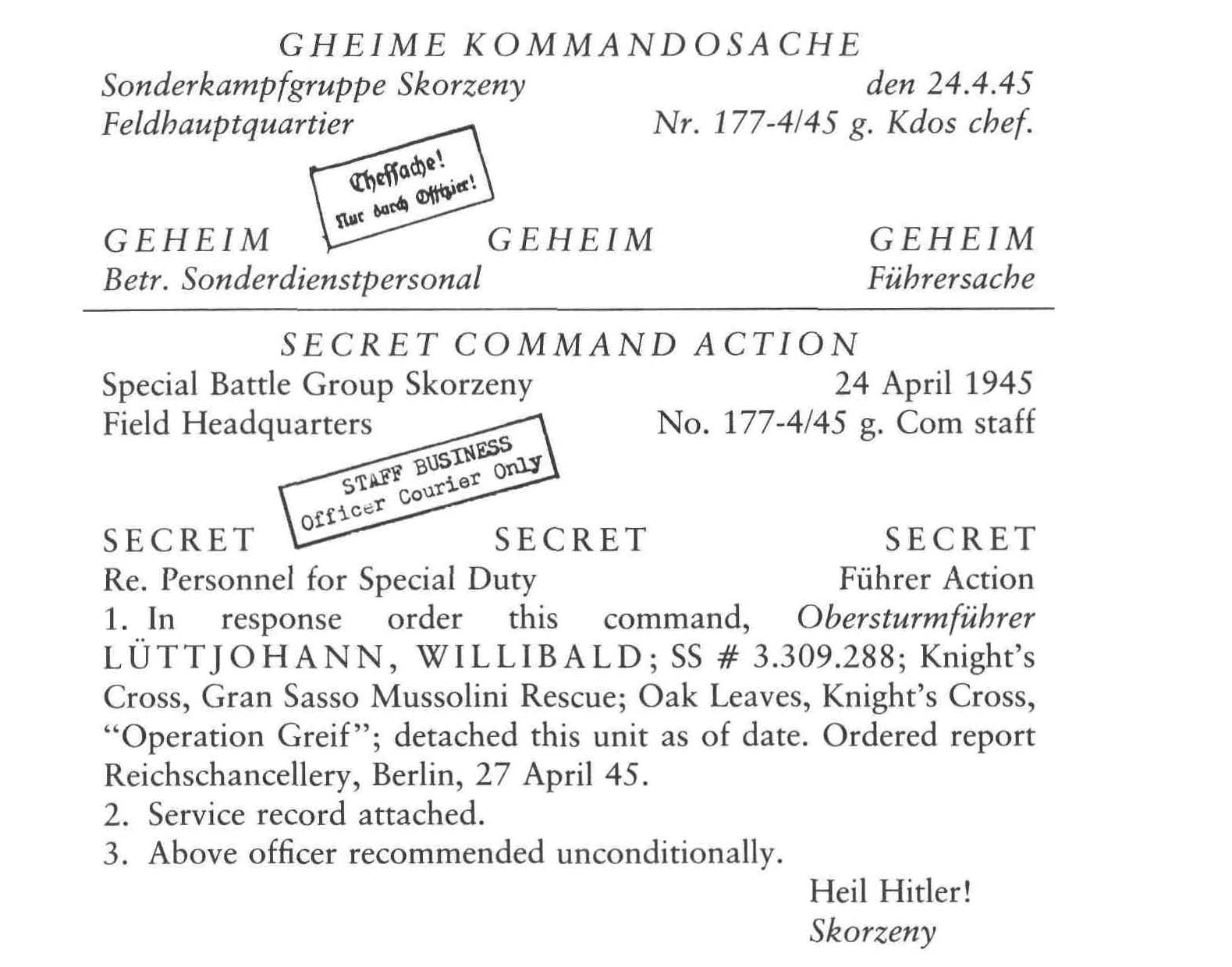
Standartenführer Otto Skorzeny, Hitler reminisced. One of his very best officers. Ein prima Kerl! And an Austrian. As he was, himself. Had he only had more officers of Skorzeny’s caliber, he thought bitterly, things might have been different. The man had made an excellent impression on him at their very first meeting, he remembered. At the Wolfsschanze. In July, two years before. When he was searching for a daring young officer of unquestioned loyalty to lead the rescue mission to free Il Duce. He had put Skorzeny in charge. Skorzeny’s action had been both brilliant and audacious. For a moment Hitler let himself savor one of the really heroic operations of the war. Well guarded, Mussolini had been held captive on top of a totally inaccessible mountain. Gran Sasso. In the Abruzzi range. With a handful of paratroopers Skorzeny had surprised the Italian troops guarding Mussolini and freed him. And to get the Duce off the mountaintop Skorzeny had crammed himself, a pilot, and the Duce into a tiny Storch and literally taxied the plane off the mountain top over the edge of a 3,000-foot drop, barely gaining enough flying speed to keep the overloaded plane from crashing. And he had brought the Italian leader to safety in Germany. It had been a magnificent feat. The entire world had been in awe of German courage and ingenuity. Otto Skorzeny was an officer he could trust. One of the few. A man of enormous imagination, personal courage, and great resourcefulness. He nodded slowly in remembrance. As with “Operation Greif.” What the Americans had called the “Jeep Parties.” Only last year. Captured American jeeps with Skorzeny’s specially trained, English-speaking troops in U.S. uniforms, roaming freely behind enemy lines, playing havoc, turning road signs around, cutting communication wires and setting fires. Skorzeny’s handful of special commandos had created such panic that vast numbers of enemy troops were immobilized searching for them. Eisenhower himself had been kept a virtual prisoner at his own headquarters. He smiled to himself. Standartenführer Otto Skorzeny was a real officer. A real German.
He grew sober. But now, when the most vital, the most crucial of all missions was at hand, when once again he was searching for a daring young officer, Otto Skorzeny could not be the man. He had wanted him. But he had realized that the officer would stand out far too much. Six feet, four inches tall, with a scar running the length of his left cheek, the man would be too recognizable. An absolute impossibility for the present mission. Besides, Skorzeny was of the greatest importance to the final preparations of the Werewolf Organization and the National Redoubt—the Alpenfestung. So he had asked him to recommend his best, his most loyal officer.
He flipped the page and peered at the Lüttjohann Personalienakt attached:
LÜTTJOHANN, WILLIBALD
SS Obersturmführer, # 3.309.288
Born: Göttingen, 21 June 1914
Hitler Youth, Group: Center, 1929
Promoted: Gefolgschaftsführer 1931
SS 1933
Assigned RSHA 1936
Assigned Sonderabteilung Ausland 1937
Agent Provocateur, U.S.A.
German-American Bund, N.Y., 1937/38
Hitler smiled a thin, self-satisfied smile. The German-American Bund under that buffoon, Fritz Kuhn, had still been an excellent operation, astonishingly successful and effective considering it had to be carried out on a large, highly visible scale in a foreign country. He recalled the many news stories of violent rallies in open support of the German cause; the American Stormtroopers—sometimes outdoing their German brothers in their brutality and zeal; the fine propaganda films and the riots in the German part of New York City. Yorkville, it was called, as he remembered. Yes, the Bund had done much for the Nazi ideology, much to weaken the internal security of the United States. Of course, only in a decadent democracy could such actions be allowed to take place. It had been to his gain. The Bund had been important in recruiting patriotic spies and saboteurs who had served the Fatherland well through the years. He looked at the Personalienakt. Largely because of the efforts of such men as Obersturmführer Willibald Lüttjohann. The young officer chosen by Skorzeny seemed an excellent choice. He would know the enemy well.
He read on:
Waffen SS 1939
Campaigns: Warsaw, Poland 1939
Belgium/France 1940. Dunkirk
Promoted: Stabsscharführer 1940
“Operation Barbarossa,” Russia 1941
Field Commission: Untersturmführer 1941
Sonderkampfgruppe Skorzeny 1942
Knight’s Cross, Gran Sasso, 1943
Promoted: Obersturmführer, 1944
Jagdverband, Denmark, 1944
“Operation Greif,” 1944
Oak Leaves, Knight’s Cross
Werewolf Training Ctr., Neustrelitz 1945
Hitler frowned. The Werewolves. Why had he heard nothing? Krueger should be in position by now. He clenched his fist. It still twitched uncontrollably. The enemy would quickly learn the deadly perils of occupying German soil once the Werewolves were let loose. They would be the ones to make the invaders cringe in fear. He had at once approved the formation of the organization when Himmler had approached him with the idea. Unternehmen Werwolf—Operation Werewolf. Dedicated young men and women; from the SS; from the Hitler Youth; civilians, who would gladly lay down their lives in the performance of their duty, a duty which was to inflict death and terror on the invaders. Like their medieval namesakes. Himmler had put Prützmann, an SS General, in charge. And, of course, there was Skorzeny. When the time came they would be the backbone, the living spark of the continued resistance from the Alpine Fortress. He frowned again. He made a mental note to order Bormann to find out why there had been no word from Krueger; the general should be ready to go into action in a few days. He suddenly felt impatient. Nothing ever went the way it should. He could rely on no one but himself. And yet he had to.
He returned his attention to the service record of Willibald Lüttjohann. It was imperative that that young officer be unfailingly reliable. He read:
Vital Statistics
Height: 6 feet
Weight: 180 pounds
Hair: Blond
Eyes: Blue
Complexion: Fair
Identifying Marks: None
Special Capabilities
Languages: Fluent English; some French, Italian
Expert Marksman, small arms
Expert, Close Combat
Parachutist
He pushed the papers aside. He had asked Skorzeny for the best. He had not been let down. For once.
Willibald Lüttjohann. A young man he had never seen. A young man who soon would be carrying the future of the German Reich in his hands.
Abruptly Hitler gathered up the papers and put them away. Squinting for the keyhole he unlocked a drawer in his desk. Two large identical envelopes embossed with the state seal and thick with papers were lying side by side. For a moment he sat staring at them—unseeingly. Then he picked up one and stood up. Dragging his left foot he shuffled toward the door.
In the little chamber off Dr. Stumpfegger’s examination room across the hall from Hitler’s study, Feldmarschall Ritter von Greim was asleep. The shock had worn off and his injured foot had begun to hurt. Stumpfegger had given him a sedative to help him sleep. An orderly was just placing a small tray with a carafe of water and a glass on a table next to the bed. He straightened up and stood at attention as the Führer entered.
For a moment Hitler hovered at the door, watching the sleeping officer. “Wake him!” he rasped, without looking at the orderly. He walked to the foot of the bed.
The orderly at once stepped up to the sleeping Greim. Gingerly he took hold of the officer’s shoulder, gently shaking him.
“Herr Feldmarschall,” he said. “Bitte. Bitte aufwecken!”
Greim stirred fitfully. The orderly became more insistent. He shook the patient. “Wake up, please!” he said loudly. “The Führer wants to speak with you.”
Slowly Greim opened his eyes. With difficulty he focused on Hitler, standing at the foot of his bed. He screwed up his eyes in an effort to clear his drowsy mind. “Mein . . . Führer,” he whispered, his voice husky.
The orderly helped him to sit up, banking his pillow behind him. Hitler nodded to the man. “Leave us,” he said.
The orderly left. Hitler pulled up a chair next to the bed. Heavily he sat down. For a moment he stared solemnly at the groggy man in the bed.
“Greim,” he said portentously, “I want you to know exactly why I summoned you here.”
Greim started to speak. Hitler silenced him with a wave of his hand. “Just listen to me,” he said. “I promoted you to Feldmarschall because I need you,” he continued. “But that is not the reason I had you come here in person. I could have done that more efficiently by telephone. Obviously I would not have subjected you to the danger you faced, if that had been the sole, the real reason for wanting you here.” He smiled cynically. “But it will serve convincingly enough as my reason for those who would question my motives. And they are legion, believe me, mein lieber Greim.” He looked soberly at the officer. “There is another reason,” he said gravely. “A vital reason—a top secret reason—which made it imperative that I see you in person. Do you understand?”
Greim nodded. Fighting Stumpfegger’s sedative, he still found it difficult to concentrate.
“Before you leave here,” Hitler went on, “you will be given official orders. But your real mission will be given to you by me. Personally. Now! I want you to have time to prepare yourself for it. There can be no margin for failure!”
Greim stared at the hunched-over old man sitting next to his bed. The Führer. The leader of the German nation. The German people. His commander in chief. He knew something of great importance was happening, and he struggled to focus his attention. “I . . . shall do my utmost, mein Führer,” he said, his speech slurred. “As I have . . . always done.”
Hitler nodded. From his pocket he brought out the large envelope he had taken from his desk. “In this envelope are some documents,” he said, his voice strangely tense. “Others will be added before you leave.” He paused. He looked at the envelope with an undecipherable expression on his haggard face, then back at Greim. “Your mission,” he grated. “Your mission will be to carry this envelope and its contents to safety and to see that the instructions contained in it are carried out faithfully.” For a moment his hooded eyes grew glassy. “Left here,” he said hoarsely, “it will only fall into—into the wrong hands.”
He handed the envelope to Greim. “I want you to read the documents. Now!” he said. “I want you to realize the vital importance of your mission.”
Greim took the envelope. He opened it. It contained half a dozen documents, all imprinted with official seals and stamps. He began to read. Hitler sat immobile, watching him.
And suddenly the drug-induced haze that swaddled Greim’s mind was torn away. At once he was fully alert. Mesmerized, he read on.
Finished, he let the papers sink down on the bed. Obviously shaken, he stared at Hitler.
“Mein . . . Führer . . .” he breathed. “I . . .”
Hitler silenced him. “Only you and I know the contents of those documents, Greim,” he said soberly. “Reichsleiter Bormann will be told. And one other—but you need not know who.” He looked at the Feldmarschall, his eyes burning. “You understand what is required of you?”
Greim nodded. “I do, mein Führer. I shall not fail you.”
Hitler nodded. He had picked the right man. “And you realize that until the proper, the designated time, the knowledge you now possess must remain strictly secret?”
“I do.”
“The documents must under no circumstances fall into enemy hands. If such a course is inevitable, they must be destroyed at all costs.”
“Understood, mein Führer.”
Hitler’s eyes bored into the man.
“And should you be captured, mein lieber Feldmarschall,” he said softly, “should you be interrogated in such a way that you are in danger of revealing what you know—and the enemy may employ means you cannot resist: torture, drugs—you will protect the secret with your life! Even if you have to take that life yourself!”
“I will, mein Führer!” Greim picked up the envelope. For a moment he stared at the embossed seal on it. The swastika, held in the claws of a German eagle.
Or was it a Phoenix?
Hitler nodded slowly. He took the envelope. It rustled faintly in his trembling hand. He stared at it.
It had begun. Phase One. The Greim mission.
Phase Two, the most crucial, the most important part of Unternehmen Zukunft—Operation Future—would begin when Skorzeny’s young officer arrived in the Bunker later that day. One Obersturmführer Willibald Lüttjohann.
He wondered what he would be like.
Everything would depend on him.
The future . . .
2
A CLOUD OF SATIATED FLIES rose in alarm from the carcass of a dead horse as Obersturmführer Willibald Lüttjohann skidded to a halt on the dirt road. Sitting astride his BMW R750 motorcycle he was aware of its power throbbing beneath him. He was glad he’d chosen the cycle for the trip to Berlin from the Commando School in Neustrelitz rather than the offered half-track and detail of SS men. He liked to depend on himself, and he’d figured he’d get through alone on the bike a helluva lot easier than with a half-assed escort. And he’d been right. Taking back roads and cutting across country he’d been able to evade enemy patrols and the crush of refugees and military traffic. It did not matter that the trip of about a hundred and fifty kilometers had become twice as long. He gunned the bike. He liked to hear the deep, controlled growl of promised power.
He raised the goggles from his grime-streaked face, revealing two circles free of dirt around his eyes. He peered ahead. It was beginning to grow dark. The back-country road in front of him was empty. He pulled his map from his brief tunic. He was wearing his commando outfit. He was approaching Berlin toward Spandau, having skirted Nauen and Falkensee. It was the only approach still open into the city, surrounded by Russian assault troops. On the horizon a red haze reached up into the sky from the city which was now the front line. The deep-throated rumble of distant battle filled the air, and it seemed as if the very clouds above were aflame.
He quickly oriented himself on the map. According to the intelligence given him there was a narrow gap in the Russian lines south of the Charlottenburg district—between Charlottenburg and Wilmersdorf—still held by friendly troops. He’d have to cross the Havel River—he hoped he could find a bridge still standing; he’d hate to have to abandon his bike—and head for the Tiergarten. The Chancellery was just beyond. He studied the map closely. Wilhelmstadt seemed his best bet.
Briefly he wondered again why he had been ordered to Berlin. Urgently. To report to the Führer himself! The thought once again filled him with excitement. He suppressed it. Get there first.
Again he gunned the motorcycle. His Blitzrad—his Blitzbike—as he liked to call it. He felt it was almost part of him, and he considered it lucky. The first two numerals of the license number, WH 219514 were his birthday, the last two his birth year. Had to be lucky.
He lowered his goggles and adjusted them. He gunned his bike and sped off toward the distant hell.
Once again Adolf Hitler unfolded the map of Berlin. He had carried it along all afternoon and it was rapidly disintegrating from the perspiration on his sweaty hands.
Where was Skorzeny’s man?
Where was Obersturmführer Willibald Lüttjohann?
He should have reported to the Bunker hours ago. He spread the map out on the conference table in the lounge hall. He stood staring at it, fixedly. He looked up as Hanna Reitsch came out from Ritter von Greim’s room. He motioned her over.
“Mein liebes Fräulein Hanna,” he said solemnly. From his tunic pocket he fished out a little glass phial sealed with copper. “It is cyanamide,” he explained meticulously. “Dr. Stumpfegger assures me it acts instantaneously. One bite—and you will not have to fear anything.” He looked at the phial in his hand with a strangely morbid look in his eyes. “We all have them,” he said. He handed it to her. “It is not what I would have liked to give you as a farewell present, meine liebe Hanna.”
Moved almost to tears, Hanna was about to speak, when across the hall a door opened and Hitler’s personal valet, SS Standartenführer Heinz Linge, came out from the Führer’s quarters. He left the door open. Through it Hanna could see a young woman sitting on the sofa, engrossed in a photo album with an ivory-colored leather cover.
Eva Braun.
For a brief moment Hanna’s eyes rested on the girl. She had been astonished, and a little jealous, when all the rumors about the little assistant to the Führer’s official photographer, Heinrich Hoffmann, who had become the Führer’s mistress, turned out to be true. Even during the short time Hanna had been in the Bunker she had seen the influence the girl had on the Führer. She looked at her. She was attractive. Blond. With a pleasant face and a good figure, perhaps a little on the plump side, she looked younger than her thirty-three years. Clad in a close-fitting gray suit she sat on the sofa unconscious of Hanna’s scrutiny. As she turned the pages in the album her little diamond-studded wristwatch glinted in the light. Hanna wondered if it had been a gift from the Führer. No doubt, she thought, again with a twinge of jealousy. But she could not dislike the girl. Eva Braun had been unfailingly friendly toward her, and grudgingly she admired her. Eva was by far the calmest and most composed of the women in the Bunker. And the most pleasant. Together she and Eva had tried to entertain the six Goebbels children, telling them stories and teaching them to yodel—to the dismay of their parents. She sighed. She, Hanna, would leave the Bunker.
Eva Braun would stay.
Hanna looked away. She wondered what would become of the Führer’s mistress.
She looked at Hitler. She could not speak. She merely smiled and took the offered phial.
Hitler once more turned his attention to the map spread out on the table. Deeply disturbed he studied it. He had entered on it every scrap of information received about conditions in the city outside. He knew it was still possible to get into the city from the west, although the Russians were driving hard to close the ring around the Chancellery. And they had been pressing their attack at Spandau. It worried him. He had issued urgent orders that the bridges across the Havel were to be held at all costs. Axmann, the one-armed Hitler Jugend leader, had deployed his Hitler Youths all along the river and he had them man street barricades and fortifications protecting the gap, along with the Volkssturm. He hoped they would hold.
Long enough.
Again he folded the worn street map. It was rapidly coming apart at the soggy seams.
Where was Lüttjohann?
Willi Lüttjohann was making his way through a rubble-strewn street approaching Kaiserdamm. It was getting dark but the many fires, most of them raging uncontrolled, lit the harrowing scene confronting him. The destruction was terrible to behold. Most of the buildings were in ruins, and those still standing showed the ugly, raw scars of bombings and shellings.
He had crossed the Havel on a bridge held by a detachment of Hitler Youth, led by a seventeen-year-old. Boys, thirteen to fifteen years of age. He had been shocked. Had it come to this? Did the Fatherland have to be defended by children? They had been efficient. They had examined him and his papers thoroughly before letting him go on. Reluctantly, he had thought.
There were few people abroad. He saw a couple of men rummaging through the mountainous piles of foul-smelling garbage heaped against the ruins. One boarded-up store had been broken into and a dozen or so ragged people were busily looting its stock. Several women brandishing knives were carving chunks of meat from the haunches and flanks of a dead horse, still harnessed to a demolished wagon. Lying between the wagon poles the head of the animal was wrenched around, its dead eyes open, sadly watching the women at their grisly task.
Willi felt sick. The city was disintegrating. And its people. It tore at him even more than the sights of villages he’d passed through, every window hung with the white sheets of surrender—waiting for the enemy.
He turned a corner, skidding in the mud cover left by the shattered masonry and mortar and the broken water mains. The street before him was empty. About a hundred meters ahead a barricade of rubble and sandbags built around an overturned streetcar blocked the entire thoroughfare. He began to work his bike through the debris.
Wolfgang Schiller was two days shy of his thirteenth birthday. He was already a Fähnleinsführer in the Hitler Youth. And he was proud of his responsibilities. He poked his friend Helmuth, almost six months his senior.
“Look,” he whispered. “Someone is coming. On a motorcycle.”
The two boys peered fearfully down the stretch of darkened, deserted street in front of the barricade. Automatically they moved closer together. They were alone at their post.
“Should—should we get Herr Brauner?” Helmuth whispered, clutching his MP40 submachine gun. “And the others?”
Wolfgang shook his head. “He said not to disturb them unless it was important,” he whispered back. “He said they hadn’t slept for two days—and better they sleep now than when Ivan comes.”
He bit his lip. He knew it was up to him. He had the rank. He had to decide if it was important. Or not. Was it? One lone soldier? He wished he could decide. If it wasn’t important and he alerted the men from the Volkssturm unnecessarily, he would surely be ridiculed. But what if it was? And he handled it himself? He would show himself to be a real soldier then, wouldn’t he? If he could only make up his mind . . .
Helmuth peered out through the barricade. He looked frightened. The strange man on the motorcycle was slowly coming closer. He turned to Wolfgang. “Who do you think it is?” he whispered, hoarsely.
“I don’t know.”
“A . . . Russian?”
“I don’t know.”
“Do you think he is one of ours?”
“I don’t know. He doesn’t look like it. His uniform looks funny.”
“What—what’ll we do?” Helmuth’s voice quavered.
Fähnleinsführer Wolfgang Schiller said nothing. He did not know what to say. He took a firmer grip on the Panzerfaust poking out through an opening in the barricade. He knew it could knock out a tank, if it hit just right. He had seen it done. It would certainly destroy a motorcycle. And the man on it. He had fired a Panzerfaust once before. In training. You just aim it. Be sure no one stands behind you. And pull the trigger. It was like a rocket.
The man on the motorcycle was steadily coming closer. Wolfgang could see him clearly now. He did not recognize the uniform. And the helmet did not look like the ones he knew. He began to tremble.
“Oh, God,” he prayed. “Let me be brave. Not—not like the last time.” And softly, full of fear, he whispered the Hitler Youth oath to himself, his dry lips moving with the words: “I promise in the Hitler Youth to do my duty at all times, in love and faithfulness to the Führer, so help me God . . .”
The motorcycle was halfway to the barricade. What should he do? Was it a Russian? A Russian scout? Would they come in force? Or—was it a German soldier? He had to make up his mind. The tears began to run down his cheeks. What should he do? Shout to the man? And what if it was a Russian, he would be warned. And start shooting. Oh, dear God, what should he do? What? . . .
His finger was on the trigger of the weapon. He began to tremble. His hands shook. And suddenly . . .
Willi more sensed than saw the flash. Instantly he knew what it was. And even as the realization streaked through his mind to reach his conscious thought he reacted instinctively. He catapulted himself from the moving bike. The violent shockwave from the blast when the Panzerfaust warhead hit the bike, disintegrating it in a ball of fire, slammed into him, hurling him into the rubble. He felt a piece of shrapnel rip through his crash helmet savagely tearing it from his head. He let himself go loose as he hit the rubble of broken masonry and chunks of shattered concrete. With detached wonder he realized he was unhurt except for a numbness of his limbs and a ringing in his ears from the explosion. He pressed himself down among the broken bits of stonework. Cautiously he raised his head.
“Idioten!” he screamed. “Hold your fire!” His shout was at once drowned out by the staccato rattle of submachine-gun fire from the barricade.
Willi was mad. What the hell did the verschissene bastards think they were doing? He kept down. Snaking his way between chunks of masonry and shattered brickwork he reached the ruined wall of a demolished building. Using all his skill of infiltration and concealment he made his way through the wreckage until he flanked the makeshift barricade. All was quiet. He drew his Walther P-38. Slowly he raised his head and peered out over the barricade position.
Behind the roadblock, at a small opening, a lone soldier was crouched. One lone soldier. Willi was surprised. The man below seemed to be watching tensely, a Mauser rifle aimed down the street toward the burning motorbike.
Quietly Willi stood up.
“You idiot!” he called sharply. “You could have . . .”
The soldier at the barricade whirled toward him. He raised his rifle—and fired.
Willi felt the bullet whizz by his right cheek. He hit the ground. He had a flash view of a white face under a large helmet. His P-38 flew into position in front of him. And he fired. Two rounds. A trained reflex action.
At the barricade the soldier fell. Backwards. As if pushed by an invisible fist.
Warily Willi got up. He ran down to the fallen soldier. He looked at him, the bile rising in his throat, burning it.
A tiny figure in a uniform two sizes too large for him. A boy. His downy, grimy cheeks still wet with the streaks of tears. His dead eyes looking at his killer with a child’s surprise. And around his neck an Iron Cross. Second Class.
There was a sound behind him. Footsteps. Hurrying. He whirled on them, automatically falling to one knee, his P-38 locked before him.
There were six or seven of them. All elderly men clad in a mixture of uniforms and civilian clothes. But the red armbands with the black stripe and white letters—DEUTSCHER VOLKSSTURM WEHRMACHT—and the two Hoheitsabzeichen—the German eagle with the swastika—worn on their sleeves proclaimed who they were. The people’s army. The defenders of Berlin. Along with the boys.
Willi rose as they walked up to him. “I am Obersturmführer Lüttjohann,” he snapped. “Report!”
One of the men stepped forward. “I am Brauner,” he said, “Alois Brauner.” He stared at the dead boy. “You—you killed him,” he said tonelessly. “Little Wolfgang. You—killed him . . .’’
“He fired on me,” Willi said curtly. He was surprised how harsh his voice sounded. “He blew up my motorcycle with a Panzerfaust. Damn near killed me!”
Brauner did not hear him. He knelt down beside the dead boy. With infinite sadness he closed the questioning eyes. Gently he touched the Iron Cross.
“Only a week ago,” he said quietly. “On the Führer’s birthday, it was. The Führer himself gave him this. In the garden of the Reichschancellery.” He looked up at Willi, accusingly. “For destroying a Russian tank.”
“I did not know he was just a boy,” Willi said defensively. “He fired at me. I called to him—but he fired at me. I had no choice. His bullets would have killed me just as damned dead as if he’d been your age!”
The men all stared at him. Brauner stood up.
“He was frightened,” he said wearily. “Just as he was when that Russian tank suddenly came around the corner and bore down on him. Up near Moabit, it was. The boy froze. He could not run. He just stood there. Watching the tank. Coming closer and closer. I was there. I saw it. Then suddenly he threw away the Panzerfaust he had been holding and ran. The Russian tank kept coming. It ran over the charge—and it exploded. It blew off a track.” He looked down at the boy. “Wolfgang got the Iron Cross. Second Class. I—I guess he was trying to live up to it.”
Willi was suddenly angry. “And what the hell was he doing here? Alone? On a military roadblock. A child! Where the devil were you?”
Brauner peered nearsightedly at him. “The Russians are still many blocks from here,” he said tiredly. “We haven’t slept for days.” He sighed. “They—they sent us a couple of boys from the Hitler Youth to—to . . .” He let the sentence trail off.
“He was alone,” Willi said.
Brauner nodded. “There were two of them,” he said, not really caring whether the SS officer believed him or not. “The other one, Helmuth, must have run off. Home, I guess . . .”
He looked at the tiny, still form of Wolfgang Schiller, Fähnleinsführer in the Hitler Youth. “Wolfgang,” he said. “He stood his ground. This time.” He looked at Willi. “And you—killed him . . .”
Willi glared contemptuously at the Volksstürmer. “His blood is on your hands, old man,” he growled. “You live with it!”
Angrily he turned on his heel and stalked off. He had to make it on foot to the Reichschancellery. It would take time. Children, he thought bleakly. Children and old men. Frightened children and foolish old men, neither of whom should be concerned with the harsh realities of war.
He disappeared into the blackened ruins.
Behind him, sprawled in death, lay Wolfgang Schiller, Hitler Youth, son of Fritz, who had been killed on the Russian front, and of Hilde, who was waiting for him at home with a wonderful birthday gift. A briefcase. For his studies at the Hochschule. Real leather. So very hard to get.
She would never see him again.
From Kaiserdamm Willi cut through the Tiergarten. There would be less chance of running into another barricade, he thought. And the Reichschancellery was located just east of the park.
He quickly regretted his choice. He had not been prepared for the harrowing sights that met him.
The Tiergarten had been mercilessly bombed. The cages and runs were all damaged, the ones holding the dangerous animals shored up with timbers from the ruins and reinforced with wire fencing. Some were burned and gutted hulks—the charred carcasses of the wild inhabitants lying like discarded toys on a smoldering city dump.
The pitiful howls and bellows of the maimed and dying animals pierced his ears and he found himself welcoming the occasional shot that abruptly stilled a piteous scream.
He was startled when a large crane, most of its feathers scorched off, flapped across his path, the remains of one leg flopping awkwardly beneath it.
At the tumbled-down wall of a brick building he passed a man, obviously an attendant, sitting on the ground, staring at a badly mangled, big red kangaroo, a dead baby dangling from its pouch. The tears were streaming down the man’s face.
He passed by the Aquarium—totally destroyed. And the reptile house. At the broken fence of the deer run a doe stood motionless, watching his approach, her glistening guts hanging from a gaping wound in her abdomen. Suddenly she took alarm and leaped to get away. Her thrashing hoofs got tangled up in her entrails and she fell heavily to the ground, unable to get up. Looking at him with huge brown eyes filled with pain and dread, she waited.
He shot her.
And he was sick.
If there was a hell for animals, he thought, it would be like this.
Finally he stood before the sandbagged, guarded entrance to the New Reichschancellery. The officer in charge of the guard detail examined the sealed envelope Willi held out to him.
“From Sonderkampfgruppe Skorzeny,” Willi said. “Urgent. For the Führer’s eyes only.”
The officer glared at him. He motioned to a non-com. “Take this man to Reichsleiter Bormann,” he ordered.
Obersturmführer Willibald Lüttjohann had arrived at the Bunker.
Unternehmen Zukunft—Operation Future—was ready to be launched.