Raiding Forces Series:
Those Who Dare
Dead Eagles
Blood Wings
Roman Candle
Guerrilla Command
Necessary Force
Private Army
Visit www.raidingforces.com and www.facebook.com/raidingforces to read more about the Raiding Forces Series.
This book is a work of fiction. Names, characters, businesses, organizations, places, events, and incidents are either a product of the author’s imagination or are used fictitiously. Any resemblance to actual persons, living or dead, events, or locales is entirely coincidental.
ISBN: 978-0-9860771-0-4
ISBN: 9780986077111
LCCN: 013943059
Published by Military Publishers LLC
Austin, Texas
www.raidingforces.com
Copyright ©2014 Phil Ward
All rights reserved.
No part of this book may be reproduced, stored in a retrieval system, or transmitted by any means, electronic, mechanical, photocopying, recording, or otherwise, without written permission from the copyright holder.
Distributed by Military Publishers LLC
For ordering information or special discounts for bulk purchases, please contact Military Publishers LLC at 8871 Tallwood, Austin, TX 78759, 512.346.2132.
DEDICATED TO LT. COL. CHARLES HARDIN
In early June 1968 then Captain Hardin took command of A/2/39. The timing could have hardly been worse. The company had been decimated in the Battle of the Plain of Reeds…thirty-seven men flying out after the four day running battle. The officer he replaced had been killed, there were only two platoon leaders and virtually no NCO’s. Never the less the mission continued with no time to stand down to allow him to reorganize his new command.
A/2/39 was engaged in intensive combat operations…160 air assault missions in one four month period. Captain Hardin provided a steady hand at a time when that was exactly what was needed. He was quick to adapt to rapidly changing missions that could come out of nowhere at any hour of the day or night, cool under fire, made commanding a hard fighting airmobile rifle company look easy and I never saw him make a tactical error.
It does not get much better than that.
THE WOMAN CAME INTO THE ROOM. SHE WAS CARRYING A big knife with a curved blade. Maj. John Randal, DSO, MC, was not as sound asleep as he appeared. His fingers tickled the ivory grip of his Colt .38 Super under the covers next to his leg.
A shadow appeared behind the woman. From the dock where the Nile houseboat was moored, a lamp beamed through the porthole, creating a yellow glow into which materialized the distinctive slim silhouette of a pistol barrel. The question in Major Randal’s mind: which one should he shoot?
Quick as a cat, the woman turned and stabbed the person behind her.
Major Randal’s Colt .38 Super spoke two times.
Flashlights came on. Armed policemen swarmed the boat. Someone blew a whistle. A sawed-off police captain with a toothbrush mustache, wearing an ill-fitting off-white linen suit, shouted, “Are you OK, Major?”
“What took you so long, Sansom?” Major Randal said as he swung out of bed, pulling on his pants and Blood’s slip-on boots.
“Events did not go strictly according to plan,” Capt. A.W. “Sammy” Sansom said. “Not anticipating a second party to show up.”
“Well, neither was I.”
“Fatima is, or I should say was, an operative for the Golden Circle—that much we know. The man she knifed is an unknown—Abwehr, Muslim Brotherhood or perchance a freelance … who is to say?”
“You’re supposed to know the players.”
“I spy spies; I don’t read crystal balls,” the policeman said. “If you had been a little quicker on the trigger and shot the miscreant before Fatima went for him, maybe she wouldn’t have felt compelled to kill you too.”
“Right,” Major Randal said. “If I had, he’d have turned out to be one of your boys.”
“Had we wanted Fatima dead, Major, we could have killed her ourselves. The plan was for you to pass out. Then, as the lady in question photographed the classified documents about the Abyssinian guerrilla operation contained in your briefcase, we break in and nab her red-handed. Couldn’t stick to the script, eh, lover boy?”
“One thing led to another,” Major Randal said.
“Have to give it to you Major, you make first-rate bait.”
“I’ve had practice.”
“So we hear,”said the chief of Cairo’s Counterintelligence Department. “Remember, you were not here tonight. This never happened.”
“Tell that,” Major Randal said, “to the sporting set at the Kit-Kat Club.”
“Quite right,” Captain Sansom said. “You shot the best belly dancer in Egypt.”
MAJ. JOHN RANDAL WAS LYING ON A LOUNGE CHAIR AT THE pool of the Gezira Club soaking up sun next to the leggy brunette Lt. Penelope Honeycutt-Parker, RM. Her husband, Capt. Lionel Honeycutt-Parker, was inside making reservations for dinner.
“Hot date last night?” Lieutenant Honeycutt-Parker asked. “You look tired, John.”
“No,” Major Randal said. Not that he would tell her if he’d had one. She was a longtime friend of Capt. the Lady Jane Seaborn, OBE, RM—worked for her in the Raiding Forces Women’s Royal Marine detachment.
The truth was, there had not been any dates. Last time he had been in Cairo, women were literally throwing themselves at him. It had helped to have Special Operations Executive supplying female operatives to sleep with him to see if he would reveal military secrets.
This trip, women would not come anywhere near him, except Fatima—and she had an agenda.
No books had been published about his latest military adventures this time around, either. In fact, Major Randal never heard the Abyssinian campaign mentioned at all. It was as if it had never happened. All the talk in the spring of 1941 was about the calamity in Greece, the threatened invasion of Crete and the German general named Rommel in Libya.
Except for the Honeycutt-Parkers, he knew hardly anyone in Cairo.
Captain Lady Seaborn was away in England. Her dead husband, Lt. Cdr. Mallory Seaborn, RN, had turned out not to be so dead when Major Randal rescued him on the first MI-9 mission to the Continent, before coming to Africa. Since Major Randal had been engaged to Lady Jane at the time, to say that his love life was complicated would be a major understatement.
When Force N, meaning Major Randal and Lt. Butch “Headhunter” Hoolihan, went missing in Abyssinia, Captain Lady Seaborn had abandoned her husband to travel to Africa to help organize a rescue operation. She stayed for the entire campaign, which did nothing to untangle their relationship.
Rita Hayworth and Lana Turner, the slave girls he had liberated in Abyssinia, had returned to England with Captain Lady Seaborn as members of her Royal Marine detachment. The girls were scheduled for complete medicals, and then who knew what Lady Jane had in store for them. Major Randal was surprised at how much he missed Rita and Lana, who had been his constant companions and shared every danger he had faced for the past six months. He wondered what the two Zar priestesses were up to.
Lieutenant Hoolihan was off on a course in England, attending a school designed to initiate him into the mysteries of being a Royal Marine officer. Captain Lady Seaborn had mentioned a visit to Chatterley’s Military Tailors for the young Royal Marine lieutenant, who was her pet project.
Major Randal had been Lady Jane’s pet project once upon a time. It was good to be her pet project.
Maj. Sir Terry “Zorro” Stone, KBE, MC, was home on leave too. His exact rank was in question (he had been an acting colonel). He was no longer commanding officer of the Lancelot Lancer Yeomanry Regiment, aka Lounge Lizards; his brother had resumed command in Addis Ababa following the conclusion of the Abyssinian Campaign. Major Stone had led the longest, fastest, most successful armored cavalry advance in modern history—over 1,700 miles. Nothing the Germans had done on any of their blitzkriegs had even come close. Only his father, the Duke, had wanted his eldest son, Reginald, to command—and it was the family regiment.
Maj. Jack Merritt, MC, MM, was staying in command of No. 9 Motor Machine Gun Company, Sudan Defense Force. Major Merritt had been nominated for an immediate Distinguished Service Order for his brilliant leadership during the run-up to the Battle of Kern and then the race to the strategic Port of Massawa on the Red Sea. There was a rumor the Free French also had plans to award him the Legion of Honor. No. 9 MMG Co. was being detached from the Sudan Defense Force to be trained by the Long Range Desert Group in deep desert operations. The plan was that it then be assigned to Raiding Forces, Middle East.
Mule Raiding Battalion commanders Capt. Taylor Corrigan, MC, Capt. Jeb Pelham-Davies, MC, and Capt. Pyro “Percy” Stirling, MC, were on home leave.
Lt. Randy “Hornblower”Seaborn, DSC, RN, had returned to Seaborn House with the naval contingent that had traveled with Lounge Lizard Force to operate the three-pound fast firers for the Lancelot Lancer Yeomanry. His boat, MGB 345, was back from its refit.
Capt. Mike “March or Die” Mikkalis, DSM, MM, had gone on leave somewhere in Africa. He had informed Major Randal that his temporary rank was only temporary as he did not intend to remain an officer. The job he wanted was Sergeant Major of Raiding Forces, Middle East.
Lt. Pamala Plum-Martin, OBE, RM, was away going to flight school. Major Randal was not sure exactly where, but it was in the Middle East somewhere. Because she had amassed so many hours flying combat missions for Psychological Warfare Executive (PWE) over Abyssinia in a Supermarine Walrus, she was going to be able to place out of most of the training. There was a possibility the aviatrix might be awarded her wings and the Distinguished Flying Cross on the same day.
Sqn. Ldr. Paddy Wilcox, DSO, OBE, MC, DFC, had gone along with Lieutenant Plum-Martin to be available to tutor her on the finer points of the written examinations. He had taught her to fly at Seaborn House, and it had been his idea to allow her to fly combat missions over Abyssinia. The Canadian pilot wanted to make sure the Vargas Girl-looking Royal Marine received her wings.
Brandy Seaborn was with her husband, Cdre. Richard “Dickey the Pirate” Seaborn, VC, OBE. Commodore Seaborn was going to get his wish at long last, command of a capital ship—a cruiser. Brandy had originally come out to Egypt to serve with Col. Dudley Clarke in A-Force, but now was thinking about doing something with Raiding Forces, Middle East, instead. She and Major Randal had always been very close.
One thing was certain—she was not going to be a Royal Marine. Brandy marched to her own drum.
Missing were Capt. “Geronimo” Joe McKoy, Waldo Treywick and ex-U.S. Marine Frank Polanski. The three had stayed behind to carry out a private enterprise the day Force N flew out of Abyssinia. No word of their whereabouts had turned up yet.
Major Randal was growing bored in Cairo. He was ready to go to work reorganizing Raiding Forces. He had been in talks with Captain Honeycutt-Parker. The Royal Dragoons officer had proven to be a superb organizer and was either going to take command of Raiding Forces, Europe, located at Seaborn House, or become deputy to Major Randal. There were a lot of possibilities for raiding to be had—he simply had to put the pieces of the puzzle together.
A blonde in a two-piece swimsuit that appeared to be made out of three Band-Aids and a couple of bootlaces strolled over to where Major Randal and Lieutenant Honeycutt-Parker lay sunning. The woman was tanned pure gold and had white platinum hair the color of ice (even paler than Lieutenant Plum-Martin’s, if that could be possible). It was pulled straight back in a long ponytail. There were a dozen thin gold bangles on her left wrist.
She looked vaguely familiar.
“Are you Major Randal?” the woman asked with a slight accent. She could not avoid staring at the scars on his chest, which were the result of being mauled by a lion.
“That would be me,” Major Randal said. “Who might you be?”
Lieutenant Honeycutt-Parker raised her sunglasses to check out the golden girl.
“Rikke Runborg. My friends call me Rocky.”
“Nice to meet you, ah, Rocky.”
Actually we have met, Major.” Rocky had an impressive set of white teeth when she smiled … which it seemed like she did a lot. She was very supple.
“Really?”
“I was with Mallory,” Rocky said, “the night you saved us. Never had the opportunity to thank you properly—things happened so quickly after the gun battle and the mad dash to the boat.”
“Didn’t recognize you,” Major Randal said, “with your clothes on.”
“Mallory failed to mention he was married,” Rocky said. “When I discovered the truth, I came to Cairo to work with the Norwegian Legation. Call me.”
“Fascinating,” Lieutenant Honeycutt-Parker said as she watched Rocky ripple her way back to her lounge. “I would not make that telephone call if I were you, John.”
“No?”
“Have you noticed women avoiding you?”
“As a matter of fact, Parker …” Major Randal said.
“Before she flew out, Jane passed the word over the ‘old girl network’ you had spent the last six months behind the lines in Abyssinia,” Lieutenant Honeycutt-Parker said. “Every woman in Cairo knows the VD rate there is 80 percent or better. Get the picture, hero?”
“I hope you’re making that up.”
CAPT. LIONEL HONEYCUTT-PARKER RETURNED TO THE POOL area. “Who was that?”
“Mallory’s ex-girlfriend,” Lt. Penelope Honeycutt-Parker said. “John rescued her from the Nazis.”
“Vichy French Police,” Maj. John Randal said.
“She wants him to phone her.”
“I would advise against that call,” Captain Honeycutt-Parker said. “Mallory has damned fine taste in women, credit him that.”
Jim “Baldie” Taylor walked out to the pool. “Who was that smasher you and John were chatting with, Parker?”
“Rikke Runborg, friends call her Rocky. She was with Mallory the night John brought the two of them out of France for Norman Crockett’s MI-9—dropped by to ask him to call her so she can thank him properly.”
“I am going to do you a favor, Major,” Jim said. “We can take off this afternoon for the RAF base at Habbaniya. Pam is graduating from the flying school there in a couple of days. Let’s fly up to see her awarded her wings.
“Take along a couple of those long-range Springfield 7mm-06s you brought back from Abyssinia. Get in some white oryx hunting. The place is a paradise in the desert.”
“Am I invited?” Lieutenant Honeycutt-Parker asked. “Lionel is leaving for England to check on Raiding Forces operations at Seaborn House. I am at loose ends.”
“Absolutely,” Jim said. “Habbaniya is the home of RAF No. 4 Service Flying Training School. It’s a man-made oasis where they send pilots who need rest. Said to have the best swimming pool in the service, golf, polo, riding … you name it. Have ourselves a nice quiet holiday.
“Besides, Major, you do not want to place that phone call.”
MAJ. JOHN RANDAL WAS SITTING IN THE CO-PILOT’S CHAIR of the Hudson, winging his way to No. 4 Service Flying Training School (SFTS) located at RAF Habbaniya, Iraq. Lt. Penelope Honeycutt-Parker was sitting in one of the few remaining theatre seats in the back, reading a stack of movie star journals. The publications were written in three different languages.
She could read them all.
Originally, the converted bomber was FM Sir Archibald Wavell’s personal plane. He had loaned it to Capt. the Lady Jane Seaborn for the duration of the Abyssinian Campaign. That’s why most of the plush carpets and theatre seats were missing. The plane had served as a paratroop dropper and freight hauler to 1 Guerrilla Corps (Parachute), Force N.
Unfortunately, the Hudson had crashed somewhere in Abyssinia.
At least that’s what was recorded in the official record. In fact, the airplane (with a new tail number) was now part of a small Most Secret private air force belonging to MI-6, British Secret Intelligence Service (SIS)—though that information was classified. The Hudson that no longer officially existed belonged to Raiding Forces if anyone with a Most Secret clearance who thought they possessed a “Need to Know” inquired. No one outside SIS, including Major Randal, knew who really owned it.
“The Golden Square,” Major Randal said. “What’s the story?”
Jim Taylor, in the left seat, gave him a sideways look. “How do you know about the Golden Square?”
“Came up in conversation.”
“I bet it did,” Taylor said. The MI-6 operative was masquerading as a high-ranking Special Operations Executive (SOE) official—which would have been news to SOE, as they thought he worked for them. “The Golden Square is a fairly recent development in Iraq. You do not have a ‘Need to Know,’ Major, but since we are on our way to Iraq I’m going to give you an unauthorized briefing. We are not having this conversation.”
“What conversation?”
“Now that the Italians are out of the Red Sea, Iraq is arguably the most strategic piece of real estate the British Empire controls. Typically His Majesty’s government is treating the place as if it has no value at all.”
“What makes the place so important?” Major Randal asked.
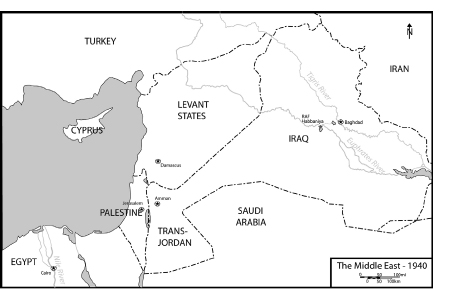
“Two things that are really three. It’s the crossroads of the air link between Great Britain and India. Iraq has massive deposits of oil in the north around Mosul, Kirkuk and Khanaqin. And the final fifty-mile stretch of the Shatt el Arab, where the Tigris and the Euphrates merge to flow into the Persian Gulf, is the conduit for the export of oil from Southern Persia. In the event the UK was to be cut off from oil from the United States it would have to have Iraq oil.”
“How might that happen?”
“The U-boats could win the battle for the North Atlantic sea lanes—you were briefed on that probability during OPERATION LOUNGE LIZARD,” Jim said.
“Roger.”
“For the interested military observer, what makes Iraq so vital is that it produces enough oil to supply all of Germany’s annual military needs. The Nazis have a treaty with the Russians that allows them overland access to Iraq. Get the picture, Major?”
“Loud and clear, sir.”
“Don’t call me ‘sir,’” Jim said. “King Faisal was our friend, but he died in 1933. His twenty-something son Ghazi took the Iraqi throne. He lacked prestige, character, and courage. He was disinclined to cooperate with us and liked the Nazis—but he was conveniently killed in a car crash in 1939.”
Major Randal said, “Where were you at the time, Jim?”
“The military success the Nazis achieved when they overran most of Europe and are now having in the Balkans has greatly impressed the peoples of Iraq and others in the Middle East,” Jim said, ignoring the question. “The Germans appear as winners, and we look to be weak.”
“I can see how we would,” Major Randal said. “What’s the Golden Square have to do with anything?”
“The new Prime Minister of Iraq, Rashid Ali al-Gaylani, is in the pay of the Abwehr—making him a de facto Nazi agent. He is supported by a cabal of four colonels, Salah al-Din al-Sabbagh, Kamal Shabib, Fahmi Said and Mahmud Salman—the Golden Square.”
“Four Iraqi colonels,” Major Randal said, “who think they’re golden—that’s got to end bad.”
“You’re right about that. The Golden Square are supported in their pro-Axis stance by the Grand Mufti who fled Palestine for sanctuary in Baghdad, where he is churning out inflammatory, anti-British propaganda,” Jim said. “Local public opinion is running against us. The region is a tinderbox. All it’s going to take is a spark.”
“What’s the plan, Jim?” Major Randal asked. “You always have a plan.”
“Not this time, Major. Our side has almost no military assets available in or anywhere near Iraq should we have to resort to arms,” Jim said. “Worse, we do not have any way to send in troops in any reasonable amount of time in an emergency—if we were able to organize a military expedition.”
“The Germans have to want the oil,” Major Randal said.
“They do.”
“YOU AND PARKER ARE GETTING OFF. I HAVE TO FLY ON TO Baghdad—it’s only about sixty miles,” Jim Taylor said. “Check into your quarters, head to the pool and enjoy your dinner tonight. Expect me back midmorning tomorrow—then I can start my leave. Looking forward to it.
“Take your carry-ons. The rest of your luggage will be delivered to your quarters while the plane is refueled. When I get back, we’ll go bag a couple of trophy white oryx.”
The Hudson flew over Lake Habbaniyah past the Royal Air Force Base. Jim came around to land on the airdrome built just inside the south side of the fence surrounding the RAF station. Coming in, Maj. John Randal saw at a glance RAF Habbaniya had not been designed for defense. Air bases rarely are.
Having raided quite a few of them, he tended to view airfields with a jaundiced eye. This one, Major Randal noted with detached professional interest, was one of the least defendable he had ever seen.
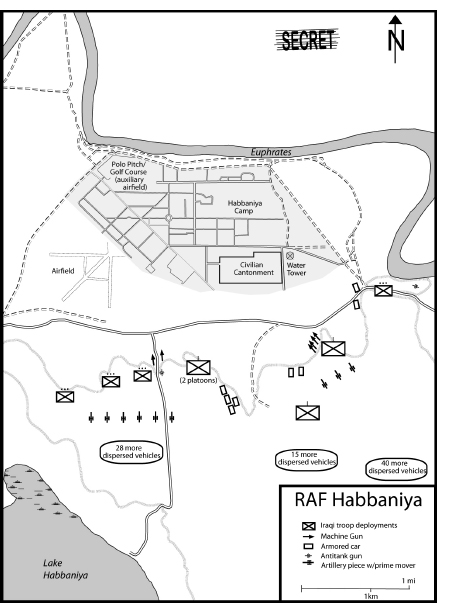
The lush, green 500-acre cantonment backed up to a bend in the Euphrates River on the north side. Two miles to the south was Lake Habbaniyah, which boasted the yacht club and a commercial flying boat port for BOAC Airlines. A couple of hundred yards or so out the front gate, between the RAF base and the lake, was a 150- to 250-foot high escarpment. Troops were conducting maneuvers on the high ground when the Hudson flew over.
The escarpment was commanding terrain—dominating the base.
A ten-foot tall fence ran for seven miles around RAF Habbaniya with blockhouses studded at 300-yard intervals all around the perimeter.
The airstrip was located outside the fence.
The most prominent feature of the man-made oasis was its water tower. At least the water well was inside the wire.
RAF Habbaniya was a backwater. Life traveled at a leisurely, prewar pace, undisturbed by outside world events. The fighting, for those fortunate enough to be stationed here, was far away. The base had a dual purpose: to train pilots and aircrew and to serve as a quiet tour for jaded combat pilots who were in need of getting their nerves back.
RAF Habbaniya seemed the perfect getaway to spend a couple of weeks relaxing and unwinding from an intense guerrilla campaign before going back to the frenetic pace of Cairo. Major Randal was looking forward to it. This trip was a good idea.
“Keep your eye on the Major, Parker,” Jim advised as the Hudson rolled to a halt. “A lot of unattached women on this post. With the unrest in Baghdad, nonessential personnel at the Embassy were evacuated to RAF Habbaniya.”
“Not me, what happens in another country does not count,” Lt. Penelope Honeycutt-Parker drawled as she looked up from her magazine. “You know that, Jim.”
“No idea you did—my three ex-wives never grasped the concept.”
Sqn. Ldr. Paddy Wilcox and Lt. Pamala Plum-Martin were waiting when Major Randal and Lieutenant Honeycutt-Parker exited the Hudson. The Royal Marine officer threw her arms around Major Randal, exclaiming, “I am so glad you could come, John.”
“Wouldn’t miss seeing you get your wings, Pam.”
Major Randal and Lieutenant Plum-Martin had a long history. She had been Lady Jane’s driver in the early days when Raiding Forces was being organized—though that was only a cover for her intelligence activities. The Royal Marine had gone with him on an unauthorized raid on a pub in France called the “Gunfight at the Blue Duck.” When he was passing through Istanbul, she was on a Special Operations Executive team that was attempting to rattrap the new Abwehr chief-of-station.
And, she had parachuted behind the lines in Abyssinia to serve with Force N before Major Randal eventually sent her back to fly psychological warfare missions against the Italians. She had serenaded their lonely troops with opera music at night from a Supermarine Walrus to make them homesick.
“We had to get John out of Cairo,” Lieutenant Honeycutt-Parker said. “Mallory’s friend turned up working for the Norwegian Legation.”
“The Norwegian blonde?” Lieutenant Plum-Martin gasped. “The one with Mallory the night Raiding Forces spirited him out of France? I have to hear this story, Parker.”
“Wanted John to call her so she could thank him properly—looked strikingly like you, Pam.”
“Never, ever make that call, John,” Lieutenant Plum-Martin said.
“Rocky Runborg doesn’t hold a candle to you or Parker,” Major Randal said.
He was immediately rewarded with a pair of insincere, million dollar smiles.
Squadron Leader Wilcox went aboard the Hudson. The aircraft was taxiing by the time Major Randal and the two women settled into the car sent by the Officers’ Club.
“This place is a hidden jewel in the desert,” Lieutenant Plum-Martin said. “A lost paradise that time has passed by.”
“Never heard of Habbaniya,” Lieutenant Parker said. “Located it on the map. The notation said ‘featureless desert’ with a little dot for the airbase.”
“The Royal Air Force has turned this place into the Garden of Eden,” Lieutenant Plum-Martin said.
Major Randal felt the accumulated stress of months behind enemy lines fighting a guerrilla war start to melt away. For the first time in a long time, he began to relax. You could not do that in Cairo—the pace was too fast.
THE SWIMMING POOL AT THE CLUB LIVED UP TO ITS advance billing. There were only a few people there, it being a workday. Major Randal was napping on a lounge chair while the two girls floated on rafts. For the first time in a long time, nothing was trying to kill him or eat him.
A captain in battle dress wearing the regimental badges of the Assyrian Levies arrived in the pool area.
“Hello, David,” Lieutenant Plum-Martin called.
“Pam.”
He walked over to Major Randal.
“Sir, Colonel Brawn, the ground commander here at Habbaniya, sends his compliments,” Capt. David Lancaster said. “The Colonel requests your presence straight away for a courtesy briefing on the military situation.”
“Situation?”
“Colonel Brawn will explain, sir.”
“Roger, let me change into uniform.”
“Pam has a tennis match in an hour,” Lieutenant Honeycutt-Parker said, “mind if I tag along, John?”
“My military aide,” Major Randal said. “Veteran of Abyssinia—behind the lines—but that’s classified. Any problem if she sits in? She has clearance.”
“Quite all right, I’m sure, sir,” the Levies officer said. “Nothing we cover is going to be a secret for long.
“I must say, sir, you have exquisite taste in aides.”
“Don’t tell anyone, but Mrs. Parker is actually my minder.”
“Major, I read your book, Jump on Bela. You need a chaperone, sir.”
CAPT. DAVID LANCASTER CHATTED UP LT. PENELOPE Honeycutt-Parker in the car on the way to the hangar at the edge of the airfield where the briefing was to be held. Maj. John Randal noted that there was a sentry outside the building. However, he seemed to be more on watch than on guard.
Major Randal clicked on immediately.
The sentry slid the door to the hangar open to let them in. Major Randal and Lieutenant Honeycutt-Parker were escorted to an office in the back. Inside, a number of officers were gathered. Not present was the base commander AVM Harry “Reggie” Smart, OBE, DFC, AFC.
The senior RAF flight officer in the room and former officer-in-charge of the Royal Iraqi Training School, Wg. Cdr. John Hawtrey, made the introductions.
“Wing Commander Paul Holder, the Senior Administrative officer.
“Major Edward ‘Ted’ Everett, 10th Indian Division, in command of the 400-man detachment of the 1st Battalion King’s Own flown in to reinforce Habbaniya two days ago.
“Lieutenant Colonel Alistair Brawn, Assyrian Levies commander.
“Squadron Leader Tony Dudgeon—our resident bomb-throwing rabble-rouser—does not suffer fools lightly. Tread lightly around Tony.
“And Captain Lancaster, you know. Wing Commander Ling is on the flight line and unable to be present.”
“Lieutenant Honeycutt-Parker,” Major Randal said. “Parker crewed on a private houseboat that made several trips rescuing troops at Dunkirk, went a thousand miles with the Lancelot Lancers Yeomanry chasing Italians across Abyssinia, then spent a month behind the lines on a classified guerrilla operation coordinating the disposition of Italian female dependents of surrendering POWs.”
Several of the men cleared their throats. Lieutenant Honeycutt-Parker had seen more action than all of them put together.
“Mind if I smoke?” Lieutenant Honeycutt-Parker asked, as she took a Player’s out of her silver cigarette case.
“By all means,” Wing Commander Hawtrey replied, as every man in the room produced a light to offer her.
“Thank you,” Lieutenant Honeycutt-Parker smiled, as she lit her cigarette from three different lighters.
“Major,” Wing Commander Hawtrey began, “we asked you here to bring you up to speed on the military situation as we understand it exists at Habbaniya since your arrival.”
“Only got here today, sir.”
“Quite a lot has occurred in that time, I am afraid,”Wing Commander Hawtrey said. “Squadron Leader Wilcox, whom we have come to respect rather highly, recommended we bring you into the picture when he learned that you would be coming to Habbaniya. Lieutenant Plum-Martin has entertained us with tales of your exploits over cocktails many evenings at the club.
“Your reputation, as they say, has preceded you.”
“I see,” said Major Randal, which meant he did not have a clue.
“Why not let me start at the top? This is an informal, off-the-record briefing, so feel free to pop in to comment or ask something at any point. No need to hold your questions until the end, as is normal protocol.”
“Roger,” Major Randal said. “Does that mean we’re not having this conversation?”
“That shall become painfully evident,” Wing Commander Hawtrey said.
“Habbaniya is a self-contained Royal Air Force cantonment built on the Indian model. Everything the inhabitants need is located right here on base—500 acres surrounded by a high, supposedly unclimbable, fence and guarded by Assyrian Levies. No one has to venture outside the wire unless, of course, they want to go to the Yacht Club located on Lake Habbaniyah.
“Amenities include fields for football, hockey and rugger. Unfortunately, our polo field and golf course were recently bulldozed to create an auxiliary landing strip. Habbaniya has fifty-six tennis courts. We have the Royal Exodus Hunt for those who like to ride to the hounds. Our swimming pool is the best in the service.
“Stationed on the base are No. 4 Service Flying Training School (SFTS), and the Iraqi Communications Flight. Previously we hosted the Royal Iraqi Training School, which I commanded, but those activities were curtailed a month ago due to unrest in Baghdad.
“While we have eighty-nine aircraft of a wide variety on station, none can be considered modern, many are not airworthy and some are unarmed trainers painted bright yellow. We have a total of thirty-nine qualified pilots, of which one is your Lieutenant Plum-Martin. Might have had a few more, but among those unfortunates who washed out, more than one or two claimed they were unable to fully concentrate with her in the class.”
“Had the exact same problem in high school,” Major Randal said. “One of my teachers was Miss UCLA.”
“On the military side we have the Assyrian Levies commanded by Lieutenant Colonel Brawn. They consist of an HQ Wing, Composite Company, four 125-man Assyrian companies numbered 1-4, and one Kurdish Company, No. 8.
“The Composite Company is the heavy weapons unit with a machine gun section, a three-inch mortar section and one .55-caliber Boys Anti-Tank Rifle.
“The six companies are staffed by seventeen British officers, three British non-commissioned officers, three surgeons, fifty Assyrian officers and 1,134 other ranks.
“The RAF has No.1 Armored Car Company with eighteen Rolls Royce Silver Spirits and two ancient tanks named—for some odd reason lost to history –‘Walrus and Seal.’
“Two days ago the contingent from the King’s Own commanded by Major Everett flew in.
“Our only artillery consists of two inert 4.5-inch ceremonial guns—decorations.
“On 30 April we received information that 6,000 Iraqi troops and thirty pieces of field artillery had departed Baghdad en route to Habbaniya. They occupied the escarpment between the base and Lake Habbaniyah. Claimed to be on training exercises. When the Iraqi Army arrived, Air Vice Marshal Smart sounded the general alarm at 0400 hours, but since no one knew what the siren was about because the base had never run any drills … everyone ignored it.”
“Those aren’t your troops up on the bluff?” Major Randal said.
“Negative. Yesterday the Iraqi Army grew to 9,000 troops, fifty field pieces with twelve armored cars confirmed.
“This morning at 0630 an Iraqi field grade officer presented himself at the front gate. He claimed the Iraqis were on a training mission. However, he made a demand—we are to stop all incoming and outgoing flights, no armored vehicles are to leave the base. If any do they will be shelled by the Iraqi artillery—the Iraqis will not be responsible.”
Major Randal said, “A live fire training exercise—staring down at your base from point blank range?”
“So the Iraqis assert.”
“I don’t think you should take their word for that, Wing Commander.”
“Prudent advice,” Wing Commander Hawtrey said. “At 1100 hours the Iraqi envoy returned. This time he demanded all training flights be suspended—essentially an act of war since it violates a long-standing treaty. That gave Reggie … ah… Air Vice Marshal Smart and the staff something to think about.”
“After deliberation, the Air Vice Marshal wired for permission to launch a preemptive air strike. The response came back in record time directly from Prime Minister Churchill, who had to be consulted because to attack would be an act of war against a country we are not officially at war with. The PM ordered us to strike only if we had no other option. But if we felt compelled to attack to do so with ‘All Necessary Force.’ ”
“Churchill said that?”
“Affirmative,” Wing Commander Hawtrey said. “Questions, Major?”
“Total Iraqi forces?”
“Four divisions and an independent mechanized brigade deployed within fifty miles of Habbaniya. The Royal Iraqi Air Force has 116 modern aircraft of German, Italian, American and British manufacture.”
“How many British personnel are here on Habbaniya?”Major Randal asked.
“All up, mostly civilian—approximately 9,000 people.”
“How many days’ rations do you have laid in?”
Wing Commander Hawtrey’s eyes flickered, “Four days for civilians—twelve days for military.”
“Why’d you ask me here?”
“Two reasons, basically. We have it on good authority that you are an expert at attacking airfields. We would appreciate if you would take the time to survey our defenses. Make recommendations on how we can improve our base security plan.”
“No problem, sir.”
“Without question you are the most experienced ground combat officer on Habbaniya, Major. We would be interested to hear your assessment of the overall situation.”
“What’s the part you’re not telling me?”
“This cannot leave the room,” Wing Commander Hawtrey said. “Create a panic among the civilians if they find out.
“The Iraqis blew the dikes protecting the road behind them after they deployed here. The resulting floodwaters from the Euphrates turned the road into a quagmire—quicksand. Arab invaders for centuries have called the combination of water and sand in Iraq the “Arab Mud Bath.’ ”
“What does that mean exactly, sir?”
“There will not be any relief column from the direction of Baghdad coming to save us, and the other way is open desert for 500 miles to our nearest friendly outpost in Palestine.”
“Attack immediately,” Major Randal said. “Work the Iraqis over with air strikes for two or three days, set up a strike force to ambush and raid the Iraqi positions at night, then go in with your ground troops. You’ve got to win this thing quickly.”
“We have to man the defenses—seven miles of perimeter,”Lieutenant Colonel Brawn said. “At most we could spare one company from the Levies to form an offensive strike force. In addition to, say, one company from the King’s Own.”
Major Everett nodded in agreement.
“Then they better be damn good men,” Major Randal said.
“We would be able to attach the RAF No.1 Company Armored Cars to this ‘strike force’ you propose, provided it takes on the mission of providing mobile counterattack response,” Wing Commander Hawtrey said. “Also, the two tanks—not that they will be much help.”
“There is this one other issue—Squadron Leader…”
Squadron Leader Dudgeon said, “Air Vice Marshal Smart is a nice enough chap—decorated veteran of the last war—but he did not need this emergency at the end of his career. The Air Officer Commanding made the right decision to request permission for a preemptive air attack.
“But what the AOC really wants is to stall for time in hopes the Iraqis will go away. Reggie wants things to get back to normal here at Habbaniya, which means comfortable.”
Major Randal said, “You don’t have any time.”
“We are all in agreement about that here in this room, but it is not clear what the AOC will do next. The staff at Habbaniya was selected because of their proven ability to carry out mundane training tasks—cranking out pilots, bombardiers and air-gunners. The staff officers are mostly all over the hill—well past their prime. Quite a number are qualified pilots but refuse to fly.
“When we first learned about the pro-Nazi activities of the Golden Square, it was suggested modifying our Audex trainers to carry bombs in event of an emergency. The AOC rejected the idea. ‘Not an authorized alteration’—we do things by the book at Habbaniya. The staff obsessively hides behind regulations. No one ever takes a risk.
“In secret, Wing Commander Ling and I fitted the bomb racks anyway. Forced to do the same with a couple of other similar projects. The only thing we have been able to get the AOC to agree to has been turning the polo pitch and golf course into an auxiliary airstrip.
“Air Vice Marshal Smart has a policy: ‘Abide by the Kings Regulation. Don’t make waves.’ ”
Wing Commander Holder said, “Habbaniya has a small intelligence section—totally worthless. They gave no warning that this situation was going to develop. Reggie was blindsided.
“When I learned of the coup by the Golden Square, I suggested we could snuff it out with no air operations, nor any loss of life, by simply warning Rashid Ali and his henchmen that we could have Messrs. Waterlow in Britain, the printers of currency for many countries including Iraq, do a special, high-volume run for us. Unless the Golden Square did our bidding we would fly over Baghdad and the other major cities and drop tons of it, flooding the market. Instant runaway inflation that would devalue all the money the Golden Colonels are stashing away in Swiss banks as fast as they can with both hands.”
“Capital idea,” Wing Commander Hawley commented. “Guaranteed to work.”
“What’d he say?” Major Randal asked, lighting a Player’s with his battered U.S. 26th Cavalry Regiment Zippo.
“‘Not be cricket’—direct quote, Major.”
Lieutenant Colonel Brawn added, “When you make your defense assessment, Major, you are going to advise roving patrols all around the perimeter day and night. I have already recommended them, but the AOC forbade it—wants to avoid a mistake in the dark resulting in a friendly fire incident.
“The AOC claims the fence is impenetrable,” Wing Commander Hawley said.
“Of the thirty-nine pilots we have on station to fly against the Iraqis,” Squadron Leader Dudgeon said, “a number are recent graduates of the school—meaning they are green pilots with only a handful of flying hours flying Tiger Moth trainers. Others are worn out from flying combat—sent here for a rest cure while still others are here because their commanders did not think them suitable to fly in an operational squadron.”
Lieutenant Colonel Brawn said, “As briefed, the majority of our ground troops are the Assyrian Levies. We are not entirely confident how reliable they are. Could very well desert, or worse, turn on their British officers.”
“What’s the good news?” Major Randal said.
“The only positive development since I have been on base, Randal,” Major Everett said, “is that you arrived out of the blue and magnanimously volunteered to organize and command the Habbaniya Commando Strike Force.”
“I’m on vacation.”
“Major, to put the situation into terms an American like you might appreciate, this is 1836 and you just checked in to the Hotel Alamo,” Wing Commander Hawtrey said. “The odds against us are approximately the same.”
“General Slim told a story about the battle of Gallabat at a dining-in one night before we deployed here from India,” Major Everett said. “Claimed you saved his life. Said it was the neatest piece of work he ever saw.”
“Slim?” Major Randal said. “I thought he got shot in the ass!”
“Fully recovered,” Major Everett said. “Except for a little hurt pride and a scar he’s not able to show anyone at cocktail parties. Plans are for him to take command of my division, the 10th Indian, in the near future when it arrives in Iraq.
“Is it true, Randal—you saved the General?”
“I was saving myself,” Major Randal said. “Slim just happened to be standing there.”
MAJ. JOHN RANDAL AND LT. PENELOPE HONEYCUTT-PARKER walked their ponies out the front gate of Habbaniya. Then they made a hard left and, staying near the fence, rode slowly toward the Euphrates River. They could see the Iraqis up on the escarpment. One of them waved at them.
They waved back.
“What are we doing, John?” Lieutenant Honeycutt-Parker asked. “This seems a little over the top—riding out in front of the Iraqi positions in broad daylight… even for you.”
“Inspecting the base defenses, Parker—Iraqis are on a training exercise. They don’t care if we go for a ride.”
“A perimeter road runs around the entire 500 acres of Habbaniya—shows it on the brochure you had me bring from the lobby of the club, John. We could have inspected the defenses from inside the fence.”
“Need to see it from the opposition’s perspective—ingress and egress,”Major Randal said. “What does that pamphlet say about the base’s flora and fauna?”
“Habbaniya has been compared to Eden,” Lieutenant Honeycutt-Parker read as they rode. “Laid out by the Knightsbridge contractor, Messrs. Humphries & Co., it boasts casuarinas, pepper and eucalyptus tree-lined boulevards, manicured lawns, roses, sweet peas, bougainvillea, hibiscus and oleander …”
“There you go,” Major Randal said.
“John, we are surrounded by a horde of bloodthirsty Iraqi savages, outnumbered nearly ten to one in fighting men, only have enough food for four days before the women and children start starving to death and you are interested in the foliage of Habbaniya?”
“You don’t think the Iraqis are going to come down off that bluff and attack the base’s fortified positions, do you, Parker?” Major Randal said. “Probably attempt to infiltrate at night so we want to make sure that’s not easy. They’ll try to starve us out, but they’re exposed to air attack up on that escarpment.”
“Sounds like the Siege of Cawnpore to me—every man, woman and child slaughtered, almost,” Lieutenant Honeycutt-Parker said. “Some vacation Jim brought us on.”
“The Iraqis do have us in a corner,” Major Randal said.
“The Alamo, wasn’t that the place the Mexican Army surrounded a group of Texans, overran their fortress and put them to the sword?”
“Yeah, but there’s a difference—they didn’t have a swimming pool,” Major Randal said. “Here at Habbaniya we’re sitting behind wire with the Euphrates River on three sides, surrounded by a million miles of desert.
“The Iraqis, on the other hand, are out in the desert with us in front and the flooded road to Baghdad to their rear—which they blew.”
“I did not come away from that briefing with the slightest impression anyone else sees the situation even remotely the same way, John,” Lieutenant Honeycutt-Parker said. “My takeaway was that Habbaniya is laid to siege in desperate peril—I am in no mood to be despoiled.”
“The Iraqis,” Major Randal lied, “are the ones in trouble.”
“Fascinating,” Lieutenant Honeycutt-Parker said. “If I had not spent a month in Abyssinia with Force N, I should think you quite mad right about now.”
“Whoa, here we go,” Major Randal said, reining in his pony.
“John, those are wild goat droppings … we rode out here for a trail of goat scat?”
“Yeah, it’s headed straight as an arrow for those rose beds, sweet peas and all the other Garden of Eden stuff. If you were a wild goat, Parker, would you try to scratch out a living in the desert or would you go for the hibiscuses come nightfall?”
“The botanical garden, naturally,” Lieutenant Honeycutt-Parker said.
“How do you think the goats are going to get into Habbaniya?”
“Not about to scale the fence,” Lieutenant Honeycutt-Parker said.
“Roger that,” Major Randal said. “Goats have a place already dug out they’ll wiggle right under … it’s their MO.”
“And why do we care that wild goats are going to crawl under the fence?” Lieutenant Honeycutt-Parker asked.
“Because that’s exactly what the Iraqi infiltrators are going to do. They’ll follow the goat droppings and slip under the wire some dark night.”
“Pretty sneaky.”
“Mark this spot on your brochure,” Major Randal ordered. “We’ll find trails like this all the way around the wire. We want to ambush the places inside the fence where the goats cross.”
“Fascinating …”
“Parker, probably not a good idea to mention our earlier conversation.”
“You mean about our having the Iraqi Army right where we want it?”
“Roger,” Major Randal said. “We wouldn’t want anyone to get overconfident—you can tell Pam.
AVM HARRY “REGGIE” SMART SAID, “WHAT WAS THAT cheering?”
“Major Randal, sir,” Wg. Cdr. John Hawtrey said. “Colonel Brawn assigned him No. 4 Company of the Assyrian Levies, and Major Everett gave him A Company of the King’s Own to form a provisional strike force. Randal will conduct raids and ambushes and serve as the commander of the base mobile counterattack group. I have attached No. 1 Armored Car Company and the two tanks for additional firepower.
“Still, not very much, sir—for what we require.”
“Randal, the American Commando chap?”
“He arrived this morning for Lieutenant Plum-Martin’s graduation,” Wing Commander Hawtrey said. “Had no idea the Iraqis have risen.”
“Why the cheering?”
“Major Randal marched the Strike Force troops outside the gate, pointed to the escarpment and said, “There is your enemy, baking in the sun while we rest in the cool shade.They cannot run away. We shall kill as many of them as we can and chase the rest back to Baghdad … or words to that effect, sir.”
“That is a provocation,” Air Vice Marshal Smart protested. “This Randal may be a bad influence.”
“Got off to a fast start, sir,” Wing Commander Hawtrey said.
“In what way?”