

Foreword
I first came to Malta in 1942, at a time when the island was enduring the second great siege in its history. I was then a naval officer, the navigator of a destroyer, and too busy to care about the island’s past, or that other great siege which had preceded the one in which I was involved, by nearly four centuries. In 1943 I revisited Malta during the invasion of Sicily. It was then that I saw the island fulfilling the role which Soleyman the Magnificent had envisaged for it in 1565. From Malta, the Allied Forces stormed and captured Sicily and Italy.
I returned to Malta in 1951, this time at the helm of my own small sailing yacht. I now had the leisure to learn something about Malta’s history, and about her first great siege. I was fortunate that Captain John Tothill, D.S.C., Royal Navy, was at that time Captain of Fort St Angelo. It was he who kindly allowed me to berth my boat in the small harbour that lies behind the fortress. For five months I lived in that narrow stretch of water which was once the moat separating St Angelo from the village of Birgu. It was here that the galleys of the Order were moored during the great siege.
During that time I grew to know every detail of the fortress, its bastions, its chapel, and its Council Chamber; as well as those long tunnels and caves beneath it, where the galley-slaves were formerly incarcerated. I did my daily shopping in the narrow streets and alleys of what is now called Vittoriosa, ‘The Victorious City’, but which is still ‘Birgu’ to the Maltese—as it has been for centuries. I visited all the places which had figured in the great siege of 1565. It seemed to me at times more real, and vivid even, than that second siege of only a few years ago.
Since then I have revisited Malta many times—in spring, summer, autumn, and winter. I have lived in several parts of the island, and have sailed all round the small archipelago. I have grown to know and respect its people. Without their kindness and assistance I would have found it difficult, if not impossible, to undertake this book.
The Great Siege of Malta was one of the decisive actions in the history of the Mediterranean—indeed, of the Western World. ‘Nothing is better known than the siege of Malta,’ remarked Voltaire. The fact remains that very little has been written on the subject in English—and this, notwithstanding that the island was confirmed a British possession as long ago as 1814. This lack of interest on the part of English-speaking historians may perhaps be traced to the fact that the English Langue of the Order of the Knights of St John had been dissolved several years before the siege took place. Certainly the bibliography is extensive in French, Italian, and Spanish. I have indicated at the end of this book the principal sources upon which I have drawn. I would in no way pretend that this is anything approaching a complete bibliography. The late Major H. E. Balbi, M.B.E., was collecting material for such a bibliography at the time of his death. It remains for some other student or research historian to complete his work.
In the recent past, Malta and its remarkable history have tended to be somewhat neglected—perhaps because the island’s name has been automatically associated with a naval and military garrison. It is noteworthy that it is only within the last ten years that the first comprehensive work on its architecture has been published: architecture which in many respects is more deserving of attention than that of many better known, and publicized, islands of the Mediterranean.
It is to be hoped that Malta has now withstood its last siege. With the current change in its status—from a fortified castle, as it were, to a country residence—it is likely that many historians, students, and art lovers will visit this remarkable small island. For Malta, as the traveller Patrick Brydone wrote to William Beckford in 1773, is ‘the epitome of all Europe’.
Maltese is a difficult language to read. For this reason I have not been logical in my orthography. I have, for instance, referred throughout to the main southern harbour of the island as Marsasirocco (the Italian place name) rather than Marsaxlokk. Similarly I have used the name Marsamuscetto for the large harbour to the north side of Valetta, rather than Marsamxett.
Malta, in fact, had no written language or dictionary even, until the nineteenth century, when the Roman alphabet was adopted. The language which is Semitic by origin, stemming possibly from the Phoenician, does not easily lend itself to this system. I have referred throughout to the ancient capital of Malta by its Maltese name ‘Mdina’, rather than Città Notabile (as it was known to the Knights). The name Mdina undoubtedly derives from the Arabic—Medine or El-Medina (The City). The second main peninsula of Grand Harbour I have called Senglea, rather than L’Isla—the name the Maltese have always given it. The village of Senglea was founded by Grand Master Claude de la Sengle (1553–7). On the other hand, where no English or Italian equivalent exists, I have kept the modern Maltese spelling of place names, such as Ghain Tuffieha (the ‘Gh’ is silent). Translated literally it means: ‘The Fountain of the Apples’.
For assistance and encouragement at various times, and over a number of years, I would like to express my thanks to many people: Sir Hannibal Scicluna, M.B.E., who first allowed me to consult his unique library in 1951; to the Malta Government Tourist Bureau, and the Director of Public Works; and to The Hon. Dr L. Galea, C.B.E., Q.C., for his assistance in the early stages of my research. I would like to record my particular thanks to Dr Vincent DePasquale, Librarian of the Royal Malta Library, for all his kindness and help over many months, also to Mr Joseph Galea and Mr E. R. Leopardi. I owe an incalculable debt to Dr Joseph Spiteri, LL.D., who, in many conversations, has enlightened me on aspects of Maltese custom, legend, folklore, and language. I also owe a debt of thanks to the Librarians of the Garrison Library, Malta, and the British Council Library.
I dedicate this book to the memory of my father, Major Jocelyn Ernle Sidney Patton Bradford, M.B.E., M.C.
E.B.
St Paul’s Bay, Malta
16 April 1961
De dehors on lui cria; des remparts on répondit. ‘Malte d’or, Malte d’argent, Malte de métal précieux, Malte, nous ne te prendrons pas, même si tu n’étais que courge, même si tu n’étais protégée que de peau d’oignon.’
‘—Je suis celle qui a décimé les galères du Turc, tous les braves de Constantinople et de Galata.’
From a sixteenth-century Cypriot ballad, translated by Hubert Pernot
Chapter 1
The Sultan of the Ottomans
Soleyman’s titles resounded through the high Council chamber like a roll of drums:
Sultan of the Ottomans, Allah’s deputy on Earth, Lord of the Lords of this World, Possessor of Men’s Necks, King of Believers and Unbelievers, King of Kings, Emperor of the East and West, Emperor of the Chakans of Great Authority, Prince and Lord of the most happy Constellation, Majestic Caesar, Seal of Victory, Refuge of all the People in the whole World, the Shadow of the Almighty dispensing Quiet in the Earth.
His ministers, admirals, and generals prostrated themselves and withdrew. It was the year 1564, and Soleyman the First, Sultan of Turkey, was seventy years old. He had just taken the decision to attack the island of Malta in the spring of the following year.
His had been a life of unparalleled distinction from the moment when he had succeeded his father, Selim, at the age of twenty-six. Known in his own country as the Lawgiver, and throughout Europe as Soleyman the Magnificent, he had truly earned these appellations. He had reformed and improved the government and administration of Turkey, and had made her the greatest military state in the world. He was unequalled as a statesman, and was a poet in his own right.
If the Turkish people for these reasons called him ‘The Lawgiver’, the people of Europe for their part had good reasons for conceding to him the respectful title of ‘The Magnificent’. His conquests alone justified it, and Europeans have always lavished more respect upon conquerors than upon lawgivers. In the course of his Sultanate, Soleyman had added to his dominions, Aden, Algiers, Baghdad, Belgrade, Budapest, Nakshivan, Rhodes, Rivan, Tabriz, and Temesvar. Under him the Ottoman Empire had attained the peak of its glory. His galleys swept the seas from the Atlantic to the Indian Ocean, and his kingdom stretched from Austria to the Persian Gulf, and the shores of the Arabian Sea. Only at the walls of Vienna in 1529 had his armies faltered.
At the age of seventy, with so many resounding triumphs behind him, it might have been expected that the Sultan would wish to take his ease and watch the decline of day over the Golden Horn. But to Soleyman in his old age there remained only the desire for power, the ambition to extend his conquests. Even if he had not been ambitious himself, those who surrounded him would never have allowed him to rest.
‘So long as Malta remains in the hands of the Knights,’ wrote one of his advisers, ‘so long will every relief from Constantinople to Tripoli run the danger of being taken or destroyed…’ ‘This cursed rock,’ wrote another, ‘is like a barrier interposed between us and your possessions. If you will not decide to take it quickly, it will in a short time interrupt all communications between Africa and Asia and the islands of the Archipelago.’
It was forty-two years since Soleyman, in the prime of his life and at the head of a vast fleet and army, had driven the Knights of St John from their island fortress of Rhodes. He had felt for them, then, an unwilling but respectful admiration. Had he not said in the presence of his advisers, ‘It is not without some pain that I oblige this Christian at his age to leave his home’? It was the sight of the seventy-year-old Grand Master, Villiers de l’Isle Adam, preparing to embark with his Knights from the captured island that had prompted this reflection. Now, at the same age himself, the Sultan was less moved by chivalry, and more by a desire for vengeance.
The sandstone rock of Malta had proved an even greater irritant than Rhodes. Rhodes had been so close to the shores of Turkey that, in the last years of their residence there, the Knights’ sallies had been almost neutralized. The movement of the Order’s galleys had been quickly made known to the captains of the Sultan’s warships and merchantmen. Yet, even so, they had still managed to harry the trade of the Levant, and interrupt the shipping between Alexandria and Constantinople. Malta, however, was worse, because it was so far distant from Constantinople that it was less easy to spy upon the Order’s movements. Furthermore, the island’s position in the very heart of the Mediterranean gave it the command of the east–west trade routes. Everything passing through the channel between Sicily, Malta, and North Africa was at the mercy of the Maltese galleys. They let few opportunities slip through their fingers.
To a ruler who had added thousands of square miles to his empire, the possession of an almost barren island might seem unimportant. To a ruler whose daily bread was adulation, who had grown weary of the title, ‘Conqueror of the East and West’, the island and its Knights were an irritation hardly to be borne.
It seemed as if the Knights, like gadflies, were determined to provoke the anger of the lion. Soleyman might mistrust the advice of his ministers. He could hardly, however, ignore the words of the greatest Mohammedan seaman of his time, the corsair Dragut.
Dragut, although a pirate, was allied to the Porte and in recent years had been careful to pay his duties and respects to the Sultan. He was, like Soleyman himself, a fighter and an opportunist. Soleyman heeded him more perhaps than his own Admiral Piali. When Dragut said: ‘Until you have smoked out this nest of vipers you can do no good anywhere,’ the Sultan was prepared to listen.
Recent events had confirmed Dragut’s opinion. When the Spanish Emperor, Philip II, had mounted an armada against the port of Peñon de la Gomera, the Knights of Malta had assisted him with their galleys, and had added the weight of their experience, seamanship, and military ability, to the Spanish forces. Peñon de la Gomera, which lay on the North African coast due south of Malaga, had long been a favourite port and anchorage for the corsairs of the Barbary coast. Its capture by the Christians was as much a blow to Moslem pride as its economic loss was important. The Knights had successfully attacked one of the Sultan’s ports on the Greek coastline. Ranging south of Malta, they had also captured a number of Turkish merchantmen. Soleyman was reminded that, ‘The island of Malta is swollen with slaves, true believers, and that among the distinguished men and women held there to ransom are the venerable Sanjak of Alexandria, and the old nurse of your daughter Mihrmah.’
Soleyman’s daughter, Mihrmah, was one of the chief advocates of an attack on Malta. The child of his favourite wife, the Russian-born Roxellane, Mihrmah never ceased to remind Soleyman of the account that still had to be settled with the Knights.
The capture of a great merchant ship belonging to Kustir-Aga, chief eunuch of the seraglio of the Sultan, was the ultimate provocation. It was an act which led Mihrmah and all the other members of the harem to raise their voices in protest. This merchantman, whose freight was estimated by the contemporary Spanish writer Balbi as being worth 80,000 ducats, was seized between the islands of Zante and Cephallonia by three Maltese galleys led by the greatest sailor that the Order of St John possessed, the Chevalier Romegas. The ship was bringing valuable luxuries and merchandise from Venice to Constantinople and, in the manner of the time, the principal ladies of the Imperial harem had taken shares in the venture. Captured and towed back intact to Malta, together with all its cargo, its loss mocked the Sultan’s favourites. Kustir-Aga, the chief eunuch, a personage of great power in the ‘boudoir politics’ of imperial Turkey, was not likely to lose any opportunity of reminding his lord and master of the constant depredations of the Knights.
The odalisques of the harem prostrated themselves before the Sultan, crying for vengeance. The Imam of the great Mosque, prompted no doubt by members of the court, was not slow to remind Soleyman, that True Believers were languishing in the dungeons of the Knights. They were being flogged like dogs at the oars of the very galleys which were raiding the empire’s shipping.
‘It is only thy invincible sword,’ the Imam proclaimed, ‘that can shatter the chains of these unfortunates, whose cries are rising to heaven and afflicting the very ears of the Prophet of God. The son is demanding his father, the wife, her husband and her children. All, therefore, wait upon thee, upon thy justice, and thy power, for vengeance upon their, and your, implacable enemies!’
It was unlikely that the Sultan, whose prudence and ability had been proved in as many council chambers as battlefields, was swayed entirely—if at all—by this clamour for vengeance. Malta was small, but, as he knew well, it was the keystone of the Mediterranean. Within its magnificent harbours he would be able to shelter his fleets, which would then be free for the conquest of Sicily and Southern Italy. The island was small, but it could be the fulcrum to the lever with which he might make the Mediterranean a Turkish lake. From it he could strike at what a later war-leader called ‘the soft underbelly of Europe’. The capture of Kustir-Aga’s merchantman, the effrontery of the attacks on his merchant shipping and coastal ports were additional factors, but irrelevant to his grand design.
Soleyman was well aware that the Knights of St John were not like other Christians. They were men who had dedicated their lives to an eternal war against his religion, and against everything that Turkey, as the leader of the Moslem world, represented. He had fought them at Rhodes and he knew that death in battle was something they sought as ardently as did his own Janissaries. He knew their reputation as sailors and corsairs. He had questioned his own sea-captains who had been in action against the Knights.
‘Their vessels,’ he had been told, ‘are not like others. They have always aboard them great numbers of arquebusiers and of knights who are dedicated to fight to the death. There has never been an occasion when they have attacked one of our ships that they have not either sunk it, or captured it.’ His sea-captains were in error there, for the records of the Knights show a number of occasions when their attempts on Turkish vessels were unsuccessful. In the main, though, it was true that in skill, seamanship, and fighting ability, there was no single vessel in the Mediterranean that could compare with a galley commanded by one of the Knights from Malta. Soleyman knew enough of their prowess to respect them as adversaries. Even as an old man, he would never have decided to attack their island-base purely on a matter of pique or prestige.
In October 1564 at a formal council, or Divan, presided over by the Sultan, the question of Malta and of a possible siege of the island formed the issue of debate. Not all of those present were in favour. Some envisaged an extension of the empire beyond Hungary and pressed for a large-scale military campaign in Europe. Others were for driving straight at the heart of their chief Christian adversary, and making an attack on the coast of Spain. Others, again, urged the capture of Sicily. Soleyman was reminded of the poverty and insignificance of Malta. ‘Many more difficult victories,’ they said, ‘have fallen to your scimitar than the capture of a handful of men in a little island that is not well fortified.’
It was the Sultan himself who pointed out that Malta was the stepping stone to Sicily, and beyond that, to Italy and southern Europe. He envisaged the day when ‘The Grand Seignior, or his deputies, master of the whole Mediterranean, may dictate laws, as universal lord, from that not unpleasant rock, and look down upon his shipping at anchor in its excellent harbour.’ Piali, admiral of the fleet, and Mustapha, Pasha of the army, were not slow to grasp the sound strategy behind Soleyman’s desire to attack the island. When the Divan concluded, the decision had been taken to invest Malta in the spring of the following year.
The edict went forth. The might of the Ottoman Empire—‘that military state par excellence…built upon an ever-extending conquest—’ was to be deployed against the minute island of Malta, and against the Knights of the Order of St John. The Sultan himself had spoken: ‘Those sons of dogs whom I have already conquered and who were spared only by my clemency at Rhodes forty-three years ago—I say now that, for their continual raids and insults, they shall be finally crushed and destroyed!’
Chapter 2
Malta of the Knights
The Maltese archipelago consists of two main islands, Malta and Gozo. Malta, the larger of the two, is only eighteen miles long by nine wide, while Gozo is no more than eight miles by four. The islands lie on an axis running north-west to south-east, and are divided from one another by a narrow channel in which lies the islet of Comino. Cominotto, a small rock adjacent to Comino, and Filfla, another rocky outcrop, a few miles south-west of Malta, complete the group. Fifty miles south of Sicily, commanding the main channel through which all shipping between east and west must pass, they are almost equidistant from Gibraltar, on the one hand, and Cyprus on the other.
The islands had been presented to the Order of St John by the Emperor Charles V of Spain in 1530, ‘in order that they may perform in peace the duties of their Religion for the benefit of the Christian community and employ their forces and arms against the perfidious enemies of Holy Faith’. On the face of it the gift was highly acceptable, for the Knights had been homeless since their expulsion from Rhodes eight years before. The annual presentation of a falcon to the Viceroy of Sicily, and a guarantee that they would never make war upon his Kingdom was all that was required of the Knights in return.
Charles V was not magnanimous by nature, and the aged Grand Master Villiers de l’Isle Adam may well have murmured ‘Timeo Danaos et dona ferentes’ when he saw that, along with the gift of the Maltese islands, went that of the seaport of Tripoli in North Africa. Tripoli, a Christian outpost in the middle of the hostile Moslem states on the notorious Barbary Coast, was a gift that Charles V could well afford to make. De l’Isle Adam was right to hesitate when he saw it in the Emperor’s rescript. He had yet further grounds for hesitation when the report of the commission, whom he had sent to investigate the Maltese islands, came before him.
‘The island of Malta,’ they said, ‘is merely a rock of soft sandstone, called Tufa, about six or seven leagues long and three or four broad; the surface of the rock is barely covered with more than three or four feet of earth, which is likewise stony, and very unfit to grow corn and other grain.’ On the other hand, they agreed that ‘it produces an abundance of figs, melons, and different fruits; the principal trade of the island consisting of honey, cotton, and cummin, which the inhabitants exchange for grain. But, except for a few springs in the middle of the island there is no running water, nor even wells: the want of which the inhabitants supply by cisterns…’
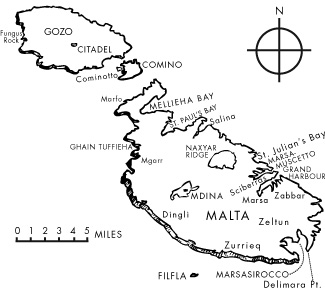
The Maltese archipelago, showing the principal places and positions at the time of the Great Siege of 1565
After fertile and fruitful Rhodes, one of the loveliest islands in the Mediterranean, Malta had been something of a shock to the eight Commissioners. Wood, they reported, was so scarce in Malta and Gozo that it was sold by the pound. Cow-dung or wild thistles were used as fuel for cooking. The capital, called Mdina in the Maltese language, or Città Notabile in Spanish, was situated upon rising ground in the centre of the island. Most of its houses were uninhabited. There were no ports, bays, or coves on the western side of the island, and the shore was studded with rocks and shoals. On the eastern side, though, there were a number of useful coves and inlets, as well as two spacious and very fine harbours. These were capable of housing the largest of fleets. Unfortunately, they were at the moment very ill-protected. A small castle called after Saint Angelo guarded part of the largest harbour, but it was furnished with only three small cannons, and a few mortars.
The Knights must certainly have known of Malta’s two great harbours in advance of the report, for they had been constantly used by European fleets for many centuries. It was they, in fact, which turned the scale and decided the Grand Master in favour of accepting Charles V’s gift. The Knights of St John at that time lived by what can only be called ‘organized piracy’, and a good harbour was their prime necessity. There was nothing to equal the harbours of Malta until one came to Syracuse in Sicily, or Taranto in southern Italy.
Apart from their favourable comments on the two main harbours, the Commissioners had found everything else disagreeable. There were about 12,000 inhabitants in Malta, most of them poor peasants speaking a kind of Arabic dialect. The climate in summer was torrid and, indeed, almost insupportable. Gozo, on the other hand, was greener and more fertile, but had no harbours at all. In this smaller of the two islands there were about 5,000 inhabitants, living mostly in primitive villages. There was also an ill-constructed castle on the highest point, to which the natives withdrew whenever the Moslem corsairs raided their shores. These raids were common, said the Commissioners, and the inhabitants of the Maltese islands were long resigned to the almost annual arrival of Moslem pirates, who carried off to slavery any Maltese who fell into their hands.
If the Order had not been desperate for a new home, there is little doubt that De l’Isle Adam would have tactfully declined the Emperor’s gift. For more than seven years, however, he had made the round of the European courts asking for assistance. Minorca, Ibiza, Ischia—innumerable islands and ports had been considered by the European sovereigns as potentially suitable for the Knights. For one reason or another, all the more fertile and prosperous islands had been deemed by their owners as unsuitable for the Order.
The fact was, that respected though it might be for its fighting prowess, the Order was not popular. Its Knights, drawn from every nation in Europe, owed direct allegiance to the Pope and were thus insusceptible to national allegiances. They were, indeed, constrained by their rules never to fight against other Christians, but only against the Moslem enemy.
In the sixteenth century, when nationalism was becoming the dominant force in European affairs, such an international Christian Order was somewhat suspect—particularly when it was known how rich it was, and how influential its members. But, quite apart from the difficulty of finding another home, De l’Isle knew how hard it had been to keep the Order together after its expulsion from Rhodes. If many more years were passed in exile the Order was likely to disintegrate. Whatever his Commissioners might say, he realized that it was Malta and Gozo—together with the unwelcome gift of Tripoli—or nothing.
In the autumn of 1530, the Knights of St John of Jerusalem sailed in their galleys from Sicily, across the Malta channel, and took possession of their new home. After Rhodes, ‘The Garden of the Mediterranean’, they found Malta as unwelcome as were they themselves to the old rulers of the island. It is doubtful whether the Maltese peasants, for their part, cared who was technically their master. Their lives of back-breaking toil, interrupted by the savage attacks of the Moslem corsairs, could scarcely have been harder. The island nobility, on the other hand, the Inguanez, the Manducas, the Sciberras and others, who were descended from, or related to, the principal families of Sicily and Aragon, viewed the newcomers with anything but good grace.
Gibbon’s remark that ‘The Knights neglected to live but were prepared to die, in the service of Christ’ was not entirely untrue. By the mid sixteenth century this militant Christian Order was beginning to be something of an anachronism. If it is true that, during the great siege of Malta, the Knights attained their finest hour, the fact remains that this fruit was (as is the case in nature) the last achievement before winter stripped the leaves from the tree. A Maltese historian, prejudiced no doubt by a natural bias, has given this account of the Knights of St John at the time when they occupied the islands:
By the time the Knights came to Malta, the religious element in their foundation had fallen into decay. Their monastic vows were usually regarded as mere form, and they were remarkable for their haughty bearing and worldly aspirations. The Maltese, on the other hand, grown accustomed to be treated as freemen, greatly resented the loss of the political liberties which had been conceded to them…It is not, therefore, surprising that there was little love lost between the Maltese and their new rulers.
The local nobility had no option but to accept the fact that the Emperor—contrary to an agreement made in 1428—had disposed of the sovereignty of their islands to these proud and haughty newcomers. They withdrew into their palaces in the old city of Mdina and maintained as little contact as possible with the Knights. To their surprise and, no doubt, also to their relief, they found that the Knights had no intention of settling in their capital. The Knights, whose service was on the sea, and who had accepted Malta only because of its fine natural harbours, preferred to settle in the small fishing village of Birgu—just inside the entrance of what is now Grand Harbour. Here they began to enlarge and restore the fortifications, and to build in the narrow streets the Auberges of their order. During two centuries in Rhodes they had evolved a plan and pattern for their island-living. Now, with the instinct of men whose minds have been formed in a conservative tradition, they began to repeat in Malta the pattern of their old home in Rhodes.
These armoured, dedicated men, who move across the history of Malta and Rhodes like visitors from another planet, represented the last active element of the three great military orders which had sprung out of the Crusades. The most powerful of the three, The Templars, had been suppressed in the early fourteenth century. The second, the Teutonic order, had never really recovered from the defeat inflicted upon it at Tannenberg in 1410. It was only the Order of St John of Jerusalem that preserved, into the renascent Europe of the sixteenth century, something of the fire and ardour which had existed in the great era of the Crusades. The Order stemmed from a Benedictine hospital for pilgrims dedicated to St John the Baptist, which had been established in Jerusalem in the eleventh century. In 1113, in gratitude for the services which this hospital had rendered to the crusaders, Pope Paschal II had taken the Order and its possessions under his protection. Unlike the Templars, who were a purely military order dedicated to fighting the Moslem infidel, the Knights of St John were primarily a nursing brotherhood.
The building, furnishing, and improvement of hospitals, research in medicine, and the training of doctors and surgeons, remained the prime motive of the Order. As well as the mother foundation in Jerusalem, daughter houses were maintained in a number of European cities lying on the pilgrims’ way to Palestine. Part of the Order’s function was also the defence of pilgrims. It was this which led to the emergence of its military side, when the renewed activities of the Saracens and, later, of the Turks made the pilgrim’s passage to Jerusalem and the holy places difficult and perilous. Yet even in the sixteenth century, when the aggressive policies of the Turkish sultans had forced the military side of the Order to become predominant, it still continued its original duty. One of the first activities of the Knights, upon their arrival in Malta, was to establish a hospital.
In 1291, after the fall of the last Christian strongholds in Palestine, the Knights of St John had emigrated first to Cyprus and then in 1310, to Rhodes. For over two centuries, until the great siege in 1522 when Soleyman had driven them from the island, the Knights had evolved the special characteristic of their order. From being hospitallers first and soldiers second, they had become sailors first and hospitallers second. In Rhodes, leaning like a spear against the side of Turkey, they had become the finest seamen the Mediterranean had ever known. Unable to pursue their war against the enemy by land, they had turned themselves into Christian corsairs.
It was in Rhodes, too, that the Knights had perfected the form of their Order, a form which they brought unchanged to Malta. They were an amalgam of all the European nations—a foreign legion of militant Christians, ‘the most remarkable body of religious warriors that the world has ever seen…’ The eight-pointed Cross they bore (which, because of its long association with the island has now become known as the Maltese Cross) was symbolic of the Eight Beatitudes. Its four arms were held to represent the four virtues—Prudence, Temperance, Fortitude, and Justice.
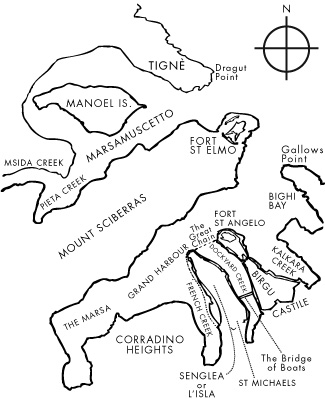
Grand Harbour, Marmuscetto, and the defences of Malta in 1565
The men who formed this unique body were divided into five distinct groups, yet all—whether fighting man or serving priest—were united by the same vows of Chastity and Obedience. First, came the Military Knights, or Knights of Justice. It was they who, in a sense, dominated the Order, and gave it that quality of patrician arrogance which the Maltese nobility found so distasteful. The Military Knights were the sons of the great houses of Europe. Before being admitted to the Order, it was necessary for them to prove noble birth, on both sides of their family, for at least four generations. That there was no disputing the necessity for these proofs of nobility, can be seen from the archives of the Order in Valetta. No matter how important or wealthy a family might be, no taint of illegitimacy (at any rate in these early days), or suspicion of common blood, could pass the scrutiny of the Grand Master and his Council. It was they who investigated the claims of all potential members of the Order. Novices for their first year after acceptance, the young Knights then joined the Convent, as it was called, for military service. By the time that the Order came to Malta this was usually held to mean service as an officer in the galleys. A complete year of this duty was termed ‘a Caravan’. After three years of Caravan duty, the Knight had to reside for at least two years in the Convent. After that he became eligible for higher posts—the Bailywicks, Commanderies, and Priories. Not all the Knights, after completing their duties with the Order, remained within the Convent. Many returned to their estates and duties in Europe. It was they whom—on any occasion of dire peril to the Order—the Grand Master was entitled to summon to his headquarters. A failure to report on such an occasion might mean dismissal from the Order, with all its consequences of social and religious disgrace.
The second division of the Order consisted of the Conventual Chaplains, or Chaplains of Obedience, for whom there were no restrictions on birth. Though not exempt from duties in the Caravans, they were, in fact, usually employed in the Hospital and Conventual Church. All of course were ecclesiastics, and were eligible for elevation to Priors or even to Bishop of the Order.
In the third category were the serving brothers who again were not required to be of noble birth, but only, as it was termed, ‘respectable’. Their service was only of a military nature. The fourth and fifth divisions, Magistral Knights, and Knights of Grace, were honorary Knights who had been nominated by the Grand Master.
At the head of the Order came the Sacro Consiglio, the Supreme Council, presided over by the Grand Master—himself a Knight, who after years of service, had progressed through the major positions of the Order, and had then been freely elected by his brethren. The Supreme Council consisted of the Bishop, the Prior of the Church, the Piliers or Deans of each national Langue, the Priors, the Conventual Bailiffs, and the Knights Grand Cross.
It was a Council that combined the wisdom and experience of the most distinguished members of both aspects of the Order—the temporal and the ecclesiastical. The Vice-Chancellor, assisted by two priests, acted as Secretary. The Bishop himself was chosen from three candidates whose names were submitted by the Grand Master to the Emperor’s Viceroy in Sicily. He, in his turn, submitted one of them for recommendation to the Pope. It can be seen that, although the Knights of St John were by their very nature independent and aristocratic, there were a number of checks placed upon their constitution, intended to ensure that only the best and most efficient rose to the responsible positions. In later centuries, as the Order declined in morale and power, many abuses crept in. But in the sixteenth century, under a strong and selfless Grand Master like La Valette, the constitution operated efficiently.
Apart from the divisions of duties within the Order, the Knights were also divided into eight Langues, or Tongues, consisting of the eight European nationalities from whom its members were primarily recruited. These Langues were Auvergne, Provence, France, Aragon, Castile, England, Germany, and Italy. The French influence in fact, predominated, with its three Langues—Auvergne, France, and Provence. In view of this numerical superiority it was not surprising that many of the most notable Knights over the centuries were of French blood. The three greatest Grand Masters the order ever possessed were all French: Guillaume de Villaret (1310) who led the Knights to Rhodes and established a home which lasted for over two centuries; Phillipe Villiers de l’Isle Adam who brought the Order to Malta in 1530; and Jean Parisot de la Valette.
‘Entirely French and a Gascon’, as the Abbé de Brantôme described him, La Valette was the greatest Grand Master the Order ever knew. Under him it reached its highest peak of glory. It was against this greatest of Grand Masters and his Knights, that Sultan Soleyman the Magnificent proposed to send the might of his army, and the largest fleet that the Ottoman empire could muster.
Chapter 3
Grand Master La Valette
Jean Parisot de la Valette was that rarest of human beings, a completely single-minded man. Born in 1494, he had joined the Order of St John of Jerusalem when he was twenty. He came from a noble and ancient Provençal family, descended from the first hereditary Counts of Toulouse, and could count among his ancestors Knights who had fought in the Crusades with St Louis. It was a family which had already given several knights to the Order, but La Valette was more dedicated to his vows than most of his ancestors. He never revisited his family estates, or returned to his native country. From the day that he joined the Order, he never left the Convent except on its duties.
As the Abbé de Brantôme described him, ‘He was a very handsome man, tall, calm, and unemotional, speaking several languages fluently—Italian, Spanish, Greek, Arabic, and Turkish.’ The last two languages he had learned when, suffering a fate not uncommon in those days, he had been captured and made a Turkish galley-slave. It was in action against the corsair Abd-ur-Rahman Kust-Aly in 1541 that Valette was badly wounded and lost his ship, the galley San Giovanni. For a year he lived and survived in the terrible world of the galley slave. Only an exchange of prisoners between the Order and the corsairs of the Barbary coast secured his release.
In that century, a man adventuring by sea in the Mediterranean was likely to find the wheel of fortune turn full circle in a matter of a few hours. Dragut, greatest of all the corsairs after Barbarossa, saw La Valette when he was a galley slave and secured for him slightly more favourable conditions. Eight years later, when Dragut himself was captured by the Genoese admiral Giannettino Doria, Valette happened to be present. He sympathized with the corsair’s anger and remarked: ‘Monsieur Dragut—it is the custom of war.’ To which Dragut wryly replied, ‘And change of Fortune.’ Valette’s own captor, Kust-Aly, was in turn taken by La Valette, then chief admiral of the Order’s fleet, in 1554, and sent to the oars along with twenty-two other prisoners.
Men like these were early inured to the vicissitudes of fate and, if they survived the rigours of their life to be ransomed and returned to their companions, they were of a physical hardiness and endurance difficult for twentieth-century city-dwellers to comprehend. Life in the sixteenth century, no matter what class a man came from, was a question of the survival of the fittest. The weakling died in childhood, and it was only the toughest and most resilient who could hope to see old age. In 1564, the year that Soleyman the Magnificent decided upon the siege of Malta, La Valette was seventy, the same age as the great Sultan. To have attained such an age after a life of constant warfare a man had to be fantastically hard. To have attained such an age with physical strength and mental ability unimpaired, a man had to be almost super-human. If at the same time he were motivated by a fanatical religious faith, there was little that could stand against him. In the great siege of Malta there were men of this calibre on both sides, men hardened by years of warfare and equally convinced of the rightness of their cause.
During his long service with the Order, La Valette had held nearly all the important positions that existed. He had been, successively, Governor of Tripoli—a post so onerous that it had been declined by all the other eligible Knights—Bailiff of Lango, Grand Commander and Grand Prior of St Gilles, Lieutenant to the Grand Master, and General of the Fleet. The last post was equivalent to that of Commander-in-Chief afloat, and Valette, as Baudouin tells us in his History of the Order, ‘was unanimously elected although he was still not a Grand Cross but only the Pilier of his Langue’. This in itself was evidence of the respect accorded him. Even more, this was the first time that the office of General of the galleys had ever gone to anyone not of Italian blood, the position normally being considered an Italian monopoly.
A born soldier, of whom it was said: ‘He was capable of converting a Protestant or governing a kingdom,’ La Valette soon proved as general of the galleys that his brethren’s trust in his skill and prowess was well justified. It was during these years that the galleys of the Order, ranging far and wide from Malta, created that disorganization in the shipping lanes of the Ottoman empire which to some extent provoked the Sultan’s decision to attack the island. These raids on enemy shipping were carried out in much the same manner as ‘destroyer sweeps’. The fast, heavily-armed galleys, with their trained gunners and sharp-shooters, haunted the Moslem shipping lanes, descending like eagles on their prey. Whether it was a lone merchantman or an escorted convoy, they swept in to the rhythmic beat of the great oars, holding their fire until almost alongside the enemy. Then, after the first discharge of artillery and the first coordinated volley from the arquebusiers, the Knights and men-at-arms boarded the enemy and engaged them with cold steel. From one raid alone, La Valette brought back in tow behind his galley ‘three merchant ships whose cargo was worth a prince’s ransom, 250 prisoners (destined if unransomed for slave labour in the galleys or on the fortifications of Malta), not to mention numerous pieces of artillery’.
If the great siege of Malta was primarily a land operation, the fact remains that it was a sea-borne invasion. It was a battle for the sea-control of the Mediterranean, and it was the maritime activities of the Knights which had provoked the attack. One cannot write of La Valette, or the Order, or the siege, without considering, however briefly, the ships in which both Knights and Moslem corsairs lived and fought.
Typical Mediterranean galleys of the period, whether Turkish, Maltese, or Algerian corsair, followed much the same lines. They were direct descendants of the classical Greek and Roman galleys and had changed little over the centuries. Long and narrow, they had little freeboard and a shallow draught. (Something like their lines, in miniature, can still be seen in the small fishing boats working out of Malta and southern Sicily to this day.) Their overall length might be as much as 180 feet but, because of the graceful rake of stem and stern, they were often no more than 125 feet between perpendiculars. On a length of 180 feet a galley would have only about 19 foot beam and a depth of hold of only 7½ feet. A sleek greyhound designed for the long calms of Mediterranean summer, they were unsuited to the winter weather. All over the Mediterranean (just as in classical times) September marked the end of the sailing year. Not until spring was securely established did the galleys take to the sea again. During the winter months the Order’s galleys in Malta were normally secured in what is now Dockyard Creek, with their bows towards the peninsula of Senglea, and their sterns to Birgu where the Knights had their Convent.
Mobility was the outstanding characteristic of the galley and it was this which had kept so essentially unseaworthy a vessel in use throughout the centuries. Too light and shallow to be a merchantman, the galley was as inbred and specialized a tool of war as a motor-torpedo-boat. At her fastest, it has been calculated that a galley could make about four and a half knots. This could only have been in short bursts, since even the hardened muscles of the galley slaves could not have maintained a fast stroke for any length of time. An average speed was about two knots, adequate for the tideless Mediterranean, but clearly of little use in the fast-running tidal streams around the British Isles or Northern Europe. (It was for this reason that the main development in sailing vessels came from Holland, Scandinavia, and Britain.)