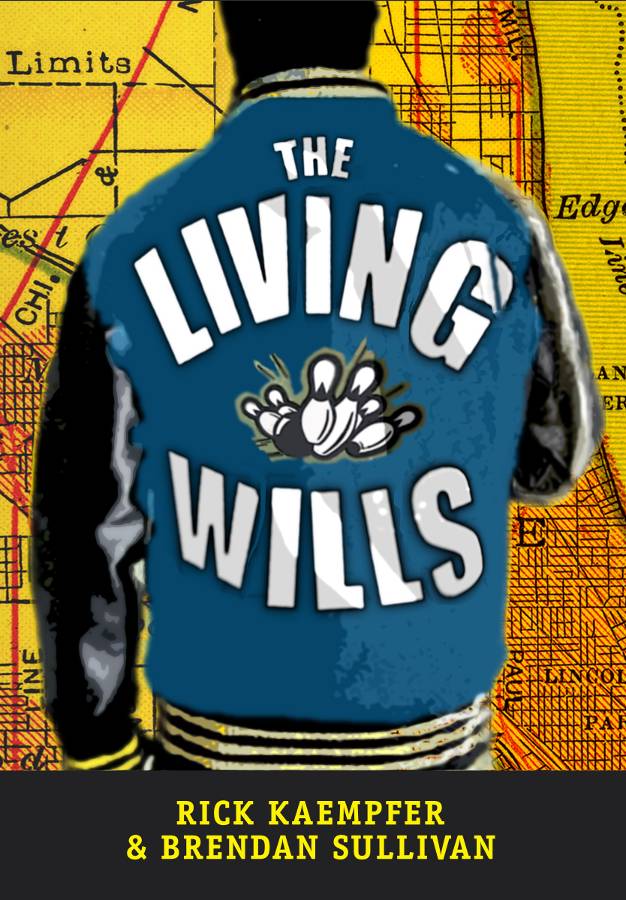
THE LIVING WILLS
Rick Kaempfer & Brendan Sullivan

The Living Wills
Publishing History
Trade paperback edition/December 2011
Published in the United States by
Eckhartz Press
Chicago,Illinois
All rights reserved.
Copyright 2011 by Brendan Sullivan and Rick Kaempfer
Title page art copyright 2011 by Jon Langford & Siena Esposito
No part of this book may be reproduced or transmitted in any form or by any means, electronic or mechanical, including photocopying, recording or by any information storage and retrieval system, without the express written permission of the publisher, except where permitted by law.
This is a work of fiction. Names, characters, places and incidents are either the product of the authors’ imagination or are used fictitiously. Any resemblance to actual persons, living or dead, events, or locales is entirely coincidental.
eISBN: 978-0-9848049-1-7
v1.0
TABLE OF CONTENTS
Title Page
Copyright page
Praise
Dedication
Preface
1 - Threat Level Red
2 - What’s In A Name?
3 - It Takes A Village
4 - Out Of The Closet
5 - Holy Smokes
6 - The Daily Grind
7 - Chryslers And Crisis
8 - Oh Yeah, One More Thing….
9 - A House Divided
10 - Mother Knows Best
11 - The Great Outdoors
12 - You Could Hear A Pin Drop
13 - Purple Haze
14 - Another Cup O’ Joe, Little Joe?
15 - Home Sweet Henry
16 - Girl Power
17 - The Parking Garage At Delphi
18 - Eye Of The Tiger
19 - Follow The Clues
20 - Yeah, We’re Movin’ On Up
21 - Renegade
22 - The Book Of Love
23 - Defrosting
24 - One Big Happy Family
25 - Oklahoma Transplant
26 - How To Succeed In Business
27 - Uninvited Guest
28 - Club Paradise Lost
29 - Two Seconds
30 - The Truth Will Set You Free
31 - Moments Of Clarity
32 - Climbing Mount Paper
33 - Hope
34 - Blindsided At The Alley
35 - Pushing The Envelope
36 - You Can’t Go Home Again
37 - Anticipation
38 - A Dick Move
39 - The Girl From Ipanema
40 - Barkin’ Up The Wrong Tree
41 - Pins, Pain And Pizza
42 - The Gift That Keeps On Giving
43 - I’ll Make Him An Offer He Can’t Refuse
44 - Deconstructing Destruction
45 - The Accidental Detective
46 - Oh, What A Tangled Web We Weave
47 - The Prescription
48 - The Hair Of The Dog
49 - Thar She Blows!
50 - Guess Who’s Coming To Dinner?
51 - Speechless
52 - Two More Seconds
53 - The Long Way Home
54 - Sweet Home Chicago
55 - The Fourth
56 - Buckingham Fortress
57 - Say Uncle
58 - Patience Rewarded
59 - Peace
60 - Should Old Acquaintance Be Forgot
61 - Justice
Acknowledgements
About The Authors
Author's Note
PRAISE FOR THE LIVING WILLS
"Rollicking and real on so many levels, The Living Wills is a captivating collaboration by two immensely talented writers. I hope this team keeps at it for keeps."
- Rick Kogan, Chicago Tribune
"...a hell of an old-fashioned read. It brings to life 'the city of broad shoulders' and makes me homesick. I want a Billy Goat Cheezborger and a shot of whiskey."
- William Petersen, Chicago-bred film/TV/stage actor, CSI:Crime Scene Investigation
"The Living Wills will bowl you over! For the love of Chicago, coffee and picking up the spare, you must read this novel from the exciting new writing team of Sullivan and Kaempfer."
- Kim Strickland, author of Wish Club and Down At The Golden Coin
Brendan: For my mother, Jeri Sullivan. You always told me I could do anything I put my mind to. If they have books in heaven, I hope you enjoy it.
~ ~ ~ ~ ~
Rick: For my father, Eckhard Kaempfer, who died far too young, and inadvertently unleashed a passion for writing in his eldest child.
PREFACE
The structure of this novel is influenced by the improvisational theater form called the Harold, created by Del Close as a member of the San Francisco theater group the Committee in San Francisco in 1967. On stage, a Harold is a long-form improvisational piece inspired by one audience suggestion and created in the moment by a team of improvisers. In the strictest sense, a Harold contains three separate ‘scenes’ inspired by the audience suggestion and a theatrical opening. Ideally, as a Harold develops before the audience’s eyes over thirty minutes or so, the three scenes begin to connect and reflect one another, coming together in the end to create one coherent performance piece, never to be seen again. Entire books have been written about the essence of the Harold. Our short explanation does not do justice to it. As they say, “You gotta see it for yourself.” When it works, it will blow your mind.
This novel is NOT a Harold, only influenced by the form. It wasn’t improvised on a stage in thirty minutes, although we did use some improvisation techniques in our process. We do have three interweaving story lines, but this novel was written, edited, rethought, rewritten, and rewritten again. Therefore, the end product of “The Living Wills” doesn’t strictly adhere to the Harold form.
Still, we would be remiss if we didn’t acknowledge the debt we owe to Del Close.
THE LIVING WILLS
1
THREAT LEVEL RED
As soon as the elevators doors opened on the 17th floor, Reed could smell trouble in the air. This week’s front desk receptionist had a look in her eyes that Reed had seen many times, in many receptionists.
“Good morning, Cindy,” Reed said, forcing a smile.
She wouldn’t make eye contact with him. Reed adjusted his tight collar away from his neck a bit as he made his way through the maze of gray cloth-covered cubicles. Nearly all of them were full already. Not a good sign. Reed didn’t like to be one of the last arrivals. It was always better to be somewhere in the middle; unnoticed, unannounced.
Charlie Turner’s office door was open. Reed poked his head in.
“Threat level?” he asked.
“Red, with a capital R,” Charlie said.
“Great,” Reed replied. The pit of his stomach flared.
“He already asked where you were,” Charlie warned.
Reed looked at his watch. 8:02. The train was more than a few minutes late this morning. “Oh my God.”
“I know,” Charlie said.
“That didn’t spark the red threat level, did it?” Reed asked.
“What do you think?” Charlie asked.
“Quarterly numbers?” Reed guessed.
Charlie nodded. “Keep your head down. There’s a meeting at 8:30 in the conference room.”
“Thanks,” Reed replied, leaving Charlie to stew in his own quarterly shortcomings.
Reed looked around the office floor at the accountants milling about their cubicles, and they all looked unusually concerned. This had the potential of being a very bad day. When Anderson unloaded on his staff about something trivial like personal phone calls, distractions in the office, dress code violations, or, as Reed had discovered a few times, late arrivals, it was nasty and uncomfortable. But when he unloaded on them about something that was actually important, like quarterly numbers, the scorching heat of his wrath singed navy blue blazers from here to Timbuktu.
When Reed arrived at his office door, he saw a standard piece of 8 ½ by 11 copy paper scotch-taped just above eye level. Not today, of all days. Is it that time of year already? The cheap rainbow colored Word-Art font proclaimed the news for all to see.
“Congratulations Read O’Hern on 27 years with Cap’n Slappy! Best Wishes, HR.”
“R-E-A-D,” he muttered to himself.
Reed calmly removed the scotch tape, and held the piece of paper in his hand as he opened his office door with the other. He flicked on the lights. Reed’s office lacked any hint of personality. In fact, his walls were bare other than the corporately mandated Cap’n Slappy poster on the wall behind his desk. He stared at the poster and sighed.
“Christ,” he said. “27 years.”
Reed coolly crumpled up the piece of paper and tossed it in the wastebasket.
When he took his seat behind the desk, he had only one destination in mind. Reed turned on his computer monitor to double check his quarterly numbers. Yup. Everything was in order. His region of Cap’n Slappy seafood restaurants was due to spend exactly the same as they spent last quarter. Sure, the cost of the small, medium, and laaaaaaaargh soft drink cups went up a bit, but that was offset by savings on the Salty the Parrot plush doll in the Yo-Ho-Ho Kids Meals.
“Thank you, Singapore,” he said, as he scrolled down the spread sheet.
Reed printed out another copy of his quarterly report in case it came up in the meeting. He put it in a standard manila folder, wrote “First Quarter 2005” in the tab, and closed the folder. Reed checked his e-mail to make sure there hadn’t been any last second directives, and walked out of his office toward the conference room. Sure, it was only 8:15, but the last thing he needed was to be “the meeting straggler.” It was bad enough that everyone would be reminded that Reed had once again “pulled an O’Hern” thanks to the ever reliable folks at Metra Rail.
He took his regular seat in the middle of the window side of the table. Charlie arrived moments later and took his seat too, right next to Reed. He was more upset than usual.
“I don’t know how I’m going to break this news to Lynée,” he said.
“What news?” Reed asked.
“We had a vacation scheduled next week,” he explained. He was shaking his head at his own stupidity. “I told her not to buy non-refundable tickets, but she said it was the only way to get the deal. I should have been more forceful.”
“Where were you planning on going?”
“One of those all-inclusive places in the Dominican Republic,” he said.
Reed nodded sympathetically. He knew that Charlie’s new wife had committed the ultimate Cap’n Slappy sin. That’s why God made the Wisconsin Dells. It was a rookie mistake, and Charlie’s first wife Linda never would have made it.
The conference room began filling up. Cranky Dick Nicholson took his place on Reed’s left. He was already grumbling about people “crapping in his pool”. By 8:25 every seat was taken except the head seat at the table.
“He’s usually here by now,” Reed said under his breath to Charlie.
“If I were you,” Dick Nicholson interjected, “I wouldn’t mention that.”
“Point taken,” Reed said, his cheeks flushing.
Anderson’s personal assistant Annie came into the room, and did a quick head count. She was charged with making sure everyone was in place before His Majesty made his entrance. After a quick check, she left again. Nervous employees cleared their throats one last time. It was too risky to make a noise of any kind once the meeting began.
Conrad Anderson’s wiry frame arrived moments later. His thinning gray hair was slicked back above his starched white collar, and his navy and red tie undoubtedly matched the pocket handkerchief in the blazer hanging in Anderson’s office closet. He was carrying a mug of coffee in one hand, and a manila folder in the other.
Anderson tried to make eye contact with everyone in the room, but all eyes were firmly glued to the reports on the table in front of them.
“Good morning,” he grumbled.
A smattering of meek mutterings returned the greeting. Anderson placed his coffee cup on the glass table, but didn’t take his seat. He simply glared through his black-framed Buddy Holly glasses at the fraidy cats that worked for him. Even though nobody saw the glare, he knew they felt it.
“I certainly don’t take any pleasure in conducting an unpleasant meeting,” he began, taking off the glasses, and rubbing his nose. He placed the glasses back where they belonged and sighed. “But I have the quarterly numbers right here—and the numbers don’t lie.”
No one said a word.
“Charlie,” Anderson spat, not wasting a moment of time with niceties. “Did you take math in high school?”
“Yes,” Charlie said.
“Can you tell me what number is bigger—seven or zero?”
“Seven,” Charlie said, bracing himself for a body blow.
“So...,” Anderson wound up, “A seven percent increase in cost would be higher than a zero percent increase.”
“Well, I...”
Anderson slammed the manila folder on the glass table.
“Were you, or were you not responsible for the Schooner of Tuna basket order?”
“I was,” Charlie admitted.
“And?”
“‘Tisket a Tasket’ went out of business last year,” Charlie reminded him, “and the only other schooner shaped baskets—“
“You checked every single basket company?” Anderson challenged, his voice rising in volume with every sentence. “You’re confident that if I researched this personally, I wouldn’t be able to find one single basket company in the entire world that offered schooner shaped baskets for a price that wouldn’t bankrupt us.”
“I know these cost a little bit more—“
“Seven percent is not a little more.”
“They’re still only—“
“Dammit!” Anderson bellowed. “Do you have any idea what corporate is going to do to me when they see these numbers?”
“I’ll find a cheaper one,” Charlie said.
“When?” Anderson demanded.
“Now,” he muttered.
“And when will you stop looking?”
“When I find one,” Charlie responded.
“You’re excused,” Anderson said. He looked through his report for the next egregious violation as Charlie gathered his things.
Charlie pushed his chair back, and tucked all of the paperwork back into his manila folder, but before he could get out of his seat, the room echoed with the sound of a loud crash. When everyone looked up to see what had happened, Anderson had disappeared. All that remained at the head of the table was a knocked-over coffee cup, and an ever growing puddle of the creamette-lightened sugary brown liquid that once resided inside of it. Nobody seemed too concerned that the puddle was expanding toward that dreaded quarterly report.
There was a bigger concern lying beneath the table. Reed rushed past Charlie, and was the first to reach his boss’ side. Anderson was face-down on the floor, his smashed glasses by his side. His body lay totally still. Reed tentatively felt for a pulse. Nothing. Everyone gathered around looking for a sign from Reed.
“I think we better call 9-1-1,” he finally garbled, although he knew it wouldn’t do any good.
Conrad Anderson was dead. As dead as a Salty the Parrot plush doll.
2
WHAT’S IN A NAME?
Waveland Bowl was crackling on a Thursday night. All 40 lanes were packed with the over-40 men’s league. The balls rumbled down the well-waxed lanes, crashing into the helpless pins. Beer bottles clinked. Roars of laughter and applause sprang up randomly. There was an energetic hum about the place; grown men, working men, playing a game to relax and forget about their cares for a while. The cacophony was music to Henry’s ears as he eagerly walked the long aisle, anxiously searching for his team.
Tonight Henry had news. He had big news. He could hardly contain himself as he spotted his three teammates at lane 23. Henry took the two steps down to where the guys were putting on their bowling shoes. He dropped his duffle bag on the plastic bench, and walked the space like a runway model, twirling and holding his arms out wide.
“Notice anything?” asked Henry.
“The Living Wills?” Ramon was reading the back of the brand new, bright blue letterman’s jacket that Henry was sporting. “What the hell is that supposed to mean?”
There were puzzled looks all around.
“I got one for each of us. They’re in the bag,” beamed Henry. “You gotta admit it’s a beautiful jacket, right?”
“Yeah,” admitted Oscar, “It’s a beautiful jacket. I got no problem with the jacket. But I’m with Ramon. What’s the deal with the name?”
“OK, I’ll explain.” Henry took a deep breath. “I had to act quick. It was a great deal. This guy who parks in the garage, he’s a wholesaler. Ramon, you know the guy, silver caddy, always tips five bucks.”
“Yeah, yeah,” said Ramon. “Dark glasses, heated seats. I know the guy.”
“Anyway,” said Henry, “he was wearing one of these jackets today when I was parking his car, same real leather sleeves, same stain-resistant, thick cloth construction, same beautiful cobalt blue color, same zip-out winter linings, same fitted cloth at the wrist with the white piping.”
“Hey,” Ramon interrupted, “I admit, it’s a beautiful jacket. It’s the most frickin’ beautiful bowling team jacket I’ve ever seen. What’s with the name?”
“Ah, that’s where my sixty years of fast thinking comes in handy,” said Henry. “This wholesaler guy sees me admiring the jacket he’s wearing, a jacket just like this except without the name of course. I ask him what it costs and he says he’s got a half-dozen that he needs to unload. Somebody over-ordered or bounced a check or something. So I say I’d need four, an XXL, two XLs and one large. He says, ‘no problem.’ I tell you it’s like a dream.”
“Henry,” Delmar jumped in to get back on point. “What’s the deal with the name? I thought we were the Lane Wizards.”
“If you’ll recall,” answered Henry, making his case, “the Lane Wizards sucked. The Lane Wizards were notoriously bad. The Lane Wizards were an embarrassment to the game of bowling.”
“Delmar, we talked about this,” added Ramon. “We agreed that we should change the name and maybe it would change our luck.”
And then Oscar’s attention turned back to Henry. “But I don’t remember agreeing on a new name.”
“That’s the joy of this,” said Henry. “If you’d just let me finish the story.”
“I gotta tell you, Henry, these are some sharp jackets,” said Delmar. “They’re a whole lot better than these windbreakers we’ve got now. How did you swing it on our sponsor’s notoriously tight budget?”
“That’s the beauty of it, if you’d let me finish.”
Ramon, Oscar and Delmar sat quietly.
“OK, so I go up to the guy’s office on the 23rd floor during my break. He’s got quite an operation up there. He’s got a machine that sews the lettering on the back, and some other thing that embroiders the team name on the front here,” said Henry, holding his hand to his heart. “It’s like computerized freakin’ magic. He’ll do it for free if I take the jackets off his hands today. He’s supposed to ship them back to the manufacturer by tomorrow. So I pay him $100 cash for the whole thing, he puts the lettering on with that computer operated machine thing and here we are. Four gorgeous jackets.”
“Twenty-five bucks a piece?” asked Oscar. “As the guy who works for our notoriously tight sponsor, I approve. Nice job, Henry.”
“Yeah,” added Ramon. “And yet the question remains.”
“Take a look at the shirts you’re wearing, gentlemen,” said Henry smugly.
The men stared at one another’s baby blue, short sleeve bowling shirts, with their first names sewn over the left breast pocket, an LW for the Lane Wizards in huge white letters on the right side of the shirt, and their sponsor’s name, BM&P Toilets, on the back.
“Where are you going with this, Henry?” asked Delmar.
“I saved our notoriously tight sponsor the cost of new shirts!” claimed Henry.
“Huh?” asked Ramon.
“You see,” said Henry, pointing to his own shirt. “The Lane Wizards. The Living Wills. Both are LW. New name. No need for a new shirt.”
“Once again, as the representative of our notoriously tight sponsor, I approve,” said Oscar. “But that’s all you could come up with, the Living Wills?”
“Hey, I had to think fast. I didn’t have time to send it to a vote. A living will’s been on my mind a lot lately, I guess. I’ve been reading up on it. You know that everyone should have a living will.”
“On the back of their bowling jacket?”
“Don’t you see? It’s a public service,” explained Henry. “Nobody thinks about a living will until it’s too late. Now when someone asks you, ‘Why are you guys called the Living Wills?’ you can tell them they should get one so their loved ones can pull the plug when they’re in a vegetative state with no hope of recovery.”
“That’s just great, Henry. If our jackets are public service announcements, couldn’t we just be the Brushers and Flossers, or the Prostate Exams?”
“Ah,” said Henry, “But those don’t start with LW.”
“Doesn’t anything else start with LW?”
“Actually,” said Henry, searching for and finding a crumpled scrap of paper in his pants pocket, “I did think of a few others before going with the Living Wills. Remember, I only had a few minutes to think.”
“I’m on the edge of my seat,” muttered Oscar.
“The Light Weights, the Limp Wrists, Little Women, Lawrence Welk, the Lemon Wedges, the Lazy Weasels, the Lame Wimps, the Lard Wagons….”
“All right, all right,” said Ramon. “Jeez, when you put it like that, the Living Wills sounds almost heroic.”
Looks of surrender and exasperation passed back and forth in silence among the four. Oscar held up his beer glass. The others followed. Glasses clinked all around.
“To the Living Wills.”
“By the way, Henry, have you got a living will?”
Henry tipped back his beer, pretending he didn’t hear the question.
3
IT TAKES A VILLAGE
Where can they be? Why isn’t she answering her phone? The school called and said it’s a nasty scrape, both knees bloody, but no need to worry, she’d be fine. So where are they!?
It sure didn’t help that this week marked the Cubs’ home opening series against the Brewers. Traffic on Addison was at a standstill. Gina sat in the back row of the eastbound 152 CTA bus, packed to overflow with hopeful Cubs fans crawling slowly toward Mecca. There was buzz around town that 2005 might finally be the year. Gina only wanted to get off this bus and get home.
Gina just happened to live near Wrigley because she’d found a needle in a haystack last fall; a good, cheap apartment in a nice neighborhood that seemed relatively safe for a 25-year-old woman. She’d heard that baseball season turned the area upside down. Now she was getting her first taste, as the mob on the bus spontaneously broke into a raucous rendition of “Take Me Out to the Ballgame.”
Gina dialed again. The phone rang and rang. No answer, no voicemail.
“Jeez, Libby, get a cell phone,” muttered Gina as she slammed the phone shut. “Join the 21st century. Damn.”
Gina glanced out the window to read a street sign. Ashland. Her stop was coming up. Couldn’t this bus move any faster? Gina stood up and began to worm her way through the sardine can of a bus to the side exit. At Southport, Gina squeezed her six-foot frame through the sea of Cubbie blue and finally pried herself and her backpack out the door like a 10-pound newborn from the birth canal. Ah, fresh air.
Most nights Gina would take this opportunity to reach her long fingers into the hip pocket of her barista uniform and light a cigarette for a leisurely walk home. But not tonight. She swept her long, straight, ebony hair from her face and took off running.
Gina barely noticed the crowds of baseball fans as she jogged the two blocks to her gray stone walk-up, praying that everything was OK. She ran up the front walk and opened the gate and the front door of the building without a key. The locks were broken. Gina agreed that these little things were the compromise she made for such a bargain living situation. She didn’t bother picking up her mail from the assortment on the entryway floor and raced up the creaky wooden stairs two at a time to the second floor.
Gina pounded on the door of the apartment across the hall from hers, and tried to catch her breath. She heard the television blaring and thought that might be a good sign. She quickly knocked again. The volume on the TV dropped and slow, heavy steps made their way to the door. Two deadbolts and one chain later, the door opened.
“Gina. Please, come on in. Good to see you.”
Gina burst into the apartment, still breathing hard. “Libby, where is she? How is she? Where were you? I called. I called a lot.”
“Everything’s fine, just fine. She’s OK. We just walked in the door ourselves,” said Libby, her XXL light green sweat suit oddly matching the bright orange she’d washed into her hair. “We went out for new shoes, and for ice cream,” Libby whispered.
The eight-year-old girl sitting on the couch turned away from the TV. “Mommy!” she screamed happily, leaping up and racing to Gina, hugging her tightly around the waist.
Emily’s knees were wrapped in gauze and bandages, but they didn’t appear to impede the little girl’s mobility at all. A little dried blood in a few spots, nothing more. Emily was beaming in white shorts, a Hello Kitty t-shirt and brand new pink sneakers.
Gina hugged Emily. “Are you OK, honey? I’m so sorry I had to work. I was so worried about you. I got home as fast as I could.”
“I’m alright. We were running around at recess and a big seventh grade boy didn’t see me and ran me over and I got big scrapes on both knees and there was lots of blood and they had to carry me to the nurse’s office and I had to miss art class and the nurse said the spray wouldn’t hurt a bit and she was right,” said Emily brightly. “I’m a big girl now.”
“Well, I’m just glad you’re OK. I was worried.”
“Uh huh. And look, I got new shoes. Pink! Libby and I got them. And strawberry ice cream!”
“Libby,” said Gina, “You shouldn’t have. What do I owe you?”
“Don’t be silly,” said Libby. “I wanted to do it.”
“What would I do without you?” smiled Gina as she stood up, finally feeling a little more relaxed.
“Guess what, Mommy,” shouted Emily.
“What?” asked Gina. “You mean there’s more?”
“My poem got picked. Mrs. Guercio told us. They’re gonna put them in a book for the parents and you can get a copy. And it’s gonna be in a big binder and everybody is gonna see it. It’s not just like last time when they put them on the wall in the hallway. This is a book. A poem book.”
“Emily, tell Mommy the best part,” said Libby.
“Oh yeah. They picked my picture. It’s gonna be on the cover of the book. It’s a picture of the earth from way up in space with stars and stuff.”
“Wow. A published author and an illustrator, at age eight. That’s just fantastic, sweetheart.”
“Would you like some tea, Gina?” asked Libby. “I put on the kettle a while ago.”
“No thanks.” The last thing Gina needed after a full day of serving coffee was a cup of tea. She closed her eyes for a moment to compose herself, so relieved now that Emily was OK. Emily ran back to the couch and plopped in front of the TV.
Libby smiled a big, cherubic smile. “She’s a wonderful girl, Gina. I love having her around and being able to help. Have a seat. You’re always rushing around and you never get a chance to relax. Relax.”
Gina looked around the room, to the kitchenette strewn with dirty dishes and to the piles of old TV Guides and People magazines stacked against the far wall, to the overstuffed La-Z-Boy where Libby spent most of her day, an open bag of chips and a Diet Coke on the small adjoining table top, next to the phone. Gina decided the only place to sit was at the dinette table, and pulled out a chrome-piped chair and sat, hopefully for just a short moment. It did feel good to sit, even here.
“I really appreciate you being here for Emily,” said Gina. “I just don’t know how I’d get by otherwise. You’re a life saver.”
“You always say that. I love watching Emily. It’s the highlight of my day. We were about to have some macaroni and cheese and little hotdogs for dinner, with chocolate milk and a popsicle for dessert, just like always. So tell me about your day.” Libby was genuinely interested.
Gina longed to cross the hall and take off her shoes. She’d been standing all day. But this was the small price she paid for a babysitter who didn’t charge her a thing. Sure, no homework was ever done, and the TV was rotting Emily’s brain, and Emily had consumed enough macaroni and cheese over the last few months to fill a grain silo, but the price was right. In return for an affordable apartment and complimentary daycare, Gina had to talk to her lonely landlady for a short time each evening and be a good tenant. A sweet deal.
“Don’t worry about feeding Emily tonight,” said Gina as Libby wandered off to the kitchen. “I’ve got it covered.”
“Okey dokey,” called Libby from the kitchen.
Gina wasn’t quite sure how old Libby was, although by the lines on her face, Gina figured she was in her 60’s. But her roundness made her move like she was seventy. And she talked like she was in her eighties.
“There’s nothing like a cup of tea after a long day, I always say. And it’s good for you too,” Libby wheezed as she waddled to the stove. “I heard that it’s got those anti-accidents in there to keep away the cancer. I saw that on the Inside Edition program. A big breaking story they had.” Libby huffed as she shuffled around the cabinets in search of a clean cup.
Emily was watching an old episode of “The Dick Van Dyke Show”. Gina began to nod off sitting on the dinette chair.
“Are you sure you won’t join me?” asked Libby, a cup of tea in her hand.
“No, no. Please.” Gina stood slowly. “We really should get going. I appreciate the hospitality, and taking care of Emily.”
“Don’t worry about it. I’ll be here tomorrow as always to meet the bus. It gives me something to look forward to. Frankly, I don’t know what I’d do without her now. It’s kind of quiet around here since mother died, you know.”
“Yes,” answered Gina, “You’ve told us. Amazing that she died right on that couch.”
“Yes, she died right there on that couch. She couldn’t reach her pills. And I was asleep on the La-Z-Boy, the TV on. Mother was hard of hearing, so the volume was up, and I didn’t hear her cries, if there were any.”
“And you slept right through it.”
“Yes. I slept like a baby through the whole thing and when I woke up, she was gone. Well, I mean, she was still lying there, one hand outstretched toward the nitro pills, but she was gone.”
“Yes, I’m sorry. It’s a sad story.”
But Libby sure seemed to enjoy telling it.
“We should get going,” Gina said toward Emily on the couch. “Someone I know has some homework to finish, I bet, even if they’re injured.”
Emily hopped up from the couch, grabbed her backpack, gave Libby a quick hug and walked silently out the door, all without any direction. “Well, good night,” said Gina to Libby. “And thank you again.”
Gina closed Libby’s door. Emily stood in the hallway, and could hear the bolts being secured behind Libby’s closed door as Gina opened theirs.
One Thai curry dinner, one chicken fried rice, one glass of wine, one glass of milk, one second grade math worksheet, one spelling quiz review, two Nancy Drew chapters and one hour of ‘Survivor’ later, Gina announced to Emily that it was time for bed. Emily clunked around the bathroom, reaching up to the faucet on tiptoe, and brushed her teeth. Rinsing was tricky. Emily actually had to leave her feet, hang over the sink on her belly and stick her mouth under the spigot.
“Let’s let Dr. Mom take a look at the damage,” said Gina.
Emily sat on the edge of the old claw foot bathtub while Gina peeked under the edges of Emily’s bandages. The school nurse had overdone it with the wrapping. Gina removed the gauze and slowly exposed the small wounds. She gently washed Emily’s knees with a washcloth and soap. She pulled the small first aid kit from the medicine cabinet above the sink, sprayed some Bactine on the scrapes and applied two small band-aids to each knee.
“There,” said Gina, “Good as new.”
Emily marched to the bedroom, climbed into the queen size bed she shared with her mother and crawled under the covers, sliding to the far side, against the wall. Gina followed Emily into the room to tuck her in. Gina knew that one of these days Emily was going to ask for her own bed or maybe even her own room. Emily was only eight, but she was growing up fast. Just yesterday it seemed she was in a crib. Gina kissed her goodnight, turned out the light and was about to head back to the living room when she heard her favorite word in the world:
“Mom?”
“Yes, honey?”
“How long will we stay in Chicago?”
“I don’t know. What do you think?” Gina sat back down on the bed.
“I like it here,” said Emily. “It’s a short bus ride to school and stuff. There’s some nice kids at school. And Libby’s really nice. I was just wondering.”
Gina reached down and brushed Emily’s soft light brown curls from her face. “I think we should just be happy for right now, and not worry. Try to go to sleep, OK?”
“OK,” said Emily. Gina made a move to stand. “Mom? One more thing.”
“What’s that, honey?”
“Is the Ponderosa a real place?”
“What?”
“The Ponderosa. Is it real?”
“What are you talking about, honey?”
“On TV, on ‘Bonanza,’ they burn that map at the beginning of every episode. So if it’s on a map, it’s real, right?”
“You watch ‘Bonanza’?”
“Sure. With Libby. It’s her favorite show and we watch it at four o’clock. With Hoss, and Little Joe and Adam and their dad. Libby says Hop Sing isn’t Oriental anymore, he’s Asian. And so is that a real map? Can we go there someday?”
“Well, honey. ‘Bonanza’ is a TV show and it’s not real. It was a new TV show before I was born. Even when I was a kid, we only saw reruns. And now you’re watching a show that’s about 40 years old.”
“So we can’t go there? But we could have gone there forty years ago?”
“Emily, it’s very late. Go to sleep.” And Emily snuggled against the wall.
Gina sat on the bed for a moment, thinking about what Emily had said. She didn’t want to raise a latch key kid, always moving from city to city without any roots. She didn’t want to create a daughter who was raised by strangers, by Libby and the Cartwrights. But for now, what choice did she have? They had each other.
“It won’t always be like this,” she whispered to Emily, already snoring quietly.
4
OUT OF THE CLOSET
Anyone stepping out of the elevator and into the lobby of MacArthur Harrison Hyde couldn’t help but be impressed. The law firm’s contemporary lobby with its sleek, clean décor was pristine. The executive conference room, visible from the lobby through beautiful glass doors, looked too nice to actually use. The office of each partner, located at the end of each hallway, was a testament to the firm’s power and wealth, from their stainless steel appliances, to their hand carved mahogany desks, to their incredible views of Chicago’s skyline.
But if that was the penthouse face of the firm, the young associates like Peter Stankiewicz resided in the outhouse. Not that it bothered Peter. He felt at home in the dingy windowless closet MacArthur Harrison Hyde had assigned him on a lower floor. His desk looked respectable enough; the bourbon cherry finish was lacquered and shiny beneath the piles and piles of paperwork Peter had strewn about. Between the hours of 7AM and 9PM, Peter was sure to be sitting behind that desk in his comfortable ergonomic office chair, in front of five bulging half-open filing cabinets. In fact, every time firm partner Clark Buckingham actually entered Peter’s domain, he berated the young lawyer for his disheveled workspace.
“I know exactly where everything is,” Peter lied. If Buckingham ever pushed and demanded to have the filing system explained to him, Peter would have collapsed like a house of cards. He simply had too much work, too little space, and too few hours in the day to stay on top of everything.
Of course, Peter was not alone. All the other third year associates also had offices on this floor, and knowing that they were going through the same thing kept Peter sane. One of them, in particular, even helped him out. Her name was Kelly Castle and she had a similarly sized closet down the hall. Kelly was Peter’s sounding board, his one-person cheering section, his late night pizza at the office buddy, and for the past six months, much more than that.
She knocked on his open office door.
“Anybody home?”
“Yup,” Peter said. “Probably forever. Buckingham’s meeting with Albright in the morning and if I don’t go through everything we have on the merger...”
“So I guess lunch is out of the question?” Kelly interrupted.
Peter looked up from his paperwork. Kelly was flashing him that toothy smile of hers. Wow, was she blessed with good genes. The graceful high cheekbones of her patrician mother, the dazzling smile her father had used to wow juries for the past thirty years, and of course that Castle name. She may have been a Castle, but she had the heart of a peasant. Peter’s.
“Can you bring back something for me?” he asked.
“Sure, what do you want?”
“Where ya goin’?”
“Probably Subway. I’ve got a mountain of work too.”
The phone rang. He held up one finger to let her know he would give her his order as soon as this call was over. She consented with a silent nod, stepped all the way into his office, and shut the door behind her. Peter lifted up the folder that had been covering his phone and picked up the receiver.
“Stankiewicz.”
“Hey there, pal. It’s me.”
Peter knew who it was immediately.
“What is it, Henry? I’m kind of busy here.”
Kelly pointed to the phone and mouthed the words: “Your Dad?” Peter nodded to her as he rolled his eyes.
“I thought maybe you could take a few minutes out of your time and have lunch with your old man. I’ve got something important to talk to you about.”
“This is a real bad time. I’ve got at least eight hours of work ahead of me, maybe more.”
“It won’t take too long, Pete.” Nobody called him Pete. Peter just didn’t have time for this today.
“Can’t do it,” he said. “Maybe another time.”
“I’m in the lobby downstairs right now. Maybe I can just come up there and we can talk in your office.”
“You’re here? Now?”
“Yeah. What floor are you on? I can just hop in the elevator.”
“They won’t let you up.”
“I was just talking to the security guard here and he was sayin’ that it wouldn’t be a problem if you just called from your desk to let him know I could come in.”
Henry had him there. Peter placed the folder he had been holding on top of his computer monitor, as he struggled for a way out.
“Um...”
“He said that he didn’t recognize the name Stankiewicz,” Henry continued, “So I showed him that 8th grade picture. I said to him, pretend the braces and the zits are gone, and look closely. Now, that’s a Stankiewicz. I think he knows who you are now.”
“Can you hang on a second?”
Peter put the phone on hold and rubbed his temples.
“Your dad is here?” Kelly asked.
“Yup.”
Kelly walked around to Peter’s side of the desk, and looked for somewhere to sit. She had been prodding him to get a few extra chairs for the other side of the desk, but Peter was afraid it would encourage Buckingham to visit more often. Kelly sat on the padded handle of Peter’s ergonomic chair, and ran her hand along the side of his face. She was attracted to Peter’s boyish features, but she also loved the way that boyish face felt rough to the touch. It wasn’t even noon, and already Peter’s jaw line was covered with rugged stubble. Her hand lingered, as it often did, on the only smooth spot remaining; the scar just above his chin.
“Why don’t you just go to lunch with him?” she asked as she looked into his eyes. “This is the third time he’s called you in the last week. There must be something important he needs to talk to you about.”
“But this merger,” Peter protested.
“You know that’s not the real reason you won’t see him,” she insisted. “Put your issues with your dad aside, just this once. I have a feeling you’ll regret it if you don’t.”
“Regret’s a two-way street you know,” Peter pointed out.
“He’s trying. He’s calling isn’t he?”
“But this work...”
“You know it’s not the work.”
“I’m not lying,” Peter said. It was fruitless to argue with her, because he knew she was right, but an attorney has an obligation to present the case to the best of his ability. He pointed to the pile of paper in front of him. “I really do have too much work to do.”
“You know I would help you,” she countered. “We could split up the documents.”
“Aha! I thought you said you had a mountain of work too,” Peter pointed out. He looked at Kelly with a mischievous grin. "If you keep helping me with my stuff people are going to get a little suspicious, don’t you think?”
“There’s no rule against helping out your colleagues,” Kelly said.
Peter raised his eyebrows. “Yeah, but there is a rule against—“
“Just have lunch with your father,” she interrupted. She gave him a peck on the cheek and stood up. “If not today, then tomorrow when your research is done. Unless you’d rather have him up here in the office, possibly running into Buckingham, telling stories about that time you were ten years old and threw up on the tilt-a-whirl.”
“You can hear everything he says when he calls, can’t you?”
Kelly nodded. “He’s got a loud voice.”
“Just for the record, lots of kids puke on that ride. It’s unnatural to spin that fast. I may have had some sort of an inner-ear imbalance.”
“I’m not judging.”
Peter picked up the phone again.
“Henry, how about an early lunch tomorrow? Want to come back here around 11:00 or so?”
“You mean it?” Henry asked.
“I promise.”
“I’ll be here with bells on,” Henry said.
“No bells,” Peter said. “Just Henry.”
“Got it.”
Henry closed his cell-phone and put it back in his pocket. The security guard was standing by, awaiting a verdict.
“We’re doing it tomorrow,” Henry beamed. “I’ll be back around 11. I’ll have Pete smile for you. Just wait until you see that smile. I’m telling you, those braces really worked. Worth every dime his mother paid for them.”
5
HOLY SMOKES
Reed was always struck by the incongruities of Holy Name Cathedral. The inscription in the cornerstone read: “AD 1874—AT THE NAME OF JESUS EVERY KNEE SHOULD BOW—THOSE THAT ARE IN HEAVEN AND THOSE ON EARTH.” The inscription looked slightly worn, but not from age. Portions of those words had been riddled with bullets during the 1920s; collateral damage from the murder of gangster Hymie Weiss. A holy cathedral’s holy words forever holey.
Holy Name Cathedral also boasted a magnificent 210-foot-tall gothic spire, but the nearby high rises and skyscrapers like the John Hancock Center and the Bloomingdale’s Building now dwarfed it, seemingly laughing at the comparatively puny church, daring it to retain its dignity and majesty.
“I didn’t even know your boss was Catholic,” Lucy whispered to him.
“Even his kids didn’t know until they read his will,” Reed answered.
They were sitting in the third row pew, awaiting the beginning of Conrad Anderson’s funeral mass. Reed tugged at his collar and adjusted his tie. That familiar discomfort was bubbling up inside him. He hoped he could hold it off until the end of the mass, but it wasn’t looking good. He looked around, trying to distract himself into peace.
There certainly weren’t many mourners on hand. Only a handful of employees from Cap’n Slappy’s purchasing department had bothered to show up. Dick Nicholson was there, in the same row, across the aisle. He was attempting to see his watch in the poorly lit cathedral. Reed never understood why Dick had been Anderson’s favorite. Dick was only two years away from retirement, but his good attitude had retired many years earlier. If there was a dark cloud in the sky, Nicholson was always able to find it. That dark cloud might have been hovering over his watch at this very moment, preventing him from seeing the hour and minute hands.
The only person who seemed to care at all was Anderson’s assistant Annie. It wasn’t like she was crying or anything, but at least she had the decency to dress in black. That’s something neither of Anderson’s ex-wives bothered to do. Those women, who once loved the unpleasant VP/Purchasing for Cap’n Slappy enough to actually marry him, were quietly arguing in the first row. Reed picked up bits and pieces of the conversation, including something about life insurance beneficiaries.
“Where’s Charlie?” Lucy whispered.
“In the Dominican Republic,” Reed replied. “He had a non-refundable ticket.”
Reed looked at his watch again. What is taking so long for this thing to start? His anxiety had been building and building and building. It happened in most churches, but this one in particular offered him no chance. The marble-framed bronze Stations of the Cross were speaking to him. The bishop’s throne on the altar was speaking to him. The Resurrection Crucifix suspended from the 150 foot high ceiling was speaking to him. They were all telling him the same thing.
Reed gave Lucy a peck on the cheek and stepped out of the pew.
“Where are you going?” she asked.
“I need to get some fresh air,” he said.
“The mass is starting any minute,” she whispered harshly.
“Don’t worry—I’ll be right back.”
The sheer size of the church’s interior made everything echo including Reed’s shoes as he walked down the aisle toward the exit, but none of the mourners even bothered to see where he was going. He pulled open those ridiculously heavy doors, walked down the stone steps, and let his feet carry him toward the chiseled cornerstone.
When he stepped into the light, and began to feel the slight chill in the spring air, he calmed down a little bit. He reached into his suit jacket pocket for his pack of smokes. This black suit was his funeral suit, so there were a dozen or so laminated funeral prayer cards in that same inside pocket, but a smoker is never confused by secondary items. The smokes nearly leapt into his hand. The Bic lighter in his pants pocket did the same.
Within seconds the cigarette was lit and a moment later the smoke was filling his lungs. When he blew the smoke out, he was almost back to normal. He reached into his pocket and tentatively pulled out a few of the funeral cards. He stared at them for a moment or two, trying to remember which was which. He started with the fresh one. Conrad Anderson. 1943-2005. That’s all it said about his boss. Apparently making your quarterly numbers year after year didn’t make the cut. The only thing that mattered was the number of years you lived, and the prayer for your soul.
The next one in the pile was just a few weeks old. Lucy’s Aunt Agatha lived to be 87. Nice life. He turned another one over. Old Jack Moran down the street had been almost 90.
Reed didn’t dare look at the rest. He knew he was already pushing his luck. One of those cards was bound to chronicle a life that lasted only 18 years. He put them back into his pocket, his anger and anxiety once again bubbling to the surface. Even that man in there, the one they built this magnificent structure to honor, the one who hangs from the 150-ft. high ceiling, the one who took Reed’s son away from him forever, even He lived to be 33. That’s 15 more years than Will had gotten. And Reed was supposed to sit in that church, and celebrate that?
With his cigarette in one hand, Reed ran his other hand across the chipped stone near the inscription.
“I wonder how old Hymie was,” he asked aloud.
Nobody was there to answer him.
Just Reed, a Marlboro, a spring chill, a bullet-ridden cornerstone, and a big black hearse waiting for a very dead boss.
6
THE DAILY GRIND
Delmar Dunwoody was in a hurry. He was always in a hurry. His customers were spread all over town, and Delmar was an old school salesman. As long as he made the effort to meet everyone face to face, instead of relying on the phone or e-mail, Delmar was confident he had a leg up on the younger guys. He always remembered what Oscar Case, his boss and bowling buddy, told him his first day at BM&P Toilets; “You’re not selling port-a-potties, Delmar, you’re selling yourself.”
He pulled into a parking space in front of a fancy frou-frou coffee shop called Al Cappacino’s. He could see through the display window that there were at least three people in line waiting for their vanilla mocha three scoop espresso whatevers, and all he wanted was an extra-large cup of coffee. Oh well. He could drive a few blocks to the next coffee shop, Common Grounds, or he could just suck it up and wait in line.
Delmar muttered to himself as he pulled the keys out of the ignition. He was still mad his neighborhood 7-11 had installed that damn security camera. That’s where he had gotten his coffee for the past ten years, but ever since that camera was installed, he couldn’t avoid looking up at the black and white monitor when he paid. There was only one thing on that monitor as far as Delmar was concerned--his huuuuuge bald spot. He would never get another cup of coffee from that place. What full-haired jerk came up with the idea to use that camera angle on the customers anyway? There’s a reason God lets most men experience male pattern baldness from back to front. It’s not right to rub your face in it.
Luckily, Al Cappacino’s didn’t have a camera. That fact alone granted them the first shot at Delmar’s business. The line moved pretty quickly too. Another feature in their favor.
“I’ll have a large cup of coffee, Gina,” he said to the cashier when he got to the front of the line. Delmar always read the name tag and always used the name; another pearl of wisdom courtesy of Oscar Case.
“Should I leave some room for milk?” she asked.
“Nope,” he said. “I like my coffee black like my...”
“Women?” Gina finished the sentence for him. She wasn’t smiling.
“I was going to say heart,” he deadpanned. Not even a flicker of a reaction from Gina. She was busy pouring his coffee.
“That’s a joke,” Delmar offered.
“I know.”
Delmar gave her his warmest sales smile. “Can I ask you a personal question, Gina?”
“Sure.”
“Who is the most famous person you’ve ever served here?”
That was one of his standard conversation starters. Just about everyone loved telling stories about their brushes with greatness. Delmar would drift off during some of the tales (he still couldn’t believe his customer in Berwyn considered the weatherman from Channel 2 a “famous” person), but for the most part they were pretty interesting stories.
“Lorne Greene,” Gina said.
He didn’t say anything at first because he was waiting for Gina to crack a smile. Gina wasn’t the smiling type.
“That’ll be $2,” she said. She slid the cup of coffee across the counter.
“How long have you worked here?”
“Six months,” she said.
“And you served Lorne Greene here?” he asked doubtfully. He was giving her his absolute best ‘you’re messin’ with me, right?’ smile.
Gina simply nodded.
“When?” he asked.
“Oh, I don’t remember exactly,” she said.
“How old are you?”
“25”.
“Do you even know who Lorne Greene is?” he asked. He had never seen anyone who didn’t smile back at his ‘you’re messin’ with me, right?’ smile. Was this woman made out of stone?
“Of course, I know,” Gina replied. “Gigantic wide face, almost square shaped. Dimpled chin, white hair. Deep, sexy, authoritative voice.”
“You’re talking about Ben Cartwright?” he asked.
“I know who Lorne Greene is,” she said. “Ponderosa Ranch. Adam, Hoss, Little Joe.”
Delmar kept waiting for a smile to betray her. Nothing.
“Two bucks for the coffee,” she said. “There are people in line behind you.”
“I think Lorne Greene has been dead for years,” Delmar said, as he handed over the money. “Like maybe longer than you’ve been alive.”
“Well then his ghost likes Grande Lattes,” she answered.
Delmar stepped to the side and very slowly walked to the door, shaking his head in disbelief. There was no possible way this girl had served a cup of coffee to Lorne Greene. She was completely full of it. On the other hand, who could keep a straight face while confronting the ‘you’re messin with me, right?’ smile? And if you’re going to lie about who you served, what normal 25-year-old would choose Lorne Greene?