Copyright ©2001 by Jackie Waldman
All Rights Reserved. No part of this book may be used or reproduced in any manner whatsoever without written permission, except in the case of brief quotations in critical articles or reviews. For information, contact: Conari Press, 2550 Ninth Street, Suite 101, Berkeley, CA 94710-2551.
Conari Press books are distributed by Publishers Group West.
Cover Photography: AP/Wide World Photos
Cover and Book Design: Suzanne Albertson
Library of Congress Cataloging-in-Publication Data
America September 11: the courage to give / edited by Jackie Waldman
with Brenda Welchlin and Karen Frost.
p. cm.
ISBN 1-57324-816-9
1. September 11 Terrorist Attacks, 2001.
2. Victims of terrorism—Services for—United States.
3. Voluntarism—United States.
4. Helping behavior—United States. 5. Generosity. 6. Courage.
I. Waldman, Jackie. II. Welchlin, Brenda. III. Frost, Karen.
HV6432. A5 2001
362.88—dc21 2001006189
ISBN: 1-57324-816-9
Printed in the United States of America on recycled paper.
01 02 03 10 9 8 7 6 5 4 3 2 1
To the lives lost, the victims’ loved ones, the invincible spirit of mankind, and an inexhaustible capacity to give
From the Publisher
The Spirit of America: Courage and Faith: A Message from the President of the Red Cross
Introduction by Jackie Waldman: Bringing Light into the Darkness
1 Kindness at Ground Zero
2 Playing for the Fighting Sixty-Ninth
3 With Compassion and Bravery
4 A Taste of Love, Texas-Style
5 Labor of Love
6 Washing Away the Hurt
7 Teachers on the Front Lines
8 Beyond the Self
9 Pentagon Heroes
10 The Search for Solace
11 To Care for My Friend
12 Twelve Hours, A Half-Day, A Lifetime …
13 I Care About You
14 Butterfly Message
15 A Time for Peace
16 Beginning Anew
17 Helping Any Way We Can
18 Students Pitch In
19 Good-bye, Dear Friend
20 Teens with Helping Hands
21 His Parish Knew No Bounds
22 Chains of Hope
23 Gotham’s Real Heroes Wear Fire Helmets
24 Doing Their Part
25 How Kids Can Help
26 An All Too Experienced Voice
27 Reaching Out Spiritually
28 A Modicum of Comfort
29 On the Other Side of the World
30 No Terrorists on this Playground!
31 Small Is Beautiful
32 In Memory, With Love
33 “I Need to Be There”
34 “The Love Is the Best Thing”
35 The Bookstore Angel
36 Protect Our Nation; Protect Each Other
37 Doing Good for Each Other
Resource Guide
Thank You for Your Courage to Give: Acknowledgments
Permissions
Who This Book Will Benefit
About the Authors
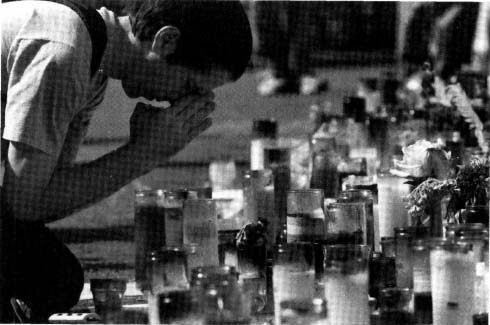
Gary Friedman / L.A. Times
This book is arriving at bookstores shortly after the events it describes. The usual reason for what passes as haste in book publishing is to “strike while the market is hot.” That is decidedly not our purpose here. Not a single business or individual, from the author and agent to the publisher, printer, and distributor is making a single penny from this book. All involved have agreed to forgo any profit and turn all net proceeds over to the American Red Cross and the New York Firefighters 9-11 Disaster Relief Fund.
We did, however, feel that the extraordinary outpouring of strength, courage, compassion, and generosity that has emerged from this tragedy has forged a powerful sense of community and connection that cries out for documentation. We believe that these stories and the thousands of others that they represent are a clear and unmistakable announcement of a deep and significant new chapter in our history.
We believe that when people look back on these events later, the greatest impact will come not from the war on terrorism itself, but from the considerably more subtle and powerful changes to the human heart that are sweeping across the globe. When trying to capture in words the power of that change, participants have routinely referred to an extraordinary “coming together.” It is, in a very real sense, the beginning of a true coming together, an awareness struck deep in the heart, that all of us, from every land, every race, and every religion, are truly in this together.
Stephanie Kriner
This terrible tragedy has touched all of us in a permanent way. America’s spirit, our liberty, and our national security have been attacked. Unfair and inexplicable, the events have created an extraordinary imprint on the mind, the body, and the spirit of a family, a community, and a nation.
America has been changed forever, but our sturdy foundations are unchanged. In the midst of the overpowering grief that envelops us all, the sadness, the loss we feel, there is strength, and there is unity. After all, America is built on an idea—of freedom and community spirit.
The resilience and dignity of Americans is renowned. In the midst of so much grief, America has pulled together. The American Red Cross is privileged to serve the American people at this time of great human need—and provide a concrete way for people to help themselves and help each other.
Everyone is asking, “What can I do?” There is much to do in the weeks and months ahead. Reach out to your neighbor, console a grieving friend, give blood, volunteer in your community, or make a donation to your charity of choice. Most of all—sustain this spirit of America at its best.
This is a time for compassion. Religion, heritage, culture, language differences cannot divide us. The Red Cross requests that community members express their feelings about this tragedy in ways that respect all humanity, regardless of how people look, speak, or worship. We condemn all acts of violence, terror, or discrimination and appeal to everyone in our country to join in our humanitarian efforts during this time of great national emergency. America will heal, and we will be stronger.
Dana Moore
I shall pass through this world but once. Any good that I can do or any kindness that I can show to any human being, let me do it now. Let me not defer or neglect it, for I shall not pass this way again.
September 11, 2001 changed us forever. Images fill our minds, hearts, and souls—planes crashing into the World Trade Center, the Pentagon, and the fields of Pennsylvania, towers crashing down in Manhattan, thousands of innocent people buried in the rubble … tears shed … courageous firefighters, thousands donating blood, millions of dollars donated to relief funds, prayer and candle vigils, e-mails of comfort circulating around the world, hands held … tears shed … our own attempts to reach out to complete strangers, and pull and pull closer to loved ones, even if they were thousands of miles away, saying “I love you” over and over again.
Words cannot express the deep feelings of sadness we feel knowing so many precious lives are lost. Nor are words enough to convey the feelings of despair we are experiencing as we realize that human beings can be filled with so much hate. We wonder how we can ever make sense of the lives lost, the devastation, and the power of hate. Can we ever trust again? Are we to live in fear? Can we get to a place where the horrific images and imaginings of more to come aren’t the last things we think about before falling asleep?
We may not be able to find the words to explain the unexplainable, but we can remember and honor the words and deeds of thousands of people—the passengers on the airplanes, our firefighters, rescue workers, police, medics, the victims’ loved ones, strangers—who not only have brought light into such darkness, but have found ways to shine because of the darkness. It is in the spirit of that honoring that this book has been created.
In these pages, you’ll meet folks like William Harvey, an undergraduate at Julliard who, offering the only thing he could at the time—his music—brought not only a little comfort to rescue workers, but new awareness to his own life. You’ll read the story of Larry Hawk, head of the ASPCA, who put aside his own grief over his sister’s death in the attacks to spearhead a movement to rescue abandoned pets at Ground Zero in New York. You’ll meet Omar Tisdell, an American of Palestinian descent, who is searching for a nonviolent solution to the cycle of hate. And flight attendant Cindy Bahnij, who found a special way to honor her friends who lost their lives in the crashes. There’s also the story of New York firefighter Kirk Pritchard, who, despite having a fractured spine, continued searching for his trapped brothers and sisters. Some special kids are here, too, like Annie Wignall, an enterprising thirteen-year-old who at age eleven started a nonprofit that gives personal care essentials—soap, shampoo, toothbrushes—to kids in need. When she heard of the events of September 11, she found a way to expand her delivery network to include the children of victims.
Ultimately, it is these heroes and many others whose stories must be told, retold, and cherished. For it is these people who reflect the true spirit of humanity through unconditional love. It is these people who give us hope and empower us to move past numbing fear and to take positive action. It is through their selfless example that we can find our own courage to give. And that, I believe, is the key, for it is in giving to others that we will find the healing we all are seeking.
It’s not enough to read these stories and admire these folks’ heroic actions. Each would tell you they don’t consider themselves a hero, only an ordinary person like you or me doing what he or she could to help. They serve as role models for each of us, inspiring us to find our own courage to take action.
For some, the courage to give means donating money to a relief fund even when there aren’t extra funds to give. Like the woman who signed over her unemployment check and the children who have emptied their piggy banks. For others, it’s organizing a fundraiser and getting others to help raise money, like the teenage girls in Virginia who started Wash America, washing cars to raise money. For some it’s hands-on help, like the people who drove hundreds of miles to help at Ground Zero. Or the New Yorkers who offered their services for free, such as Caren Messing, a massage therapist you’ll meet in this book, who gave rescue workers massages during their breaks, and Texans who brought thousands of pounds of barbecue to serve the workers.
Those people whose giving style is hands-on may be feeling frustrated right now. We’ve been told no more volunteers are needed at Ground Zero. May I suggest that it is the perfect time to think about your own community? Babies still need rocking, at-risk teens still crave mentors, tutors are still needed in schools, seniors still want companionship, those in hospice care still require our love. The needs go on and on. Call your local volunteer centers and offer to help. Or check out the volunteer Web sites in the Resource Guide at the back of this book. All you have to do is get on the Internet, type in your zip code and interests, and you’ll find volunteer opportunities within ten minutes of your home.
For others, finding our courage to give is about brainstorming other ways to help, creating models for making a difference, and offering suggestions to those who can make them happen. This last giving style happens to be mine. For the first forty-eight hours following the tragedy, I was numb, my heart filled with sadness, fear, and anger. Suddenly, I recognized what I was experiencing as no different than when I was diagnosed with multiple sclerosis in 1991. But now, it was our world that was diagnosed with a threatening disease. I knew from my battle with MS that only when I began helping others did my own healing begin. This situation was no different.
Realizing this, I had a vision of a book that honored our unsung heroes who put their own pain aside long enough to reach out and help another person and discovered the beginning of their own healing in the process. I would donate my royalties to the American Red Cross and the New York Firefighters 9-11 Disaster Relief Fund. The book would recount some of the miracles that occurred at a time of urgent need—thousands lining up to donate blood, friends and neighbors filling trucks with medical goods, clothes, and other supplies, people lighting candles, sending prayers and money—and ultimately this book would motivate each of us to act. I immediately called my agent, Jim Levine, and my publisher, Conari Press, and they both shouted, “Yes!” I also recognized I needed lots of help, and called upon Brenda Welchlin, an accomplished writer, and Karen Frost, my publicist and “Finding Your Courage to Give” workshop speaker and facilitator, to donate their talents to the project. Again, another resounding “Yes!” America, September 11: The Courage to Give was born. Since then, everyone involved in this process—from my collaborators, agent, and publisher to the distributor and printer—have agreed to forgo all profits so that the maximum amount can be donated to these worthy causes.
We have seen buildings fall, but spirits rise. This is our monumental chance to rise to the occasion, like phoenixes out of the still-smoldering ash, to give new life to compassion and create new lives for ourselves as people who help other people. May the compelling stories you’re about to read, the compassionate people you’re about to meet, be a source of comfort, inspiration, and healing. May they motivate us never to forget September 11, 2001, and to choose to be changed by love, not fear. May we find our own courage to give so we may understand that true peace begins within each of us.
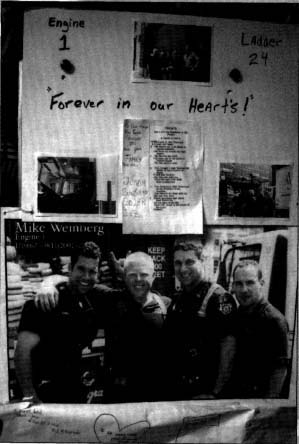
Milwaukee Journal Sentinel by Mark Hoffman
The clothes I wore around Ground Zero last week are piled in a corner of my hotel room, crowned by the hospital mask I breathed through for days. They stink of smoke and death. So did I, until I took two showers.
As a former police reporter, I am more inured to tragedy than most people. I have been to my share of murder scenes. This is different. The trauma here comes in waves.
On the way to New York, I passed electronic highway signs stating that New York was closed. The whole city. Closed. Who would believe that New York could be closed with the abruptness of a school during a snow emergency?
As I drove on, I thought of Lt. David Chong. Chong is a New York police lieutenant who was a keynote speaker at a Midwest gang conference two weeks ago in Milwaukee. I spoke to him for just a half-hour, but he is one of those dramatic personalities who make an impression even in the briefest of meetings.
It was devastating to imagine someone so vibrant losing his life this way. For three years, he had risked everything posing undercover as an Asian gang member. He received countless death threats. But he made it through.
Now I wondered whether he was still alive. The officials who brought him to Milwaukee—the Great Lakes International Gang Investigators Coalition—were wondering the same thing. It later turned out he had been hospitalized with a concussion. But I wonder: How many David Chongs were among the victims?
In New York, I made it past three sets of barricades and approached Ground Zero. The smoke and silt covered everything—cars, streets, people—in a ghostly blanket. The burned hulls of squad cars were abandoned on virtually every corner. Charred papers or soda cups remained inside some of them, images of lives interrupted.
Emergency vehicles zigzagged everywhere, dodging soldiers and rescuers who were trudging around with frozen faces. The smoke chapped my lips and gave me a lingering cough.
Ground Zero was a looming mishmash of mountainous rubble. There are thousands of people in there, I kept reminding myself. Thousands of people who just vanished, turned to dust.
A friend asked if I took pictures of the area around Ground Zero.
Would you take a picture of hell?
When I walked into a firehouse, another stranger in the haze, the exhausted firefighters, just back from digging at the World Trade Center site, offered me food. I can’t possibly take your food, I told them. They insisted. I refused. After the fifth firefighter offered me food, I gave in.
Firefighters are used to helping people, not being helped. The latter makes them uncomfortable. They invited me to spend the night at the firehouse, watching their rescue efforts and hearing their stories. Firefighter Jamal Braithwaite dragged a mattress into a room for me and made a comfortable bed, without being asked. Everyone takes care of everyone in Ground Zero.
The following morning, a newspaper report said a child’s hand was found clutching a doll. A man and woman were found still holding hands, their wedding rings intact. The woman’s head and the man’s legs were missing.
As I read the newspaper in the firehouse, the emotions I had been holding back started to surge in my chest, threatening to overtake me. Firefighter Rick Saracelli was watching. He was feeling it, too. We forced the emotions down together. The brief connection helped.
As I left the firehouse in the pouring rain, a firefighter came rushing over with a pair of donated hiking boots to replace my running shoes. I can’t take those, I insisted. He said they were too small for any firefighter’s feet and motioned over to the mountain of donated goods they would not be able to use. Strangers had given them everything from toothbrushes to contact lens solution to T-shirts five times too small.
I took the boots, mostly to pacify him, and then set them down in a corner of the kitchen. A few minutes later, he spied the boots and asked why I wasn’t wearing them. He looked hurt, so I finally put them on. They gave me a plastic rain poncho, too.
The Salvation Army, serving reporters and rescuers alike, gave me a warm cup of coffee and a pair of orange slickers not far from the station. A block later, a teenage boy offered bottled water. I took one; he said to take two. I stopped to speak with a pair of firefighters from Rhode Island whom I had met the day before, and as I was leaving, one of them shoved a pair of gloves into my hands. He didn’t want my hands to get cold. I hadn’t mentioned being cold. He gave me a flashlight, too.
As a reporter, I am used to being treated with animosity or aloofness at crime scenes. But everyone was in this together.
I looked down and smiled. Just about everything I was wearing had been given to me by a series of strangers. Without them, I would have been soaking wet and very cold.
After about 48 hours with minimal sleep, I needed to get someplace where gray dust wouldn’t eat at my lungs and people weren’t talking about picking up pieces of other people’s heads. I had $6 in my pocket but needed to walk almost 50 blocks on almost no sleep to get to my hotel.
A state trooper guarding an intersection stopped me, asked me if I wanted some coffee. I thanked him.
Not far away, restaurants like Olive Garden and Hard Rock Cafe had closed to the public, and were serving rescuers for free.
Another few blocks and I was stopped by two young women who peppered me with questions. How could they help? They had heard there were no more volunteers needed because there are so many offering their services.
I imagined the firefighters heading back out to dig, covered with gray dust, talking about body parts. What could the two do? I told them to wait a week and then go down to Ground Zero and help the firefighters.
Exhausted from sleeplessness and emotion, I hailed a cab. I only have $6, I told the driver. Please take me as close to my hotel as that will get me. He took me all the way there. If the fare goes over, the New York cabbie said, don’t worry about it.
Everyone is taking care of everyone now.
The New York Fire Department’s Engine 54 sent fifteen men to the first call for help. None returned. The forty-five fire fighters left behind worked 24-hour shifts and returned to the attack site on their own time to search for their comrades. While they were gone, folks in the neighborhood built a tribute—with food donations, flowers, cards, candles, American flags under the photos of the station’s missing firefighters.
Ira Rosenblum
On September 16, 2001, 1 had the most incredible and moving experience of my life. Juilliard organized a quartet to play at the Armory in New York. The Armory is a huge military building where families of people missing from the disaster went to wait for news of their loved ones. Entering the building was very difficult emotionally, because the entire building, the size of a city block, was completely covered with posters of missing people. Thousands of posters, spread out up to eight feet above the ground, each featuring a different, smiling, face.
I made my way to the huge central room and found my Juilliard buddies. For two hours the three of us sight-read quartets. I don’t think I will soon forget the grief counselor from the Connecticut State Police who listened the entire time, or the woman who listened only to “Memories” from Cats, crying the whole time.
At 7 P.M., the other two players had to leave; they had been playing at the Armory since one in the afternoon and simply couldn’t play any more. I volunteered to stay and play solo, since I had just gotten there.