ISBN: 9781483539188
For LaRonnee,
You give me a reason to stay.
This is written on behalf of all of us who know;
Yet choose to NOT forget
And
For those, from both sides, who never made it home.
Heinrich (my brother)
Katja
Jürgen
Helmut
Andreas
Petra (with who I was in love)
Dago the dog and Dago the rat
both of whom loved me.
AND
Those names that will never be spoken in the light.
Special thanks to you who uttered those words
“Sure I’ll read your manuscript”
Barbara Mackenstadt, Wayne Parsons, Jarrod Ramsey-Lewis
and Rhea Reinbold.
They saved me from the “Ridicules”
of continuously misspelling “Ridiculous”.
Without them this would have remained
an exercise in mental health.
Thanks to Jerry Garcia and Gretchen at Blue Mountain Collective
for being so very veteran friendly
Thank You Rabbi John Sherwood
I would be much more of an idiot had I never known you.
Cover art by Stephanie Whitney
FRATRIBUS SINE PARI
My World
Eleven Bricks high,
Eight and a half bricks long,
Four and a half bricks wide,
This is my world.
Three and a half paces up, three and a half paces back
A bare hundred watt bulb,
Two buckets and a sleeping mat.
This is my world
A large yellow rat, my one friend
I share all that I have with him
Eventually a meal; He nourished me,
This is my world
No contact with the outside,
A guessing game
Identifying the sounds from beyond the Steel door.
This is my world.
My Day and My Night
Controlled by my captors,
Time is no longer real
This is my world
A familiar smell of morning
Creeps in, telling me another day has broken
I imagine the sound of birds singing. Reflect on the home I will never see
Still, I take solace that I did my job. I kept my secrets
This is my world
My world, I have become familiar with it,
I even find rest in it,
At least, in here, I am safe from interrogation,
Exempt from beatings.
Most of the time.
All that is required of me is to survive… “Stay Alive Jinnik”
A Soldier’s Code to live by; A soldier’s code to die by
Duty and Honor, God and Country
This was my world………………………………I DID SURVIVE
Gideon D. Asche
Hauptmann. BND
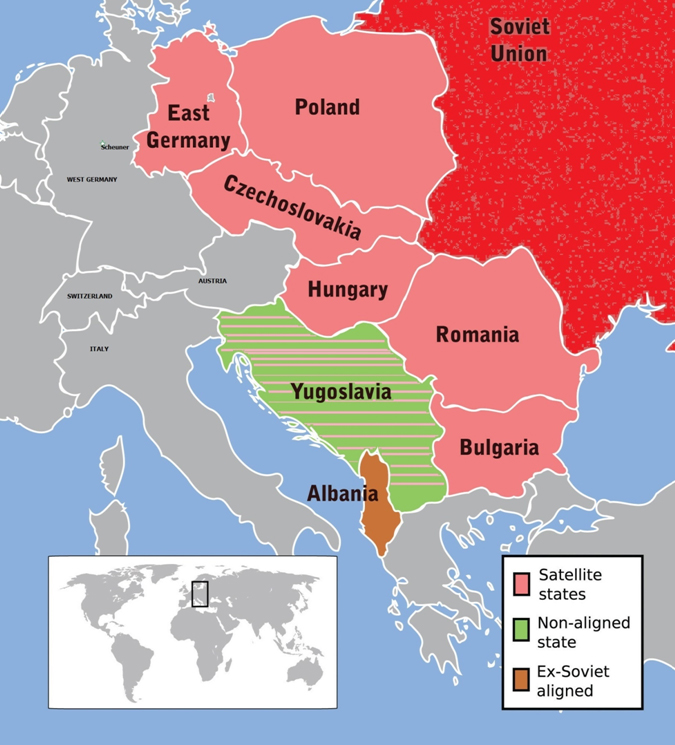
Table of Contents
The Last Chapter of the story
JINNIK
January 1979
Recruited
Contract Civilian
The Operator Course.
Pirogi: my new best friend.
The Exercise
On the run
1330hrs day one
Sleepers
The Scheuner
Special Reconnaissance Team 31
Team Assembly
Settling in
First trip
Section 2
Ranger Farts
Ethiopia
The Rouse
Deutsche Democratic Republik
Moskva – Moscow, USSR
Going Greek! Oh my!
Screwdriver blues
Delivery
Snow Graffiti
Alte Jakkob
Section 3
My Enemy, My Brother
“Mission Calm”
My Enemy
My Brother
Summer 1981
Zugeuner (Gypsies)
The Audi
Turnu Severein: “The Iron Door”
Aufweidersehen Kleine
Banker busted
Section 4 1983
The Wedding
The Devil Cat
Georg & Atzel Dorf
Helmut
Stand Down - Spring 1984
Memorial Day
Noodling
Bar Fines
0500hrs: Boooom!
Hawaii
Section 5
Pepper eaters press
Bug school
Angels and Pears
Katie Los
Prague, CSSR
Onkel Lewie
Pig car
Conrad
Bulgaria
Section 6
Copenhagen Marriage
Christiania
Man Down
Mossad
Tattoos
They issue you a wife?
Amsterdam
God Save the Queen!
Team Approval
Stara Zagora
Toothpaste
MaGrath
Circumcised?
Lost ones?
Big Bird Jews.
Weapons to Palestine.
Wedding ring.
First Sanction
Target of opportunity
Debrief
Section 7
Sodium Pentothal.
Mission Execution
Going swimming – The Boatel
Back to the grind
Chocolate
Púrodad the Great
Frozen diesel
Kaufhaus incident.
Choir?
Crisis on the Border
Fritz & me
Kal’s last stand
The End.
1st Airborne: Arnhem, Holland.
Boblingen Conference.
One last fling with Mossad
Positive Target Identification
Black October 1987
0917hrs
The Ride
Water
Smokey the maggot and Yogi the bear
Chemical interrogation
DAGO
The UH-1H daily inspection
Another Goodbye
Cadillacs have them!
Yogi my Brother
Authors note:
“What happened to Heiney?”
The Slides
The Last Chapter of the story
In late September of 2013, I went to visit my “Crazy Uncle Gideon”. No one ever called him crazy out loud or to his face; mainly because he scared the shit out of most people. Crazy was not accurate anyway. He was a little odd, a little bitter and maybe a little sad, but not crazy. Not in the way people thought. He just used it to keep people away from him.
Uncle Gideon sent me a text message a few days before asking me to drop in over the weekend; he had something for me. He was the kind of man you heard stories about but never suspected they might be true. When I entered his home I was greeted by Bearchen, his 125lb Great Pyrenees who was, for lack of a better description, sitting guard over Uncle Gideon’s body. My favorite uncle was just sitting on the couch in front of the picture window as if he was watching a soccer game taking place in the meadow outside his house. He loved World Cup Soccer.
He was dressed in what I think was his original uniform, shiny silver Jump Wings with a star in the middle on his left breast and forest Green Beret perfectly perched on his head. I have never seen a pair of boots shine like the ones Uncle Gideon had on when I found him. A half-finished water glass of white wine sat on the coffee table next to a small brass Marijuana pipe that, in his old age, Uncle Gideon was quick to declare: “I’ve had this bowl since I was thirteen years old”. Followed by a quick calculation of how much older the pipe was than his audience.
On the floor next to his foot was a box similar to the ones in which copier paper comes packed. A sticky note written in Uncle Gideon’s hand was attached. All it said was “it is finally finished and I am tired”. Inside I found this manuscript, a loaded Llama .380ACP Pistol, a shot glass, a Crown Royal bag full of old slides and a Russian Bible. The Llama was wrapped up in a note written in German. The signature was a heart with a “P” inside it. It looked like a woman’s writing.
The paramedics arrived and they agreed he was in fact dead and had been so for at least 18 hours; Rigor Mortis had already passed. In Uncle Gideon’s inside pocket were two passports, one Maroon with the seal of the United States and the word “Official” on the cover. The other was green with the words “Bundes Republik Deutschland” across the front cover. Both had the same picture of my uncle in his twenties and both had a name I had never heard before. For lack of a better Idea, I called the local VFW office and asked how to get an Honor Guard for my uncle’s funeral. They immediately said they would take care of it and offered to help making notifications. On an odd chance someone cared, I called the German consulate in San Francisco and gave them the name on my uncle’s passports along with the German passport number and let them know he was deceased.
Uncle Gideon’s funeral wasn’t planned as a big affair. A week after he died we put buried him in the Veteran’s section of the small country cemetery near his house and had planned a simple graveside service. The only attendees we expected were my mother, the Honor Guard from a California National Guard Unit and Bearchen1 who sat at my feet for the entire thing. The only time the old dog even raised her head was when the volleys were fired.
I’m not sure if I was actually surprised when the white Mercedes SUV pulled into the cemetery. Out stepped two older men and four Germans in grey dress uniform with maroon berets; they were Fallschirmjäger2. The German officer exchanged formalities with the Commander of the Honor Guard then the American officer, accompanied by the German, approached my mother. I could see the young National Guard Lieutenant was puzzled and not sure how to proceed.
He introduced the German officer as a Major, attached to the German consulate in San Francisco. The Major asked permission to drape a German military flag over one corner of the coffin. He continued that his men requested the honor of assisting in carrying the coffin from the hearse to the grave site.
My mother was speechless so I answered in the affirmative for her at which time the German officer snapped to attention, saluted us, did an about face and began speaking soft orders to his men. What began as a quick “let’s get him in the ground and go shoot Tequila in his memory”, turned into what looked like an international state funeral.
After the military service both civilians stepped up to Uncle Gideon’s coffin where they placed a black, red and gold flag with an eagle prominently displayed in the center. I heard a gasp from the National Guard lieutenant and saw that both of the German civilians had drawn side arms and were holding them crossed over the flag they had just draped over Uncle Gideon’s coffin. I suspected these were not “ceremonial” weapons like the honor guard carried. The two men spoke what sounded like a prayer but it wasn’t German then re-holstered their weapons, stood at attention, and saluted.
One of the men, who wore a Yamaca, approached us and instead of talking to me, he knelt down to Bearchen and spoke to her in a language I did not recognize but that she apparently did. When he stood up he looked me in the eyes and spoke, in English. “You will care for her…Yes?” I nodded and the man reached down, stroked Bearchen’s head saying “animals always loved him”. He wiped a single tear then returned to his place in line with the soldiers. Both civilians along with the German Major approached us after the American flag was presented to my mother. The Major shook my mother’s hand. All three stood at attention as the man with the Yamaca spoke.
“On behalf of all of us who know… yet choose to NOT forget.” He presented my mother with the German military flag, folded so that only the black was visible, all three saluted and left. We never got an opportunity to ask what would make Germany send an honor guard to my uncle’s funeral. I have since read the following manuscript and I have a hunch one of the German civilians would have answered to the name “Turk”; if I had known to try it.
A few days after Uncle Gideon’s funeral Bearchen went to sleep on my front deck and just never woke up; I don’t think she knew how to live without him. She was his only real friend for the better part of fifteen years. I had her cremated and I spread her ashes over my uncle’s grave. They belong together. I never really knew his story or his pain or what he meant was finished.
A glass cyanide capsule was found between Uncle Gideon’s teeth, but it was his past that actually took him in the end. No one ever figured out where he got a glass cyanide capsule. Personally, I think he saved it for years. It turned out he had Pancreatic Cancer and would not have lived more than a few weeks anyway…
He never told any of us he leaving.
The following is his story as he wrote it… And as he lived it…
Uncle Gid’s odd spellings and bizarre capitalizations are included for your entertainment
Harpo J.
Section 2
Ranger Farts
“So why the hell didn’t you blow a Ranger Fart? I mean if there was ever a situation that warranted a Ranger fart that was it”.
“I was asleep, the damned thing just slipped out!”…….
“Well I heard it didn’t just slip out, it was more of an eruption than a Slip”.
Heinrich laughed. I spent an entire month being subjected to abuse of this kind after we got home from that first trip. I was just thankful that Andrea limited her narration of our final night in Hungary to the fart and left the other parts out.
“Ranger Farts” got their name exactly where it sounds like; from the US Army Rangers (RLTW48). Fear and excitement will affect a man’s body in many different ways. One of them is flatulence. I’m sure you have heard of a person having the shit scared out of them. Well it is a distinct possibility and it is common for a person to develop gas when they are subjected to intense fear.
There was an instructor at Ranger Indoctrination Program (Ranger School) who served with Lima Co. 75th Rangers in Viet Nam. SFC Ruben Longoria told of being on a Long Range Reconnaissance Patrol at the end of the Viet Nam conflict. His squad took cover because the Ranger walking point thought he saw something. He was right; the Rangers had crossed paths with a platoon-sized element of Viet Cong.
Being a recon patrol meant they were not equipped or manned sufficiently to engage an enemy element of that size. They took cover with the intent of calling in air support as soon as the squad was clear of the impact area. Charlie walked right up where young Private Longoria was hiding and nearly stepped on him.
Longoria said even after the enemy soldier walked away that he had gas cramps so bad he was sure he would expel it with a rumble giving his position away subsequently getting he and his squad killed. He overcame the situation with shear genius by grabbing one ass cheek and pulling it to the side far enough that when he expelled the excess pressure it gave out a gentle “Pffffffeeeeeeeft!” rather than the customary report.
The “Ranger Fart” was born out of desperation in the heat of combat; it had an honorable lineage and a proud history. It was my privilege to introduce it to my German colleagues.
Janosh was requesting substantial amounts of printing equipment and Rubles. One of his contacts in the Ukraine had a direct line into the local police making it possible for Janosh to “purchase” the blindness of certain local authorities. If nothing else, Janosh was an opportunist when it came to exploiting the greed and corruption inherent to every branch of the Soviet government. The result was a frenzy of travel into Hungary that put everyone on the road.
By winter of 1980, every member of my team had a minimum of five operations under their belts. In a normal year, we would all be just about to make our first trip but the success of the first trip Andrea and I made and the need to move a lot of cargo before the snow hit gave Manfred no choice but to send us out early.
There were operators on AG-27 who had been in the field for a year or more and had less travel time than I did. In just a few months, I had completed seven trips to Hungary including two transits through Yugoslavia. We ran out of border crossings to use making it necessary to take a break from travel into Hungary. Another team would pick up the slack in Hungary and we would start working a different country.
It was unusual to make so many trips into one area in such a short time frame, we usually tried to space trips to the same area long enough apart to make sure it would not look odd at the border. Counting the ones on the Austrian border and Yugoslavia, Hungary had nine good frontier crossings we could use. Tourism was good to Hungary and they got a taste for the benefits of having an influx of foreign currency. It didn’t take a rocket scientist to figure out that the Hungarian authorities were becoming progressively less strict on border controls so Hungary would become a staging area for operations into Romania and Czechoslovakia (CSSR).
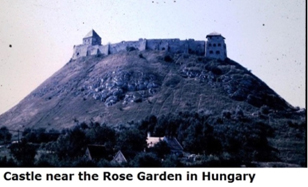
On about the third trip to see Janosh I needed to exchange currency so, we stopped at the Citadella and I went looking for an exchange office. Currency exchange in Eastern Europe was a racket that everyone benefited from, communist and dissident alike. You could go to any bank or rail station and change western currency into Forint49 at the official exchange rate, or you could find one of the unofficial currency exchanges and get about 20% more Forint for your Dollars or Deutschmarks. The command staff discouraged using unofficial exchanges but it wasn’t forbidden. I went into the Hotel at Citadella and found I was looking at a line of about 15 tourists waiting for the Exchange office. I decided to come back a little later rather than stand in line so I went for a walk out to the monument. At the base of the statue itself, there were six or eight small booths where various local products were being sold, peppers, needlework, honey and nuts.
There was a character right out of “Fiddler on the Roof” selling walnuts in jars of honey while his partner was running a “Three Card Monty” with walnut shells and a kernel of corn. I promptly lost $15 US in ones to the “Monty”. It wasn’t that I thought I could beat him but I was so intrigued by the speed and agility of the old guy’s hands it was worth $15 just to see it up close. Just for future reference, it doesn’t matter what country you are in, it is impossible to beat the Monty.
While I was standing there, I noticed an Austrian tourist buying a jar of nuts packed in honey, she paid with hundred Schilling notes but the vender gave her change in Forint. I couldn’t tell what exchange rate he gave her but I figured it was worth a try. I already decided I was going to buy a jar of walnuts and honey for “Tante Milli”, an old woman who lived on our street. She made it a practice to bring the team house some kind of baked treat or homemade preserves every couple of weeks. I think she was just lonely for her own two sons and husband who had died forty years before in the Great War.
Tante means Aunt and is used by Germans as a sign of respect and affection for any older woman. With Millie it was more like she really was an aunt or even a grandmother to some of the team. Millie was also one of the church volunteers who worked in the sorting room a few days a month so there wasn’t any security issue with her being in the team house.
I knew Tante Millie liked walnuts and she used honey in her coffee making it a perfect gift plus I knew that the same nuts and honey would end up in some delicious example of Millie’s baking prowess and more than likely on our table at coffee some afternoon in the near future. I selected a large a jar of half-walnuts packed in honey then fished a hundred Mark bill out of my pocket. The nuts would cost seventy Forint, or about two marks, so I knew the vender would want to give me Forint as change rather than Marks. The question was at what exchange rate. The official exchange rate was just about forty to one so I should get a little less than 4,000 Forint in change if he gave me the official rate and up to 4800 if the rate was good.
The vendor gave me 4650 Forint in change, a much better rate than I expected. Still, I asked the vendor if he couldn’t do any better. “For a Hundred marks? Forget it, make it a thousand or more and we can talk”. I didn’t have any need for that much Forint but the vendor’s response let me know he was a man who might be a useful acquaintance in the future.
This was actually the first time Heinrich and I had traveled together since the exercise phase of training. We both made several trips with other operators but never both of us in the same vehicle so we were really having a good time. Heiney and I were beyond friends by that point and I felt like I had grown up with him. Hungary was becoming easier to get into every day and this trip would be a vacation compared to other places we would be going in the near future.
We went across at Kormed, a medium sized border crossing between Austria and Hungary and then made our way to Budapest. Heinrich drove from the Austrian border, which gave me a chance to take in the sights. Somehow, I always drove on prior trips and missed much of what Hungary had to offer. We were stuck in traffic in a small village north of Lake Balaton when I caught the sight of a shadow out my window, a micro second later I identified the threat as an aircraft that appeared to be crashing into the street. I hit a personal high with a pucker-factor50 of about nine and shouted, “Get Down…. Get Down” as I made a dive for the floor. Just about that time a Stork made a hard left bank in front of the van followed by a perfect two point landing on a nearby roof. “What the hell is wrong with you?… You scared the shit out of me…. we almost hit that car!” I tried to explain that it was instinct. I thought we were about to be mashed by an airplane. Heinrich was not impressed and I somehow knew he would be sure to share the episode with anyone who needed a good laugh back at the Scheuner. “I gotta say having an Ami around is entertaining”. I shot him the Bird, in stereo.
The Stork was standing up on the roof of a nearby building holding its wings out as if he was drying them in the breeze. I felt a little better because the beast was the size of a small aircraft. I pointed it out to Heiney and said “it’s big enough to be a plane”. Heiney grinned and confided in me that he had an almost identical reaction the first time he saw one of these giants. I finally understood the children’s stories about Storks delivering babies when I actually saw one.
Winter was about to let loose on Europe, few western tourists would use campers in the winter as most campgrounds were closed. Travel in campers would be too risky for three or four months each year. Consequently Werner was constantly working on some new way to breach border security and continue to operate during the winter months. When we did make a winter trip the vehicles were much smaller and carried much less cargo so we focused on financial support during the winter. We could smuggle a year’s worth of cash in during the winter and worry about other items when the weather broke.
Ethiopia
Once the snow set in across Europe, if we weren’t actively involved in transporting cash, we would spend most of our time either repairing equipment, helping Werner build some new system or working with the relief organization.
Ethiopia was in the grips of famine and the Communist government that held power was making it almost impossible to have any positive impact working through official channels. A small German Pentecostal church from the BFP51 was trying to get relief goods across the border from Djibouti to Ethiopia. We were asked to give them a little unofficial assistance which we gave both in the form of labor preparing shipments and technology for moving contraband.
The plan was to send a forty-foot container from Bremen to Djibouti by ship. A small contingency of relief workers would fly down and meet the shipment, get it through customs and then take it across the border into Ethiopia for distribution. Customs would be no problem as long as nothing was obvious and the customs agent’s appetite was quenched. The low standard of living in that part of the world made it possible to satisfy a customs agent or cop or just about any other government official with small bundle of twenty-dollar bills.
A soup manufacturer in France donated four and a half tons of dried vegetarian vegetable soup for the Ethiopia project. It was the over-fill that spilled out of the packaging machines on the production line. Collected in troughs, it was normally recycled into some kind of animal feed. The only reason it wasn’t recycled back into soup was the fact that it left a controlled, clean environment when it spilled out of the machine and could not be sold for human consumption. There really wasn’t any reason it wouldn’t still be edible so the plant manager had it collected and placed in plastic drums in the hope he would find a way to get to someone who needed it.
The soup donations were shipped directly to the Church in Märchenfritz where Georg was youth pastor. The company suggested we at least sift the powder and make sure nothing ugly fell in. Georg converted the downstairs meeting room into a soup sifting operation. After a week of sifting they ended up with six pallets of five-kilo bags of dried soup and a small bucket of cigarette butts and various other things they sifted out. The same company made the extra step and donated another nine tons of elbow macaroni which was also packed into sacks and paired up with a bag of soup creating “just add hot water” meals for a starving family. All we had to do was figure out how to get it into Ethiopia.
The fact that it was “vegetarian” soup proved to be key to getting into Djibouti. The customs official who was making the arrangements was a Muslim and although it didn’t bother him to allow a shipment to enter the country un-inspected or take a bribe; he was adamant about there being no “Swine”. He knew the shipment was relief goods and was happy to profit from it as long as there was no Swine flesh in the food. From Djibouti it was a short trek to the border and on into Ethiopia. It was the crossing into Ethiopia that would be tricky.
Werner was recruited to come up with a way to package and ship almost 14 tons of soup and noodles. We got a break with the customs official in Djibouti but had to figure out how to get it across the Ethiopian border. Ethiopia posed less of a contraband issue but there was a distinct possibility that the entire shipment would be confiscated and split up by the border detachment. Food is of great monetary value in a country that is experiencing famine.
Werner was convinced the only way we could ship the soup was in wooden crates. He built an example of a rigid wood crate with a waxed-cloth lining. There was no way of knowing what kind of equipment would be available at the delivery point so the crates had to be small enough for two men to carry. The result was a plywood box approximately three feet square by two and a half feet tall with rope handles on two sides. Including the weight of the soup and noodles each box would weight just about 235lbs, light enough to move by hand and all that needed to be done for distribution was to open the top and hand out the pre-packaged bags.
The volunteers from the church in Märchenfritz were packaging four plastic bags of noodles and four bags of soup inside a used coffee sack. The sacks would make it easy to carry and could later be used for all kinds of things like clothing and shelter. Even the crates were designed so they could be dismantled and the wood and screws reused, basic tools were included in each crate. I was impressed with the care and planning that went into the relief transport. It ran like a good military operation.
The Rouse
The one issue that had not been resolved was the rouse. Driving up to the Ethiopian border with a truckload of food was a recipe for getting yourself killed and the food stolen and sold on the black market. We had to figure out what kind of cover story would be most effective for the border. We spent two or three evenings sitting at the Ratzkellar52, an old pub in the neighboring town of Gedern. We would spend hours just throwing out any idea we could come up with. The big problem was every good cover we came up with, left no legitimate reason for the guard to be bribed.
It sounds odd, but if we labeled the crates as “Building Materials” for example, the cargo would more than likely be safe from being plundered at the border but… if it was really building materials there would be no problem with a border inspection and it would look suspicious to try to bribe a guard for entry. On the other hand if it was marked as anything resalable or edible, the odds of getting it past a greedy pack of Ethiopian frontier guards was very low.
The Ratzkellar was owned by the Fuchs family and had been in the family for just about 400 years. In fact, every one of the people at the table, besides Heiney and me, came from an old established family in the area. Werner’s family had been there for over 350 years. He and Herr Fuchs had known each other since childhood, Werner’s father knew Fuchs’ father and his grandfather knew Fuchs’ grandfather and so on back to about seven or eight Greats before grandfather. This was a tight group with a long history as a social unit. All of the families represented there had known each other for more than two hundred years.
The entire area was a small Fiefdom back as far as the 13th Century and had a history of surviving the onslaught of invaders who ransacked Germany over the centuries. It was an agricultural area adorned with orchard covered hills and farms producing various foodstuffs. From what I could glean from their history, the citizens learned very early that they could barter themselves into a relatively harassment free existence by meeting invading armies with the offer to help supply the occupying force with food in exchange for letting them look after their own affairs without interference. Even in WWII, the farmers and shopkeepers were reluctant to take part in the “Final Solution”53.
Herr Fuchs had a brother that was about ten years his younger. Benjamin Fuchs was a Jew. He wore the Star of David openly around his neck and sported a Yamika. Herr Fuchs or Otto as he was known, on the other hand, was a tongue talking Pentecostal, as were the rest of the volunteers from the church in Märchenfritz. Otto Fuchs and Werner were both Waffen SS soldiers in the war. This created a conundrum I really couldn’t figure out. How did an SS guy end up with a Jewish brother and how did the Jewish brother survive the war? I finally got up the balls to ask one evening at the bar and got the story first hand from Benjamin Fuchs.
His real name wasn’t Fuchs and he didn’t bother to tell me what it was. What he did tell me was that he was eight on November 9th, 193854. Gestapo kicked in his door and took his entire family; everyone but Benjamin. Benjamin just happened to be at the Fuchs family dairy where he worked cleaning up stalls to help his family make ends meet.
The reputation of the Fuchs family as a pillar of the community and having a son already in the Waffen SS made it possible for the Fuchs family to hide the boy for the duration of the war. Märchenfritz itself was the only town I knew of that, although it was in the middle of the path Allied Armor took through central Germany, didn’t look like it sustained any war damage. Märchenfritz had a knack for doing the right thing at the right time and coming out smelling like a bunch of roses.
While Werner and Otto were out fighting the war their parents were farming just as they had done in every war in the past and like every war in the past there was a shortage of labor since many of the sons, who would normally be doing the farming, were out doing the fighting. The way the Nazis got over this problem was to import slave labor from conquered European countries. Märchenfritz was supplied with about two hundred Polish prisoners, not military prisoners but farmers and laborers who were unfortunate enough to be living in an area where Hitler’s army went through Poland.
The Village included a small furnace factory that was converted to produce war material. The prisoners were required to work shifts at the factory after which they were released to the farm families where they were to work the fields and orchards. The farmers had no restrictions on how hard they could work the prisoners or how much rest or food they had to give them. The Nazis would just replace any that died. Werner’s mother told me that they actually encouraged the farmers to be cruel and that there were some families who took joy in seeing how many Poles they could work to death.
At the end of the war both Werner and Otto ended up in POW camps run buy American troops. Since they were SS, they were sent to special camps for potential war criminals. At the same time US troops from Patton’s 3rd Armor and the 101st Airborne were setting up shop in the area and commandeering homes and farms to house and feed US troops. Märchenfritz was right in the middle of all the activity and was occupied by George Patton’s tankers.
The German soldiers who were tasked with guarding the factory and labor force were nowhere to be seen when the Americans arrived and the Factory was used as a headquarters for, I assume, a brigade or battalion of tankers. I know that the commander was a Colonel because the old folks called him the “Bird”. American Colonels wear an eagle with outstretched wings as a sign of their rank.
The Polish prisoners were interviewed by the Americans shortly after arrival, after which Americans came through Märchenfritz rousting some of the families taking them into custody. They even used a few of their farmhouses for target practice. The remainder of the village was corralled into the factory while the village was used to house American troops. Werner’s wife was quick to point out that they were not mistreated just confined to the factory grounds. They heard the news that Hitler was dead from the Americans guarding them but no one really believed it.
As soon as they were ordered to move into the factory grounds the Fuchs family took Benjamin to the American commander and explained that they had been hiding him. One of the other women said they ate better in those weeks then they had eaten the entire war. She said the Americans ate first then the villagers were allowed to get in the same line and eat whatever the Amis were having that day. “It was Mitaggessen three times a day” one of them said referring to Americans eating habits of having three hot meals a day. Werner’s mom showed me an old K-Rations55 tin of “spice beef” that she said she saved ever since the war just to remember the kindness shown to her family and village.
Apparently, the Polish prisoners were quick to identify the cruel farmers, which resulted in their arrest within days of the occupation, but they also told of the way most of the Märchenfritz farmers fed and cared for the prisoners rather than work them. When Werner’s family, along with Fuchs and the rest of them were allowed to return to their homes, they were met with a pleasant surprise.
None of their homes was damaged or looted. When Fuchs’ parents went into their storerooms they found them stocked with C and K-rations. Werner’s family found a similar stash of food in their barn. The Fuchs’ and other storerooms were filled with enough food that virtually every family in the village survived on combat Rations for the entire winter after the war.
On the wall of the Ratzkellar was an old wooden frame containing a piece of cardboard box with Hebrew letters scrawled across it in two lines. It was found on a stack of C-Ration boxes in the storeroom at the Fuchs’ dairy. No one but Benjamin could read Hebrew, so no one knew what it said until Benjamin came back a few weeks later and moved in with the Fuchses for good. It was a scripture from the Torah.
“I will bless those that bless you. And I will curse those who curse you”
Not long after the occupation began Otto, Werner and two other village sons who were prisoners in American POW camps were taken out of the general population and told that they had been found to NOT be war criminals and were released. Werner said they knew some American officer had written statements in support of their release but never knew who until they got home. I got goose bumps when I heard the whole story and I was proud to be an Ami.
The “Bird” came back to Märchenfritz to visit in the mid-sixties. I saw a picture of the men with the Old Bird and noticed that the Colonel had a Star of David lapel pin. I can only assume it was his handwriting on the note. Again, Märchenfritz had done the right thing at the right time and was blessed for it.
As far as our problem with packaging the soup and noodles for Ethiopia, it was Benjamin Fuchs who came up with the solution. He said the border guards think they are taking a bribe to let some kind of contraband across so why don’t we meet their expectations? “Liquor is illegal in Ethiopia so why don’t we package it as whisky and vodka and tell them it’s headed for embassy employees in Addis Ababa. So that is exactly what we did. Robert used a hot brand to mark each crate with the mark of a whisky or vodka distillery and put Russian address labels on the main crates. We added two crates that actually contained liquor just in case the border guard was a little less Muslim than we anticipated and wanted some for himself. The Ethiopian transport went perfect and I was proud to have been part of it.
Deutsche Democratic Republik
(DDR- East Germany)
After the last trip to Hungary, Heinrich and I made a transit run to Berlin with a Xerox copier that was destined for a contact in East Berlin. West Berlin was an island of capitalism in the middle of communist DDR. A barrier surrounded it but there was an agreement to allow westerners free transit between the West and West Berlin. The Transit Highway was also one of the main highways used by East Germans so, in an effort to separate us from them; all Autobahn stops in DDR had segregated parking. Western vehicles in one area and DDR vehicles in another. They also required us to pay with Deutsch Marks at an even exchange rate although East Marks were only worth about a tenth of a Deutsch Mark.
Our only function on this trip was to drop the copier off with a woman who worked at the Danish Embassy in East Berlin. She had a White oval sticker on her car with the letters CD denoting “Corps Diplomat” and the Diplomatic passport to go with it, exempting her from ANY border control. My father always had Diplomatic Immunity so I understood how valuable this was. This woman would just put the copier in her trunk and take it on in. We were able to send five or six transports a year as long as she was with the Embassy.
On the way back through DDR I saw another car with western plates processing through the East German border, but not in the transit line, they were going somewhere in the DDR so their car was being gone over with a fine toothed comb. I only noticed because one of the women in the car was gorgeous. In spite of the hairy armpits and legs, she was still someone I wanted to get to know intimately.
Halfway across DDR we decided to stop and get a Fanta so we pulled into the next Rastplatz where we were directed by a VOPO56 to the parking area for westerners. As we were pulling in, I notice the same woman from the border coming out of the restaurant. She got into the same car, which was parked within two spaces of where we just parked, and left. It dawned on me that they weren’t transit traffic but they were still directed to the western parking area. I seemed like we should be able to use that somehow so I started chewing on it. Katja had more experience in DDR than anyone I knew so when we got back from Berlin, I went directly to her and asked if she thought we could get away with crossing the border in two vehicles, one transit and one into DDR then swap license plates at a Rastplatz. Her response was “well we won’t know unless we try. So let’s try it… it just might work”.
I went to Werner for ideas about how to change plates with as little effort as possible. It took less than an hour to come up with a system that looked like it would work. He took each plate and attached to a frame with short hex bolts so the plate looked like it was properly attached. Then he placed trim fasteners, shaped like little Christmas trees, in the frame protruding out the rear of the plate. These fasteners were the right size to match the screw holes in the bumper. To remove and replace the plate was just a matter of pulling it off and pushing the other one on. He had an alternate system using Velcro if the trim fasteners didn’t work well enough. I was beginning to think we were on to something. There were two white Volkswagen Passats that belonged to the group but were only used for local travel. They had not been modified in any way. I decided to ask for authorization to use both of them and make a trip to DDR. Katja had the experience and still had contacts in the DDR so she was the obvious choice to lead the mission. I presented my plan to Manfred and did my best to convince him I had looked at every possibility and really believed we could pull it off. He bought it, and with permission to make a dry run, we began planning the trip.
The original plan was to have both vehicles enter DDR at two different border crossings, one as a transit to West Berlin and the other with an entry Visa. The two teams would meet at a predetermined Rastplatz and change license plates with the loaded vehicle continuing into DDR. The problem with using two different crossings was timing; we had no way of knowing how long each border would take so we couldn’t come up with a way to coordinate the meeting. Without a way to coordinate and time border crossings to insure that both vehicles would be able to meet, I decided to use the same border crossing for both vehicles. If it went well I planned on getting authorization to buy two new vehicles and setting them up for DDR runs.
DDR was almost impossible to get into because of the extreme measures used on the border. A rash of escapes in the 60’s and 70’s all but closed the DDR border. Some of the Christian organizations were marginally successful in sending very small shipments in every few months but as a whole, it was shut tight as a drum. It was common for Border troops to measure the inner and outer dimensions of any suspect vehicle even going as far as to weigh a car and compare the published weight with the actual weight. If we could figure out a safe way to get goods into DDR it would be, to put it in Heinrich’s words, a real “Feather up my ass”. I never did get him to understand it was “Hat” not “Ass” and “In” not “Up”.
The test run went perfect and I was convinced that we had found an effective way to move small quantities of support into DDR. I prepared my report and set out to convince Werner that I had done my homework and covered all possible screw-ups. To my surprise Werner rolled over like a dog wanting his belly rubbed. He said he would authorize up to 75,000 DM. This would be our budget. Werner’s support made the operation a reality.
Werner and I set out early the next day looking for two suitable cars. We had enough money for a pair of four-year-old Opal Senator Sedans. Nice large trunks and large numbers of this model on the road made them a perfect choice. One was white with the other an off-white eggshell shade making one look like a dirty version of the first. Registration would be a challenge because we had to make sure whoever the registered owners were, that they had no family in the DDR. If something went wrong and the vehicle was confiscated it was a sure thing for the VOPOs to research any contact the registered owner had with anyone in DDR and those unfortunate individuals would more than likely simply disappear.
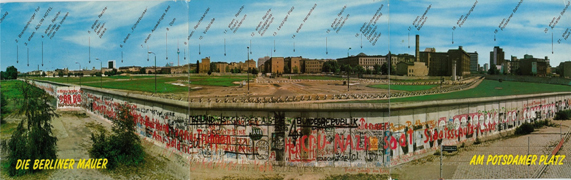
Virtually everyone had some kind of family that was caught on the other side of the wall when it went up so we had to go to some extremes in order to get good paperwork for the cars. We ended up actually registering them to a travel agency and an auto rental company, neither of which actually existed except on paper. We prepared rental contracts, receipts, and other documentation based on actual rental contracts used by the big auto rental companies so there was no reason it shouldn’t work.
There wasn’t any modification of the stock vehicles required and the license plate system was installed with little effort. We were ready to do it. All I needed was the final go ahead from the boss. Manfred was in France buying another toy for his collection so I had to wait for his return to actually begin the operation. I figured if we went ahead and prepped for the trip, applied for visas, bought supplies and packed one vehicle with as much cargo as could be loaded and still be out of plain view, he would be inclined to let us go rather than waste the effort.
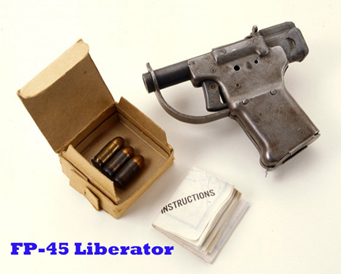
Manfred did give us the OK to make another trip into DDR but not until he made sure I was thoroughly versed in the magnificence of his newest acquisition. It looked like a “crackerjack” toy to me but Manfred assured me it was one of the best preserved examples of the “Liberator Pistol” in Germany. We always made fun of Manfred’s obsession with his gun collection and usually referred to it as his toy collection but this new one really looked like a toy.
It was a 45 caliber pistol that was stamped out of sheet metal and had an un-rifled barrel of only about two inches long. Although it had what looked like a magazine in the grip it was a single shot weapon. The magazine was just bullet storage and each round had to be taken out of the grip and manually loaded into the chamber.
I was informed that my “Compatriots” had Para-dropped thousands of these “Liberator Pistols” and ammo into France and Belgium during the war in the hopes that partisans would use them to dispatch a few of the occupying German soldiers. This one was recently discovered inside an old heating oil tank. The current owner of the house was replacing the 1920’s era heating oil tanks with modern ones. When they hoisted the oil tanks out from under the house it was obvious something was inside. Opening the tank revealed a group of eight Liberators and an assortment of other WW2 weapons. The owner’s grandfather was executed in 1944 for being part of the resistance. He apparently stashed the weapons in the tank sometime before his arrest.
The fact that they were constantly submerged in heating oil prevented any metal corrosion leaving Manfred’s new toy in the same condition it was in the day it made the drop into France. I declined an offer to shoot it out of fear the relic would come apart but Manfred shot it several times without any problems.
Heinrich and I had been through the transit borders twice in less than thirty days so neither of us could make the first trip into DDR. We chose Katja, Andrea, Jürgen and Helmut to make the trip with Katja and Andrea making the actual entry into DDR and delivery. Both teams left the Scheuner mid-morning headed toward Helmstadt, one of the main transit crossings.
The plan was for them to try to get through the border and on to the second Autobahn Rastplatz arriving within 30 minutes of each other. The women would go into the restaurant and get settled for lunch. The men would park as close as possible to the other car and discretely switch the plates. Once the vehicles were ready they would also go into the restaurant.
Katja had keys to the opposite vehicle, as did Helmut. They would take all the registration paperwork into the restaurant with them so when the Men entered the restaurant the women would know to leave. They would simply go out to the other car, which now had an entry visa, and proceed to the contact and delivery. It sounded great in theory but everyone knew there was always a significant risk.
One fear I had was the possibility that we weren’t the first ones to try this. What if the VOPOs pick up on the license plate mounts but don’t bother to stop the delivery. If they were to follow Katja and Andrea to the contact, it would mean jail for everyone involved. To top it off this was my first actual command decision if I was wrong it would be a very costly error.
It seemed like Manfred was giving me a lot of room to fuck up, not like he was going to let me hang myself with all the rope but more like he was giving me a chance to prove I could do the job. Werner was officially just the head technician but anyone who knew the inner workings of the Scheuner knew that Werner’s endorsement or opposition was a major factor in any decision made at the command level. Werner was also the only person besides Manfred who had authority to draw funds. I learned very early that if I wanted to get something approved, Werner was the key. The fact that we were becoming very close on a personal level didn’t hurt.
The two entry teams rehearsed the operation by traveling separately on one of the Autobahns in Germany meeting at a random Rastplatz and going through the process of making the switch without drawing any attention. These rehearsals uncovered several issues that needed to be addressed before the hot run. One of the most important discoveries we made was that the trim mounts we were using for the quick exchange were only good for two or three mountings. One of the front plates detached and almost fell off the car when a fastener wore out. Werner fixed the problem by enlarging the holes in the bumper just enough to allow the fastener to be installed and removed without damaging the fastener itself.
The border crossings into DDR were the busiest on Fridays, Mondays and Wednesdays. I understood Friday and Monday but Wednesday was mystery to me. We decided to make the crossing on the following Wednesday which would make it possible for the return trip to be made on Friday. If it worked, I was planning to request authorization to schedule regular trips until the summer travel season kicked off in May. We could make eight to ten more trips before it was warm enough to use campers again. This might just turn out to be a “feather up my ass” after all.
Katja and Andrea set out first since they would go through more thorough search before being allowed to enter DDR. The trip out would be even worse. Transit traffic was not subjected to anything other than a document check so the men would require much less time. The transit drive to Berlin was less than eight hours even with the border crossings. I expected to hear from the transit team by early evening. They would be back in West Berlin and would call from their hotel. Early evening became late evening with no word from the team and I began to get concerned. If the mission were aborted, I would have still received a phone call telling me; but there was just nothing. Every possible scenario of how things went wrong raced through my head.