
 THE WOMAN'S BOOK OF
r e s i l i e n c e
12 Q U A L I T I E S T O C U L T I V A T E
BETH MILLER, PH. D. 

CONARI PRESS
First published in 2005 by Conari Press,
an imprint of Red Wheel/Weiser, LLC
York Beach, ME
With offices at:
368 Congress Street
Boston, MA 02210
www.redwheelweiser.com
Copyright © 2005 Beth Miller
All rights reserved. No part of this publication may be reproduced or transmitted in any form or by any means, electronic or mechanical, including photocopying, recording, or by any information storage and retrieval system, without permission in writing from Red Wheel/Weiser, LLC. Reviewers may quote brief passages.
Library of Congress Cataloging-in-Publication Data
Miller, Beth
The woman's book of resilience : 12 qualities to cultivate / Beth Miller.
p. cm.
Includes bibliographical references and index.
ISBN 1-57324-964-5 (alk. paper)
1. Women-Psychology. 2. Resilience (Personality trait) 3. Self-realization in women. 4. Self-actualization (Psychology)—Problems, exercises, etc.
5. Self-management (Psychology)—Problems, exercises, etc. I. Title.
HQ1206.M498 2005
155.6'33—dc22
2004018757
Typeset in Dante by Gopa & Ted2, Inc.
Printed in Canada
TCP
12 11 10 09 08 07 06 05
8 7 6 5 4 3 2 1
contents
Foreword
Introduction
1 Undressing: I Am Open
I Will Admit and Embrace My Vulnerability
2 Who Do You Call at 3 A.M.?
I Will Practice and Increase My Ability to Connect
3 Hands On, Hands Off
I Will Find Parts of the Problem That I Can Manage
4 Not That One, This One
I Will Discover and Get My Needs Met
5 Look Ma, I Am Dancing on My Toes
I Will Recognize and Develop My Own Special Gifts and Talents
6 That's Close Enough
I Will Develop My Ability to Say No
7 Poison or Pearls
I Will Increase My Ability to Transform Resentment and Forgive
8 Now That's Funny!
I Will Develop and Use My Sense of Humor to Help Me Through Stressful Situations
9 Staying Power, Leaving Power
I Will Explore the Range of Responses and Possibilities and Find Ways to Improve Things
10 Can't Take Any More, or Can I?
I Will Endure Suffering
11 Diving for the Pearl
I Will Find Meaning in the Crisis
12 Pearls of Great Price
I Will Stand Alone, Independent in Thought and Action, But I Will Not Be Afraid or Reluctant to Rely on Others
Epilogue
foreword
iN MY YEARS OF EXPERIENCE as a psychotherapist and Jungian psychoanalyst, I have listened to untold numbers of people speak of sexual and emotional abuse, devastating loss, physical trauma, and life-threatening illness. I have often wondered why, given similar circumstances, some people are laid waste by these events while others find ways to survive them and even thrive as a result. And, there are many in between who suffer but still carry on reasonably satisfactory lives. Is there something special that some people are born with and others not? Or is it that mysterious quality like a tender plant that needs to be nourished and strengthened in order to reach its inborn potential?
Psychotherapist Dr. Beth Miller defines resilience as the quality that enables people to bounce back when life knocks them off balance. Resilience is for the soul like a good mattress for the body; it gives support and helps to resist a tendency to slide down into depression.
We were born resilient. The very act of getting born entails working our way out of a space that has become too tight, fighting our way to freedom down a dark narrow passage, accepting help when we need it, and sometimes, when it is too tough, to allow someone to intervene with a knife because that is the only way. And then we face light and gasp for air for the first time without knowing what either light or air is. Something powerful in us wants to live, and so we come howling into the world.
It has been theorized that the way we traverse the birth canal affects our start on our lifelong path. We can't be sure of how much that influences our future course; we can only be sure that we are here, and that we are on our way. Some people strongly believe that they can succeed, that they can overcome every obstacle. Some think that life is filled with impossible tasks. Both are right. Attitude is a major factor in determining how we deal with the obstacles on the road. But what about the vast majority of people in between? What of people who think they might be able to succeed but have some doubts, and people who would like to change their ways but lack the courage?
Beth Miller has not been afraid to put her head in the lion's mouth. At midlife she left a comfortable marriage to return to graduate school, earned a doctorate in psychology, worked with groups of male sex offenders in a treatment center, taught psychology at the California Institute of Integral Studies, and established a private practice in individual and group psychotherapy in San Francisco. Over the past ten years, she developed and tested a program for developing resilience in women. This book contains a distillation of her program. It will appeal to those who believe that their lives can be more fulfilling and that they can deal better with problems and relationships than they now do. Dr. Miller describes a series of qualities that lead from embracing your vulnerabilities through analyzing your problems, getting your needs met, setting limits, giving up resentments, using humor, and practicing forgiveness to improving your ability to communicate. She provides exercises to help you practice the steps in everyday life. The book is a valuable personal guide; it can be used with a friend or partner, and it can serve as a model for support groups.
June Singer, Ph.D.
introduction
A pearl is a beautiful thing that is produced by an injured life.
It is the tear [that results] from the injury of the oyster.
The treasure of our being in this world is also produced by an injured life.
If we have not been wounded, if we have not been injured,
then we will not produce the pearl.
—S. HOELLER
mOST OF US want to see ourselves as survivors, as having that deep sense of confidence that allows us to conquer our personal demons and catastrophes. We want that exhilarating feeling of accomplishment and achievement. We want not just to survive but to thrive.
We want to think we'll be able to overcome unrequited love, have the confidence to look for another job, learn how to live with loss and disappointments creatively and constructively, whether it is not being able to have a child or being passed over for a promotion. We want to believe that we'll have courage when we fail and know how to keep trying, especially when the addiction, pain, loss, or fury appears to be getting the best of us.
We want to be resilient. We want to bounce back from misfortune and thrive from difficulties.
Sensing its importance to people's ability to cope with adversity is how I came to study the quality of resilience a little over a decade ago. At first I just loved the sound of the word. It seemed to embody a certain lightness and buoyancy. As a psychotherapist working with people stung and damaged by all sorts of life events, I had a sense that resilience might be the single most important capacity people need to develop in order to cope with their demons, with life's inevitable misfortunes, and with a vastly changing world.
As I delved into the subject, I immediately thought of the many children who survive horrific backgrounds relatively intact and began to wonder why they are able to do so when others are crushed by similar circumstances. I wondered the same thing about adults who managed to bounce back from profound losses, personal addictions, and serial disappointments. How is it that some of us are able to stand back up from tragedy able to love while others are permanently scarred? Why are some people resilient and others not? The further into that question I got, the more I became entangled in a debate similar to the nature-nurture one. My research led me to believe that we are born with a temperament that determines, to a large degree, how we relate to the world and each other and how much stress and tragedy we can withstand without breaking. But if that's the case, I then went on to wonder, if resilience is inborn, what happens to those of us who do bend too far under hardships? Is that it for us, or can we actually develop bounce-ability and become resilient again? If temperament plays such an important role in our ability to be resilient, can those of us who are more tender increase our resilience? Can those areas in all of us that leave us quivering become stronger?
I discovered many things:
Resilience is natural. Bones heal, hearts mend, and the human spirit's destination is enlargement. Change or misfortune is part of the human journey through life. In fact, without troubles we would not have the need to be resilient. There are changes throughout our natural development, like birth, adolescence, midlife, and death. There are changes in our societal initiations, like marriage and career choices or shifts. There are cataclysmic events like earthquakes and hurricanes. We torture each other with rape, holocausts, wars, slavery, and oppression.
But our culture teaches us to pick ourselves up again, brush ourselves off, and start all over again. Our myths regale us with triumphant phoenixes rising out of the ash heaps. We swell with pride when ordinary people champion over horrendous odds.
We know that resiliency reigns because we survive to tell our tales of misfortune, trauma, abuse. Indeed, we are built to be able to go to the edge of life and come back with heart and soul elevated, with the ability to evaluate and reevaluate what is important in light of whatever adversity is going on in our lives, with the ability to deepen our understanding of ourselves and the environment we live in. We are built to be resilient, to be able to take sure and steady steps over rocky terrain.
No one is resilient all the time. Even for those of us who appear naturally resilient and take life in stride, there will be pockets of our lives that are more difficult to navigate. One aspect of our life can be flexible; for example, being a crackerjack on the job is easy but relationship breakups do us in; major crises are manageable but not so the everyday disappointments. Many bright, capable people can feel overwhelmed by a calamity or an unexpected turn in the road.
Also, what is easy for one person is hard for another. It is irrelevant and even destructive to compare ourselves to others, because pockets of resilience and pockets of vulnerability differ from person to person. Some people are so disciplined that losing control to an addiction is anathema. Others make friends so easily they cannot imagine being lonely. It is important to locate the areas in our own lives where we find ourselves down for the count and not look to others as a benchmark.
We may be designed to be resilient and flourish, yet life and how we perceive and receive hard times can crush this natural ability. Poverty, abuse, unrelenting difficulties, overwhelming loss all can and do take their tolls on our ability to thrive. And, yet, even with all these difficulties, what most often determines our resiliency is how we perceive the event and what it means to us. The literature on resilience speaks of working well, playing well, and expecting well. Not too much or too little. From growing up in a profoundly neglectful environment without enough to eat to parenting an autistic child, being resilient means not denying the reality of the situation, not wishing for it to be different, and not succumbing to a victim mentality. Instead, expecting well, seeing clearly, knowing that what is, is, and then finding what you can do about it—these are the keys to resilience. The child who finds a kindly neighbor who invites her in for dinner, the parents who give their child all the love and support they have without waiting for their child to do what a child without autism would be able to do—expecting well frees us up to creative responses.
Resilience can be crushed out. We need to be resilient to be human and we are born with that quality—but what happens when life crushes us over and over or trauma, disappointments, and loss are too horrific to bear, what about when we break in certain places? The astonishing number of depressions, the varying degrees of anxiety lived with on a daily basis, mental illness, the loss of work hours as a result of not being able to face the day, suicides and violence in the home, work, and world reveal the crushing blow that life can deliver. Sometimes we have to relearn to be resilient. We feel wrung out or walked on. How do we rekindle the ability to bounce back and not merely survive, but thrive?
We can learn to be resilient. The work that I have been doing for the past ten years is based on the reality that resilience can be cultivated, relearned, developed. While I began my study with the question, “Who is naturally resilient and who is not, and why?” I soon moved away from those artificial poles, and through years of research and interviews developed an understanding of the way the most resilient people think, process, and behave. It is out of that work that I designed the Art of Resilience Process.
For the past ten years, as I have worked with people in my individual practice, in groups on resilience, in classrooms, conferences, and seminars, I have continued to marvel at the elasticity of the human spirit and how, given the proper ingredients, people show up in more and more resilient fashion. I have borne witness as people who heretofore saw themselves as weak and victimized discover their innate strengths and talents enough to bring a new bounce to their step. I have helped hundreds of people find meaning within the black holes and noticed that, as a result, they have developed (or found within themselves) more creative responses to their difficult times. I have walked along the hopeful journey of cultivating resilience and developing the mental and emotional acumen of producing pearls from injured lives.
 the art of resilience process
As I see it, resilience has twelve qualities that interrelate like spokes on a wheel. The Art of Resilience Process is designed to teach you how to strengthen each spoke of this wheel and thereby increase your resilience quotient. The process is designed as a preventative tool. Each quality can and will definitely help when you find yourself in the middle of or in the aftermath of a crisis or difficulty, but a more fundamental use of cultivating resilience is using this process to strengthen your muscles of flexibility during calmer times.
The center of the resilience wheel, I have found, is making friends with your vulnerability. As counterintuitive as this might sound, think about the difference between an oak tree and a reed during a violent windstorm. As Aesop illustrated in his fable, “The Oak and the Reed,” the reed responds to the oak, “I secure myself by a conduct that is the reverse of yours: instead of being stiff and stubborn, and being proud of my strength, I yield and bend to the winds. I let the storm pass over me, knowing how fruitless it would be to resist.”
The moral of this fable: A person of a quiet, still temper—whether it be given him by nature or acquired by art—calmly composes himself in the midst of a storm, so as to elude the shock, or receive it with the least detriment. He is like a prudent, experienced sailor who, in swimming to the shore from a wrecked vessel in a swelling sea, does not oppose the fury of the waves, but stoops and gives way that they may roll over his head.
The doctrine of absolute submission in all cases is an absurd dogmatical precept…but, upon particular occasions, and where it is impossible for us to overcome, to submit patiently is one of the most reasonable maxims of life.
The process works in a spiral, beginning and ending with embracing our vulnerability. We begin by recognizing our more tender spots and move to strengthening the qualities listed on the wheel. So, in order to flex the vulnerability muscle, to learn that our strength truly does lie in our flexibility, we must build connections and interdependence, own our talents and gifts, take good care of ourselves, strengthen the core of our being, learn what we can manage for life's overwhelming times, and increase our repertoire of responses to hard and challenging times. In order to enlarge our sense of self, we must learn to sit with suffering, staying long enough to discover the pearls in minor and major irritations, and not running away prematurely. We must learn to how to laugh at life, even during the dark times, and also know how to say, “Enough already!” These are the twelve spokes of the wheel, each one designed to brace and support our deepest self. By bracing and supporting our deepest self, we can be more and more comfortable with our vulnerability—and back to further strengthening the other qualities. That's what cultivating resilience is all about. The chapters that follow are designed to help you develop each of these qualities of resilience. They can be read straight through or used as reference when you feel the need to cultivate a particular strength or be reminded of how to take a particular approach. The qualities do not need to be worked in any particular order. You will find exercises at the end of each chapter to help guide you in this journey. These, too, can be revisited over and over with the intent of going deeper and deeper into the psyche. If only one of the exercises feels right for you, do only one. If they all work, go for it. I encourage you to make them work for you—rather than make yourself work for them.
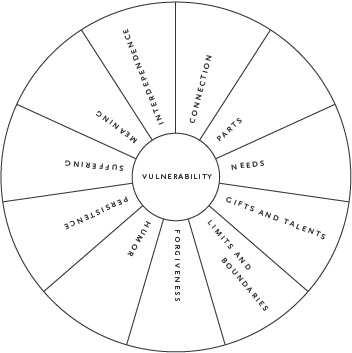
THE WHEEL OF RESILIENCE
In each chapter I use mythology, interviews, and/or personal stories to bring life and dimension to the approaches of this resiliency process. Throughout these pages you will meet many courageous and impressive women. Though their paths are varied, their stories unique, their talents and abilities particular, their resilient attitudes can be beacons of light for you as you find the courage and strength to master your own demons or overcome life's hardships. I tell their stories to show you that you can deal with sorrow and tragedy, you can find your power and your voice, you can squarely face life's hard times, inequities, and diabolical schemes—and even thrive.
(Out of respect for confidentiality, I use composites and pseudonyms to detail the lives and behaviors of these quiet heroines.)
Becoming resilient is not an easy process, and it has no definitive ending. It takes hard work, perseverance, willingness, and desire. You have to be willing to take yourself on. But it can be done. May you find through the teachings in this book that you do possess the strength of a reed, the composure to ride out even the mightiest of storms, the willingness and ability to give way so that the waves may roll over your head.
undressing: i am open 1
I WILL ADMIT AND EMBRACE MY VULNERABILITY
The world's mine oyster,
Which I with sword will open.
—WILLIAM SHAKESPEARE
LIFE IS UNFAIR. Some of us will never be rich; some of us will never be beautiful; some of us will never have parents who love us. Some of us carry more burdens than others. Some of us were abused and some of us were tortured. Tragedy is everywhere, and death is certain. We all have to learn to live with these realities.
That is why we need resilience. The ability to be resilient is what helps us bounce back from the edge, helps us find our strength in adverse circumstances, helps us thrive in this life—and it most often begins with opening the inner doorway to our own vulnerability. No matter how tiny a crack we may feel ready to open. Because becoming resilient requires a willingness to fall apart for a time—and getting to know ourselves at our rawest—so that we may open ourselves up to those deepest of inner resources that can enable us to bend and flex with whatever life brings our way.
we are all vulnerable
All of us, out of necessity, have built up defenses to protect ourselves from others, to avoid being or feeling hurt, feeling out of control or helpless. We shy away from people who appear needy and often blame others to avoid the truth of our own vulnerabilities. We cling to the familiar, the known, even if it's not in our best interests to do so: a relationship that is not constructive, a job that bores us to death, an outmoded identity or pattern or behavior. We fear change, so we look for ways to keep the status quo. But in order to put our lives back together, we need to acknowledge that we are tender, that we don't know everything, that we cannot control everything, that we need each other. In other words, we need to be vulnerable.
We may fear our vulnerability, but the truth is we are all vulnerable. We are physically vulnerable for many months and for the first many years could not survive on our own. We are wholly dependent on human kindness and suffer greatly when others fail us.
We are mentally vulnerable in that we have the consciousness to know that we and those we love will die. We not only experience abandonment, we know ahead of time that we are susceptible to being left alone. As a psychologist, I see this existential anxiety in almost every person who walks into my office. We know we are alone; we are on a journey only we can navigate, even when we have help from others.
We are vulnerable to our environment through our dependency and conditioning. We learn early on how our parents, families, and neighbors think and feel. We learn from them the “right” way of behaving, what is considered good, what is bad, what we want to be, who we don't want to be.
We are emotionally vulnerable to loving, hating, and indifference; to a wide range of feelings: sadness, anger, joy, devastation, ecstasy. We can't be open to joy without also being open to pain.
We are vulnerable to each other. The neighbor's loud music or barking dog that keeps us awake. We know the dangers of toxic wastes, nature's furies, and the economic ups and downs around the world. We are aware of the precipice we live within and on.
As women we know additional vulnerabilities—and we know that our vulnerability is seen as a weakness. We are vulnerable because our history of second-class citizenship and our lack of access to education or the circumstances to be self-sufficient and equal made us even more dependent on others than men are.
We have also had our vulnerability reinforced by the dominant culture, which sees us as unfocused, fickle, and too emotional to get the job done well. We know that we are often (yes, still!) perceived as weak, inferior, and dependent, and in many cases we have internalized this view of ourselves. It's no wonder we view our vulnerability as a detriment; it's no wonder we feel we must never show it.
it's our strength
I'd like to suggest that our history of being second-class, our struggles and our innate access to emotions and feelings position us to see our vulnerability as strength and to model that for the world. Instead of defending against the sore spots and tender mercies, we can model how to use them to produce rich and appropriate responses to whatever situation we may find ourselves in, to be far more flexible and versatile in all things.
I am convinced that an underlying reason behind judgments, blaming, threats, alienation, and even violence is the desire to hide our vulnerability—our failures, intimidations, weakness, helplessness. I am convinced that a means of increased psychological and spiritual growth begins with recognizing the insecurities that cause us to lash out in a reaction. As women we can model how being relatively unguarded allows us to respond rather than react, to be open and receptive students of life.
I am not advocating indiscriminate openness or a permanent wearing of your heart on your sleeve. There is a time and place for guardedness and lack of trust; there are times for skepticism and for protecting yourself from some people and circumstances. But it is powerful to know and be comfortable with your own vulnerability and exercise the choice of when to be open or not.
Knowing and admitting that we are insecure, afraid, out of our league, or lost in the woods puts us more in charge of our emotions and our situations. We are much less likely to be blind-sided by our “weaker” emotions. And since much of being resilient is about prevention—taking precautions before being run over by a truck or preparing the home before the earth quakes—it is smart and prudent to become more and more familiar with our vulnerability.
I had been working with my client Carolyn for two years when she began to plan her wedding day, which was fast approaching. As so many women do, she wanted this day to be picture perfect. The man she was marrying was funny and playful, a wonderful complement to her serious approach to life. The setting they chose, a bucolic, open grassy expanse overlooking acres and acres of grapes in the wine country, reflected her sophisticated and cultivated taste. She helped the caterer design an elegant vegetarian meal and chose wild and varied flowers, further adding her personal signature.
When she had first come to see me, Carolyn was just twenty-four years old. Her mother had recently been diagnosed with cancer, and Carolyn was struggling to balance her caretaking role with a busy career as a trial attorney. She felt tremendous pressure to perform well on every front.
A strong, direct, and very capable young lady, Carolyn had always been cast in the adult role in her household, which left her with the double-edged sword of being extremely competent and having many unmet needs. Her mother had been a harsh critic—pushing her to try harder when she felt tired, criticizing her when an A was not an A+, expecting her to hold herself together when the family went through difficult times—and Carolyn had internalized this well. She was more apt to beat herself up for what she did not do for her mother or for when she was not there for her than to cut herself slack because she did so much. She did not truck with weakness or softness. Not surprisingly, then, during her mother's illness Carolyn's stamina was impressive. But her soul was burning out.
She would come into my office absolutely exhausted and having no idea how to relax or let go of some of the responsibilities without feeling guilty or worrying that she was not doing enough to keep her mother alive longer.
One summer evening, she came into my office looking put together, as usual, plunked herself down in the oversized chair, and said, “It's over. Mom died last night.”
Neither of us was expecting it this soon; her mother had rallied so many times before, inspiring hope and optimism in all who cared for her. With my own sadness and surprise showing, I leaned toward her and took her hands in mine as she cried in relief, shock, sorrow, and pain. She could easily cry because she had lost her mother and missed her terribly, but she could not possibly have admitted needing something herself or allowed herself to be taken care of.
As her wedding day approached, Carolyn missed her mother more and more. She would talk about how much her mother would have loved this time, about how she wished she could ask her mother to help her choose a dress and to help her decide which earrings were the perfect match. When she had fights with her fiancé or felt prewedding jitters about her choice of a mate, she longed to have her mother there for a heart-to-heart.
The week before the wedding, Carolyn came to see me, inconsolable. She spoke through tears. “I just know if my mother were alive she would do something very special for me the day of the wedding. It would be something I had not thought of, something that would tell me she was thinking of me on this big day.”
We both knew that there was no one who would or could fill this role for her. Her mother had many friends who loved Carolyn, but she had no desire to turn to them. Only her mother would do, and her mother was not here.
Near the end of the session I said to Carolyn, “I don't mean to be presumptuous, but I am wondering if there is anything I can do?”
Without missing a beat, Carolyn cried harder and asked, “Would you come and see me right before I walk down the aisle?”
I was deeply touched, and my eyes filled as we cried together. It takes profound strength to admit that you need someone when you have been taught that you do not have needs or that the needs you have are wrong or irrelevant in the face of others' needs. By letting down her guard, she could begin to trust that I would be there to “see” her at that archetypal moment before she wed.
I once read about a nun who worked in a rough area of New York. Each evening, before leaving the church for the day, she checked herself for her level of vulnerability. On the days she felt particularly soft, she took a taxi home. Even on the days she was in a stronger frame of mind, she took precautions as she walked the dangerous streets to her bus stop. She did not turn a fool's eye to her circumstances or condition.
On the other hand, I have watched people pull out their stiff upper lip and muscle strength without admitting their vulnerability. This gritting the teeth does not bring resiliency; instead the stiff and muscled “heroine” is brittle and vulnerable to the next thing or person who is stronger and louder.
If we do not allow the vulnerability, the softness, or the tenderness, we are more apt to end up with sharp edges and holes in our heart. For example, a woman I worked with insisted that the barbs and slights from her husband didn't bother her. She could easily grin and bear it, especially understanding his warped “sense of humor.” Her avoidance of the pain his remarks instilled in her left her open to being treated the same way by her children.
During my own childhood I perfected the defense of denial. It took me years and years of concentrated effort and analysis to free the pain and thaw the icicles that kept me frozen within myself and unable to love or be loved. It took devotion to rediscover my vulnerability, and it takes faith and trust to remain in touch with it on an everyday basis.
A woman I worked with had, in childhood, developed a habit of using garbled talk so her father would not hit her for back-talking. This was a creative response to a threatening environment, possibly the only way she could find to maintain herself in the face of worrying she would lose her father's love and incite his anger. As an adult, however, this garbled talk kept her from being understood and seen, kept her at a distance from others when she desired to be close. What ultimately helped this woman was not just changing the behavior, but understanding it as a creative response to an outdated situation. She now has a better chance of becoming free to relate intimately because she allowed herself to be vulnerable to the old feeling of needing her father's love, of wanting to be seen and not hurt. She allowed herself to fall apart a little in order to emerge stronger.
taking the inner journey
Like so many of you I grew up with the myth of the hero and was told that conquering ourselves and the world was our most important challenge. That holds for some times in life, but once you experience loss, sorrow, or significant change, you recognize that there is another journey to make: a descent into the soul to understand the flow of feeling, emotion, and lost parts of ourselves. A journey to discover the threads that bind us to each other and to all aspects of the living world.
Myths of descent usually begin with an unexpected twist of fate or a deliberate dive into the underworld—the unknown path that lies ahead when we experience loss, tragedy, or serious disappointment—and the road not taken that calls to us when we enter a new passage. These myths give us a framework for overcoming adversity and enlightening the process of redemption, showing the heroes and heroines figuring out their own way and righting their course as a result of a great fall.
One such legend comes to us from ancient Sumeria: the tale of Inanna. In his book From the Poetry of Sumer, Samuel Noah Kramer tells of the power and influence Inanna's journey held for the people of that time: “The goddess who outweighed, overshadowed, and outlasted them all was a deity known to the Sumerians by the name of Inanna, ‘Queen of Heaven.’” Inanna is the tale of a woman's journey from her early days of being courted, admired, and enriched to her descent to the underworld in her middle years. It is about sacrifices she must make to achieve wisdom and affirm her purpose of life.
Inanna was much loved and revered, yet she voluntarily abandoned her office of holy princess of heaven and earth to descend into the underworld. This was a descent of uncertainty and danger, a descent to journey within the depths of the psyche. Before her departure she spoke to her faithful friend, Ninshubur, leaving elaborate instructions. If Inanna did not return, her friend must go to the gods and ask them all to save her, not leaving to chance that she might not be able to recover.
Inanna departs to the underworld to see her older sister, Ereshkigal, raw, bitter, and entangled, the Queen of the Underworld. But this place of grief and sorrow is not one we enter lightly. Inanna passes through seven gates, and at each one she is required to surrender a talisman or article of clothing, leaving her bowed and naked upon her entrance to the throne room. Her journey is stark and perhaps surprising, given that she has volunteered to go deep within herself. She is willing to unburden herself from all she has held dear, and yet when at each surrender she asks for the meaning of this stripping she is told that the ways of the underworld are perfect and may not be questioned.
Then Ereshkigal fastened on Inanna the eye of death.
She spoke against her the word of wrath.
She uttered against her the cry of guilt.
She struck her.
Inanna was turned into a corpse,
A piece of rotting meat,
And was hung from a hook on the wall.
This is what a transformation—or the conscious reflection on a lifetime loss or change—can feel like. We descend to the underworld, leave behind all earthly attachments and accomplishments, and don't know what will happen next. It is a time of facing ourselves, looking squarely at the demons and feeling like we are a piece of flesh hanging from a hook on the wall, being seasoned and matured! This is a chilling image of vulnerability, a raw look at surrender. Why would Inanna leave her secure world and walk into the void voluntarily?
Because we cannot live a conscious life without facing the terrors of uncertainty and the unknown. Always staying within the safe zone simply doesn't work. No, our task is to open ourselves to the darkness—the realm of emotion, feeling, the unknown—and experience the anguish of sorrow, uncertainty, confusion, and powerlessness. We must be willing, mentally and emotionally, to be confused, to be wrong, to take a risk, fall down, skin our knees, be wrong again, be confused again, feel the pain and sorrow. Because until we are ready to let go—of what is no longer working, of people who stand in our way, of our familiar defenses—we will never grow.
In a society that believes we must be strong and positive, where we shun our negative and vulnerable feelings, carrying our burden of self-doubt with dignity is a socially significant statement. In our world, where we find it hard to experience pain or to realize that we feel small in certain ways, we can set a rare example by continuing to walk erect and by carrying our woundedness with consciousness and dignity.
Collectively it is time to validate, honor, respect, and make room for falling apart, admitting vulnerability. It is time to bring reasonable and appropriate falling apart into fashion. It is a long process, and we can find and learn our own rhythms, our own ebbs and flows as we have patience and compassion with ourselves. To be a student of life is to be vulnerable—open to life, to learning, to experiences, to you, to emotions—and willing to accept things as they are.
Everyday life is full of struggles, and we have daily opportunities for descent: experiencing arguments and conflicts, admitting discomforts, anger, and fear. Sometimes we are faced with major problems and challenges, and many times we are just faced with bad traffic, holes in our pantyhose, and not being able to get adequate attention at the bank, store, gas station, fill-in-the-blank. In fact, as we often hear, it can be easier to deal with the really big stuff; it is the everyday annoyances and irritants that begin to wear and can cause an emotional meltdown.
We often thirst for intimacy and spend much of our time running at top speed. We go on a job interview; we need to learn a new job, task, or challenge. We lose money on bad investments. We meet and lose friends and partners. We desire to start our own company and risk failure. We have more than enough chance to feel vulnerable and out of sorts on an everyday basis. Here, too, it is important to recognize and admit our vulnerability so that we might deal with it in a straightforward manner.
Being successful at facing our vulnerabilities—our failures, our missteps, our lack of control over events and other people—is an art form. It is an art form to apologize, to let go of what is not working, and to face change with an open heart and mind. It takes courage and dedication to face ourselves and seek out deeper truths about ourselves.
What do you imagine when you hear the word vulnerability? The soft spot on a newborn's head, the fuzz on a peach, the sensitive and tender skin of the genitals, the underbelly of a newborn kitten or puppy? The scariness of being unguarded? The unpleasant feeling of weakness? How often have you had a dream of being naked in a public place? Of being ashamed of the most delicate parts of your personality?
When you hear yourself bitterly referring to the unfair difference between your lot in life and your friends' or that of other members of society, try to hear the deeper truth of jealousy or sadness or disillusionment. When you find yourself stamping your feet in frustration because you are not getting the kind of help you want from a loved one, sit a moment and recognize your desire to be rescued or taken care of. Without judgment, try to experience the softer, tenderer underbelly of your psyche.
The frontier is visible. The stories abound. The stage is set for acknowledging, welcoming, and inviting our vulnerability to the dinner table.
exercise
REFLECTION
As you consider the following questions, there are a few effective tools you can use to help you connect with your answers. You can write in a journal to free associate and explore your thoughts, feelings, and experiences; create pieces of artwork to investigate the ideas through images, colors, and correlations; and/or simply use your imagination to access associations, pictures, feelings, dreams, hopes, and fears.
Remember the last time you were criticized (by someone well intended):
 How did you react? (What were your defenses?)
What were the underlying vulnerabilities? (You felt hurt, insulted, humiliated…?)
How can you befriend this part of yourself?
Remember the last time you did not get what you wanted:
How did you react?
What were the underlying vulnerabilities?
How can you befriend this part of yourself?
Remember the last time you, metaphorically, were naked out in public:
How did you react?
What were the underlying vulnerabilities?
How can you befriend this part of yourself?