Copyright © 2015
By Garry Leonard and Deirdre Flynn
All rights reserved
The Library and Archives of Canada has catalogued the electronic version of this book under the following ISBN: 978-0-9878062-5-3.
Please respect the rights under copyright reserved above and do not reproduce this book, introduce it into a retrieval system, or transmit it in any form, or by any means (electronic, mechanical, photocopying, recording, or otherwise). Your support of our copyrights is appreciated. Your feedback, too, is appreciated. Feel free to email us at leonardgarry@hotmail.com or flynnd@sympatico.ca.
Also Co-Authored by Garry Leonard and Deirdre Flynn
Nerves in Patterns on a Screen: An Introduction to Film Studies
Where All the Ladders Start: Introduction to Western Culture Through Literature and Film (1900-1940)
When Harry Met Godzilla: How Hollywood Genres Hold the Key to Your Personality (And Everybody Else’s, Too!)
Also by Garry Leonard
“Let’s Get Fiscal: Hollywood Romance and the Modern Economy” in Film International
“Monsters and Mortgages: Hollywood Horror Films as a Prime Economic Indicator” in Film International
“Technically Human: From Apes to Astronauts in Kubrick’s Space Odyssey” in Film Criticism
Advertising and Commodity Culture in Joyce
Reading Dubliners Again: A Lacanian Perspective
Also by Deirdre Flynn
The McGraw-Hill Handbook, First Canadian Edition
“An Uncomfortable Fit: Joyce’s Women”
in Joyce and the City
“Virginia Woolf and the Fashionable Elite”
in Virginia Woolf and Communities
“Proust’s Fashion Sketches,”
in The Bulletin of Proust Studies
Table of Contents
| Introduction | Living in a Political World: “As soon as you’re awake / you’re trained to take / what looks like the easy way out.” (Dylan) |
| Chapter 1 | World War II and the Drive Toward Authenticity: “Our task is to find a form for the chaos, and not pretend it is something else.” (Beckett) |
| Chapter 2 | “Nothing To Be Done” (Beckett): Waiting is an awareness of being brought on by an absence of doing in Waiting for Godot. |
| Chapter 3 | I Tweet, Therefore I May Be: What if Vladimir and Estragon had Smart Phones? |
| Chapter 4 | Power Play, Purity, and Propaganda in The Balcony: Reality is an effect of fantasy … and vice-versa. |
| Chapter 5 | “The Thing Without a Name” (Naipaul): Place, Agency, and Strategy in Miguel Street |
| Chapter 6 | The Four Faces of Esther in The Bell Jar: “Piece by piece, I fed my wardrobe to the nightwind.” (Plath) |
| Chapter 7 | Challenging the Law of The Bluest Eye: “Quit hiding from life like thieves in the night.” (Black Star) |
| Chapter 8 | Theology, Technology and Death in White Noise: “The greater the scientific advance, the more primitive the fear.” (DeLillo) |
| Chapter 9 | Double or Nothing in Vertigo: “We are all born mad. Some of us remain so.” (Beckett) |
The final belief is to believe in a fiction, which you know to be a fiction, there being nothing else. The exquisite truth is to know that it is a fiction and that you believe in it willingly.
Wallace Stevens, Opus Posthumous: Poems, Plays, Prose
Introduction
Living in a Political World: “As soon as you’re awake / you’re trained to take / what looks like the easy way out.” (Dylan)
In the aftermath of World War II, a great deal of innocence, if not all of it, was lost as the world reeled from the horrors of fascism (in which individuals were transformed into compliant masses using cutting edge propaganda and technology), concentration camps (in which people were eliminated using state of the art science and technology) and atomic bombs (also the result of astonishing advances in science). It was no longer possible to see science as certain salvation. Clearly, science could be used for destructive purposes, and there was nothing in the science itself that would save us. To put it another way, a revolution in technology was not a revolution in ethics, or wisdom, or self-awareness. One result: the world began to look like a place where everything was an effect of power—who had it, who didn’t, who lost it, who gained it. We no longer lived in a world imagined as an ordered creation of God or nature; we lived in a political world.
It is this distinction that Bob Dylan drives home in his song, “Political World,” which opens with the following lines:
We live in a political world
Love don't have any place
We're living in times
Where men commit crimes
And crime don't have any face.
We live in a political world
Icicles hanging down
Wedding bells ring
And angels sing
Clouds cover up the ground.
We live in a political world
Wisdom is thrown in jail
It rots in a cell
Is misguided as hell
Leaving no one to pick up a trail.
We live in a political world
Where mercy walks the plank
Life is in mirrors
Death disappears
Up the steps into the nearest bank.
We live in a political world
Where courage is a thing of the past
Houses are haunted
Children unwanted
The next day could be your last.
What is the difference between a world and a “political” world? Why make the distinction at all? Politics is the art of making up rules we all view as more or less fair. These rules relate to how resources are to be distributed—and this is the case whether those resources are material or human. The fairness of the rules is paramount because once they go into effect we are all expected to abide by them and penalties can be imposed on those who do not. However, rules are also a great way to gain an unfair advantage. Imagine a rule in a hockey league stating that your team can’t have a goalie, but every other team can. Then, when your team doesn’t perform well, imagine having this understood as demonstrating you are a weak team, rather than being the inevitable result of an unfair situation merely presented by the “law” as fair. Lacking a goalie, while playing a team that is allowed to have one, guarantees it will be much, much harder for you to win, if it is possible at all, and, if you ever do, it will be because you put forth ten times the effort of the opposing team, at a level of intensity you are very unlikely to be able to keep up day after day. Yet, when exhaustion sets in, this, too, will be seen as evidence of your team being “out of shape” relative to other teams, when the truth is you are far more fit.
Passing unfair rules while convincing people they are fair (for instance, by means of political lobbying) is the basic foundation of modern power because it makes oppression and institutionalized exploitation seem like “that’s just the way things are.” All the centralization and mass media technology of our age has made it easier than ever before to broadcast these rules, naturalizing power to such an aggressive extent they seep into every crevice of modern life. Think how many ads you see daily on YouTube, Facebook, not to mention billboards, walls, and even public washrooms. All of these ads contribute their little bit to an organized world view that is very much produced in a way that makes it seem natural, and not produced at all.
In former times, kings and emperors could call on their connection to God for legitimacy, but in modern times, even the most ruthless dictators must at least pretend they are somehow representing the will of the people. Thus, we now have a world that is, in fact, always political, while claiming to still just be the world. This is how the political process can be used to “naturalize” power—to make it look as if we are all “playing by the same rules.” Such a perception is crucial to the continuation of a given power regime because the best way to suppress revolution is to make it seem even if you disapprove of something, it represents the general will of the people so in the interest of civic harmony you should go along with it.
When it becomes obvious to people that a ruling power is accruing everything of value for themselves and depriving everyone else, a movement toward revolution begins. However, if the privileged and the powerful appear to have earned what they have, and done so in a manner equally available to everyone, then their wealth and power is seen as the “natural” outcome of their abilities and hard work. Conversely, someone laboring under an institutionalized disadvantage (like the hockey team forbidden to have a goal) can now be seen as someone lacking the will or character to “make their way” in the world. For a king, much of his legitimacy came from the assumption that his bloodline had been anointed as a representation of Divine will. Therefore, any perception of his operating in bad faith, or for personal gain at the expense of others, amounted to brazenly questioning the will of God. Given that, protesters could be jailed or beheaded for blasphemy against God when in fact the engine of their death was a king eliminating threats to his power without having to acknowledge this is what he is doing.
For political regimes today, their legitimacy comes from the general perception they represent the will of the people. There is no presumed “transcendent” authority bestowing their right to rule from above. If they act in such a way as to lose the trust of the people they represent, their right to rule comes under question. In addition to public perception, ruling parties wield two other powerful systems: the military and the economy. In a dictatorship, for example, the economy can be manipulated to make sure one is able to maintain a military that is loyal to the preservation of the current rulers because they are too well looked after by the system to want to see it changed. In this system, the taxes of the people are used, at least in part, to pay for the very military that oppresses them. Equally, any corporation that can make the dictatorship beholden to them (by loans or bribes, for instance) gains direct access to the law-making machinery, leading us back to the situation I descried at the beginning of this introduction.
This combination of military and money—better known as the “political economy”—is a modern phenomenon. The “political economy” takes shape as both the dominant science and the science of domination. The intricacies of the system are seen to be beyond the scope of the average intelligent person, and thus “experts” must always be consulted even for change to be considered. Often such experts, like the well cared for military leaders, have too much invested in the system to critique it in a meaningful way. Small wonder we are in an age of surveillance and terrorism. Huge powers, with limitless resources and much to defend, try to manipulate world events to maintain their advantage. In this way, government, the economy and the military are virtually seamless, constituting what U.S. President Dwight D. Eisenhower called “the Industrial Military Complex.” For example, drone strikes manipulated in one place while actually taking place on the other side of the world represent, at one and the same time, a military action and an economic action. With “globalization” the political economy goes yet a step further and becomes the geo-political economy. Now the personal is the political and even the geographical is the political: both you and the ground under your feet are subject to a ceaseless contest of conflicting ideologies, each vying for supremacy over the other. This is the case for virtually every square foot of land on Earth. As Dylan says, “you can travel anywhere and hang yourself there you’ll always find more than enough rope.”
In this class we will explore the complex, interconnected systems of modernity as they are expressed and challenged in novels, short stories, poems, films, advertisements, and other forms of popular culture. A central purpose of this class will be to consider one of the great triumphs of modern art: its ability to expose the “you can’t have a goalie” rule as unfair, punitive, and quite destructive to the human spirit if we lack the wherewithal to understand. Although reading literature and studying films will not grant you sweeping powers to change everything, it will, I hope, restore your own locality to you, your own ability to at least understand that you are subject to unfairness when it happens. This insight alone can change a situation from one in which you might feel ashamed and inadequate to one in which you feel empowered to understand and respond appropriately. Even in cases where you cannot change the inequity, you at least no longer need to accept blindly any judgment of you as deserving whatever happens because, somehow, it is strictly your own inadequacy that has brought it about.
Instead, you may notice the social, military, and industrial systems that police borders and protect trade in ways that control the flow of resources throughout the entire capitalist system. This control of resource distribution is difficult to see because the interconnectedness of the system is “below ground”—an invisible root structure. And so Dylan intones:
We live in a political world
Where mercy walks the plank
Life is in mirrors
Death disappears
Up the steps into the nearest bank.
The geo-political economy illustrates the increasing dynamics of distantiation (in which decisions made far away directly affect life at the local level) and dis-embeddedness (a sense that one’s immediate context has no bearing on one’s own well-being anymore). Taken together, the twin dynamic of distantiation and dis-embeddedness is a hallmark of the modern experience of globalization where the sense of the “local” has been completely appropriated by the “global.”
How are the masses to be convinced such a system is in any way in their best interests? By reducing the concept of value or meaning, as much as possible, to either rates of production or rates of consumption and insisting that a current geo-political economy is the only possible way to “grow” this economy (i.e. increase the profit margin). An example of this would be regarding something beneficial to others as not worth producing because it would be too difficult to ”monetize.” Developing pharmaceuticals for diseases of the so-called third world are rarely undertaken—not because people suffer from such diseases any less, but because they are not a “consumer market” and no drug developed to their benefit is likely to create a large return investment for the various stockholders.
Where economics used to be seen as the study and application of fair distribution, it is now presented as something that must, at all costs, be allowed to “develop.” Such a development is conceived of as boundless. The economy must “grow” we are told. The reward of this growth in production, we are told, will be an increase in the possibilities for consumption—for buying things. We see ourselves reflected in the products we buy (“life is in mirrors”) and wars fought become the unacknowledged foundation for this “growth” so “death disappears up the steps of the nearest bank.” The “self” that we think we see in the product is actually the idea the product is designed to promote (friendly, communal, powerful, seductive, etc.).
This quality is nowhere in the product, but an effect of advertising. In ads, the particular qualities most often presented—a sense of belonging or purpose, for example—are powerful appeals precisely because they are no longer easily experienced in everyday life. The product can’t help with this; consequently, buying the product does not “work” really, which only prompts us to “try again” (consume more). The rise of fascism in the 1930’s accelerating into World War II, showed an early, ferocious example of just how powerful a geo-political machine could become in the era of mass media (newspapers, radio, film) mass production (the assembly line, the factory) mass transportation (trains, planes and automobiles) and mass consumption (malls).
In the end, after the death of approximately twenty million people (to be added to the ten million who died in World War I), fascism and Nazism were defeated militarily, but not before some disturbing modern truths became all too clear. As Joseph Goebbels, the inventor of modern propaganda and head of propaganda for the Nazi party put it, “if you tell a lie big enough, and keep repeating it, people will eventually come to believe it.” Of course, the lie can be maintained only for such time as the State can shield the people from the political, economic and/or military consequences of the lie. It thus becomes vitally important for the State to use all of its powers to repress dissent, for the truth is the mortal enemy of the lie, and thus by extension, the truth is the greatest enemy of the State.
With radio, newspapers, and other forms of mass-media it became so much easier to lie, so much more often, to so many more people, all at once and in the same way, over and over gain. Propaganda is a form of lying: it is a political form of lying. It is the art of persuading people to act in a way that is not in their best interests (and/or that goes against their core values) in order to further the best interests of the people formulating the propaganda. It is a way to cheat people while persuading them you are anxious about their welfare and willing to work selflessly on their behalf. It is a con game, a “stacked deck” as Dylan says in “Political World.”
One way to think of propaganda is to think of a shell game—where you put a pea under one of three shells and then move them about so quickly you may thing you know where the pea is; in fact, you have lost track, and now the pea is wherever you are told it is—if it is even there anymore at all.
In 1920, William Butler Yeats said, “the center cannot hold.” Now the center holds; it’s just not really the center. Or, it’s the center in the way that the death star in Star Wars is a centre. The death star is the “center” of a self-proclaimed Empire—not because it is a center in any integral way--but because it is capable of destroying anything around it, and thereby making everything else the perimeter. Despite all the talk about the need to “create more jobs,” the primary benefactors of a capitalist industry—those who own the means of production and dictate the terms of consumption—often prefer high unemployment to a situation where they have to compete for scarce labor.
The business model of Walmart is a case in point—a sort of “death star” that approaches a community from the outside only to impose itself as the new “center, banishing or annihilating all that it distances. First it comes into town and secures tax breaks for building a center because it promises to hire a great deal of people. Then it wells products manufactured overseas for poverty wages, thus underselling the traditional markets already in the town. As these local businesses go out of business, more and more people agree to work for Walmart. As Walmart becomes the primary employer, it can dictate terms more and more: los hourly wages with little chance for meaningful raises. These low paid employees cannot afford the prices of local merchandise. They themselves shop at Walmart, further decimating the local economy.
Just recently (December 2013) a furor broke out because a Walmart put out empty bins inviting employees to help even less fortunate employees by donating food. Helping out someone in need is, of course, a nice gesture—but this is a case of people near the poverty line helping those who have slipped below it entirely, all of which ignores the larger issue which is Walmart’s profit margins are huge and they could afford to pay wages that would eliminate actual hunger as an issue for its own employees. The competitive situation among workers sometimes emerges with particular bitterness when lay-offs lead to conflicts between workers with seniority and groups who seek a foothold in a particular industry. The conflict can easily become racial—desperate workers feeling threatened because even more desperate recent immigrants are willing to do the work for even lower wages. In a situation of job scarcity any newcomers are perceived as a threat. Workers, instead of feeling solidarity and organizing on the basis of their common interests, find themselves pitched and played off against each other. The racism and sexism that can frequently be found among workers is one way in which the general alienation of workers from each other has found a concrete expression. Once again, this atmosphere of mutual suspicion protects the owners from having to deal with collective job actions.
Dylan’s song is radical in the sense that he knows he cannot possibly unravel all the lies presented as truth by people manipulating power, and manipulating it all the more by making it appear that what they do is “fair.” This is the way Darth Vadar and the Evil Emperor manipulate power from so far above: nobody even knows they’re there. Nor can Dylan expose all the propaganda you may have mistaken as good advice. All he can do is tell you your world is always political—the whole world, all the time. This is the world we will explore over the next twelve chapters.
Chapter 1
World War II and the Drive Toward Authenticity:
“Our task is to find a form for the chaos, and not pretend it is something else.” (Beckett)
Last semester in A10 I said, “what the 20th century needs is not more answers (not more false certitude), but better questions.” Certainly this still applies in A11, but now we can add “we don’t need better explanations for why things need to be as they are, we need a clearer understanding as to why it’s not good enough, why it has to change, and why our own sense of futility regarding what appears to be the inevitable world actually helps injustices to continue unabated in what is, in fact, a political world.
Don’t be alarmed. You didn’t buy a political science textbook by mistake. Literature since World War II is not so much about how power structures are built; it is more about what they feel like when their force is brought to bear on us in our personal lives. Part of the genius of modern politics is the way it disguises power as something else. Crime is a way of life in a political world, but, as Dylan notes in “Political World,” it is a new kind of crime and it no longer “has a face.”
If literature at the beginning of the century responded with horror at the reality behind the façade (the “infrastructure” behind the “superstructure”), literature after World War II no longer tries to figure out how to reconcile the two. Instead, it sets out to explore the force behind appearances that has such power to sway us, or deceive us, or impoverish us, or isolate us. This force is no longer treated like something invisible, something inexplicable, something that “just happens.” Nor is it misunderstood as something outside of us and beyond us. In The Picture of Dorian Gray, we are left with this sense of “if only”: if only Dorian had never met Lord Henry; if only he had not made such a foolish wish as to let the painting age while he stayed young; or, having made such a wish, if only he had repented, changed his mind. Now the emphasis shifts to much more existential questions. What is perception? What is memory? What is knowledge? What is power? Now, the assumption is that none of these things are essential in themselves, but rather all of them are an effect of relationship.
We can see this shift in emphasis in the 1939 poem by WH Auden “In Memory of W.B. Yeats.” In 1920, Yeats wrote one of the definitive poems of the Twentieth Century, just upon the close of World War I, where he said “turning and turning in the widening gyre, / the falcon cannot hear the falconer.” For Yeats, the crisis was a giving way at the center of whatever held us together as humans. “Thing fall apart,” he said. “Mere anarchy is loosed upon the world.” Auden’s poem begins a different perspective: maybe there is no essential “center.” Maybe, even when the center is “holding,” what is holding is not something of essence but something that is the effect of a power construct, a set of relationships, a cluster of rules. Writers after World War I feared that an essence had been corrupted, that a center, like the sun, had imploded and now the planets were swinging wildly out in orbit-less trajectories. Writers after World War II, on the other hand, found themselves stuck between “good news and bad news.” The good news? The shattered center doesn’t matter anymore. It’s impossible to find it, much less return to it, but it doesn't matter because, like any “center” it was only there because of our collective belief in it and our collective willingness to behave with some sort of adherence toward it.
It isn’t really the center at all, but one of many possible momentary centers. There are as many centers as there are people to imagine them. The idea that first there is an essence and then, from that essence, we come to a knowledge of existence, gets reversed: we find ourselves existing and then invent or mythologize an essence that precedes us in order to “make sense of”, and thereby organize, our existence: “essence” is the alibi of existence. It is no more an essential center than the porch light around which moths gather in the twilight. It gives us a direction and a purpose, but only because we nominate it as a designation and we celebrate it as a goal.
As moths to a porch light, so today’s students toward their GPA—a designated “essence” of quality that is arbitrary outside of the central role it is allowed to play, a role that organizes the otherwise chaotic experiences of thousands of individuals learning, wondering, realizing, forgetting. We all agree to the designation of these “porch lights” so life “makes sense.” Imagine stopping a moth to ask, “why are you flying toward that porch light?” The question would not even be comprehensible (assuming you could talk to a moth in the first place!). And if someone snaps off the porch light, the effect will not be a dawning awareness that, all this time, it was a porch light, but a deep existential crisis, a panic of unendurable proportions until, far off, spied by first one moth then another, a light! Off they all go again, mystified by the sudden darkness, but grateful for the renewed light, and spared the terror of experiencing their consciousness as arbitrary.
W.H. Auden’s “In Memory of W.B. Yeats” (1939)
This is a terror to which W.H. Auden refers in his 1939 poem, “In Memory of W.B. Yeats,” which opens as follows:
He disappeared in the dead of winter:
The brooks were frozen, the airports almost deserted,
And snow disfigured the public statues;
The mercury sank in the mouth of the dying day.
What instruments we have agree
The day of his death was a dark cold day.
Far from his illness
The wolves ran on through the evergreen forests,
The peasant river was untempted by the fashionable quays;
By mourning tongues
The death of the poet was kept from his poems.
But for him it was his last afternoon as himself,
An afternoon of nurses and rumours;
The provinces of his body revolted,
The squares of his mind were empty,
Silence invaded the suburbs,
The current of his feeling failed; he became his admirers.
Now he is scattered among a hundred cities
And wholly given over to unfamiliar affections,
To find his happiness in another kind of wood
And be punished under a foreign code of conscience.
The words of a dead man
Are modified in the guts of the living.
For Auden, Yeats’s death is a “disappearance.” (Yeats died in France and in the dead of winter, 1939.) What startles Auden is that the man of such wisdom dies, and the world changes not in the slightest: at least not in any way we know how to measure: “What instruments we have agree / The day of his death was a dark cold day.” Of course the operative words here are “what instruments we have.” The instruments we have do not measure everything; they measure what we want to know and translate it into the format in which we want to know it. A thermometer or a Google word search take a measurement—of our current distance from the sun, or our current store of knowledge on the internet. They convert this potentially infinite experience into an essence. It might seem like the essence precedes the existence: that we look at the thermometer, it says zero degrees, and we put on a scarf before going outside; or we wonder what a neutron is, Wikipedia “tells us,” and we add it to our store of knowledge.
In both cases, what is measured “centers” us: we are the ones about to experience zero degrees, or who now know what a neutron is, should we be asked. And the instruments on the day of Yeats’s death agree: it was a dark cold day. Of course, they register this literally, and Auden wants us to register it more emotionally even spirituality: a great poet will never write again, what have we lost? And the answer is perhaps less than we think. Although the “myth of progress,” that Yeats might yet write a great poem, now must stop, if we can stop waiting for something we can’t imagine, we can appreciate more what we still have: “The death of the poet was kept from his poems.” The poems don’t know Yeats is dead, which is to say they go on living. For better and for worse, they will now be “wholly given over to unfamiliar affections: and perhaps “punished under a foreign code of conscience.” As words of an author who is dead, their only life now is their affect on whoever reads them: “The words of a dead man / Are modified in the guts of the living.”
Auden is not naïve about the actual influence of a poet, as he notes in the second stanza:
But in the importance and noise of to-morrow
When the brokers are roaring like beasts on the floor of the Bourse,
And the poor have the sufferings to which they are fairly accustomed,
And each in the cell of himself is almost convinced of his freedom,
A few thousand will think of this day
As one thinks of a day when one did something slightly unusual.
What instruments we have agree
The day of his death was a dark cold day.
“In the importance and noise of tomorrow…the brokers are roaring like beasts on the floor of the Bourse.” The bourse is the stock exchange. Matters of far greater importance will seem to be taking place there on this day of Yeats’s death, but all this importance Auden contemptuously downgrades to “noise,” and characterizes those generating it as roaring “beasts.” Is this the “rough beast” now “slouch[ing] toward Bethlehem,” in Yeats’s Second Coming? If so, it seems powerful enough: “Roaring” is a powerful force. It can get your attention. However, a roar has no real content apart from an urge to intimidate or dominate. Most importantly, there are no words—even when Katy Perry says “you’re gonna hear me roar,” it seems fair to ask “uhm, so what?” There’s no message beyond self-assertion and self-promotion. By contrast, poetry is a delicate, intricate web of language finely spun so as to catch fleeting experiences and feelings that would otherwise pass unnoticed. It is failing to take account of these unnoticed moments that often unfit us to see ourselves, or other people, clearly. Worse, we think we see others and ourselves clearly, but we make precarious, overly simplistic assessments—we think, but do not feel. We might then be prone to reflexively defend our assessments by “roaring,” only to have someone else roar back, and then we have created a stand-off, rather than any kind of communication.
The roaring in a stockmarket is not about feelings or truths. It is about generating more money from money; it is about maneuvering one’s self into a better position with respect to everyone else; it is about valuing the accumulation of abstract wealth—to be spent we don’t even know how—over communication about the mysterious wonder of life, and of ourselves in relation to others. This makes the stock exchange a jungle, a savage battle for leverage, for power, for control: this may all seem to be of great moment for those involved, and for those whose investments are being championed. In our culture, we give this “roar” immense importance and allow it to drown out everything else. Yet, from the wider perspective of history, it is virtually meaningless: numbers go up, numbers go down; people attain wealth; people go bankrupt—we know nothing of how they lived, the wisdom they might have accrued in the course of their lives, the love they received and offered in return.
The bourse is a center of commerce, like Wall Street. Certainly this is the center of the geopolitical economy of Europe on the eve of World War II. The roaring there will soon be echoed in the roaring of tank engines churning across the mud toward the Polish nation that will quickly be overrun by Hitler’s Panzer divisions. A new word will enter the lexicon—Blitzkrieg—a sudden savage attack that snuffs out all life it encounters without discrimination or mercy—a roaring indeed.
How on earth will poetry avail itself against all this? By making no direct impression whatsoever, as Auden notes in his next stanza:
You were silly like us; your gift survived it all:
The parish of rich women, physical decay,
Yourself. Mad Ireland hurt you into poetry.
Now Ireland has her madness and her weather still,
For poetry makes nothing happen: it survives
In the valley of its making where executives
Would never want to tamper, flows on south
From ranches of isolation and the busy griefs,
Raw towns that we believe and die in; it survives,
A way of happening, a mouth.
When he states “poetry makes nothing happen, Auden paradoxically points to precisely what poetry does: poetry actually makes a silence that transcends the roar of the market place and its terrible, logical extension—the world war on the battlefields. It is important to “make” nothing in all the hustle and bustle so we can actually hear ourselves and others (instead of waiting for others to stop talking, so we can continue saying what we were about to say before they interrupted us), so we can actually assess our needs and distinguish what we most require from what we are told we must have. Poetry makes nothing happen, yet it survives whatever happens. World War II will happen. Nazi Germans will exterminate six million innocent men, women and children in concentration camps. Battlefields will claim the lives of millions of soldiers; bombs will rain down on men, women, and children night after night through the skies over London and later Berlin and Dresden; atomic bombs and other incendiary bombs kill tens of thousands of innocent people in Hiroshima, Nagasaki, and Dresden in a matter of minutes, or even seconds. Were poetry something that “happened” it would be incinerated in these same terrible blazes of man’s inhumanity to man, but it doesn’t “happen.” It survives whatever happens because it is “nothing,” except the human spirit struggling to flourish despite how frequently and monumentally we misunderstand ourselves and others. The roaring stock market is the very definition of something that is “happening”; but apart from the mayhem of hectic exchange, it signifies a “nothing” where no reflection takes place.
Poetry survives because it begins “in the valley of its making where executives / Would never want to tamper.” Why would they not, since they seem willing to tamper with anything that might produce a dollar? Because it is worthless, at least in that sense. You cannot monetize the experience of feeling changed in the presence of great poetry. (Ask an impoverished poet—of which there are legions—and they’ll vouch for this fact.) There is no gold in the valley where the poem begins or the one where it continues—where it survives. The valley of poetry is an isolated valley, one that winds its way past “ranches of isolation” and the “busy griefs, / Raw towns that we believe and die in; it survives, / A way of happening, a mouth.” Poetry is “raw” in the sense of being “uncooked” by reigning modes of thinking—the raw carrot pulled from the Earth not a lovely piece of carrot cake from a café.
As such, it does not seek to offer more than it is, and, in doing so, it reminds us we are enough as we are, that we, too, need not “cook up” strained personas and overly contrived poses that we do not really believe in to attract people who therefore will never really know us. Poetry does not happen because it flows, rather than stopping and starting, rather than “closing the deal.” It flows through the otherwise isolated dry valley in the soul of each of us that lies behind everything that happens—and everything that doesn’t: the decisions we make; the decisions we avoid; the decisions we neither make or avoid, because they never even appear to us in the form of a choice that begs to be considered. You cannot mine for treasure in the valley of poetry. You cannot drill for oil with a poem, or frack for natural gas, or modify genetics for profit. It is a valley where you will realize your grief because you will not be distracted by the dazzling prospect of yet more profit. It is a place without time as we know it, since all we know about time now is that it is money, which is not what time is but what we imagine it to be as we fear mortality and minimize consequences.
So Yeats is dead, and no instrument we have registers his passing—except, possibly, that most ignored and devalued of all instruments in our gadget-obsessed culture: the human soul. At the moment, this “instrument” is frozen: “the seas of pity lie / Locked and frozen in each eye.” Our instruments can be brought to a place where they all agree, but, meanwhile, we can’t: “In the nightmare of the dark / All the dogs of Europe bark”:
Earth, receive an honoured guest:
William Yeats is laid to rest.
Let the Irish vessel lie
Emptied of its poetry.
In the nightmare of the dark
All the dogs of Europe bark,
And the living nations wait,
Each sequestered in its hate;
Intellectual disgrace
Stares from every human face,
And the seas of pity lie
Locked and frozen in each eye.
Follow, poet, follow right
To the bottom of the night,
With your unconstraining voice
Still persuade us to rejoice;
With the farming of a verse
Make a vineyard of the curse,
Sing of human unsuccess
In a rapture of distress;
In the deserts of the heart
Let the healing fountain start,
In the prison of his days
Teach the free man how to praise.
One reason the stock market (the bourse) roars with such importance is that it is there nations vie for economic advantage, each with their own currency at stake; each has their own mythologies designed to make them feel superior. They are far from the valley of poetry, and deeply entrenched in the pursuit of profit. Profit, of course, is always at someone else’s expense: someone wins; someone loses. What happens when the game is fixed? What happens when someone wins all the time, and does not mind assuring that someone loses all the time, so that this can be possible?
What happens is war, and it’s coming. Auden can feel it: “the living nations wait / Each sequestered in its hate.” The tragedy that is about to ensue is not the curse of some unappeasable God, it is the just an inevitable outcome of our own blind pursuits. It is the result of a massive failure of leadership. It is the explosion of noise in the bourse when there is nothing left to pillage-- except each other: “Intellectual disgrace / Stares from every human face.” There will be millions of innocent victims in the coming conflagration, but humanity itself has blood on its hands. And through this valley of death only one thing can flow: the force that informs the greatest poems which survive as a repository of what is greatest and best about us, however dark a night we bring upon ourselves: “Follow, poet, follow right / To the bottom of the night, / With your unconstraining voice / Still persuade us to rejoice.” Because great poetry begins in the humble valley of our own beginning, it alone can flow uncorrupted though the hell of our own making: “With the farming of a verse, / Make a vineyard of the curse, / Sing of human success / In a rapture of distress.” When we have gone to the darkest place of what is the worst about us, it is poetry alone—“a way of happening”—that can still show us light. Although we may celebrate the “noise” of the stock market, and ignore words of the poet, it is the words that will survive when the roar of our own unstaunched greed overwhelms us. Poetry, which makes nothing happen, can, nonetheless, “modify your guts” and change who you are, which is, after all, only who you think you are, only who you have become, not who you are doomed to be.
Poetry can destroy the cities of our pride and ignorance and return us to Earth and the valley where we actually can grow: “With the farming of a verse / Make a vineyard of the curse / …. In the deserts of the heart / Let the healing fountain start.” Where we locate the poison that is killing us, there, too, we will find the cure. More of what sickens us will not make us better; but a realization of how the sickness began will bring us back to what we need, which we discarded somewhere along the line as not worth our time. So much of what we designate as a “waste of time” (reading poetry, reflecting on our own grief, and the grief of others, in order to divert mere passion into compassion) is all that matters. So much to which we devote all our time is, ultimately, pointless—though it seems to have a point, and a compelling one, at the time (as does a porch light to a moth), and often it is easier to generate the feeling of direction than genuinely consider the confusion of existence. Fighting for freedom from the valley of our own beginning, we build a prison. There, locked up, forgotten, it is only poetry that still flows through the bars before everything has burned and collapsed: “In the prison of his days / Teach the free man how to praise.”
Auden here uses poetry to make a plea for communication: for seeing other “human face[s]” not as thing, “frozen” by fascism, nor as “dogs,” roaring for more resources at the “Bourse.” This was a silent scream, as World War II exploded. If WWI was the Chemist’s war, WWII was technology’s war. Technology was not just a series of increasingly efficient machines, including proto-computers (allowing a more lethal organization of ways to destroy more effectively), trains, poisonous gasses, crematoriums, atomic bombs, and so forth. Rather technology was a way of thinking. In WWII it was this way of thinking that made it possible for the Nazi’s and their allies systematically to destroy six million innocent civilians in a Holocaust that occurred in a mere four years (1940-1945).
Another War to End All Wars
This systematic brutality was part of the total war that was WWII; a war in which there was a new brutality of civilian bombings, total bureaucratic involvement, and extensive compartmentalization that involved all social structures. In sum, three things made WWII a “Total war”:
This compartmentalization was made possible by the dominant myths of modernity that we discussed throughout A10 (technological progress, bureaucratic efficiency, scientific innovation) as well as through the careful dissemination of the myths of perfection and satisfaction. We see these PEPSI myths in most of our current ads. They may be used in what seems to be a less “political” way, such as in cosmetic ads and other ads, but they still “get under our skin” and make us feel that what we do and consume determines who we are. However, we see these ads used in a much more overtly political way in propaganda, such as that widely disseminated ads and movies by the Nazi’s as part of their war effort. For instance, in the propaganda poster below, which was disseminated by the NAZI’s to promote eugenics (the killing of people deemed no longer capable of making a contribution to society), we see an Aryan man holding up two physically challenged men.
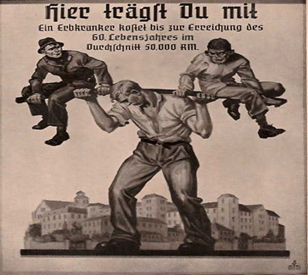
Roughly translated, the text reads as follows: “These genetically ill people will cost our people’s community 50,000 marks over the course of each one’s lifetime. Citizen, that is our money.” A key word here is “genetically” as this becomes a way to stigmatize ethnic groups and other “undesirable groups” such as homosexuals.
This kind of brutal dehumanization operates on the basis of the myths of perfection and efficiency, two myths that Hitler and his propaganda machine exploited ferociously, to the point that Joseph Goebbels, Hitler’s minister of propaganda, based the entire Nazi platform upon them: “Our starting point is not the individual: We do not subscribe to the view that one should feed the hungry, give drink to the thirsty, or clothe the naked … Our objectives are different: We must have a healthy people in order to prevail in the world.” Of course “feeding the hungry” is more than “starting with the individual. In fact, feeding the hungry is a way to start with community and with shared responsibility, both characteristics that promote empathy and compassion. Breeding a super race is the epitome of individualism—sacrificing all shared feeling to a pre-determined desire to dominate.
This and other such posters privilege the ideal of Aryan perfection (white skin, blond hair, blue eyes), something that Hitler’s head filmmaker also focused on in her 1934 documentary, Triumph of the Will, which opens with four title cards that communicate the way the Nazi party viewed their military pursuits as a pursuit of satisfaction (or, at the very least, the release from suffering)
The rest of the propaganda film capitalizes on the myths of modernity in ways that position Germany as fully justified and capable of using weaker, less efficient humans as standing reserve: First, it is presented as a massive human machine, as seen in the huge military crowd shots. The Nazi’s are themselves depicted as machine like in formation and as healthy and strong in the crowd shots of Aryan youth:
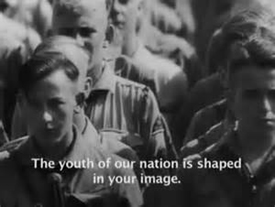
As such they seem poised to use weaker humans as standing reserve.
In closer shots we see young, well-fed, satisfied men and more youthful aryan profiles.
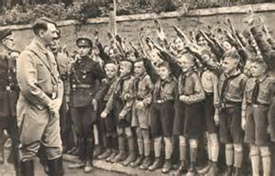
Almost like perfect robots themselves, these young men seem poised to either use or be used by others, to either consume or be consumed.
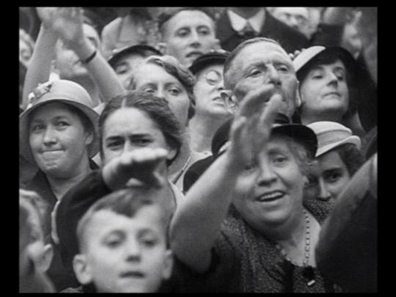
Along with the myths of perfection, efficiency, and satisfaction, Hitler capitalized on the myth of innovation and progress, using posters and military displays to show Germany’s superiority to all the world in the1937 Paris World Fair that ran mere months after Hitler’s planes had bombed Guernica a small town in Spain fighting against a fascist dictator, and less than a year before Hitler’s forces invaded Poland in what most historians agree was the official beginning of the second world war. This Mercedes poster, below, hung in the German Pavilion, under the guise of showcasing “new technology, virtually shouts out the invasions to come.
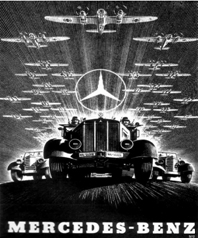
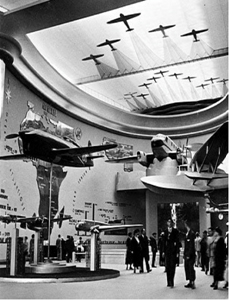
The beautifully arranged aircrafts in the pavilion similarly show the threat of Germany’s military: