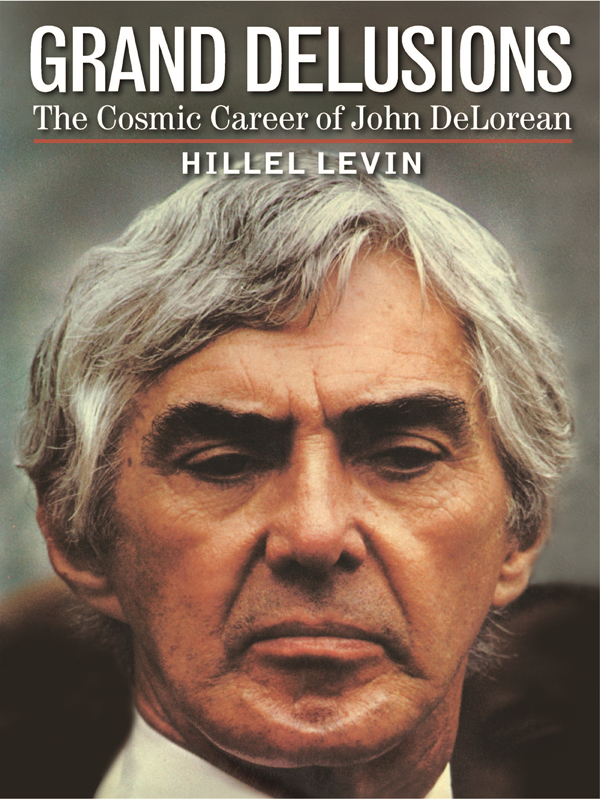

Copyright © 1983 by Hillel Levin All rights reserved First published in 1983 by The Viking Press
LIBRARY OF CONGRESS CATALOGING IN PUBLICATION DATA
Levin, Hillel.
Grand delusions.
1. De Lorean, John Z. 2. Businessmen—United States— Biography. 3. Automobile industry and trade. I. Title. HC102.5.D4L48 1983 338.7‘6292222’0924 [B] 83-47906
Grateful acknowledgment is made to Lawrence Institute of Technology for permission to reprint “Know You What It Is to Be an Engineer,” by John De Lorean, which appeared in Tech News.
ISBN: 9781483522647
Foreword
I first interviewed John De Lorean while on assignment for New York magazine in the spring of 1979. Like so many other reporters, I was struck by his charm and intelligence. I was also caught up in his effort, then well under way, to build his own sports car. In preparing a favorable profile, I used no more than our three hours of conversation and his glowing press clips as source information. Before New York could run my story, several other De Lorean articles went to print. My editors decided not to be lost in the shuffle and eventually killed my piece.
Two years later, as senior editor of Monthly Detroit magazine, I returned to De Lorean in much different circumstances. His first stainless steel, gull-winged cars had already rolled off the assembly line, and I was getting reports from dealers around the country about shoddy product quality. I also received a copy of the prospectus for a new stock offering that significantly reorganized the car company. At just a glance, I could see that the goals he once articulated for the De Lorean Motor Company had drastically changed.
What interested me most, however, were other changes in his personal holdings, especially the De Lorean Manufacturing Company. When I hunted up annual reports for this Michigan firm, filed with the state’s Department of Corporations and Securities, I found a list of other places of business, which included Route #1, Salmon, Idaho. From there I followed a paper trail of lawsuits and court hearings—all leading to an area of De Lorean’s past business affairs that had never before been examined by the press.
As I would write in the magazine, the details that emerged from De Lorean’s Byzantine empire did not amount to a flattering portrait, but rather one of “a man who has reached too far, perhaps jeopardizing all he has already gained.” I gave De Lorean a chance to respond to several disturbing questions about his business conduct raised by my research, and he chose to speak with me on the telephone. Our tense conversation lasted for ninety minutes. He called me again, before the magazine went to press, warning me that I was “doing tremendous injury to the people there in [the] Belfast [Northern Ireland assembly plant].” It was the last time De Lorean was willing to speak to me. The resulting article, which appeared in December 1981, was some 5,000 words long, but I felt I had only scratched the surface of the De Lorean story.
Even as De Lorean’s car company unraveled around him, the American press was still reluctant to look closely at the legend he had spun. The time would come, almost one year after my article, when De Lorean’s record would be scrutinized more carefully, but it took the auto executive’s arrest with over $24 million of cocaine to spark the media’s interest.
While De Lorean’s involvement with narcotics has made him newsworthy, there is no evidence that he had any long-term relationship with illegal drugs, either as a user or dealer. Instead, his arrest appears to be a jarring coda to a fascinating career—a career that I believe deserves close and thorough examination in its entirety.
John Z. De Lorean remains a sensitive subject for all those who have worked with him. While some people were willing to be interviewed about De Lorean, for a variety of personal reasons, they asked not to be identified by name. I fully appreciate their concerns, and when quoting them, refer to only the generic terms for their positions. Many more sources have given me permission to attribute quotes directly. I’m deeply grateful to everyone who aided my research.
Acknowledgments
Kirk Cheyfitz, the editor of the magazine article I did on De Lorean, remains the guiding force behind this project. In bringing me to Detroit, he restored my faith in the potential of journalism and gave me opportunities that I had never known before in this profession. He continues as my editor at Metropolitan Detroit, and I’m proud to call him a friend and teacher.
My thanks also go to the other founders of Metropolitan Detroit— Tom Jones, Eric Keller, Jane Rayburn, and Jack Felker—who all put up with my repeated absences at a crucial stage in the magazine’s development.
As a novice at book writing I’m greatly indebted to my agents, Paula Diamond and Nat Sobel, who have directed and sustained this effort from beginning to end. I’m also grateful for the considerable aid I received in the development and preparation of the manuscript from my editor at Viking, Alan Williams.
In Detroit, my principal researcher was Mike Morgan. I had further help from lawyer Lawrence C. Burgess.
Contents
- 1 -
The Shell
- 2 -
Dark Secrets
- 3 -
A Company Man
- 4 -
High Performance
- 5 -
Hollywood
- 6 -
Falling from the Fourteenth Floor
- 7 -
A Very Brilliant Financial Analyst
- 8 -
Four Bad Deals
- 9 -
100 West Long Lake
- 10 -
Silver Beauty
- 11 -
Forty-five Days
- 12 -
GPD
- 13 -
Belfast
- 14 -
New York
- 15 -
Irvine
- 16 -
The Ethical Car
- 17 -
Out of Control
- 18 -
Roy to the Rescue
- 19 -
Trapped in a Terrible Tower
- 20 -
Aftermath
- 21 -
Epilogue
— 1 —
The Shell
Forty-three stories above 280 Park Avenue, the smoked-glass doors of the De Lorean Motor Corporation headquarters swung open to an expanse of white marble floor and red upholstered furniture. A brown glass reception desk—long enough for ten secretaries— loomed straight ahead. Once corporate headquarters for Xerox, this penthouse suite now made an impressive setting for a company that had only begun manufacturing and was still far away from turning a profit.
In the fall of 1981, Robert Henkel became a frequent visitor to the De Lorean sanctum. “There was,” he says today, “a tremendous excitement in those offices—not just among the executives. Even down to the secretaries and maintenance men.”
As executive vice president for the public relations agency of Carl Byoir & Associates, Henkel had the job—within the span of a fifteen-minute promotional film—of transmitting that excitement to all the De Lorean employees, dealers, and potential customers who would never ride an express elevator to the top of the Bankers Trust Building.
He worked mostly with the company’s in-house PR staff. Occasionally John Z. De Lorean himself would wander into their meetings. With a smile and a nod, he’d ask what they were up to, and then sit back, in his light blue Pierre Cardin shirt-sleeves, and pensively listen to their explanations. “He struck me as a person with natural curiosity,” Henkel recalls. “He wanted to know how we did this or that. He seemed to appreciate the importance of what we were doing, and no doubt he was very creative himself.”
It took Henkel a few months to put the finishing touches on an eleven-page proposal for a film he entitled, The De Lorean Dream: A Reality that Works. But by the time he submitted the script in December, the dream was already disintegrating around De Lorean. The public relations project went no further. Henkel wouldn’t even see payment for his services.
Nevertheless, his stillborn proposal remains a fascinating relic of the De Lorean empire—a typewritten inscription for a latter-day Ozymandias. The last page of Henkel’s film treatment follows:
We return now to John De Lorean in his office, standing in front of a worldwide map or some other business graph.
He says something like this: “Our dream is coming true, and justifying the calculated risk we took. Sure, I’m a risk taker. And the people who drive our De Lorean car are probably risk takers, too. People who dare to lead other people. People who live life to its fullest potential. People who enjoy the special exhilaration of making things happen. People who dream of a better world, and do whatever is needed to transform that dream into reality.”
John De Lorean is next shown sitting inside his car. He ends by saying, “As hard as I’ve struggled, I’m one man who can say that my dream has come true. Our difficult efforts have succeeded, life is good, and I’m grateful!”
Then De Lorean closes the car and drives off onto a handsome modern highway with elegant city skyscrapers in the background. Closing music and credits appear over this final radiant scene.
De Lorean’s words in the script were his own—pasted together from speeches he had delivered over the years—and they ring with the blare of Sixties-style pop psychology. Taking risks, daring to lead, making things happen, living life to the fullest: these were the credos of a turbulent, activist decade—probably the most important period in De Lorean’s adult life. He would keep his Sixties’ sensibilities along with his predilection for long, drooping collars, turtlenecks and bell-bottom pants. He also kept the era’s fascination with dreams—not the ones that were cooped up in the bedroom, but the dreams that trembled on the verge of fulfillment for those bold enough to “do whatever is needed to transform … dream into reality.”
Oddly enough, in the Henkel script as well as in the few ads that De Lorean actually completed, the chief executive’s personal success was more prominently featured than his stainless-steel product. This strategy may have helped endow the car with the glamour of its namesake’s wealth and power. But the personal sales appeal worked at another level. De Lorean’s customers did not only get a car. They also became a part of what De Lorean liked to call his “personal Horatio Alger dream.”
In a dream come true, De Lorean would have ended his own story as happily as Henkel closed the film—the modern industrial hero riding his gleaming dream car into the sunset. But on the night of October 19, 1982, less than one year after Henkel finished writing his proposal, the eyes of the world were to see John De Lorean in a very different “radiant scene,” one lit by the icy blue glare of photographers’ strobe lights. This time he would not be riding off in his own car, but in the backseat of a police car with his hands cuffed behind him.
He was arrested earlier that evening with more than $16 million worth of cocaine. In the first few dispatches to beam out over the news wires, he had to take second billing to the narcotic that has become a Hollywood celebrity in its own right, and the headlines read, BUSINESSMAN HELD IN COCAINE DEAL.
But if there were some members of the press who were not aware of De Lorean or his gull-winged innovation, the legal authorities were quick to provide them with the details. They made the car company his prime motive for breaking the law. De Lorean would have gone to any end to save his dream, prosecutors charged, and the drug deal was his last-ditch, Faustian bid to buy back the assembly plant.
It was the climax to a drama that had played for months in hotel-room stakeouts around the country. The select audience—federal authorities with videotape cameras—watched behind two-way mirrors. Some of the cast were indeed actors: agents of the FBI and the Drug Enforcement Administration posing as Mafiosi drug dealers. But the police charge that other performers, such as pilot William Morgan Hetrick, who allegedly smuggled the cocaine into the country, and his indicted accomplice, Stephen Lee Arrington, were not playacting. The sting, the authorities say, was initially staged for the benefit of Hetrick and Arrington. De Lorean was the walk-on who ended up stealing the show. Only moments before the arrest, De Lorean had held up a packet of dope and crowed, “This is better than gold.” And he brought down the curtain by pouring wine all around and proposing a toast to one of the great moments in his career.
His battery of high-powered defense lawyers was left with the monumental task of proving that the authorities had preyed on De Lorean’s desperation to save his company and lured him into a deal he would never have attempted on his own.
Such legal strategies may keep a man out of jail, but they do little to salvage his good name. They do nothing to blot out the pictures of a rumpled, downcast De Lorean, slumped in the backseat of the police car. No one understands that better than John De Lorean. His public image was his most finely crafted creation. Ironically, his final attempt to keep up appearances would pull them down forever.
Jail, De Lorean liked to tell reporters, was graduate school for many young men in the tough Detroit neighborhood where he grew up. He would add, half jokingly, that he was lucky not to have joined them.
De Lorean’s own route to incarceration strayed far from the paths of his childhood friends. Along the way to federal prison on Terminal Island—where he stayed two weeks until bail bonds were raised—he passed through the centers of corporate power and high society in America: from the boardrooms of General Motors to Hollywood, Wall Street, and Fifth Avenue.
These travels were accompanied by a more internal voyage, which started back at General Motors when the brilliant young engineer realized that he’d need more than mechanical sophistication to climb the corporate ladder. His involvement with the company product moved outward—from the gritty detail of the transmission and suspension, to the surface appeal of its gleaming metal shell, and finally to how the whole package was marketed to the masses. The public, he discovered, bought the wrapping—not the contents.
He rose to be the youngest general manager at Pontiac in the history of the division. With his flair for merchandising, he was given the lion’s share of credit for changing the image of what had once been “the old lady’s car.” In the process, he changed his own image as well. By the end of the Sixties, he had gone through extensive facial cosmetic surgery. He dieted half the weight of his six-foot-four-inch frame away and built up the other half with barbells. Even his closest friends were shocked by the obsession with his appearance. He filled his home with mirrors, and in later years he carried a compact so he could check his face in the backseats of limos and blot his complexion with corn starch. He limited his wardrobe to a few styles and colors that most flattered his figure and, some say, he had many sets of the same light blue, high-collared shirt, and dark blue, Italian-cut suit. His efforts at reconstruction went beyond the scalpel, reaching even to his Eastern European roots, which he later denied in interviews.
Much to the chagrin of his General Motors superiors, he also remodeled his lifestyle. He made an effort to spend more time on the West Coast, making the nightclub scene with Hollywood celebrities and race-car drivers. He divorced his wife of fifteen years, dated movie starlets, and finally settled for a nineteen-year-old as his second bride.
He didn’t just marry youth, he incorporated it. Young people, who had long been ignored by Detroit automakers, were buying his fast, sleek Pontiacs and turning the division into a powerhouse. In a time when the media focused on a generation gap, De Lorean jumped to the other side, becoming a vocal defender of youthful protest and an incisive critic of the establishment—even as he climbed higher into the General Motors stratosphere. Never had the Detroit press corps found a top auto executive both so accessible and such good copy. When they pegged him as eventual chief executive material, it was partly wishful thinking.
Yet his departure from General Motors in 1973 did not dismay De Lorean’s admirers. For a lesser mortal, it would have been an ignominious development. With De Lorean, it took on the shining armor of high moral principle. His initial explanation laid the blame on his promotion from general manager at Chevrolet to policymaking vice president on the vaunted fourteenth floor of GM’s headquarters. In his favorite analogy, he had gone from quarterback “to the guy who owned the stadium,” and the cramps from his inactive managerial muscles became unbearable.
But as time went on, the reasons he gave for leaving became more pointed. His most detailed account of the split would emerge with the publication, in 1979, of On A Clear Day You Can See General Motors, a scathing attack on the wisdom and morality of GM’s management, which he wrote as a first-person narrative with the considerable aid of longtime Detroit automotive reporter J. Patrick Wright. Already embarked on the developmental stages of his own car company, De Lorean tried to stop publication of the book, fearful that the wrath of GM would snuff out his infant firm. Wright finally published the book himself, but De Lorean still garnered credit as a courageous critic. Eventually, the book’s place on the best-seller list only added luster to the De Lorean success story.
He did not need the book to bring him publicity. His supposedly gutsy career change and conquest of mid-life crisis was immortalized by Gail Sheehy in Passages. Despite his exile from GM, he remained hot copy for business reporters, always the ideal subject for an interview. He was never too busy for the press. Before an interview was over, he could bring up the Beach Boys, quote Montaigne, or mention the ruminations on human misery by social historian Peter Gay. Just as important, he listened. Like a gracious host, he turned encounters with reporters into casual conversations. The results that reached publication were almost reverential. His stellar achievements at GM seemed to glow even more brightly in retrospect.
If the seeker had been anyone but De Lorean, the quest to start a new auto company might have been written off. But the press was caught up in his dream to produce the “ethical car,” and closely followed his search for investors. Ultimately, it seemed as though De Lorean had done the impossible. Against all predictions, and beyond even his own best expectations, he landed over $90 million in start-up money from the British government. Their condition—that he build the cars in strife-torn Northern Ireland—paled next to the magnitude of the windfall.
Even before one of his stainless-steel, gull-winged cars plopped off the assembly line, he already appeared to be climbing to the top of America’s corporate, capitalist royalty. His residential estates, apartments, and ranches dotted the country. Their garages were filled with a private fleet of expensive cars. His third wife was an elegant, raven-haired beauty and one of the world’s highest-paid professional models. All this, and he still professed a social conscience, and a desire to be a good corporate citizen.
It was all too good to be true.
And it wasn’t true.
John De Lorean had not led just a double life. He led a quadruple life. Even as he sealed his deal with the British government and seemed ready to change the face of the automobile industry, his own pristine facade was starting to crumble away. Press clips were not the only chronicle of De Lorean during the Seventies. Court documents in lawsuits filed across the nation told another story, and they ran alongside the laudatory media accounts like photographic negatives.
Miniature auto racetracks; a breakthrough engine-coolant system; a cattle ranch; an auto dealership; a warehouse of CB radios; movie projectors for salesmen: all belong to a motley catalogue of soured deals that ended up in rancorous court battles. In these arenas, John De Lorean was not a lone gunfighter up against greedy corporate giants. His opponents charged that he was the goliath, trampling their precious dreams underfoot. One case carries the strong implication that his relationship with a GM supplier forced his exit from the corporation.
The records show that De Lorean did pay a heavy price to live his dream, assembling an unwieldy string of incongruous properties that sapped his energy and periodically threatened his bank account. It was all he could do to hold his byzantine empire together, while he canvassed for new partners to support his auto venture.
Cited in virtually all of the lawsuits was Roy Nesseth, a huge, six-foot-six, former car salesman. His intimidating performances mark the course of the less-publicized business career of John Z. De Lorean. Nesseth, a man who is alternately charming and offensive, has a record of civil lawsuits that runs through the indexes of Los Angeles courthouses like a page torn from a telephone directory.
De Lorean once described Nesseth to one of his auto-company executives as “a mean man who enjoyed being mean.” He told others that Nesseth was a man who could get things done, and he counted on him to extricate the De Lorean name and fortune from investments that went bad. Despite warnings from De Lorean’s associates that Nesseth’s bullying—and, possibly, illegal—tactics did more harm than good, the two men grew only closer over the years. It was an affinity that mystified some De Lorean friends, but more important, it was a bond that most knew little about. In his world of business transactions, the orbits of De Lorean’s satellites seldom intersected.
Only one man besides De Lorean is capable of putting the pieces together: his personal lawyer, Thomas Kimmerly. A mild-mannered tax specialist of slight build and owlish countenance, Kimmerly is the antithesis of Nesseth, preferring to blend into the background instead of taking center stage. The mastermind behind the web of De Lorean holding companies and subsidiaries, during the last decade Kimmerly became De Lorean’s closest and most loyal business associate. Together, Kimmerly and Nesseth helped mask De Lorean’s more embarrassing forays into private enterprise. In any case, the British government, like the media, seemed more anxious to accept the De Lorean myth. Their charity became his undoing.
The car company, like nothing before, tested the power and limitations of De Lorean’s delusions. His ability to attract financing, auto dealers, and accomplished executives to his unlikely project revealed the stuff that the industry’s pioneers were made of. In the process, he created a whirlpool that sucked in both the British government and his employees. The fact that they brought the company as far as they did—even as they lost faith in De Lorean’s legendary prowess—remains a testament to their own determination.
The corporate renegade who had continually tested his superiors at GM suddenly found himself in charge, and there was no one to keep him in check. His expenses skyrocketed and company funds found their way into his personal household. For all the talk of a dream fulfilled, De Lorean’s attention wandered off the car and onto other projects. Some of his executives wondered whether he was enriching himself at the expense of the British-backed company—much the same accusation he had once made against GM’s brass. If anything, he seemed intent on repeating the litany of managerial errors he’d recited in On A Clear Day. His headlong rush to reap a paper profit—the shortsighted business behavior he had once so roundly condemned—doomed his dream to insolvency.
The wreckage of the De Lorean Motor Company is scattered across two continents: from the unpaid bills of a multinational conglomerate in France, to the dashed hopes and dignity of an assembly worker in Belfast, to a small parts-supplier in California. But the ultimate victim of his own delusions was John De Lorean.
In the summer of 1982, when all those around him saw imminent collapse, he—for the first time—saw a reason to invest personal funds in the dream car. The last evangelist in his own church, he still tried to convince auto dealers and investors that somewhere behind the miasma of mounting debt, there had been a stunning success. Even when Kimmerly and Nesseth couldn’t find the impossible solution, De Lorean believed that he could summon the miracle, and took matters into his own hands.
Finally, he would find salvation—or so he thought—in a Mafia drug dealer. This was not an investor who cared about an “ethical car company,” or an “ethical” anything. De Lorean’s pitch could be aimed no higher than greed.
In exchange for his piece in a narcotics transaction that could net $60 million, he offered half his stock in De Lorean Motor Company, Inc. In fact, DMC, Inc. was something quite different from the De Lorean Motor Company. Formed some time before by Kimmerly, it existed as no more than a paper entity—a shell company—and ultimately another hollow prop in a De Lorean charade.
— 2 —
Dark Secrets
It took a while, but Michigan Bell finally caught up with John Z. De Lorean. For months, the twenty-three-year-old had plied Detroit in a battered green utility truck, offering merchants advertisements in something he called the Yellow Pages. He made enough money on his first calls to even print up a few copies of his Yellow Pages for the advertisers.
The scam was no news for his close friends at the Lawrence Institute of Technology. The phone company didn’t worry him, he laughed. He had just started attending law school at night and had already researched copyright law. Michigan Bell had forgotten to register its Yellow Pages as a trademark. His whole scheme was made in the shade.
Of course, Michigan Bell’s lawyers were of a different opinion, and they weren’t going to stop with a civil suit. They demanded criminal prosecution as well. The college boy had sold advertising under false pretenses, not only denying Bell its rightful returns but also bilking the misbegotten merchants.
The news about the phony phone books quickly buzzed through Lawrence Tech. The perpetrator wasn’t just any member of the 1948 graduating class; if the engineering school had a Big Man on Campus, it was John De Lorean. He wrote a column for the school paper, sat on the student council, made the Lambda Iota Tau honor society and organized the first chapter at the college of the American Society of Industrial Engineers. To top it off, he could do the jitterbug with the best of them, and often did, spinning the prettiest girls at dances. The lanky young man with the unruly shock of hair seemed to have everything else in life at his fingertips. But suddenly, Michigan Bell threatened to bring the big bopper down to earth. In the eyes of some classmates a brilliant career hovered on the brink of oblivion even before graduation.
When John De Lorean returned home from college each night, he needed no reminder of how far he had already come in the world, and of how far he had yet to go. He still lived with his mother and younger brothers on the east side of Detroit in a narrow wood-framed bungalow, crammed between two other small homes. The house was just a few streets from the railroad tracks in one direction, and a few streets from an elevated freeway in the other— stuck in a dingy matrix of flat treeless streets crowded with tiny shingled houses. Bars, gas stations, and body shops dotted the main avenues.
When John was growing up, most of the neighbors were of Eastern European stock: still peasants who sowed postage-stamp backyards with vegetable gardens, slaughtered their own pigs, and made their own wine from the vines hanging off their garages. Although they took pride in their small homes, carefully cutting the grass and sweeping their sidewalks, the working-class neighborhood never measured up for their children. It was a place to leave behind.
John was born to Zachary and Katherine Pribak DeLorean on January 6, 1925, the first of four sons. His father was a tall, dark-browed, brooding man who sweated out a living in the foundries of the Ford Motor Company. The next to last of fourteen children in a farming family that lived just west of Bucharest, Rumania, Zachary had come to America alone as a teenager. According to John, before his father found factory work in Detroit, he was a ranch hand in Montana, and a steelworker and policeman in Gary, Indiana. The latter occupation seems most odd since the elder De Lorean was not fluent in English, but at the turn of the century, the constabulary of industrial cities often hired immigrants to keep order during worker demonstrations.
There was evidently no great affection between father and son. In fact, as John grew older, he became more vague about Zachary’s ethnic origins. In early interviews he placed his father’s birthplace in middle Europe, and later, in the Alsace-Lorraine region of France. In 1974, while on a trip to an auto factory in central Rumania, De Lorean actually had the chance to visit Zachary’s hometown. He was accompanied by two other Rumanians. One, Reo Campian, also grew up on Detroit’s east side. “I couldn’t understand it,” Campian recalls. “Here we were near the village where his father was from and he didn’t want to see it. I couldn’t understand why he didn’t want to go.”
De Lorean was not embarrassed by his father’s problems with alcohol or marriage. He is brutally frank in interviews and in his recollections for J. Patrick Wright in On A Clear Day You Can See General Motors. In the book, he says of his father, “He was a big man at six foot one and 220 pounds and enjoyed a certain amount of physical violence. Not that he was mean, but he got into his share of fights, sometimes after having a few beers with the boys after work.”
While he attributes some of Zachary’s bellicose behavior to his difficulties with the English language, he doesn’t say what his father’s native tongue was. As he told Wright, “Part of my dad’s inclination toward fisticuffs came from a deep frustration caused by his inability to communicate effectively and thereby capitalize on his mechanical genius. He was uneducated when he came to the U.S. and he couldn’t speak English. Though he eventually mastered the language, he always spoke with a trace of an accent.”
John’s grade school records report that primarily Rumanian was spoken in his home. He explains in the book, “I do know that [my father’s] frustration with his inability to verbally get out the things that were inside of him eventually led to a serious drinking problem which resulted in the breakup of our home.”
De Lorean blames Ford for his father’s frustration as well. No matter how well Zachary spoke English, he asserts, management wouldn’t have taken him seriously. In a later interview with one reporter he says, “[my father] was one of the more intelligent people I’ve ever met. Among the corporate executives I’ve known in my lifetime, and I’ve known a lot of them, I don’t know of a single man who was dramatically more intelligent than my father. But the way the world cast its lot, he was destined to be a common laborer all his life… . He led a frustrated life because he felt he had a contribution to make and the mechanism by which he could make a contribution wasn’t available to him. Nobody would listen when you’re just a little guy down on a foundry floor.”
In the book, as he often did in interviews, De Lorean graphically recounts his favorite story about the indignities of working for Ford: how company security men broke into his childhood home one morning and ransacked it in a futile search for stolen tools. He calls the intruders, “Harry Bennett’s goons.” Bennett was a brawler who rose from bodyguard to head of Henry Ford’s private police force and became the second most powerful man in the company. Whether or not his men did break into De Lorean’s house, two of John’s childhood friends recall that it was Bennett who actually hired Zachary for his foundry job to begin with. Evidently the older DeLorean had come highly recommended by a local political hack who assured the antiunion Bennett that Zachary was “a character with a closed mouth.” Certainly his former stint working for the police in Gary couldn’t have hurt. It wasn’t unusual for Bennett to hire workers. It has been estimated that for a while in the Thirties and Forties, one out of three men on the shop floor was doing double duty as a Bennett spy.
Whatever De Lorean’s later reflections on his father’s stunted talent, as a child his affections lay with his mother. She, too, was an immigrant. But she arrived in America from Salzburg, Austria, as a child, and was better adjusted to American life than her husband. When the couple fought, she often took the children and left for long periods to join her family in Los Angeles. The DeLoreans finally divorced after John left high school, but he continued to live with his mother until he first married at the age of twenty-nine.
In On A Clear Day, De Lorean calls her “an incredible woman,” and most who knew her agree. At times she held down two jobs to support her four sons. She worked longest for General Electric as a tool assembler. Active in the local church, she also found time to garden around her house. Neighbors remember her trellises covered with roses.
The constant shuttling back and forth to Los Angeles made it difficult for John to fit in with the kids from the neighborhood. He tended to hang out with older boys whose fathers worked with Zachary. At one time he earned some money working at a friend’s newsstand, although he ended up losing most of the wages to his employer pitching pennies against a curb.
Although most of the parents in the area were hardworking, their American-born children were not as willing to fit into the system as law-abiding cogs in the wheel. Reo Campian grew up around the corner from the De Loreans. He remembers an adolescence filled with random fights and petty lawlessness. Teens would graduate from stealing the tires off cars to breaking and entering homes. “Some people on my block made a living from stealing,” he says. Today Campian owns a successful engineering firm, but he adds, “It took some hard work and good luck to get where I did. A lot of my friends wound up in Jackson [Michigan state prison].”
The teenagers Campian knew who got into trouble did so on their own. But one contemporary recalls that there were others who had some help from adults. Even after Prohibition, the mob thrived in Motor City. The government may have permitted alcohol, but taxed it heavily. Canada and cheaper booze lay just a few minutes’ cruise over the Detroit River. The smugglers’ favorite craft were the pleasure boats they borrowed from the yacht clubs on the city’s east side. Often they had street kids riding along in the hold to help load the contraband. Children were also used as runners between their nightclubs—not the safest job at a time when rival gangs were engaged in mutual annihilation.
Henry Ford, the man who choreographed the nightmare of the fathers’ working lives, also directed the dreams of their children. He became the prime example of what a little mechanical know-how could reap. Ford was no more than a semiliterate farm boy when he first came to Detroit, and his tinkering would bring him one of the world’s greatest fortunes.
John De Lorean was only ten years old when he grappled with his first car in the tiny wooden garage in the alley behind his house. Underneath the steel shell lay dark secrets of grease and iron to be fathomed on endless Saturday afternoons. “It was an old Model T that my dad bought for us for some insignificant amount,” he remembers. “We’d take it apart and he’d always have to come out again and put it back together for us.”
Of course, boys did not just take apart cars hoping to be a mechanic in a service station. “In those days being an engineer was a big deal,” Reo Campian says. “It was a title and it was a good job. That’s the sort of thing kids in the neighborhood shot for.”
From the start John De Lorean wanted to be an engineer. In interviews and in On A Clear Day he represents himself as a poor student in grade school who hung out with juvenile delinquents. “I know about being a street kid,” he told a reporter for the Detroit Free Press. “I learned about getting in trouble. I thought the whole world grew up like I did.”
But De Lorean’s neighbors from those days don’t think he was as tough a street kid as he says. “I remember him as being studious,” says one man his own age who grew up in the house behind the DeLoreans’. “While everybody else was playing baseball, [John] had his books. He wasn’t much like the rest of us.” For a boy who was willing to study, Detroit in the 1930s offered unlimited possibilities. Probably no city in America better demonstrated the opportunities of capitalism and democracy: the public school system meshing perfectly with private industry to offer any good student a secure job after graduation.
The first rung on the ladder for aspiring engineers was Cass Technical High School. As De Lorean says, his elementary school years may have suffered from his constant travels to Los Angeles with his mother, but he had to have above-average grades to get into Cass—and getting in was much easier than getting out with a diploma.
Housed in an imposing seven-story limestone building, Cass offered its predominantly male students practical training in such careers as drafting, mechanical engineering, and electronics. But a liberal arts education ran alongside the vocational classes and the standards in those courses were high as well. “English and math were especially rough,” Thaddeus Pietrykowski remembers. An engineer today, he entered Cass the same year as De Lorean. “I was in one algebra class with twenty-four students, and eighteen flunked out. That was pretty typical. They didn’t bend over backwards to help you at that school. If you didn’t study, you were gone. I believe that in our time only one out of six entering as freshmen ever graduated.”
Often Cass students got enough training to go into industry without a diploma. Although he did not continue on to college, Reo Campian, who went to Cass a few years after De Lorean, wound up at a drafting table at Fisher Body. Long after De Lorean had left the school, Campian says, his mechanical drawings were still displayed in the hall. “They were so neat and meticulous, they were like works of art.”
De Lorean made his mark at Cass primarily as a student, but his classmates also elected him a class representative and member of the senior council. Among his extracurricular activities were the Radio Club and something called the Star Delta Club, which featured field trips to such places as a radio-station transmitter and telephone company switching house.
In the yearbook pictures, young John stands surrounded by an ethnic melting pot: children named Ryan, Hrit, Palazzolo, Gotkowski, Soo Hoo, and Goldstein. De Lorean was a year younger than most of his graduating class and despite his height, he looks less mature, although very serious with his furrowed brow. His face is soft, with a weak chin, and his head appears disproportionately small on a long neck and gangling body.
College was to be the first of the many radical transformations in De Lorean’s personality and appearance that layer his life like geological strata. The Lawrence Institute of Technology was an unlikely place to improve his social skills. Far from the typical college campus, the school was only one ivy-covered Georgian-style mansion and located down the street from Chrysler’s Highland Park headquarters. Hardly ten years old when De Lorean entered in the fall of 1941, the school was started by the two Lawrence brothers, who felt that even in the midst of the Depression the auto industry needed a nearby breeding ground for engineering talent. The brothers’ lofty hope was to offer the chance for a degree to all those who wanted one, no matter what their financial status. If students had to work to support a family, they could earn their degree at night. Those who were especially bright and able to pass an entrance exam could earn a full scholarship for day classes.
But the school administrators were wise enough to make Lawrence Tech more than an advanced vocational training center. Although all the students commuted from home, they were offered all the typical collegiate trappings—varsity sports, school bands, newspapers, and fraternities. “Whatever impression you might have of engineering schools and students,” says John Fawcett, a professor from De Lorean’s era, “it was actually a very informal, tight-knit place. Most of the teachers were on a first-name basis with the students, and I think the students were pretty close with each other as well.”
With the start of World War II and the specter of the draft, it was hard, even for engineering students, to take study all that seriously. In his freshman year, John De Lorean quickly became the school’s most irreverent student spokesman. He immediately plunged into extracurricular activities, starting out with the anemic college band. The group is pictured in a 1942 yearbook wearing Salvation Army-style uniforms. De Lorean had picked up the clarinet in high school and had led his own neighborhood dance band over the summer, and eventually he’d push the college ensemble from Sousa to swing.
But first, the freshman became the band’s biggest recruiter. He joined the Lawrence Tech News and wrote two columns he called, “Music Makers” and “Men of Note.” In the first he’d ask, “Where are the jive hounds around this jernt? The LIT band had dwindled from the thirty-one pieces of Smartie Pshaw’s poor man’s symphony to the six-man size of Benya Goodman’s Sextet (Benny and his five bagels)… . Gendemen, Lawrence Tech is a major College that does not have a major dance band. This certainly is not the type of distinction we want. So, let’s get out and do something about it!”
The band didn’t fare much better, but De Lorean stuck with the biweekly paper, inaugurating a joke column he called, “5 with D.” He’d later aptly caption the spot as “a place where old jokes go to die,” many on the order of the following: “As a Burlesque queen said when she woke up one morning and found herself fully clothed—‘My God, I’ve been draped.’”
The column was more a showcase for jive talk than humor. “Hey, cat,” one party in a story says to another, “you look shot to the sox.” Or “I was talking to a pretty girl and trying to dig up jive for this five minute intermission. I said, ‘Hurry up Fat Woman, I got a deadline to make.’ She said, ‘Tell it to me anyhow.’” The story is followed by De Lorean’s offer to give “a special course to explain my jokes.”
Most of the jokes poked fun at the school administrators and other students. Some were self-deprecating as well. At first he made the author of each column another variation on De Lorean: H. V. De Loreanborn, Ross De Loreanhollen, and so on. But, more important, he used the newspaper to create another John De Lorean. This version was not Rumanian, but in his words, “the leering Frenchman.” This John De Lorean was also a hip sophisticate, an insouciant rake and inveterate bar-hopper. He leads off one column with: “What popular, handsome, dashing Tech student got kicked out of three jernts last night? What can Ido for a bruised eye?” He casts himself as the lead in most of his necking jokes as well: “I kissed her. She sighed. I said, ‘Don’t mention it, the pressure was all mine.’”
His newsprint image may not have been idle boasting. The awkward adolescent had filled out, and his face became longer and leaner. He had the large almond-shaped eyes and dark features of a Hollywood Latin lover. “He was quite a ladies’ man,” one of his Lawrence Tech frat brothers remembers. “It didn’t seem as though he had any problem finding women. But he was very vain about his looks. Whenever he passed a mirror, he glanced over to see himself, or tried to comb down his hair. He was an immaculate dresser, always wearing the most stylish things. I never figured out where he got the money for those clothes.”
The spring semester of 1943 was the last De Lorean spent as a civilian. He signed off for the duration with one more joke: “In my spare time I’ve written a book on how to stay out of the army. Those who wish to secure a copy of this infallible booklet should send twenty-four cents to … Pvt. J. Sachelpants De Lorean at Camp Custard. But, seriously, the best way to stay out of the army is to join the navy … s’long JD ERC [Enlisted Reserve Corps].”
The next semester, enrollment at Lawrence Tech plummeted from 2,000 to 200. De Lorean spent the duration on uneventful stateside duty. He returned for the fall semester in 1946, and shortly thereafter resumed “5 with D,” but the column was to be much more truncated. He had the GI Bill paying his tuition and living expenses, but like his veteran classmates, the twenty-one-year-old was anxious to finish school and get out into the working world.
If studying became more frenzied, social life at the school kept pace. Lawrence Tech’s basketball team went big time, playing schools from around the nation. Games were held in the coliseum on the Michigan State Fairgrounds. Afterwards, students adjourned to the nearby Horticultural Building for dances that would go on long into the night, often featuring the best of the big bands—Woody Herman, Gene Krupa, Tex Benecke, Stan Kenton. Although he was going to night school as well, De Lorean didn’t miss a dance. “He was the life of the party,” the wife of one classmate remembers. “I don’t think anybody there could jitterbug like he could.”
His fraternity brother has the same memories. “There was something about crowds that turned him on. He always seemed to project himself out front. And he was a fun guy to be around. He liked to laugh and joke. But I don’t think he had one best friend. He was one of those sorts who’s popular with everyone and not close to anyone in particular.”
He also remembers De Lorean living up to the reputation he painted for himself in the newspaper column. “He liked to drink a lot, and he liked to drive his car as fast as he could go. After my brother’s wedding, he was pulling out of a long, narrow road and there were some old folks ahead of him going too slowly, so he just bumped up right behind them with his car and started pushing them. Another time I got in his car and as soon as we hit the freeway, he kicked that thing up to what must have been eighty miles an hour. Afterwards he told me he thought he had a blister on his tire and he was testing to see whether it would blow. That was the last time I ever rode in his car.”
Nothing about De Lorean’s social life disrupted his schoolwork. “He could just thumb through a book half an hour before a test and have the best grades of anyone,” his frat brother says. Another classmate, Ted Pietrykowski, adds, “He was a genius. It was that simple. He used to say he had a photographic memory and you had to believe it.”
Hurst Wulf, an associate professor at the time, taught De Lorean’s classes in strength of materials, mechanics, and calculus. “He was one of the best students I had,” Wulf says. “I can’t think of one better. The whole thing seemed to be effortless for him; to come naturally. I liked to schedule tests on Monday, so the boys could study over the weekend, but De Lorean would think nothing of going to Chicago and getting back just in time to get a perfect mark on the exam.”
De Lorean stood out in humanities courses as well. One of his favorites was world economics, taught by Edwin Graeffe. Almost a stereotype of the stiff-backed Prussian, Graeffe proudly bore an old dueling scar raked down the side of his face. Despite his threatening appearance, and the fact that his students had recently fought against his countrymen overseas, Graeffe was among the most respected members of the faculty. He liked to play devil’s advocate and De Lorean enjoyed battling him. Having practiced law in Europe, Graeffe encouraged De Lorean to try some legal courses at night school, and he briefly took a stab at them.
But engineering was evidently closer to his heart. Hurst Wulf says, “He always did like engineering best. And he got to be pretty good at it. By his senior year, he figured he could engineer his way out of anything.”
One of the few serious notes he ever struck in his Tech News column was an elegy to the profession. He starts off with a typical wisecrack: “5 with D: By William De Loreanspeare, ‘The Immoral Barge.’” But what follows is evidently, and quite portentously, serious:
Know you what it is to be an Engineer?
It is to have a dream without being conscious you are dreaming lest the dream break; it is to be trapped in a terrible tower of pure science.
It is to live in a mean, bare prison cell and regard yourself the Sovereign of limitless space; it is to turn failure into success, mice into men, rags into riches—stone into buildings, steel into bridges, for each engineer has a magician in his soul.
It is to make the guns roar, the machines hum, the night resound with such meaningful glory as sparks fly up from hidden plants that nightingales cease song in reverence to listen to the call of golden fountains from afar and revel in the promise of moon swept silver stars.