APPENDIX
Existence: Mind in a Box
I want to know Gods thoughts, the rest are details.
Albert Einstein
In contrast to the Newtonian or classical laws of motion, quantum physical laws do not allow us to determine actualities. Instead, we face possibilities.1 For example, using classical physics, when you flip a coin and allow it to land, you can predict with certainty which side will land face-up. To actually do this, however, you would find using classical physics difficult because of complications such as air currents, weight imbalances in the coin, and so on. Instead, you assign a probability of fifty percent that it will land heads, and fifty percent that it will land tails. You give up any hope of control. But within quantum physics we find a new and apparently paradoxical concept: separate possibilities can combine or interfere with each other, which leads to new possibilities. For example, the two possibilities of observing a flipped coin's face could combine and result in the coin standing on its edge. Usually we don't see this, of course, because the coin interacts with many things before it lands. But nevertheless, the separate possibilities of heads and tails, even though they do not manifest simultaneously, can actually interfere with each other and produce new possibilities.
Also, according to standard reasoning in quantum physics, a possibility is only realized when it is observed. A quantum object capable of existing in one of two possible states “suddenly” leaps into one of those states at the instant of observation. This is called the observer effect.
Consider again the example shown earlier in chapter 5 and repeated here. Perhaps this example is just a metaphor; or perhaps it is an actual quantum phenomenon involving quantum processes in your retina, nervous system, and brain. To participate with the quantum process, first observe the white box in figure A.1. Note the two distinctly front and rear square faces of the box. Now look again. Which of these square faces is in front? Is the lower-square face in front? Or the upper-square face? Or perhaps the box is leaping from the former to the latter? Or perhaps it is not seen as a box at all. Note the gray geometrical pieces pasted on the white background. Is it still a box? Why or why not?

Figure A.1. A Cube or Gray Pieces?
According to what has been called the Bohr or Copenhagen interpretation (named after Niels Bohr, a major contributor to the discovery of quantum physics) the box only becomes a real box, with one side apparently forward, when you observe it. In the Bohr interpretation of quantum physics, you cause the event (such as seeing a specific view of the box) to occur. Bohr said that an act of observation involved a merger of two ways of seeing: the classical world of perception and the atomic world of quantum events. By attributing the effect of an observer to an intrinsic eventual merger of the atomic world with the classical world, the question of the nature of the action of observation is left open. The Bohr interpretation says that when an observation takes place the property of the object under scrutiny mysteriously takes on a value. That is to say, we really don't know how an act of observation takes place.
Another interpretation, however, says that the observation of a physical attribute is nothing special and, in fact, when you see the box with a particular face in front, you also see the box with the other face in front at the same time—except that you as a second observer do not exist in this world but in a parallel world, or parallel universe! This has come to be known as the many-worlds interpretation of quantum physics.
How do you prove that the other world exists? According to the many-worlds interpretation, looking at the box once again, you see the superposition of the box simultaneously in its two position-states when you see the picture as gray pieces. Both position-states cannot exist in a single world. But the overlap can. The two states interfere with each other, producing in your mind a picture of gray pieces instead of a box with either side in front. In other words, you see both worlds at the same time, provided you do not see a box. If you choose to see a box, you do not see the gray pieces.
The many-worlds interpretation example given above visually illustrates this interpretation. Hugh Everett III, a graduate student at Princeton University studying under the highly regarded physicist John Archibald Wheeler, came up with the rather strange notion that even though quantum physics posits a view of the world that contradicts common sense, we should take it seriously.2 If it says that two alternative possibilities can interfere with each other, overlapping together in one world, then somehow those alternatives must both exist simultaneously in other worlds. If possibilities affect each other by overlapping each other; if two or more possibilities somehow “add up” to produce a single-world (a consistent picture of reality); then somehow these possibilities must each manifest somewhere else. They must both be real.
Accordingly the two possibilities—although describing separate “you”s, each with a single perspective of the box, and separate boxes—really exist somehow in separate universes. Just as an “interference” pattern can be seen on a bright day when looking through overlapping layers of a fine mesh window curtain, the interference of both universes can be seen as the gray-pieces view. Only when a perspective view of the box was taken would each of the separate and parallel universes be observed.
In the many-worlds interpretation, when an observer observes the box, he or she, in effect, interacts with the box in a completely quantum physically predictable way and is thereby changed by the observation as well. If the box, after the interaction, exists in parallel universes, then so does the observer. Thus the many-worlds interpretation also explains the observer effect—the effect that an observer has upon a physical system simply because he or she observes it. Nothing magical happens when an observation occurs. The observer simply becomes part of the universe or universes in which the observation takes place.
As we have seen, paradoxical boxes possess an attribute called perspective. With respect to any given spatial direction, the perspective of a box can be seen as either looking up or looking down upon the box. Thus, the box can have perspective-up or perspective-down position. According to the Bohr interpretation, when you observe the direction of the box's perspective, it will instantly quantum leap into a state of perspective-up or perspective-down. The other perspective view vanishes in some mysterious way. But this doesn't happen in the many-worlds interpretation.
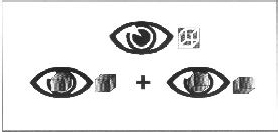
Figure A. 2. The Cube and the Eye of the Beholder. The black-eyed observer at the top of the picture comes into contact with the mysterious paradoxical gray pieces/cube. By observing the figure as a cube he or she enters two parallel worlds.
In the many-worlds interpretation, no leap occurs. The box splits into two parallel boxes (figure A. 2) and the observer of that box (symbolized by the large black eye), or at least the mind of the observer that is able to make the distinction, also splits into two parallel minds. An observer of the box's perspective direction, and a box with its perspective appropriately matching the observer's observation, exists in each universe.
Look at figure A.3. You see what happens when another observer (symbolized by the gray eye) enters the scene.3 If this observer also looks at the box, her mind will split. However, her mind will join with the mind of the first observer (the black-eyed observer) and they both will agree on what they see. If a third observer were to come along, the same thing would happen to him. In this way, what we call consensus reality is constructed and the interference between the possible parallel worlds diminishes.
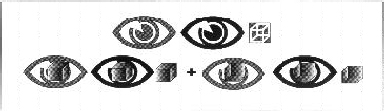
Figure A.3. A Second Observer Is Caught in Parallel Worlds. The gray-eyed observer and the black-eyed observer, at the top of the picture, come in contact with the mysterious paradoxical gray pieces/cube. By observing the figure as a cube, they both enter two parallel worlds.
After N observations by N observers (where N is an arbitrarily large number; see figure A.4, where N=5 for simplicity), there will only be two well-separated universes. In each universe there will be N observers all agreeing that they saw the same thing (perspective-up in universe 1 and perspective-down in universe 2) and normally the two universes should no longer interfere with each other because of the correlation arising between all of the observers. In order to create interference between these two universes, each of the observers as well as the box would need to be overlapped so that each observer sees gray pieces.
Observers, however, are so complex that it becomes very difficult to create an overlap of them all. Consider for a moment that you contain all N observers in your head. Notice that you are now seeing both sets of your selves in parallel worlds. Now you can see why each observer only sees one perspective at a time. If you were in just one of these two worlds, the other perspective—the other “you” consisting of N observers all existing in a parallel world—would be unknown to you. With so much agreement in each world, little or no overlap exists between the worlds, everything appears normal, and everyone, all N of you, agrees.
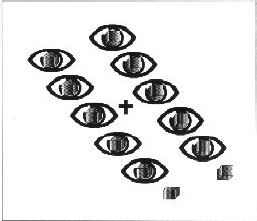
Figure A.4. Many Agreeing Observers Caught in Parallel Worlds.
However, the two universes could still interfere with each other if we could create a proper overlap. Suppose that you are the black-eyed observer's memory of the original box. You exist in your brain as an environment capable of registering the direction of the box's perspective. Now suppose you are the gray-eyed observer's memory and you observe the box and the content of your first memory interacting with each other; but you don't observe the box by itself. How would the classical interpretation, Bohr interpretation, and many-worlds interpretation describe this?
In a classical Newtonian world the two memories would agree. The box is either perspective-up, with you both seeing it that way, or perspective-down, with you both seeing it this way. The world is one way or the other. The box is in only one of those states. But before either of you look, there is no way to determine which way the box will appear.
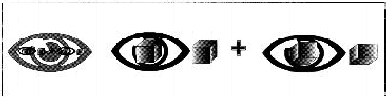
Figure A.5. Gray-Eyed Observer Observes Black-Eyed Observer, while Black-Eyed Observer Observes the Cube. The gray-eyed observer and the black-eyed observer come in contact with the mysterious paradoxical gray pieces/cube. But this time the gray-eyed observer only observes the superposition of both worlds.
According to the quantum rules, as given by the Bohr interpretation, before either of you looks, the box exists in a superposition. After either of you looks, the box will have only one of the two possibilities remaining standing. Regardless of who looks first, both memories will be in agreement.
According to the many-worlds interpretation, in one universe the box is perspective-up and that fact is recorded in your memory 1; in the other universe the box is perspective-down and that fact is recorded in the same memory. And both of these worlds and memories exist in your head. Not only do both exist separately in parallel worlds, but their superposition is also observable by memory 2 in your head. I denote this second observer in you as the pair-of-eyes observer.
The pair-of-eyes observation will be like observing gray pieces, though not quite the same thing since it involves both the box and black-eyed observer's memory. We can call this a pair-of-eyes observation to distinguish it from the gray observation of a single box. Memory 2 records the pair-of-eyes observation.
Suppose now that the gray-eyed observer tells the black-eyed observer about the pair-of-eyes observation and this information enters the black-eyed observer's memory. Then your black-eyed observer memory will contain two very interesting bits of information. In one universe, it will contain the fact that the box is perspective-down and the fact that the box and its parallel universe partner are part of a pair-of-eyes system. In the other universe, it will contain the fact that the box is perspective-up and the fact that the box and its partner are also part of a pair-of-eyes system. Being intelligent, and identifying with one of the perspective views, you will know that a pair-of-eyes observation means that you must have seen the opposite perspective view in a parallel world. You won't be conscious of the opposing box's position, but you will know it exists. Your memory state will be, so to speak, schizophrenic. That pair-of-eyes bit tells you that another parallel universe exists. Your memory, in effect, in this universe, has a “photograph” of another parallel universe. You could think of this other universe as your imaginal realm.
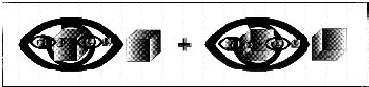
Figure A.6. Black-Eyed Observer Becomes Schizophrenic.
To speculate a bit with this: If we think of your memory 1 as an engram capable of storing a memory, we can construct a model for a well-known psychic disorder called multiple personalities. Each parallel universe engram acts independently unless there is some feedback of information about the totality of personalities. With the feedback about the pair-of-eyes, each engram is aware of the presence of the other parallel engram. This also could be a base explanation for some forms of schizophrenia or altered states of consciousness.
Again, put yourself into the picture as a memory 3 outside of memories 1 and 2. You can see the black-eyed observer and the gray-eyed observer. You can see that the black-eyed observer sees the box and in each world that observer knows what state the box is in. You can see that he also knows that the pair-of-eyes state exists, so you know that he is aware of the other world.
You can also see the gray-eyed observer. She is only aware of the combination of the two worlds. She is only aware of the pair-of-eyes state. If you asked her which way the box was facing, she wouldn't have the slightest idea. In fact, from your point of view, seeing both worlds in parallel, you also can't say which way the box is facing. Of course, if you look at the box and it leaps into one of its states, you will be caught in one of the perspective-up or perspective-down parallel worlds.
Thus, the world depends on you and what you communicate to others. It also depends on what you believe is real. If the many-worlds interpretation is real, then you exist in more than one world and every event in every universe affects you. More than that, you affect everything else in all of these universes in truly countless ways.