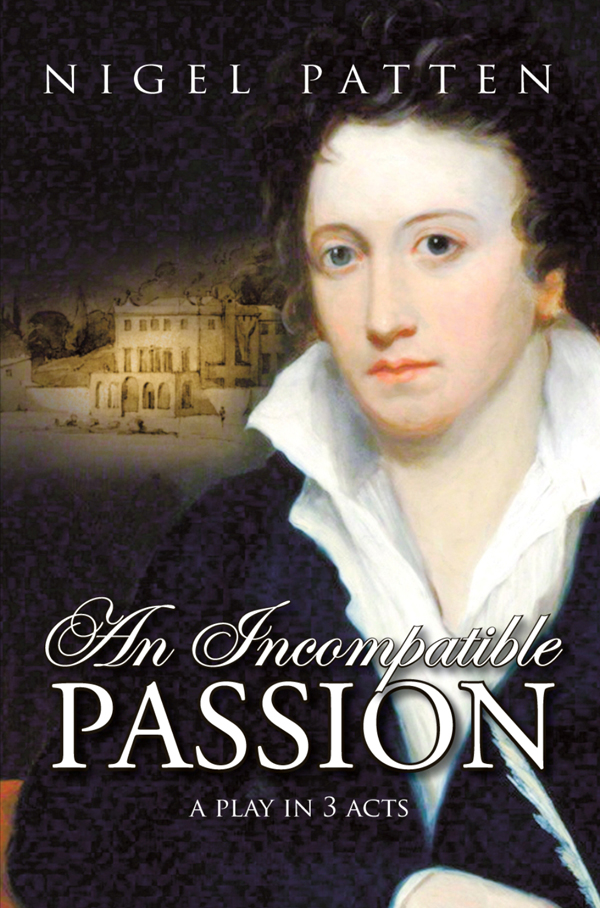
AN INCOMPATIBLE
PASSION
a play in 3 acts
by
NIGEL PATTEN
«There is an incompatibility between love and creativity»
Percy Bysshe Shelley: Alastor (1815)
«A poet is a nightingale who sits in darkness and sings to cheer its own solitude.»
Percy Bysshe Shelley: A Defence of Poetry. (1821)

Strategic Book Publishing and Rights Co.
Copyright © 2013
All rights reserved—Nigel Patten
No part of this book may be reproduced or transmitted in any form or by any means, graphic, electronic, or mechanical, including photocopying, recording, taping, or by any information storage retrieval system, without the permission, in writing, from the publisher.
Strategic Book Publishing and Rights Co.
12620 FM 1960, Suite A4-507
Houston, TX 77065
www.sbpra.com
ISBN: 978-1-62516-971-6
Design: Dedicated Book Services (www.netdbs.com)
Cover photo (Shelley): Courtesy of the National Portrait Gallery, London.
Villa Magni (Shelley’s last home): Courtesy of Eton College.
Acknowledgments
Any biographical study of a famous literary figure must of necessity rely largely on earlier research by other writers. From the very extensive material available I have drawn essentially from the following books: Percy Bysshe Shelley by James Bieri, Being Shelley by Ann Wroe, Young Romantics by Daisy Hay, Mary Shelley by Miranda Seymour, Recollections of the Last Days of Shelley and Byron by Edward John Trelawny and the journals and letters of Shelley, Mary and Claire Clairmont.
Author’s Foreword
Sixty percent of the dialogue in my play is historically authentic, having been said (or written) by the character to whom it is attributed. On rare occasions I have deliberately given words to a different character than the one who in reality spoke them, or slightly modified the language to make it more accessible. I have also sometimes displaced time, using dialogue that was in fact spoken or written at an earlier date, and in one case modified an event without in any way diminishing its impact.
As this edition is for reading and not performance purposes, there are only stage directions where I feel they play an essential part in character development. In any case, no director should need the help of the author in staging a play and the reader can now allow his imagination to wander freely round the stage and people it with whatever action best suits his state of mind at the moment.
Prologue
In 1822 the Villa Magni, recently rented by Percy and Mary Shelley, stood on the rocky shore a mile or so from San Terenzo, a Tuscan hamlet across the bay from Lerici and overshadowed by a crumbling gray fortress. Centuries earlier it had been the site of a cult to Diana, goddess of the woods and the moon. Above it dark woods of chestnut and ilex cloaked the hills. Built directly on the rocks over four massive arches harboring cellars where local fishermen kept their boats and tackle, the ground floor was composed of a single vast living area, opening onto a wide terrace on the seaward side and overhanging the rocky tide line. Access to the first floor and its four bedrooms was by a single open staircase leading from the living area. The second floor provided cramped quarters for quarreling servants.
The scene is in darkness, except for a single spot downstage, revealing the figure of EDWARD TRELAWNY.
TRELAWNY
In the spring of 1822 Percy Bysshe Shelley, his second wife, Mary, author of Frankenstein, her half-sister Claire and another English couple they had known in Pisa, Edward and Jane Williams, rented a dilapidated villa on the rocky shore near Lerici, a fishing village on the Tuscany coast.
At the time Percy was thirty-two years old and Mary twenty-seven. From descriptive accounts by those, like me, acquainted with the poet, we learn that Shelley had a delicate, negligent even dishevelled appearance. His face was singularly engaging with a strongly marked intellectuality and a childish simplicity combined with great refinement. He had large bright blue rather wild eyes like a deer.
His eager vehement manner demanded the instant execution of any project that took his fancy. He overwhelmed all opposition. When awake he was fierce, energetic, and would argue instantly. He paced the room, gesticulating, like a dragonfly, dazzling in movement, and erratic in flight. He had a violent and excitable temper with sporadic outbursts of anger and rage. Then his gestures were abrupt, sometimes violent, occasionally even awkward. He could be terrifying when roused with his flashing eyes, wild hair and deathly white cheeks.
Physically he was rather odd, tall and slim to the point of limpness. His walk was willowy, low and stooping. When reading he leaned over his book, his eyes almost touching it. He often slid into a room, perched on a chair, talked and then disappeared as noiselessly as he came. He coughed violently at times and had pains in his side and chest, which he called ‘spasms’. When they struck him, he fell on the ground, screamed, drummed his heels and pulled down cushions to cover him.
Guests noticed his odd starts, peculiar gestures and sudden fixed attitudes, as if frozen in abstraction. He often rubbed his hair fiercely so it was singularly unkempt and rough. Sometimes when visitors were announced he hid under the table or lay on the carpet like a dog or a faded flower.
His voice was, shrill, harsh and discordant. The intensity of feeling produced an electric effect. He was fond of wearing a long gray dressing gown, trailing at the heels. On more formal occasions he wore a large-brimmed leghorn hat, jacket and waistcoat and nankeen trousers, all fitting loosely to the body. He always left his shirt unbuttoned and washed his shock of curls by dousing his head in a bucket of cold water.
He believed his gastrointestinal symptoms were engendered by an earlier bout with syphilis. He feared it would degenerate into leprosy and condemn him to permanent ill health and a miserable death. He manifested an obvious persecution complex at times that verged on insanity. He suffered from anxiety symptoms, depressions, paranoid fears and terrible headaches, which he combated with doses of laudanum. He twice so overdosed himself that his life was threatened. The power of laudanum to soothe pain and give rest delighted him and retained a seductive hold on him all his life. He had periodic moments of panic when he lost consciousness.
He lived chiefly on tea, bread and butter, and occasionally drank lemonade made of a powder from a box, but his favorite dish was panada, water-soaked bread sprinkled with sugar and nutmeg.
Contents
Act One March 1822
Act Two May 1822
Act Three July 1822
Epilogue