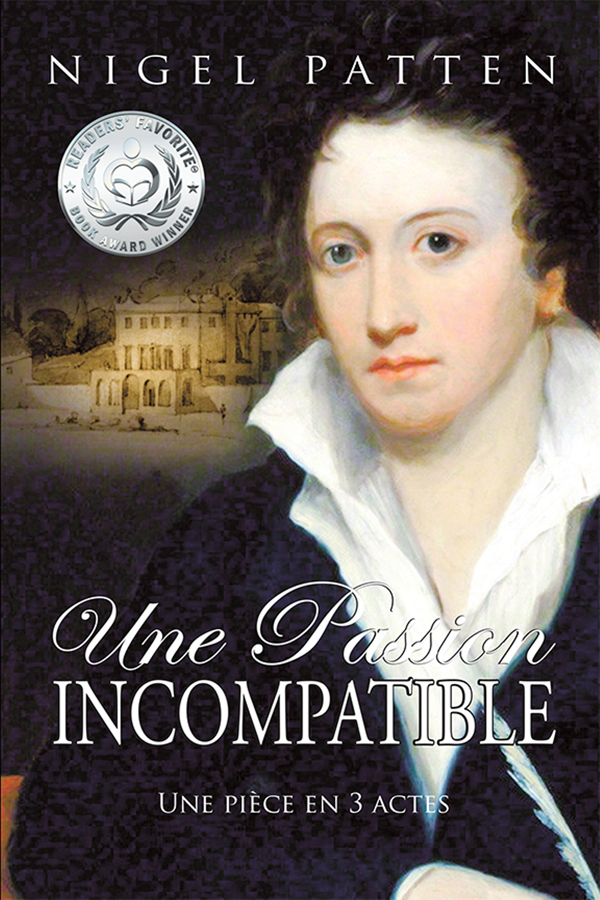
UNE PASSION
INCOMPATIBLE
Une pièce en 3 actes
Traduite de l’anglais par l’auteur avec la collaboration d’Anthony Le Cam.
«Il y a une incompatibilité entre l’amour et la créativité» Percy Bysshe Shelley: Alastor (1815)
«Le poète est un rossignol qui se blottit dans l’obscurité et chante pour désassombrir sa propre solitude» Percy Bysshe Shelley: A Defence of Poetry. (1821)
Par le même auteur: The Hounds of Samaria (version française Les Molosses de Samaria), The Winter Should Pass, Under Table Mountain, The Tide of Destiny.

Strategic Book Publishing and Right Co.
E-book edition © 2013
Print edition © 2013 - ISBN: 978-1-62516-898-6
All rights reserved—Nigel Patten
No part of this book may be reproduced or transmitted in any form or by any means, graphic, electronic, or mechanical, including photocopying, recording, taping, or by any information storage retrieval system, without the permission, in writing, from the publisher.
Strategic Book Publishing and Rights Co.
12620 FM 1960, Suite A4-507
Houston, TX 77065
www.sbpra.com
ISBN: 978-1-62857-464-7
Design: Dedicated Book Services (www.netdbs.com)
REMERCIEMENTS
De l’immense quantité de matériel biographique disponible sur Shelley, j’ai obtenu des renseignements précieux des livres suivants: Percy Bysshe Shelley de James Bieri, Being Shelley de Ann Wroe, Young Romantics de Daisy Hay, Mary Shelley de Miranda Seymour, Recollections of the Last Days of Shelley and Byron de Edward John Trelawny et les journaux et lettres de Shelley, Mary et Claire Clairmont.
AVANT-PROPOS DE L’AUTEUR
Plus que la moitié du dialogue dans ma pièce est historiquement authentique, les personnages à qui il est attribué l’ayant vraiment prononcé ou écrit. De temps en temps j’ai attribué certaines paroles à un personnage autre que le véritable propriétaire. Parfois j’ai transposé le temps, me servant de dialogue prononcé ou écrit à une époque antérieure. Dans un seul cas j’ai modifié un événement sans diminuer son impact.
CONTENTS
ACTE PREMIER
ACTE DEUXIEME MAI 1822
ACTE TROISIEME
EPILOGUE