In the Mekong Delta of Viet Nam Phil Ward proved to be an outstanding Infantry Platoon Leader. Now he has shown he is also a skilled military fiction writer. His Raiding Forces series will capture a new generation of readers. His extensive research is evident and I will look forward to reading of the future exploits of Major John Randal and his band of Commandos...
— TOM ROWAN,
LTC(R), US ARMY SPECIAL FORCES,
Phil Ward is a highly decorated special warfare infantry officer. I have served with him in combat, as his commanding officer, and know firsthand that he is meticulous in the way he plans and executes combat operations. The books within the Raiding Force Series fully reflect this mindset, and Phil’s extensive special warfare training and experience. They are soundly based on real combat situations and historical happenings that Phil inventively weaves into fascinating stories. Phil’s books are fast-moving, suspenseful and absorbing, but easy to read and follow. This new book, Guerrilla Command, will be a great addition to this Series.
—CHARLES HARDIN,
LTC(RET) INFANTRY
Visit www.raidingforces.com and www.facebook.com/raidingforces to read more about the Raiding Forces Series.
This book is a work of fiction. Names, characters, businesses, organizations, places, events, and incidents are either a product of the author’s imagination or are used fictitiously. Any resemblance to actual persons, living or dead, events, or locales is entirely coincidental.
Published by Military Publishers LLC
Austin, Texas
www.raidingforces.com
Copyright ©2013 Phil Ward
All rights reserved.
ISBN: 9780989592215
No part of this book may be reproduced, stored in a retrieval system, or transmitted by any means, electronic, mechanical, photocopying, recording, or otherwise, without written permission from the copyright holder.
Distributed by Military Publishers LLC
For ordering information or special discounts for bulk purchases, please contact Military Publishers LLC at 8871 Tallwood, Austin, TX 78759, 512.346.2132.
GUERRILLA COMMAND IS DEDICATED TO LT. GEN. HENRY “Gunfighter” Emerson. On 3 June 68 then Col. Emerson flying over the Plain of Reeds inserted A/2/39 of his 1st Brigade to investigate muddy water he spotted in a canal. The unit came under heavy fire. The company CO ordered (me) “Take that tree line”. Away we went 71 men on line charging an estimated 800 to 1300 Main Force Viet Cong. The CO stayed behind only to be shot dead when he came up. Now it was learned we were “outside the artillery fan” and air support was “a half hour away” The VC gained fire superiority. Men pulled knives and laid out grenades standing by to repel boarders. And I was wondering if it had looked this bad at the Little Big Horn? On the radio all was chaos and hysteria events spiraling out of control. A voice came up, “Paisley Butterfly 6” (or some such call sign). No response. However Butterfly 6 was not to be denied—still no joy. Finally Butterfly shouted, “God dammit this is the Gunfighter!” The net went silent. And I knew we were going to win that fight. No officer who has worn the uniform ever had a greater impact on the troops he commanded than Gunfighter Emerson. In Vietnam he was a peerless brigade commander, an innovative tactician and a brilliant combat leader who instilled confidence in the men he commanded. I can testify to that—my last hero.
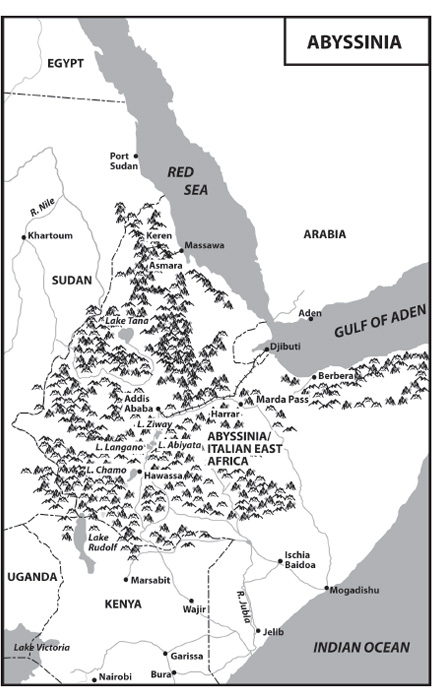
SOMEWHERE IN ABYSSINIA
MAJ. JOHN RANDAL, DSO, MC, LAY ON A RIDGE STUDYING the coffee plantation in the valley down below, through the Zeiss binoculars he had captured from a Panzer colonel at Calais, France, in what now seemed another life.
The plantation was something the Italians called a Democratic Colonization Project (DCP). The Fascists had the model farms scattered all around Italian East Africa. The layout of this DCP consisted of a main house, three outbuildings and a tall silo.
The Blackshirts had brought agricultural experts by the thousands to Italian East Africa to operate the model farms after forcibly evicting the previous owners. The projects were intended to be showpieces. “The Leader,” Benito Mussolini, wanted to demonstrate to the international community the superiority of the Fascist system of managing an African colony.
The plantations were worked by slave labor, something that Il Duce failed to mention.
Major Randal glanced at his black-faced Rolex wristwatch. The lime green digits read 0615 hours. The watch was a present from his ex-fiancée Capt. the Lady Jane Seaborn, OBE, RM.
Originally it had been intended as a birthday present for her husband, but he had been lost at sea before she could give it to him … temporarily lost, as it turned out. This had made Major Randal’s love life, for lack of a better word, complicated. Though it had been pointed out that Captain Lady Seaborn was in Africa working to support Force N instead of home in the U.K. with her returned-from-the-dead husband.
Major Randal thought about her every time he glanced at the watch. He had been informed by a reliable source that this was why Lady Jane had given him the Rolex. If true, it worked.
Also attached to his wrist on a faded olive green canvas strap that matched his watchband was a wrist compass. It was made by Rolex for the Italian firm Panerai on contract to the Italian Navy, especially for its elite frogmen. Captain Lady Seaborn had given the compass to him on the last night he was in Kenya. It was a gift from Cdre. Richard “Dickey the Pirate” Seaborn, VC, OBE, who had captured it when he boarded the Italian submarine the Galileo.
Now he had two reasons to think about Lady Jane on a regular basis. Not that he needed them.
“Stand by ready,” Major Randal ordered.
“Roger that, John,” Capt. “Geronimo” Joe McKoy replied, fiddling with the traversing wheel of the tripod machine gun mount on which a Boys .55-caliber Anti-Tank Rifle was mounted.
The Boys could not penetrate any known armor and was arguably the worst antitank weapon in history. On paper its cigar-sized, .55-caliber, armor-piercing bullet had a maximum effective range of one mile and was extremely accurate. However, in practice the weapon’s loud blast, punishing recoil, and its iron sights limited its actual range to 400 to 600 yards.
Captain McKoy studied the weapon and saw possibilities. He installed an all-steel, No. 32 Mk1 scope designed for use on Bren light machine guns on a Boys and then mounted the AT rifle on an obsolete 110-pound GP Hotchkiss Omnibus tripod. The result was a deadly accurate .55-caliber rifle effective out to its maximum effective range of one mile.
Why no one had ever thought of the combination before was a fair question. Captain McKoy had created the world’s finest long-range sniper’s weapons system.
1 Guerrilla Corps (Parachute), Force N had a dozen of them scattered between its Mule Raider Battalions (MRB).
In the early morning light down in the valley, Lt. Butch “Headhunter” Hoolihan, RM, could be seen leading a file of his Force Raiding Company troops into position on the south side of the plantation building complex. His Abyssinian Patriots were armed with U.S. M-1903 A-1 Springfield rifles. The men were wearing Tom Mix style cowboy hats and had bandoleers of .30-caliber ammunition strapped across their chests, making them look like Mexican banditos. The native troops were all barefoot.
In addition to rifles, each soldier was armed with a short sword. Only after a great deal of persuasion had they been convinced to leave their small round shields and spears behind. The Abyssinians were miserable shots—mainly because ammunition was currency to them, so they never fired any to practice.
The Force Raiding Company troops were the exception. They had been trained in the fundamentals of marksmanship when they were No. 3 Company of the 2nd Mule Raider Battalion, “Lounge Lizards” trained in Kenya before being selected to deploy to Force N as the Force Raiding Company.
Regardless of their training, the troops still preferred the spear as their weapon of choice, but eight-foot spears and shields are unwieldy.
Lieutenant Hoolihan had finally hit upon issuing his men bayonets, and that solved the problem. Bayonets are heavy. More ammunition could be carried if they were left behind. They also took up precious cargo space on the handful of aircraft that supplied Force N. However, having a standard issue (U.S. Army) 16-inch bayonet fixed on their rifles which could be used like a spear made the troops happy.
In a small guerrilla army far behind enemy lines, having happy indigenous troops is a good thing.
On the north side of the plantation house, Major Randal could see that Lt. Dick Courtney was already in position with his two former Gold Coast Border Police strikers, X-Ray and Vanish, and a small detachment of Force Raiding Company men. Also with him was an experienced Green Jacket, formerly of the Rifle Brigade and Swamp Fox Force, manning a Hotchkiss Mk1 light machine gun. The LMG was notoriously prone to jamming, but it was hoped that a trained Raiding Forces operator could keep it running.
The Rolex read 0630.
Normally, people on farms are early risers. But this was Africa, and there were a lot of hungry animals with big teeth out and about—not to forget shifta bandits. So no one on Abyssinian plantations ventured forth until well after daylight. Everyone was still inside the DCP model farm.
Lieutenant Courtney ordered, “Commence firing.”
On his command, the Hotchkiss LMG opened, as did everyone else in his detachment, firing their M-1903 A-1 Springfields.
The result was instantaneous. The Italian nationals and the farm security detail spilled out of the main house and the outbuildings, some half-dressed, and stood to. The Blackshirts manned the fighting positions on the north side of the perimeter in the direction the firing was coming from.
That was a mistake. Lieutenant Courtney was carrying out a feint. And it worked like a charm.
As soon as the Italians built up their base of return fire directed toward Lieutenant Courtney’s men, on the far south side of the plantation house Lieutenant Hoolihan stood up and shouted loud enough (he hoped) for the people inside the main building to hear the command every Royal Marine officer secretly longs to give: “Fix bayonets!”
This was a completely unnecessary order since the men of Force Raiding Company never, ever unfixed theirs.
“Move out!”
The Force N troops stepped off in a ragged line formation and, as they had been trained to do, bolted and fired their rifles every time their bare left foot hit the ground. The Patriots were screaming savage war cries as much to build up their own courage as to intimidate the opposition. The crackle of forty M-1903 A-1 Springfields was inspiring even if they were not hitting much, not even their objective—the three-story plantation house.
Italian resistance melted the instant the security detail realized they had fallen for the oldest trick in the book. Those men not already dead or wounded bolted from their fighting positions. A lone sniper remained at his post in the top of the silo and began firing on Lieutenant Hoolihan’s assault line.
BAAAAAROOOOOMMM! Captain McKoy’s Boys .55-caliber Anti-Tank Rifle spoke. A tiny puff of smoke appeared from the target followed by a small “crunch,” and there was no more firing from the silo.
Lieutenant Hoolihan signaled one of his platoon leaders, Bimbashi Cord Granger, to clear the outbuildings while he continued the attack on the main objective.
Lana Turner, one of the two slave girls Major Randal had liberated on his first day in-country, brought up his white mule, Parachute. Then, with the other ex-slave, Rita Hayworth, in hot pursuit, the three made a death-defying ride straight down the steep ridge, racing to get to the plantation house in time to influence the outcome of the firefight.
Waldo Treywick, himself a former slave, and Gubbo Rekash, aka Cheap Bribe, the Patriot commander of Major Randal’s auxiliary troops, and his shifta, came pouring around the mountain on their animals at a dead run. Each man was leading a mule belonging to one of the Force Raiding Company soldiers. The Patriot troops were hoping to get to the scene of the action before all the loot was gone.
In the world of the Abyssinian shifta bandit, there were only the quick and the broke.
As Lieutenant Hoolihan’s assault line approached the plantation house, Lieutenant Courtney ordered, “Shift your fires!”
The Hotchkiss Mk1 machine gunner adjusted his point of aim to the main house as planned and swept through it from left to right, then ceased fire. Within seconds the assault troops hit the building. Lieutenant Hoolihan led them inside with his Thompson submachine gun at his shoulder.
Major Randal and the two girls rode up. Cheap Bribe and his bandits thundered into the yard. Inside the house there were a couple of muffled pops, then the RAAAMP of the Thompson was heard.
Lieutenant Hoolihan appeared at the door. “Clear, sir,” he reported, Royal Marine cool.
“Nice job, stud,” Major Randal said. “Secure all the military-type weapons, then let Bribe’s boys clean out the rest.”
When Waldo translated that to the one-eyed bandit chief, the old scoundrel immediately started shouting commands to his men. The established protocol was that he and Major Randal would divvy up the take once it had been collected—with anything of military value going to Force N and the bandits keeping the rest.
Gubbo Rekash was a veteran shifta chieftain. He suspected that there was going to be hard money or jewels in the house somewhere, and he was already making plans to strip search his Patriots once they made camp later that day. Any of his men caught hoarding loot was going to be in serious trouble.
Cheap Bribe only had one punishment for major crimes, like not turning in all the captured booty—and that was banishment. To be cast out was a fate worse than death. In a country where murder was the national sport and strangers were viewed as fair game, anyone on his own was in for a slow, painful demise.
The threat of banishment should have been a major deterrent. However, there was always someone in his band willing to take a chance. So Cheap Bribe never did. His policy was to consider every member of his command guilty until proven innocent.
There were no prisoners. Any of the Italians or their minions who had not run away were dead. Force N was fighting a war to the knife. No quarter was asked or given.
Orders had been issued before the action began not to pursue anyone who tried to escape. Capt. Hawthorne Merryweather, the Force N Special Warfare Officer assigned from Psychological Warfare Executive, wanted panicked Italians arriving at the nearest Blackshirt base describing the attack.
“You’d better come see this, sir,” Lieutenant Hoolihan said.
Inside the house, the sack was on with the Patriots frantically tearing through drawers and closets and climbing up into the ceiling. The master bedroom on the third floor was an ugly scene. There was a dead blond woman sprawled on her bed in a pink silk negligée with a bloody head wound and a dead Italian male in his fifties on the floor—also with a wound to the head. A Bodeo 10.4mm service revolver was laying next to him.
“We do that?”
“No, sir. It looks like the plantation manager killed his wife to keep her from being captured, then shot himself, a murder—suicide. I wanted you to see for yourself, Major.”
“Roger,” Major Randal said. “Search this room for anything of intelligence value, then let Bribe’s boys in to get at the rest.”
“Sir, I …”
“This is guerrilla war, Butch; women get shot like anybody else.”
Waldo came in, “Gunroom downstairs, Major. Got some heavy huntin’ rifles would ’a’ come in handy when we was sittin’ up for lion every night. Couple ’a’ right nice over ‘n’ under Beretta bird guns down there too.”
“Secure the weapons we need, Mr. Treywick,” Major Randal ordered. “Tell Cheap Bribe to hurry it up. I want to move out shortly.”
“Shot his wife, huh?” Waldo said. “Wops is real brave when they got the upper hand, not so much when the shoe’s on the other foot.”
Out in the yard, the Patriots were piling up the plunder. Major Randal mounted Parachute as Captain McKoy came trotting up with the three mules that carried his Boys Anti-Tank Rifle, followed by his security detail.
“Butch did a right nice job,” the ex-Arizona Ranger said, pulling out a thin cigar and biting off the end.
“Yes, he did.”
Waldo came outside with two of the Force Raiding Company troops, each carrying an armful of weapons confiscated from the gunroom.
“We’re moving in fifteen minutes, Mr. Treywick.”
When Lieutenant Hoolihan walked outside, Major Randal ordered, “There’s too many men bunched up here at the house, Lieutenant. Post security.”
The orgy of looting continued, with Cheap Bribe’s men dragging everything that could be moved out onto the yard, including overstuffed chairs, sofas, even a slate pool table. It was a mad race between the Patriots to see who could score the most treasure, even if most of it could not be carried away on mule back.
“You planning on playing pool, John?”
“Might be nice to have us a game now and then,” Waldo said.
“Hope springs eternal,” Major Randal said.
Kaldi, the Force N interpreter, reported, “We found a small safe, sire. It was open, but there was nothing in it but documents, some of the manager’s personal papers and a handful of cheap jewelry.”
Major Randal glanced at his Rolex. “Time to go, Butch, saddle up.”
A detail was driving in the livestock that the raiders wanted to take with them. Exultant bandits were wearing petticoats, colorful men’s neckties or curtains draped around their necks. One stuck a lampshade on top of his Tom Mix hat.
A giant letter “N” crudely painted on the side of the silo made it clear who had come calling. Captain Merryweather was going around and placing a calling card he had recently printed up on his mobile printing press on every dead body. The cards had a large “N” on the front and the message, “If you are reading this you may be next. 1 Guerrilla Corps (Parachute), Force N.”
The back of the card read, “If everything is blowing up around you—it’s probably us.”
As the raiders rode out, all the buildings were in flames.
All across central Abyssinia, the four Force N MRBs were carrying out similar operations following orders to “move fast, hit hard and disappear.”
Major Randal’s private war was in full swing.
MAJ. JOHN RANDAL, CAPT. “GERONIMO” JOE MCKOY, WALDO Treywick and Cheap Bribe were sitting outside at the small camp table in the 1 Guerrilla Corps (Parachute), Force N Headquarters’ overnight position, located outside of the largest village they had ever encountered. The sun was beginning to fade to golden orange as it went down behind the mountains. Force Raiding Company had been living up to its title. In the last five days, they had attacked and destroyed five Italian Democratic Colonization Projects (DCP).
Major Randal was following his own orders to his Mule Raider Battalion (MRB) commanders to “attack constantly.” He had no intention of slowing the rhythm of the operations. However, the men and the animals of Lt. Butch “Headhunter” Hoolihan’s Force Raiding Company needed a short break from the intense pace of the constant attacks. No good would come from grinding them into the ground.
While they stood down briefly, time could be spent on the reconnaissance of their next series of targets—ambushing the few roads in the district and reorganizing—a constant, ongoing process.
Major Randal planned to keep hitting the isolated plantations until the Italians reinforced each one with at least a platoon-sized unit. The math was simple. If there were a thousand of the projects in Central Abyssinia (and there were many more than that) at the rate of one platoon per plantation, the Blackshirts would tie down 30,000-plus troops on static guard duty. Then once that happened, Major Randal would not raid the DCPs any more—until he did.
The Italians were never going to know what was coming at them next.
Waldo and Kaldi had gone into the native village to palaver with the village chief, as was the long-established Force N standard operating procedure. However, the headman was not in. According to the villagers, he had ridden off with an Italian patrol three days prior. They had been quick to point out no one had any idea why. The villagers were not Blackshirt sympathizers, and the chief, they claimed, hated Italians.
“John,” Captain McKoy said, lighting up a thin cigar and offering one to the one-eyed Patriot chief Gubbo Rekash, “you know I’m gonna’ want my own outfit. Liberating Abyssinia is turning out to be the biggest circus of the twentieth century. I don’t aim to miss out on it.”
“You’re not missing much.”
“This is big country. You can squeeze me in somewhere with my own MRB.”
“There’s two reasons I can’t do that, Captain,” Major Randal said, holding out his battered U.S. 26th Cavalry Regiment Zippo to light Cheap Bribe’s cigar. “You’re not in the British Army, and I don’t have any command to give you.”
“There’s recruits pouring in.”
“Officers and NCOs,” Major Randal said. “All the good ones are already assigned. Besides, I need you on that Boys, Captain.”
The sound of an aircraft could be heard in the distance. This was of no great concern to the men at the table. The Force N camp was widely dispersed and from the air would appear to be a part of the village.
A green and tan mottled Savoia-Marchetti 73 transport swooped low over the village. Rocking its wings, it then banked around to come back for another pass. To make absolutely certain they had everyone’s attention, the Italian aircrew started firing their submachine guns out the open door, indiscriminately strafing the village—ripppp, ripppp, ripppp.
A tiny speck detached itself from the fuselage. For a moment it looked like a paratrooper, only there was no blossom of silk.
Then they heard the voice—shrieking.
“What the hell …” Major Randal said.
The falling man screamed all the way. He windmilled down, slamming into the center of the village. The natives milled in a panic. Women were crying hysterically, and men were shouting.
Cheap Bribe jabbered angrily with a wild look in his one good eye and shook his cigar at the departing airplane.
“Looks like the chief just got home,” Waldo said.
Capt. Hawthorne Merryweather came over to where they were now standing. “My guess is, gentlemen, we have been witness to a working example of the Blackshirt Recalcitrant Village Pacification Program.”
“Pacified the chief,” Waldo agreed. “Don’t know about the rest ’a’ them people. That kind ’a’ rough stuff generally backfires with Abyssinians.”
“Mr. Treywick, you and Kaldi shove off to the village and check things out,” Major Randal ordered. “Give me a report.”
“On the way, Major.”
“Stay away from the honey wine, Mr. Treywick. You’re riding out at first light.”
Captain McKoy said, “Now John, about that outfit …”
CAPT. MICKEY DUGGAN, RM, THE FORCE N CHIEF OF SIGNALS, hand-carried a message to Maj. John Randal, who scanned it and ordered, “Have Butch report to me immediately.”
“Sir!”
Within minutes, Lt. Butch “Headhunter” Hoolihan arrived at Major Randal’s HQ tent where he, Capt. “Geronimo” Joe McKoy and Gubbo Rekash, the commander of the Force N auxiliary forces, were enjoying delicious Abyssinian coffee with their cigars.
“Lieutenant Hoolihan,” Major Randal said in the command tone he subconsciously slipped into when issuing orders. “Have one of your platoons conduct a day ambush of the nearest road at a location of your choosing. Cheap Bribe and his boys will accompany it. Be prepared to move within the hour.”
“Yes, sir!”
“Have your other platoon be prepared to travel with me tonight to mark a landing strip for an aircraft inbound from Camp Croc.”
“Any preference as to which platoon you would like for an escort, sir?”
“It’s your company—pick one.”
“Where do you want me to position myself, sir?”
“Your call, Lieutenant.”
“In that case I will accompany the ambush party, sir.”
“Before you ride out, Butch, we’ll pick out a location to rendezvous in three days’ time. Be ready to resume the DCP raids when we marry up.”
“Very good, sir.”
“Ask Capt. Honeycutt-Parker to report to me at his earliest convenience.”
When the Royal Dragoons officer serving as the Force N adjutant arrived, Major Randal ordered, “Have the Force N Rear ready to move out as soon as possible. Get with Butch and me before you ride out and we’ll select a place to link up in three days.”
“What about recruiting, Major?”
“We’ll sort that out when Mr. Treywick gets back from the village.”
“If it actually was the chief the Eyeties tossed out of that airplane, the locals’ feelings should be running rather high about now. Might be an ideal opportunity to capitalize on that, sir.”
Ever since Lieutenant Hoolihan had taken command of Force Raiding Company, the adjutant had assumed his responsibilities as the Force N chief recruiter and training officer.
“Well then, we’ll seize the opportunity,” Major Randal said. “Inform Lieutenant Plum-Martin she can travel with the Rear or accompany me tonight.”
“Very good, sir.”
The Headquarters 1 Guerrilla Corps (Parachute), Force N began humming with activity. Any move was a major undertaking, but they were gypsies and had been striking camp almost every day for some time now. The native troops and camp followers had the drill down. Everyone knew what to do.
Capt. Hawthorne Merryweather hurried by, lugging a Hotchkiss light machine gun. “I am off with the Headhunter, sir.”
“Planning to win hearts and minds with that LMG?” Major Randal called to his Special Warfare Officer.
“Oh, I shall have my bullhorn with me as my primary,” Captain Merryweather replied without breaking stride. “Wops fail to listen to reason—then I go to the gun.”
“You’ve been a bad influence on ol’ Hawthorne,” Captain McKoy observed as he took a sip of the local high-octane coffee.
Lt. Dick Courtney appeared. “Sir, I’ve been detailed to be your escort tonight, attached to Bimbashi Masters’ platoon.”
“Inform Bimbashi Masters to have his men ready to pull out as soon as Mr. Treywick returns from the village, Dick.”
“Yes, sir,” the former Gold Coast Border Police officer replied. “Do you care to advise me where it is we’re going?”
Major Randal took the flimsy out of his pocket. He handed it to the young officer. “Here’s the coordinates. The plane will land on a stretch of the road we mark with kerosene flares. Make sure we have enough tin cans and fuel oil for the ground signals.”
Rita Hayworth materialized, leading Parachute with Major Randal’s night M-1903 A-1 Springfield with the ivory post front sight in the boot. His personal gear was strapped on the back of the saddle.
Lt. Pamala Plum-Martin, OBE, took a place at the table. “Any idea who we shall be meeting tonight, John?”
“Not a clue,” Major Randal said. The last time he had been ordered to meet a plane out of Camp Croc it had whisked him away on a counterintelligence operation in Nairobi.
That gave him something to think about.
GG, the Force N cook captured in one of the early ambushes, poured the snow-blond Royal Marine a cup of coffee. She produced a Player’s cigarette, which Major Randal lit for her.
Lana Turner arrived with Major Randal’s sand-green parachute smock. It got cold in the mountains at night. She had his 9mm Beretta MAB-38 submachine gun slung over one shoulder and her Carcano 6.5mm carbine on the other.
Mr. Treywick and Kaldi came trailing back from the village.
“Chief, all right,” Waldo said. “Every fightin’ man in the village done volunteered for duty with Force N—to include the dead headman’s personal bodyguard. Since they ain’t any new boss man to put a stop to it we might make a big haul here, Major—recruitin’ wise.”
“What do you recommend, Mr. Treywick?”
“Strike while the iron’s hot, Major. We ain’t gonna’ get many opportunities like this when nobody’s in charge.”
“All right,” Major Randal said. “Mr. Treywick, you go ahead and move out now on that reconnaissance we discussed. Take a four-man security detail. Get with me before you leave, and I’ll show you on the map where to link up with us.”
“I like to travel light when I’m sneakin’ and peekin’...”
“Take the security, Mr. Treywick.”
“Yes sir, Major, sir.”
“Captain Honeycutt-Parker will be moving out with the Rear so he won’t be available to handle recruiting,” Major Randal said to Captain McKoy. “I can pull Butch off his ambush to evaluate the recruits, or you and Kaldi could do it.”
“I knew you was goin’ to let me have my own outfit.” Captain McKoy grinned ear-to-ear. “I’ll be proud to handle recruiting, John.”
“Sign up as many volunteer Patriots as you can who have a mule to ride and Italian-issue weapons or rifles that fire compatible ammunition. Let ’em bring as many pages as their hearts desire. We’ll turn ’em into Bad Boys later—but you don’t have to tell the volunteers that out front.”
“Love to, John,” Captain McKoy said. “I’ll be real particular seeing as how they’ll be my men. That’s the way you build a crack team—handpick your troops for unit cohesion.”
“We’ll talk later.”
“Kaldi,” Captain McKoy said, “Why don’t we mosey over right now and get to work before the locals go and elect themselves a new headman.”
“OK, Captain Geronimo,” Kaldi agreed. “You should shoot a cigarette out of my mouth to impress the villagers. Or throw your knives.”
“Sounds like a plan, son,” Captain McKoy said. “I’m gonna’ enjoy this.”
THE HUDSON LANDED ON THE DESOLATE STRETCH OF road approximately 600 miles behind Italian lines at 0225 hours under a full tropical moon. Maj. John Randal and Lt. Pamala Plum-Martin were waiting when the door opened. They climbed aboard to find Maj. Gen. James “Baldie” Taylor, OBE, all alone—the only passenger.
The twin-engine light bomber had been converted into a plush private transport for Lt. Gen. Sir Archibald Wavell. The General Officer Commanding Middle East had loaned the plane to Capt. the Lady Jane Seaborn to use in the effort to locate the missing Force N advance party and then allowed her to keep it for the duration of the campaign. Recently all the carpet and most of the theatre chairs had been removed.
Nowadays it was a troop transport, paratroop carrier, cargo hauler and whatever else was required to support Major Randal’s guerrilla army in the field. Tonight it was crammed with cases of Maria Theresa silver dollars, weapons, ammunition and other military supplies. Bimbashi Jack Masters’ men immediately began the task of unloading everything on board.
“Evening, General,” Major Randal said. “What brings you to the other side of the rainbow?”
“Slight change of plans, Major. I wanted to discuss them with you in person.”
Major Randal and Lieutenant Plum-Martin took seats in two of the chairs.
“And to tell the truth, I have been looking for a reason to fly upcountry to get a taste of being close to the action,” the Chief of Station Special Operations Executive Khartoum admitted.
“How’s it feel to get out of the office?”
“Great! Managing the personalities I have had to deal with to get CANVASS off the ground is enough to put a man in the loony bin. I need to get back in the field.”
When Major Randal had first met the SOE operative, he was a down and out spy, banished to the obscurity of the Gold Coast—or at least that was what he claimed. Now he held the local rank of Major General and was the man running OPERATION CANVASS, the invasion of Abyssinia. Everyone answered to him—though that was classified Most Secret and would never appear in any history book.
Major General Taylor was a hands-on operator who liked to make things go bang in the dark and bad guys disappear in the trunks of automobiles. However, being in possession of every piece of classified information worth knowing regarding the upcoming invasion of Italian East Africa, he had absolutely no business being behind enemy lines. Major Randal was not the least bit surprised to see him. In fact, he had been wondering when the General would show up.
“Lady Seaborn sends her regards. She would have liked to come along tonight, but duty demands she remain in Cairo doing what she does best—making things happen.”
“What’s so important you had to come all this way to break the news, General?”
“When we parachuted Lieutenant Hoolihan’s Force Raiding Company into Abyssinia, the operation stretched our troop transport air capability to the breaking point,” Major General Taylor said. “There is no way we will ever be able to drop Terry’s entire battalion.”
“That’s not good.”
“Sustaining your Mule Raider Battalions is taking a toll on our aerial delivery resources. This is the first time in history a British field force has ever been entirely supplied by air. And it’s not proving to be as easy as it sounds, particularly with the hand-me-down obsolete aircraft we have to do it with.”
“I’ve been counting on Terry and his Lounge Lizards, General,” Major Randal said. “Not one of our MRBs has more than 250 men. Force N is covering an area larger than France—we’re spread thin.”
“Once the invasion kicks off,” Major General Taylor divulged, “you are going to be spread even thinner, Major. That’s one of the things I wanted to talk to you about.
“When the balloon goes up, the Kaid, General Platt, will attack out of the Sudan. It does not take a Napoleon to understand how his campaign is going to develop. Initially, Platt is going to make a mad dash toward his ultimate objective—the port city of Massawa on the Red Sea.”
Major General Taylor unfolded a map. “Everything will go like clockwork until he reaches Keren, a mountain fortress the Italians have been fortifying for years. At that point General Platt is going to hit a brick wall.
“To make matters worse, Dudley Clarke conducted a misinformation campaign to convince the Duke of Aosta the Kaid would be attacking with overwhelming force—a joke if ever there was one. The Duke believed every word. He concluded the situation was hopeless, pulled all his troops back from the border and consolidated them at Keren, unintentionally reinforcing the one place we did not want reinforced.”
“Really?”
“We still have a lot to figure out about the misinformation game. Dudley says he learned, a little late this time around, that the purpose of the exercise is not to make the enemy ‘believe’ something. The object is to make the enemy ‘do’ something. And we got it wrong.”
“What does that have to do with Force N?”
“As you may recall, General Platt specifically forbade your guerrillas from operating anywhere near his axis of attack.”
“Loud and clear.”
“My guess is at some point while he is bogged down in a slugging match in the mountainous terrain at Keren, it’s going to dawn on the Kaid that it would probably be a good idea to have someone threaten the Italian’s rear.”
“Who might that be?”
“You, Major,” Major General Taylor grinned. “So be ready with a plan when I contact you to ride to the rescue.”
“I don’t have the men,” Major Randal said. “I can raise the troops, but all the qualified company commanders are assigned. I don’t have anyone to trust with a battalion except Captain McKoy.”
Major General Taylor arched an eyebrow, “The old cowboy wants troop command?”
“I’m getting ready to let him raise an MRB, but company commanders are in short supply.”
“We have half a dozen Operational Centers (OC) trained and ready to go,” Major General Taylor offered. “Originally they were penciled in for Wingate’s Gideon Force, but they can be yours if you want them. Cannibalize them and use the personnel any way you need to.”
“Six officers, thirty-six NCOs and 180 indigenous personnel,” Major Randal said. “That’s almost enough to make up for the Lounge Lizards, but it won’t compensate for Terry, General.”
“I can send you the OC officers and NCOs, but don’t count on the native troops except piecemeal as we can get them in to you.
“And I have more bad news,” Major General Taylor continued.
“You need to designate a liaison officer to travel with the advance elements of Platt’s northern pincer. On top of which, I will need to find someone to travel with Wingate and the Emperor’s column. Their mission will be to coordinate your Force N guerrilla operations.”
“You’re not making this easy, General.”
“The liaison job is a serious assignment, Major. It requires an officer you can count on—not someone you want to get rid of. I have Terry penciled in to assume the role of Force N liaison with General Cunningham—subject to your approval.”
“I’ve really been counting on having him with me, General.”
“He doesn’t know it yet,” Major General Taylor said. “I am going to commission him temporarily as a Lt. Colonel in the Sudan Defense Force. Since SDF officers traditionally wear the insignia of the nexthigher grade, Zorro will be a full colonel. Sir Terry is going to command a cavalry regiment. That’s one of the things Lady Seaborn is arranging as we speak. Did you know the Stone family has its own regiment—the Lancelot Lancers Yeomanry?”
“No, Terry never talks about his family much.”
“The LLY is a single squadron regiment. Came out to Palestine with the Cavalry Division only to be dismounted. Since then they have been converted to a search light unit.”
“How’d that set with Terry’s father?”
“Not very well. The Duke moved heaven and earth to get the LLY back in a combat arms role, but no luck. No armored cars are to be had for them anywhere in the Middle East Command, which is bankrupt of armor of any kind. A maharaja in India had three 1924 Pattern Rolls Royce armored cars built on Silver Ghost chassis stored on blocks in a garage on his estate. Terry’s father bought them and had them shipped out to Cairo.
“Then the Duke contacted Lady Seaborn to use her influence with General Wavell to convert the Lancelot Lancers to an armored car regiment. Wavell agreed, and acting on my request assigned the LLY to General Cunningham’s East Africa Force.”
“A three-car squadron?”
“Cunningham has provided the Lancelots with an additional three South African Dingo armored cars, and Lady Seaborn arranged for a team of South African auto mechanics to convert three more Ford vans into ‘fighting cars’ by installing oversized truck tires, cutting off the tops and mounting twin .303 Vickers K model machine guns.
“When East Africa Force steps off, the Lancelot Lancers will be leading the charge with Sir Terry in command.”
“Good for him,” Major Randal said. “‘Right Man, Right Job,’ General.”
“I thought you would agree. No officer could have done better organizing things for Force N in your absence,” Major General Taylor said. “So, Major, who are you going designate as the Kaid’s guerrilla liaison officer? Has to be a good man.”
Major Randal glanced at Lieutenant Plum-Martin.
“Jack,” she said without hesitation.
“Lieutenant Merritt,” Major Randal said. “Captain Stirling is senior but we need him operating against the railroad, our highest priority target. Really hate to take Jack away from Captain Pelham-Davies, General.”
“Lieutenant Merritt impressed me in the short time we worked together in Khartoum before he ran off with Geronimo Joe to go searching for you,” Major General Taylor said. “I’ll commission him a temporary captain in the SDF, which means he will wear the rank of major assigned to command a machine gun car company attached to Gazelle Force.”
“Before his commission, Jack was a corporal in the Life Guards,” Major Randal said. “He has a solid cavalry background.”
“One more thing,” Major General Taylor added. “Lady Seaborn had her movie star friend David Niven travel out to Camp Croc to evaluate the Force N long-range communications setup a while back. As you may know, Niven is with the super hush-hush Phantom signals organization.
“Phantom’s primary duty is to communicate the location of friendly forces in the attack to each other. CANVASS is the perfect live-fire field training opportunity for them since they have never actually done it before. Niven has arranged for a long-range radio team to travel with all three liaison officers and a team for your HQ and each of your MRBs.”
“General, you hijacked two of my best officers and deprived me of a total of two battalions worth of trained indigenous troops—what’s the good news?”
“Good news?” Major General Taylor laughed. “I’m not in the good news business. The best I can think of is that Squadron Leader Wilcox has promised to teach me how to land an amphibian. After the invasion kicks off, you will be seeing a lot more of me. I shall be flying a Walrus in support of Force N.
“Oh, there is this,” Major General Taylor added as an afterthought, as he reached into his pocket. He produced a small blue box which he tossed to Major Randal.
Inside were a pair of khaki cloth shoulder boards with the crown and three pips of a Brigadier.
“Put those on,” Major General Taylor ordered. “Don’t worry, Brigadier Randal, like everything else in this Alice in Wonderland theatre of operations it’s only temporary—think of it as an illusion. That’s what I do.”
LT. BUTCH “HEADHUNTER” HOOLIHAN WAS WAITING IN concealment with his page on a ridge overlooking an S-shaped curve in the road below. On the far side was an Italian Fascist kilometer stone marker carved with the Imperial Eagle, a symbol of the modern Roman Empire in Africa that could be found along all strategic roads. Through binoculars he could see it had a graffiti letter ‘N’ painted on it—so much for symbolism.
The Headhunter was waiting for Bimbashi Cord Granger to bring his men up to the ambush location they had reconnoitered. Cheap Bribe would be moving into place a little higher up on the ridgeline. They had found an almost textbook-perfect location for a road ambush.
In the distance, the roar of a fast-moving 500cc Moto Guzzi motorcycle could be heard. Lieutenant Hoolihan detected movement down at the edge of the road. He swung the glasses over to the spot. Two young Abyssinians he had not spotted before were crouched down in the bushes.
What was this?
The motorcycle blazed into the S-shaped curve, engine screaming as the Bersaglieri dispatch rider shifted gears. The motorcyclist was leaning hard into the turns. As if snatched by an invisible hand, the rider became suspended in mid-air. The Moto Guzzi was running on its own, doing a wheelie for about 20 yards before crashing over backward and tumbling down the center of the road, screeching tortured metal.
The two young natives dropped the steel cable they were pulling taut and ran out into the road. One pulled a short sword and stabbed the dazed Bersaglieri who was sprawled where he had fallen. The other ripped off the Carcano carbine strapped across the Italian’s shoulders, put the gun to its owner’s head and pulled the trigger.
CRAAAACK.
The two quickly searched the dead motorcyclist, taking anything of value. Unbuckling his pistol belt, they pulled it out from under his body, and then scurried off into the underbrush.
Lieutenant Hoolihan looked over at his page, who was staring wideeyed.
“Bad Boys.”
“LET’S SEE IF I GOT THIS STRAIGHT,” CAPT. “GERONIMO” JOE McKoy said, “You’re a brigadier but you ain’t a general?”
“That’s right.”
“Doesn’t make any sense, John. If you’re a brigadier that makes you a general—a one star.”
“Not in the British Army.”
“Well, that’s a rip-off—a brigadier is a general in my book.”
“Maybe you can explain it to him,” Brig. John Randal said to his adjutant, Capt. Lionel Honeycutt-Parker.
“Brigadier is a title, not a rank,” the Royal Dragoon officer said. “It is temporary in duration for colonels who command other colonels. When the specific mission, operation or campaign for which the officer was tabbed a brigadier is over, then he reverts back to his permanent grade without prejudice.”
“Well, John wasn’t a colonel,” Captain McKoy pointed out. “And there ain’t any other colonels around here for him to command.”
“You’re right about that, Joe,” Waldo concurred. “Ain’t a colonel in sight.”
“One would presume General Taylor was anticipating that Force N shall come in contact with elements of British Forces commanded by colonels in the future,” Captain Honeycutt-Parker said. “That would warrant the promotion.”
“Tell me again,” Captain McKoy persisted, “what I’m going to be.”
“A captain,” Brigadier Randal said, “in the Sudan Defense Force.”
“But you just gave me your old major’s badges.”
“Don’t lose ’em. I’m going to need ’em back when ROMAN CANDLE is over.”
“By tradition,” Captain Honeycutt-Parker tried once more, “SDF officers are badged one grade higher than the rank they hold.”
“Well, that’s crazy as a bedbug.”
“I’m with you, Joe,” Waldo shook his grizzled head. “How’s anybody supposed to know who’s what and who’s not?”
“I think that’s the idea,” Brigadier Randal said. “It’s only temporary anyway. I could make you a major in the SDF but we don’t have any insignia for colonel.”
“I don’t care what rank I carry, John, as long as you let me have that mule battalion,” Captain McKoy said.
“You’ve got it,” Brigadier Randal said. “Now we have to find company commanders for you … and that’s a problem.”
“There was a general one time,” Captain McKoy said, “I can’t recollect his exact name … but he claimed there’s four kinds of military officers—clever, diligent, stupid and lazy.
“Most of ’em have at least two of those qualities at the same time. For example, the general said the clever/diligent are good staff officers.
“The stupid/lazy make up about 90 percent of the officer corps of every army worldwide, and we want to avoid those for my MRB if we can, John.”
“Back when me and P.J. Pretorius was scoutin’ square heads in the last one,” Waldo said, “P.J. used to say most brass hats was dumber than dirt.”
“Now the stupid/diligent ones,” Captain McKoy continued, “they’re dangerous. They’ll plot on you.
“But the clever/lazy—they’re the best. Good combat leaders—make even better generals.”
Brigadier Randal said, “You learn that in one of your correspondence school courses?”
CAPT. “PYRO” PERCY STIRLING, MC, RODE INTO CAMP. HE gave Brig. John Randal a briefing on the current state of his railroad interdiction program. He had two reinforced “Railroad Wrecking Crew” platoons operational on the northern end and the central part of the line. They were hard at it blowing the tracks and culverts, and then ambushing the cuts. These were merely working-up operations with a full-scale assault on the rail line planned to coincide with the start of the invasion.
However, the southern part of the line ran through a desolate arid desert region before reaching the tropical, more heavily populated coastal section. Captain Stirling needed to craft a plan for the best way to attack it before committing his third platoon. He wanted to discuss the situation.
It was quickly concluded that what was needed was an aerial reconnaissance. Brigadier Randal saw a chance to kill two birds with one stone. He decided to send Capt. “Geronimo” Joe McKoy down to Kenya on a recruiting trip to find the officers he needed. Captain Stirling would accompany him as far as Camp Croc.
From there Captain McKoy would continue on to Nairobi while Captain Stirling conducted his aerial survey of the Italian rail line.
Capt. Lionel Honeycutt-Parker coordinated an aircraft to fly in that night to make the passenger pick-up.
Before the party flew out, Brigadier Randal quizzed Captain Honeycutt-Parker about Lounge Lizard officers who had not been deployed yet. And he inquired about any Kenyan colonial officers who might be suitable recruits for Captain McKoy’s battalion.
“There were several men Sir Terry tried his best to have assigned, but no joy.”
“Write their names down,” Brigadier Randal ordered. “Give them to Captain McKoy.”
“Yes, sir,” Captain Honeycutt-Parker replied. “I fear that he will not have much success getting the men released. The Secretary of the Colonial Manpower Office, Capt. the Lord Joss Hay, was implacable when it came to allowing Kenyans to volunteer for the 2nd Lounge Lizards or the Force N Operational Centers.”
“I don’t think that’s going to be a problem.”
LT. CHARLES KEAREY, SOUTH AFRICAN AIR FORCE, THE pilot of ancient vickers –Valentia, had been assigned to fly the first SAAF aerial resupply mission to Force N. Sitting in the co-pilot’s seat this first mission was Plt. Off. Gasper “Bunny” Featherstone, DFC, formerly of the Millionaires Squadron, now serving as the liaison between Force N and the South African Air Force.