
Danu Forest has practised Celtic witchcraft, Druidry and Celtic shamanism for more than 25 years, and is a respected wisewoman and spiritual teacher. Born with the second sight, she is an experienced seer, or Awenydd, and has helped others to ‘walk the green road’, developing and healing their relationship with the spirits of nature and their ancestors for many years. She is a Druid-grade member of OBOD (the Order of Bards, Ovates and Druids) and an Ard banDrui (Arch Druidess) of the Druid clan of Dana. She leads a Druid grove in Glastonbury in the UK, and has held public seasonal celebrations for over a decade. Danu is the author of several books on Celtic spirituality. For more information on her work and courses, visit www.danuforest.co.uk.
THE
MAGICAL
YEAR
SEASONAL CELEBRATIONS TO HONOUR
NATURE’S EVER-TURNING WHEEL
Danu Forest

For my family, and for that most mysterious woman, the ever-radiant, ever-changing Mother Nature, into whose arms we must always surrender.
Acknowledgments
INTRODUCTION
CHAPTER ONEIMBOLC
CHAPTER TWOSPRING EQUINOX
CHAPTER THREEBELTANE
CHAPTER FOURSUMMER SOLSTICE
CHAPTER FIVELUGHNASADH
CHAPTER SIXAUTUMN EQUINOX
CHAPTER SEVENSAMHAIN
CHAPTER EIGHTWINTER SOLSTICE
With thanks to Watkins, Jo Lal and Sandy Draper for honing the vision. Also thanks to Philip Carr-Gomm and the Order of Bards, Ovates and Druids, Glennie Kindred, Ronald Hutton and Alexander Carmichael for all their excellent work on the subject of seasonal lore. Lastly all honour and praise to Dan Goodfellow for his stalwart support and beautiful illustrations.
The ever-changing tapestry of nature in all its sublime beauty is something that stirs us all. Since the first ceremonies to honour the hunt, we have marked nature’s turning wheel with magic and ritual in our spiritual as well as our physical lives, drawing wisdom and power from the patterns of the seasons. In the Celtic lands of Britain and Ireland festivals have for millennia marked the migration of animals, the growth and decay of wild foods and crops, as well as the movements of the sun and moon. From the Neolithic era the solar cycles of the Summer and Winter Solstices and the Spring and Autumn Equinoxes were honoured as agricultural and spiritual markers, and evidence suggests they also celebrated the cross-quarter days positioned in between these solar events. To the later Celts, these cross-quarter fire festivals – Imbolc, Beltane, Lughnasadh and Samhain – were of greater importance, and were often celebrated in conjunction with the new or full moon and great public bonfires. As well as reminders to reap and sow, these were times of spirit migrations, when the veils shifted between the worlds of life and death, between the mortal realm and that of the spirits, faeries and gods. To our ancestors, the divine was manifest in nature and all the earth was sacred, something many of us now seek to remember and draw upon once again for spiritual nourishment and support.
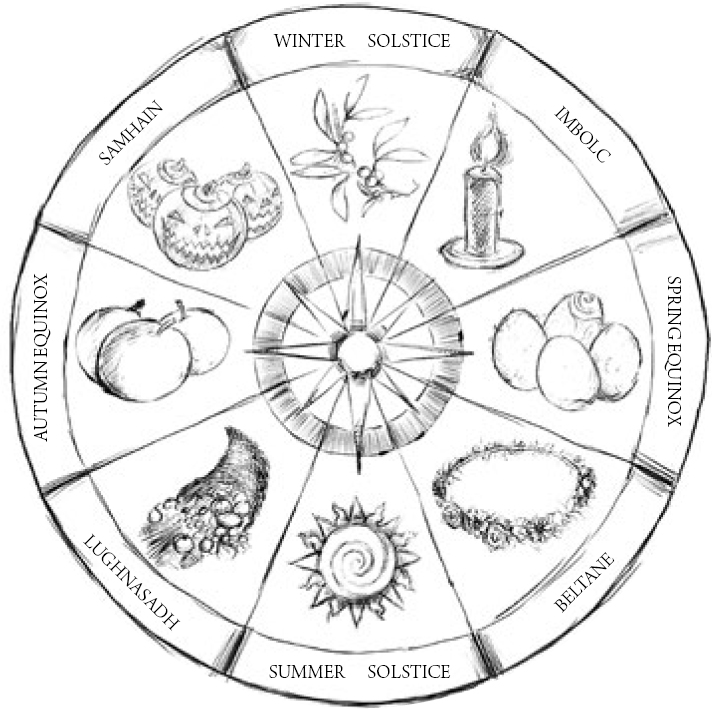
The turning of nature through the deep rest and renewal of winter, the bursting forth of green shoots in spring, the fiery exuberance of summer and the wholesome harvest of autumn (fall) is an endless cycle of growth and completion that can be mirrored in our own lives – spiritually, psychologically and practically. Every one of the eight special seasonal festivals (see right and pages 4–5) has a history of observance going back to the very earliest times, marked by solar alignments in Neolithic burial mounds and stone circles throughout the British Isles, invoked in myths and folklore and recorded in histories and the ancient Celtic calendar, and these traditions have survived until the modern era in various forms across the 'Celtic fringe'. In the last few decades these ancient celebrations have seen a passionate revival, as many people feel the call to relate spiritually to their environment once again and seek to rediscover their heritage. Woven together in the modern era, these festivals make a consistent whole: the Wheel of the Year. This cycle of conscious celebration helps us, year on year, to align with nature’s rhythms with feelings of wonder and insight, walking in the footsteps of our ancestors as well as creating new ways to mark the seasons for generations to come.
Iron Age Celtic culture spanned much of northern Europe and the Atlantic coast, and was highly sophisticated for its time. Long-distance trade routes facilitated the exchange of ideas, helped by a common language and shared values and spiritual outlook. The Celts’ relationship with nature and their environment was all encompassing; they understood that their very lives were dependent upon nature, its seasons and its patterns. The heavens above, their agricultural life below, and the wilderness that surrounded them were all infused with spiritual significance. In the Celtic worldview, the gods were immanent in nature; they were present in tree and rock, wind and rain, river and soil, sun and moon, together with a whole host of spirits and the ever-guiding ancestors.
Celtic culture waned in the centuries following the expansion of the Roman Empire, but lingered on in what is commonly called the ‘Celtic fringe’ – notably Brittany, Cornwall, Wales, Scotland, the Isle of Man and Ireland. When Christianity came, many Celtic gods were forgotten or turned into saints or faery figures remembered only in folklore, yet traditions that celebrated the turn of the seasons with ceremony and magic have spanned the millennia.
Eight seasonal festivals honour and celebrate nature's yearly cycle:
1–2 February (northern hemisphere)
1–2 August (southern hemisphere)
A time of birthing, of the year’s first green shoots, of the lambs in the pasture and of our own hopes and plans.
20–23 March (northern hemisphere)
20–23 September (southern hemisphere)
A time when life springs forth with the turn of the season, bringing joy and exuberance with the blossoms on the bough.
1 May (northern hemisphere)
31 October (southern hemisphere)
A time of lovers, the fertile season, when Jack-in-the-green meets his mate, and all life is seeded through the marriage of opposites and their magical embrace.
20–23 June (northern hemisphere)
20–23 December (southern hemisphere)
A time of power when the sun is at its height and all life swells as plans come to fruition.
1 August (northern hemisphere)
1–2 February (southern hemisphere)
A time to feel pride in our accomplishments and abundance as life’s harvest comes into fullness.
20–23 September (northern hemisphere)
20–23 March (southern hemisphere)
The harvest is gathered in, and it is time to prepare for the darkness ahead and find gratitude in our hearts.
31 October (northern hemisphere)
1 May (southern hemisphere)
The spirit night is a time to face death and the darkness within, as the wheel turns to winter and the ancestors and the spirits are abroad.
20–23 December (northern hemisphere)
20–23 June (southern hemisphere)
A time of deep rest and renewal, while nature dreams within the womb of the earth and the sun is reborn, giving us more hours of light each day.
The Druids, the Celt’s religious caste, were fabled for their extensive knowledge of nature, philosophy and the sciences, which included detailed starlore. This mastery allowed them to mark the passage of time and seasonal shifts with a startling accuracy that was beyond even the astronomical capabilities of the Roman Empire at the time. The wonderful Celtic calendar, dating from the second century CE, found in Coligny, France, in 1897, demonstrates the Druids’ significant mathematical and astronomical knowledge. Based on the moon’s 19-year cycle, it is an accurate lunisolar calendar that unites the solar year with the lunar months – an astounding feat for the time. Each of the months recorded in the Coligny calendar runs from full moon to full moon, charting the fall and rise and fall again of the lunar rhythm.
Each month was given a dark half and a light half, with the word atenoux, meaning ‘renewal’, inscribed in the middle of the month, suggesting that the month darkened as the moon waned and was renewed at the new moon, after which the month lightened night after night until the moon became full once more at the beginning of the next month. The year was also divided into a dark half and a light half following the same pattern, the dark from Samhain to Beltane and the light from Beltane back to Samhain.
There is much argument about the Coligny calendar and which part of the year it started but the names of the months give us reliable clues that the year began with Samhain, or Samonios, meaning ‘summer’s end’ or ‘seed fall’, and progressed through the winter to the following spring, summer and autumn. This method of tracking time placed importance upon the inner life, on the emotional and the spiritual, as well as on the ebb and flow of the tides – both of the sea and of women’s fertility – balancing the solar pattern of the seasons to create a rich and deeply soulful way for the Celts to relate to the world and to themselves. It’s clear the stars and seasons were observed not only for practical reasons, but also for their spiritual lessons: a pattern of increase then decay, followed by rebirth and renewal.
The Coligny months are as follows, beginning on the full moon of each month:
Coligny month |
Meaning |
Modern month |
1Samonios |
‘Summer’s end’ or ‘seed fall’ |
October/November |
2Dumannios |
‘Darkest depths’ or ‘month of sacred or sacrificial smoke’ |
November/December |
3Riuros |
‘Cold time’ or ‘month for fattening’ |
December/January |
4Anagantios |
‘Stay at home month’ |
January/February |
5Ogronios |
‘Time of ice’ or ‘time of cold’ |
February/March |
6Cutios |
‘Month of winds’ |
March/April |
7Giamonios |
‘Winter’s end’ |
April/May |
8Samivisionos |
‘Time of brightness’ or ‘time of the sun’ |
May/June |
9Equos |
‘Horse time’ |
June/July |
10Elembiuos |
‘Claim time’ or ‘month of the deer hunt’ |
July/August |
11Edrinos |
‘Arbitration time’ |
August/September |
12Cantlos |
‘Song time’ |
September/October |
Each of the names of the months was based upon agricultural and cultural events as much as on spiritual devotions or natural occurrences. This gives us additional insight into the Magical Year as it spirals from one season to the next, which we can apply to our own understanding of the seasons and our seasonal celebrations today. By using our experience of nature as a mirror for our own patterns of increase and restoration we can adapt our celebrations to reflect our own lives and make them relevant to our own needs today as much honouring nature itself and the traditions of the past.
The Wheel of the Year can be understood as a continuous cycle of celebration and magic that relates to the four directions and also to the patterns of growth and decrease in our life cycles as well as in the earth’s seasons. Colours, herbs, crystals and other natural objects can also be associated with appropriate positions of this wheel. In this way a web of correspondences can be drawn upon to add extra insights, power symbolism and magic to our celebrations, to help us maximize their effects. These are some of the associations of the Wheel of the Year, but each person will have their own ideas and each landscape its objects and natural resources that can be added to this list. Feel free to add your own associations over time.
Direction |
Festival |
Key associations |
North |
Winter Solstice |
Night; earth, winter, age, crossing over into spirit; onyx, jet, granite; holly, all evergreens – cedar, pine; death as gateway to renewal; peace, knowledge; the Cailleach |
Northeast |
Imbolc |
Pre-dawn; first stirrings of new life, emergence, birth; rutilated quartz; snowdrops, pine birch, anemones; white gold and green; candlelight; purity; Brighid |
East |
Spring Equinox |
Dawn; air; new life, childhood; birch, blackthorn, daffodils, primroses; birdsong; yellow, green; exuberance, inspiration, ideas; Eostre |
Southeast |
Beltane |
Morning; youth, sexual emergence, discovery; faeries; bluebells, wild roses, hawthorn; green, red, white; rose quartz; the May queen |
South |
Summer solstice |
Midday; fire; adulthood, power, pride, passion ; roses, honeysuckle, oak; amber, pyrite, gold; red, orange; action; Áine and Gréine |
Southwest |
Lughnasadh |
Afternoon; parenthood; harvest, skill, wholeness, pride, sacrifice; corn, barley; poppies, cornflowers; red, orange, brown; Lugh and Tailtiu |
West |
Autumn Equinox |
Evening; water; maturity, age, the moon, dreams, vision, intuition, emotions, the unconscious; silver, amethyst, aquamarine; brown, gold or water colours, blues and purples; elder, rosehips, blackberries; Avalloc |
Northwest |
Samhain |
Sunset; death, descent, dissolution, spirit, infinity; the blood of our ancestors; honouring spirit and chthonic forces; black, silver, purple; blackthorn, elder, poplar, aspen; Gwyn ap Nudd |
Modern life can draw us away from the earth and the changing seasons: we can be overtaken by technology and an endless drive to consume rather than create. Our homes are centrally heated and electrically lit, and we focus our gaze on TV or computer screens where once we sat entranced by flickering fires and the company of our loved ones. Yet the wild world, and a more organic, simpler life is never far away, and we can open our hearts to the beauty of nature once more. Marking all eight of the ancient Celtic festivals then becomes a continuous cycle of spiritual growth and celebration that deepens our connection to the earth, and makes our lives soulful and seasonally rich once again.
Much is said of becoming ‘present’ to the wonder of the ‘now’, and there is no more effective way to do this than stepping outside and touching the earth, letting your body and soul realign with nature’s pulse, and finding spirit at last in the sensuality of the wild. Deep snow, spring rain, fallen leaves or the wind in the barley fields – I have always found spirit, divinity, in the wonder of nature. The wild places, the forest, the hedgerow or the green spaces in the city are as full of holiness to me as any temple. Lying back in the meadows of my childhood, I knew that, for me, God was the wind in the trees, the gentle voice of the river.
Growing into adulthood, this sense of the natural cycle stayed with me. Even when I lived in the city, I could watch the rowan trees along the road change from green to gold, observe the stillness of their bare branches in winter, and how they became green and resplendent in the new spring. I have walked the spiritual path of the wisewoman, practising the ways of my Celtic ancestors for nearly 30 years, and the cycle of the seasons remains as fresh and as full of wonder to me now as it ever did.
Celebrating these seasonal festivals is a way to make our relationship with the earth and the world around us conscious and sacred once again. Here is an opportunity to reclaim our natural selves, and rediscover the greater whole of which we have always been a part. This book will guide you through the rich traditions of the Magical Year, with information and practices that can help you realign with nature’s rhythms.
• Discover the old Celtic gods and goddesses, the spirits of nature, and learn how to call them into your own life.
• Weave magic and reclaim your power with seasonal spells, charms and blessings.
• Explore the changing heavens with Celtic starlore.
• Make gifts and decorate your home with beautiful seasonal crafts.
• Discover herbal remedies and kitchen witchery to create traditional cures and nourishing recipes to share with friends and family.
• Deepen your experience of the Magical Year with guided visualizations and meditations.
• And lastly, create seasonal celebrations and ceremonies that are both spiritually rich and joyful, and meet your needs whether you celebrate alone or with a wider community.
In the pages that follow there are many ways to connect to the seasons and celebrate nature’s ever-turning wheel. Drawing on traditional lore for insight, any of the activities can be practised using what you have to hand or with ingredients and materials easily bought or found in nature, at a time to suit you. In the past many of these festivals were celebrated over a week or so, and focused on different specific dates from community to community, or changed over the centuries, so weave these celebrations into your life in a way that works for you, including your friends and family or seeing them as an opportunity for solitude and self-nourishment. Be creative and confident, allowing yourself to customize what you do so that it is meaningful to your own life and the landscape in which you live.
Cooking and crafting can be great fun, and provide a chance to really involve yourself in the seasons in a practical, physical way. Use whatever materials come to hand for crafts, and adapt recipes to suit your tastes and your local produce. Invite friends and other members of your community to cook together as part of your celebration and gather to make decorations for your homes and your shared spaces. These simple forms of practical magic help us grow and bond as community, family and tribe, and create offerings of goodwill and care as well as gifts of art and food to share with each other and to give to the spirits of our land, honouring the old ways in a new era.
Remember, if gathering moss and greenery from the wild, make sure you only take what you need and give thanks to the plant for its gifts.
You may choose to do the guided shamanic journeys/visualizations in this book either in your sacred space (see page 14), or out in nature, accompanied by drumming or a drumming CD if you wish, or in silence. It important to allow at least 20 minutes for each one and ensure that you won’t be disturbed in that time. You may like to record or memorize the journey path before hand, or just remember the key details, as you choose. Start each one of the journeys the same way. Begin by making yourself comfortable, preferably sitting upright with your feet on the ground, as the old Celtic seers used to do. Next, take a few deep breaths, gentle and easy, breathing deep into your belly, and close your eyes. Let the vision unfold before you, first as if you are watching a film, and then, as you go on, engaging with it more and more. There is no need to analyse, and there is no right or wrong way to do it. You may find your journey unfolds differently from the way it is described in the book. Just remember to always return the way you came, visualizing the path in reverse as you return to your body and ordinary consciousness.
For the starlore meditations you may choose to search out the relevant constellation in the night sky if you live in the northern hemisphere, but it isn’t essential, as it is possible to tune into these stellar energies wherever you are in the world.
Seasonal festivals are a wonderful time to get together with friends, family and community. Group celebrations infuse spiritual meaning into social events and serve to bind us together and deepen our relationships by giving us common purposes and insights. We can use all sorts of elements to create our own meaningful ceremonies, depending on who is attending, what we have to hand and how we feel, and this book will provide you with all the knowledge and inspiration you need together with simple templates to create your own holistic rituals and seasonal celebrations. They don't have to be perfect – they need to be fun and loving, events to draw people together.
Celebrating alone is also a wonderful and powerful thing, often allowing us to go deeper into our spiritual selves to foster a connection with our own soul. After your spiritual work is done, be sure to ground yourself by eating and drinking.
However you decide to celebrate, start by choosing a special site. This could be a place in your home or garden, a local community hall or out in nature. If celebrating out in nature, remember that the old gods and faeries remain even in cities, so choose a place of special beauty and atmosphere, as a clue to their presence. You may also want to prepare your space by using the sacred-space ritual and calling in the four directions (see page 14) and decorating it with seasonal crafts and perhaps an altar.
If you are planning a group or community celebration then you may want to get together in the days leading up to the festival to prepare a feast of festive treats to share. You might also like to have a purifying lustral bath (see page 36) and spend some time in contemplation or meditation considering the meaning of the season in your own life.
The eight festivals of the Wheel of the Year can be celebrated in so many ways, so feel free to mark them in a manner that feels true to you. Allow yourself to be inspired by nature and discover your own methods of honouring each one. Initiate your own traditions as well as remembering the old ways, open the windows, step outside and take a little time to feel the fresh air on your face … the wheel has turned.
Blessed be!
Before working on any of the ideas in this book, you may find it helpful to mark the beginning of your celebrations by creating a sacred space in which to work, and also by renewing your connection with nature. Simple practices that acknowledge the sacred in your life and your surroundings can be very powerful.
You can create sacred space anywhere and in any way you choose. You may wish simply to ensure that wherever you are working is clean, tidy and decorated. You may like to light incense or an oil burner to delight your senses, and play some music in the background to create some atmosphere. You may also want to make a seasonal altar as a focus for your activities, or ‘cast a circle’ by calling in the four directions and their corresponding elements.
To help you feel a connection to the landscape around you, take time to look to the horizon at each of the four cardinal points: north, east, south and west. What can you see? (If you are indoors – what lies beyond the walls outside?) In spiritual traditions around the world, the four directions are associated with the four elements:
• North – Earth
• East – Air
• South – Fire
• West – Water
Taken as a whole, along with the fifth unseen element of spirit, we have all the ingredients of creation, held in balance and harmony.
Cast a circle by facing each of the four directions in turn, holding in your mind and heart the landscape that stretches before you, and ask that the blessings of each element and direction be with you and all present. You may want to use these words or your own. Whatever feels heartfelt and simple is best.
‘I ask for the blessings of the north, of earth and stone!
I ask for the blessings of the east and the air, the blessings of the sky and the winds!
I ask for the blessings of the south and the fire, of the hearth, and of the light of the sun!
I ask for the blessings of the west, of the waters, of sea and rain!’
When you have finished your work, remember to give thanks and bid farewell to each direction in turn, and to any other energies, spirits or gods you have called upon, to close down your sacred circle until next time.
You are invited now to dance in the ever-turning wheel of the seasons, discovering the magic of the eight festivals of the Wheel of the Year for yourself in the pages that follow.
Blessed be!
In the northern hemisphere, the festival of Imbolc marks the very first stirrings of new life. It is a time of bitter weather and biting winds. The days may have been growing longer since the Winter Solstice but it often seems like winter is now at its harshest. The long cold nights of January often weary the spirits and fierce storms are common in February. Yet look closely and glimmers of change can be found in the new buds on the trees and the green shoots of early spring flowers breaking through the frozen earth.
Key Themes
Cross quarter
pre-dawn new life
Celebrating and honouring
awakening
quickening
cleansing
return of the sun
hope
birth
fresh thoughts, dreams, actions
rising sap
the home
family bonds
The animals, too, know that winter’s hold will soon be broken, and the first of the year’s lambs are usually born on these long cold nights, greeting the dawn of the spring with their first breaths, and giving this festival its name – Imbolc means ‘in the belly’, referring to sheep who are pregnant at this time, as well as to the fertility of the earth. Another name for Imbolc is Oimelc, meaning ‘ewe’s milk’, which was a valuable supplement to our early ancestors’ diet, giving strength to those who were weakened through the winter, such as children and the infirm.
Imbolc honours the home and hearth, as well as blessing the fields for future fertility. Central to the festival is the Celtic goddess Brighid, known also Brigid, Brigit, Brigidh, Bride, meaning ‘exalted one’. Another interpretation of her name is that it comes from the Gaelic Breo-Saighead, meaning ‘fiery arrow’ and signifying her solar aspects. Brighid is the patron goddess of birth, pregnancy, the home and all domestic and dairy-related activities, as well as smith-craft, healing and poetry. In Ireland Brighid is the daughter of the Dagda, ‘the good god’, and she is said sometimes to have two sisters, also called Brighid, suggesting she is in fact one of many triple goddesses found in Celtic and other European traditions (see also page 163). In antiquity such goddesses are usually three women of similar age but with perhaps different aspects – usually one holding a baby, another a sheaf of grain and a third with some other relevant symbol, such as a scroll to represent knowledge or a bowl of food – rather than the modern triplicity of maiden, mother and crone.
Fed as a child on the milk of otherworldly or faery cows, and often portrayed as milking a cow, Brighid is deeply associated with fertility. She provides ample supplies of milk for the tribe or village that honours her, and her limitless larder means none go hungry. Honouring Imbolc and the goddess Brighid is about strengthening the bonds of home, family and community that are so important at this time. You might want to think of this period as providing sustenance for both your body and your soul after the challenges of a long winter.
Brighid was worshipped all across Britain and Ireland, and is often associated with holy wells and springs, such as Bride’s Well in Glastonbury. Brighid is likely to be the same goddess as Brigantia, honoured by the Brigantes tribe in northern England, and Britain itself is named after her – Britannia is the Romanized version of her name. As such she is also concerned with ideas about sovereignty, both of the nation and in the sense of personal empowerment.
During your Imbolc festivities, you may like to perform a simple welcoming ritual for Brighid, asking for her blessing upon the household for the following year. First make the home as tidy and pretty as possible, fit for an honoured guest, and as dusk approaches, open the front door wide and take a moment to feel or visualize her presence. Then use this traditional welcome or your own words, to welcome and invite her to your home:
‘The bride has come! The bride is welcome! Goddess Brighid, this is your day, I welcome you to our home, beloved guest. Blessed be!’
You may also then like to set her a place at your table, or put a glass of milk or wine in a special glass beside the fire for her.
Goddess transformed
With the coming of Christianity, Brighid became transformed, if somewhat demoted, into St Brigid/St Brigit. The church took on her names, sacred enclosures, legends, prayers and characteristics, her associations with fertility making her known as the midwife of Christ. Her holy day of Imbolc remained also, transformed into Candlemas, a remaining vestige of her fire worship. In Anglo-Saxon times, libations of bread and milk were given to the fields on this day, as Saxon practice merged with the earlier traditions. Some scholars now associate Brighid with numerous grain goddesses worshipped across Iron Age Europe, linked to similar practices and symbolism. Brighid’s crosses (see page 37), solar wheels made of straw, or sometimes of willow and wool, are still popular for protection and blessing in Ireland and across Celtic Britain.
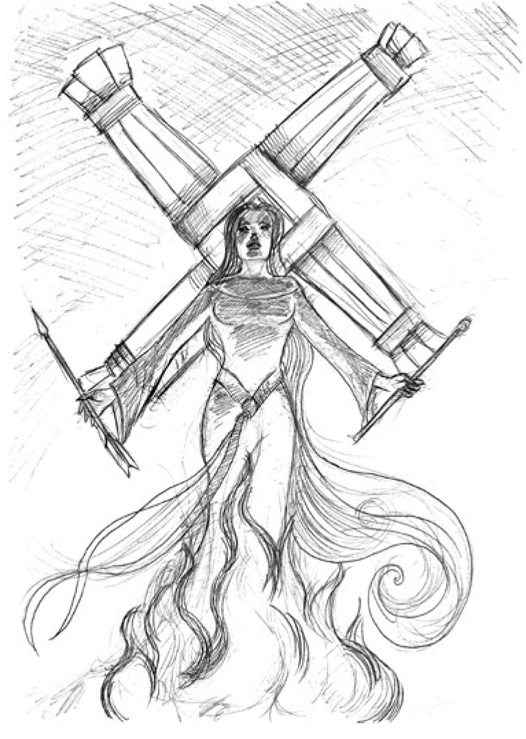
Brighid, goddess of the home, healing and poetry
Brighid and later St Brigit had a sanctuary at Kildare, in Ireland, which was famous for its healers and was likely to once have been a pagan Druidic college. The word Kildare is a modernized version of cil dara, meaning ‘the church of the oak’, suggesting that a great oak tree once stood in the area – a last vestige of the pagan temple before the church claimed the site for their own. At Kildare a sacred perpetual fire, used for healing, blessing and inspiration, was maintained for centuries until it was extinguished in the Reformation in the 16th century. This fire has now been relit, and other Brighid’s flames have been kindled from this and are held in numerous sacred places around the world, including at Glastonbury in the UK.
The Brat Bhride – Brighid's or Bridie's mantle – is traditionally a white cloak or piece of cloth used for blessings and healings. At dusk on 31 January, place the cloth outside, over the branch of a tree or bush, and in the night Brighid will pass by and bless it.
The blessed cloth can be used in a variety of ways, but is particularly good to cover those who are unwell or those receiving healing. Smaller cloths can be used dipped in water – especially water drawn from a sacred natural spring – to lave the forehead of those with fevers, or to hold over bruises, etc.
This is good magic to use, especially around children. While it’s not meant to compensate for modern medicine, a Bridie's mantle can be a source of great comfort, and bring ease and peace to those in distress, like a magical comfort blanket.
Sometimes negative energy naturally accumulates over time in an area. This energetic cleansing ceremony is an expanded version of the traditional house blessing performed at Imbolc. You may find it particularly useful if you have had a harsh winter, have just moved home or just want a new start.
You will need a fresh white candle in a good sturdy holder that you can move about easily, and a handheld mirror. First see to it that everywhere is clean and tidy – floors swept and any dust and, especially, any cobwebs, wiped away – so that you are ready to welcome the goddess Brighid into your home. Starting at the kitchen table, take your candle and light it with a new match. As you do so, ask Brighid to bless the flame, and that it may represent her power. Use the following or your own words:
‘Great goddess Brighid, keeper of the flame, I ask that you bless this candle. May it be a sign of your presence and power, clearing away all negative energies. Blessed be!’
Think of Brighid’s perpetual flame at Kildare and see this flame as one seed of that great fire. Then take the mirror and angle it so that the light of the flame is reflected in the mirror. Move the mirror about so that the light it reflects dances in turn upon each wall of the room, in every nook and cranny, on every shadow. In your mind’s eye, empower the flame by trusting in Brighid, and visualize it burning away and transforming all negative or stuck energy.
Take the candle to each room and repeat the process, so that the light of Brighid reaches every corner of the house, from top to bottom. The mirror takes the energy of the candle to another level, the reflection world seen within it being the spirit version of the room you are in. However, it is also possible to perform the same blessing by just moving the candle around.
When you have gone around the whole house, set the candle somewhere where it can safely burn all the way down. Don’t blow it out, as this releases all the negativity again. Let the candle take its time, and when you look at it, see in your inner eye how it is consuming the stagnant life force that the home has accumulated over the winter and transforming all stuck patterns of the household. Thank the fire spirit present in the candle, and thank Brighid especially, for her hard work and assistance. If there is a candle stub left when the wick has burned through, bury it in the earth when the magic is done.
In the Hebrides, folklore refers to Brighid doing battle with the Cailleach or hag of winter and bringing the thaw (see page 227). At Imbolc the life force of the earth is just beginning to awaken as the wheel of the year begins its ascent toward the Spring Equinox: the sap is rising in the trees; the seeds are starting to germinate. This is symbolic of what is happening in our lives, too, as we anticipate the year ahead and make plans and resolutions for the future. These are sacred to the goddess Brighid. Her link with fire and the resurgence of life force at springtime suggest a Celtic version of the Indian concept of kundalini, which can be understood as energy rising up through the earth as well as through our bodies. Kundalini is often symbolized by a serpent, which is one of Brighid's sacred animals, and signified vitality, health, sexual potency and the phallus to our ancestors.
We, too, can honour Brighid at this time to nurture our fertility or productivity for the year ahead, calling her to be a spiritual midwife to our own life, birthing our potential as we grow in tune with our heart and spirit. Brighid can be contacted in many ways. For example, you might want to meditate on her qualities of birthing, healing and domesticity, or light a white candle in her honour or call upon her as the women used to not so long ago, for protection. There are also traditional charms to use to ask her for assistance; the one below, the ‘Descent of Brighid’, is from The Carmina Gadelica, the collection of Gaelic texts compiled by Scottish folklorist Alexander Carmichael in 1900. Visualize Brighid before you (she is usually pictured with red hair and a green dress) as you raise your arms in invocation and say:
‘Each day and each night,
That I say the Descent of Brighid
No fire shall burn me,
Nor sun shall burn me,
Nor moon shall blanch me.
Nor water shall drown me,
Nor seed of faery host shall lift me,
Nor earthly being destroy me.
I am under the shielding
Of good Brighid each day
I am under the shielding
Of good Brighid each night
Each early and late
Every dark, every light.
Brighid is my comrade-woman
Brighid is my maker of song
Brighid is my helping-woman
My choicest of women, my guide.’
As part of the Imbolc celebrations, Brighid was represented by a corn dolly, which was prepared and dressed as a ‘bride’ by the women and paraded about the houses before being led to her marriage bed, where she was lain for the night next to a phallic acorn-tipped wand, representing her lover, the god of fertility. Together they would bring life back to the land, and to ‘bring in the bride’ was to bring her blessings and protection into the home, and to enlist her power to banish any ill will or misfortune that may have gathered through the winter.
Today, 'a bed for the bride’ could be a made-up guest bed or a basket by the fire, with a white blanket in which a cloth Bridie doll (see page 38), corn dolly (see page 205) or Brighid effigy could be placed. A bed made for the night on the sofa is also a good gesture of welcome.
The acorn-tipped wand, often made of birch, is known as the white wand. Frequently thought of in modern goddess circles as a symbol of Brighid's power, this is in fact the last sign of her forgotten husband, the god of fertility banished from Christian practice when she became a saint. In some stories he is Bres the Beautiful, who holds the secret knowledge of agriculture and so, like Brighid, is associated with the fertility of the land. In other tales, he is the Dagda, the good god. Either way, Brighid’s balancing partner is surely her lover and the father of her children, by whatever name. The phallic wand of Brighid holds the male, fertilizing magic which, when used together with her female magic, blesses the home and all within it, and brings the blessings of spring. For new life, of any kind, there must be both male and female, and so it is important to remember the white wand at Imbolc.
Today, skilled woodcarvers still create beautiful white wands, some decorated with a phallus on the tip, as well as with snakes, leaves, acorns and other symbols. All you need is a stick or small branch that is straight and sound. Oak, holly and hazel are all good woods to use. When gathering the wood, ask Dagda to bless the branch and request that it may bring the male fertile magic into the house with it.
You may also wish to sand down the wood before varnishing or painting it. Traditionally, the wand was wrapped with red and white ribbons. The colours red and white recur in British mythic imagery; for example, there are red and white roses, dragons and streams or rivers. Red and white rivers may represent breast milk, tears, semen and blood or menstrual blood, symbolizing the sacred polarities of male and female, positive and negative, and referring to the divine tension and cycle of creation and destruction that governs all things.
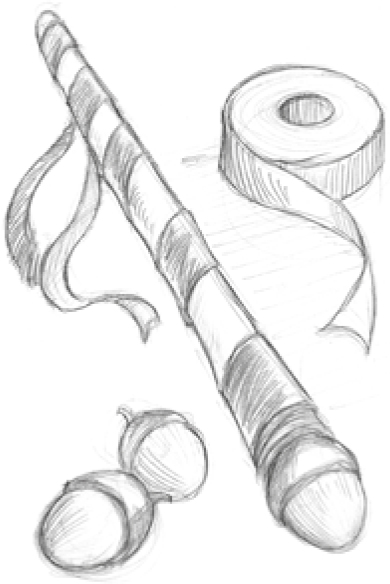
A white wand
Attach an acorn or a pinecone to the top of the wand by cutting a slot in the wood, before gluing it and/or binding it into place with cord or ribbon. Finish by charging your wand with the god’s energy by making any prayers to it you choose, allowing your words to express your feelings and intuition.
Seeing the Milky Way stretched out encircling the horizon, our ancestors would have understood that they were held in a divine cauldron, within which the very ingredients of life were stirred with the turn of the seasons.
At Imbolc the long nights are still with us and the winter stars can be especially bright. At these times the heavens seem to take on a dramatic quality, attracting our attention as the world below slumbers beneath the soil. Start by finding Orion’s Belt, to the south and west in the northern hemisphere, and then follow the line of the belt upward to find a bright red-orange star. This is Aldebaran in the constellation of Taurus the Bull. In the Celtic tradition, bulls (known as tarbh in Gaelic) are sacred to the goddess Brighid, associated with the earth, fertility, virility and wealth. Bulls feature widely in prehistoric rock art and their skulls were placed prominently in ancient burial chambers, perhaps as totems to bring the dead back to the living in due course, just as spring returns after winter.
During the winter nights our galaxy, the Milky Way, is also especially visible as a band of shimmering stars that 5,000 years ago would have appeared to encircle the horizon during winter. It has been suggested that the Neolithic stone circle and henge at Avebury in Wiltshire were built to align with the appearance of the Milky Way at a time when it held this position.
Known as Caer Gwydion in the Welsh tradition, the Milky Way has for millennia been associated with milk and whiteness, symbolizing fertility and blessedness all around the world. The Greeks believed it was formed by the spilled breast milk of the goddess Hera, and called it the Galaxias Kyklos, meaning ‘the milky circle’, while to the Romans it was known as the Via Lactea.
Milk is seen as a magical substance in traditions all around the world, and Brighid’s associations with milk as well as with fire reveal her connection to the very primal form of fertility, the energetic, alchemical streams that combine to make life itself, often associated with the colours red and white (see page 27). This is perhaps the key to her power; in combining these energies she is able to transform or overturn the magic of the Cailleach, the old woman of winter, to forge life anew and bring the spring.
In this meditation visualize the Milky Way as our ancestors perceived it – as the rim of a divine cauldron in which life itself was created with the turn of the seasons.