

For Kaitlyn Clare Arquette
September 18, 1970—July 17, 1989
with love
This is a true story. The facts are documented. Newspaper articles and psychic readings have been slightly condensed in the interest of space and to avoid repetition. Several names have been changed to protect sources of information whose identities are not part of the public record.
“It is no measure of health to be well adjusted to a profoundly sick society.”
Krishnamurti
Prologue
Chapter 1
Chapter 2
Chapter 3
Chapter 4
Chapter 5
Chapter 6
Chapter 7
Chapter 8
Chapter 9
Chapter 10
Chapter 11
Chapter 12
Chapter 13
Chapter 14
Chapter 15
Chapter 16
Chapter 17
Chapter 18
Chapter 19
Chapter 20
Chapter 21
Chapter 22
Chapter 23
Chapter 24
Chapter 25
Chapter 26
Chapter 27
Chapter 28
Chapter 29
Epilogue
Afterword
A Biography of Lois Duncan
Listed by Page Number for Easy Reference
48-54 Betty Muench
77-84 Betty Muench
122-24 Betty Muench
124-26 Betty Muench
145-47 Betty Muench
156-58 Betty Muench
166-72 Betty Muench
252-55 Noreen Renier
255-58 Noreen Renier
265-70 Noreen Renier
274-82 Nancy Czetli
284-89 Betty Muench
295-302 Nancy Czetli
306 Greta Alexander
309-10 Greta Alexander
OUR TEENAGE DAUGHTER KAITLYN was chased down and shot to death while driving home from a girlfriend’s house on a peaceful Sunday evening.
Police dubbed the shooting “random.”
“You’re going to have to accept the fact that the reason Kait died was because she was in the wrong place at the wrong time,” they told us.
But to our family the circumstances didn’t add up to “random,” especially after we made the shocking discovery that Kait had been keeping some very dangerous secrets from us.
Some of those secrets were exposed by psychics.
Others by private investigators.
Others by an aggressive newspaper reporter who followed up on leads the police refused to look into.
After spending two years investigating Kait’s death our family has managed to accumulate enough information to form a fragmented picture of what may have happened to her, but the jigsaw puzzle still lacks the few key pieces that could nail the identity of her killers.
It is my hope that reading Kait’s story will motivate potential informants to supply us with those pieces.
Tipsters can address their letters to:
Lois Duncan, Author of Who Killed My Daughter?
c/o Dell Publishing
Dept. LD
1540 Broadway
New York, NY 10036
ONCE UPON A TIME, in a faraway land, there dwelt a man who was a teacher of things strange and wonderful.
He taught that the soul could leave the body and fly, and that people could foretell the future, and that healing could be accomplished by love and by touch, and that the spirits of those who moved on to other dimensions could communicate with the living through visions and dreams.
Such teachings were considered heresy in that time, so the teacher was forced to conduct his classes in secret. He met with a small group of students in a garden by a fountain and continually cautioned them never to reveal what he taught them.
Among those students there were three strong-willed young men who were very excited about the things they were learning and desperately wanted to share this knowledge with others.
The first went off to teach in a foreign country so as not to endanger his teacher and fellow students.
The second absorbed, not only the lessons of the teacher, but his fears and paranoia as well. Cautious and conservative, he monitored the safety of the group and struggled to keep the others under control.
But the third young man was a rebel who would not be intimidated. He considered himself invincible, but his judgment was poor, and he trusted all the wrong people. His actions brought disaster to himself and his teacher.
This took place long ago in a faraway land.
Centuries later it happened again.
OUR DAUGHTER, KAITLYN ARQUETTE, was murdered in Albuquerque, New Mexico, on Sunday, July 16, 1989.
They got her at night.
I have lived that evening over so often in dreams that by now it has become an extension of myself. When I go to bed it runs through my head like a videotape, the images sharp and precise, the dialogue unchanging, except that with each repetition there are new things I notice.
The setting is always the same, of course; it’s our family room. Although we no longer live in that house, I can picture it perfectly. The rug, a rich rust color, muted by pet hair, as our cat and cocker spaniel shed in the summertime. The brown-and-white couch and love seat with cushions molded into irreversible slopes and hollows by years of accommodating the bodies of sprawling teenagers. Bookshelves, lined with albums that are filled with photographs chronicling ski trips, camp-outs, Christmases, graduations, and birthday parties. A television set across from the sofa. A Navajo rug on one wall. On another, a painting by my stepmother that depicts my late father—white haired, bearded, shirtless—on the porch of a beach cottage, baiting a fishing hook for a grandson.
I am a writer by trade and am practiced in recreating scenes. It is easy for me to place myself back in that room again. Beyond the bay window there lies a tree-shaded yard, and, beyond that, an unkempt rose garden. When I peer out through the glass, I can see that it’s raining, and the soft gray drizzle produces a premature twilight.
Now that I have set the stage, I will bring on the players.
Kaitlyn, eighteen, comes into the house. I hear the slam of the front door and the sound of her footsteps in the hallway and immediately know this is Kait and not one of her brothers. Her tread is solid and purposeful and distinctly her own.
My husband Don and I have just settled ourselves on the sofa to watch 60 Minutes. I raise my eyes from the television screen and call, “Is that you, honey?”
“Who else?” Kait answers, and materializes in the doorway. “I thought I’d stop by and say hi on my way to Susan’s.”
“The bad penny returns!” says her father. “You were here all morning. We see more of you now than we did before you moved out!”
“The rain’s depressing, and Dung’s out with his friends,” Kait says. “The apartment feels weird tonight and I don’t like being there.”
She comes into the room and perches on the arm of the sofa. She is dressed in a short black skirt and a black-and-white striped blouse, and around her neck there hangs a chain with a tiny gold cross. She is wearing the sand-dollar earrings I brought her from Florida the last time I visited her sister, Robin. The earrings are rimmed with gold, the same burnished shade as her hair, which she is still determinedly trying to grow back to one length after last summer’s disastrous asymmetrical cut.
Each time I rerun the scene, new details leap out at me. For instance, how perfect her teeth are, straight, white, and even. Her complexion is perfect also, unmarred by the adolescent acne that torments her friends, totally unblemished except for an odd little hollow on the ridge of her left cheekbone. When I caught my first sight of her in the delivery room, I gasped, “My baby has a hole in her face!” but the obstetrician assured me that the dent wasn’t permanent. As it turned out, it was, but we came to regard it as a misplaced dimple and jokingly referred to it as “God’s fingerprint.”
Kait flashes her mischievous smile, but something doesn’t feel right to me, and I regard her suspiciously. Her eyes are red, and the lids are abnormally puffy.
“You’ve been crying.” I make it a statement rather than a question.
“Like I told you, the rain depresses me,” she says defensively. “Besides, I’m pissed at Dung, and I always cry when I’m mad.”
“Have you two had another fight?”
“Not another one since last night, if that’s what you mean,” Kait says. “The reason I hung around here so long this morning was because I didn’t want to have to go home and talk to him. This living-together business is a crock. Things were a whole lot better when we were just dating.”
“Why don’t you move back home, then?” Don asks reasonably. “There’s no sense staying in a situation where you’re miserable.”
“I’m not about to crawl back into the womb,” Kait responds with characteristic stubbornness. “I love my apartment, I’m just sorry I ever let Dung move in. His weirdo friends are over there all the time. I feel like I’m running a crash pad for half the Vietnamese in Albuquerque.”
“Ask him to move out,” I suggest. The solution seems so simple.
“I have, but he won’t,” says Kait. “He says it’s his place, too, but it isn’t because the lease and utilities are in my name. He still doesn’t understand how things work in America. He says that in Vietnam women do what men tell them. I’ve told him I’ll let him stay until the end of the month, but then I want him out so Laura can move in with me.”
“What’s suddenly gone so wrong between you and Dung?”
“I don’t want to get into it now, it’s just too heavy. I’ll tell you about it sometime, maybe later tonight even.” She glances at her watch. “Well, I’d better get going. I’ve never been over to Susan’s, and it may take time to find it. I thought I’d stop on the way and pick up some ice cream. She’s cooking the dinner, so the least I can do is bring dessert.”
“Where does she live?” Don asks.
“It’s down around Old Town. I’ll either spend the night there or come back here. If Dung calls trying to find me, don’t tell him where I am.”
“That’s cruel!” I exclaim, shocked by this display of callousness. “You may be breaking up with him, but you’ve been going together for a year and a half, and whatever your problems are, you know Dung cares about you. If you don’t come home, he’s going to think you’ve had an accident.”
“Mother, you don’t understand—”
“I do understand! What you don’t understand is how horrible it is to worry about somebody!”
I consider myself an authority on that subject. Even after our five children were all bigger than I was, I insisted that Don and I dovetail our business trips so that one or the other of us was always home to keep an eye on things. When Kait was an infant, I was chronically reeling from sleep deprivation from checking her crib throughout the night to make sure she was still breathing, and despite the fact that my fears were never substantiated, I didn’t get any better when the children became teenagers. They knew that if they missed their curfew by as much as ten minutes, they could expect to find me pacing up and down in the entrance hall, fighting hysteria as I pictured a blazing car wreck with beloved bodies mangled and strewn across the highway.
I’d expected my paranoia to diminish once the nest was empty, but now, as Kait starts toward the door, I realize that it is stronger tonight than it has ever been. Here in this familiar room, on a damp, sweet summer evening that couldn’t be less threatening, I am suddenly overwhelmed by such a surge of panic that I can feel the pounding of my heart in my fingertips. I sense the vibrations of a tidal wave rolling toward us as we stand on a peaceful beach with our backs to the ocean.
“Don’t go out! Something terrible is going to happen!”
“What did you say?” Kait can’t believe she has heard me correctly.
“Something terrible is going to happen!” I repeat irrationally, and grasp for some way to make the statement less preposterous. “We don’t even know this girl Susan. Who is she, anyway? Daddy and I haven’t met her. Why hasn’t she ever been over here? She certainly doesn’t live in a good part of town.”
Kait glances across at her father. Can you believe this?
“The reason Susan hasn’t been over here is—if you’ll remember, Mother—this isn’t where I live now.” She addresses me with exaggerated patience. “She’s a very nice girl who sells snow cones in front of Pier One. I met her on a lunch break, and we got to be friends. We’ve been trying to get together to see a movie or something, but our plans keep falling through because of my work schedule. And what do you mean about Old Town’s being a bad area? You and Daddy have friends who live there. It’s not like it’s one of those creepy barrios like Martineztown.”
“I won’t let you go,” I say firmly.
Then I leap from the sofa and grab her before she has time to take in what I’ve said and flee from the room.
Kait is a big girl, taller and heavier than I am, but that doesn’t matter; she’s no match for the crazy middle-aged woman who bears down on her. I shove her onto the sofa and pin her arms at her sides with a powerful viselike grip that cannot be broken.
“Get me some rope!” I shout.
“Rope?” Don repeats blankly, shifting his gaze from Dan Rather to zero in on the battle scene. He has never seen me like this, and he’s obviously horrified. He is looking at a woman gone suddenly mad.
“There’s a coil of rope in the garage! I saw it there yesterday! Hurry and get it, I can’t hold her down forever!”
We’ve been married so long that Don responds automatically. He jumps up from the sofa and takes off at a run for the garage.
Kait struggles to break my grip, but the same bony, long-fingered hands that buckled her into her car seat and snatched her away from hot stove burners and steadied her two-wheel bicycle when she took off the training wheels have developed incredible strength when it comes to her safety. There is no way in the world that she can break my grip on her.
“Is this being taped by Candid Camera?” she asks, half laughing, half crying, trying to pretend it is a joke. “It isn’t as if we’re going to be doing something dangerous. We’re going to eat dinner, and then we’re going next door to decorate Susan’s boyfriend’s apartment. He’s out of town, and she wants it to be a surprise for him.”
“I’m sorry,” I say. “This isn’t the evening for you to do that.”
Don reappears with the tow rope we use for water skiing and makes an attempt to hand it to me.
“You’re going to have to help me,” I tell him. “Wind it around her shoulders and work your way down. Make it tight, but be careful not to cut off her circulation. All we want is to keep her from going out tonight.”
Don takes the rope and starts looping it around Kait’s body, doing his best to ignore her shrieks of outrage. It takes us a while, but the job is finally completed. With our daughter securely cocooned, I test the knots to make sure they will hold.
Kait lies on the sofa, glaring up at me in impotent fury.
“I will hate you for this forever!” There is venom in her voice.
“That’s all right,” I say gently, stroking her hair.
I sit by her side and guard her the rest of the night.
That is the way the scene plays when I run it in my dreams. In truth, of course, that is not what happened at all. Common sense took precedence over instinct, and I confined my admonishments to telling Kait to drive carefully.
“I always drive carefully,” she said.
That wasn’t true, and we both knew it. Kait was an aggressive driver, given to risk taking, but traffic was light on Sunday nights, and it wasn’t as if she was going to be driving on the freeway. The easiest route to Old Town was straight down Lomas, an east-west street that ran one block south of our home. There wouldn’t be many drunks on the road on a Sunday, and her plans for the evening were certainly simple and harmless.
She’s going to be fine, I told myself. I’m being ridiculous.
Still, I said, “I want you to leave us Susan’s phone number. That way, if you don’t come back, we’ll know where to start looking for you.”
“Honestly, Mother, there are times when you’re just unreal!” She indulged me by scribbling a number on the back of a magazine. “Now, you do something for me. I want you to promise that if Dung calls here you won’t tell him I’m at Susan’s.”
“I promise,” I said reluctantly, with the mental reservation that, while I wouldn’t divulge Susan’s name, if Dung did call, frantic with worry, I would tell him that Kait was all right and was sleeping at a friend’s house.
Kait raised her hand in a comical half salute.
“Later! I’ll see you guys later!”
Those were the last words we were ever to hear her speak.
The call from the emergency room of the University of New Mexico Hospital came just before midnight. The woman who called said Kait was there and had been injured but would give out no further information over the telephone.
Don and I threw on our clothes and drove to the hospital. I sat in the passenger’s seat with my hands clasped tightly in my lap, the nails of one making gouges in the back of the other, living a nightmare eighteen years in the making. I wanted to pray, but I didn’t know what to pray for. I hated to press my luck by asking God for too much and offending Him with my greediness, so I couldn’t ask for the call to have been made by a prankster or for Kait to have suffered nothing more than scratches.
I finally decided to confine my prayer to the request that she not have a head injury. Two years ago my stepsister’s teenage son had been in an accident that had left him brain damaged, and Kait had gone into hysterics when she learned about it.
“Poor Andy!” she’d gasped through her tears. “He was always so smart!”
Kait’s tough, I told myself. She can deal with almost anything—fractures, disfigurement, even with life in a wheelchair—but, please, oh, please, don’t let anything have happened to her brain!
The space in front of the emergency room was reserved for ambulances, so Don dropped me off at the door while he took the car across to the visitors’ parking lot. The nurse who had called us was standing in wait in the doorway, and I knew that it had to be bad when she took me in her arms.
“You’re sure it’s Kait?” I whispered. “There’s no chance it’s a mistake?”
“It’s Kait,” the woman said. “There was a picture ID in her wallet. She’s alive, but in critical condition. You need to prepare yourself for the fact that you may lose her.”
“A car wreck?” I couldn’t conceive of any other possibility.
“Your daughter’s been shot in the head,” the nurse said quietly.
The sand of the beach slid out from under my feet, as the tidal wave struck the shore and I was sucked under.
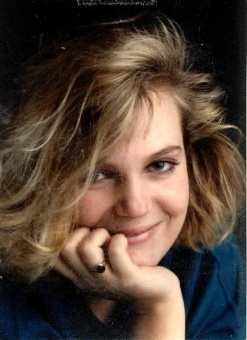
Kaitlyn Clare Arquette, age eighteen, in the spring of 1989, the year of her death
DON AND I SAT in a small private waiting area off the emergency room, side by side on a green vinyl couch, propped against each other like Raggedy Ann and Andy dolls. If one of us had moved, the other would have fallen over.
After a while Don said, “We should call the boys.”
“Please, not yet,” I implored him. Once we started informing people I would no longer be able to tell myself this was a fragment of a fever dream. “There’s no sense dragging them down here at this hour of the night. It’s not as if there’s anything they can do here. Let’s wait until we have something definite to tell them.”
I could tell that Don didn’t agree, but he didn’t make an issue of it, and we continued to sit there, staring out into the hallway, waiting for somebody with authority to come in and talk to us.
At one point we saw Kait being wheeled past our doorway on the way to the X-ray room. Her face was slack and waxen, and her head was swathed in bandages. If we had not been told who she was, we would not have recognized her. We jumped up from the couch and trailed the gurney down the hall until the green-clad orderlies shoved it through a set of double doors into an area designated for doctors only. Then we went back to the waiting room and sat back down again.
We didn’t feel alone, because hospitals are busy places even on Sundays, and there was a steady flow of traffic in and out of the emergency room. Somebody brought us coffee that we couldn’t force down, and we let it grow cold on a table piled with magazines. A nurse came in with Kait’s purse and a plastic jar that contained the items removed from her person when she arrived at the hospital—her watch, the chain with the cross, the sand-dollar earrings.
The next person to visit us was a detective from the Homicide Department. He asked us when we had last seen Kait.
“She left our home at around six-fifteen to go to a girlfriend’s house for dinner,” I told him.
“I’ve spoken with the friend, Susan Smith,” the police officer told us. “Her address and a hand-drawn map were in Kait’s car. Susan said Kait was planning to spend the night with her and then suddenly remembered she had to study for a test tomorrow.”
“She’s taking two college classes in summer school,” I said. “She’s going to be attending full time in the fall.”
“Is her home address the one on her driver’s license?”
“No,” Don said. “That’s the family home. Kait lives at the Alvarado Square Apartments. She moved out on her own a month before she graduated.”
“Not quite on her own,” I said. “She lives with her boyfriend.”
“Dung Nguyen? We got his name from Susan. Is there anything we ought to know about that relationship?”
“It’s pretty much over,” I said. “They’ve been fighting a lot lately. Dung’s going to take this hard, though, so break it to him gently.”
The detective left, and a doctor came into the room to give us the results of the CAT scan.
“It doesn’t look good,” he said. “Kaitlyn’s head wounds are massive. One bullet struck her cheek, and another entered her temple. We’ve placed her on life support, and if she survives the next forty-eight hours, we might want to consider surgery to relieve the intracranial pressure. Aside from that, there isn’t much more we can do for her.”
“Is she in pain?” Don asked him.
“I’d like to believe not.”
“If she survives, will she ever be well?” I asked. ‘
“It’s possible, but not probable, that she’ll regain consciousness,” the doctor said. “Miracles do happen, and we never totally rule them out. The one thing I can tell you with certainty, though, is that if she does live she will never again be Kaitlyn as you knew her. Too much of her brain is gone for that to be possible.”
“What should we pray for?” I asked him.
“I don’t know what to tell you.”
The future rolled out before me like a thin gray carpet—days, months, years spent taking care of Kait’s body, an empty shell with the kernel of awareness removed from it. I experienced an unforgivable moment of self-pity. For the rest of my life I would be cast in the role of caretaker—bathing, diapering, spoon-feeding, exercising a vegetable. Unable to work, to travel, to visit my out-of-state children and grandchildren, I would live out the rest of my days with Kait’s body as my jailer.
“I can do that,” I said.
Don turned to stare at me.
“I can do that,” I repeated, and amazingly I meant it. There were plenty of people with heavier burdens to carry. My love for Kait wasn’t based upon her level of intelligence; with or without a brain she would always be my daughter.
“It’s time to tell the boys now,” Don said firmly. This time I gave him no argument.
We called our older son first. At twenty-eight Brett was still a swinging single with a party-boy life-style who sported a single earring and a three-inch ponytail. Although it was two A.M., we didn’t expect him to be asleep and were not surprised to find that his line was busy. After several attempts to reach him, during which we continued to get a busy signal, we decided he was probably entertaining a girl and had taken the receiver off the hook. Since he lived only blocks from the hospital, we drove over to get him.
When we pulled up in front of the house Brett shared with two other bachelors, we found him standing in the driveway.
“How badly is she hurt?” he demanded, getting into the car.
“It’s bad,” Don said. “Very bad. How did you know?”
“I had a call from a girl named Susan,” Brett said. “She said the police had been over at her place questioning her. They wouldn’t tell her what happened, but from the kinds of things they were asking her, she thought Kait must have been in an accident. She tried to call you, and when she didn’t get an answer, she decided to try the only other Arquette in the phone book. I thought you’d be headed over here, so I came out to wait for you. If you hadn’t turned up soon, I was going to start checking out hospitals.”
“She wasn’t in a wreck,” Don said. “She was shot.”
“Kait was shot!” Brett exclaimed incredulously. “You mean in a holdup?”
“We don’t know what happened,” Don said. “All we know is she’s critical. Now, let’s get Donnie, so we can get back to the hospital.”
Donnie, our twenty-one-year-old, had recently moved into his own apartment. We phoned him from Brett’s and drove over to pick him up. When he saw the headlights of our car turning in through the gate, he started to run toward us across the parking lot, his mane of wheat-colored hair flying out behind him.
I got out of the car and held out my arms, and he threw himself into them.
“I’m so mad!” he sobbed. “I’m so mad! It’s just not fair! Kait’s so nice! Why would anybody hurt Kait?”
“It wasn’t on purpose,” I said. “It has to have been an accident. Some crazy idiot was playing around with a gun.”
I got into the backseat with him and tried to haul all six feet one of him into my lap, rocking him back and forth as if he were a baby and I was the Mighty Mother with magical powers who could kiss away hurts and make everything right for everybody. I felt his tears on my neck and longed to cry with him, but everything inside me had turned to stone.
Back at the hospital we were taken up to the intensive-care trauma ward to which Kait had now been transferred. She lay motionless on the bed, encased in a network of wires and tubes that connected her body to machines that blinked and beeped like monsters in a Star Trek movie. A screen over the bed displayed wavering lines that we assumed had important significance, but none of us had enough courage to ask what they indicated.
I went down to the lounge to put through calls to our two older daughters. I first called Kerry, who lived in Dallas with her husband, Ken, and their two little girls. Our son-in-law answered the phone, so I gave him the news first. By the time he handed the receiver over to Kerry, she had overheard enough to begin to brace for what was coming.
“Kait’s been shot,” I said. “I think you should come.”
“Shot dead?” Kerry asked, too stunned to show emotion.
“She’s alive,” I said, “but I think you’d better come soon, honey.”
Then I called Robin in Florida. I’d saved that call for last because I dreaded it so much. Despite a sixteen-year age difference the oldest and youngest of our children had always been exceptionally close. Robin lived by herself and had no one to give her emotional support as Kerry did. I hated to give her the news when she was alone, but I didn’t feel I could wait to call her at work. To my relief she managed to hold herself together and said she would make arrangements to come immediately.
When I got back to Kait’s room, I found that Dung had arrived and was standing next to her bed, seemingly in shock.
“It’s all my fault,” he muttered under his breath.
“No,” said Brett, who was extremely fond of Kait’s boyfriend. He put a comforting arm around the younger man’s shoulders. “So you guys had a fight, that doesn’t make you responsible for what happened. You couldn’t have prevented this, even if you’d been with her.”
“It’s all my fault,” Dung insisted, pulling away from him. He crossed to the window and pressed his face against the glass, staring out at the dark silhouettes of the mountains that were rapidly taking form against a lightening sky. I went over to stand beside him, and we watched the clouds in the east turn peach—then gold—then puffy and white against a backdrop of blue. The rain was over, and the day was going to be beautiful.
I remember that long, strange day as a series of vignettes, an assortment of images closer to dreams than reality. The shooting made the morning news shows, and friends began to turn up at the hospital. Susan Smith arrived and stood weeping in the hallway; I know we talked, but I can’t remember what we said to each other. A group of Kait’s coworkers at Pier One Imports trooped in with a get-well bouquet, and Kait’s best friend, Laura, and her boyfriend and mother came also. There wasn’t much conversation, but we were grateful for the emotional support of people who cared about us. One friend brought a sack of quarters so we could make calls from the pay phone. Another, assuming correctly that none of us had eaten, came with milk shakes. A neighbor we hardly knew volunteered to go over to our house to take care of the pets.
Kerry flew in from Dallas, and a friend picked her up at the airport and brought her to the hospital. Robin called to report that she had not been able to get the early flight she had tried for but would arrive that evening. She said to tell Kait to hang on until she got there.
One nurse told us that even though Kait was comatose it was possible she might be soothed by familiar voices.
“I know this sounds crazy,” she said, “but there are people who have come out of comas and been able to report everything that happened in their hospital room while they were seemingly unconscious. They’ve said they were out of their bodies, floating near the ceiling, looking down and taking in everything.”
Robin was a professional singer and songwriter. Knowing her voice was the one Kait would be most likely to react to, we put a cassette of her lullabies on a tape recorder and played it over and over throughout the day.
I sat by the bed and held Kait’s broad, strong hand—so unlike my own hand, so unlike the long, slender hands of her sisters—and told her, “Robin is coming. Robin’s on her way. You can’t leave yet, you have to wait around for Robin.” I watched the lines on the monitor, hoping to see some change in the sequence of patterns, but they stayed the same. Feeling foolish for doing so, I glanced self-consciously up at the ceiling, but if Kait’s spirit was there, it wasn’t in evidence.
The media descended upon us, and the hospital spokeswoman suggested that we hold a press conference so we wouldn’t have to talk to reporters individually. A friend taped the television interview and gave us a copy. Don and I are shown seated at a conference table, holding hands and staring, glassy eyed, into the camera lens, as we struggle to answer a barrage of questions.
“No, we don’t know who did this. It can only have been an accident.”
“What is she like? She’s pretty and funny and smart. She wants to be a doctor.”
“No, she doesn’t do drugs. No, she doesn’t drink. No, she wasn’t coming home from a party. No, she didn’t have any old boyfriends who were mad at her; she’s been dating only one person for a year and a half.”
The one question that really registered with me didn’t make it onto television and wasn’t quoted in the papers. Just as the conference was ending, one reporter demanded, “Didn’t you think it was dangerous to let a blond girl drive a red car in a city filled with Mexicans?”
“Of course not,” I told her. “That can’t have been the reason for this.”
When we returned to the trauma ward, Dung was waiting at the elevator.
“Hurry!” he told us frantically. “Something’s happening with Kait!”
We set off at a run down the hall, and when we reached Kait’s room we found that it was crowded with doctors and Kerry was standing out in the corridor.
“The lines on the monitor suddenly started jumping all over,” she told us. “I screamed for a nurse, and she sounded a Code Blue. They think the sudden acceleration in her heartbeat may have been caused by a massive hemorrhage in her brain.”
Eventually the doctors filed out, and we were allowed in the room again. The lines on the monitor had now flattened out, and Kait’s heartbeat appeared to have stabilized.
People from the organ donor program arrived to ask if we would consider donating Kait’s organs for transplant. As a contributing editor for Woman’s Day I had recently written an article about a woman who had given a kidney to her critically ill husband. Kait had responded to the story by getting a donor card. We agreed to donate her organs, grateful that she had spared us that painful decision.
We decided we needed to start spelling each other at the hospital, so Kerry and Dung kept a vigil at Kait’s bedside, while the rest of us went home for a couple of hours’ sleep. Don and our sons and I walked out into the parking lot to be confronted by a spectacular sunset. The heavens were blazing crimson and orange and gold, while a cloud-banked pathway of light fell straight to the earth like a stairway leading into the heart of the sun.
Kait will never see a sunset again, I thought, but Donnie surprised me by saying, “Look what a welcome they’re giving her!” He had never shown any interest in organized religion, and I had not even realized he believed in an afterlife.
Back at the house Don and I lay down to try to nap, but the phone kept ringing, and we were afraid to ignore it in case it was a call from the hospital. After an hour we gave up and decided to go back. Friends had been leaving food at the house all day, and we loaded up a tray of casseroles to take back with us.
This time, when we got off the elevator, it was Kerry who was waiting.
“I’ve been trying to decide whether to call you or just wait,” she said.
“Then it’s over?” I asked.
“Yes, Mother, I think it’s over. That hemorrhage flooded the brain stem. They think she’s brain dead.”
We stood in silence, waiting for a formal announcement.
Eventually a doctor emerged from Kait’s room and told us, “We have to make some final tests before it’s official, but there isn’t much doubt but that she’s gone.”
One by one we went in to say our good-byes. I kissed Kait’s cheek, and it was warm to my lips. When I placed my hand on her chest and felt it rise and fall to the steady rhythm of the respirator, it was hard to believe that she wasn’t alive.
“Sleep well, my baby,” I whispered. “Go with God.”
We all made phone calls. First, we called Brett and Donnie and told them to come back to the hospital. Kerry called Ken. I called my brother in San Francisco. Don called his three brothers in Michigan and Ohio. Dung wanted to use the phone, and I told him there was another at the end of the hall.
We met again with the organ-donor people to sign papers.
“You can’t take her yet,” I told them. “You have to wait until her oldest sister gets here. Her plane’s due in at midnight.”
“I don’t know if that will be possible,” one woman said doubtfully. “The heart and lung recipient is already on his way. His parents are driving him down from Santa Fe.”
“If you move her before Robin gets here, you can’t have her organs,” I said.
By now Kait’s brothers had arrived and were standing in the corridor, weeping and hugging Kerry.
Dung stood a little way apart with his face to the wall. I went over and turned him toward me and put my arms around him.
“Why don’t we call a friend to be with you?” I suggested, thinking he would want to be with someone who spoke his native language.
“I have no friends,” he said brokenly.
I smoothed back the glossy black hair that Kait had so loved and caught a whiff of the cologne she had given him for Christmas.
“Then stay with us,” I said. “We’ll all be together tonight.”
We took the food we’d brought over into a private consultation room and tried to force it down. Then our sons and Dung went back to our house, while Kerry drove with Don and me to the airport to meet Robin’s plane and take her to the hospital.
Kait was still there, but obviously on borrowed time, as the transplant surgeon was pacing impatiently up and down the hall outside her room.
“So, I’ve got me another heart!” he said triumphantly when Robin went in to tell her sister good-bye.
“Yes,” I told him, “you’ve got you another heart.”
Robin stayed in the room fifteen minutes, while the doctor continued to pace and glance at his watch. When she emerged at last, she was pale, but composed.
“I didn’t know a bullet could make such a big hole,” she said.
“You don’t mean they’ve taken off the bandages!” I exclaimed in horror.
“There was a bandage around the top of her head,” Robin said. “The hole in the side of her face was the one that wasn’t covered.”
“Oh, honey!” I started to move toward her to take her in my arms, but she had already turned and was striding down the hall.
“I’m okay,” she called back over her shoulder. “Don’t worry about it.”
When we were finally all assembled back at the house, I was struck by such a wave of exhaustion that, after organizing the sleeping arrangements, it was all I could do to stagger upstairs to our bedroom. I fell onto the bed fully clothed, and before long Don came up and lay down next to me. We slept the night as heavily as if we had been drugged, holding on to each other like survivors of a shipwreck, attempting to keep afloat in an ocean of darkness.
Even so, I was up at dawn to check on the children. Brett and Dung had bedded down in the family room, but both the sofa and love seat were now unoccupied, so I continued on down the hall to the room at the end.
Dung wasn’t there, but our four older children were in Kait’s oversized water bed, tumbled together like a litter of puppies in a basket.
But there ought to be five, I thought. Why aren’t there five of them? One of the children is missing!
“It’s the baby,” I murmured inanely. “Something’s happened to the baby.”
I was too much in shock to ask the obvious question, “Who could have murdered our daughter?”
THE DAY THAT BEGAN like a surrealistic nightmare continued on that way. We staggered around like zombies—bumping into each other, dropping things, making lists of things that needed to be done and then losing the lists—dependent upon kindhearted friends to guide and direct us.
The first of those friends to arrive on that terrible morning was a recent widow who knew firsthand how the grief process worked. She took one look at our faces, realized we were dysfunctional, and loaded us into her car to go shopping for a cemetery plot. Other friends took over our telephone, answered the doorbell, kept records of people who brought food and flowers, and offered to house out-of-town relatives who came for the funeral.
Kait’s murder received extensive coverage by the media. Both our morning and evening papers ran banner headlines—HONOR STUDENT DIES FOLLOWING CAR SHOOTING AND BRIGHT FUTURE OF SHINING TEEN DIES IN GUNSHOTS—with Kait’s smiling senior picture prominently featured. Television cameramen materialized on our doorstep, targeting in on Kerry in particular. A former hostess for the P.M. Magazine New Mexico television show, she was well remembered in Albuquerque, and reporters threatened to trample each other down as they competed for interviews.
The police respected our grief and did not contact us. Like everyone else we learned the facts about the shooting by reading the newspapers:
Albuquerque Journal, July 18, 1989:
Eighteen-year-old Kaitlyn Arquette died Monday night of two gunshot wounds to the head. She was discovered in her car at about eleven P.M. Sunday by police officers investigating what they thought was a routine car accident on Lomas near Broadway NE, said Albuquerque police spokeswoman Mary Molina Mescall.
Mescall said someone apparently had pulled up alongside Kaitlyn’s car as it was moving and fired three gunshots through the side window. Two bullets struck her head. The car went out of control, veered, and struck a telephone pole.
Kaitlyn, a University of New Mexico student who recently graduated with honors from Highland High School, had been returning home from dinner with a girlfriend.
Police, late Monday, had no witnesses, no suspects, no weapon, and no explanation for what appeared to be a random shooting.
Albuquerque Tribune, July 18, 1989:
The national test scores arrived on Monday. As expected, Kaitlyn Arquette had passed “with flying colors.”
Teacher Jo Colvard tried to call the 1989 Highland High School graduate with the good news, but there was no answer.
Arquette was shot in the head Sunday night as she drove home from having dinner with a girlfriend.
The eighteen-year-old student whose mother writes critically acclaimed teen books under the name Lois Duncan died Monday night at University Hospital.
Police have no leads in the shooting.
“When these things happen you say, ‘That person was probably involved in drugs,’ “ said Arquette’s sister, Kerry, of Dallas. “Not Kait. She was a straight arrow. She worked throughout her senior year and still held down shining grades.”
Kerry said her parents, Don and Lois Arquette, were “doing as well as could be expected—lousy.”
Colvard, the Highland teacher, called the shooting “a freak thing, especially after those other traffic things.”
There followed a list of fatalities that had occurred during physical conflicts over traffic disputes.
Don and I read the articles aloud to each other and tried to make sense of their contents. To us the terms freak and random seemed inappropriate for Kait’s shooting. They implied that her death had been caused by an act of nature, like being struck by lightning or crushed in an earthquake.
“None of the deaths they’re comparing it to were ‘random,’ ” Don commented as he read through the list. “All of them occurred during fights. Kait didn’t have enough time to get involved in a confrontation. She was shot just minutes after leaving Susan’s house.”
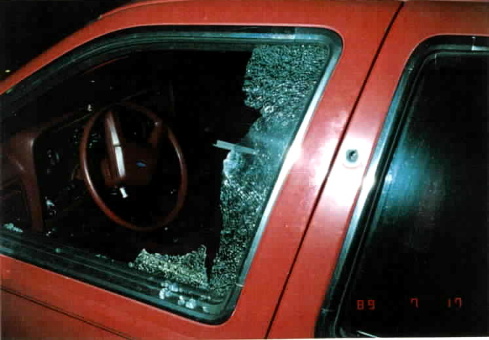
Photo of the bullet holes in Kait's car
“And three shots were fired,” I added. “That’s too many for an accident. And the shots weren’t fired from the sidewalk. Somebody pulled up next to her and fired from a vehicle.” Although an empty Budweiser can had been found in the gutter next to Kait’s car, the autopsy had turned up no trace of alcohol in her blood, and the fingerprint on the can had not been hers.
The fact that our world was a madhouse actually proved a blessing, because it allowed us more time to accept the unacceptable. The telephone rang nonstop; people streamed in and out of the house bringing casseroles and condolences; Don’s brothers and their wives flew in from Ohio and Michigan, and my brother arrived from California. There were planes to meet, Kait’s obituary to compose, a minister with whom to confer, and a funeral to orchestrate.
At one point I realized it had been hours since I’d seen my daughters. I went in search of them and found them in Kait’s room, deep in conversation on the bed.
“What’s going on?” I asked. “Is this a private conference?”
“Actually, no,” Robin said. “We need to talk to you. Will you, please, come in and shut the door?”
I did as she asked and joined them on the bed.
“Mother, Robin and I have been talking and—well—the thing is, we don’t think Dung should be staying with us right now,” Kerry said.
“Why not?” I asked in surprise.
“There are some things that are bothering us. We have no idea who shot Kait, but we do know she was having problems with Dung. They were having a lot of fights, and she was looking for a new roommate.”
“That’s hardly a reason to suspect him of murder!” I exclaimed.
Robin and Kerry exchanged glances.
“There’s something else,” Robin said. “Something’s come to light that makes us believe Dung’s not the simple, honest person you seem to think he is. Tell her, Kerry.”
“A friend of Kait’s told me something weird,” Kerry said.
“She said that back last summer Kait confided to her that Dung was involved in some sort of car-wreck scam in California. Kait didn’t understand how the thing was set up, but Dung went out to L.A. with a bunch of his friends, and they staged wrecks in rental cars. Kait said she thought each of the guys was paid two thousand dollars.”
“Who told you that?” I demanded.
“I don’t remember her name. It was one of the girls Kait worked with.”
“I can’t believe anybody would be such a troublemaker,” I said. “Especially at a time like this, when we’re so vulnerable.”
“But what if it’s true?” Kerry persisted. “I know Dung’s been over here a lot, but what do we really know about him? When Ken and I came for Christmas, there he was, scarfing down turkey like one of the family, but nobody ever told us where Kait came up with him.”
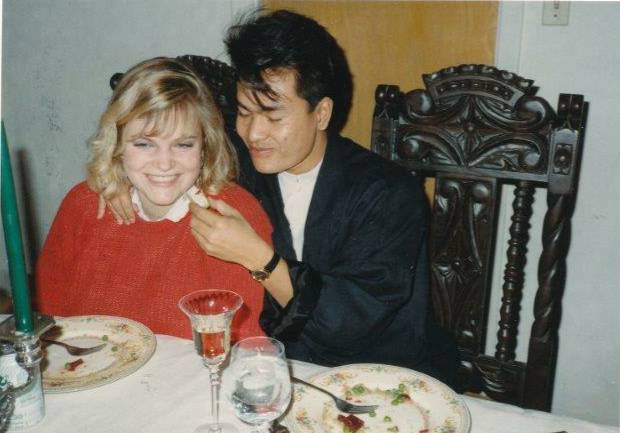
Photo of Kait and Dung at dinner table on Xmas, 1988
I tried to recall exactly what Kait had told me.
“She met him at a coffeehouse across from the university. He hasn’t had an easy life. He was one of the boat kids, and from what Kait told me, his journey to America was horrendous. He lived for a while in California, then he and his best friend, An, decided to move here. He has a sister who owns an import shop in Orange County. He and Kait stayed with her in March when they went out to do Disneyland during Kait’s spring break. The rest of his family is still in Vietnam.”
“How has he been getting his money?” Robin asked. “I know there was a long time there when he was out of a job, and the only reason he finally got one was because Kait wouldn’t let him move in with her unless he was working.”
“He did have a job when Kait first met him, but he got fired,” I said. “Work isn’t easy to find when you don’t speak the language well. Kait told us the Vietnamese take care of their own. Dung’s sister in California was sending him money.”
“Well, under the circumstances, I’m not comfortable with it, and I think we should have him stay someplace else until we figure this out,” Robin said.
“You’re being ridiculous,” I told her. “And it’s a moot point, anyway. He’s not here now, and he wasn’t here when we got up this morning. Brett said one of his friends came by at dawn and picked him up.”
“I thought Dung said he didn’t have any friends,” Kerry said.
“Then, maybe an acquaintance picked him up. For God’s sake, girls, your sister is dead! Can’t you find something better to do than backbite her boyfriend?”
I got up off the bed and stalked out of the room, leaving my daughters staring after me with stricken faces, and three minutes later I couldn’t remember why I was angry with them.
The rest of the day went by in a meaningless blur as I moved in a daze from one pressing demand to another. It was late afternoon when I dropped down on the couch in the family room and looked up to find Dung standing over me.
“I got problems, Mom,” he said in his awkward English. “I just come back from the apartment. The manager changed the locks so I can’t get in. Will you tell him it’s okay that I still be sleeping there?”
“Of course,” I said. “I can’t believe he’s done such a thing. He had no right to change the locks. All your things and Kait’s are in that apartment, and I know Kait paid the rent through the end of the month.”
“I want to sleep in our bed again,” Dung said softly. “I want to smell her cologne on the pillow like roses.”
“Don’t worry, I’ll call and take care of things,” I told him. “It’s just a silly mistake that can be easily corrected.”
I looked up the number of the Alvarado Square Apartments and put through a call to the manager.
“I’m Kait Arquette’s mother,” I said. “Her boyfriend tells me you’ve locked him out of their apartment. I’m calling to give our permission for him to continue living there until the lease runs out.”
“I know this is a tough time for you, Mrs. Arquette,” the manager said apologetically. “The last thing I want to do is to create more problems for you, but there’s no way I’m going to let Mr. Nguyen back in there.”
“Why not?” I asked in bewilderment.
“Because that guy’s bad news. I rented the place to your daughter, not to him. Kait was a real sweet kid—both my wife and I thought the world of her—but Nguyen and his cronies are something else again. I don’t know what was going on in that apartment, but there were times when Kait would come running over to our place, begging to sleep on our couch because she was scared. She asked me to change the locks to keep the guys out.”
I couldn’t believe what I was hearing.
“Did you do it?”
“Yes, but they smashed a window and got in that way. Another time she locked Nguyen out, and he kicked in the door. Now I’ve changed the locks again, and if Nguyen tries to tamper with them or goes in through a window or does any more damage to our property, I’ll have him arrested. He can come get his things, if one of you people comes with him, but I don’t want him in there unsupervised, and I don’t want his friends there. If you’ll come to the office, I’ll give your family the new key.”
“All right,” I said, too shaken to put up an argument. “One of my sons will be over there in a few minutes.”
I hung up the phone and turned to Dung, who was standing expectantly at my elbow. “It’s okay?” he asked. “Did he say he will let me go home now?”