
“ If you want to have good ideas
you must have many ideas.”
Linus Pauling, Nobel Prize-winner for Chemistry
Rob Eastaway
ANY IDEAS?
Tips and Techniques to Help You Think Creatively

First published in 2007 under the title Out of the Box
This extensively revised edition first published in the UK and USA 2017 by
Watkins, an imprint of Watkins Media Limited
19 Cecil Court
London WC2N 4EZ
enquiries@watkinspublishing.com
Design, typography and artwork copyright © Watkins Media Limited 2017
Text copyright © Rob Eastaway 2017
Rob Eastaway has asserted his right under the Copyright, Designs and Patents Act 1988 to be identified as the author of this work.
All rights reserved.
No part of this book may be reproduced or utilized in any form or by any means, electronic or mechanical, without prior permission in writing from the Publishers.
1 3 5 7 9 10 8 6 4 2
Illustrations by Bonnie Dain for Lilla Rogers Studio and Jade Wheaton
Typeset by Clare Thorpe
Printed and bound in Finland
A CIP record for this book is available from the British Library
ISBN: 978-1-78678-021-8
www.watkinspublishing.com
Introduction
1 IDEAS AND WHERE THEY COME FROM
2 IDEA-BLOCKS AND MIND TRAPS
3 LATERAL THINKING (OR “WHAT’S THE REAL PROBLEM?”)
4 HAVING IDEAS ON YOUR OWN
5 EXCHANGING IDEAS
Messy Creativity 1: Sydney Opera House
6 GIVING IDEAS
7 RECEIVING IDEAS
Messy Creativity 2: The Discovery of Drugs
8 HOLDING IDEAS MEETINGS
9 DEFINING THE PROBLEM IN MEETINGS
10 BRAINSTORMING IN MEETINGS
Messy Creativity 3: “Yesterday” and Other Song Lyrics
11 INJECTING MORE SILLINESS
Messy Creativity 4: Post-it® Notes
12 TAKING IDEAS FORWARD
Solutions
Further reading
Everyone needs ideas.
Maybe they are just ideas for something routine, like thinking of a birthday present, or deciding what to do this weekend.
But there are times when you need to come up with ideas for more important things: ideas for a speech or a big presentation at work; how to decorate your house on a budget; how to balance your family and work commitments; or even – for more and more people these days – coming up with an idea for a new product or business.
Of course, ideas are needed to solve problems too: when you’re stuck, sometimes the only way forward is by thinking around the problem with what’s often called lateral thinking.
Without ideas you can’t be creative, and in a world that is constantly changing, where it’s becoming rare to find jobs in which you can spend years following a routine, we’re all being forced to become more creative whether we like it or not.
This is a book about how to have ideas, on your own or in collaboration with others, and how to nurture them so they help you to solve everyday problems.
Ideas do, of course, happen by themselves, they are a natural part of how the human brain works.
But sometimes they need a helping hand, so there are tips here about techniques that can significantly increase the number of ideas that you have.
Creative thinking can help you to come up with better solutions to problems. It can also lead you to new experiences and opportunities that just make life a bit more exciting and fun. And that’s what most of us want.
Unfortunately, ideas have enemies. Idea-killers.
Ideas can be fragile things, and it doesn’t take much to kill them off. Ideas are often killed off just by being ignored, but they can also be killed by being criticized or laughed at.
There are two main idea-killers. These are:
OTHER PEOPLE
and
YOU
If you want to have more good ideas in life, then it’s vital to be able to recognize idea-killers so that you can protect yourself against them.
Idea-killing (and how to avoid it) is a recurring theme in this book. It’s discussed in Chapter 2 (about personal blocks), Chapter 5 (Exchanging Ideas) and Chapter 8 (Holding Ideas Meetings) and Chapter 10 (Brainstorming).
When trying to overcome idea-killing, there is one principle that is so important it also deserves a mention up front – and that is that you need to nurture and protect silliness.
Not all ideas seem sensible when they are first aired. In fact, if an idea is genuinely novel, then by definition it is something that hasn’t been encountered before; and when we haven’t seen something before, we are, as human beings, naturally sceptical. “Oh you couldn’t do that …”, “Oh that would never work …”.
This means that many new ideas will at first seem a bit … silly.
And of course not all silly ideas are good ones, many deserve to be killed immediately. But among them are some that don’t. It’s often the ideas that at first seem silly and impractical which turn out to be the best.
About 20 years ago, somebody somewhere made a suggestion: “At stores, instead of having to have your groceries scanned by a checkout operator, why not arrange it so that you scan all the items yourself.” That person could easily have been laughed out of the room. “The supermarket would be bankrupt in a week!” Instead, that idea got picked up, and these days self-scanning is normal practice (even if it isn’t universally popular).
Other ideas that would no doubt have been dismissed as fanciful, impossible or just downright silly just 20 years ago include:
• A taxi service where the drivers don’t know their way around the city (Uber).
• Injecting a deadly toxin into your face to make you look younger (Botox).
• A TV show where you watch people watching TV (Gogglebox).
• A device that allows you to print sophisticated solid objects (3D printers).
And the list goes on.
So as you read through this book, remember that if you want to have more ideas, there are times when you need to allow yourself to be just a little bit more silly – if not in the things that you do, at least in the things that you think.
This book is the result of an idea. I first had that idea (to write a book about creative thinking) 20 years ago. The first version was binned after a couple of months, and there were several years when the idea was left on the shelf, then there was a first attempt (under the title Out of the Box and written to somebody else’s brief) in 2007, before it finally ended up as the book you are now reading. Like many ideas, it only turned into this finished product after several iterations and dead ends.
Why did I want to write this book?
For as long as I can remember, I’ve been interested in puzzles.
I always particularly enjoyed puzzles that involved “Aha!” moments. In my junior school I had a teacher, Mr Hudson, who used to like posing us questions like this:
Tom lives on the 20th floor of a block of flats. One Monday morning, Tom gets in the lift, rides down to the ground floor and heads out. When he returns later that day he presses the button for the 16th floor, gets out and walks up the final four flights of stairs to get to his flat. Why doesn’t Tom take the lift all the way up to the 20th floor?
There could have been lots of reasons why Tom made the detour. The point of these so-called lateral-thinking puzzles is to figure out what happened by asking questions.
“Was the lift working properly?”
“Yes.”
“Did Tom want to get out at the 16th floor to do something?”
“No, he wanted to go the 20th floor.”
“Was something blocking the lift exit?”
“No.”
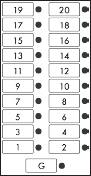
The solution? It turns out that Tom was a young boy on his way to school. He could reach the button for the ground floor, but he wasn’t tall enough to reach button 20 when he returned. The highest button he could reach was 16 so he pressed that and had to walk up the rest.
The “Aha!” feeling when you solve a puzzle like this is closely related to creative thinking. In the 1950s, the philosopher Arthur Koestler wrote a book called The Act of Creation, in which he proposed that creativity is Art, Discovery or Humour. Somebody else summed this up as: “Ah, Aha and Haha”.
My interest in “Aha!” puzzles stuck with me, and for a few years I became a monthly puzzle-setter for New Scientist magazine. It was an exciting but sometimes nervewracking immersion into a world where I had to come up with something new every month. And it had to be an idea that worked: a puzzle that had a flaw and couldn’t be solved was worthless, as I discovered when my second New Scientist puzzle proved to be a dud, prompting dozens of letters from angry readers. Setting puzzles to a deadline was excellent training in practical creativity.
That involvement with puzzles got me interested in creative problem-solving techniques, and for several years I ran workshops on this topic for civil servants and graphic designers. It is also what led me to start writing books about the hidden maths of everyday life.
Puzzles and maths in turn have led to me running Maths Inspiration, interactive maths lecture shows for teenagers held in theatres around the UK. Producing stage shows is fertile ground for creative ideas: every year we have to come up with new ideas for material and ways of presenting to ensure we keep audiences engaged. “What if we get the audience to do a Mexican wave …?”; “How about getting two volunteers to build a tower onstage using tin cans ...?”
So, while I’m fascinated in the whole process of how ideas happen, I’m just as interested in how to make them work.
This book is tips and techniques for having and acting on ideas in everyday life, either alone or with other people.
But its origins were in the “Aha!” moments of puzzle-solving.
“Why, sometimes I’ve believed as many as six impossible things before breakfast.”
The White Queen, Through The Looking Glass
This is a book you can read from start to finish, but it’s also one you can just dip into. The book has two main sections: Chapters 1–4 are about the process of having ideas on your own. Chapters 5–10 are about having ideas with other people – both one-to-one exchanges and in meetings. (Chapters 11–12 apply to both.)
Although many of the techniques lend themselves to the workplace, most of the principles are universal. For example, one extremely useful tool for developing ideas is a whiteboard, something that is normally found in an office or a school. Most homes don’t have a whiteboard on the wall – but there’s one in my kitchen, and I can vouch that it has been a constant focus of creative output for my family.
Dotted through the book you will find puzzles, exercises and other asides (solutions to puzzles can be found at the end of the book). There are also four famous examples of Messy Creativity. Creativity is often seen as a flash of inspiration that leads to a brilliant result. What we rarely see is the messy process by which many inventions and creations come about – the blind alleys, arguments and hopeless prototypes. The examples of messy creativity are a reminder of how wonderfully random and unstructured the idea process can be.
Thank you Alison Kiddle, Jill Walsh, Timandra Harkness, Dave Birch and my wife Elaine Standish, who not only had plenty of ideas to offer but were also there as sounding boards when I needed them most. Thank you to the Twitter community, who were, as ever, a rich source of material when I asked for suggestions, and to Dennis Sherwood for some lovely examples of opposites.
Thanks to Jo Lal for being such an easy-going and receptive publisher, which made the creative process so much easier. And special thanks to my friend Ben Sparks who suggested “Any Ideas?” as a title when we were having an informal brainstorm over a cup of coffee. We (and the publisher) came up with numerous ideas for titles, but it’s Any Ideas? that I liked most. So that’s why this book isn’t called Ignite Your Creative Spark or Beyond the Blue Sky or What’s The Big Idea? As Linus Pauling said, in order to have a good idea you need to have lots of ideas.
An idea is a thought about something that might be done or created.
“Why don’t we go to the beach?” is an idea. So are “What if I start my talk with that joke about the cheesegrater?” or “How about a tune that starts ‘do-doo bah doo-bah’.”
Ideas can be good or bad, new or old. We’ll come on to judging the quality of ideas later. The important point is that you are having ideas all the time, but many of them are so short lived and subconscious that you are barely aware of them.
Let’s explore what it feels like when you try to have ideas.
For this exercise you will need something to record your ideas – a smartphone, or a pencil, paper and a timer. Find them now before you start!
Ready?
OK, imagine that you’ve just been presented with a cheap ballpoint pen, made out of clear plastic. The pen has one big drawback: it has run out of ink.
Give yourself ONE MINUTE to record as many things as you can think of that you can do with the inkless pen.
Start … now.
OK, how did you do in the one minute challenge?
• Most people find this exercise difficult, and come up with no more than three ideas. The most common idea of all is: “Throw the pen away and forget about it.”
• Some people think of four or five ideas. Typically, these will be practical ways in which they’ve used a defunct ballpoint pen in the past – for example, as a pointer, or for punching a hole.
• A few people score much higher. I’ve known the odd individual score as high as fifteen ideas in a minute.
You can see some of the different uses to which people have put the inkless pen on page 144, and this is just the start. Many of those ideas may seem weak, but others may strike you as quite clever and creative.
It shows that there are plenty of ideas out there as long as we aren’t worried about quality. Given time, between us we could probably find as many as a thousand ideas for using a defunct ballpoint pen.
There are all sorts of reasons why you might have come up with so few ideas. We’ll explore those barriers to being creative in the next chapter.
But first, let’s explore where ideas come from.
What is it that causes an idea to pop into your head? Here’s where ideas typically come from:
We draw very heavily on what we’ve experienced before. Suppose you’re having to think up ways to fundraise for a charity. The first ideas you have will almost certainly be ones that you have come across in the past – a sponsored bake-off or running a marathon, for example. So the more diverse your past experiences have been, the bigger the pool of ideas you have to draw from.
Do you know how to build your own home and live off the land? If you suddenly found yourself stuck on a desert island, you’d have no choice but to learn. Ideas flow when you need them, so facing – or even creating – a problem that needs solving is one way of ensuring that you come up with ideas.