This is dedicated to every human who has felt heartache,
uncertainty, or confusion in relationships with others or,
most importantly, with yourself. You are not alone,
and we are all in this together.

Mention of specific companies, organizations, or authorities in this book does not imply endorsement by the author or publisher, nor does mention of specific companies, organizations, or authorities imply that they endorse this book, its author, or the publisher.
Internet addresses and telephone numbers given in this book were accurate at the time it went to press.
© 2017 by Lewis Howes
All rights reserved. No part of this publication may be reproduced or transmitted in any form or by any means, electronic or mechanical, including photocopying, recording, or any other information storage and retrieval system, without the written permission of the publisher.
Book design by Amy King
Library of Congress Cataloging-in-Publication Data is on file with the publisher.
ISBN 978–1–62336–862–3 trade hardcover
ISBN 978–1–63565–300–7 signed hardcover
ISBN 978–1–62336–863–0 e-book

We inspire health, healing, happiness, and love in the world.
Starting with you.
RodaleWellness.com
RodaleBooks.com
Preface
INTRODUCTION
THE STOIC MASK
THE ATHLETE MASK
THE MATERIAL MASK
THE SEXUAL MASK
THE AGGRESSIVE MASK
THE JOKER MASK
THE INVINCIBLE MASK
THE KNOW-IT-ALL MASK
THE ALPHA MASK
Conclusion
Acknowledgments
Endnotes
mask \mask\ noun. 1: a cover or partial cover for the face used for disguise. 2: something that serves to conceal or disguise: pretense, cloak
masculinity  1a: male. 1b: having qualities appropriate to or usually associated with a man
—MERRIAM-WEBSTER DICTIONARY
Here it was, the moment I had driven myself toward for more than 5 years. I’d written and sold my first book, The School of Greatness, and by leveraging every relationship and calling in every favor I’d ever accumulated, the launch of the book had been enormously successful. Copies were flying off the shelves. It was written about everywhere, from Forbes to the New York Observer. Midway through the second week after launching, I’d gotten the email from my agent that every author dreams of. “Lewis,” he said, “you’re debuting at #3 on the New York Times bestseller list.”
Me. The kid who had trouble reading in school. The one who other kids (and my teachers) thought was dumb. The one whose brother went to prison for selling drugs, who people said I’d grow up to be just like. Not only was I a published author, I was a New York Times bestselling published author. And a named bestseller on the Wall Street Journal, USA Today, Washington Post, and every other bestseller list you could think of.
I’d never felt higher. My biggest professional dream had come true.
While riding high on my book tour to packed events around the country, I got up and told the story of The School of Greatness, passing along the lessons I’d learned from studying under and interviewing some of the most successful athletes, actors, thought leaders, and elite performers in the world. Now with this new achievement, I had a little taste of that greatness myself. Like I said, it’s the kind of stuff that dreams are made of.
Yet something nagged at me. Inevitably, at these events, during the Q&A session or afterward at the book signing table, someone would ask me a question that temporarily punctured this bubble of happiness. They’d ask me, “What’s next?” or “It seems like you have it all; is there anything missing in your life?” Something about that second question would always catch me off guard. What I had accomplished for myself over the last decade had taken a lot of sacrifice. I was proud of that work, and yet when I looked into the eyes of the person asking me the question, it felt like they saw right through me.
Having just ended a long-term relationship, I spent each night on the book tour alone, wondering the same thing. The high I had felt on stage or at the signing table in front of a long line of fans and readers deflated. I would feel deep and profound loneliness in an impersonal, nondescript hotel room. I had achieved so much of what I wanted with my book and with my career, but deep down, I was asking myself about the point of it all. I had no one to share it with. I had no intimacy or deep connection with anyone else.
I should have felt amazing, but all I felt was terrible.
One night, after repeating this routine several cities in a row—giving a cheerful answer about my struggle with relationships that, while honest, underplayed the true loneliness I felt—it struck me that this was not a new experience for me. There was another moment in my life where I had achieved my personal goals and reached the pinnacle of success, yet felt utterly unfulfilled with the rewards and alone with my accomplishments: in college, literally as I mounted the podium to accept the honors of becoming a newly minted All-American athlete in the decathlon. Precisely when I should have felt the most overwhelming feelings of pride and confidence and satisfaction, I found myself overcome with depression and doubt.
You might be familiar with this story; I told it at length in The School of Greatness. Only I left out a part. The part where, as a young 21-year-old at a very confusing moment in my life, I did what most young men do with confusing feelings: I ignored them. I stuffed them down and pretended they didn’t exist. I put them in a box because that’s what you are supposed to do if you’re a man. Feeling this stuff was just a part of life, and I was weak if I dwelled on it too much. All I knew was that I had to get my life together financially and professionally—the idea that any other concerns mattered was inconceivable to me. Besides, I thought, doesn’t becoming successful solve all your problems?
This was rooted in something I learned as an athlete. If something was bothering you, you absolutely 100 percent did not bring it with you on the field. If you were struggling with something in school, that was your problem, and you had better fix it yourself (cheat and lie) or get really good at faking your way through it. Just don’t let it impact your performance. As an entrepreneur and media personality, I felt a similar pressure: Show everyone how great your life is going, how much of a badass dude you are, because no one wants to hear your complaints on social media. Toughing it out and then winning, I learned over and over again, was the cure for all that ails. Especially if you’re a man.
Though I picked up that way of thinking from multiple influences over the course of my life—family, coaches, teammates, movies, media—I knew deep down that there was something wrong with it. In fact, whenever I met truly great performers—athletes like Rich Roll, Ray Lewis, Travis Pastrana, and Steve Weatherford, or motivational speakers like Tony Robbins and Chris Lee—I found that they didn’t think that way. They weren’t stuffing their feelings back down inside themselves. They explored them. They questioned them, and most important, they were aware of them. By dealing with and processing their feelings, they didn’t just lift an emotional burden from their shoulders, they found a kind of emotional strength and fuel. The ways these great performers process their emotions have been, and continue to be, awe-inspiring.
There was only one problem: I had no idea how to do what these men could do. Don’t get me wrong, I’d started doing the work on identifying and understanding these feelings. I took seminars and read books. I did one-on-one work with coaches who specialized in working with guys like me. I felt that I knew what to do, I just had no idea how to do it. So I suffered. I compensated for my insecurities by doing and achieving more, more, more. And it worked, right up until I found myself back in the same position as I had been on the medal stand. Outwardly successful, inwardly unfulfilled and confused.
As the book tour came to a close, I decided the time had come to do things differently. A younger me would have gotten frustrated and given up, or would have heeded the pressure from my school friends to “stop being such a bitch, Lewis” or to “man up and get over it.” I didn’t want to do that. I couldn’t just ignore the anxiety and the uncertainty I felt. I wanted to go beyond exploration and understanding and really figure out how to fix this stuff, so that I could grow and become a better man.
So I could use whatever was bothering me as fuel to grow.
When the book tour ended, I returned home to Los Angeles and realized that the best way for me to grow, and help other men like me grow too, was to dive in deeper and write a book about this very topic, about masculinity and the challenges I face as a man in all areas of my life. Admitting that you are struggling and suffering is important. Recognizing what you are struggling with is just as critical. But understanding why you are struggling and how to overcome it, well, that’s where the magic is. So that’s what I set out to do.
At the same time, I started to hear about this documentary by Jennifer Siebel Newsom, called The Mask You Live In. Everyone was telling me I had to see it. I thanked the first person who told me about it and put it on my to-do list. I thanked the second person too. By the third, I was intrigued. By the fifth, I said enough already and watched it.
Have you ever watched a movie or read a book that hits you like a ton of bricks? Something that just shakes everything you think you know about the world? Something that feels like it was made especially for you? This documentary was that for me.
The Mask You Live In is about the pressure our masculine culture puts on men and boys to be someone they’re not, to ignore their emotions, or worse, to actively fight against them. The movie also talks about the effects this pressure has on male relationships (both platonic and romantic) and on society as a whole. A lot of time in the documentary focuses on inner-city schools, where the profound effects of these issues can clearly be seen. But the issues it deals with are universal to men everywhere.
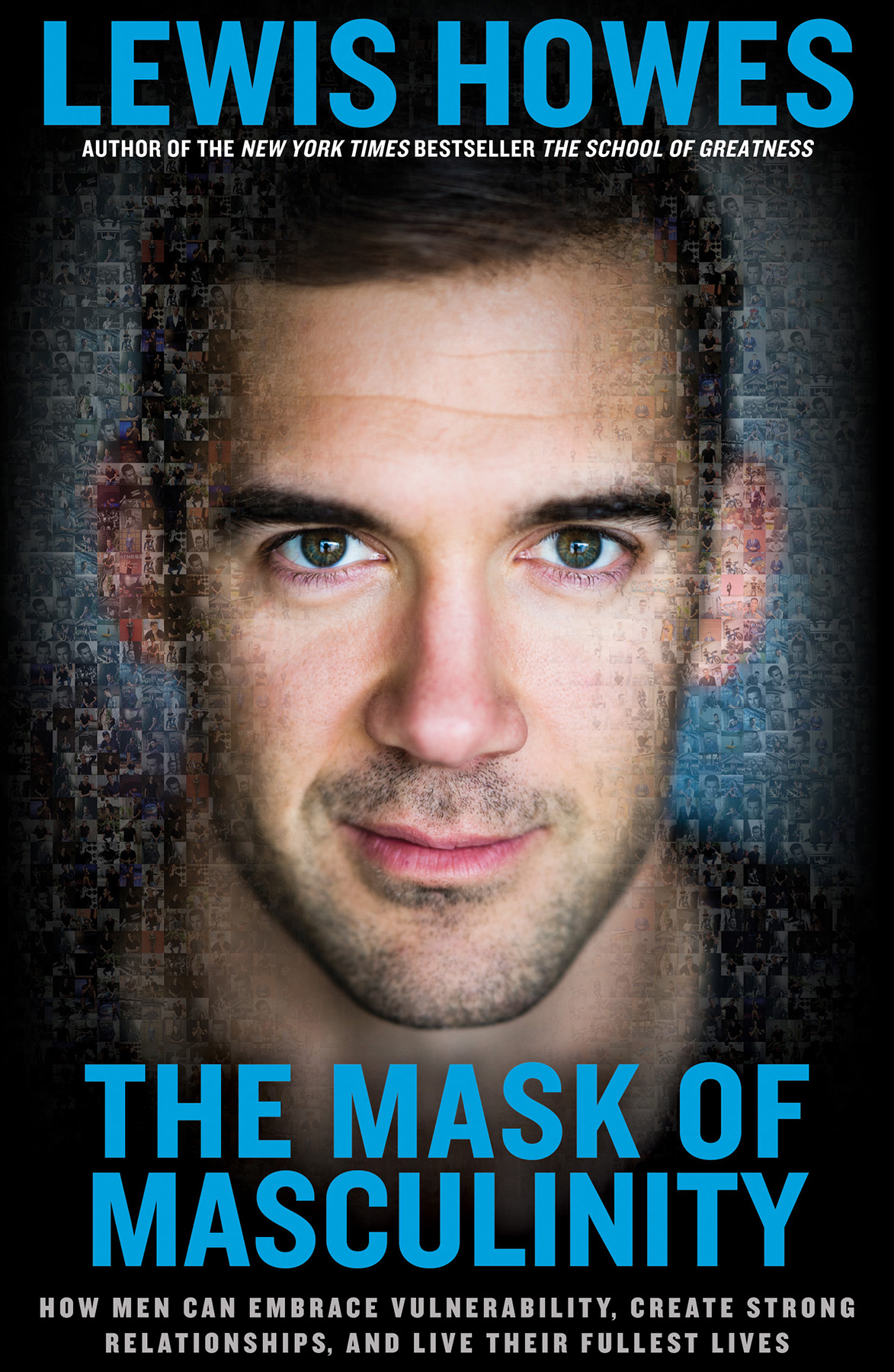
The Mask You Live In struck me deeply for two reasons. One was serendipity. I’d already decided that my next book would be about masculinity and sold the book to my publisher with the title The Mask of Masculinity. It was like the filmmakers could see inside my head. More like they could see inside my heart.
Additionally, the movie affected me deeply because it put crystal clear language to emotions I was still struggling to get my head around. The documentary opens with Joe Ehrmann, a former NFL football player (one of my first big dreams), talking about what he considers to be the most destructive phrase in our society—be a man. It’s a phrase every football player has heard from a young age, probably as often as a whistle blow. Certainly, they are three words that have nagged me in the back of my mind for a long time.
The reason I felt so alone after those book signings and the reason it touched such a nerve when people would ask me “How do you do it?” was because I wasn’t doing it. I’d been with my girlfriend for more than a year during the researching and writing of The School of Greatness, only to have the relationship fall apart shortly before the release. As I was out there meeting thousands of people across the country, she was dating other people. My father, due to failing health and serious memory issues from a severe car accident 10 years prior, was not able to even conceptualize what I did for a living. I also discovered that several important friendships had recently ended, right under my nose. Thus, as I was experiencing all this life-changing success, I felt like I had no one to experience it with and no one with whom to share those fears and sorrows. I had just published a book with multiple chapters about the importance of relationships, yet I didn’t have the relationships I needed. I was on top of the world in some ways, yet I felt creeping sadness that I couldn’t shed. All I had was this voice in the back of my head telling me that there was something wrong with me for feeling this way.
Though I was aware and emotionally capable of processing my feelings, I was in so much pain and in so much conflict with myself that I couldn’t use any of these skills. I just felt sad and alone, stuck and uncertain, with no idea why and no idea what to do. What were my options? Pop a pill? Meditate? Lift heavy? Run from the problem? Those are legitimate therapies that work for some people, some of the time, for some of their problems. But I needed something else. I needed to build my vocabulary around my issues so I could speak to them and about them.
This documentary was the first step in teaching me the language of masculinity. It explained for me why men—especially successful men—feel so trapped. As children, we have been put in a box and told to ignore the walls that start to feel like they’re closing in around us.
In The School of Greatness, I never pretended that I held the secret recipe for greatness. In fact, I never claimed that I was great. In that book, I admitted that I was a student yearning to achieve greatness just like everyone else. Thousands of other people could have written some version of this book, but it ended up being me, because I possessed one little advantage: my podcast. In 2013, I started a podcast interviewing high performers and interesting people of all types. This project quickly grew from a hobby into an Internet sensation—to date it’s been downloaded more than 35 million times. I am privileged to be able to reach out and interview true greats, from #1 New York Times bestselling authors, world-class doctors, and Olympic gold medalists to celebrity influencers, media moguls, and entrepreneurs like Tony Robbins, Larry King, Taye Diggs, Russell Simmons, Arianna Huffington, Gary Vaynerchuk, Ray Lewis, Gabby Reece, Rob Dyrdek, Daymond John, Alanis Morissette, Maria Sharapova, and Mike Rowe. When I wanted to learn about greatness, all I had to do was call up Tim Ferriss or Shawn Johnson or Eric Greitens, ask questions, and let them give me (and my listeners) hours and hours of unmatchable answers.
Amidst my personal crisis of masculinity and happiness, I took solace in knowing that if there was an answer to my questions or a way out of how I felt, then the smart people I got to speak to on my show each week would know it. Somewhat selfishly, I found that in each of my episodes I was asking my guests personal questions that I thought might be of use to me: What’s your definition of masculinity? Has it changed from when you were a child to now as an adult? What does it mean to be a man? What’s missing in your life? Do you ever feel sad? Do you have any defense mechanisms? What masks do you think you wear?
Off mic and off camera, I would ask even more questions. Whether the responders were men or women, gay or straight, transgender, married or single, their answers were helpful. In fact, the female guests often provided the most honest and the most helpful answers, because they could describe from their own experiences the impact that wearing a mask has on other people.
I remember talking to my dear friend Glennon Doyle, who is the super popular blogger and New York Times bestselling author of Love Warrior, about the disintegration of her marriage and how she and her husband rebuilt it from scratch. She told me that “what it takes for a real man and a real woman to love each other is an incredible unlearning.” She said it requires taking apart what our culture has taught us about what it means to be a man and what it means to be a woman. To realize how much we’ve been poisoned. To strip down to who we actually are. To be naked and unashamed in front of each other. That’s the kind of relationship I started to realize was possible if I learned how to take off my own mask. I wouldn’t have to apologize or hide my masculinity, but I also wouldn’t have to use it as a facade.
Of course, I also learned a lot in these conversations about the masks that women struggle with and the pressures and the unfair standards society forces on them (the same goes for the gay men I spoke to, as well as people of different races and different identities). But recounting these observations are for different books by writers much wiser than me.
Hearing about the universality of the male experience and struggle helped me clarify what my next journey would be—not only as a human being but also as an author. I recognized that in my quest to remove the masks of masculinity that I wore, and that were holding me back, I could help other men—and the women in their lives—remove their own. Just as we became great together in The School of Greatness, together we could become loving, vulnerable, and, most important, real men. Together, we could improve the world.
On the field, in my personal life, and in my career, I’ve always subscribed to traditional notions of masculinity. Work hard, be tough, win at all costs, be aggressive, don’t be emotional—you know the clichés. I’m a boy from Ohio. It’s a factory, farming, football, meat and potatoes kind of place. The way I was taught to deal with my problems was to smash into things as hard as I could—on the football field, maybe in the parking lot too, if necessary.
In this way, I’m like most guys—whether they live in America or Zimbabwe. I was living the way I was taught by my dad, just like his dad taught him, just like we’ve all seen on television and in the movies. I was following their lead, on the path to becoming a real man. And just like most guys, it worked okay, until it didn’t. Sadness slipped in where success used to live. Loneliness and addiction took over for love. And depression blanketed all of it.
I think it’s time we ask: Is this lifestyle really working for the men in our society? Consider that, statistically speaking, males underperform in school compared to their female counterparts,1 have underdeveloped social skills and friendships,2 and are more prone to bouts of anger and unprovoked aggression brought on by depression.3 They also are more likely than women to use almost all types of illicit drugs,4 engage in more reckless sexual behavior, and be an absentee parent when that sexual recklessness results in pregnancy.
These are just a half dozen examples of problems men face that researchers, educators, and psychologists have connected in one way or another to our misguided notions of masculinity. As you might imagine, these problems don’t stop with the men they afflict. They ripple throughout society as a whole. In fact, their effect on the male quality of life often results in early death, either theirs or others.
Consider these numbers:
According to the FBI’s 2015 annual report on crime in the United States, nearly 88 percent of all homicides are committed by men.5 Men in the United States are six times more likely to commit suicide than women.6 Meanwhile, they are significantly less likely to seek help from a suicide prevention institution and half as likely simply to visit a doctor.7 And this trend starts early in the lives of men. One of the psychologists featured in The Mask You Live In, Dr. Niobe Way, found that it is when “we began to hear the language, the emotional language, disappear from boys’ narratives, that boys begin to have five times the rate of suicide as girls.”8 A suicide prevention study conducted in Switzerland summarized these findings in as blunt and bleak a fashion as possible: “Women seek help—men die.”9
Over the years, many well-meaning men and women have tried to address these problems from a variety of angles. Some thought the solution was to teach men how to “get in touch with their feminine side” or “get in touch with their emotions.” Others have invented ridiculously divisive terms like “metrosexual” and “alpha male.” Men have been lectured and harangued and criticized for being too much of this and not enough of that. These so-called experts promise us better relationships, more personal happiness, solutions to all our personal problems.
Like many guys, I’ve had certain books recommended to me—or rather, had a girlfriend or a relative try to push them on me—and yet, I never found any that resonated. Not because I have everything figured out or I’m perfectly well-adjusted, but because more often than not, the advice was condescending and impractical or just plain wrong. I couldn’t relate to the people trying to tell me these things.
It was a real shame.
Which is why, in this book, I want to do something completely different.
I’m not going to lecture anyone. I’m not going to criticize. More than that, I’m not going to try to change you. I don’t think men are fundamentally flawed or broken. Not at all. They are just trapped. I know that’s the way I felt for 30 years of my life. Remember those boxes we stuffed our emotions into when we were younger? As we outgrew the boxes, they transformed into masks that hold us back and hurt our friends, family, career partners, and intimate lovers.
The simple purpose of this book is to show you what those masks are, why they’re there, and how to take them off. I don’t want to change you. I just want to help you be who you already truly are. If you’re a woman, I want you to be aware of why men wear certain masks, how you can communicate with men when they are hiding behind them, and how you can support and inspire men to slowly remove these masks.
Am I saying that most men are not being true to themselves?
Yes.
Let’s look at the traditional depiction of a “real man.” A real man must always be:
▸Successful at everything he does
▸Physically fit
▸Strong
▸Skilled at fixing things
▸Good at sports or, at the very least, knowledgeable about them
▸Attractive enough to women to be able to get in bed with them
At the same time, a real man must never be:
▸Interested in what women think about his appearance
▸Too emotional
▸Afraid
▸Without the answer to a problem
▸Anything but first, most, or best
▸Seen crying—not ever
If you think those are dated clichés I gathered together to make my point, let me point you to an experiment that English teacher Celine Kagan conducted over the course of 4 years from 2008–2012 at Little Red School House and Elisabeth Irwin High School in Manhattan with high school juniors and seniors in a class she specifically designed to “deconstruct the myth of masculinity.” She gave her students 10 minutes to respond to a simple prompt: “What is a man?” Their answers matched almost word for word the phrases I just listed off for you.
As Kagan describes so beautifully, here’s how the process unfolded and how ridiculously skewed it tended to be:
Inevitably, the discussion that follows begins with a student positing, “A man is someone with a penis.” From this point, the conversation moves into a listing of male stereotypes: strong, tough, tall, rich, brave, independent, likes cars, doesn’t cry, has lots of sex, watches sports and pornography, etc. I write this list on the board, creating a powerful visual for the students to critique. “Does this list represent what the men you know are really like?” I ask them. Their answer is always, “No.” 10
Each of us will have a slightly different definition of what it means to be a man—a little bit more of one trait, a little bit less of another—but no matter what, the recipe will always add up to the same impossible creation. No human being could ever successfully live up to the standards we’ve constructed. Few ever even come close.
Yet falling short can have dire consequences: Men who are deficient in any of these categories are called soft, weak, and stupid. Other men in society label them as gay, losers, bitches, girls, or pussies. To disagree publicly with any of these notions of masculinity is to risk being made fun of, beaten up, or lumped in with these categories yourself.
I know. I remember one day in fourth grade at Smith Elementary School in Delaware, Ohio, my teacher decided that instead of going out for recess on our own, we would all play dodgeball together. I’m not sure if he did this intentionally, but he picked two of the popular boys to be team captains for the game. In standard playground fashion, each boy then chose one classmate after another to join their team until everyone had been selected.
I remember standing there, expecting to be picked early as part of a strategy to build a good team. I was one of the better athletes in class, so I wasn’t being egotistical, I was just being logical. The captains, being boys, started by picking boys. I was the tallest kid in class, so they couldn’t miss me, but boy after boy was chosen before me. Then the last boy besides me, a kid who was notorious for having no athletic abilities at all, was chosen. Being the last boy picked hurts, a lot. But as a 9-year-old, that pain doesn’t compare to the humiliation of not being picked at all, of watching as the two captains called out the girls’ names one after another until the very last girl—a girl whom I could lap around a track in a sprint—was chosen. I was the only person left. By default I ended up on the team with the tough luck of having to pick second.
Like many kids, I’d been bullied and teased before, made fun of, picked on, and laughed at. But not like this. This was in front of all my classmates. I was made to appear not only less than the other guys, but I was shown to be less even than the girls. It was deliberate and intentional humiliation—for a reason I can’t even remember.
In that moment, I decided that I would never be picked last in sports again. In response to their snub, I set out to “prove” those boys wrong and show them how good I actually was. I went out during that game and literally crushed every single one of them. I returned the humiliation they gave me by dominating them, not only in that inconsequential game of dodgeball but in every game I ever played from that point forward, physically reminding them of their mistakes. I dedicated my life after school to becoming the biggest, fastest, strongest athlete I could become. Without a doubt, this was the fuel for my drive to become All-State in multiple high school sports, a two-sport All-American in college, a pro football player, and then after a wrist injury ended my football career, a USA Men’s National Handball Team member. Winning and succeeding in sports made me feel the opposite of how I felt as a vulnerable, picked-on kid.
Do you know what the worst part of my story is? That it’s not unique. Nearly every man I know has his own version. The specifics may be different—it could have happened in eighth grade instead of fourth. It might have been a teacher who mocked him for being stupid instead of unathletic. It might have been from a well-intentioned father figure or an early girlfriend. It might have been about money or academics or any number of other topics. It could have turned him into a soldier, a ladies’ man, or a billionaire instead of an athlete or an entrepreneur. But almost every man has a story in which he learned—through pain, humiliation, or even force—how he does not measure up. When that happens to him, masks become more than a way to hide, they become armor. In this way, all men—each and every one of us, including myself—have worn or currently wear a variety of masks in order to endure the onslaught of expectations from the world and to live up to the definitions of what it means to be a man.
Over the last few years, I’ve interviewed hundreds of successful men and women in all sorts of fields. As I began to research the topic of masculinity, I asked the guests on my podcast several questions: What does it mean to be a man? How does this hold people back? What is your greatest fear? Who are you pretending to be?
What I learned from them is that all of us have or have had our own insecurities. All of us are, or have been, afraid to be vulnerable and real. Though this fear manifests itself in unique ways for each individual, with their help I was able to uncover nine common masks of masculinity that men wear interchangeably. I’ve worn almost all of them at some point in my life, and most likely, so have you or someone you know and love.
1.The Stoic Mask: Because every man must be invulnerable and tough, emotions are carefully managed and suppressed. There can be no crying, no pain, no feeling. A wall is put up between him and the world to protect him, to pretend he doesn’t feel the things he does, because weakness is an invitation to scrutiny and judgment and rejection.
2.The Athlete Mask: One of the clearest ways a man can distinguish himself is on the field or on the court. He is like a modern-day gladiator whose weapon isn’t death, but domination. Sports are how men prove themselves, and a good athlete is a good man—period. This means spending hours in the gym to get in shape. It means fighting through injuries and pain and fear to win at all costs. And of course, if for some reason a man isn’t good at sports, he had better compensate for that by loving them and knowing everything he can about them.
3.The Material Mask: There is no clearer sign of a man’s worth than the amount of money in his bank account. Not only do men work incredibly hard—and sometimes do questionable things—to make as much money as possible, it’s all for naught if other people don’t know how much money he has. In this way, his cars, his watches, his houses, and his social media feeds become a representation of who he is. A man’s net worth becomes his self-worth.
4.The Sexual Mask: A man is defined by his sexual conquests—his worth determined not only by his bank account but by the number of women he’s slept with. Relationships? Those are for lesser men—for quitters and settlers. A real man loves them and then leaves them—but he’s so good in bed, they’re left fully satisfied, of course.
5.The Aggressive Mask: Men are aggressive. It’s their nature. They’re violent and tough, and they never back down. When they see something they want, they take it. Men hate; men have enemies. Of course they have a temper; of course they break things; and of course they get into fights. They’re the hunters, not the gatherers. It’s what men do. A man who thinks otherwise is not a man and is responsible for the weakening of the world.
6.The Joker Mask: A man has a sense of humor and a wit that can repel even the most withering critique or the most nagging doubt. Talk about his problems? Okay, Dr. Phil, maybe later. Cynicism and sarcasm and a sense of superiority, these are the intellectual weapons that a man uses to defend against every attempt to soften him or connect with him. If you want a man to let you in, expect a knock-knock joke, not an open door.
7.The Invincible Mask: A man does not feel fear. A man takes risks. Whether that’s betting his life savings on a company or cliff diving or smoking and drinking in incredible quantities, a man doesn’t have time to think about consequences, he’s too busy doing. Other people (i.e., women and betas) have “problems.” But men? Men have it all under control. They’ve “got this” and they’ll be fine.
8.The Know-It-All Mask: A man is not only physically dominant but intellectually dominant too. If you don’t understand why that is, a man is happy to explain it to you—along with all the other subjects he’s an expert in. He went to a top school, he watches the news, and he knows all the answers. He certainly doesn’t need your—or anyone’s—help. He knows it all.
9.The Alpha Mask: At the most basic level, men believe that there are only two types of men: alphas and betas, winners and losers. No man can stand to be the latter—so a man must dominate, one up, and win everything. A man can’t ever defer. As a man, he must be in control, and he can’t ever do anything a beta (or a woman) would do.
The writer John Updike once observed that “celebrity is a mask that eats into the face.” I think what he meant was that celebrities, forced to perform and be “on” constantly, lose a sense of their real selves. Masculinity is a similar mask. And unlike the perils of fame, this is a problem that affects more than 0.001 percent of the population.
Many of us have worn our masks for so long that we’re not even sure what’s actually underneath anymore. We’ve lost track of where we end and the mask begins, of who we really are. That’s why removing the mask is not only terrifying, it’s painful. They’ve fused to our faces. This will not be an easy journey—though I will do my best to make the book easy to read. My own journey required confronting serious pain in my life. I had to face and sit with moments I would have much rather forgotten, things that I held on to and wasn’t willing to share with anyone for the first 30 years of my life. These weren’t just things that were done to me; I had to accept and acknowledge things I had done to other people—men and women alike.
However, it’s in the most difficult and challenging moments that we find the most meaning. An easy journey isn’t a journey at all—it’s just a walk in the park. In my journey of waking up and trying to pull off my masks in the lead-up to writing this book, I went from a passive-aggressive, egotistical, easily triggered, stuck in the stereotype “dumb jock,” to an inspired and inspiring, empowered and empowering, approachable and compassionate, loving . . . man. Not only did my business explode, but my relationships became richer with men and women, and my life is more fulfilled because of it.
Do I still catch myself wearing my masks from time to time? Absolutely! I’m still human. Triggering situations can at times set me off, and in those moments I do and say things that aren’t who I want to be. But because of the work I’ve done over the years, I’m now aware of it when it happens and I’m able to make amends. Most importantly for my growth, I’m able to laugh at myself with my masks on and take them off much more quickly so that I can live the loving life I desire.
Stripped of the various masks of masculinity, we’re free to be who we actually are. We can love. We can find our purpose. We can connect. We can actually work harder, do more, be better, and appreciate every step of the way. That’s what I am proposing we try to do here together.
I am not proposing an exploration of masculinity for political, biological, or even anthropological reasons. While all of these would be valid reasons, they are certainly above my pay grade. Instead, I have written this book to encourage you to remove your masks for one simple reason: It will make you a better and more successful person in all areas of your life.
Regardless of gender, the key to success in life is creating meaningful relationships. You cannot reach financial freedom, become an Olympic gold medalist, have a loving family, solve any of the world’s problems, or achieve your wildest dreams on your own. Doing anything great requires creating a team and fostering important relationships that develop and support you along your journey.
I have spoken to many successful entrepreneurs, athletes, inventors, designers, and writers. Regardless of their reputation, I have found that what lies beneath was a caring, empathetic, and insightful person. There was no way they could have accomplished what they did without empathy and insight—and certainly their success would not have lasted long if they did not have them. In fact, when we discussed their mistakes and darkest periods, inevitably what came up were regrets about selfishness, ego, aggressiveness, and a refusal to listen to the feedback from the world around them—all of it driven by a fear of vulnerability.
Contrary to what much of our culture tells us, invulnerability was a weakness that threatened their success, not a strength that supported their achievements. The obvious irony is that from a place of vulnerability, many new ways of existing in the world open up: honesty, compassion, acting for the good of others and without ego, and the ability to heal from one’s own wounds. As Dr. Brené Brown wrote, there is nothing weak about vulnerability. On the contrary, it “sounds like truth and feels like courage. Truth and courage aren’t always comfortable, but they’re never weakness.”
There are many things that our definition of masculinity inhibits, but the damage it does to our relationships and sense of self, and therefore to our chances of success in life, should be enough to make you reconsider the stereotypical definition of “masculinity.” For that reason, I’m going to be making my case for removing the masks of masculinity for the most selfish of reasons: It will make you better, make you happier, and make you more successful. The fact that these choices may ripple through your relationships and the world as a whole in a positive way—that’s just a bonus.
This is going to be a book that sets forth a new definition of what it means to be a “real man.” My goal is to support