About the Book
May 1940. Sergeant Jack Tanner has been posted to a training company on the south-east coast of England where the mysterious deaths of two Polish refugees lead him to believe there has been foul play.
As the Germans launch their blitzkrieg in Europe, the entire company are sent to battle to stop Hitler’s drive across the Low Countries. Pitted against the die-hard Nazis of the SS ‘Death’s Head’ Division and the great panzer commander, General Rommel, it is left to Tanner to get his men back to Allied lines.
But if they are to have any hope of surviving the mayhem of Dunkirk, Tanner must first deal with an enemy far more deadly than the Germans…
Contents
Cover
About the Book
Title Page
Dedication
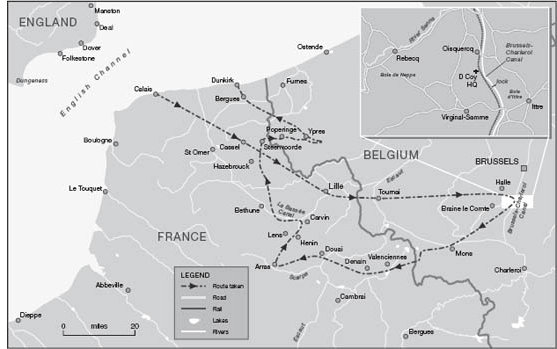
Maps
Chapter 1
Chapter 2
Chapter 3
Chapter 4
Chapter 5
Chapter 6
Chapter 7
Chapter 8
Chapter 9
Chapter 10
Chapter 11
Chapter 12
Chapter 13
Chapter 14
Chapter 15
Chapter 16
Chapter 17
Chapter 18
Chapter 19
Chapter 20
Chapter 21
Chapter 22
Chapter 23
Chapter 24
Historical Note
Glossary
About the Author
Also by James Holland
Copyright
For Sue, Bill and Giles Bourne
Historical Note
On the whole, the British Expeditionary Force performed rather well in France in 1940, even though it was forced to evacuate at Dunkirk. Most of the troops were bewildered by the rapid series of withdrawals that took place in order to keep in line with the French and Belgians as they fell back, but as the German net closed around them, the British fought with considerable gallantry and determination despite the enemy’s superior numbers and fire-power. As the Germans would discover later in the war, fighting on the ground when the enemy commands the skies is not much fun.
Most of the characters depicted at BEF Headquarters were real and, thanks to diaries, testimonies and copies of messages and conferences, it has been possible not only to gather a fairly clear picture of what was going on at Gort’s command post but also to use words spoken verbatim. I have, however, probably been a bit generous to General Lord Gort. He had many fine qualities, and it must have been an exasperating and extremely depressing time, but he also had his faults, not least his insistence on having far more staff officers than were necessary. Both GHQ and his advance headquarters were heaving with them, which made for a slow dissemination of orders and did nothing to improve the already parlous state of Allied communications. Nonetheless, his decision to act swiftly and unilaterally to evacuate as much of the BEF as possible, and his system of maintaining strongpoints as the bulk of his force fell back towards Dunkirk, was courageous and deftly handled.
I’m conscious I have been quite hard on the French, although I should make clear that any criticism applies more to the commanders than to the fighting men. Unfortunately, however, the French commanders have a lot to answer for. In May 1940, France had a bigger army, navy and air force than Germany, and when one considers that accepted military doctrine suggests you should not attack unless you have at least a three-to-one advantage in manpower and matériel, it seems incredible that the Germans should have rolled over the French so easily. Furthermore, it was an extraordinary gamble on the part of Germany to launch such an attack against not only France, but Belgium, Holland and Britain as well. There is not the space here to explain why the German panzer thrust was so successful, but it is certainly true that France – and, indeed, many German commanders – thought the war would soon become largely attritional just like that of 1914–18. Only a few on the German side ever envisaged the kind of fast-paced highly mobile campaign that became the reality: as has been proved convincingly by the German historian Heinz Frieser, there was no ‘blitzkrieg’ concept as an agreed and fully formed strategy at this time.
It was because the war was expected to be attritional that most of France’s aircraft were spread out across the country and held in reserve rather than being near the front. It is also why the French went to such lengths to build the infamous Maginot Line. No one (apart from one French government minister) suspected that Sedan, the hinge between the end of the Maginot Line and the manoeuvrable front that was to enter Belgium the moment the Germans attacked, would be the point of the German spearhead. As a result, it was horribly under-defended, with no active minefields whatsoever, poorly trained troops and incomplete, scarcely manned bunkers.
Despite this, all the French really needed to do was stand firm at the key nodal points – bridges, key road junctions and so on – and the German lines of supply would have been cut off, isolating the thrusting panzer divisions. As it happened, just six German panzer divisions and four motorized divisions were largely responsible for defeating a French Army of some two million men; panicking commanders, unable to move their cumbersome, defensive-minded troops quickly enough, and lacking sufficient radio sets, became like rabbits caught in headlights. General Gamelin, the French commander-in-chief until he was sacked, General Billotte, commander of First Army Group, General Blanchard, Commander of First Army, and General Altmayer, Commander of French V Corps, were all reported to have broken down in tears at various points. General Ironside, the British chief of the Imperial General Staff, even grabbed Billotte’s jacket and shook him to try to knock some steel into him. What was needed was resolve, determination and clear thinking; blubbing was certainly not the answer. I have made the point in the novel about the comparative ages of the British and French commanders and I think it’s valid. Most of the French commanders were a bit long in the tooth, and not only far too ingrained with the military thinking of the First World War, but physically and mentally too old to deal with the enormous stresses of commanding a modern army. Few generals have won decisive battles aged sixty-five plus.
I have tried to depict the main events described in the book as accurately as possible and all the locations, dates and timings of events are written as they were. The Waffen-SS Totenkopf Division was one of only two SS divisions to see action in France, and both Eicke and his frustrations in trying to convince the Wehrmacht of his division’s worth were much as depicted. The reconnaissance battalion’s bulldozing through a retreating French column was also based on a similar episode, although it was a reconnaissance unit from 7th Panzer Division, rather than the Totenkopf, who were responsible. Timpke, however, is fictional, although the reconnaissance battalion is not. The real-life commander was Sturmbannführer Heimo Hierthes, but I did not think it fair to give him Timpke’s many disagreeable qualities when I could find out nothing whatsoever about him.
Actually, there were French troops in the area near Hainin where Tanner and his men stole the Totenkopf’s trucks; that is, a part of the French 43rd Division had been trapped to the north of Mauberge after heavy fighting against the 5th Panzer Division on 17 May. Most of the division had fallen back to Bavay and then across the Escaut, but those trapped continued to fight on stubbornly while German troops advanced around them. This was not an uncommon scenario in the battle for France and it is quite possible that on 19 May, Timpke’s reconnaissance battalion would have missed them entirely.
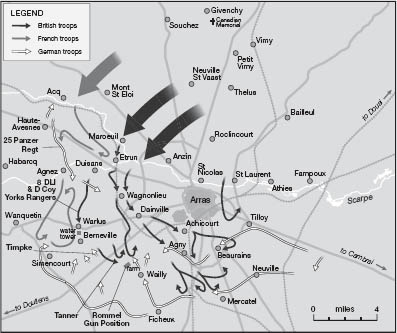
I have tried to recount the British counter-attack at Arras as accurately as possible, but it was complicated and the precise details are often contradictory. Although the British knew that the Germans were concentrating forces south of Arras and vice versa, neither Major-General Franklyn nor Major-General Rommel knew that the other was going to attack in precisely the same place. Thus, the 25th Panzer Regiment, Rommel’s main tank unit in his 7th Panzer Division, had already thrust successfully north-west of Arras towards Acq by the time the two British columns were moving south. This was why German forces were spotted west and north-west of Maroeuil as they moved south; 25th Panzer hung around near Acq during most of the afternoon of 21 May, until Rommel ordered them south-east again at around seven p.m. so as to cut off the retreating British. This is why the 8th Durham Light Infantry, still in Duisans, and the accompanying artillery found themselves under renewed attack from the north-west that evening.
It is true that Rommel personally directed the German battery at Point 111. The guns were situated in an old quarry next to Belloy Farm, just north-west of the village of Wailly, and it is not only still there, but clear to see why they had positioned themselves in such an ideal spot. It is also true that Rommel’s aide-de-camp, Oberleutnant Most, was killed while standing right next to him; also, Rommel, in his diary, expressed surprise as to how it had happened because he was not aware that the position was under direct attack – rather, the British tanks in front of them and on their right were aiming at the troops moving either side: the SS Totenkopf on their left and his artillery and 6th Rifle Regiment on his right.
Tragically, the massacre of the Royal Norfolks at Le Paradis also occurred much as described, although there was no Timpke egging Knöchlein on to carry out such an appalling deed. There have been all sorts of suggestions as to why he ordered the executions. One – entirely unconfirmed, I hasten to add, and without any evidence at all – asserts that it was a revenge attack for the death of a number of Totenkopf prisoners at Arras. Two men survived and escaped, although wounded, and were later recaptured and spent the rest of the war in PoW camps. Afterwards, however, they revealed the truth of what had happened. Knöchlein, who had survived the war, was tracked down, put on trial, found guilty and hanged.
One brief note about the weapons. Interestingly, an MP28 sub-machine-gun – almost identical to the Waffen-SS MP35 – was brought back from Dunkirk and handed over to the Admiralty. With the RAF, they decided to commission a new sub-machine-gun. The Lanchester, as it became known, was an almost like-for-like copy of the German model.
Had the French not lost their heads and panicked and instead dealt with the German attack logically and calmly, the Second World War would, no doubt, never have become a world war in the way that we think of it today and would very likely have been over that summer. Sadly, that did not happen. France was vanquished, and by the signing of the armistice on 22 June 1940, all of continental Europe, from the top of Norway in the Arctic Circle, all the way down to the southern tip of Spain, lay in Nazi or Fascist hands. Britain faced five more years of war and the men of the Yorkshire Rangers had many more battles to come. Jack Tanner and Stan Sykes were needed again all too soon.
1
A LITTLE AFTER half past ten in the morning, Thursday, 9 May 1940. Already it was warm, with blue skies and large white cumulus clouds; a perfect early summer’s day, in fact. It was also quite warm inside the tight confines of the Hurricane’s cockpit, even fifteen thousand feet above the English Channel, and Squadron Leader Charlie Lyell was wishing he hadn’t worn his thick sheepskin Irvin over his RAF tunic but the air had seemed fresh and crisp when he’d walked across the dew-sodden grass to his plane just over half an hour before. Now, as he led his flight of three in a wide arc to begin the return leg of their patrol line, the sun gleamed through the Perspex of his canopy, hot on his head. A line of sweat ran from his left temple and under the elastic at the edge of his flying goggles.
Nevertheless, it was the perfect day for flying, he thought. It was so clear that he could see for a hundred miles and more. As they completed the turn to head southwards again, there, stretching away from them, was the mouth of the Medway, shipping heading towards and out of London. Southern England – Kent and Sussex – lay unfolded like a rug from his starboard side, a soft, green, undulating patchwork, while away to his port was the Pas de Calais and the immensity of France. Somewhere down there were the massed French armies and the lads of the British Expeditionary Force. He smiled to himself. Rather you than me.
Lyell glanced at his altimeter, fuel gauge and oil pressure. All fine, and still well over half a tank of fuel left. The air-speed indicator showed they were maintaining a steady 240 miles per hour cruising speed. He turned his head to check the skies were clear behind him, then back to see that Robson and Walker were still tight in either side of him, tucked in behind his wings. Good.
Suddenly something away to his right caught his eye – a flash of sunlight on metal – and at the same moment he heard Robson, on his starboard wing, exclaim through the VHF headset, ‘Down there – look! Sorry, sir, I mean, this is Red Two, Bandit at two o’clock.’
‘Yes, all right, Red Two,’ said Lyell. He hoped he sounded calm, a hint of a reprimand in his voice, even though he was conscious that his heart had begun to race and his body had tensed. He peered down and – yes! – there it was, some five thousand feet below, he guessed, and perhaps a mile or so ahead. It was typical of Robson to assume it was an enemy plane – they all wanted the squadron’s first kill – but the plain truth was that most aircraft buzzing around the English coast were British, not German. Even so.
‘This is Red One,’ he called, over the R/T. ‘We’ll close in.’ At least the sun, already high, was behind them, shielding them as they investigated. Lyell pushed open the throttle and watched the altimeter fall. His body was pressed back against the seat, and he tightened his hand involuntarily around the grip of the control column. A few seconds later and he could already see the aircraft ahead more clearly. It appeared to have twin tail fins but, then, so did a Whitley or a Hampden. The brightness was too great to distinguish the details of the paint scheme or symbols on the wings and fuselage.
Ahead loomed a huge tower of white cloud and together they shaved the edge of it, so that Lyell fleetingly lost sight of the plane before it appeared again and then, in a moment when it hung in the shadow of the cloud, he saw the unmistakable black crosses. His heart lurched. Christ, he thought, this is bloody well it.
Pushing open the throttle even wider, he closed in on what he could now see was a Dornier. It appeared not to have spotted them yet, but as he was only around seven hundred yards behind and a thousand feet above, Lyell checked that Robson and Walker were still close to him before he said, ‘Line astern – go!’ Still the enemy plane continued on its way, oblivious to the danger behind it. Lyell turned his head to see Robson and Walker now directly behind him.
Taking a deep breath, he flicked the firing button to ‘on’ for the first time ever in a real combat situation, then said into his mouthpiece, ‘Number One Attack – go!’ Opening the throttle wide he dived down on the Dornier. As it grew bigger by the second, he pressed his thumb down hard on the gun button and felt the Hurricane judder as his eight machine-guns opened fire. Lines of tracer and wavy threads of smoke hurtled through the sky but, to his frustration, fell short of the enemy plane. Cursing, he pulled back on the stick, but already he knew he had misjudged his attack. Seconds, that was all it had taken, but now the Dornier seemed to be filling his screen and he knew that if he did not take avoiding action immediately, they would collide. He pushed the stick to his left and the Hurricane flipped onto its side to scythe past the port wing of the Dornier, just as a rip of fire cut across him. He could hear machine-guns clattering, Robson and Walker shouting through the airwaves – all radio discipline gone – and saw tracer fizzing through the air, and then he was away, circling, climbing and scanning the skies, trying to pinpoint the enemy again.
Lyell swore, then heard a rasp of static and Robson’s voice. ‘Bastard’s hit me!’ he said.
‘Are you all right, Red Two?’ Lyell asked, peering about desperately for the Dornier and conscious that several enemy bullets had torn into his own fuselage.
‘Yes, but my Hurri’s not. I’m losing altitude.’
‘I’ve got you, Robbo.’ Walker this time.
Damn, damn, damn, thought Lyell, then spotted the Dornier again, a mile or so ahead, flying south-west once more. ‘The bloody nerve,’ he muttered. ‘Red Two, turn straight back for Manston. Red Three, you guide him in.’
‘What about you, sir?’ asked Walker.
‘I’m going after Jerry. Over.’ Damn him. Damn them all, thought Lyell. He glanced at his instruments. Everything looked all right; the plane was still flying well enough – it was as though he had not been hit at all – but the fuel gauge showed he was less than half full now. It was a shock to see how much he had used in that brief burst of action. Well, bollocks to him, thought Lyell. He was damned if some Boche bomber was going to make a fool of him or his squadron. Applying an extra six pounds of boost he climbed five hundred feet and turned towards the Dornier.
He was soon catching up and, making sure the sun was behind him again, waited until the German plane began to fill his gunsight. Then, at a little over four hundred yards, distance, he pressed down on the gun button. Again, the Hurricane juddered with the recoil and Lyell was jolted in his seat despite the tightness of his harness. Lines of tracer and smoke snaked ahead, but the bullets were dropping away beneath the Dornier. Lyell pulled back slightly on the stick and continued pressing hard on the gun button. His machine-guns blazed, and his tracer lines looked to be hitting the German plane perfectly, but still it flew on. It was as though his bullets were having no effect.
‘Bloody die, will you?’ muttered Lyell. Then tracer was curling towards him from the Dornier’s rear-gunner, seeming slow at first, then accelerating past, whizzing across his port wing.
‘For God’s sake,’ said Lyell, ducking his head.
Suddenly the Dornier wobbled, belched smoke, turned and dived out of Lyell’s line of fire. ‘Got you!’ said Lyell, then pushed the stick to his left and followed the enemy down. Not far below and away from them there was a larger bank of cloud. So that was the enemy’s plan – to hide. In moments, the Dornier was flitting between puffs of outlying cloud, all signs of black smoke gone, but Lyell was gaining rapidly, the Merlin engine screaming, the airframe shaking, as he hurtled towards the enemy and opened fire again.
Just as the lines of tracer began to converge on the German machine, Lyell’s machine-guns stopped. For a moment, he couldn’t understand it – could all eight really have jammed? But then it dawned on him. He had used up his ammunition. Fifteen seconds’ worth. Gone. More than two and a half thousand bullets pumped out and still that bloody Dornier was flying. Lyell cursed and watched the German disappear into the cloud. Following him in, he banked and turned reluctantly towards home, a strangely bright and creamy whiteness surrounding him, the airframe buffeted by the turbulence. Suddenly, it thinned, wisping either side of him and over his wings, and moments later he was out in bright sunshine, the Kent coast ahead. Trickles of sweat ran down his neck and from beneath his leather helmet, tickling his face.
He throttled back, lifted his goggles onto his forehead and rubbed his eyes. He felt sick, not from being thrown about the sky but from bitter disappointment. The squadron’s first kill! It should have been his – a sitting duck if ever there was one. And yet, somehow, it had got away.
From the corner of his eye he noticed feathery lines of grey between the cockpit and the starboard wing. He glanced up at his mirror. It was filled by the enemy plane bearing down on him, pumping bullets, its ugly great Perspex nose horribly close.
Christ almighty, thought Lyell, momentarily stunned. Then something clicked in his brain. He remembered that a Hurricane could supposedly out-turn almost any aircraft and certainly a lumbering twin-engine Dornier. Jamming the Hurricane to its full throttle, he turned the stick, added a large amount of rudder and opened the emergency override to increase boost. The Hurricane seemed to jump forward with the dramatic increase in power. With the horizon split between sky, land and sea, Lyell grimaced, his body pressed back into his seat.
In no more than half a circle, he could see he was not only getting away from the enemy but creeping up on the Dornier’s rear. Again, the German rear-gunner opened fire. Jesus, thought Lyell. How much ammunition do these people have? The two aircraft were circling together now in a vertical bank. Lyell wondered how he would get away without the German rear-gunner hitting him, but a moment later the firing ceased. He pushed the stick to starboard, flipped over the Hurricane and reversed the turn, breaking free of the circle and heading out of the Dornier’s range as he did so.
Although he was certain the enemy aircraft had neither the speed nor the agility to follow, Lyell glanced back to make sure the German pilot was not coming after him. The Dornier was banking away from the circle too, levelling out to return home. And as he straightened, he waggled his wings.
‘Bloody nerve!’ exclaimed Lyell. Was the enemy pilot saluting or sticking two fingers up at him? Either way, he had foxed three RAF fighter aircraft – out-thought, out-flown and out-gunned them.
About thirty miles away, a fifteen-hundredweight Bedford truck turned off the Ramsgate road that ran through Manston village, almost doubling back on itself as it entered the main camp at the airfield. The driver swore as he ground down through the gears, the truck spluttering, jerking and rumbling forward, past two hangars on the right, then towards several rows of one-storey wooden huts. He turned off the road, brought the truck to a halt and, letting the engine idle, said to the sergeant beside him, ‘Hold on a minute. Let me find out where they want you.’ He jumped down from the cab, and strode to what appeared to be an office building.
Sergeant Jack Tanner stepped out and went round to the back of the truck. ‘All right, boys?’ he said, to the five men sitting in the canvas-covered back, then pulled out a packet of cigarettes from the breast pocket of his serge battle-blouse.
‘It’s certainly a nice day for it, Sarge,’ said Corporal Sykes. ‘Not bad up here, is it? I’ve always had a soft spot for Kent. Used to come as a boy.’
‘Really?’ said Tanner, flicking away his match.
‘’Op-pickin’ in the summer. Quite enjoyed it.’
Tanner made no reply, instead turning to the open grassland of the airfield. A number of aircraft were standing in front of the hangars to their right, bulky twin-engined machines, their noses pointing towards the sky. Further away to his left, he saw several smaller, single-engine aircraft that he recognized as Hurricanes. A light breeze drifted across the field. Above, skylarks twittered busily.
‘It’s all right round here,’ said one of the men, a young-looking lad called McAllister, ‘but give me Yorkshire any day.’
‘Nah,’ said Sykes. ‘It’s always bloody raining up there. Every time I go to HQ it bloody pours. Half my kit’s still damp. And the air’s a lot cleaner here than it is in Leeds.’ He breathed in deeply and sighed.
‘I meant the Dales, Stan,’ said McAllister. ‘The Dales are grand, ain’t that right, Tinker?’ He nudged another of the men, a short, fair-haired boy.
‘Don’t know, really,’ said Bell. ‘I suppose. I like our farm well enough.’
Tanner smiled and took a drag of his cigarette. A faint hum caught his attention and he looked back towards the coast. The sound grew louder and he stepped away from the truck, a hand to his forehead to shield his eyes as he looked up into the deep blue sky.
‘Sarge?’ said Sykes.
‘Aircraft,’ he said. ‘Sounds like one in trouble.’
Immediately Sykes leaped down from the truck and onto the road beside Tanner. Together they scanned the skies.
‘There,’ said Tanner. Hepworth and McAllister were out of the truck now too. Two Hurricanes were approaching the north end of the airfield, one above and gliding effortlessly towards the grass strip, the other belching dark smoke, a grey trail following. The engine of the stricken aircraft groaned and thrummed irregularly, the airframe slewing and dipping, the port wing sagging.
The men watched in silence as the crippled plane cleared some buildings on the far side of the ’drome, dropped what seemed like fifty feet, recovered briefly, gave a last belch of smoke and crashed into the ground. The port wing hit the soft earth first, the undercarriage collapsing and the plane ploughing in an arc through the grass. Its propeller snapped and the fuselage buckled.
‘Come on – get out, you stupid sod,’ muttered Sykes. For a moment there was silence. Then the pilot heaved himself out of the cockpit, jumped onto the wing and sprinted away from the scene for all he was worth. He had not gone thirty yards when there was an explosion and the broken Hurricane was enveloped by a ball of angry orange flame and billowing black smoke. Tanner and the others flinched at the sound, saw the pilot fling himself flat on the ground then watched the fire-wagon, bells ringing, speed out from the watch-tower and hurry to the scene.
‘Look, ’e’s getting up again,’ said Sykes, who had taken it upon himself to be the commentator.
‘Good lad,’ said Tanner, as the other Hurricane touched down safely behind them.
The truck driver returned. ‘One’s still not back. The CO an’ all. Station commander’s not at all happy.’ He clicked his teeth and indicated to them to get back aboard. ‘You’re just down here,’ he added, as Tanner clambered into the cab beside him, ‘the other side of the parade-ground.’
He took them to the last of a row of long wooden huts. ‘Here,’ he said, pulling up. ‘Make yourselves at home. The CSM’ll be along shortly.’
Tanner undid the tailgate, waited for his men to jump down, then grabbed his kitbag and rifle. Like all British rifles, it was a Short Magazine Lee-Enfield, a No. 1 Mark III model, and although the newer No. 4 version was now coming into use, Tanner had no intention of surrendering this personal weapon. The son of a gamekeeper from south Wiltshire, he had learned to shoot almost as soon as he could walk and with it had come the well-drummed-in lesson of looking after a gun, whether it was an air rifle, twelve bore, or Lee-Enfield rifle. But, more than that, Tanner had made an important modification to his.
He had done it almost as soon as he had returned to Regimental Headquarters in Leeds back in February after nearly eight years’ overseas service. Having been issued with new kit, he had gone straight to the Royal Armoury where he had had a gunsmith mill and fit two mounts and pads for an Aldis telescopic sight. They were discreet enough and few people had noticed – no one in authority, at any rate, not that he imagined they would say much about it even if they did. The scope had been his father’s during the last war and Tanner had carried it with him throughout his army career. Although he had never attempted to become an army sniper, he had certainly sniped, and on several occasions the Aldis had proved a godsend. Slinging the rifle and his kitbag onto his shoulder, he followed the others into the hut.
Jack Tanner was twenty-four, although his weather-worn and slightly battered face made him appear a bit older. He was tall – more than six foot – with dark hair, pale, almost grey eyes and a nose that was slightly askew. He had spent almost his entire army career in India and the Middle East with the 2nd Battalion, the King’s Own Yorkshire Rangers, even though he was a born and bred Wiltshireman. This last Christmas he had finally returned to England. Home leave, it had been called, not that he had had a home to return to any more. He had not seen the village where he had been brought up for over eight years. A lifetime ago. He wished he could return but that was not possible and so he had spent the time in Yorkshire instead, helping a gamekeepeer on an estate in the Dales; it had reminded him how much he missed that life. Four weeks later he had presented himself at Regimental Headquarters in Leeds and been told, to his dismay, that he would not be going back to Palestine. Instead he had been posted to bolster the fledgling Territorial 5th Battalion as they prepared for war. In Norway, the Territorials had been decimated; Tanner and his five men, along with a few others, were all that remained of the 5th Battalion. A fair number were dead, but most were now either in German hospitals or on their way to a prison camp.
Tanner had hoped he might be allowed back to the 2nd Battalion now, but the regimental adjutant had had other ideas. The 1st Battalion was with the BEF in France; new recruits were being hurried through training and sent south to guard the coast. Men of his experience had an important part to play – all the veterans of Norway did. The 2nd Battalion would have to do without him for a while longer. Forty-eight hours’ leave. That was all he and his men had had. The others had gone home, to their families in Leeds and Bradford, or in Bell’s case to his family farm near Pateley Bridge, while Tanner and Sykes had got drunk for one day and recovered the next.
The hut was more than half empty. Just ten narrow Macdonald iron beds and palliasses were laid out along one wall, but otherwise it was bare. Tape had been criss-crossed over each window. Tanner slung his kitbag beside the bed nearest the door, then lay down and took out another cigarette.
‘What are we supposed to do now, Sarge?’ asked Hepworth.
‘Put our feet up until someone tells us where we’re to go,’ Tanner replied. He lit his cigarette, then closed his eyes. He was conscious of another Hurricane landing – the engine sound was so distinctive. Bloody airfield and coastal guard duty, he thought. Jesus. He told himself to be thankful for it. They had escaped from Norway by the skin of their teeth so a soft job would do him and the others good. In any case, the war wasn’t going to end any time soon, that much was clear. Their chance would come. Yet part of him yearned to rejoin his old mates in Palestine. For him, England was an alien place; he had spent too long overseas, in the heat, dust and monsoon rains of India, and the arid desert of the Middle East. Before that he had only ever known one small part of England, and that was the village of Alvesdon and the valley of his childhood. He still missed it, even after all these years. Often, when he closed his eyes, he would remember the chalk ridges, the woods on the farm, the clear trout stream, the houses of thatch, cob and flint. But both his parents were gone, and dark events from his past ensured there could be no going back.
He sighed. Long ago, he had resigned himself to exile, but it still saddened him. That long train journey south from Leeds: too much time to think, to remember. Tanner chided himself silently. No point in getting bloody maudlin. What he needed was a distraction. Activity. It was, he realized, barely a week since they had returned from Norway yet already he felt as though he had been kicking his heels for too long.
Soon after, he dozed off, the others’ chatter a soporific background noise that lulled him to sleep. He was awake again, however, the moment his subconscious brain heard a new voice in the hut – a distinctive one: a deep, yet soft Yorkshire accent that was strangely familiar.
‘Morning, gents,’ Tanner heard, followed by a squeak of springs and the clatter of boots on the wooden floor as the men stood quickly to attention. Tanner swung his legs off the bed.
‘All right, lads,’ said the newcomer. ‘As you were.’
Tanner’s eyes widened in shock. A big, stocky man of nearly his own height stood in the doorway. The bright sun behind cast his face in shadow, but Tanner would have known him anywhere. Blackstone. Jesus. He groaned inwardly. That was all he needed.
Blackstone stared at him, then winked and turned back to the others. ‘Welcome to Manston, lads,’ he said, ‘and to T Company of the First Battalion.’ He had a lean face, with deep lines running across his brow and between his nose and mouth. He was in his mid-thirties, with thick sandy hair that showed beneath his field cap.
‘I’m Company Sergeant-Major Blackstone,’ he said. ‘Captain Barclay is the officer commanding of this training company, but as far as you lot are concerned, I’m the one who runs the show. So if I were you I’d try to keep in my good books. It’s better that way, isn’t it, Sergeant? Then everything can be nice and harmonious.’ He grinned at Tanner. ‘Now,’ he continued, ‘I’m going to take Sergeant Tanner here away with me for a bit. Later on you’ll meet your platoon commander and be shown about the place. For the moment, though, stay here and get your kit together. All right?’ He smiled at them again, pointed the way to Tanner and said, ‘See you later, boys.’
Outside, he said, ‘Well, well, my old friend Jack Tanner. Fancy us ending up here like this.’
‘Fancy,’ muttered Tanner. ‘You recovered, then.’
‘Oh yes, Jack. You can’t keep a good man like me down for long.’ He chuckled. ‘I’m taking you to see the OC.’ He took out a packet of Woodbines and offered one to Tanner. ‘Smoke?’
‘No thanks, sir.’
‘Don’t tell me you’ve given up the beadies, Jack.’
‘I just don’t want one at the moment.’
‘You mean you don’t want one of mine.’ Blackstone sighed. ‘Jack, can’t you tell I’m trying to be friendly? Come on – let’s have no hard feelings. It was a long time ago now. Let bygones be bygones, eh?’
Tanner still said nothing. Blackstone stopped and offered him his packet of cigarettes again. ‘Come on, Jack. Have a smoke. Water under the bridge, eh?’
They were now at the parade-ground. A platoon of men was being drilled on the far side, the sergeant barking orders. Tanner looked at Blackstone, then at the packet of cigarettes being held out towards him. Briefly he considered taking one.
‘Look here, Jack,’ said Blackstone, ‘we’re at war now. We can’t be at each other’s throats.’
‘Agreed,’ said Tanner, ‘but that doesn’t mean I have to like you.’
The smile fell from Blackstone’s face.
‘A few pleasantries and the offer of a smoke,’ Tanner continued, ‘and you think I’ll roll over. But I was never that easily bought, Sergeant-Major. Trust and respect have to be earned. You prove to me that you’re different from the bastard I knew in India, then I’ll gladly take your bloody cigarette and shake your hand.’
Blackstone stared at him, his jaw set. ‘Listen to you!’ he said. ‘Who the hell do you think you are? I offer you an olive branch and you have the nerve to spit in my face.’
‘Don’t give me that crap. What the hell did you expect? You listen to me. Whether we like it not, we’re both here, and for the sake of the company I’ll work with you, but don’t expect me to like you and don’t expect me to trust you. Not until you’ve proved to me that you’ve changed. Now, I thought you were taking me to see the OC so let’s bloody get on with it.’
Blackstone laughed mirthlessly. ‘Oh dear,’ he said. ‘You always were an obstinate beggar. I can promise you this much, though, Jack. It’s really not worth getting on the wrong side of me. It wasn’t back then, and it certainly isn’t now.’
‘Just as I thought,’ snarled Tanner. ‘You haven’t changed.’
‘You’re making a big mistake, Jack,’ said Blackstone, slowly. ‘Believe me – a very big mistake.’
2
BY THE TIME he reached Manston Squadron Leader Lyell was already in a bad mood, but his spirits fell further when he saw the wagons dousing the flames of Robson’s Hurricane – or, rather, what was left of it: the fuselage was nothing more than a crumpled black skeleton. Then, clambering out of the cockpit, he saw Cartwright, his rigger, examining what was evidently damage along his own fuselage.
‘Don’t worry, sir,’ said Cartwright. ‘Only a couple of bullet holes.’
‘I didn’t notice any difference,’ Lyell muttered.
‘No – looks like they went clean through. Soon patch that up.’
‘What about Robson?’
‘Believe he’s all right, sir. His kite didn’t blow until he was well clear.’
‘That’s something, then.’ He began to head back, but Smith, his fitter, called after him.
‘Did you get it, sir? The Dornier?’
Lyell stopped. ‘Put it this way, Smith, I doubt very much that it will have made France.’ As he walked on across the grass, he decided to continue with the lie, but it did little to improve his mood or assuage the humiliation and anger he felt at having been foxed by a lone German reconnaissance plane. Christ, how many times had they practised their aerial attacks? Almost every day since the war began! Each attack procedure had been assiduously drilled into every pilot, yet the first time they had tried the Number One Attack – which was also the most straightforward – it had failed hopelessly. He had been thrown by the Dornier’s return fire, but what had really shocked him was the ineffectiveness of the .303 Browning bullets. Was it the range, or their velocity? He wasn’t sure. And his ammunition had run dry so quickly. Fifteen seconds had always seemed a reasonable amount during gunnery practice, but in the heat of combat, it had gone by in a trice. Had their training been wrong or were the German aircrew simply better?
As he neared the dispersal hut he saw Dennison, the intelligence officer, hovering by the doorway, itching to ask him about the sortie. Lyell felt a further flash of irritation.
‘So what happened, Skip?’ Dennison asked as Lyell dropped his flying helmet into a deck-chair in front of the wooden hut.
‘Did you get the bastard?’ asked Granby, the commander of B Flight.
‘I caught up with him, all right,’ Lyell told them. The other pilots were also listening now. ‘He was a wily sod, though, making the most of the cloud. Still, I managed to get in a couple of bursts and I’m pretty sure I knocked out his port engine. Must have got the rear-gunner too because he shut up shop pretty quickly. Anyway, she was losing height and trailing a fair amount of smoke when she disappeared into a large bank of cloud.’
‘Probably in the Channel by now, then,’ said Granby.
‘I’d have thought so.’ Lyell glanced up at the almost perfectly clear sky above them. ‘Bloody weather. Why couldn’t it have been like this all the way to France?’ He looked at Dennison. ‘Don’t worry,’ he said to the IO, ‘I know we can’t claim it.’ He paused to light a cigarette, exhaled and said, ‘I hear Robbo’s all right.’
‘Bloody lucky,’ said Granby. ‘Another few seconds and, well, I hate to think.’
Reynolds, the adjutant, now approached Dispersal. ‘Station commander wants to see you, sir,’ he told Lyell.
Lyell sighed. ‘I’m sure he does.’ He ran his hands through his hair. ‘I think we should have a few drinks tonight.’ He addressed this comment to Granby, but it was meant for all of the pilots. ‘We should celebrate Robbo’s narrow escape, commiserate over the loss of a Hurricane and raise a glass to our first almost-kill.’
‘Hear, hear,’ said Granby.
‘And I don’t mean in the mess. Let’s go out.’ He turned to the adjutant. ‘Come on, then,’ he said. ‘Better face the music.’
Tanner had followed Blackstone to a brick office building at the far side of the parade-ground. In silence they walked up a couple of steps and through the main door, then along a short corridor. Blackstone stopped at a thin wooden door, knocked lightly and walked in.
‘Ah, there you are, CSM,’ said the dark-haired captain from behind his desk. ‘And this must be Sergeant Tanner.’
‘Yes, sir,’ said Blackstone.
Tanner stood to attention and saluted, while Blackstone ambled over to a battered armchair in the corner of the room and sat down, taking out another cigarette as he did so. Tanner watched with barely concealed incredulity. Jesus. He was surprised that the captain should tolerate such behaviour.
‘At ease,’ said the captain. He was, Tanner guessed, about thirty, with fresh, ruddy cheeks, immaculately groomed hair and a trim moustache. Beside Tanner, sitting stiffly on a wooden chair in front of the desk, was a young subaltern. The room smelled of wood and stale tobacco. It was simply furnished and only lightly decorated: a coat of whitewash, a map of southern England hanging behind the desk, a metal filing cabinet and a hat-stand, on which hung a respirator bag, tin hat and service cap.
‘I understand you know the CSM,’ said Barclay, taking his pipe from his mouth.
‘Yes, sir.’
‘In India together?’
‘Yes, sir. With the Second Battalion.’
‘Good, good.’ He nodded. ‘Well, let me introduce you to Lieutenant Peploe. You and your men will be joining his platoon.’
The subaltern next to him now stood up and shook Tanner’s hand. ‘How do you do, Sergeant?’
‘Well, sir, thank you.’
Peploe smiled. ‘Glad to have you on board.’ It was said sincerely. The lieutenant had a rounded yet good-looking face, blue eyes and a wide, easy smile. His hair was thick strawberry blond, slightly too long and somewhat unruly, as though it refused to be tamed by any amount of brushing. His handshake was firm and he looked Tanner squarely in the eye; it was something the sergeant liked to see in an officer. He hoped they would get on well enough.
Barclay tapped his fingers together and shifted in his seat. ‘I see you’ve been decorated, Sergeant.’ He noticed the blue, white and red ribbon of the Military Medal sewn above Tanner’s left breast pocket.
‘A few years ago now, sir.’
‘Do you mind me asking what it was for?’
‘Nothing much, really, sir. A bit of a scrap with some Wazirs, that’s all.’
Blackstone laughed from his armchair. ‘Such modesty, Jack. Honestly, sir, Tanner’s single-handed defence of Pimple Hill is the stuff of legend – at least,’ he grinned, ‘the way he tells it. Isn’t that right, Jack? I’ve heard the story a few times now and it gets better with every telling – especially with a bit of the old sauce inside.’
You bastard, thought Tanner.
Blackstone laughed, and shot Tanner another wink, as though it was nothing more than friendly ribaldry between two old comrades.
Barclay raised an eyebrow. ‘Well, I’m sure you deserved it, Sergeant.’
Tanner shifted his feet, aware that he was betraying his discomfort. What could he say? He knew Blackstone was baiting him, daring him to rise. He had never spoken of that September day, four and a half years before, in the hills around Muzi Kor – not once – but Barclay wouldn’t believe that now. He cleared his throat. ‘I was proud enough to be awarded it, sir, but there are many brave deeds carried out in battle and most go unobserved. And there were certainly other men braver than me that day.’
‘Yes, well, I’m sure you’re right. In any case …’ Barclay let the words hang and fumbled for his tobacco pouch. ‘So,’ he said at last, ‘were you briefed in Leeds, Sergeant?’
‘The regimental adjutant told me that this is still really a training company, sir. That most of the men have been hurried through formal training and have been sent here to do coastal and airfield guard duty.’
‘That’s about the sum of it. Since Norway, everyone’s expecting Jerry to make a move against us in the Low Countries. With the Second Battalion in Palestine and the poor old Fifth in the bag, the First Battalion’s a bit stretched. The idea is that our recruits can do a bit of soldiering of sorts and carry out more training while they’re about it. But, of course, we need experienced men like the CSM here and yourself.’
‘And the men Sergeant Tanner has brought with him, sir,’ added Peploe.
‘Absolutely.’ Barclay lit his pipe, a cloud of blue-grey smoke swirling into the still air of the office. ‘I hear you had quite a time of it out in Norway, Sergeant.’
‘Yes, sir.’ Tanner knew the captain wanted to hear more, but he was not going to indulge him. Not in front of Blackstone.
‘Sounds like you were lucky to get out.’
‘Yes, sir.’
‘I don’t know how you do it, Jack,’ interrupted the CSM. ‘Most of the Fifth Battalion get themselves put in the bag, but you manage to get yourself safely back to Blighty.’ He sniggered. ‘I tell you, sir, Tanner’s one of those lucky soldiers. Always gets himself out of a tight fix.’
Tanner glared at Blackstone. Then, too late, he saw that Peploe had seen.
‘We need men like that,’ said the lieutenant. ‘If what the CSM says is true, Sergeant, I’m very glad to have you in my platoon.’
‘Thank you, sir,’ said Tanner.
Barclay put another match to his pipe. ‘Yes, I’m sure we can all learn something from you, Sergeant. Anyway,’ he leaned back in his chair, ‘what else do you need to know? We’re a small company. Three platoons, most not quite at full strength although Mr Peploe’s will be, now that you’re here. We rotate duties between training, guarding the airfield and a stretch of the coast at Kingsgate – do you know it? Between Broadstairs and Margate. Big castle there. It’s a hotel and, incidentally, out of bounds to servicemen. Not very taxing stuff, I’m afraid, but important work all the same.’
‘So, do you think we’ll be going to France, sir?’
‘Yes – I meant to say. That’s the point of us being down here. In effect we’re the reserve for the First Battalion. A hop across the Channel and we’ll be right alongside them. Now,’ he said, placing his hands flat on the desk. ‘Is there anything else?’ He turned to Blackstone, who was absent-mindedly picking at his fingernails. ‘CSM?’
Blackstone looked up. ‘Shall I brief the sergeant on duty rotas, or will you do that, Mr Peploe?’
‘I can do that, thank you, Sergeant-Major,’ said Peploe. ‘I want to meet Tanner’s men in any case.’
‘Very good, sir.’
Barclay clapped his hands to signal the end of the interview, then suddenly said, ‘Oh, yes – I almost forgot, but there is something else you should know. I’m afraid we’ve had some thieves here at the airfield.’
‘Sir?’
‘Two nights ago a dozen barrels of fuel were stolen. Understandably, the station commander’s livid about it. He rather wants us to get to the bottom of it.’
‘It’s those Poles, sir,’ said Blackstone.
‘I really don’t know how you can be so certain,’ said Peploe.
‘You’ll see, sir,’ said Blackstone. ‘I’d put good money on it.’
‘Poles, sir?’ Tanner asked Peploe.
‘Yes. Former soldiers and pilots, mostly. They’ve come over since the fall of their country, poor devils. They’re being housed here for the moment.’
Barclay raised an eyebrow at Peploe, then said, ‘We’ve got several dumps here, you see, Sergeant. Lorries deliver the fuel in barrels – presumably from a refinery somewhere – a couple of times a week. They’re taken to the fuel stores and then the bowsers siphon the petrol from there. One of these dumps was broken into and the barrels swiped. Of course, the fuel’s got dye in it but that hardly stops people using it. After all, once you’ve put it in your car or what-have-you, who’s to know? It’s all high-octane stuff but apparently that’s of little concern on the black market.’
‘Why do you think the Poles are responsible, sir?’ Tanner asked Blackstone.
‘I saw several of them skulking around the store in question the other day. And a number of them are employed around the airfield and camp, some as drivers. You couldn’t nick all those barrels without a number of men being involved, and I can’t see any of the military personnel doing it. We’ve a war to fight and win, not help lose by pinching fuel needed for the aircraft here. No, it’s those Poles, all right. Certain of it.’
‘Anyway, the point is, Tanner,’ added Barclay, ‘we need to be vigilant. You see anything suspicious, you tell one of us right away.’
‘Yes, sir.’
Barclay dismissed Tanner and Peploe, but not Blackstone. To Tanner’s surprise, the CSM took out another cigarette and settled back in the armchair next to the OC’s desk. Blackstone. Tanner sighed. Christ, but that man had made his life difficult during the Nowshera Brigade days, yet when the CSM had been wounded he’d thought it would be the last he’d ever see of him. Of all the luck! And he was just the same – five minutes in front of Captain Barclay had proved that. Tanner clenched his fists. He had an urge to hit something very hard.