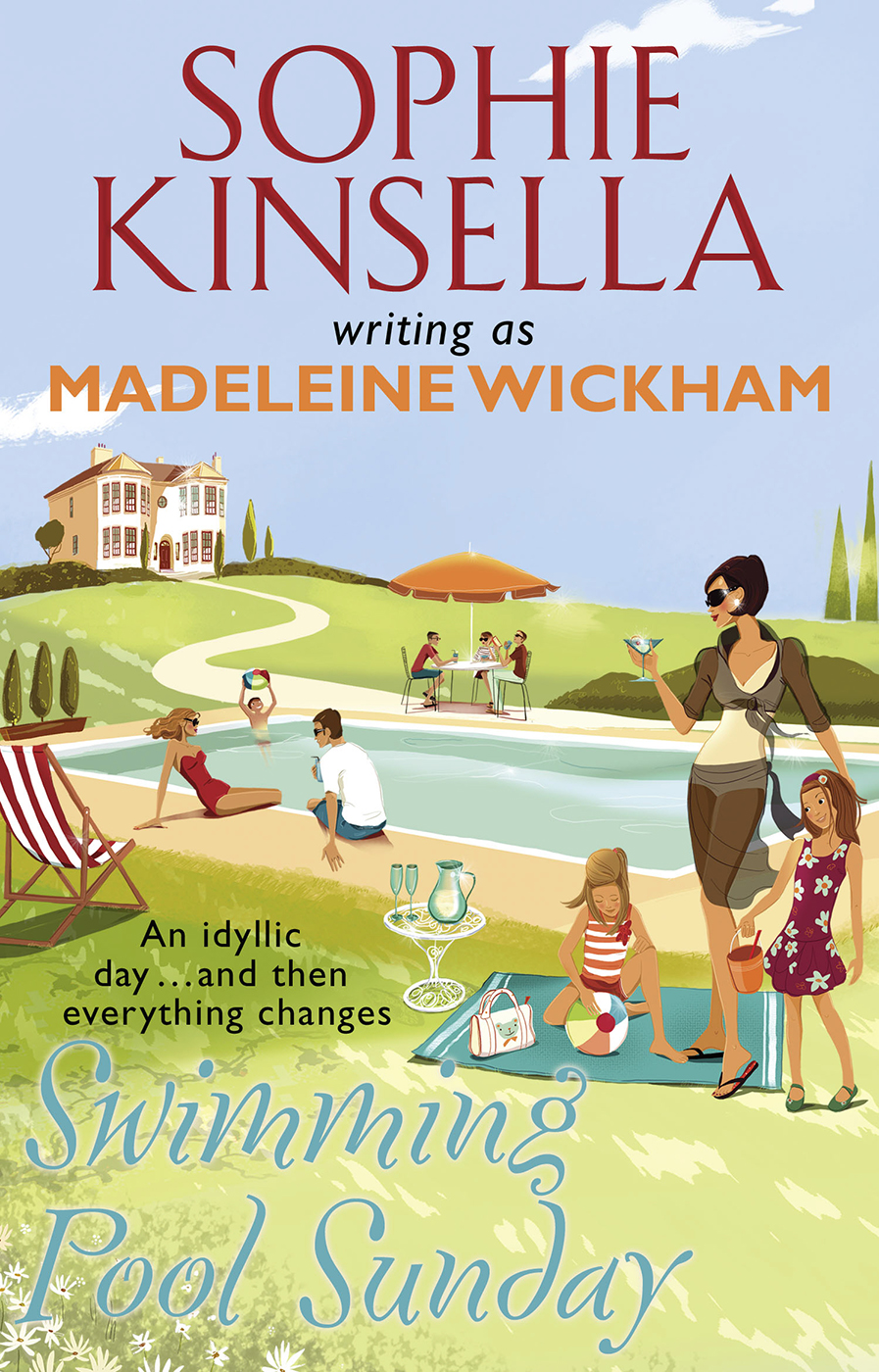
One shimmeringly hot Sunday in May, the Delaneys open their pool to the whole village for charity. Louise is there with her daughters, and while the children splash and shriek in the cool blue waters, she basks in the sunshine, attempting to ignore her estranged husband and dreaming of the new man in her life, a charismatic lawyer. The day seems perfect.
Then a sudden and shocking accident changes everyone’s lives forever. Recriminations start to fly. Whose fault was it? Louise’s new lover insists that she sues the Delaneys. Her ex-husband isn’t so sure. Opinion in the village is split. Old friendships start to crumble. New ones are formed. Will the repercussions from the accident ever end?
Cover
About the Book
Title Page
Dedication
Acknowledgements
Author's Note
Chapter One
Chapter Two
Chapter Three
Chapter Four
Chapter Five
Chapter Six
Chapter Seven
Chapter Eight
Chapter Nine
Chapter Ten
Chapter Eleven
Chapter Twelve
Chapter Thirteen
Chapter Fourteen
Chapter Fifteen
Chapter Sixteen
Chapter Seventeen
Chapter Eighteen
Chapter Nineteen
Chapter Twenty
About the Author
Also by Madeleine Wickham
Copyright
TRANSWORLD PUBLISHERS
61–63 Uxbridge Road, London W5 5SA
www.penguin.co.uk
Transworld is part of the Penguin Random House group of companies whose addresses can be found at global.penguinrandomhouse.com

First published in Great Britain in 1997 by Black Swan
an imprint of Transworld Publishers
Black Swan edition reissued 2011
Copyright © Madeleine Wickham 1997
Madeleine Wickham has asserted her right under the Copyright, Designs and Patents Act 1988 to be identified as the author of this work.
This book is a work of fiction and, except in the case of historical fact, any resemblance to actual persons, living or dead, is purely coincidental.
Every effort has been made to obtain the necessary permissions with reference to copyright material, both illustrative and quoted. We apologize for any omissions in this respect and will be pleased to make the appropriate acknowledgements in any future edition.
A CIP catalogue record for this book is available from the British Library.
Version 1.0 Epub ISBN 9781446423998
ISBN 9780552776714
This ebook is copyright material and must not be copied, reproduced, transferred, distributed, leased, licensed or publicly performed or used in any way except as specifically permitted in writing by the publishers, as allowed under the terms and conditions under which it was purchased or as strictly permitted by applicable copyright law. Any unauthorized distribution or use of this text may be a direct infringement of the author’s and publisher’s rights and those responsible may be liable in law accordingly.
2 4 6 8 10 9 7 5 3 1
For Gemma and Abigail
I have written many novels over the last ten years and am probably best known for my comedies under the name Sophie Kinsella. However, long before I dreamed up the Shopaholic series I wrote seven books under the name Madeleine Wickham (my real name).
I’m often asked why I write under two names and the reason is that these books are in a different style from my Sophie Kinsella books.
Although I have not written as Madeleine Wickham for several years, I am immensely fond of these novels and hope you enjoy this one!

aka Sophie Kinsella
I am grateful to Dr Stephane Duckett of
The Children’s Trust, Tadworth, and to
Anna Lordon, for their expert advice.
Madeleine Wickham was born in London and published her first novel, The Tennis Party, while working as a financial journalist. Under the name of Sophie Kinsella she is the author of many number one bestselling novels including the Shopaholic series, now filmed as Confessions of a Shopaholic. She lives in London with her husband and children.
Her Madeleine Wickham novels:
THE TENNIS PARTY
A DESIRABLE RESIDENCE
SWIMMING POOL SUNDAY
THE GATECRASHER
THE WEDDING GIRL
COCKTAILS FOR THREE
SLEEPING ARRANGEMENTS
Her Sophie Kinsella novels:
THE SECRET DREAMWORLD OF A SHOPAHOLIC (also published as CONFESSIONS OF A SHOPAHOLIC)
SHOPAHOLIC ABROAD
SHOPAHOLIC TIES THE KNOT
SHOPAHOLIC & SISTER
SHOPAHOLIC & BABY
MINI SHOPAHOLIC
CAN YOU KEEP A SECRET?
THE UNDOMESTIC GODDESS
REMEMBER ME?
TWENTIES GIRL
I’VE GOT YOUR NUMBER
WEDDING NIGHT
MY NOT SO PERFECT LIFE
For more information on Sophie Kinsella and her books, see her website at www.sophiekinsella.co.uk
IT WAS ONLY May, and it was only ten o’clock in the morning. But already the sun was shining hotly, and the grass in the garden sprang warm and dry underfoot, and the breeze under Katie’s cotton dress felt friendly and caressing. Katie gave a little wriggle. She felt like doing some ballet jumps, or rolling down the slope of the lawn until she landed in a heap at the bottom. But instead she had to stand, still as a rock, with elastic round her legs stretched so tightly it was going to give her red marks. She bent down and shifted the elastic slightly.
‘Katie!’ Amelia, who had been about to jump, stopped, and regarded her crossly. ‘You mustn’t move!’
‘It hurts! It’s too tight!’ Katie bent her head round until she could catch a glimpse of the backs of her calves. She spotted a small pink line. ‘Look! It’s making marks on my skin!’
‘Well, stand nearer the chair, then. But keep the elastic tight.’ Katie gave a melodramatic sigh and shuffled nearer the chair.
They were playing with a chair because you needed three people for French skipping, and there were only two of them. Sometimes Mummy played with them, but today she was too busy, and had got cross when they asked. So they’d had to drag a chair out into the garden, and thread the elastic round its legs, just like human legs. Now it stretched, two white springy lines, a few inches above the grass. The very sight of it filled Katie with an excited anticipation. She loved French skipping. They played it in every single break at school; during lessons she would often put her hand into her pocket and check that the tangled mass of elastic was still safely there.
‘Right.’ Amelia sounded businesslike. She began to jump efficiently over the taut elastic, biting her lip, and planting her feet carefully in exactly the right places. ‘Jingle, jangle, centre, spangle,’ she chanted. ‘Jingle, jangle, out.’ She jumped out without even touching the elastic.
‘My go,’ said Katie hopefully.
‘No it isn’t,’ retorted Amelia. ‘Don’t you know how to play French skipping?’
‘In my class,’ said Katie, raising her eyebrows expressively, ‘we play so that everybody has one go, and then it’s the next person. Mrs Tully said that’s the fairest way.’ Amelia wasn’t impressed.
‘That’s just for little ones,’ she said. ‘We play until the person makes a mistake.’
‘But you’ll never make a mistake!’ cried Katie. She scratched the place on her leg where the elastic had been too tight.
‘Yes I will, I expect,’ said Amelia kindly. ‘And anyway,’ she added, ‘at least you know it’s your turn next; I don’t think the chair will want to play.’ Katie looked at the chair, standing benignly on the grass. She giggled.
‘We could ask it,’ she began. But Amelia had started jumping again.
‘Jingle, jangle, centre, spangle, jingle, jangle, out.’
They had been sent out to play in the garden until their father came to pick them up. Nobody could quite remember what time he’d said he was coming. Amelia thought it was ten, and their mother thought it was ten-thirty, and Katie had been convinced it was quarter to nine, like school, and had actually stood by the door, ready to go, until nine o’clock had come and gone and it was obvious he was coming later.
Amelia had suggested, sensibly, that Mummy should ring Daddy and ask him. But for some reason she didn’t want to. She never wanted to ring Daddy. It was always Daddy who rang. He’d rung during the week, and talked to Mummy, and said he was going to take the girls fishing this Sunday. Fishing! Katie had never even been fishing. They’d both got very excited and gone down into the cellar and brought up all the nets and buckets they could find. Amelia actually had a fishing-rod that Grandfather had given her, and she’d generously said that Katie could hold it with her if she wanted. Mummy had washed out two jamjars for them, in case there was anything small that they wanted to bring home, and they’d chosen a chocolate bar each as a special treat for their packed lunch.
But all of them, even Mummy, had forgotten that this Sunday was Swimming Day at the Delaneys’ house. They couldn’t miss the Swimming Day. Everyone was going from the village; even people who didn’t really like swimming. Amelia briefly wondered what it must be like, to be a person who didn’t like swimming. She simply couldn’t imagine it. Everyone she knew liked swimming: her, Katie, Mummy, even Daddy when he was really hot.
They’d only remembered about the Swimming Day yesterday, when they bumped into Mrs Delaney at the shops, and she asked if they were coming, and Mummy said that she thought this year, unfortunately, the girls would have to miss it. Katie had nearly started crying right there in the street. Amelia was more grown up than that, but as soon as they were in the car, she’d asked in a desperate voice, ‘Couldn’t we go to the Swimming Day tomorrow and go fishing another time?’ At first Mummy had said no, of course not, in an angry voice. Then, when they got home, she’d said no, but it really was a pity. Then, later, she’d said maybe Daddy wouldn’t mind. And last night, as she tucked them into bed, she’d said that as soon as Daddy arrived, she would ask him, and she thought he was sure to agree.
‘Jingle, jangle, out.’ Amelia thumped heavily onto the grass. ‘I’m boiling,’ she added.
‘So’m I,’ said Katie quickly. ‘I can’t wait to go swimming.’
‘I’m going to dive straight in,’ said Amelia. ‘I’m not even going to feel it with my toe or anything.’
‘So’m I,’ said Katie again. ‘I’m going to dive in.’
‘You can’t dive,’ said Amelia crushingly.
‘I can,’ retorted Katie. ‘I learned it in swimming. You sit on the side and …’
‘That’s not a proper dive.’
‘It is!’
‘It isn’t.’
‘It is!’ Katie’s voice rose in fury. ‘It is a proper dive!’ Amelia smirked silently. ‘I did it the best in my class,’ shrilled Katie. ‘Mrs Tully said I was a little otter.’
There was a pause. Then Amelia wrinkled her nose superciliously and said, ‘Yuck.’
‘What?’ Katie looked discomfited. ‘Why is it yuck?’
‘Being an otter is yuck.’ Amelia looked at Katie challengingly, and Katie met Amelia’s gaze silently for a moment, then she looked away. Amelia’s eyes glinted.
‘You don’t know what an otter is, do you?’ she said.
‘Yes, I do!’
‘What is it, then?’
Katie stared crossly at Amelia. Her mind scrambled over half-imagined pictures. Had Mrs Tully ever actually told her what an otter was? Otter. What did it sound like? Into her mind came an image of blue-green water; of silvery streaks of light and a lithe body shooting through the water in a perfect dive.
‘It’s like a flower fairy,’ she said eventually. ‘It’s a water fairy. It lives in the water and it’s all blue and green.’
Amelia started to crow. ‘No, it’s not! Katie Kember, you don’t know anything!’
‘Well, what is it then?’ shouted Katie angrily. Amelia brought her face up close to Katie’s.
‘It’s an animal. It’s all slithery and hairy and its feet are all webbed and slimy. That’s what you are. You thought you were a water fairy!’
Katie sat down on the grass. It didn’t occur to her not to believe Amelia. Amelia hardly ever made things up.
‘I haven’t got slimy feet,’ she said, her voice trembling slightly, ‘and I’m not all hairy; I’ve just got normal hair.’ She pushed her bright brown fringe off her forehead and looked at Amelia with worried blue eyes. Amelia relented.
‘No, but otters are really good at swimming,’ she said. ‘I expect that’s what Mrs Tully meant.’
‘Yes, that’s what she meant,’ said Katie, immensely cheered. ‘I’m the best swimmer in my class, you know. Some of them still have arm-bands.’
‘One boy in my class still has arm-bands,’ said Amelia, giggling, ‘and he’s nine.’
‘Nine!’ echoed Katie scornfully. She was only just seven, and she’d been swimming without arm-bands since last summer.
Suddenly there was the sound of a car pulling up outside the house.
‘Daddy!’
‘Daddy!’
They both ran around the side of the house. There was their father getting out of the car, as tall as ever, wearing a pair of shorts and a very old-looking blue checked shirt. There was a combination of familiarity and strangeness about the sight of him which made Amelia stop momentarily in her tracks and look away. Katie pushed past her.
‘Daddy!’ she cried. Their father turned and smiled. And immediately, predictably, Katie burst into noisy, copious tears.
Louise Kember sat in her pretty kitchen and waited for Barnaby to come in. She’d heard the car pull up, heard the girls run out to greet him, and could now hear Katie’s muffled sobs. It was nearly five months since Barnaby had moved out, and still Katie wept every time he arrived or left. And every time, a hand seemed to squeeze Louise’s heart until fresh painful guilt filled her chest.
Hadn’t she been told that it was far better for parents to separate than to stay together, arguing? In those awful few weeks over Christmas, when the rows between her and Barnaby had reached their height, when her frustrations and his suspicions had spilled over into everything they did, contaminating every gesture and giving every seemingly innocuous remark a double-edged meaning, she’d been convinced that when the split did come, it would be a relief for all of them. For her and Barnaby, certainly, but also for the girls.
Larch Tree Cottage wasn’t big enough for two shouting parents and two sleeping children; more than once she and Barnaby had been interrupted mid-flow by a white-faced, white-nightied little person at the kitchen door. They would shoot accusing looks at one another as they quickly adopted soothing voices, proffered glasses of water and spoke gaily to Mr Teddy or Mrs Rabbit. And then they would inevitably both go back upstairs with whichever of the girls it was, in a self-conscious togetherness – tucking in and tiptoeing out as though they were once again the young married couple besotted with their first baby.
For a few moments the pretence would last. They would float down the stairs together in a cloud of deliberate good nature, fulfilling the image of the happy, loving, contented parents. But downstairs in the kitchen, the air would be thick with lingering, remembered jibes. The smiles would fade. Barnaby would mutter something incomprehensible about popping to The George for a quick half, and Louise would run a hot bath and weep frustratedly into the foamy water. By the time Barnaby got back she would be in bed, sometimes pretending to be asleep, sometimes sitting up, having formulated in her mind exactly what she wanted to say. But Barnaby would wave her speeches aside.
‘I’m too tired, Lou,’ he’d say. ‘Busy day tomorrow. Can’t it wait?’
‘No, my life can’t wait,’ she once hissed back. ‘It’s been on hold for ten years already.’ But Barnaby was already in his automatic, unseeing, unthinking, undressing and going-to-bed mode, and he didn’t even reply. Louise stared at him in exasperated anger.
‘Listen to me!’ she screeched, forgetting the children, forgetting everything but her need to communicate. ‘If you really loved me you’d listen to me!’ And Barnaby looked up, baffled.
‘I do love you,’ he said in a low resentful voice, folding up his trousers. ‘You know I love you.’ And then he stopped and looked away.
And Louise looked away too. Because the truth was that she did know that Barnaby loved her. But knowing that Barnaby loved her was no longer enough.
Katie was sitting on the grassy bank outside the cottage next to Barnaby. His arm was round her, and she was juddering slightly, but her tears had dried up. On the other side of Barnaby was Amelia, who felt a bit like crying herself, but was far too grown up.
‘That’s better,’ said Barnaby. He squeezed them both tightly so their faces were squashed against his shirt. After a moment Katie started to wriggle.
‘I can’t breathe,’ she gasped dramatically. Amelia said nothing. She felt safe, all squashed up against Daddy, smelling his smell and hearing his laugh. Of course, Mummy hugged them all the time, but it wasn’t the same. It wasn’t so … cosy. Her face was pressed up against a shirt button and her neck was a bit twisted, but still she could have stayed safely inside Daddy’s hug all morning.
But Barnaby was letting go of them and reaching into the car.
‘Here you are, you two,’ he said, tossing a package into each lap. ‘Vital equipment for the day.’ The two girls began to unwrap their parcels and Barnaby watched, a pleased smile on his face. He’d bought each of them a present. For Katie he’d bought a small collapsible fishing-rod, and for Amelia, who already had a fishing-rod, he’d bought a smart little fishing-tackle box.
Katie unwrapped hers first. She squealed in delight and leaped up.
‘Goody gum drops! A real fishing-rod! You can keep your smelly old rod, Amelia!’
But Amelia looked up from her tackle box in sudden realization, and said in dismay, ‘What about going swimming?’
‘What about it?’ said Barnaby easily. ‘I’m afraid you’ll have to leave that to the fish. You might be able to paddle, though.’
‘No, silly!’ Katie dropped her fishing-rod on the ground and rushed over to Barnaby. ‘Swimming Day, at Mrs Delaney’s house! Can we go instead of fishing?’
Barnaby tried to hide his surprise.
‘What! Don’t you want to go fishing?’
‘I want to go swimming,’ said Katie coaxingly. ‘It’s so hot!’
By way of illustration she began to fan her legs with the skirt of her dress. It was a familiar-looking pink and white striped dress; a cast-off of Amelia’s, Barnaby abruptly realized. He had a sudden memory of a small Amelia wearing it, leaving for a birthday party, excitedly clutching a present, while an even smaller Katie jealously watched from the stairs.
‘Mummy said you wouldn’t mind,’ offered Amelia. She tried to signal to Katie to shut up. She would make Daddy cross if she wasn’t careful, and then they’d never be allowed to go swimming. ‘We could go fishing next week,’ she suggested. Abruptly, she remembered. ‘And thank you for the lovely present,’ she added.
‘Yes, thank you, Daddy,’ said Katie quickly. She picked up her fishing-rod and stroked it tenderly. ‘For my lovely fishing-rod.’ She looked up. ‘But can we go swimming? Please? Please?’
‘I don’t know yet,’ said Barnaby, trying to keep his temper. ‘I’ll go and talk to Mummy.’
Louise had begun rather self-consciously to make some coffee, waiting for the moment when Barnaby would come in. She moved gracefully around the kitchen, a careless half smile on her lips, noting with pleasure the pretty citrus-tree stencils which she had carefully painted onto the pine back door the week before. Those, and the new curtains, splashed brightly with orange and yellow flowers, had really lifted the kitchen, she thought to herself. Next she intended to stencil the bannisters, and maybe even the sitting-room. Larch Tree Cottage had, in the ten years they’d lived there, always been pretty, in a predictable old-fashioned sort of way, but Louise was now determined to transform it into something different and beautiful; something which people would look at with admiration.
As she heard Barnaby’s heavy tread in the hallway, she glanced quickly around, as though to reaffirm in her mind the image which she presented. A happy, fulfilled, independent woman, at home in her own beautiful kitchen.
Nevertheless, she turned away as he got nearer, and turned on the coffee-grinder. Her hand trembled slightly as she pressed the top down, and the electrical shriek meant that she couldn’t hear his greeting.
‘Louise!’ As she released the pressure on the coffee-grinder and the noise died down, Barnaby’s voice sounded aggressively loud. Louise slowly turned. A jerk of fearful emotion rose up inside her, then almost immediately subsided.
‘Hello, Barnaby,’ she said in carefully modulated tones.
‘What’s all this nonsense about going swimming?’
As he heard his own rough voice, Barnaby knew he was playing this wrong; rushing in angrily instead of asking reasonably, but suddenly he felt very hurt. He’d planned this fishing expedition carefully; he’d been looking forward to it ever since he’d had the idea. The cheerful disregard with which his daughters had abandoned the idea wasn’t their fault – they were only kids; but Louise should have been more thoughtful. An angry resentment grew inside him as he looked at her, half turned away, feathery blond fronds of hair masking her expression. Was she trying to sabotage his only time with the girls? Was she turning them against him? A raw emotional wound, deep inside him, began to throb. His breathing quickened.
Louise’s head whipped round. She took in Barnaby’s accusing expression and flushed slightly.
‘It’s not nonsense,’ she said, allowing her voice to rise slightly. ‘They want to go to the Delaneys’ to swim.’ She paused. ‘I don’t blame them. It’s going to be a boiling hot day.’
She tipped ground coffee from the grinder into a cafetière and poured on hot water. A delicious smell filled the kitchen.
‘Mummy!’ Katie’s piercing voice came in from the hall. ‘Can we have a drink?’ There was the sound of sandals clattering against floorboards, and suddenly the girls were in the kitchen.
‘I’ll pour them some Ribena,’ said Barnaby.
‘Actually,’ said Louise, ‘we don’t have Ribena any more.’ Barnaby stopped still, hand reaching towards the cupboard. ‘Water will do,’ added Louise.
‘What’s wrong with Ribena?’ demanded Barnaby. He flashed a quick encouraging grin at Amelia.
‘What’s wrong with Ribena?’ Amelia echoed.
‘It’s bad for your teeth,’ said Louise firmly, ignoring Barnaby. ‘You know that.’
‘What’s wrong with Ribena?’ Amelia repeated, lolling against a kitchen cupboard.
‘I want Ri-bee-na,’ said Katie.
‘I can’t blame them,’ said Barnaby.
‘Or Tango,’ said Katie, encouraged. ‘Or Sprite. I love Sprite …’
‘All right!’ Louise shouted. There was a sudden silence. Louise scrabbled inside a jar on the work-surface.
‘Go on, both of you, along to Mrs Potter’s shop, and buy yourself a fizzy drink.’ Katie and Amelia stared at her uncertainly. ‘Go on,’ repeated Louise. Her voice trembled slightly. ‘Since it’s such a hot day. As a treat. Stay on the grassy path and come straight back.’
‘And then will we go swimming?’ said Katie.
‘Maybe,’ said Louise. She handed some coins to Amelia. ‘It depends what Daddy says.’
When they’d gone, there was silence. Louise slowly pushed down the plunger of the cafetière, lips tight. She stared down into its gleaming chrome surface for a minute, formulating words. Then she looked up.
‘I would appreciate it, Barnaby,’ she said deliberately, ‘if you would try not to undermine everything I do.’
‘I don’t!’ retorted Barnaby angrily. ‘I wasn’t to know you’d suddenly taken against Ribena. How the hell was I supposed to know?’ There was a pause. Louise poured the steaming coffee into mugs.
‘And anyway,’ added Barnaby, remembering, with a sudden resentful surge, the reason for his anger, ‘I’d appreciate it if you didn’t muscle in on my time with the girls.’
‘I’m not! How can you say that? They’re the ones who want to go swimming, not me!’
‘What, so you aren’t going swimming?’
‘I probably will go, as a matter of fact,’ said Louise, ‘but I wasn’t planning to take them.’
‘Planning to take someone else, were you?’ said Barnaby, with a sudden sneer. ‘I wonder who?’ Louise flushed.
‘That’s unfair, Barnaby.’
‘It’s perfectly fair!’ Barnaby’s voice was getting louder and louder. ‘If you want to go swimming with lover boy, then I don’t want to get in your way.’
Louise’s eyes swivelled, before she could stop them, towards a new shiny photograph, freshly pinned up on the notice-board behind the door. Barnaby’s gaze followed. His heart gave an unpleasant thud. The picture was of Louise, smiling, standing next to an elegant young man with smooth brown skin and glossy dark hair, on the steps of some grand-looking building that Barnaby didn’t recognize. They were both in evening dress; Louise wore a silky blue dress that Barnaby had never seen before. The man wore a double-breasted dinner jacket; his patent-leather dress shoes were impeccably polished and his hair had a confident well-groomed sheen. As he stared, unable to move his eyes away, Barnaby’s chest grew heavy with despair and loathing. He scanned the picture bitterly, as though searching for details, for clues; trying not to notice the excited happy look in Louise’s face as she stood, with a strange man, in a strange place, smiling for a strange photographer.
Abruptly, he turned to Louise. ‘You’ve had your hair cut.’
Louise, who had been expecting something more aggressive than that, looked surprised.
‘Yes,’ she said. Her hand moved up to her neck. ‘Do you like it?’
‘It makes you look … sexy.’
Barnaby sounded so gloomy that Louise smiled, in spite of herself.
‘Isn’t that good? Don’t you like me looking sexy?’ She was moving on to dangerous ground, but Barnaby didn’t take the bait. He was staring at her with miserable blue eyes.
‘You look like someone else’s idea of sexy, not mine.’
Louise didn’t know what to say. She took a sip of coffee. Barnaby slumped in his chair as though in sudden defeat.
For a few minutes they sat still, in almost companionable silence. Louise’s thoughts gradually loosened themselves from the current situation and began to float idly around her mind like dust particles in the sunshine, bouncing quickly away whenever she inadvertently hit on anything too painful or serious. Sitting, sipping her coffee, feeling the sunshine warm on her face, she could almost forget about everything else. Meanwhile Barnaby sat, in spite of himself, blackly imagining Louise in a pair of strong dinner-jacketed arms; dancing, whirling, laughing, being happy, how could she?
Suddenly there was a rattling at the back door. Louise looked up. Katie was beaming in through the kitchen window, triumphantly clutching a shiny can. The door opened and Amelia bounded in.
‘We had a lift,’ she said breathlessly, ‘from Mrs Seddon-Wilson. She said, were we going to the swimming?’
‘And we said, yes we were, nearly,’ said Katie. She danced over to Barnaby. ‘Are we going, Daddy? Are we going swimming?’
‘We haven’t talked about it yet,’ said Louise quickly.
‘You must have!’ said Katie in astonishment. ‘You were talking all that time, when we went to the shop and got our drinks … They didn’t have any Sprite,’ she added sorrowfully, ‘but I got Fanta.’ She offered her can to Louise.
‘May you open my drink for me?’
‘In a minute,’ said Louise, distractedly.
‘Are we going swimming, Mummy?’ asked Amelia anxiously. ‘Mrs Seddon-Wilson said it was going to be tremendous fun.’
‘Tremendous fun,’ echoed Katie, ‘and I told her about my new swimming-suit and she said it sounded lovely.’
‘What about it, Barnaby?’ Louise adopted a brisk businesslike voice. ‘Can they go swimming?’ Barnaby looked up. His face was pink.
‘I think the girls and I should go fishing as planned,’ he said stoutly. He looked at Katie. ‘Come on, Katkin. Don’t you want to use your new rod?’
‘Yes, I do,’ said Katie simply. ‘I want to go fishing, but I want to go swimming, too.’
‘But you go swimming every week at school,’ said Barnaby, trying not to sound hectoring.
‘I know we do, Daddy,’ said Amelia, in an attempt to mollify, ‘but this swimming is different. It’s the Swimming Day. It only happens once a year.’
‘Well, tell you what,’ said Barnaby, giving her a wide smile. ‘I’ll speak to Hugh, and get him to invite us over to swim another day; just us. How about that?’ Amelia looked down and swung her foot.
‘It won’t be the same,’ she said in barely audible tones. Barnaby’s good humour snapped.
‘Why not?’ he suddenly bellowed. ‘Why is it so important that you go swimming today? What’s wrong with the lot of you?’ Louise’s eyes flashed.
‘There’s nothing wrong with the girls,’ she said icily, ‘just because they want to spend a nice hot day swimming with their friends.’ She put a proprietorial hand on Amelia’s shoulder. Amelia looked at the floor. Suddenly Katie gave a sob.
‘I’ll go fishing, Daddy! I’ll go fishing with you! Where’s my rod?’ She fumbled with the back door and rushed out into the garden.
‘Oh great,’ said Louise curtly. ‘Well, if you want to blackmail them into going with you, that’s fine.’
‘How dare you!’ Barnaby drew an angry breath. His cheeks had flushed dark red, and his forehead had begun to glisten. ‘It’s nothing to do with blackmail. Katie wants to come fishing. So would Amelia, if you hadn’t …’
‘If I hadn’t what?’ Louise’s grip tightened on Amelia’s shoulder. ‘If I hadn’t what, Barnaby?’
Barnaby looked at the two of them, mother and daughter, and suddenly a defeated look came into his eyes. ‘Nothing,’ he muttered.
Then the back door opened and Katie was in the kitchen again. She was holding her rod in one hand and a piece of tangled elastic in the other. ‘I nearly couldn’t find my French skipping,’ she said breathlessly.
‘Are you sure you want to go fishing?’ said Louise, ignoring Barnaby’s glance.
‘Yes, I’m quite sure,’ said Katie grandly. ‘And anyway, I’ve got my swimming-suit on under my dress, so I can go swimming with the little fishes.’ Barnaby began to say something, then stopped.
‘All right,’ said Louise. ‘Well, we’ll see you later, then.’ She looked at Barnaby. ‘Not too late.’
Barnaby looked at Amelia. He gave her a friendly smile.
‘How about you, Amelia? Want to come fishing?’
Amelia blushed. She looked up at Louise, then back at Barnaby.
‘Not really,’ she said in a small voice. ‘I want to go swimming. Do you mind, Daddy?’ Barnaby’s cheerful expression barely faltered.
‘Well,’ he said slowly, ‘of course I’d love you to come with us, but not if you’d rather go swimming instead. You should just do what you enjoy the most.’
‘I enjoy fishing the most,’ announced Katie, brandishing her rod. ‘I hate nasty old swimming.’
‘You love swimming,’ objected Louise.
‘Not any more,’ retorted Katie. She looked up at Barnaby. ‘Me and Daddy hate swimming, don’t we, Daddy?’ Louise’s lips tightened.
‘Well, Katie,’ she said, ‘you’re a big girl now, you can make your own decision. I just hope you don’t regret it.’
‘What’s regret?’ asked Katie immediately.
‘It’s to look back on something you’ve done,’ said Barnaby, ‘and wish you hadn’t done it. You won’t do that, will you, Katkin?’ But Katie wasn’t listening. She had begun to do her birdcage dance around the kitchen, using the fishing-rod instead of her birdcage. As she danced, she began to hum the tune.
‘We won’t regret going swimming,’ said Amelia bravely. ‘Will we, Mummy?’
‘No,’ said Louise, ‘I shouldn’t think we will. Katie, stop dancing, and go with Daddy.’ Katie stopped, foot still pointed out.
‘I don’t regret going fishing,’ she said.
‘You haven’t been yet,’ pointed out Amelia.
‘So what?’ said Katie, rudely.
‘Come on,’ said Barnaby, impatiently. ‘Go and get in the car, Katie.’ He grinned briefly at Amelia. ‘I’ll see you this evening,’ he said, ‘and we’ll tell each other about our day.’
When he had left the kitchen, Amelia’s chin began to wobble. She suddenly felt very unsure of herself. The kitchen seemed empty and silent now that Daddy and Katie had gone, and she wasn’t sure that she’d made the right decision. She looked up at Mummy for a comforting glance, but Mummy was staring at something on the notice-board. Amelia followed her gaze. It was a photograph of Mummy and Cassian.
‘Is Cassian coming swimming, Mummy?’ she asked, falteringly. Louise’s head whipped round.
‘No!’ she said. Then, at the sight of Amelia’s anxious face, her voice softened. ‘No,’ she repeated. ‘he’s in London.’
‘Oh.’ Amelia wasn’t quite sure why, but this piece of news made her feel a bit better about going swimming with Mummy instead of fishing with Daddy. ‘Oh,’ she said again. Louise suddenly smiled.
‘So we’ll have a lovely day, just the two of us,’ she said, ‘swimming and getting brown. Mummy and Amelia. What do you think?’
Into Amelia’s mind appeared a blissful image of a blue swimming-pool glittering in the sunlight, herself floating effortlessly in the middle of it. She looked happily up at Louise.
‘I think, yes please,’ she said.
‘Well, go and get your things, then,’ said Louise brightly. ‘We want to make all we can out of the day.’
Amelia clattered out of the kitchen and thudded up the narrow cottage stairs. And Louise followed at a more leisurely pace, humming gaily to herself and wondering which sun-hat she should take with her, and trying as hard as she could to dispel from her mind the lingering image of Barnaby’s indignant, angry, wounded face.
HUGH AND URSULA Delaney had first opened their swimming-pool for charity more than twenty years ago, when their two sons were children and the people at Melbrook Place – the largest house in the village – were refusing to hold a village fête. Devenish House, the Delaneys’ own house, was not in quite the same league as Melbrook Place, but it was the second biggest house in the village – and it had a swimming-pool.
The first Swimming Day had been on a blisteringly hot day, at a time when the nearest public swimming-bath was thirty miles away in Braybury, full of chlorine, and housed in an unpleasantly green-tiled building. Parents and children alike, unused to the luxury of an outside heated pool, had thrown themselves into the blue water like joyous seals, tumbling and splashing with the determination of those who know they have a limited amount of time for pleasure. Pictures of the occasion in the Delaneys’ photograph album showed women and men in baggy pre-Lycra swimming-suits emblazoned with orange flowers and purple swirls, leaping from the diving-board, or floating on their backs, or sitting round the side of the pool, legs dangling in the depths, unwilling to relinquish the water for a moment. And all around them – in the water, under the water, jumping and diving and ducking and shrieking – were the children. Some, unable to swim, clutched in fearful delight to the edge of the pool, while parents coaxed them further in, others floated in pleasurable torpor, buoyed up by shiny rubber rings and arm-bands. Some had proper bathing-suits; many did not. Many had never been swimming before in their lives.
In the two decades since then everything had changed. The people of Melbrook now benefited from a shiny new leisure centre in nearby Linningford, complete with indoor and outdoor pools, Jacuzzi, steam-room and sauna. All the children of the village could swim as a matter of course. The appeal of a simple swimming-pool – by now rather old, and with no accompanying exercise bikes or health bar – had rather diminished. Meanwhile, new people had moved into Melbrook Place and declared themselves more than happy to reintroduce a Melbrook Place fête. There was really no need for the Swimming Day to happen any more.
But the people of Melbrook were both loyal and conservative. When Hugh and Ursula had tentatively suggested, six or seven years ago, that the Swimming Days had outlived their function, there had been a general outcry. People whom Hugh and Ursula had never met; people who, as far as they were aware, had never even been to one of the Swimming Days, had accosted them in the street, and asked anxiously whether the rumours were really true. The residents of the new development just outside the village had drawn up a petition. One young woman, who had only been living in Melbrook for a few months, had waited for Ursula outside church one Sunday, and proceeded to berate her soundly for eroding the character of the village.
In the end it hadn’t been worth the struggle. Hugh and Ursula had capitulated and agreed to carry on; now it seemed as though the Swimming Days would go on for ever.
There was only one year in which they had not held a Swimming Day. Three years before, Simon, their younger son, had died, suddenly, of a brain tumour, at the age of twenty-eight.
He died in February, on a cold grey day, and the coldness stayed inside Hugh and Ursula all year. After the funeral they stayed inside their house, avoiding the world, while outside the blossoms opened and the air grew warm and the sun played on the water of their swimming-pool. Then, when the leaves began to turn and the air grew cooler, they packed up and went to their little house in France. Hugh left his wine-importing business ticking over in the hands of his assistant. Ursula told people not to expect them back for Christmas.
They spoke to nobody. Matthew, their elder son, was in Hong Kong, working hard and coping with his grief as best he could on his own. Their own families, based respectively in Derbyshire and Scotland, were both too far away to have known Simon properly and too close to provide dispassionate comfort.
The only one who understood was Meredith. Their daughter-in-law; Simon’s widow.
He had met her at a gallery opening; she was an artist from America, via most cities in Europe. She was slightly older and slightly cleverer than him, and quite a lot richer. Hugh found her fascinating; Ursula found her frightening. The wedding had been at a register office in London; Meredith had worn a black tailcoat and top hat and at the reception had decorated, in dark-red ink; the shirt-back of Simon’s enchanted managing director.
After Simon’s funeral, Hugh and Ursula looked at Meredith’s blue-white face, her long lank hair and shaking hands, and pressed her warmly to stay with them for a while. Ursula filled her room with flowers and pot-pourri, and ran her hot baths; Hugh poured her deep glasses of whisky and offered her cigarettes. But after two days she disappeared. They received a post-card from the airport; Meredith had returned to her native San Francisco.
For months after that they heard nothing from her. They had not had the chance to get to know her very well; there were no grandchildren to be considered; now it seemed that Meredith, too, had left their lives for ever.
Until she turned up in France. ‘I didn’t realize you guys’d run away too,’ were her first words. Her face was still white; she looked worse than she had done after the funeral. ‘The States didn’t work,’ was all she would say.
They spent an uneasy first week all together in the cottage, skirting and hesitating and avoiding the subject of Simon. Then, one evening, as the windows of the little kitchen fogged up with condensation and Hugh built up the fire in the grate, Meredith began to talk. She talked about Simon, about herself, about herself and Simon, about herself and her family. Her hands shook. She smoked furiously. She made challenging assertions about Simon, then stared from Ursula’s face to Hugh’s face and back again, looking for a reaction. Around midnight, she began to cry. Ursula, strung up, confused and bewildered by most of what Meredith was saying, began to cry too. Hugh leaned across the table and clasped Meredith’s hands tightly in his own. ‘Please don’t stop,’ he said shakily, ‘Don’t stop. And please don’t go away again.’
They stayed in France, all together, until the first anniversary of Simon’s death had passed. Hugh began to communicate with his assistant in England, Meredith began to draw again, but it was Ursula who decided, with uncharacteristic firmness, as February turned into March and another spring began, that it was time for them to go home.
They arrived back in Melbrook on a bright, clear, sharp morning. While Hugh and Ursula unpacked, Meredith wandered around the house and garden as though she’d never been there before. Eventually she came inside.
‘You got two barns here,’ she stated.
‘That’s right,’ said Hugh, surprised. ‘Although, actually, one’s a stable.’ Meredith waved her hands at him impatiently. ‘What I want to know is’, she said, ‘which one can be my studio?’
A bubble of joy rose up inside Hugh. Meredith had always been vague about her plans. He and Ursula had felt sure she would soon announce her intention to move back to London – or further. After all, they had reasoned miserably to each other, what on earth was there to keep a young, independent, vibrant woman like Meredith in a village like Melbrook? Now he tried to catch Ursula’s eye. She was looking confusedly at Meredith.
‘Does that mean …’ she began. Hugh broke her off.
‘Whichever one you want,’ he said, unable to keep the delight out of his voice. ‘Have both. Have the whole house.’
Meredith had lived with them ever since. When Matthew got married in Hong Kong, she designed an outfit for Ursula and went to the wedding with them. When Hugh took Ursula on a wine-tasting trip around Burgundy, Meredith came too.
Every so often she would take off on her own – to London, or Amsterdam, or New York; once for a month to Sydney. During those times, while she was away, the atmosphere was taut, the shared unspoken fear hanging over the house like an exam result. But she always came back to her red-painted bedroom, and her gold-painted bathroom, and her muralled sitting-room. And relief would flood painfully through Hugh, and he would block from his mind the gnawing truth that, sooner or later, Meredith was going to find someone to share her life with, and was going to leave him and Ursula alone again, to live their lives as they did before, but no longer knowing quite how to go about it.
It was Meredith who had masterminded the first Swimming Day after Simon’s death. That year the weather was unremittingly gloomy throughout May; Hugh and Ursula expected that few people would turn up. But they were reckoning without the curiosity of the village. Everyone had heard about Meredith; few had met her. As family after family trooped in, their faces lit up as they saw the object of their visit sitting at the entrance, smiling rather ferociously as donations dropped into the plastic pot. It really was too cold to swim that year; only the hardiest children ventured into the pool. But it wasn’t too cold to sit and stare at Meredith and tell each other what a striking girl she was, and what a tragedy the whole thing had been.
And now Meredith was as much part of the Delaneys’ Swimming Day as Ursula’s elderflower cordial. This year, expecting a large crowd, she had enlisted the help of the vicar’s wife, Frances Mold, at the entrance table. After a shaky first meeting at Simon’s funeral, at which Meredith pronounced herself ‘Agnostic-stroke-Atheist-stroke (if anything) Buddhist, I guess’, these two had developed an unlikely friendship, and could often be seen striding the fields together; a tweed skirt and brogues alongside a pair of velvet jodhpurs and riding boots.
Hugh and Ursula were having a cup of coffee in the conservatory when Meredith poked her head through the window.
‘Lots of people are here already,’ she said, gesturing behind her.
‘So we can see,’ said Hugh. ‘Jolly good. We’ll come out in a minute and help.’
‘What I came for,’ said Meredith, ‘was that list of people who have paid already.’ She looked at Ursula. ‘You know the one? You had it yesterday.’
‘Ah yes,’ said Ursula vaguely, ‘the list.’ She patted her silvery blond hair, arranged becomingly in a French pleat, and took a sip of coffee.
‘Do you know where the list is?’ asked Meredith. ‘Did you find it last night?’
‘Not last night, no,’ said Ursula, frowning slightly, ‘Wasn’t it on the dresser?’ She looked at Meredith with large blue eyes, bright in the greenish gloom of the conservatory.
‘No, Ursula,’ said Meredith patiently. ‘Don’t you remember? We were talking about it last night. I couldn’t find it, and you said you’d taken it off the dresser to add a couple of names, and you said you’d look for it.’
‘Ah yes,’ said Ursula, ‘now I remember.’
‘Did you look for it?’ prompted Meredith.
‘I may have had a little search,’ said Ursula unconvincingly. Meredith exchanged glances with Hugh. This was the sort of behaviour that used to drive Simon mad with his mother, she thought. And before she could stop it, a familiar series of pictures flashed briefly through her mind: Simon, the wedding, Simon in hospital, the funeral. She felt a short pang of pain, but in a moment her mind was clear again; the memories packaged neatly away, All that was left behind was a strong feeling of fondness for Ursula.
‘But you didn’t find it,’ she suggested.
‘I don’t think I did,’ said Ursula eventually. ‘But I’ll go and have a look for it now, shall I?’ She screwed up her face in thought. ‘You know, dear, I’m sure it’s on the dresser.’
‘It’s not on the dresser, Ursula,’ said Meredith, grinning at her. ‘That’s the whole point. I already looked there,’
‘Well, dear, you never know; you might have missed it,’ said Ursula in gently obstinate tones. She put down her coffee cup on a bamboo table, and stood up. A white and green print crêpe de Chine dress rustled prettily in soft folds around her. ‘I’ll go and look for it straight away,’ she announced.
‘OK then,’ said Meredith, ‘and maybe, Hugh, you could have a look too? Somewhere other than the dresser?’ Hugh winked at her.
‘I’ll see what I can do,’ he said.
By the time Louise and Amelia arrived at Devenish House, Hugh had found the list lurking behind an ormolu clock on the dining-room mantelpiece. Meredith had gone to change into her swimming things, and Ursula was presiding over the entrance table, together with Frances Mold.
Frances’s husband, the Revd Alan Mold, was, that morning, taking family service in the neighbouring village of Tranton. He was in charge of both parishes Melbrook and Tranton – and alternated between them every Sunday. This arrangement had been in existence for nearly ten years, and at first the general idea had been that the congregation from Melbrook would follow him to Tranton every other Sunday, and the congregation from Tranton would reciprocate. In practice, however, the arrangement was cheerfully regarded as a good excuse to attend church only once a fortnight.
The only person who regularly accompanied Alan to Tranton was Frances herself. However, this morning, even she had forgone the family service in favour of a quick eight o’clock communion, in order to be free to help the Delaneys. Now she sat, chatting cheerfully to Ursula at the entrance table, looking about her with a pleasant anticipation.
Although labelled ‘The Entrance Table’, there was, in fact, no obvious place of entrance to the swimming-pool of Devenish House. From the conservatory and French windows of the house, the garden sloped and stepped in a vague Italianate fashion, embellished with carved stone walls, urns and slabs, until the ground flattened out a few hundred yards from the house. And here, framed by a decorative paving area and, beyond, endless smooth lawns, was the swimming-pool – cool, blue and shaped like a kidney bean. It had been installed by the people who lived in Devenish House before the Delaneys, at a time when the kidney-shaped swimming-pool was the ultimate in status symbols. Many times since moving in, Hugh had threatened to fill it in; to replace it with something oblong and functional and further away from the house, or even with nothing at all.
‘That pool could be a putting-green, you know,’ he would exclaim, on days when the tarpaulin cover flapped in the wind and the very idea of plunging into anything cooler than a hot bath brought on a shiver. ‘It could be something useful. Or at least tasteful.’
‘Count your lucky stars,’ Meredith had retorted the first time she heard him, ‘It could be painted black and in the shape of a penis.’
As Louise approached the entrance table, Ursula looked up.
‘Louise, dear! How lovely to see you! And Amelia! No Katie?’
‘Katie’s gone fishing for the day with Barnaby,’ said Louise shortly.
‘Oh dear,’ said Ursula, her face falling slightly. ‘Hugh will be sad not to see Barnaby.’ She paused. ‘But I can quite see that it would be a little awkward …’
painful