Table of Contents
Title Page
Copyright Page
Acknowledgments
Introduction
Chapter 1 - Special Relativity
Why can’t you tell how fast a ship is moving through fog?
How fast does a light beam go if you’re running beside it?
If you head off in a spaceship traveling at nearly the speed of light, what ...
Can you reach the speed of light (and look at yourself in a mirror)?
Isn’t relativity supposed to be about turning atoms into limitless power?
Chapter 2 - Quantum Weirdness
Is light made of tiny particles, or a big wave?
Can you change reality just by looking at it?
If you look at them closely enough, what are electrons, really?
Is there some way I can blame quantum mechanics for all those times I lose things?
Can I build a transporter, like on Star Trek?
If a tree falls in the forest and no one hears it, does it make a sound?
Chapter 3 - Randomness
If the physical world is so unpredictable, why doesn’t it always seem that way?
How does carbon dating work?
Does God play dice with the universe?
Chapter 4 - The Standard Model
What do we need a multibillion-dollar accelerator for, anyway?
How do we discover subatomic particles?
Why are there so many different rules for different particles?
Where do the forces really come from?
Why can’t I lose weight (or mass)—all of it?
How could little ol’ LHC possibly destroy the great big world?
If we discover the Higgs, can physicists just call it a day?
Chapter 5 - Time Travel
Can I build a perpetual motion machine?
Are black holes real, or are they just made up by bored physicists?
What happens if you fall into a black hole?
Can you go back in time and buy stock in Microsoft?
Who does time travel right?
How can I build a practical time machine?
What are my prospects for changing the past?
Chapter 6 - The Expanding Universe
Where is the center of the universe?
What’s at the edge of the universe?
What is empty space made of?
How empty is space?
Where’s all of the stuff?
Why is the universe accelerating?
What is the shape of the universe?
What’s the universe expanding into?
Chapter 7 - The Big Bang
Why can’t we see all the way back to the Big Bang?
Shouldn’t the universe be (half) filled with antimatter?
Where do atoms come from?
How did particles gain all that weight?
Is there an exact duplicate of you somewhere else in time and space?
Why is there matter?
What happened at the very beginning of time?
What was before the beginning?
Chapter 8 - Extraterrestrials
Where is everybody?
How many habitable planets are there?
How long do intelligent civilizations last?
What are the odds against our own existence?
Chapter 9 - The Future
What is dark matter?
How long do protons last?
How massive are neutrinos?
What won’t we know anytime soon?
Further Reading
Technical Reading
Index
Acknowledgments
This book has been a labor of love. We’ve tried to translate our love of teaching and our love of physics into something that could be understood and enjoyed by people at every level. We are so grateful for the feedback from our friends, family, and colleagues. First and foremost, Dave wants to thank his wife, Emily Joy, who was so supportive throughout, and who gave her honest opinions at every turn. Jeff wishes to thank his family (especially his brother), who remained politely neutral during the majority of his winded tirades and pointless doodling; he is also grateful to Frank McCulley, Harry Augensen, and Dave Goldberg, the three physicists who inspired him to give physics a fair shake. We are also indebted to feedback from Erica Caden, Amy Fenton, Floyd Glenn, Rich Gott, Dick Haracz, Doug Jones, Josh Kamensky, Janet Kim, Amy Lackpour, Patty Lazos, Sue Machler (aka Dave’s mom), Jelena Maricic, Liz Patton, Gordon Richards, David Spergel, Dan Tahaney, Brian Theurer, Michel Vallieres, Enrico Vesperini, Alf Whitehead, Alyssa Wilson, and Steve Yenchik. We also would like to acknowledge Geoff Marcy and Evelyn Thomson, with whom we had several enlightening discussions. We appreciate Rich Gott and Akira Tonomura allowing us to reproduce their figures. Thanks also to our very hardworking agent, Andrew Stuart, and our excellent editors, Eric Nelson and Constance Santisteban
Introduction
“So, what do you do?”
The life of a physicist can be a lonely one.
Imagine this: You sit down in an airplane, and the person next to you asks you what you do for a living. You reply that you’re a physicist. From here, the conversation can go one of two ways. Nine times out of ten, the first thing out of his or her mouth is something along these lines: “Physics? I hated that class!”1
You’ll then spend the rest of the trip (or party, or elevator ride, or date) apologizing for the emotional trauma that physics has apparently inflicted on your erstwhile friend. These random encounters often reveal an almost joyful contempt, reserved specifically for the fields of physical science and mathematics. “Oh, I’m terrible at algebra!” for example, is said in an almost boastful tone, in a way that “I barely even know how to read!” never would. But why?
Physics has a somewhat unfair reputation for being hard, impractical, and boring. Hard? Perhaps. Impractical? Definitely not. Indeed, when people try to “sell” physics to the public, it is almost always in terms of how it can be used to build bridges or launch rockets—that is, how physics is ultimately the foundation for engineering or chemistry.
But boring? That’s where we really take issue. The problem, as we see it, is that the practical side of physics is almost always put forward at the expense of the interesting side. Even folks with technical focuses such as engineering and computer science typically don’t get past mechanics and electromagnetism to the really fun stuff. And that’s a shame, because quite frankly there has been very little cutting-edge research done on pulleys in the past few years.
This hostility to physics seems to be ingrained, and makes it difficult to have discussions without jading an audience. In starting a scientific conversation with a “civilian,” we purveyors of physics often feel like we’re trying to force people to eat their vegetables, and rationalize it in the same way. We never begin physics discussions with “It’s fun!” but almost always with “It’s necessary,” which naturally drains all of the fun out of it.
In an era when new technologies are constantly emerging, scientific literacy should be fundamental. On the other hand, it isn’t necessary that you have four extra years of college sciences to understand them. You don’t need to have a detailed knowledge of exactly how the physics works to appreciate the revolutions in quantum computing or cosmology. It is important, rather, to understand why these developments are significant, and how they are poised to change technology and our lives.
And it’s not simply that people need to understand a particular theory. Physics is the archetypal inductive science, and by understanding how science proceeds, people are better able to make informed decisions about issues from global warming to “theories” of intelligent design. The hope is that we are more prepared to refute people who disagree with us by offering facts rather than simply insisting “No.”
The United States, in particular, has an immense problem with science and mathematics education, with high school students performing well below average compared to those in other developed countries. But we cannot limit ourselves to only blaming teenagers, or their teachers, or, for that matter, programs such as No Child Left Behind.
The problem is far-reaching, affecting all walks of life. It is most evidently manifested in teenagers because we don’t sit down with people in their fifties and ask science-y questions such as, “If you have ten chickens and you eat five of them, how much does your cholesterol go up?” Looking at a so-called practical story problem now makes the whole premise of applied math seem absurd. At a very early stage, many children throw up their arms and say, “When am I ever going to need algebra?” and assume that the sole virtue in studying for the class is getting a good grade.
In an excellent series of books, John Allen Paulos addresses the epidemic of “innumeracy” and through a series of lively essays on topics that students normally don’t see, tries to give his readers the ability to think critically about numerical concepts, and tries to show (successfully, in our opinion) that mathematics is interesting above and beyond its practical import in computing the tip on your bill or balancing your checkbook.
As your own experience may suggest, physics has the same break between the practical and the groundbreaking. Although dry, mechanics-based classes may drive people away from physics, they are sometimes drawn back in by science fiction, or newspaper accounts of big discoveries, or the latest pictures from the Hubble Space Telescope.
These accounts, however, rarely feature the latest breakthroughs in inclined plane technology.
Rather, when the public gets excited, it tends to be about the universe, or big experiments such as the Large Hadron Collider, or life on other planets. We said before that nine times out of ten, our attempts at discussing physics at an airport or cocktail party left us with no phone number and a lonely cab ride home, but the rest of the time something wonderful happens. Occasionally we will actually have conversations instead of confrontations. Sometimes we’re lucky enough to be seated next to somebody who had a great physics teacher in high school, or whose uncle works for NASA, or who is an engineer and thinks what we’re doing is simply “quaint.”
In these cases, the conversation goes quite differently. It seems that every so often we run into someone who has been holding a question about how the universe works in reserve for some time but couldn’t figure out the keywords to plug into Wikipedia. Maybe the latest NOVA special only hinted at a topic, and they were eager to know more. Some recent questions have included:
• I heard that the Large Hadron Collider is going to create mini black holes that will destroy the universe. Is this true? (Providing yet more evidence, as if any were needed, that physicists are perceived as nothing more than mad scientists who would love nothing more than to destroy Earth.)
• Is time travel possible?
• Are there other, parallel universes?
• If the universe is expanding, what’s it expanding into?
• What happens if I’m traveling at the speed of light and I try to look at myself in the mirror?
These are the sorts of questions that got us excited about physics in the first place. Indeed, the last question on the list above was one that Albert Einstein himself posed, and was one of the main motivations for his development of special relativity. In other words, when we talk to people about what we do, we find that some people, however rare they may be, are excited about exactly the same aspects of physics as we are.
The most obvious method is to make the subjects more approachable through available mathematics and science teaching materials. In response to this, most textbook authors try to make physics exciting by putting pictures of volcanoes, locomotives, and lightning bolts on the covers.2 The desired response, presumably, is that students will look at the book and say, “Cool! Physics is really coming alive for me!” Our own experience is that students aren’t fooled by these ploys. If they are, they end up looking for the “How to Make Your Own Lightning” chapter, and are even more disappointed when they fail to locate it.
We’d like to note in passing that we don’t take that approach in this book. You won’t see any cool graphics,
3 or anything else likely to increase the publication costs of the book. Rather, our approach will be quite simple: the physics itself is interesting. No, really! And if you need further persuasion, we solemnly promise to deliver no fewer than five bad jokes per chapter (including groaners, puns, and facile cartoons). To give you an idea of the sort of family-friendly humor you’re in for, consider the following:
Q: What did the photon do at the ballpark?
A: The lightwave!
With that in mind, each chapter of this book will start with a cartoon featuring an inexcusably terrible pun, and a question about how the universe works. By way of answering the question, we’re going to take you on a tour of the physics surrounding it, and by the end of the chapter, it’s our hope that the mystery surrounding the question will become clear, and that given the opportunity to reexamine it, you will find the cartoon hilarious. We will do so in exactly the way you’d expect from scientists-very circuitously.
That is not to say that you must be a physics guru to understand; quite the contrary. Our aim is to find some middle ground between those who appreciate the underlying majesty of the physics foundation and those who would rather gag themselves with a spoon than be caught dead within a hundred yards of a protractor.
Without equations, many science writers usually resort to analogies, but the problem is that it isn’t always clear to the reader that what’s being written is an analogy rather than a literal description of a problem. Without using math, it’s clear that there will be some crucial element of the physics missing. What we’d like to convey is how you would want to think about the problem, even if you don’t have the equations to set it up. In other words, once you understand what’s really going on, doing the math is just, well, math.
This description raises this question: What exactly do you eggheads expect from me? In writing this book, we make no presumptions. Every bit of evidence we present is constructed from the basics. It is not our intention to scare you with mathematics or daunting equations. In fact, why don’t we get all of the equations out of the way right now?
That’s it. That didn’t hurt too badly, did it?
1
Special Relativity
“What happens if I’m traveling at the speed of light, and I try to look at myself in a mirror?”
A Il high school experiences have one thing in common: there are always a handful of students—the cool kids—who feel the insatiable need to mock everything and everyone around them. This is why we like to think of ourselves as the cool kids of physics, if such a thing could be said to exist. We’ll give you an example.4 We spent part of the introduction making fun of textbook authors who need to use examples involving cataclysmic natural events, sports, or monster trucks to “make physics come alive.” We aren’t backpedaling, but some of those goofy examples have a tiny bit of merit.
That, and we know in our heart of hearts that we’ll never get this physics party started unless we set off some fireworks. If you’ve ever been to the local Chamber of Commerce Independence Day celebration and decided to get a little physics in, you’ll have noted that there’s a time delay between the rockets’ red glare and the sounds of bombs bursting in air. You see the explosion several seconds before you hear the sound. You’ve probably experienced the same thing if you’ve ever had back-of-the-theater tickets at a concert: the music and the musicians suffer a delay. Sound moves fast, but light moves faster.
In 1638, Galileo of Pisa (one of the original cool kids of physics) devised a scheme to figure out the speed of light. The experiment went like this: Galileo parked himself on a hill with a lantern, while his assistant, armed with his own lantern, walked far away to a different, distant hill. The two signaled each other. Each time Galileo saw his assistant’s lantern open or close, he would toggle his own, and vice versa. By performing the experiment on more and more distant hills, Galileo hoped to measure the speed of light. The precision wasn’t really there, but no one can blame him for taking a crack at it, and he did come to a pretty interesting conclusion.
If it isn’t infinite, the speed of light is pretty darn fast.
Over the next few centuries, physicists made ever more precise measurements, but we won’t bother you with the design specs for the intricate instrumentation. Suffice it to say that as time went on, scientists grew more and more determined to shed light on light.
The modern value of the speed of light is 299,792,458 meters per second. Rather than rattle off all of the digits, we’ll simply call it c for the Latin celeritas, meaning “swift.” This measurement is not the kind of number you get with a ruler and an egg timer. To measure c this precisely, you have to use an atomic clock powered by cesium-133 atoms. The scientific community defines the second as exactly 9,192,631,770 times the frequency of light emitted by the “hyperfine transition” of cesium-133. This may sound like it’s unnecessarily confusing, but it actually simplifies things a great deal.5 The second, like your hat size, becomes something that we define in terms of something real; a bunch of physicists could build cesium clocks, and since all cesium acts the same, everyone tells the same time.
We’ve come up with a creative way of defining the second, but how does that help us measure the speed of light? Speeds are ratios of distance over time, such as miles per hour, and defining the second gives us some leverage. The only thing left to do is determine the length of a meter. This may seem pretty obvious since a meter is exactly one meter long. Just get out a meter stick and you’re all set. But how long is that?
From 1889 until 1983, if you wanted to know how tall you were, you’d have to go to the International Bureau of Weights and Measures in Sèvres, France, go into their vault, and take out their platinum meter stick to measure yourself. Not only was this cumbersome (and illegal, if you didn’t ask nicely to use it first), it tends to be pretty inaccurate. Most materials, including platinum, expand when heated. Under the old system, a meter was slightly longer on hot days than cool ones.
So instead of using an actual meter stick, we have a clock capable of measuring a second, and we define a meter as 1/299,792,458 the distance that light travels in 1 second. To make this blindingly obvious, what we’ve done is say, “We know the speed of light exactly. But meters, on the other hand, have a tiny uncertainty.” All this hard work means that we can normalize the second and the meter, and everyone uses the same measurement system.
Keep in mind, though, that the crux of it all is that light doesn’t move infinitely fast. Not impressed? Brace yourself for a philosophical bombshell: because light moves at a finite speed, we are forever gazing into the past. As you’re reading this book, a foot in front of you, you’re seeing it as it was about a billionth of a second earlier. The light from the Sun takes about eight minutes to reach Earth, so our star could well have burned out five minutes ago and we’d have no way of knowing it.6 When we look at stars in our Galaxy, the light takes hundreds, or even thousands of years to reach us, and so it is a very real possibility that some of the stars we see in the sky are no longer around.
Why can’t you tell how fast a ship is moving through fog?
No experiment has ever produced a particle traveling faster than the speed of light.7 The speed limit of the universe seems to be something we can’t brush off even if we wanted to, and the constant speed of light is just the first of two ingredients in what will turn out to be one of the finest physics dishes ever cooked. For the second, we need to think about what it even means to be moving at all.
Allow us to introduce you to Rusty, a physicist-hobo riding the rails, ostracized by society for the unique standards of hygiene common to his lot. Rusty has managed to “borrow” the platinum meter stick from the International Bureau of Standards (which, while not perfect, is still pretty good by hobo standards), and he has a bunch of cesium atoms to build an atomic clock.
He passes his day by throwing his bindle8 across the train. Each time he throws it, he measures the distance it travels, and the time it takes to cover that distance. Since speed is the ratio of distance traveled compared to the time it takes to cover that distance (miles per hour), Rusty is able to calculate the speed of his bindle with high accuracy.
After a tiring day of bindle-tossing, Rusty nods off to sleep, and he awakes in his own private freight car. Since freight cars don’t have any windows, and the train is moving on smooth track, he finds himself somewhat disoriented when he slides open the door and finds that he is moving. You may have noticed that even in cars, you sometimes can’t t tell that you’re moving without looking out the window.
You also may not have noticed that if you’re standing on the equator, you’re moving at more than 1,000 mph around the center of Earth. Faster still, Earth is moving at about 68,000 mph around the Sun. And the Sun is moving at close to 500,000 mph around the center of our Milky Way Galaxy, which, in turn, is traveling through space at well over 1 million mph.
The point is that you (or Rusty) don’t notice the train (or Earth, or the Sun, or the Galaxy) moving, regardless of how fast it’s moving, as long as it does so smoothly and in a straight line.
Galileo used this argument in favor of Earth going around the Sun. Most people at the time assumed that you’d be able to somehow feel Earth’s motion as it flies around the Sun, so therefore we must be standing still.
“Nonsense!” said Galileo. Not having a ready supply of either hobos or trains, he compared the motion of Earth to a ship moving on a calm sea. It’s impossible for a sailor to tell under those circumstances whether he’s moving or standing still. This principle has come to be known as “Galilean relativity” (not to be confused with Albert Einstein’s special relativity, which we will encounter shortly).
According to Galileo (and Isaac Newton, and ultimately Einstein) there is quite literally no experiment you can do on a smoothly moving train that will give a different result than if you were sitting still. Think back to trips with your family in which you threw mustard packets at your little brother until your parents threatened to “turn this car around this minute, young man!” Even though the car was moving at 60 mph or more, you threw the packets exactly as you would have if the car were sitting still. Like it or not, all of that tormenting was nothing more than a simple physics experiment. On the other hand, this is only true if the speed and direction of the car/train/planet/galaxy are exactly (or really, really close to) constant. You definitely felt it if your parents actually made good on their threat and slammed on the brakes.
So when he awakes from his blissful hobo slumber to return to his bindle-tossing experiments, Rusty might be quite unaware that the train has started steadily moving at about 15 mph. After arranging himself at one end of the train car, he tosses his bindle and measures the speed at, say, 5 mph. Patches, a fellow hobo-physicist, stands outside the moving train but also decides to participate. Using special hobo X-ray goggles to see through the train’s walls, he also measures the speed of the bindle as Rusty throws it. Patches, from his vantage point outside the train, finds the bindle to move at about 20 mph (the 15 mph that Rusty’s train is moving plus the 5 mph of the bindle).
So who’s right? Is the bindle moving at 5 mph or 20 mph? Well, both are correct. We’d say that it’s moving at 20 mph withrespect to Patches and 5 mph with respect to Rusty.
Now imagine that our train has a high-tech lab equipped with lasers (which, being made of light, naturally travel at c). At one end of the train sits the laser, manned by Rusty. At the other end of the train sits an open can of baked beans. If Rusty turned on the laser for a short pulse (to heat his baked beans, naturally) and measured the time for the beans to start cooking, he could compute the speed of the laser, and he’d find it to be c.
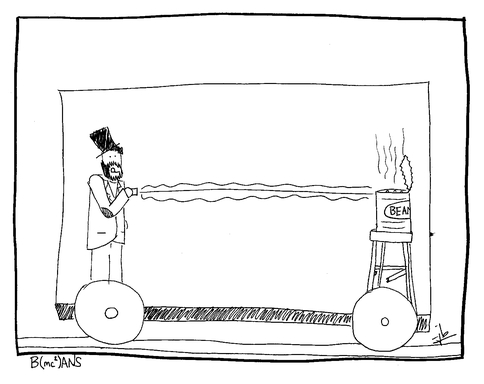
What about Patches? He will, presumably, measure the same amount of time for the light pulse to reach the detector. However, according to him, the light doesn’t have to travel as far to get there, so he should measure the speed of the pulse to be faster than c. In fact, common sense tells us that he should measure the pulse to be moving at c + 15 mph. Earlier we said that Einstein assumed that the speed of light is constant for all observers, but by our reasoning the beam doesn’t appear to be constant. Not constant at all! Could the great Einstein be wrong?9
Fifteen pages into the book, and we’ve already broken the laws of physics. We couldn’t be any more embarrassed if we showed up to a party wearing the same dress as the hostess. It looks like we just blew it. If only there were some obsessive scientist we could look to, some concrete example to revalidate the concept of c as a constant.
We just so happen to have such a scientist. His name was Albert Michelson, and he loved light in a way that today might be characterized as “driving” or “unhealthy.” His scientific career began in 1881, after he left the navy to pursue science. He measured light independently for a while, doing gigs in Berlin, Potsdam, and Canada, until he met Edward Morley. They worked together to produce ever more elaborate devices for measuring the speed of light, eventually reaching number 1 with “Bridge over Troubled Water,” which stayed at the top of the charts for six straight weeks.
The devices they constructed worked on the following basic premise: since Earth travels around the Sun once a year, relative to the sun their lab should travel at different speeds and in different directions at different times of year. Michelson’s “interferometer” was designed to measure whether the speed of light was different when moving in different directions. Your basic intuition should tell you that as Earth moves toward or away from the Sun, the measured value of c should change.
Your intuition is wrong. In experiment after experiment, Michelson and Morley showed that no matter what the direction of motion, the speed of light was the same everywhere.
As of 1887, this was a pretty big conundrum, and it defied the senses because this only seems to work for light. If you found yourself on a bike, face-to-face with an angry cow, it would make all the difference in the world whether you rode toward or away from the charging animal. Whether you run toward or away from a light source, on the other hand, c is c.
Putting it even more bluntly (on the off chance that the strangeness of this still isn’t clear), if you were to shine a laser pointer at a high-tech measuring device, then you would measure the photons (light particles) coming out of the laser pointer at about 300 million meters per second. If you were in a glass spaceship traveling away from a laser at half the speed of light (150 million meters per second) and someone fired the laser beam through your ship to a detector, you would still measure the beam to be traveling at the speed of light.
How is that even remotely possible?
To explain this, we need to take a closer look at a hero of physics, the “Light”-Weight Champion10 of the World: Albert Einstein.
How fast does a light beam go if you’re running beside it?
When Einstein first proposed his principle of special relativity in 1905, he made two very simple assumptions:
1. Just like Galileo, he assumed that if you were traveling at constant speed and direction, you could do any experiment you like and the results would be indistinguishable from doing the same experiment in a stationary position.
(Well, sort of. Our lawyers advise us to point out that gravity accelerates things, and special relativity relies on there being no accelerations at all. There are corrections that will take gravity into account, but we can safely ignore them in this case. The correction required for the force of gravity on Earth is very, very small compared to the correction near the edge of a black hole.)
2. Unlike Newton, Einstein assumed that all observers measure the same speed of light through empty space, regardless of whether they are moving.
In our hobo example, Rusty threw his bindle and measured the speed by dividing the length of the car by the time the bindle took to hit the side. Patches sat by the side of the tracks and watched the train and bindle speed by, and therefore saw the bindle move farther (across the car and across the ground the car covered) in the same amount of time. He saw the bindle move faster than Rusty did.
But now consider the same case with a laser pointer. If Einstein was right (and Michelson and Morley’s experiment demonstrated, almost two decades earlier, that he was) then Rusty should measure the laser moving at c and Patches should measure the same exact speed.
Most physicists believe that c is a constant without batting an eye-lash, and use it to their collective advantage. As a form of exploitation, they frequently express distances in terms of the distance light can travel in a particular amount of time. For example, “light-seconds” are approximately 186,000 miles, or about half the distance to the Moon. Naturally, it takes light 1 second to travel 1 light-second. Astronomers more commonly use the unit “light-year,” which is about 6 trillion miles—about a quarter the distance to the nearest star outside our solar system.
So let’s make our previous example a little weirder and give our hobo-physicist an intergalactic freight car. It’s 1 light-second long, and while Rusty has more space than he will ever need to stretch out and nap, he has the perfect amount of space to run his laser experiment again. He fires off the laser from the back of the train and, by his reckoning, the laser takes 1 second to traverse the train. It must, after all, because light travels at the speed of light (duh!).
But Patches watches the light beam on the moving train and says (correctly) that while the beam was traveling, the front of the train moved farther ahead, and therefore, according to Patches, the beam traveled farther than measured by Rusty’s reckoning. In fact, he finds that the beam travels a total of 1.5 light-seconds. Since light must still travel at the speed of light, Patches will find that it takes the light pulse 1.5 seconds to go from the laser to the target.
Let’s be clear: Rusty says a particular series of events (the pulse being shot and then hitting the target) takes 1 second, and Patches says that the same series of events takes longer. Both have perfect working watches that were built at the same intergalactic hobo-physicist depot. Both made excellent measurements. Who’s right?
They both are. 11
No, really. If the speed of light is the same for both Rusty and Patches, then Patches must interpret what he sees by saying that his own clock must be fast—or Rusty’s clock was running slow. The weirdest part is that this is true of every clock in Rusty’s train. He sees pendulums swinging slowly, wall clocks ticking slowly, and even (if he had the equipment to measure it) old Rusty’s heart pumping away more slowly than usual.
This is true in general. Whenever you see someone speed by you, their clocks will run more slowly as far as you’re concerned, but you don’t have a watch precise enough to show this. If you look overhead and see a plane flying by at about 600 mph, and somehow you had the keen eyesight to see the captain’s watch, you could see her clock running slower than yours—but only by 1 part in about 10 trillion! In other words, if the captain flew for 100 years, by the end of that period, she would have escaped from almost an entire second’s worth of aging. So even though this effect (called “time dilation”) is always in force, the fact is that you will never notice it in your everyday life.
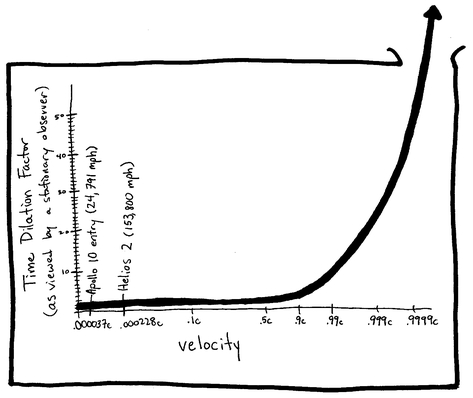
Time dilation really kicks in when you start going close to the speed of light. We’re not going to give you the exact equation, so you’ll have to take our word for it that we’re doing the calculations correctly. If the train were going half the speed of light, then for every second on Rusty’s clock, 1.15 seconds would pass on Patches’. At 90% the speed of light, for every one of Rusty’s seconds, Patches would measure 2.3 seconds. At 99% the speed of light, the ratio becomes 7:1. And as the speed gets closer and closer to c, the number gets bigger.12 The time dilation factor becomes infinite as the train gets to c—which is our first hint that you can’t actually move at the speed of light.
It’s not just time, either. Space behaves the same way. Let’s imagine that Rusty is ramblin’ on down the track toward a switching station at a sizable fraction of the speed of light. Let us also imagine that Patches is trying to sleep at the same switching station. Rusty covers the distance along the ground in a shorter amount of time by his own reckoning than by Patches’. Since they both agree that the train is approaching the station at the same speed, Rusty must think that the total distance to the station is shorter.
Time and space really are relative to your state of motion. This is not an optical illusion; it is not a psychological impression; it is actually how the universe works.
If you head off in a spaceship traveling at nearly the speed of light, what horrors await you when you return?
While this might seem like trifling over vague curiosity, scientists have figured out ways to exploit this phenomenon for more interesting study. As an example of the sort of grand pronouncements we can now make about the universe, consider the humble muon. Never heard of it? We don’t blame you. If you have a muon, then you’d better treasure your time together, because, on average, they last only about a millionth of a second (the time it takes a light beam to travel about half a mile, or the total duration of Vanilla Ice’s acting career) before they decay into something else entirely.
Between how they’re made and how long they stick around, there aren’t a heck of a lot of muons around. They primarily form when cosmic rays hit the upper atmosphere and create particles called pions (which are even shorter-lived) and then those pions decay into muons. This all happens about 10 miles out from the surface of Earth. Since nothing can travel faster than light, you might suppose that the farthest muons can travel before decaying is about half a mile and that none of the muons will reach the ground.
Once again, your intuition is not quite right.13 The muons have such high energy that many of them are moving 99.999% of the speed of light, which means that to us on the ground, the “clocks” inside the muons—the very things that tell them when to decay—are running slow by a factor of about 200 or so. Instead of going half a mile without decaying, they are able to go 100 miles before decaying, easily enough to reach the ground and then some.
Perhaps a scenario that will make a bit more sense involves the so-called twin paradox. There are twin sisters, Emily and Bonnie, who are thirty years old. Emily decides to set out for a distant star system, so she gets in her spaceship and flies out at 99% the speed of light. After a year, she gets a bit bored and lonely and returns to Earth, again at 99% of the speed of light.
But from Bonnie’s perspective, Emily’s clock—and watch, and heartbeat, and everything else—have been running slow. Emily hasn’t been gone for two years; she’s been gone for fourteen! This is true however you look at it. Bonnie will be forty-four; Emily will be thirty-two. You can even think of traveling close to the speed of light as a sort of time machine—except it only works going forward and not backward.
There are other, perhaps subtler effects as well. For example, since Emily was traveling away from Earth for seven years (according to Bonnie) at nearly the speed of light, she must have gotten 7 light-years from Earth before turning tail and returning. This takes her most of the way to Wolf 359, the fifth-nearest star to our Sun. By Emily’s account, though, she knows that she can’t travel faster than light, so in her 1 year outbound, she’ll say that her distance traveled was only 99% of a light-year. In other words, while on her journey, she measures the distance between the Sun and Wolf 359 to be only about 1 light-year.
This effect is known as “length contraction.” Like with time dilation, length contraction isn’t just an optical illusion. While she is traveling at 99% the speed of light, Emily measures everything to be shrunk along her direction of motion by a factor of 7. Earth would appear squashed, and Bonnie would appear to be rail thin as well, but with her normal height and breadth.
Like with time dilation, we don’t notice this effect in everyday life. If our pilot friend took the time to look down from her plane, the streets below would seem slightly thinner than normal, but even flying at 600 mph, the difference amounts to about 0.04% the size of an atom. While relativity is useful for explaining bizarre and interesting high-speed phenomena, it is clear that it is a poor excuse for a healthy diet and exercise.
The time dilation and length contraction should be observed symmetrically when Bonnie is looking at Emily or Emily is looking at Bonnie. Here’s where the paradox comes in. When Emily steps off her ship back on Earth after traveling to Wolf 359 and back, everyone agrees that she’s aged only two years in the same time that Bonnie has aged fourteen. That is totally inconsistent with pretty much everything we just told you, because we immediately know that Emily was the one who “moved” and not Bonnie, and the first rule was that you could never tell who was moving and who was sitting still. So how do we resolve it?
There is one rule we gave you early on that tells you whether special relativity is the law of the land—for special relativity to work, you need to be moving at constant speed and direction. And to move things along, we’ll tell you that Emily certainly wasn’t. She had to launch her ship to get off Earth and get up to speed (during which she felt a tremendous force of acceleration), she needed to decelerate and reverse direction when she reached Wolf 359, and then she needed to slow down to land when she got back to Earth.
With all of those accelerations, all bets are off, and we need a much more complicated theory to describe everything. To put things in a bit of historical perspective, Einstein came up with his theory of special relativity (no accelerations) in 1905, and didn’t get the theory of general relativity right (which includes gravity and other forms of acceleration) until 1916.
Can you reach the speed of light (and look at yourself in a mirror)?
We’ve taken a heck of a digression from our original question, and that’s a shame, because it’s a good question—so good, in fact, that it’s the very one Einstein asked himself. You may feel, however, that we’re no closer to answering the question than we were before.
Au contraire!14
Our answer will actually have two parts, and one of them you’re already prepared to answer (and have been for some time). Think back about old Rusty in his train. Now imagine that Rusty’s train is traveling at 90% of the speed of light (or any other speed you like). Rusty, however, is unaware of anything around him because he’s too busy preening for his date with Hambone Lil. As Rusty gazes into the reflection of his handsome mug, does he see anything amiss? He does not. Since there are no windows in his boxcar, and he’s moving on straight, smooth track, there is no experiment he can do that shows he is moving rather than sitting still. As long as the mirror is moving with Rusty, he looks the exact same as he would were he not on the train.
All of this is fine and good if Rusty is traveling slower than light, but what if he’s traveling at the speed of light? We know, we know, we’ve said that nothing can travel at the speed of light, so perhaps you’ll be inclined to just take that at face value. But why should you?
We can illustrate. Patches, jealous of Rusty’s success with the ladies, watches Rusty prepare for his date. Of course, he has to pay very keen attention, as Rusty’s train is speeding by at 90% of the speed of light. Tragedy strikes for Rusty, who gets a call from Lil, who is phoning to cancel. She lets him down easy, but Rusty is still upset, and thus picks up his still-warm can of beans and hurls it toward the front wall at 90% the speed of light (as seen by him).
Patches may be overcome with schadenfreude, but he’s not too distracted to note how fast the can of beans is flying from his own perspective. Now, in his own naive youth, he might have assumed that the beans were moving at 1.8c—the speed of the train (0.9c) plus the speed of the beans within the train (0.9c). But he has long since left behind that sort of foolishness.
Remember the two facts:
1. He sees Rusty’s clock running slow (in this case, by a factor of 2.3).
2. He sees Rusty’s train compressed (again, in this case, by a factor of 2.3).
The details obviously don’t matter too much, but the important thing is that according to Patches:
1. The beans take a far longer time to go from Rusty’s hand to splattering against the wall than Rusty says they do.
2. The beans don’t travel nearly as far as Rusty says they do.
The point is that the beans are going far slower than our (and Patches’) original naive estimate. Instead of 1.8c, the beans are moving a paltry 99.44% the speed of light.
We could keep playing this game indefinitely. For example, imagine that there was an ant sitting on the can. The ant had big plans with the queen of his colony until she called to inform him that she had to stay in to clean her thorax. In anger, he threw a crumb of food at 0.9c (from his perspective) toward the front of the train. Patches, with his unbelievably keen eyesight, would see the crumb moving at 99.97% of the speed of light.
And if on the crumb there lived an amoeba who, reproducing asexually, stood itself up for a date ... you get the picture.
No matter how hard we try, no matter how many boosts we give to something, we can’t ever get it going up to the speed of light. It just gets closer and closer and closer.
It also requires more and more work to get things moving faster as it gets closer and closer to the speed of light. It seems that it would take twice the work to get something moving at 99% of the speed of light compared to 50% of the speed of light; in fact, it takes more than six times as much work. And it takes more than three times as much work to get up to 99.9% of the speed of light from only 99%.
So now we can work up to the question posed by sixteen-year-old Einstein15: What happens if you travel at 99% of the speed of light and look at yourself in a mirror? Nothing, or at least nothing unusual. Your spaceship looks normal; your internal clocks seem to run normally. Your mug looks exactly as it always has. The only thing that you might notice is that your friends back at home see their hearts, clocks, cheese-cake calendars, and every other assorted timepiece running about seven times slower than they should. Also, for some reason, they appear to be smooshed by the same factor.
We could take it a step further and ask if anything appears amiss to someone looking in the mirror and traveling at 99.9% of the speed of light. The time dilation and length-contraction numbers are a bit bigger (a factor of 22 rather than 7), but otherwise everything’s the same.
The problem here is that each of these speeds, while very, very close, is still less than the speed of light. Every tiny incremental speedup requires more and more energy, but to actually get up to c would require an infinite amount of energy. Not very big, mind you. Infinite.
Perhaps you’re not satisfied with that. If you could somehow go at the speed of light (never mind that it’s impossible), the light from your face could never reach the mirror, and therefore, much like a vampire, you wouldn’t be able to see your reflection. But wait! The very fact that you wouldn’t see a reflection would make it immediately obvious to you that you were going at the speed of light. But since we’ve already determined that nobody can ever tell that they are the ones in motion, this proves that you cannot get up to the speed of light.
Isn’t relativity supposed to be about turning atoms into limitless power?
All of this about clocks and meter sticks and the speed of light may be interesting enough in their own right, but they’re probably not the first things you think of when (and if) you think about relativity. You almost certainly think about the most famous equation in all of physics (and the only one we’re going to write out explicitly in this book):
Writing it out is simple enough, and by now you’re even familiar with one of the terms in the equation: c, the speed of light.
The E on the left stands for energy, and in a moment we’ll talk about how energy enters into it, but for now we’re going to focus on the other term, m, which stands for mass.
You may think of mass as a measure of the “bigness” of a thing, but to a physicist mass is simply how hard it is to get something moving and how hard it is to stop it once it’s moving. It’s far easier to stop Rusty when he’s running at you at 10 mph than it would be to stop his train moving at the same speed.
But we’ve already noticed something interesting about the effective mass of, in our case, a can of beans. We found that as the speed of the can of beans gets higher and higher, it requires more and more work to speed it up even a little bit. In other words, the beans and the can act as if they are getting more and more massive (that is, harder and harder to move). And, as we already observed, if the speed of the can gets arbitrarily close to the speed of light, eventually you need to do an infinite amount of work to speed the can up at all.
Put another way, as the energy of motion increases, the inertial mass seems to increase as well; that is to say, the can does not acquire more matter, but it behaves as if it does. But even if the speed of the can goes down to zero—which is to say that there is no energy of motion—the inertia of the can doesn’t go away. If the can and the beans are completely stationary, they have a certain amount of energy, a sort of minimum inertial mass. The inertial mass can only increase from here as energy is added.
Einstein’s famous equation is really a conversion formula between mass and energy.
The formula has a plethora of interesting applications, and we quite literally see the repercussions of it every second of every day of our lives in the radiation from the Sun. Even with the seemingly successful application of Einstein’s theory, though, there has been an incredible impact on popular perception, especially by those who do not understand it.
As a working scientist, one of your esteemed narrators (Goldberg) frequently gets manuscripts from people with claims that they have a theory that will overturn the existing paradigm of science as we know it, and nine times out of ten, the central thesis of their argument is that Einstein’s great equation was wrong, that there was some flaw in his reasoning, or that the math simply admits of an alternative explanation. This phenomenon is so pervasive (and ongoing) that a hundred years after Einstein first derived his equation, the NPR program This American Life did a story on a man who tried (unsuccessfully) to show that “E does not equal mc squared.”
Why does this fascination with a simple conversion exist? In part, it’s because the equation looks so simple. There are no unfamiliar symbols, and most people have a working understanding of all of the terms in the equation. And in a real respect, the equation is simple. It’s a way of saying, “I’d like to trade in my stuff for energy. What’ll you give me for it?”
The answer is “rather a lot.” The reason is that we’ve already established that c is a big number, and we multiply the mass by the square of c in order to calculate the energy released.
We’ll start small. Let’s say that you have about 2 grams of boomonium, a substance we just invented just so we could use the name. The amount you have is about the mass of a penny, and you somehow manage to convert it all to energy. Were this possible—and we assure you it is not—you’d get out about 180 trillion joules of energy. Don’t have an intuitive feel for how much that is? No problem. With the energy released you could:
1. power more than fifty-thousand 100-watt lightbulbs for a year;
2. exceed the caloric energy consumption by the entire population of Terre Haute, Indiana (pop.: 57,259), for a year; or
3. equal the energy output of about five thousand tons of coal or about 1.4 million gallons of gasoline. Provided they carpooled, this would be enough to drive everyone in Terre Haute from New York to California. It is not clear, however, why you would want to do that.
By comparison, the normal combustion energy of 2 grams of coal can power one lightbulb for about an hour.
Emc2


