About the Book
A nation divided.
England is at war with itself. King Charles and Parliament each gather soldiers to their banners. Across the land men prepare to fight for their religious and political ideals. Civil war has begun.
A family ripped asunder.
The Rivers are landed gentry, and tradition dictates that their allegiance is to the King. Sir Francis’ loyalty to the crown and his desire to protect his family will test them all. As the men march to war, so the women are left to defend their home against a ruthless enemy. And as Edmund, the eldest of Sir Francis’ sons, will do his duty to his king, so his brother Tom will turn his back on all he once believed in...
A war that will change everything.
From the raising of the King’s Standard at Nottingham Castle to the butchery and blood of Edgehill, Edmund and Tom Rivers will each learn of honour, sacrifice, hatred and betrayal as they follow their chosen paths through this most savage of wars.
Contents
Cover
About the Book
Title Page
Dedication
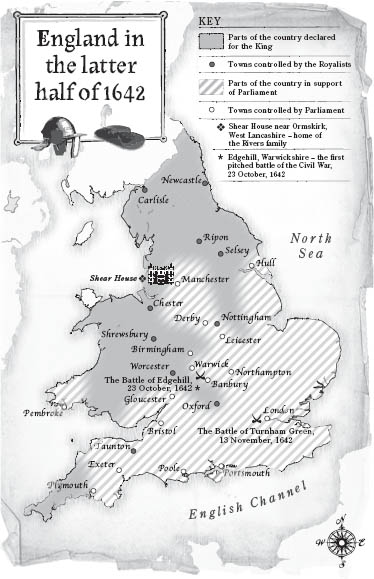
Map
Epigraph
Prologue
Chapter One
Chapter Two
Chapter Three
Chapter Four
Chapter Five
Chapter Six
Chapter Seven
Chapter Eight
Chapter Nine
Chapter Ten
Chapter Eleven
Chapter Twelve
Chapter Thirteen
Chapter Fourteen
Chapter Fifteen
Chapter Sixteen
Chapter Seventeen
Chapter Eighteen
Chapter Nineteen
Chapter Twenty
Chapter Twenty-One
Chapter Twenty-Two
Chapter Twenty-Three
Chapter Twenty-Four
Chapter Twenty-Five
Chapter Twenty-Six
Chapter Twenty-Seven
Chapter Twenty-Eight
Chapter Twenty-Nine
Chapter Thirty
Chapter Thirty-One
Chapter Thirty-Two
Author’s Note
About the Author
Also by Giles Kristian
Copyright
THE
BLEEDING
LAND
For James, this tale of brothers
‘That country is in a most pitiful condition, no corner of it free from the evils of a cruel war. Every shire, every city, many families, divided in this quarrel; much blood and universal spoil made by both where they prevail.’
Robert Baillie, 1643
PROLOGUE

Sunday, 23rd October 1642, Edgehill
IF HE CLOSED his eyes Mun could almost convince himself that the great booms were peals of thunder rending the grey October sky. But for the screams. Men did not scream and shriek and wail at thunder, though they did when twelve-pound iron balls ripped off their limbs, smearing the air crimson and leaving splintered bone and mangled flesh in their wake. They screamed then and it was a sound from Purgatory itself; tormented, agonized and hopeless.
Horses whinnied, stamped and snorted, steam rising from their flanks to thicken the fug of men’s breath and stinking fear that hung above them all like a veil through which God could not see. Which was just as well, Mun thought, for murder was about to be done.
‘There, Hector, good boy. Steady, boy,’ he soothed, pushing against his stirrups to pat the stallion’s neck where the thick veins throbbed beneath the skin. Hector snorted gruffly in reply and Mun glanced into the throng of restless riders around him, judging his fear against theirs, for they were in the first line of the Royal Horse and it was nearly time. Surely.
For the best part of an hour the cannon had roared their defiance, the fury of each barrage like a bully’s bluster, hiding the fear and revulsion that really squirmed in men’s guts. For they must be terrified as I am, Mun thought, a shiver crawling up his spine at the sight of thousands of armed men in all their rebellious glory massed thick as briar at the far end of the ploughed field. And there are more of them than us. Damn them.
As for the Horse of the Royalist right wing, in which Mun waited like a man on his way to hang, it was said there were upwards of twelve hundred. Yet Mun felt as vulnerable as though he were naked. His skin crawled at the thought of flying lead being drawn to him like wasps to jam. His guts churned at the vision of wicked sharp pike blades gouging into his flesh. He knew, too, that the passage of so many horses would plough the field again, churn it to a killing quagmire.
And yet, when the order came he would ride at the enemy as though Satan were at his back.
He pulled all two-and-a-half feet of carbine round from where it hung suspended on his right side and checked it was at the half cock, the lead ball snug in the barrel, then made his eyes trace the swirling scrollwork in the polished beech stock. He tried to imagine the craftsman, quietly, carefully etching by candlelight long before this bitter trouble had come to the land. He wondered after the man from whose dead hands he had prised the gun following the fight at Powick, but then a horse screamed nearby, yanking him back to the present.
‘At my word we go like Hell’s hounds!’ Prince Rupert yelled, vigorously wheeling his mount round to face his men. He wore back-and breastplate over a long buff-coat. His scarlet sash and helmet plume matched the red and gold embroidered saddle cloth and the pistol holsters that lay in front of the fine leather boots that reached his thigh. His black mare tossed her head spiritedly, impatient to charge, but instead the Prince had her perform the Passage, lifting each diagonal pair of legs high off the ground and suspending them in a slow trot.
‘Damn beast looks like it’s dancing, not going into a fight,’ O’Brien growled on Mun’s right, leaning over in the saddle and spitting. ‘I’ll wager the Prince’s horse can fence like a bloody French gentleman too.’
Mun knew his father, a master of training and riding horses, a student of manège, would appreciate the horsemanship and he twisted in the saddle, looking for him amongst the three hundred men of the King’s Lifeguard whom the Prince had placed in the second line. But he could not see him and turned back.
‘A horse will do that for a prince,’ he said with a tight smile. In truth, he thought, a performance like that, with the big guns singing to the world, would impress anyone, even a man snagged by the fear of pissing down his own leg.
‘You will keep your ranks and let the rebels see your blades!’ the Prince hollered, then drew his own sword, which gleamed dully, and held it aloft like a challenge to the heavens. He clung on with one hand as his horse neighed and reared, pawing the air before stamping down and blowing fiercely. ‘You will not give fire until we are amongst the enemy man to man.’ He grinned and his mare bared her teeth, foaming spittle flecking at the bit. ‘In their fright the rebels will give fire too soon, but we shall not. And that is how we will beat them.’
Men cheered and the Prince hauled on his reins and, still waving his sword, galloped along the line, his horse’s hooves flinging up great clods of earth as he went.
A foul taste, sour as vinegar, rose in Mun’s throat. Fear. He tried to spit but found he could not, for his mouth was dry as saltpetre. Beside him young Vincent Rowe looked as if he was about to vomit, his face ashen as the dead.
‘Lord, I am afraid,’ Mun muttered, feeling the words on his lips because he could not hear them above the cannon and the horses, the yells of officers and the flat beat of the drums, which had started up again. ‘We are all sinners. I more than most men. If I deserve thy retribution, be it a bloody end or maiming, then so be it. But I beg you, Lord. I ask only this. Preserve Tom and keep him from harm. Though we are enemies on this field, he is my brother.’ He grimaced because the prayer felt pathetic amongst that gathering maelstrom, like a moth in a rain-flayed, ball-jangling storm, and he suddenly thought he should check his pistols once more. Too late.
He sensed a tremor in the ranks, felt the whole right wing shudder and saw men craning, shifting in their saddles to get a glimpse of the Prince, who was walking his mare back along the line to the cheers of his men.
‘Just run, Hector, I’ll do the rest,’ Mun growled in the stallion’s ear.
‘For God and King Charles!’ the Prince roared, standing in the stirrups, and the words were echoed along the whole Royalist right wing as twelve hundred swords rasped up scabbard throats into the grey day.
‘For God and King Charles!’
And then the shouts were not words at all but the senseless clamour of men rousing themselves to butchery, yelling as though to defy the agony that was coming for them.
‘Keep him safe!’ Mun gnarred at the sky. ‘Just do what I have asked.’ Then he put his spur to the stallion’s flank and rode.
August 1632, Parbold, West Lancashire
The grass in Old Gore meadow had been left to grow long and would have reached the boys’ shoulders had they not been mounted. At the end of the summer it would be scythed and dried to provide winter fodder for livestock, but that was a lifetime away. For now it was a wilderness and the Rivers boys were hunting Spaniards.
‘Let’s go into Gerard’s Wood,’ Tom piped. ‘If I were a Spaniard that’s where I’d hide out and plot against the King.’ His voice was reed-thin and years from breaking, but the challenge in it was clear as spring water and Mun felt his lip curl.
‘It is getting late,’ he said, glancing up at the darkening sky. It was stained red, as though the heavens were on fire, and Mun reckoned it would be a fine day tomorrow. ‘You know how Father gets when we keep the horses out past dark,’ he muttered. It was true that Sir Francis had only recently scolded them for riding at night, saying that it was all too easy for a horse to injure itself on uneven ground and go lame. Next day, however, and with the boys still numb from their father’s wrath, their mother had confided that Sir Francis had been worried for their safety rather than the horses’. There were Godless men and cut-throats abroad after dark.
‘But it is not yet dark,’ Tom said now through a wicked smile. ‘Besides, Father is in London.’
‘Maybe tomorrow,’ Mun said, tugging the reins to wheel his mount round towards the stream that would lead them south-west and home. Being eleven and the elder by three years, Mun knew he would bear the greater part of the punishment if they stayed out after dark. Their father’s riding crop left angry welts that smarted for days after.
‘You’re not scared are you, Edmund?’ Tom needled, weighting his brother’s full name the way their mother did when they were in company and Lady Mary was painting a bonny picture of her polite, darling young men. Mun bristled, twisting in the saddle and wrapping his tongue round a grown man’s curse. But the words were scattered in a gust and lost as Tom kicked his heels and galloped off through the long grass, sending a kestrel careening up from its kill, crying shrilly at the dusk.
Mun grimaced at the thought of a dozen burning weals peppered up the backs of his legs, then flicked his reins, cursed again and raced after his brother.
Once across the shifting green sea of Old Gore meadow Tom followed the ancient sheep path past clutters of boulders and a few stag-headed Scots pines all cloaked in pale green lichen. It was dusk proper now, the sun having all but sunk far beyond the Irish Sea and the western edge of the world. Over the centuries countless sharp-footed herds had dragged up stones from the soil, so that even Tom slowed his mount to a walk now to lessen the risk of injury. He could smell the woodland beyond the rise – musky, green, rich and damp – and after a little further he wheeled his bay north across a dense scrub of nettles and onto a ridge thronged with bright yellow St John’s wort, where he waited for Mun. He had known Mun would follow him. For all his brother’s high-mindedness – born of the responsibilities that attended being the eldest – Tom knew that Mun too loved nothing better than galloping across the countryside to fight the imaginary enemies of the King. England needed brave warriors, men who could fight and ride and who feared nothing. What were some hard words and a few lashes of their father’s crop compared with the defence of the kingdom?
‘I expect we will miss supper,’ Mun moaned, catching his breath as he came alongside Tom, who was leaning forward letting his bay crop the yellow flowers.
‘Maybe Bess will save us some,’ Tom suggested hopefully, suddenly realizing how hungry he was. They had not eaten since waking and nothing whetted the appetite like fighting Spaniards.
A sound brought both boys’ heads whipping up. ‘Did you hear that?’ Tom gasped.
‘It came from the woods,’ Mun said, nodding towards the mass of beech and oak that sprawled before them, at once both inviting and forbidding.
‘Sounded like a girl,’ Tom piped, blue eyes wide as he stared towards Gerard’s Wood. Sir Gerard had been dead for twenty years and in the absence of an heir the land had gone to the Church, but folk still knew the swath of broadleaf forest as Gerard’s Wood. It was a no man’s land, a place in which children highborn and low wiled away the summer days confined only by their imaginations.
Mun clicked his tongue and his horse started forward. ‘Is your powder dry?’ he asked, mimicking the austerity of some of his father’s stiff-necked friends who were veterans of the Dutch wars.
Tom clutched at an invisible flask hanging from an invisible bandolier. ‘Dry as bone dust, sir!’ he snapped with a nod.
‘Good man. Then let us round up these Spanish curs.’ Mun started down the flower-bright ridge and across another clump of nettles. A flutter of swallowtail butterflies scattered chaotically and Tom grasped for one but missed. ‘Don’t give fire until my word, you hear?’ Mun ordered, looking straight ahead as they passed the first trunks and entered the forest. Again Tom nodded, clenching his jaw and easing his horse on with a stab of heels.
The last shafts of golden dusk light arrowed eastwards through the trees and all around them leaves rattled one against another in the breeze. Tom shivered with the thrill of the hunt and the bay, sensing its rider’s excitement, whickered, the sound stifled by the dense cluster of undergrowth. Deeper they delved, through corridors and passageways, across glades and clearings and babbling streams. The forest grew so thick that any sense of direction came only from the nature of the slope. Here, where the evening breeze could not penetrate, the only sounds were the clinks of their own tack, the occasional snort of a horse, and the creaks of boughs rubbing against each other, stretching, twisting as they had over centuries. Until—
‘I heard it again,’ Mun hissed. ‘Over that way.’ He pointed towards a stand of beech marked with a clear browse line some six feet off the ground where deer had eaten the twigs and branches as high as they could reach. Nearby, an ancient holm had been savaged into contorted, outlandish shapes. ‘We should ride home,’ Mun said, though he was leaning towards the sound, ears straining. ‘What do you say? Shall we go back?’ He twisted in the saddle now and glared at his younger brother.
Tom shook his head, his blue eyes wide and his imaginary carbine still in his right hand. Mun nodded and, clicking his tongue, moved off in the direction from which the noise had come.
Someone was shouting now, cursing in a tone barbed and malicious. Someone else was laughing and then the boys heard the girl’s voice again, just as they pushed their horses between a holly briar and a dead beech standing in ruins and perforated by generations of woodpeckers.
‘What in Jesu’s name do we have here?’ a skinny, ashen-pale boy of about sixteen said, brandishing a gnarled lump of oak towards the mounted intruders.
Mun took in the scene: three boys, all with sticks, all bigger and older than he. In the middle of them was Zachariah the cripple. Zachariah’s nose was bleeding and his breeches and hempen doublet were filthy and bloodied. And there, standing just behind the ashen-faced boy, her hands to her mouth, eyes round with fear, was Martha Green.
‘What offence has he done you?’ Mun asked Henry Denton, the boy he knew the best of the three. It was nothing he had not seen before – Zachariah’s twisted foot invited the worst cruelty boys were capable of and though Mun had never beaten the boy himself, he had never defended him either.
‘Little boys should be in bed,’ Henry Denton spat, pointing a stubby finger up at Mun. A stocky youth, Henry Denton was handsome, but a mop of fair hair, clear skin, ruddy good looks and a rich father had made him arrogant too. At least, that’s what Mun had heard his mother say.
‘Everyone is little compared with you, you fat toad,’ Tom said from Mun’s left.
‘Hold your tongue!’ Mun snapped at his brother, keeping his eyes on Henry who was staring balefully at Tom, his lips twisted in a grimace.
‘Thomas, isn’t it?’ Henry said, tilting his head to one side. ‘Does your wet-nurse know you are out?’ The other two boys laughed and Tom glowered, looking to his elder brother to do something. Anything.
But Mun sat his horse like a statue, legs gripping like a vice, holding the beast still as it snorted and dragged a foot across the ground. Henry shrugged broad shoulders and turned, nodding to his pale, reed-thin companion, who slammed his club between Zachariah’s shoulder blades knocking him to the ground. Martha Green screamed and stepped forward but Henry snarled at her to stay back. ‘Leave him be, whore!’ he said and even the boy with the oak club seemed shocked at that word. The third boy, a fat bully with a face full of pimples, merely grinned, spitting on Zachariah and threatening another blow, so that the cripple dared not rise again. He lay there, face in the forest litter, ruined leg trembling and, Mun noticed, wet.
‘You are evil!’ Martha cried, her green eyes blazing, finger pointing. ‘God will punish you, Henry Denton. He’ll punish you all!’
‘You think God cares about one of His mistakes?’ Henry asked, lips warping into a smile. ‘Why do you care, anyway, whore? What’s this cripple to you? Surely he can’t screw. He can barely walk!’
‘Shut your mouth!’ Martha screamed, tears in her eyes.
‘Mun,’ Tom hissed. ‘Edmund.’ But Mun was staring at Henry.
‘Hobbes, have you got a halfpenny?’ Henry asked the pale, skinny boy. ‘They say Martha Green will open her legs for a farthing, but seeing as there are three of us, I’d happily stretch to the price of a quart of good ale.’
Without thinking what he was doing Mun dismounted, taking the reins in his right hand and offering them up to Tom, whose eyes were round as coins in a bone-white face.
‘Ride home, Tom,’ Mun said calmly. ‘I’ll be along.’
Tom shook his head, glancing at Martha Green whom he thought the most beautiful girl he had ever seen.
‘Do as I say or I’ll take Father’s crop to you myself,’ Mun threatened, thrusting his mount’s reins into his brother’s hand. Tom hesitated a moment, then turned his horse and led Mun’s from the clearing, half twisting his neck off his shoulders as he went.
‘You mean to fight us, Mun?’ Henry asked and, grinning, threw his two foot of beech to the ground.
‘They’ll kill you, Mun,’ Martha warned, hands clasped as Henry’s cronies came and stood behind their leader, one at each shoulder.
‘I would rather be dead than a coward,’ Mun said, pleased with the way it sounded, though he was terrified enough that his whole body had begun to tremble.
He did not even see the first blow. It crashed against his ear in a burst of white-hot pain, sending him staggering, but before he could fall more blows were raining down, scuffing across his head and shoulders. Mun threw his forearms up, trying to protect his face, but he could do nothing about the kicks that were gouging into his shins and larruping the muscles of his thighs. He was aware of Martha screaming and Henry yelling curses, some of which Mun had never heard before, but mostly he was aware of terrible pain coming from all parts of his body at once. He was certain that one of the boys still had a club and he desperately hoped that the boy would not strike his head, for surely he must know you could kill a man like that.
Then he threw his fists forward, feeling the left one crunch against a nose. A boy yelped and Mun gouged at an eye but then his right leg buckled and he fell to one knee, tasting blood and fearing that they would not stop until he was dead. Another cry, this from Henry Denton perhaps, and then Henry was holding his head and yelling and there was blood between his fingers. Mun called out, blood flying from his lips, his ears ringing so that all sound was muffled. Tom!
Tom was there, wielding his own stick, wild as a boar, teeth bared. He struck Henry again but then the fat boy managed to grab the stick with both hands and yank it from Tom’s grasp, turning the weapon on his younger, smaller opponent with a glancing blow that sent Tom reeling.
Mun yelled and charged, half stumbling into the fat boy, knocking the wind from him and falling with him in a tangle of thrashing limbs, and now Martha was amongst the fray too, screaming and clawing at the older boys like a bird of prey.
As suddenly as it had started it was all over. Mun sat against the trunk of an ancient oak watching in a daze a cloud of hornets and moths diving to feed off several glistening dribbles of sap leaking from the tree. This tree is slowly bleeding to death like me, he thought, feeling like a fallen hero, cuffing snot and blood from his nose and smearing it across his cheek. Nearby, little more than shadows in the half light, Martha was nursing Zachariah, who looked like the most wretched thing Mun had ever seen, but then Mun looked down at himself and was unimpressed with what he saw. His doublet was ripped and blood-spattered and his breeches were filthy. As for his face, it felt lumpy and puffed-up and he suspected only his mother would recognize him.
Tom entered the clearing leading both of their horses and wearing a smile. Apart from a slight limp and a sore-looking graze at his temple he appeared quite unhurt.
‘Well that put paid to them,’ Mun muttered, wincing from a dozen aches and cuts, for Henry Denton and his cronies had gone, vanished into the trees with the last of the daylight. Now the clearing was streaked with the tarnished silver light of a waxing moon. ‘We taught those villains a lesson they won’t forget,’ he added for Martha’s benefit. In truth Mun knew they had lost. He suspected that not even Henry Denton would stoop so low as to fight a girl and so it was more likely that Martha had saved them by joining the skirmish. She was the hero, he realized, though there was no need to say as much, especially as his split lip made talking smart like the devil.
‘We squashed that fat toad, didn’t we, Mun?’ Tom said, bringing the horses up to his brother, who rose on unsteady legs and began to brush himself down with his hands, wincing because his knuckles were grazed.
‘I told you to ride home, Tom,’ Mun said sternly. Zachariah was on his feet now and seemed mostly unhurt, though you wouldn’t know it from the way Martha was fussing round him.
‘You were outnumbered, Mun,’ Tom said, ‘and they had sticks.’ Then he smiled again, gingerly touching the bloody graze on his head. ‘And anyway, we’re brothers.’
Mun glanced at Zachariah again, knowing it would not be long before the poor boy took another beating. As for himself and Tom, they would receive one as soon as Sir Francis returned from London. That was as sure as night following day.
‘Tell them that we will see them home,’ he said, nodding towards Martha and Zachariah.
‘But we shall be home very late then,’ Tom said.
‘Yes, I know,’ Mun replied, patting his horse’s neck.
Tom grinned and limped across to the others and Mun felt his own lips curl, stretching the bloody split so that it stung awfully. It had been some fight after all and even though they had lost, their cuts and bruises the proof of that, they had stood together until their enemies had fled.
Because they were brothers.
CHAPTER ONE
November 1641, London
TOM RIVERS HAD spoken barely a word since breaking fast in the Ship Inn. There were too many questions; so much to say that he feared to start talking now would be to never stop. And so he kept his tongue still and let his eyes work, glutting themselves with each and every wonder they could cram in. And what a feast it was! At once wonderful and terrifying and like nothing they had ever known. Besides, though he was amongst more people than he had ever seen, he knew not one of them and did not imagine any would be the least bit interested in anything he had to say.
Standing on the south bank he stared through the drizzle across the Thames, taking in the sprawled mass of humanity cloaked in November grey before him. The western end of the city was topped by the great mass of St Paul’s Cathedral, seat of the bishop of London. Tom recalled his father telling him that the church had once boasted an enormous spire, but that had been destroyed by lightning some eighty years ago – a sure sign of the Almighty’s displeasure with the papists, Sir Francis had said ominously. To the east at the opposite end of the city stood the Tower, England’s fortress. Arsenal, prison, government storehouse, royal palace and site of the national mint, its sprawling complex was London’s most important centre of state. Cathedral and Tower dominated the city’s skyline, but it was what lay in between them that sent Tom’s mind reeling, filled his nose with its stench with every gust from across the river. Market areas, wharves, guildhalls, monuments, myriad church spires, houses, and the city gates were linked by a tangle of meandering streets all crammed with people. So many people!
Rag-and-bone men soliciting folks’ saleable waste, pedlars crying their wares, woodcutters offering their skills, food vendors transporting fresh victuals. Animals, too, choked the thoroughfares; draught horses drawing carts and coaches, riding horses carrying travellers and messengers, dogs, pigs and poultry running loose in the streets. Then there were the cattle and sheep that were daily driven into the city on their way to rich men’s tables. Along with the stench of people and manure, the hearth smoke slung in dirty brown clouds above the buildings added its muscle to this assault on Tom’s senses. It was a seething, reeking clutter, a scene of chaos that half intrigued and half terrified him, so that for now he was glad that the sluggish brown river lay as a barrier between him and it.
He took the wide-brimmed hat from his head and shook the water from it, watching a ship trawling for eels, pushing its way against the tide past the Old Swan inn and the Fishmongers’ Hall. The Thames was choked with all manner of craft, from the tall ships moored in the Pool of London before the yeomen warders of the Tower, to the rowboats, or wherries as he had heard men call them, and barges that ferried passengers hither and thither.
Yet Tom knew he must soon immerse himself in the flow of folk joining the southern end of London Bridge and make his way along that most important of arteries into the city’s beating heart, where he would meet his father and brother. He would leave Southwark behind, passing through Bridge Gate upon whose crown the heads of traitors were skewered as ghastly reminders of what awaited such men. To Tom such barbarity reinforced his image of London as a living thing, an anarchic beast to which sacrifices must be made if some semblance of civilization were to be maintained. Many of the heads were little more than skulls now in which not even the crows would be interested, scraps of leathery skin and wisps of hair stirring in the chill breeze. That morning, when Sir Francis and Mun had left their lodgings early to be about their business in the city, Tom had walked with them as far as the bridge, there telling them he would join them later after he had explored Southwark. But the heads on London Bridge had bound him for a while with their macabre allure. He had simply stared at them, even though he knew such fascination marked him clearly as a countryman. He had stared and wondered what kind of men they had been in life and what offence had led them to that bad end. He’d wondered too how it must feel to cut off another man’s head.
Now, peering up through the grey at the pale sun, rain falling softly on his face, Tom reckoned it was approaching midday. Time to cross the bridge then and walk the two miles upstream to Westminster, the other major suburb outside London proper and where, last morning, he had marvelled at the great buildings of Westminster Hall and the royal palace of Whitehall. His father and Mun would be expecting him, for as MP for Ormskirk Sir Francis had privileged access to Westminster Hall and had promised to show Tom its famous roof today, made, Mun had announced proudly, from six hundred and fifty tons of English oak. It irked Tom that his brother knew all these things before him, but that was ever likely, seeing as their father had taken Mun to London several times even before his elder son had become a resident of the Inns of Court.
An appreciation of the complexities of English law was an essential quality in any gentleman, even one owning but a modest acreage, their father had explained when it had been decided that Mun, just turned eighteen, would lodge in London for two years. But this was Tom’s first experience of the city and it had not proved disappointing. He drank it in like a parched man. Yet, for all its vibrancy and chaos it was a bitter draught, because Tom knew his fate lay in the Church, where order and hierarchy suppressed instinct and channelled impulse. Such was the lot of many second sons, he knew, young men who could not inherit their father’s wealth and power. Mun would get Shear House and its estate and the Church would get Tom. First, though, he would spend four years at Oxford with Homer, Aristotle, Ovid, Virgil and Cicero, honing his skills in grammar and logic, history and mathematics. He would gain the degree of Bachelor of Arts and perhaps even go on to achieve Master of Arts. But all that could wait. For now there was London.
Tom clinched the neck of his coat in a fist and tilted his hat against the rain before stepping back into the road. Then, avoiding two oxen driven by a young man whose face was a mass of pustules, he turned left and made his way towards the bridge.
‘How is the debate proceeding, Father?’ Tom asked, banging his slipware cup against his brother’s before downing a great wash of beer. Pushing through the sopping crowds thronging Westminster had been thirsty work. Sir Francis shook his head and put his own cup to his lips, sipping carefully. His face was gaunt and the reeking tallow candles of the Three Cranes only emphasized the dark pools under his eyes.
‘I cannot get a taste for beer,’ he said, dragging his hand across his lips, ‘I find it too bitter. Let me have my ale and all is well.’ Mun rolled his eyes and Tom grinned, drinking again. ‘I fear it has gone ill for the King,’ their father said, returning to the question and glancing round to make sure he was not overheard. The inn was glutted with drinkers, all types of men so it seemed, and though it thrummed with noise it paid to be discreet about matters to do with the great debate. The Three Cranes being so close to the corridors and alcoves of Westminster Hall, some of those enjoying wine and beer were, Tom knew, bound to be men involved with the Grand Remonstrance in one way or another. ‘It’s fair to say the Commons is split on the issue,’ Sir Francis went on, smoothing his short beard between ringed finger and thumb, ‘with many who find it abhorrent that at times like these we should arraign the King and, furthermore, accuse His Majesty of misrule.’ He frowned darkly. ‘It is preposterous.’
‘The Irish rebels must be rubbing their hands at the thought of us all at each other’s throats,’ Mun put in, shaking his head, so that a damp curl of fair hair fell across his right eye. He took a lump of cheese from the plate between them and bit into it.
‘Indeed they must,’ Sir Francis said. ‘But Pym is persuasive. And determined to boot. Neither does he lack for supporters. Unfortunately. Their strength grows daily and those that are against them begin to fear for themselves.’ He shook his head. ‘They are all too keen to drag old skeletons from their graves.’ At that Tom thought again of the heads spiked on London Bridge. ‘Pym would have us believe there are Jesuits lurking in every shadow, waiting behind every tree. The man is a fear-monger and the thing about fear, boys, is that it binds folk. Prevents a man from pursuing his hopes.’
‘But what if he’s right, Father, and the Catholics are preparing to strike?’ Mun asked, chewing. ‘You only have to look to Ireland. There is no smoke without fire. Don’t you always say as much?’
‘Aye, perhaps,’ Sir Francis admitted. ‘And yet, instead of rallying support and raising an army to retake Ireland we are railing against our king.’ He scowled as though hit by a foul odour. ‘There are those who love chaos. Who would turn the world upside down.’ Sir Francis leant closer to his sons, his face tired and drawn; a mask of sharp angles in the dim fug. ‘Remember this, boys, fear is the lengthened shadow of ignorance.’ He shook his head and grimaced. ‘And I am guilty enough. This night we have even stopped a motion that would have seen much-needed arms put in the hands of our brave and loyal men in Ireland.’
‘Poor bastards,’ Mun muttered, earning a reproving glance from their father. ‘As if it wasn’t bad enough them being sent there in the first place.’
Tom had heard it said that Protestants were being savaged in Ireland. Men were being butchered, women were being raped, and children were being skewered with pitchforks and roasted in flames. And fear and chaos, he knew, were very much like fire. They were flames that devoured and spread.
‘Aye,’ Sir Francis said again, nodding, ‘God save their souls.’ Mun mumbled a curse as Sir Francis sat back, picking up his cup again. ‘And damn Pym for that.’
‘If you are too tired, Father,’ Tom began, ‘we can see Westminster another day. I have already seen so much that I fear I shall not sleep for a week once we return home.’ He rubbed his knees, trying to rein in the grin that was running away with his lips. ‘Besides, Mother says these days your bones object to London’s streets and the flagstones of Westminster’s grand halls. She says this is a young man’s city.’
Sir Francis’s brows arched, bridging bewildered eyes, then he slammed his cup down. ‘Nonsense!’ he declared. ‘I have not begun to patch up this old body for Heaven yet, despite your mother’s . . . concerns. We shall go there this very moment. What say you, Edmund?’
Mun finished his own beer and belched into a fist. ‘Oh if we must,’ he conceded, though there was a half smile playing on his lips. ‘We cannot have these country folk being entirely ignorant of how the kingdom is run.’ He jabbed a finger at his younger brother. ‘So long as you get back to Parbold in time to plant the wheat before Martinmas. And we’ve hogs that need slaughtering before the snows. London is not for the likes of you, young Master Rivers,’ he mocked in a quavering voice, repeating the very words their parish churchwarden had used when Sir Francis had first made public his intention for Tom to take the cloth.
‘I’ll slaughter you if you don’t watch your tongue,’ Tom threatened, presenting his eating knife to his elder brother before stabbing a chunk of cheese with it. Several slices of cured meat lay untouched beside a pot of fruit preserve, but Tom was too excited to eat properly.
‘Father, isn’t it today that they shall present the Root and Branch again?’ Mun asked, thumbing towards the inn’s door, which yawned open, vomiting a crowd of drunken apprentices into the afternoon grey. Many such men had been given the day off in light of the furore that gripped the city.
‘Root and Branch?’ Tom said, feeling light-headed because the beer was strong, of the first water he guessed.
‘A petition that seeks the exclusion of the bishops and papists from the House of Lords,’ Sir Francis explained soberly. ‘Many would take it further still and have us rid of bishops altogether.’
Tom lifted his head, understanding. ‘On the way here I heard men protesting loud enough to wake the dead. Though I’ll be damned if I could fathom their grievance. Is London always like this?’
Sir Francis shook his head, teeth dragging a small portion of beard across his bottom lip. ‘Not like this,’ he said, sharing a knowing look with Mun. ‘There’s a storm brewing, boys, and someone ought to reef the sail before we are all drowned.’
‘No fear of drowning around here,’ Mun announced. ‘I am empty.’ He upended his cup, the last drops of beer spotting the rough wooden table. ‘Either we go now or I shall have another drink and be damned with Pym and Parliament and their squawking.’
‘Edmund!’ Sir Francis hissed, glancing around them. ‘Do not forget that I am a member of this Parliament you would damn for the sake of a pint of beer.’
Grinning, Tom wagged an admonishing finger at his brother who stood, snatching a last piece of cheese and wrapping it in a slice of ham.
‘Come, little brother,’ Mun said, producing a shilling from his doublet and slamming it down on the table, ‘let me show you where our father and the rest of them spend their days and nights bickering like children.’
Sir Francis sighed, Tom grinned, and the two of them followed Mun, whose broad shoulders cleaved a passage through the press towards the door.
Their father had smelt trouble in the air even before they had threaded their way amongst the crowds thronging the Palace of Westminster, through St Stephen’s Porch and into Westminster Hall. Mun had seen him hitch his cloak over the hilt of his rapier, seen his thumb rubbing the swell of the weapon’s fluted pommel as they walked, as though to gently wake the sword from its sleep. And though Sir Francis had told them that he expected quite a gathering for the Root and Branch petition, Mun got the impression that even he had been surprised by the multitude. He had said nothing though, and now Mun watched his eyes sift the assembly into types of fellows, that he might deduce what new grievances had bloomed into open protest. Everyone knew that as MP for Ormskirk Sir Francis Rivers felt it his duty to keep one ear to Westminster’s ancient flagstone floor, but now Mun suspected their father was beginning to think they should have left the city that very morning. For angry crowds of apprentices swarmed around Westminster, converging on Whitehall, and the whisper was that many amongst the nobility had already retreated to their estates. ‘Even the King has quit the city for Windsor,’ Sir Francis had said. A hot fever was taking a grip of London.
They moved with the tide as folk sought to get to the west end where, in the wash of grey afternoon light from the great arched window, a boisterous horde, their petition presented to a stern-looking official, had taken up a chant against Catholics and popery. The tumult rose, filling Mun’s head, weaving with a thousand other voices to cram the vast hall right up to the magnificent hammer-beamed oak roof.
Sir Francis removed his kidskin gloves and turned to Mun through the press, wincing against the din. ‘Where is Tom?’ he shouted. ‘I thought he was with us.’
Mun shrugged, craning his neck for any sign of his younger brother. The great hall was a seething mass of black coats and broad-brimmed hats that gave Mun the impression of a dark, tempestuous sea in which a man could be drowned if he did not keep his wits about him.
‘You know Tom, Father,’ he said through a smile, as though that was explanation enough, for amongst the Rivers family Tom was famous for having a wandering mind and the feet to match.
But Sir Francis shook his head, brows shadowing flinty eyes. ‘This is no time for your brother’s games. Find him, Edmund.’
Mun nodded and, hitching his cape back over the hilt of his own rapier, waded into the swell.
Tom had not yet set foot in Westminster Hall. Instead, he had let himself get snarled up amongst a knot of rabble-rousers and found himself more or less borne south along Margaret’s Street, past the sprawl of ancient chambers, parliament buildings and law courts, like a leaf on the wind. And a bitter wind, too. Several of this band, which was largely made up of apprentices by the looks of their close-shorn heads, eyed him suspiciously, which was hardly surprising, he supposed, given his fine clothes and long hair. One of the louder apprentices, a bullet-headed, stocky man, had even asked if he was a Catholic, to which Tom had replied that he most certainly was not, and this had seemed to satisfy the man, who had given an approving nod and resumed his raillery against papists. For the mob was angry. Many brandished cudgels or balled fists, though none of them so far had threatened Tom as they continued through the pervasive drizzle that thickened the air with the tang of wet wool. So, his heart hammering in his chest, Tom let them and his own curiosity lead where either would.
Which was past the building his father had earlier told him was the Court of Requests, then into the House of Lords chamber, where he was confronted by a wall of uproarious noise that took him aback, making his head spin. Three hundred or more souls, men and women both, had crammed into the chamber, all eager to get near the rails at the east end of the place where the business was being done. A poor view, it seemed, did nothing to blunt their passions and they bellowed, crowed and squawked, their voices making the loudest sound that Tom had ever heard. And yet he would not retreat, not until he had seen for himself the object of the crowd’s rage, and so he thrust himself into the maelstrom.
Being the son of a knight and looking like one too still had its advantages, he realized, even in a city where ‘the embers of reform’, as his father had put it, were beginning to glow, and men instinctively shuffled aside so that Tom was drawn inexorably through the clamorous, damp-smelling array and was soon spat out at the other side. Where he found himself face to face with a grim-looking soldier who hefted his halberd towards him in warning, the wicked-looking, rust-spotted blade gleaming dully in the candlelight. Tom showed his palms, a gesture that said he had no intention of coming any closer. And nor did he. Some of the soldiers were no older than he and nervous-looking, their eyes flicking across the boisterous throng, bloodless hands gripping their halberds a little too tightly. Glancing around, Tom saw scorn and malice twisting every face whether yeoman, journeyman, apprentice, or gentleman. To his right was a woman who had left her head uncovered to show off her elaborate coiffure; Tom suspected she was a beauty but could not be sure with her face warped by the squawking of obscenities that would make a sailor blush.
In sconces along the oak-panelled walls candles, whose wicks needed trimming, were failing against the dark and miserable afternoon, so that with all the people, smoke and noise, Tom was reminded of the rowdy gaming houses in the Bankside and Montague Close that Mun enjoyed telling him about.
A shoulder struck him square in the back, shoving him forward.
‘Stay back, sir!’ the soldier yelled and Tom replied that he would if only he could. Wearing an iron helmet and back-and breastplate over a thick buff-leather coat, the soldier was one of twelve tasked with keeping the crowd from encroaching on the Lords and the man before them: an old grey-bearded priest who Tom perceived was being accused of some crime, though he could not yet say what.
‘Who is he?’ he asked the soldier, but the man ignored him to glare threateningly – but do no more than that – at an apprentice who had spat a wad of phlegm at the priest. So Tom asked the same question of a man beside him whose face bore the pitted scars of the pox. Like many around him the man was smoking a pipe, its fumes thickening air already acrid with burning tallow, wet cloth and sweat.
‘He’s a Scot,’ the man spat, nodding towards the priest. ‘Name’s Robert Phillip. He’s the Queen’s confessor, a damned papist.’
Insults cut through the fug, most of them aimed at the elderly priest, but if they were arrows he was suited in plate armour and seemed oblivious of them.
‘This is all because he is a Catholic?’ Tom asked, staring at Phillip and straining to hear what the Speaker for the Lords was saying to him.
‘It is crime enough if you ask me,’ the pockmarked man said, eyebrows arched. Then he pointed the stem of his pipe at the priest. ‘But worse than that they say he’s the Pope’s bloody spy, sent here to spread his filth and pervert His Majesty.’
Tom watched Phillip’s lips move but could not hear his words, though whatever they were had the Lords scowling and shaking their heads. ‘He looks harmless enough,’ he said, wondering how the old man could remain so calm in this bubbling cauldron of hatred.
‘That’s what makes the bastard dangerous,’ his neighbour muttered through tight lips as he drew on his pipe. ‘His type are a bloody canker that needs cutting out for the sake of all God-fearing men. For the sake of the country.’
‘Bastard’s refusing to be sworn on our Bible!’ another man yelled, raising a chorus of jeers and taunts.
‘Hang ’im!’ a man yelled.
‘Aye, string the cur up!’ someone else bawled. The Speaker for the Lords, a fat man whose red face and sharp black beard glistened with sweat, turned to the throng, both hands raised in an appeal for quiet. Eventually the clamour died, leaving a few late-hurled curses hanging in the pungent air.
‘This man is accused of being an agent for the Pope,’ he said, ‘and of divers seditious and traitorous acts.’
‘Give him the whip!’ a woman shrieked.
‘Furthermore,’ the fat man went on, ‘he has before this assembly stated his refusal to recognize our Holy Bible.’ This provoked another storm and someone threw a fleshy bone, which struck Robert Phillip’s shoulder, though he barely flinched as his rheumy eyes glared at the crowd from beneath bushy, unkempt eyebrows.
The Speaker turned back to the Lords, seeming to seek a particular bishop’s approval to continue. The aquiline-faced bishop nodded sombrely, his eyes revealing nothing, and the fat man turned once more to the crowd.
‘Robert Phillip will be confined to the Tower,’ he announced, stirring a chorus of ayes from the Lords and inciting another two dozen opinions for and against the punishment as Tom was buffeted this way and that.
Now Robert Phillip’s face flushed as at last he lost a grip on the reins of his equanimity.
‘You dare not!’ he bellowed in a voice that surprised Tom, for it defied the priest’s apparent frailty. Men jeered at his outburst. ‘I am Her Majesty’s servant! I claim our queen’s protection!’
‘The Queen is a whore!’ someone yelled. Even the Lords were jeering now, some daring to voice their own opinions of their Catholic queen.
‘Take him away!’ the Speaker commanded the soldiers, and so they formed a guard of iron and steel in which they ensconced the priest that he might make the three miles to the Tower in one piece.
CHAPTER TWO
THE RAPIER WHISPERED up the scabbard’s throat, flashing in the dimly lit hall, and Mun looked along all three foot of slender blade at the man who had come at him with a dagger.
‘Stand off, sir!’ he said, at which his would-be attacker bared well-worn teeth and spat in disgust. Mun had not seen who had begun the trouble but none of that mattered now, for he was caught in the maw of it come what may.
‘You Roundhead dogs grow too bold!’ Thomas Lunsford roared at the growing mob that had forced Lunsford’s party and Mun and Sir Francis back into the hall’s north-east corner, by the stout door that led to the Receipt of the Exchequer. Being similarly attired to Lunsford’s men, Sir Francis and Mun had been lumped together with the objects of the mob’s wrath and now found themselves outnumbered five to one with the odds getting longer as more apprentices were drawn to the fray.
Having failed to find Tom, Mun had returned just as the one-eyed soldier had swaggered into Westminster Hall, threatening anyone who dared bawl against bishops. Mun had asked who the man was and his father had told him as they watched Lunsford’s men shoving their way through the protesters, their battle-scarred commander riding roughshod through an already volatile situation.
‘The King has made him Lieutenant of the Tower,’ Sir Francis had said, his tone betraying that even he thought that an odd appointment for a man of Lunsford’s dubious qualities. ‘That raised Cain in the Commons. Lunsford’s a hot-headed fool, a bully and a braggart. Look at him! He’s like a child poking a stick into a beehive.’
Many, including Members of the House and others whose curiosity had brought them to Westminster to witness the presentation of the Root and Branch, had slunk off as the mood darkened. Others, city apprentices mainly, who had heard that Lunsford was about the Hall making threats, had come to add their spleen to the growing discord. Any who had come looking for trouble had found it and now Mun and Sir Francis had their swords in their hands and their backs to the wall.