Contents
About the Authors
Preface
1 The Nature of Psychology
2 Psychology and Society
3 Psychology, Intelligence, and IQ
4 Psychology and Race
5 Psychology and Women
6 Beyond Nature Versus Nurture
7 Psychology in Service to the State
8 Ethical Standards in Psychology
9 Personality and Personality Tests
10 Psychology and Mental Health
11 Freud and Psychology
12 Parapsychology
13 Psychology in Everyday Life
14 Further Issues in Psychology
15 Psychology at Issue?
Selected Glossary
References
Index
Psychology in Social Context
This edition first published 2011
© 2011 Philip John Tyson, Dai Jones, and Jonathan Elcock
BPS Blackwell is an imprint of Blackwell Publishing, which was acquired by John Wiley & Sons in February 2007. Blackwell’s publishing program has been merged with Wiley’s global Scientific, Technical, and Medical business to form Wiley-Blackwell.
Registered Office
John Wiley & Sons Ltd, The Atrium, Southern Gate, Chichester, West Sussex, PO19 8SQ,
United Kingdom
Editorial Offices
350 Main Street, Malden, MA 02148-5020, USA
9600 Garsington Road, Oxford, OX4 2DQ, UK
The Atrium, Southern Gate, Chichester, West Sussex, PO19 8SQ, UK
For details of our global editorial offices, for customer services, and for information about how to apply for permission to reuse the copyright material in this book please see our website at www.wiley.com/wiley-blackwell.
The right of Philip John Tyson, Dai Jones, and Jonathan Elcock to be identified as the authors of this work has been asserted in accordance with the UK Copyright, Designs and Patents Act 1988.
All rights reserved. No part of this publication may be reproduced, stored in a retrieval system, or transmitted, in any form or by any means, electronic, mechanical, photocopying, recording or otherwise, except as permitted by the UK Copyright, Designs and Patents Act 1988, without the prior permission of the publisher.
Wiley also publishes its books in a variety of electronic formats. Some content that appears in print may not be available in electronic books.
Designations used by companies to distinguish their products are often claimed as trademarks. All brand names and product names used in this book are trade names, service marks, trademarks or registered trademarks of their respective owners. The publisher is not associated with any product or vendor mentioned in this book. This publication is designed to provide accurate and authoritative information in regard to the subject matter covered. It is sold on the understanding that the publisher is not engaged in rendering professional services. If professional advice or other expert assistance is required, the services of a competent professional should be sought.
Library of Congress Cataloging-in-Publication data is available for this publication
HB: 9781405168243
PB: 9781405168236
A catalogue record for this book is available from the British Library.
This book is published in the following electronic formats: ePDFs 9781444396225;
ePub 9781444396232
To Jacob, Christiana, Mona, Ken, and all the other Tysons
who've taken an interest in this project
Phil Tyson
To my mother with love
Dai Jones
To Kathleen May Elcock
Jonathan Elcock
About the Authors
Dr. Philip Tyson is an academic psychologist with a special interest in mental health, neuropsychology, and critical psychology. He did his undergraduate psychology degree at Middlesex University, then completed an MSc in cognitive neuropsychology at the University of Essex. He then moved to the University of Hull to study for his PhD. His thesis here investigated the cognitive effects of medication used to treat schizophrenia. He has worked at the University of Gloucestershire since 2003, where he pursues his joint passions of research and lecturing.
Dai Jones has been a lecturer in psychology at the University of Gloucestershire for 15 years, teaching in the areas of conceptual and historical psychology, cognitive psychology, and research methods. He is co-author (with Jonathan Elcock) of History and Theories of Psychology, and contributed four chapters on historical and conceptual issues to Davey’s Complete Psychology. He has been consulting editor for books on historical and conceptual issues in psychology for BPS Blackwell. His scholarly interests include history of psychology, psychology and social issues, psychological language, and e-pedagogy.
Jonathan Elcock is a senior lecturer at the University of Gloucestershire, where he has worked for 18 years. He has co-authored with Dai Jones Histories and Theories of Psychology, and has publications in human–computer interaction, research into cognitive problems in older adults diagnosed with dementia, and discourse analysis of rave culture. His current scholarly interests include historical and conceptual issues in psychology, and how psychology interacts with social class, gender, and sexuality.
Preface
Recent years have seen an increasing recognition of issues with psychology, and a growth in critical approaches to the discipline. However, existing texts in critical psychology are rather advanced for most readers. This book provides an accessible introduction to ideas in critical psychology, highlighting key debates about the assumptions, practices, and claims of the discipline. It takes a distinctive approach of considering historical controversies in psychology to show the ways in which psychology is embedded within particular sociohistorical contexts. Using a range of examples – including IQ measurement, gender, ethics in psychology, parapsychology, and the nature–nurture debate – we show that the discipline is shaped by the ways in which it interrelates with society, and that positions taken towards fundamental issues in psychology are reflections of that social context. The approach we take has a number of advantages over more conventional treatments of issues and debates in psychology, which discuss them in isolation and in quite abstract terms. Our approach allows us to provide concrete examples of the impact of these debates on psychological thought and practice. Our emphasis is on understanding issues in psychology in the context of wider psychological thought, and in the context of society. Thus, for example, bias is considered in talking about psychology’s dealings with gender and with race, and also in considering methodology; while the discussion of ethics considers how ethical standards are constructed by society, but are challenged by the demands of governments and other organizations. In addressing these debates, we develop a conceptual framework for understanding the nature of psychology as a reflexive human science.
The material covered in the book is intended to address the topic area of conceptual and historical issues in psychology, as outlined in the British Psychological Society’s syllabus requirements for accredited undergraduate courses in psychology, and in the UK Quality Assurance Agency for Higher Education’s subject benchmarks for psychology degrees. It shows how the lessons of history can inform understanding of contemporary psychology, and applies that understanding to issues such as the status of scientific psychology, reductionism, the nature–nurture debate, and ethics in psychology research and practice. A particular emphasis is placed on understanding the extent to which psychology is constructed within particular social and cultural contexts, and the ways in which psychological concerns are intertwined with political and moral concerns. The book presents an image of psychology as a distinctively human science that is shaped by, and in turn reflexively shapes, the sociohistorical contexts in which it develops.
The book will be useful for specific courses in conceptual and historical issues in psychology, and courses covering controversies in psychology. In addition, specific chapters of the book will be valuable for courses in other areas of psychology; for example, the chapter on intelligence will give useful background for courses on individual differences. The book is organized in such a way as to establish a broad framework for understanding issues in psychology, and to apply this framework to a range of controversies and debates. The framework is established in chapters 1 and 2, which introduce the notion of psychology as a reflexive discipline shaped by society; and chapters 14 and 15, which consider some fundamental issues before drawing conclusions about the nature of psychology. Other chapters consider specific issues, and are designed to be self-contained to a large extent. The intention is for the reader to be able to select from these chapters according to their own interests and needs. Because of this, there is sometimes a small degree of overlap between chapters, which provides multiple perspectives on particular topics.
Each chapter incorporates a number of pedagogical features to aid the reader. Chapters open with a brief introduction, which gives an overview of what the chapter will cover. Each chapter has a consistent structure with sections and subsections, and concludes with a summary. Box-outs are used to focus on specific examples or to suggest activities to advance learning. Chapters conclude with a set of self-test questions to test your understanding, and a set of thinking points to encourage the application of the ideas in the chapter to wider issues. Suggestions for further reading help you to pursue the topic in more depth. These features are intended in part to support the SQ3R reading method, a study skill strategy for improved comprehension and retention. The method has five steps, from which its acronym derives: survey, question, read, recite, and review. The survey stage involves forming an overview of the text: the chapter introductions and summaries, and the consistent structure of each chapter, are intended to facilitate this. The question stage involves developing a set of questions about the material, as a set of study goals, based on the initial survey. The self-test questions included with each chapter can be used directly for this purpose, and can inspire your own further questions. The read stage, as the name suggests, involves reading the target material and making notes as required. The recite stage involves recalling the material: after reading a section, try to remember the material, and to answer your set questions from memory. The review stage is an ongoing process where you look back over your notes on a regular basis, and check that you can still answer your questions.
A consistent theme throughout the book is that the work done by psychologists – the research they choose to conduct, and the interpretations they make – is informed by the pre-existing views of the psychologist. We shall see this, for example, in the work of the “scientific racists” in the early twentieth century, whose search for differences between racial groups was inspired and shaped by their pre-existing belief that those differences existed. This observation is, of course, as true for the authors of this book as for those the book discusses. It is reflected in the choice of material to include in the book, the ways in which we discuss the material, and the claims we make about the nature of psychology. It’s important, therefore, to know and consider our views when reading the text. We all describe ourselves as left of centre politically, and socially liberal, with a particular concern with equality and ethics. We openly acknowledge the influence of these views on the material we present, believing this to be a more honest approach than striving for unattainable objectivity. We attempt to be fair in our coverage of the material throughout the book, but it is impossible to adopt a truly objective stance. Indeed, we argue in the text that claims of objectivity are often used to obscure the subjectivity of those making the claim. Objectivity is often confused with neutrality – the attempt to give equal coverage to different sides in a debate. However, neutrality comes with its own problems. In particular, giving equal weight to competing views may have the effect of validating claims that are rightly seen as marginal; or, conversely, may lead to claims being seen as true solely because they’re believed by the majority of people, rather than because they provide the best explanation of a phenomenon. In this book, we give our own evaluation and interpretation of the material we present, because it’s impossible to do otherwise. However, we encourage you to consider this as one possible reading amongst many, and to perform your own interpretation in coming to your own position. We want to encourage you to think critically about the issues we address, and part of this entails evaluating the effect of our subjectivity on what we write, and the effect of your own subjectivity on what you believe.
We’d like to acknowledge a number of individuals without whom the book would never have been completed. Our thanks go to Andrew McAleer and Karen Shield from our publishers, for believing in the project and guiding it to fruition. We’d also like to thank our students for acting as guinea pigs for the ideas contained herein. Particular thanks go to Graham Richards for introducing us to a new way of thinking about the nature of psychology. The authors have been greatly influenced by Graham’s ideas, as may be reflected in the material that follows. The book is co-authored, and the named writers share responsibility for the content, including any errors and omissions. However, individual chapters have an identified lead author, reflecting his particular interests and expertise. Any queries about the content should be directed to the relevant named author in the first instance.
1
The Nature of Psychology
Contents
Learning Outcomes
Introduction
1.1 What Is Psychology?
Focus Box 1.1 Psychology and psychology
1.1.1 Popular views of psychology
Figure 1.1 The relationship between the discipline of psychology and its subject matter
1.1.2 Defining psychology
1.1.3 The emergence of psychology
1.1.4 Contemporary approaches to psychology
1.2 Psychology as Science
1.2.1 The appeal of science
1.2.2 The nature of science
1.3 Issues in scientific psychology
1.3.1 Issues in the quality of scientific psychology
1.3.2 Issues with bias in scientific psychology
1.4 Chapter Summary
Self-test Questions
Thinking Points
Further Reading
Learning Outcomes
When you’ve finished reading this chapter, you should be able to:
Introduction
This book introduces a range of issues and debates in psychology by looking at how psychology is actually done. We’ll look at several examples of how psychology has engaged with controversial social issues, and use these examples to highlight debates about the way in which psychology is conducted, presented, and understood. Along the way, we’ll see that the discipline of psychology is a socially embedded activity that uses a number of methods to produce knowledge about human nature and human behaviour. This activity is conducted by psychologists with multiple purposes behind what they do. This range of methods and purposes leads to psychology being a very diverse discipline, investigating every aspect of human life from a variety of perspectives (Richards, 2010). The result is that different kinds of psychology produce different kinds of knowledge about mental life and behaviour.
Although there is great diversity in the discipline, there is a standard view of psychology that is most commonly presented in popular writing, most often taught in institutions, and most frequently practised by researchers and practitioners. This view sees psychology as an objective science that uncovers the truth about human behaviour (Fox & Prilleltensky, 1997). Most kinds of psychology conform to this view to varying degrees, but there are some psychologists who have fundamental disagreements with it. Such psychologists describe themselves as critical psychologists, and emphasise the ways in which the discipline has particular relationships with its members, its host society, and its subject matter (Jones & Elcock, 2001).
In this book, we’ll consider some of the claims of critical psychologists by looking at examples of what psychology has done, and what it has claimed, from the past and present. In looking at these examples, we’ll consider why psychology has produced the knowledge that it has, and evaluate the extent to which the standard view of psychology is accurate, or the claims of critical psychologists are valid. Before we can do this, we need to describe the standard view of psychology more fully. We do that in this chapter. We start by considering what the discipline of psychology claims to be, and where it comes from, before looking at the range of theoretical approaches that psychologists adopt in trying to explain human behaviour. We’ll then look particularly at how scientific method can be applied to psychology, before considering some debates about whether such a scientific approach is appropriate.
1.1 What Is Psychology?
The term psychology is much used, but also much mis-used. Throughout this book, we will use the term to refer to the academic and professional discipline that investigates mental events and behaviour, and dysfunctions of these. There is a problem here, though, because those things the discipline investigates – mental health, behaviour, and so on – are also called psychology. So, psychology is the discipline that has as its subject matter psychology! Focus Box 1.1 discusses the relationship between the discipline and its subject matter in more depth.
Focus Box 1.1 Psychology and psychology
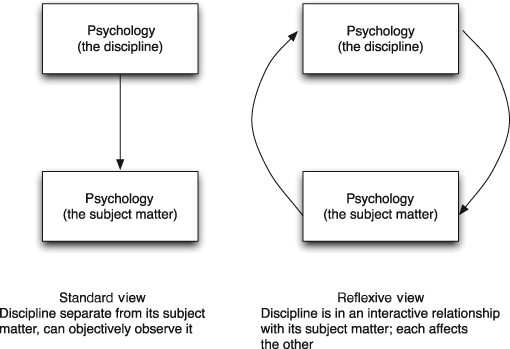
The term psychology can refer to a particular subject matter – mental states, behaviour, disorders, and the like – and to the academic and professional discipline that investigates that subject matter. This distinction between the discipline and its subject matter is important. The standard view of the discipline is that it is separate from its subject matter, and is able to objectively observe and theorise about it. So, just as a physicist can investigate gravity objectively, without affecting it, so can the psychologist investigate attitudes without affecting them. This view supports the use of the scientific method to investigate topics in psychology, just as it is used in natural sciences like physics.
An alternative view is that there isn’t a clear separation between the discipline of psychology and its subject matter. Rather, psychologists are influenced by their own psychological states in doing their work; and the work of psychologists influences people’s psychology, the subject matter of the discipline. We can say that there is a “reflexive” relationship between the discipline and its subject matter (Jones & Elcock, 2001), such that they affect each other interactively (see Figure 1.1). As an example, we’ll see in chapter 4 that psychologists have long investigated the question of whether different ethnic groups differ in ability, particularly regarding intelligence. Typically, those psychologists who believe beforehand in the existence of such differences find evidence to support those beliefs, whereas those psychologists who don’t believe in such differences find evidence to support their views. The contrast between the two sets of claims is largely due to differences between the views of the psychologists concerned. In addition, the effect of the work is to persuade people of the existence or not of such differences, which then changes their behaviour, which in turn changes the experiences of different ethnic groups and hence the results of future studies in the same area. As Valentine (1992, p.4) states, “[A]ctually doing psychology constitutes part of its subject matter.”
The idea that there is a reflexive relationship between the discipline and its subject matter is at the heart of this book. When we look at controversial social issues, such as race and IQ, we’ll see that the views of psychologists can influence the results they report, lending support to the idea that the discipline does not stand apart from its subject matter in the way that the natural sciences do. If this is the case, then we need to think differently about many of the claims that psychology makes.
The term psychology is also used more widely. When we think about the performance of sportspeople, we may attribute success or failure to “their psychology”. When we think about our own or others’ behaviour, we may say that we’re psychologising. We’re surrounded by claims about psychology in the media, and there’s a large market for “popular” psychology. All these uses of the term are reasonable, but by and large they are beyond the scope of this book. Our focus will be on the discipline, and so we’ll start by setting out what we think the discipline of psychology consists of.
1.1.1 Popular views of psychology
Given how frequently the term psychology is used, it should come as no surprise to learn that there are a range of different views of what psychology is. Unfortunately, popular views of psychology are usually at odds with the reality of the discipline. Before giving our definition of psychology, we’ll look at some of these popular views. Popular, or “everyday,” views of psychology fall into two broad groups. On the one hand, people sometimes think of psychology in terms of self-help or self-improvement, and relate it to the general category of “mind, body, and spirit” so popular with booksellers. On the other hand, there are a set of views of psychology as an academic and professional discipline. We’ll look at both of these.
Figure 1.1 The relationship between the discipline of psychology and its subject matter.
This book takes the view that there is a reflexive relationship between the discipline of psychology and its subject matter. Each influences the other.
For many people, the idea of psychology is synonymous with self-help. In part this is due to the way psychology is presented in the media (Howard & Bauer, 2001), and in part it is due to the extraordinary growth of the self-help industry (Justman, 2005). Psychology in the media often consists of untested claims and advice, myths, and pseudo-psychological concepts of limited validity (Furnham, 2001). This collection of topics is sometimes termed popular or pop psychology, and constitutes many people’s idea of psychology. There is concern within the discipline of psychology about the influence of pop psychology. Stanovich (2009) suggests that it gives the illusion of expert knowledge that allows any individual to take control of their life. This is a worthy goal, but many of these “experts” lack expertise, and pop psychology often obscures the findings of the psychology conducted by academics and professional practitioners. Such are the concerns about pop psychology that we examine it in more depth in Chapter 13. It suffices for now to say that pop psychology is an inaccurate representation of what the discipline is like (Jones & Elcock, 2001).
Despite the prevalence of popular psychology, people recognise a separate discipline of psychology that consists of academics and professionals doing research and conducting interventions. However, here too there is a misunderstanding of what psychology is like. For many, disciplinary psychology is synonymous with the work of Freud; for example, Furnham (2001) suggests that 90% of people in the street identify Freud as a psychologist, but only around 5% can identify a living psychologist. Freud’s psychodynamic approach was successful with the public, with people finding it easy to imagine that subconscious motivations and drives may influence our behaviour (Richards, 2010). However, we shall see that it had a limited influence on the discipline of psychology. The other (less) common view of disciplinary psychology is of a person in a white coat shaping people’s behaviour through a system of rewards and punishments. This reflects the behaviourist approach that was widespread from around the 1930s to the late 1950s, but this view has little relevance to contemporary academic psychology.
One reason why these popular views persist is that the discipline has done quite a poor job of presenting itself to the public. Despite a long tradition of psychologists urging each other to be accessible and relevant, much disciplinary psychology remains obscure and arcane to the layperson. Most publications in psychology are dry and academic, and require education in the field to be understandable. There have been some notable recent attempts to give more accessible introductions to the discipline, including Stanovich (2009) and Jarrett and Ginsburg (2008). However, we shall see that although psychologists have their own views of what their discipline is, these views may themselves be mistaken. In this book, we hope to give an alternative understanding of the nature of psychology.
1.1.2 Defining psychology
Psychology has been defined in many different ways, but the usual definition is as “the science of mind and behaviour” (e.g. Gross, 2005). This tells us both the subject matter of psychology and the methods that most psychologists prefer to use, those of science. Actually, this definition both reveals and obscures the diversity of modern psychology: reveals, because its subject matter is extensive, and any discipline attempting to investigate such a large subject must be diverse; and obscures, because it suggests that psychology is a single entity, with a unified purpose and approach. As we shall see, there is considerable debate within psychology about the methods that should be used, and the purposes of psychological investigation.
Given the diversity of modern psychology, a safer definition might be “the systematic study of mental life and behaviour”. This suggests that psychology investigates a range of phenomena using a range of techniques, with an emphasis on the use of empirical evidence to support theory (Stratton & Hayes, 1999). This emphasis on systematically gathered evidence is what unites psychology, and differentiates it from other approaches to explaining mind and behaviour. For most psychologists, this means using the scientific method, and such is the importance of the scientific method that we devote a large part of this chapter to discussing its use. Broadly speaking, scientific approaches to psychology aim to ascertain truths about human psychology through objective observation. However, some reject this view and claim that human psychology cannot be investigated objectively. There is debate in some parts of psychology about the nature of the discipline, and particularly about the validity of the scientific method (e.g. Bell, 2002; Gross, 2009). Over the course of this book, we use evidence of how psychology has been conducted to tell us more about these debates. For example, if a psychologist produces theories about racial differences in IQ that seem to be influenced by their political views, then we might doubt their objectivity (see chapter 4). We hope that by the end of the book, the reader will be better able to interpret psychological claims.
1.1.3 The emergence of psychology
The idea of investigating “mind and behaviour” isn’t a novel one. As a social species, it is difficult to see how people could not think about such things. We need to understand how the world around us works. We develop some understanding of how the physical world works; for example, we expect most objects to stay where we put them and not to fly away, unless the object in question is a bird. This physical understanding is sometimes called naïve physics. Similarly we have a naïve, or “everyday”, psychology that is the sum of our understanding of the social and psychological world (Furnham, Callahan, & Rawles, 2003). However, this everyday psychology is flawed in a number of different ways: it is subjective, idiosyncratic, and often inaccurate (Jones & Elcock, 2001). Because of this, from the earliest times scholars have attempted to find better ways of explaining mind and behaviour, developing disciplines such as philosophy and theology. We use the term reflexive discourse to refer to such approaches to explaining human nature. Reflexive discourse is an important part of any field that deals with people, including for example education, medicine, and literature. Educators, clinicians, and writers all deal with aspects of human nature, and characterise people in particular ways. In this sense, we can see the discipline of psychology as a distinct form of reflexive discourse, as is everyday psychology. Psychology emerges to provide better explanations of human thought and behaviour than other forms of reflexive discourse, by using systematically gathered evidence.
We can learn a lot from studying the development of different forms of reflexive discourse, and of psychology in particular. Ebbinghaus (1908, p.3) famously stated, “Psychology has a long past, but its real history is short.” This is presented in introductory textbooks as meaning that psychology can trace its roots to ancient Greek philosophy, and that psychology answers the same kinds of questions as philosophy but uses the “superior” scientific method to do so. As such, psychologists claim the kudos of the ancient Greeks, together with the kudos of the scientific method. This is an appealing justification for the existence of psychology, but is also a self-serving misrepresentation (Jones & Elcock, 2001). It is true that Greek philosophy represents one of the earliest formal approaches to reflexive discourse. It is also true that all forms of reflexive discourse ask similar questions to each other about aspects of mind and behaviour. However, Danziger (1997) shows that ancient philosophy and modern psychology have very different understandings of human nature. As such, they represent different strands of reflexive discourse.
Arguably, psychology doesn’t have the long past alluded to in Ebbinghaus’ quote. It is truer to say that its history is short – psychology as a scientific discipline is often claimed to begin in 1879, when Wilhelm Wundt opened an experimental psychology laboratory in Leipzig. However, this too is something of a misrepresentation. It is more reasonable to suggest that psychology emerged gradually over the course of the nineteenth century, as one of several attempts at a scientific form of reflexive discourse (Jones, 2008a). Why psychology emerges during this period is a demonstration of the extent to which psychology relies on the sociocultural context it finds itself in. Modern Western science is usually seen as beginning during the sixteenth-century Renaissance, although scientific thought can be seen in Hellenic, Indian, Chinese, and, particularly, Arabic civilisations (Munday, 2005). If reflexive discourses have been pursued for millennia, and modern scientific methods have been available for 400 years, why did it take so long for psychology to develop? Richards (2010) claims that the means for scientific psychology were available in 1700, but the demand was absent. It required significant social changes for the idea of psychology to take hold. These included an emphasis on individualism following economic change, and the widespread acceptance of evolutionary thought. Before this, humankind was seen as separate from the animal kingdom and only explicable through theology. With the acceptance of evolutionary thought, humankind came within the scope of natural science (Jones, 2008a). Helped by advances in understanding of physiology and psychophysics, by the second half of the nineteenth century a science of psychology became both possible and, more importantly, acceptable.
When psychology emerged, the form it took was strongly influenced by the social context it emerged within. Initially, the new scientific psychology developed in Germany, whose university system was more amenable to generating new knowledge than more traditional English-speaking universities (Goodwin, 2004). Many of the students at these universities were visiting scholars from the United States, who took the new ideas back to North America. However, the form of psychology that developed in the United States was a hybridisation of German experimentalism and British evolutionary biology, further adapted to local circumstances (Jones & Elcock, 2001). We shall see in chapter 2 that different social contexts in the United States and in Germany led to different forms of psychology. German psychology began as a science of mind, but in the United States quickly became a science of behaviour – what Leahey (2003) terms a shift from mentalism to behaviouralism. As psychology expanded in the United States, the new knowledge began to be applied in a range of areas, including mental health and business (Benjamin, 2007). By the late 1930s, behaviourism was the most common academic approach, with a separate strand of applied work and with psychoanalytic approaches marginalised (Jones & Elcock, 2001).
1.1.4 Contemporary approaches to psychology
A major change occurred within psychology in the middle of the twentieth century. Although before that most experimental psychology adopted a behaviourist view, it became clear that there were aspects of psychology that behaviourism couldn’t explain, notably language. These included additional areas of human experience, for example social interaction, where psychology looked beyond the individual; and neuropsychology, where psychologists investigated the importance of brain operation to human behaviour (Goodwin, 2004). This has led to two separate ways of characterizing the work of academic psychologists: through the theoretical approaches adopted, and through the topics investigated.
In the second half of the twentieth century, a range of approaches developed to investigate psychology. This range is one reason for the diversity of psychology. We’ll briefly list them here. For fuller coverage, see Jarvis (2000) or, more briefly, Jones (2008a).
This range of approaches exists because of the complexity of human behaviour. For any particular phenomenon in psychology, it may be explained at one of several levels of explanation, from basic physiology to the influence of others on our behaviour (Jones, 2008d). There’s no one right level of explanation: which is appropriate depends on the kind of question one wants to ask. For example, we might want to know why a particular behaviour is performed, or how it is performed. These are two different questions, and may require different approaches to answer them. This presents a potential problem. Given that psychologists are able to choose different approaches for a particular question, then it may be that psychologists will choose approaches that will give them the kinds of answer they want. As an example, when we consider psychology and gender in chapter 5, we’ll see that some psychologists investigate gender differences using a physiological or cognitive approach, while others reject the notion of fixed gender differences and adopt a social constructionist approach. This is one way in which the views of the psychologist may influence the theories they produce.
In addition to the theoretical approaches listed above, there is a standard set of topic areas within contemporary psychology which capture most aspects of human nature, behaviour, and experience. Psychologists may identify themselves through the topic area they investigate; for example, someone may describe themselves as a social psychologist. This set of topic areas is reflected in the curricula of taught psychology programmes. In the United Kingdom, for example, the British Psychological Society has a standard syllabus for accredited psychology degrees. This syllabus identifies five main topic areas:
The set of approaches that may be adopted and the set of topics that may be studied intersect with each other. Different psychologists may use the same approach to investigate different phenomena, or different approaches to investigate the same phenomenon. For example, the cognitive approach may be applied to cognitive psychology or to social psychology, while social psychological phenomena may be investigated using a cognitive approach or a social constructionist approach (Jarvis, 2000). This combination of topics and approaches leads to the diversity of contemporary psychology. Indeed, some would claim that various areas of psychology differ so much from each other that they constitute different kinds of psychology. That is, they are separate forms of reflexive discourse that all happen to share the label psychology (Richards, 2010).
1.2 Psychology as Science
We have already seen that there is a considerable degree of diversity in psychology. However, we have also heard that for most people, a defining characteristic of psychology is that it uses the scientific method to investigate phenomena. Of the six approaches listed above, only the humanist and social constructionist approaches reject the scientific method. One reason why the scientific method is so highly valued is that it is seen as ensuring objectivity. We will see throughout the book that some of the most controversial issues in psychology revolve around whether or not psychologists are making objective claims. Given this, it is important that we understand why science is believed to ensure objectivity, and reasons why this belief may be misplaced.
1.2.1 The appeal of science
Jones (2008b, p.20) describes science as a “way of knowing” that has a particular appeal in modern society. Part of the reason for this appeal is that scientific findings can be tested by others, providing a degree of self-regulation in scientific claims: it is difficult, though not impossible, for idiosyncratic or unsupported claims to be accepted without challenge. Beyond that though, the appeal of science reflects changes in society since the Renaissance, and particularly since the Industrial Revolution. The technologies wrought in the Industrial Revolution were seen as improving people’s lives, and science came to be seen as a benefactor. A significant reason why scientific psychology developed in the United States in particular is that people wanted a technology of social change (Jones & Elcock, 2001). Later in the book, we’ll see many examples of how this desire for a practical science showed itself in the work of psychologists.
When scientific psychology first emerged in the late nineteenth century, there were competing ideas of what a scientific psychology might be like (Danziger, 1994). As psychology grew, and as behaviourism became the dominant approach to experimental psychology, a standard methodology developed in psychology. This standard method is that which is most commonly taught in psychology courses and most commonly used by psychology researchers, and is often presented as the “obvious and only way” to do psychology research (Jones & Elcock, 2001, p.60). However, Danziger (1994) shows that the reasons why this particular form of science was adopted owe much to its value in a particular social context. McGhee (2001) shows how psychology’s methods reflect philosophies of science that were extant in the 1930s, reflecting several hundreds of years of development of classical science. However, philosophies of science have developed since the 1930s, particularly with advances in quantum physics and an increased appreciation of the sociology of scientific knowledge (Potter, 1996). McGhee suggests that the result is that “some psychological research is still stuck in an earlier framework” (p.23). Despite this, it is still the standard methodology, and so is the method that we discuss here. As you might imagine, though, there are issues with this method. We shall discuss some of those in the next section.
1.2.2 The nature of science
Science has a number of features, and these features underpin the way in which science is conducted and the kinds of theories that science produces. Only some theories count as scientific, and they do so insofar as they display these features. When people debate whether psychology should be a science, they’re asking whether psychology can and should display the features of science. Gross (2009) identifies these as including:
1.3 Issues in Scientific Psychology
1.3.1 Issues in the quality of scientific psychology
Control
Total control is very difficult to achieve in a pure experiment, but it is possible with careful design. However, many claims in psychology are based on quasi-experiments. In a pure experiment, the experimenter engineers a change and can, in principle, guarantee that this is the only difference between experimental groups. In a quasi-experiment, a researcher looks for differences between pre-existing groups. It looks like an experiment, but there’s no control. Think about this the next time you hear someone claim that they’ve found differences in, say, sociability between men and women. Usually when researchers report gender differences, they report them as fixed biological facts. However, the researchers aren’t themselves changing the gender of their participants. They have no way of knowing whether there have been different life experiences between men and women that might affect their sociability, meaning that sociability might be entirely socially determined and have nothing to do with biology (Jones, 2008c). Chapter 5 considers problems with gender research in more depth.
The problem of control is an example of the wider issue of validity. Validity has two senses. On the one hand, it refers to the extent to which a study investigates what it claims to investigate, known as internal validity. A study without adequate control doesn’t have internal validity, and hence its results can’t be trusted (Rosnow & Rosenthal, 2004).
External validity
A particular problem faced by psychologists is that it’s not usually possible to directly observe psychological phenomena. For example, how do we measure “extroversion”? However, the scientific method relies on making observations. The difficulty of measuring internal mental states is one reason why philosophers such as Kant argued for the impossibility of a science of the mind, and part of the reason why behaviourists focused on overt behaviour (Goodwin, 2004). The solution was found in physics. The principle of operationism stated that hypothetical constructs, such as extroversion, can be measured in terms of the observable behaviours they produce (Jones & Elcock, 2001). So, people with high levels of extroversion behave in outgoing ways, while people with low levels of extroversion behave in a less outgoing manner. This allowed psychologists to develop measures of psychological phenomena through operational definitions (Jones, 2008b). In the case of extroversion, a standard questionnaire measuring extroversion, the EPI (Eysenck & Eysenck, 1964), asks respondents to indicate how frequently they behave in certain kinds of behaviour, with some behaviours counting as extroverted, and some behaviours counting as introverted.
Artefacts
1.3.2 Issues with bias in scientific psychology
A range of different forms of bias has been identified within psychology. The most commonly discussed are ethnocentrism, androcentrism, and racism (Jones, 2008c). Ethnocentrism relates to the way in which psychologists approach cultural differences. In an ethnocentric view, the psychologist’s own culture is seen as correct or natural, and any differences observed in other cultures are seen as deficient. For example, psychologists in strongly individualistic cultures may see the behaviour of people from more collectivist cultures in negative terms. Androcentrism relates to a male-centred point of view, where male characteristics and performance are seen as the norm, and any deviation by women is seen negatively. Racism similarly relates to looking for differences between ethnic groups, and seeing any differences found as suggesting a deficiency on the part of one group or another.
1.4 Chapter Summary
psychology
Self-test Questions
academic psychologypopular psychology?
psychology
reflexive discourse
5. What different approaches do contemporary psychologists adopt?
7. What are the key features of science?
9. What forms of bias exist in psychology?
1. In what ways does psychology differ from other forms of reflexive discourse such as philosophy, sociology, and theology?
3. What are the limitations of the scientific approach as a way of knowing for psychology?
Benjamin, L. T. (2007). A brief history of modern psychology. Oxford: Blackwell.
Burr, V. (2003). Social constructionism (2nd edn). London: Routledge.
Gross, R. (2009). Themes, issues and debates in psychology (3rd edn). London: Hodder Arnold.
Jarvis, M. (2000). Theoretical approaches in psychology. London: Routledge.
McGhee, P. (2001). Thinking psychologically. Basingstoke: Palgrave Macmillan.
Richards, G. (2010). Putting psychology in its place: Critical historical perspectives (3rd edn). London: Routledge.