| DAVID NICOLLE | ILLUSTRATED BY GRAHAM TURNER Series editor Marcus Cowper |
The reformed French army of Charles VII  English armies in the mid-15th century
Morale and the rise of nationalism
French commanders English commanders
The English invasion From the Grand-Vey to Formigny The battle of Formigny
The final collapse in Normandy
The battle of Castillon The end of English Gascony
The impact on France The impact on England Postscript in Calais
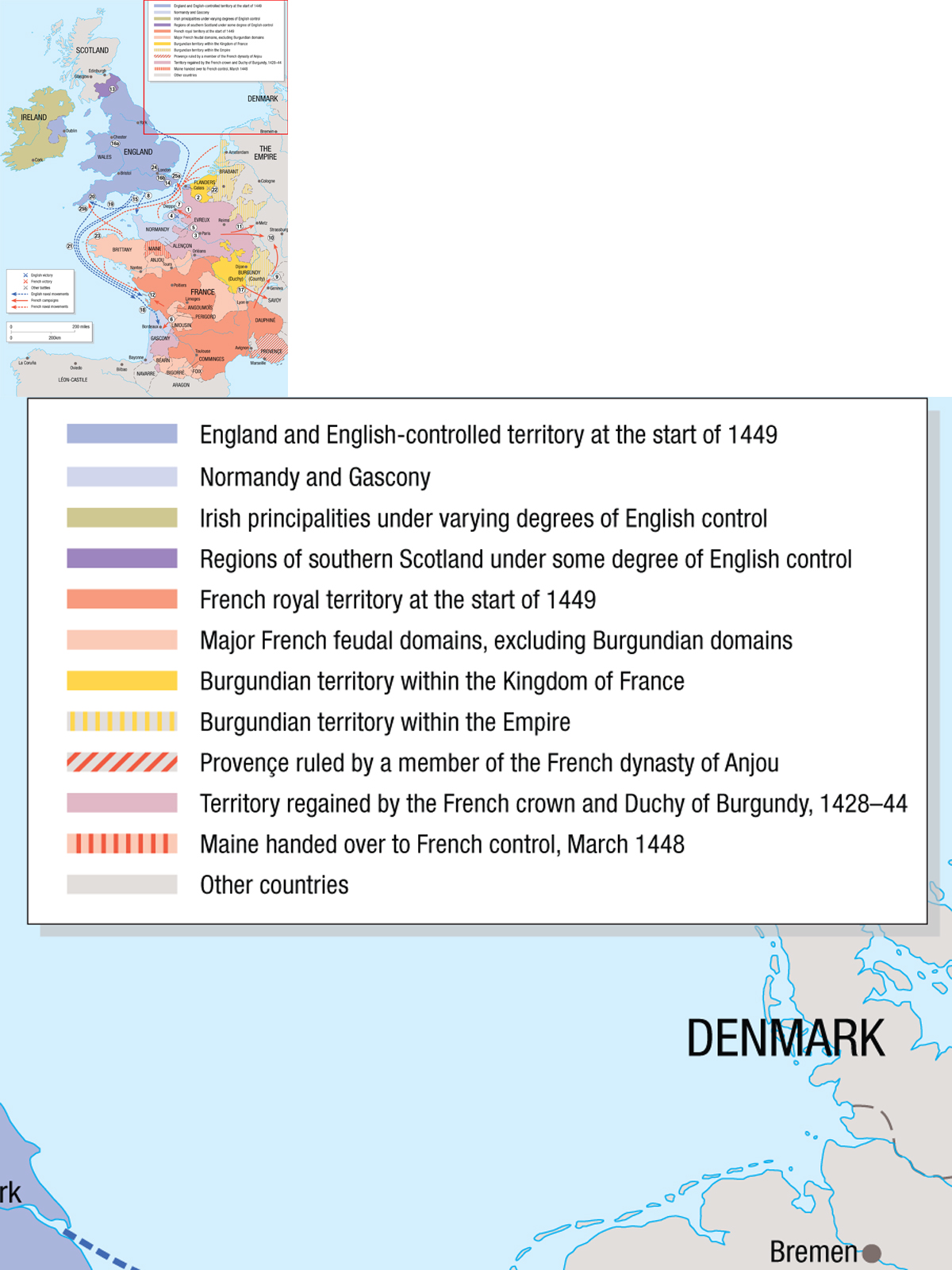
The decline of English France: frontiers c.1448
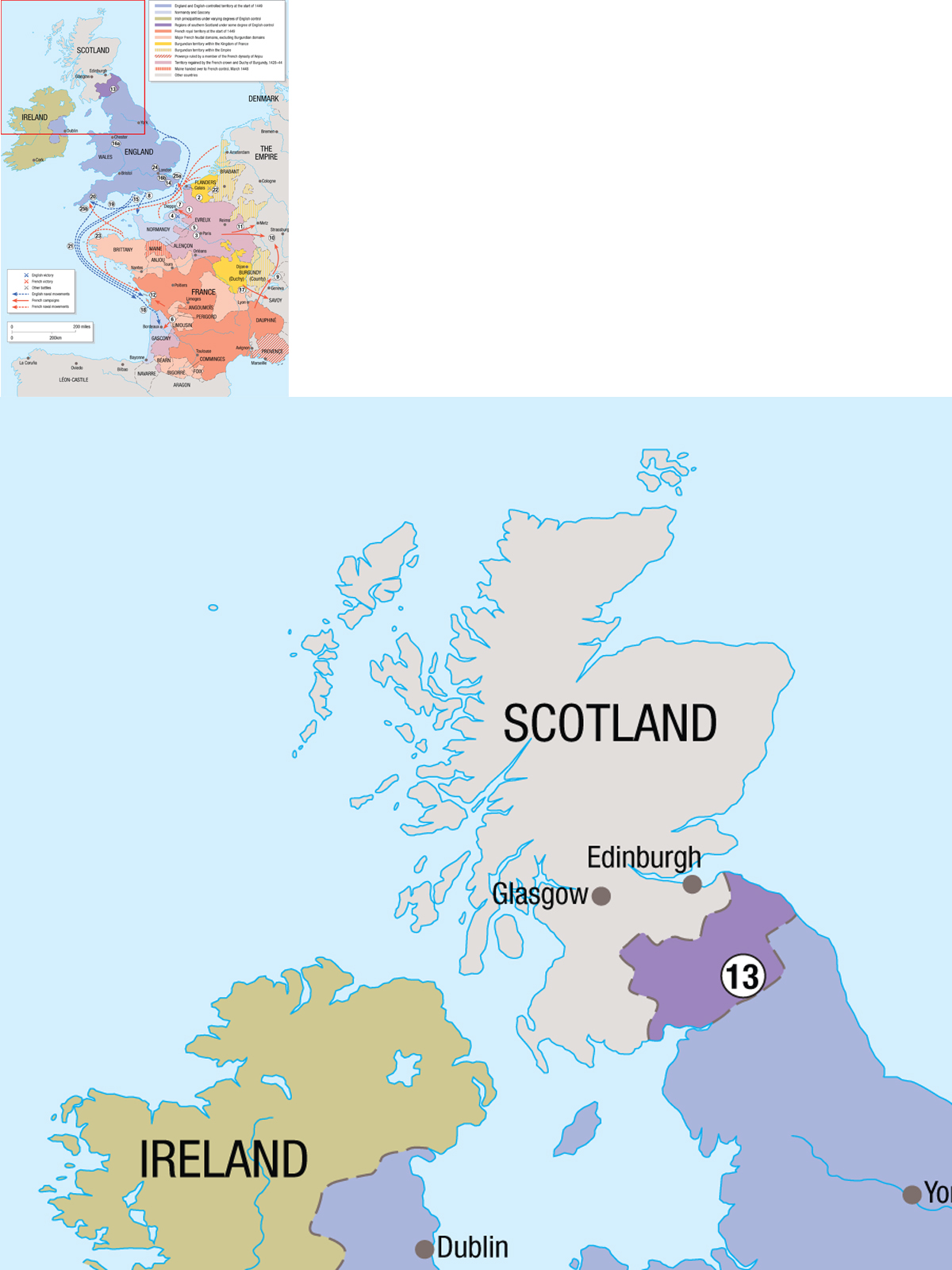
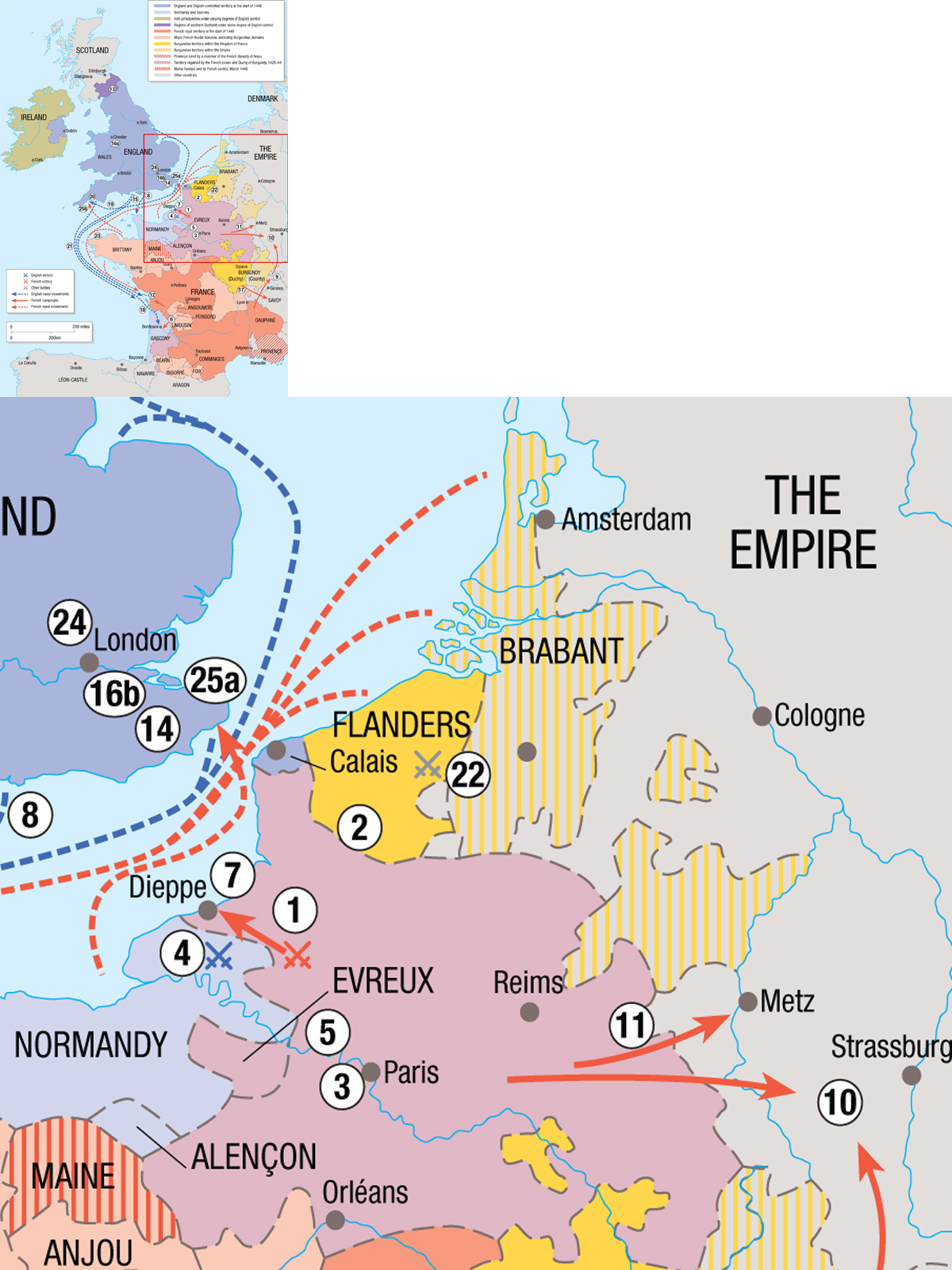
After a period of uneasy truce, the Hundred Years War flared up again early in the 15th century with yet another English invasion of France, marked by a crushing English victory at Agincourt in 1415, soon followed by the signing of an Anglo-Burgundian alliance. In 1418 the Burgundians took control of Paris and in 1420 the Treaty of Troyes recognized Henry V of England as heir to the aged and mentally unstable Charles VI of France. Henry V then married Catherine de Valois to unite the ruling houses of England and France. On the face of it England had won the war, but Charles VI’s disinherited son, the Dauphin Charles, refused to recognize the treaty and established a rival court in the central French city of Bourges. This ‘Kingdom of Bourges’ was financially and militarily weak but became the centre of an increasingly effective resistance and, after Jeanne d’Arc had convinced the ex-dauphin, now the self-declared King Charles VII, into having himself crowned in the sacred city of Reims (see Campaign 94: Orléans 1429, Osprey Publishing Ltd: Oxford, 2001), the balance gradually shifted in his favour.
Charles VI of France and Henry V of England both died in 1422, leaving their theoretically joint Crown to the infant Henry, called the VI of England and the II of France (though this title is not accepted by French historians). The concept of two kingdoms coming together in such a personal union was widely accepted in late medieval Europe, and many English historians still harbour a nostalgic feeling that it would have been a reasonable way to end the long conflict. Nevertheless, English and Burgundian armies failed to take control of the whole country, and the English faced huge difficulties maintaining order in the vast areas they ruled after the Treaty of Troyes. Whether this territory really formed an ‘English France’ during the 15th century remains controversial. Meanwhile, the English position in south-western France had hardly been affected by the great victories in the north. Here there was no significant expansion, and what might be called ‘French France’ under Charles VII still controlled the Mediterranean coast and an Atlantic coast between Gascony and Brittany. Then there was Brittany itself; this Duchy was a powerful military force that overlooked the strategic sea lanes between England and Gascony. Both sides were eager to draw Brittany into their fold, and Charles VII’s eventual success in doing this was a major boost to his cause.
1 French defeat English at Gerberoy, spring 1435.
2 Alliance between Charles VII and the Duke of Burgundy confirmed at Arras, 1435.
3 English evacuate Paris, 1436.
4 English defeat French at Ry, 2 February 1436.
5 French retake Pontoise, 1441.
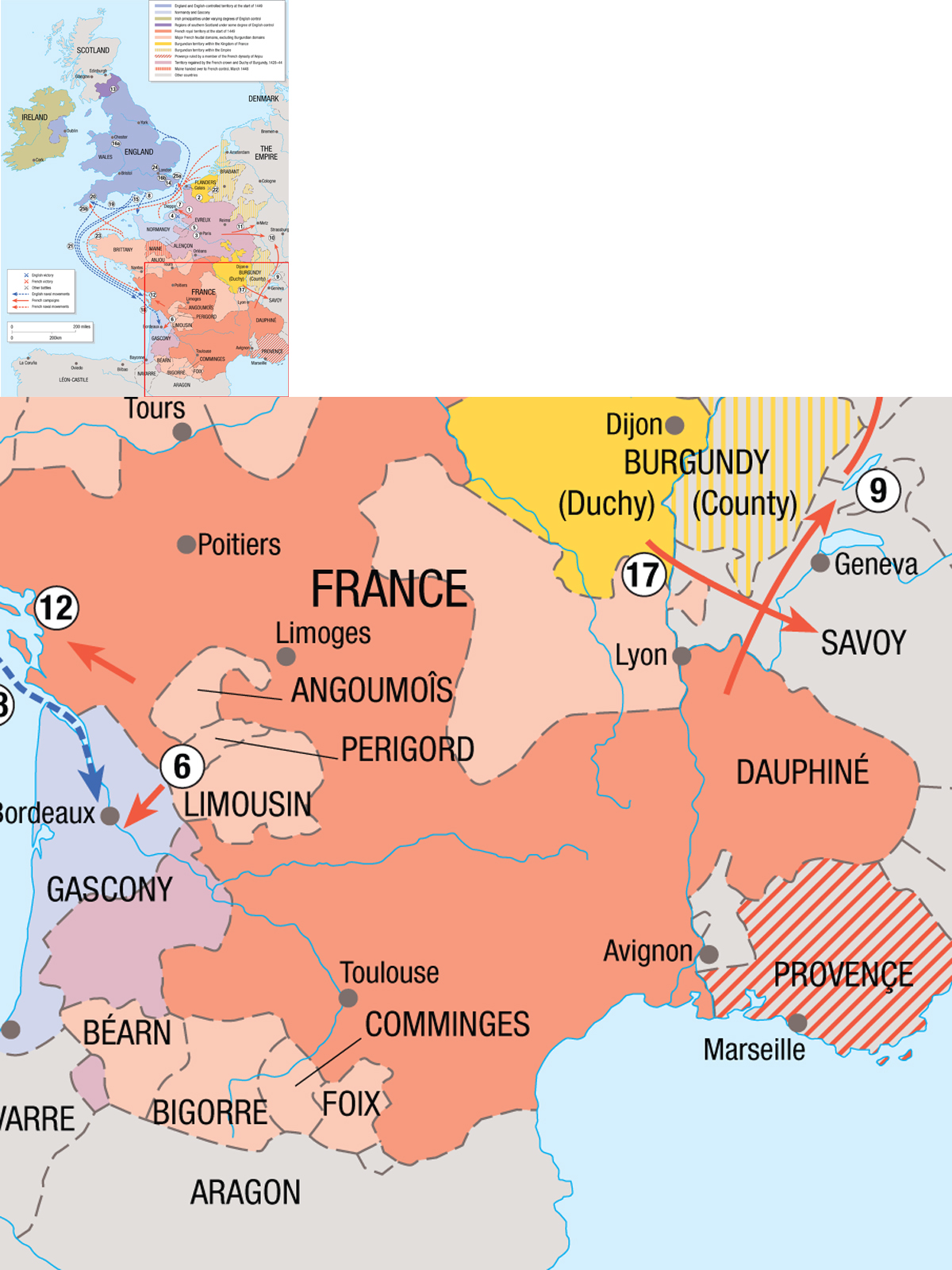
6 French threaten Gascony, 1441–42.
7 French retake Dieppe and an English attempt to retake it fails, 1443.
8 English army sails to Cherbourg from Portsmouth because French taking of Dieppe makes eastern part of English Channel unsafe.
9 The Dauphin Louis campaigns against the Swiss in support of Frederick of Hapsburg, 1444.
10 Charles VII and the Dauphin Louis campaign against écorcheurs in Alsace and Lorraine, 1444.
11 Charles VII leads punitive expedition against Metz in support of the Duke of Lorraine.
12 Major upgrading of fortifications at La Rochelle naval base, 1445–47.
13 English defeated by Scots in renewed hostilities, 1448–49.
14 Kentish rebellion led by Jack Cade reaches London but is crushed in July 1449.
15 English reinforcements under Richard Woodville Lord Rivers sent to Gascony, 1450.
16 Yorkist revolt in Ludlow (A) in February, stand-off between Yorkist and Royalist forces at Dartford is ended by negotiation (B) in March, 1452.
17 Charles VII marches against Savoy, August 1452.
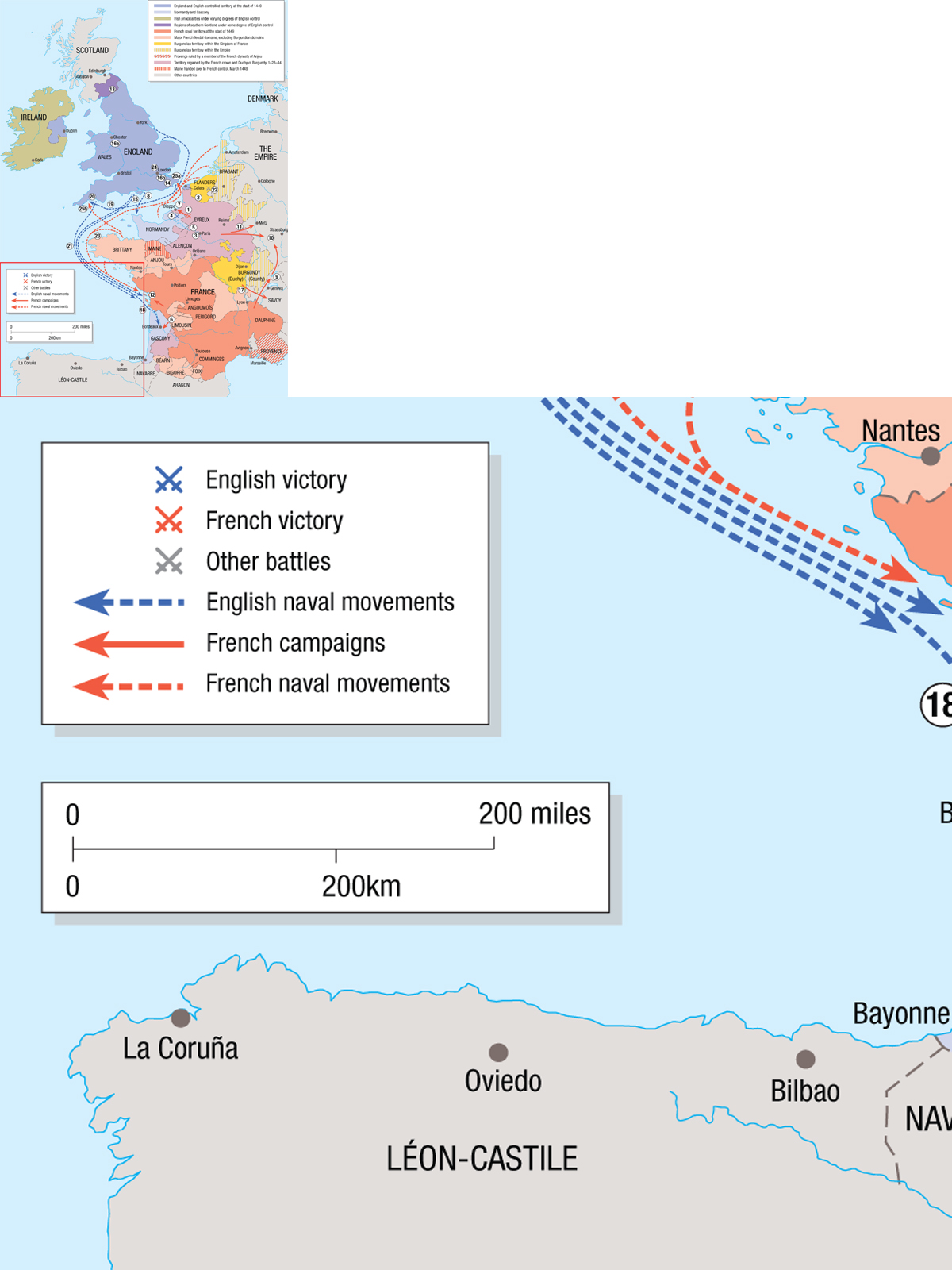
18 English army under Talbot, initially mustered to support Calais, sails to retake Bordeaux from the French, September–October 1452.
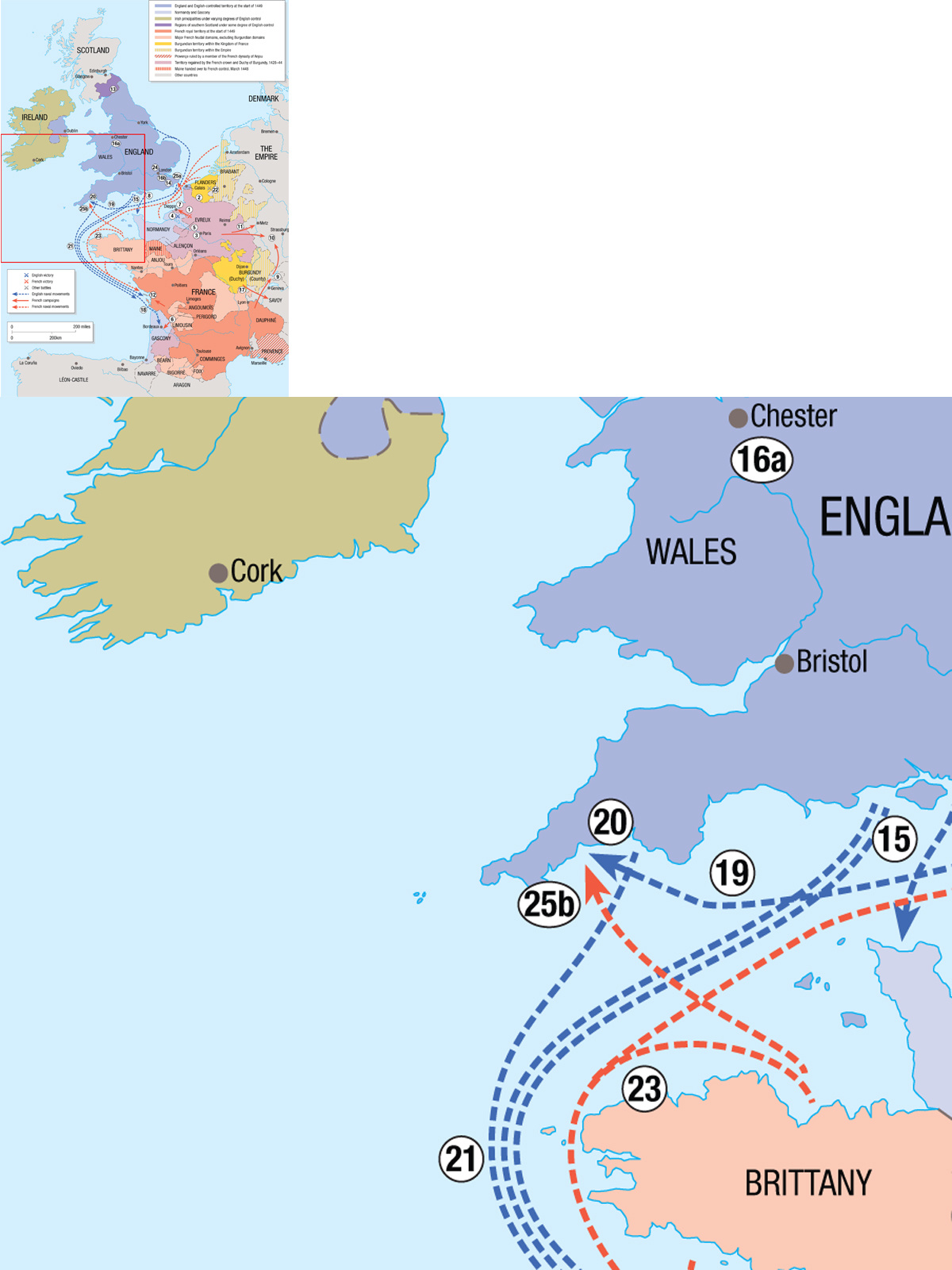
19 Ships from Hull, King’s Lynn and Dover assemble at Fowey for second expedition to Gascony, autumn and early winter 1452.
20 English fleet moves from Fowey to Plymouth, February 1453.
21 English army under John Viscount Lisle sails to support Talbot, March 1453.
22 Duke of Burgundy defeats Ghent rebels at the battle of Gavere, 23 July 1453.
23 Charles VII assembles ships from Holland, Zealand, Flanders, Brittany, Poitou and Spain at La Rochelle to support second French siege of Bordeaux, summer 1453.
24 First battle of Barnet, 22 May 1455 (start of Wars of the Roses).
25 French fleet attacks Sandwich (A) and Fowey (B), nominally in support of Lancastrians in the Wars of the Roses, 1457.
A French illustration, made around 1460, showing the relationship between the kingdoms of England and France in French eyes, with King Richard I of England offering homage to King Philippe Auguste of France. (Grand Chroniques de France, Bib. Munic. Ms. 5, f.225v, Châteauroux)
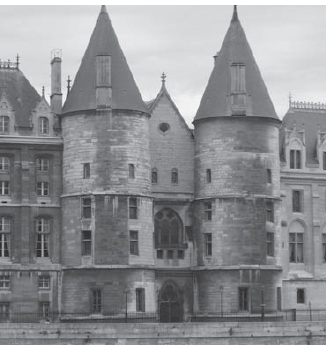
Little remains of the French kings’ fortified palace on the Isle de la Cité in Paris apart from three massive towers incorporated into the later Palais de Justice. (Author’s photograph)
The apparently deep-seated pro-English sentiment in Gascony was in reality an attachment to local autonomy strengthened by commercial self-interest. Put simply, the people of Gascony preferred the distant rule of England to that of an increasingly centralizing and powerful French monarchy. The link between London and Bordeaux was particularly strong, English settlement in Gascony being primarily focused upon Bordeaux, Bayonne and Dax. Here the resident English included merchants and craftsmen as well as garrisons. Most seem to have been prosperous, with the only exceptions being some rural parishes where poorer English settlers may have been involved in wine growing.
Meanwhile the situation in England was surprisingly complex for a country that believed that it had won the war, with widespread criticism of the cult of royal militarism. Some even linked the war with the stories of King Arthur and prophesied that – as in the Tales of the Knights of the Round Table – all would end in catastrophe. The high hopes of King Edward III’s reign had largely evaporated and an increasingly unpopular war had become a political burden for Henry VI’s government. Even the King’s marriage to another French princess, Margaret of Anjou, did little to raise the Crown’s prestige, and the unfortunate Margaret was seen as an interfering foreigner.
The situation in France outside those regions under English rule was dominated by relations between the Duke of Burgundy and his cousin, King Charles VII. While the alliance between Burgundy and England endured, Charles VII had little hope of expelling the invaders and his struggle was as much diplomatic as military. There were also deep-seated tensions between other senior aristocratic families, not least between the houses of Bourbon and Burgundy. To further complicate the issue, the reforms that characterized Charles VII’s reign were intended to strengthen the King’s position, thus weakening that of the great nobles upon whom the King’s military power ultimately rested.
Meanwhile the Duke of Brittany became a somewhat reluctant ally of Charles VII, largely owing to pressure from his brother, Arthur de Richemont, the Constable of France. Unlike their ruler, however, the people of Brittany remained strongly pro-French and furnished the royal armies with large numbers of committed troops. One major diplomatic triumph nevertheless trumped all others when, in 1435, the Duke of Burgundy changed sides and formed an alliance with Charles VII. This was seen as a betrayal in England, where Parliament approved a large sum of money to continue the war. On the other side, Burgundy’s new stance meant that Charles VII’s overstretched armies could focus on their struggle with the English in Normandy and Gascony.
The following year the English evacuated Paris, and in 1441 the French broke through to the English Channel, taking Pontoise, and then launching an offensive in the south-west. In 1443 the French took Dieppe, thus acquiring a major port in Upper Normandy and making English shipping in the Channel highly vulnerable. Indeed English armies sailing for France now tended to embark at Portsmouth rather than higher up the Channel, where the English were losing control of the sea.
Under such circumstances the truce agreed at Tours in 1444 came as a relief to the English, not least to those governing Normandy. It would be renewed until 1448, though in the meantime Henry VI secretly agreed to hand over the province of Maine – a move that would precipitate the final crisis.
| 1415 | English defeat French at battle of Agincourt. |
| 1416 | Anglo-Burgundian alliance is signed at Calais following the assassination of Duke John the Fearless of Burgundy. |
| 1418 | Burgundians take control of Paris. |
| 1420 | Treaty of Troyes recognizes Henry V of England as heir to Charles VI of France; the Dauphin Charles is ‘banished’ (though only to Bourges); marriage of Henry V and Catherine de Valois. |
| 1422 | Deaths of Henry V and Charles VI; the one-year-old Henry VI is declared King of both England and France under separate regencies; the Dauphin declares himself King as Charles VII. |
| 1429 | French under the nominal command of Jeanne d’Arc raise the siege of Orléans, and defeat the English at Patay; Charles VII is crowned at Reims. |
| 1431 | Jeanne d’Arc is burned at Rouen; Henry VI is crowned King of France in Paris. |
| 1435 | French defeat English at Gerberoy; the Treaty of Arras between Charles VII and Duke Philippe the Good of Burgundy ends the Anglo-Burgundian alliance. |
| 1436 | English evacuate Paris. |
| 1439–40 | Praguerie revolt of French nobles. |
| 1441 | French retake Pontoise. |
| 1442 | French threaten Gascony. |
| 1443 | French retake Dieppe. |
| 1444 | Truce of Tours; Henry VI agrees to marry Charles VII’s niece Margaret of Anjou and relinquish Maine; the Dauphin leads a French army against the Swiss; Charles VII and the Dauphin campaign against écorcheurs in Alsace and Lorraine. |
| 1445 | Major reforms of the French army. |
| 1448 | English garrisons evacuate Maine; English defeated by Scots. |
| 1449 | 24 March: English seize Fougères in Brittany despite current truce. |
| 1–25 April | Rioting in London. |
| May | French take Gerberoy, Cognac, Saint-Mégrin, Conches and Pont-de-l’Arche. |
| June | Charles VII plans reconquest of Normandy; Kentish ‘rebels’ under Jack Cade reach London. |
| July | Charles VII starts campaign of reconquest in Normandy; rebellion in south-eastern England led by Jack Cade is crushed. |
| August | French take many towns in Normandy; Earl of Douglas defeats English raiding force on Scottish borders. |
| September–October | French take further towns and castles in Normandy, notably Rouen, plus Mauléon in Guyenne. |
| Late summer to early autumn | English send small numbers of reinforcements to Normandy. |
| October–December | English assemble ships from the east coast at Portsmouth, where an army musters under Lord Powis and Sir Thomas Kyriell; French continue to take territory in Normandy and besiege Harfleur. |
| 1450 | January: Harfleur and Honfleur surrender to the French; Adam Moleyns is killed by mutinous troops in Southampton. |
| February | Count of Foix seizes Guiche. |
| 15 March | English army lands at Cherbourg. |
| 16 March | Guillaume de Couvran, Captain of Coutances, sends news of English landing to Charles VII at Alençon. |
| March (later in month) |
English attack Valognes; Duke of Somerset sends reinforcements from Bayeux, Caen and Vire to strengthen Kyriell; Jean de Clermont establishes himself at Carentan. |
| 22 March | French take Fresnay. |
| 10 April | Valognes falls to the English. |
| 12 April | English march towards Bayeux; de Richemont reaches Granville. |
| 13 April | De Richemont reaches Coutances. |
| 14 April | English cross the Grand-Vey and camp at Formigny; de Richemont reaches Saint-Lô. |
| 15 April | French defeat English at battle of Formigny. |
| 23 April (around this date) | French take Vire. |
| 12 May | French take Avranches. |
| May and early June | Jacques de Luxembourg takes most of the Cotentin peninsula. |
| 16 May | French take Bayeux. |
| 25 June | French take Caen. |
| 21 July | Falaise capitulates to the French. |
| July (end of month) |
Death of Duke François of Brittany. |
| 2 August | Domfront surrenders to French. |
| 22 August | Capitulation of Cherbourg brings Normandy campaign to an end. |
| October | French invasion of Guyenne begins with siege of Jonsac. |
| 1451 | May: Mont-Guyon, Blaye, Bourg, Arqués, Rions, Castillon and Saint-Émilion capitulate to the French. |
| June | Bordeaux and Fronsac surrender to the French |
| 6 August | French take Bayonne. |
| 1452 | |
| February–March | Yorkist revolt in England ends through negotiation. |
| August | Charles VIl invades Savoy. |
| June–July | English muster army under Gervase Clifton, Edward Hull and John Talbot. |
| October | English fleet and army arrive in the Gironde then retake Bordeaux; French rush reinforcements to Blaye. |
| November–December | English retake Blanquefort, Libourne, Castillon, Rions, Cadillac, Saint-Macaire and Longon but French garrisons retain Fronsac, Blaye and Bourg. |
| December | Ships assemble at Fowey for the forthcoming expedition to Gascony. |
| 1453 | |
| 19 February | English fleet moves to Plymouth. |
| March | English fleet under John Viscount Lisle sails to Gascony. |
| March–April | Talbot besieges Fronsac. |
| 2 June | Start of second French campaign to regain Guyenne. |
| 17 July | French defeat English at battle of Castillon. |
| 23 July | Duke of Burgundy defeats army of Ghent at battle of Gavere. |
| 29 July | Châteauneuf and Blanquefort surrender to the French. |
| August | Henry VI is declared insane. |
| 17 October | Capitulation of Bordeaux concludes campaign in Guyenne. |
| 1455 | Beginning of the Wars of the Roses in England. |
| 1457 | French fleet attacks Sandwich and Fowey. |
| 1461 | Death of Charles VII; he is succeeded by Louis XI. |
| 1475 | Truce of Picquigny marks the end of the Hundred Years War. |
| 1558 | Calais falls to the French. |
| 1801 | English monarchy relinquishes its claim to the throne of France. |
The Truce of Tours in 1444 was not followed by the usual disbandment of most French forces. Instead there was a purging of poor-quality units while the best were retained as a large force under arms. These were now subjected to a thorough process of reform, while continuing to campaign against other enemies. In the same year of the truce with the English, the Dauphin Louis led an army against the Swiss in support of Frederick of Austria and won a notable victory near Basel. The following year Charles VII led a punitive expedition against the city of Metz in support of the Duke of Lorraine and, with his son Louis, dispersed many of the écorcheurs (bands of unemployed soldiers) that were terrorizing the region.
The old French army had been raised and organized along much the same lines as the English. Most troops were hired under contract, sometimes as units, sometimes individually, and during the early years of Charles’ reign his armies included substantial numbers of foreigners, notably Scots, Spaniards and Italians. From now on, however, the proportion of Frenchmen increased. Nevertheless the Scots are thought to have had a profound influence, especially in the increasing use of mounted-infantry archers and the declining use of crossbows.
Following the siege of Orléans, French armies were also fragmented into smaller companies with little royal control. Even when such forces were not roaming the country, the burden of billeting more military units was unwelcome for most French towns. Not only was it expensive, but the troops were also frequently undisciplined. Indeed it is likely that one purpose of Charles VII’s military reforms was to regularize and control such billeting. Ever since the late 14th century soldiers had been subject to widespread criticism, often being portrayed as vain and cowardly and as a source of disorder. In contrast the new, more disciplined troops in direct royal service were widely praised and as a result the differentiation between ‘good’ and ‘bad’ soldiers came to be judged in terms of whom they served, ‘goodness’ being seen as reflecting loyalty to the Crown – a development greatly to the King’s benefit.
On 5 January 1445 Charles VII’s government formally announced the establishment of royal compagnies d’ordonnance, which were regular military formations, largely recruited from the best of the old bands of freelance écorcheurs. The rest, many of whom were little better than brigands, were dispersed and, when necessary, crushed. The resulting expensive changes had to be carried out carefully to avoid a revolt by established military captains, some of whom would lose status and earnings even if they avoided dismissal. Indeed it took many years for these reforms to become fully effective and it was Charles VII’s grandson, King Charles VIII, who reaped the full benefit (see Campaign 43: Fornovo 1495, Osprey Publishing Ltd: Oxford, 1996).
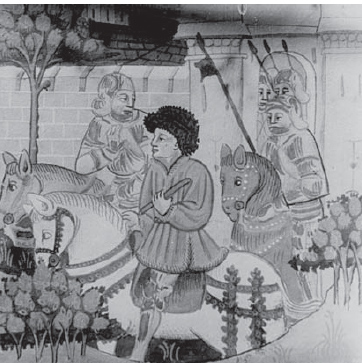
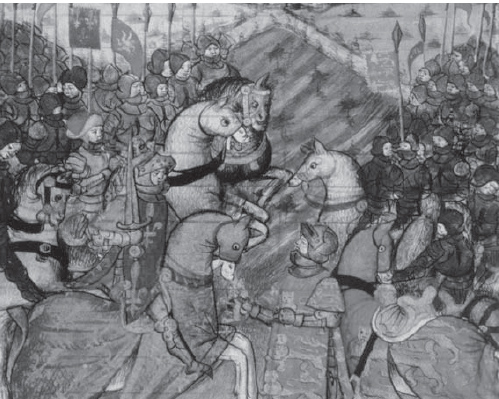
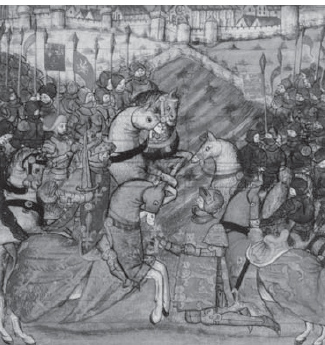
Typical French cavalry, preceded by their commander holding his staff of office, in a mid-15th-century copy of the Legend of Troy. (Bib. Roy., Ms. 9240, f.23r, Brussels)
The mid-15th century also witnessed dramatic improvements in guns and gun carriages for field and siege use, though there still seem to have been no real distinctions between the two. Although gunners were still seen as ‘dirty artisans’ they were no longer regarded as a threat to the established social order. In fact many masters of artillery now came from the minor aristocracy, reflecting the growing prestige of this arm. Fundamental to the improving efficiency of guns was the development of ‘crumbed’ gunpowder, which became widespread after 1420. Unlike the original powered form, its constituent elements did not separate during the jolting of transport, and thus was more reliable. The use of separate powder chambers for breech-loading cannon also meant that several such chambers could be prepared in advance, resulting in a remarkably rapid (if brief) rate of fire until these chambers needed refilling. The smaller guns, which were becoming increasingly popular, could also be reloaded and fired faster than the old large-calibre bombards.
The Bureau brothers, Jean and Gaspard, are generally credited with making King Charles VII’s artillery such a formidable force. One of their most significant achievements was to regularize the seemingly chaotic variety of battlefield weapons currently in use, as well as purchasing higher-quality and more standardized bronze gun barrels. The resulting weapons still included heavy bombards for siege work, while the veuglair was a smaller-calibre breech-loader. Some cannons also had ‘queues’ (pig tails), which were a form of swivelled mounting pin that slotted into something fixed and substantial like a wall, parapet or ship’s bulwark. The culverin and serpentine were smaller still and were sometimes supported on forks, though neither was a strictly hand-held weapon. Real hand-held guns were also changing as their barrels became longer and thus more accurate, gradually taking over the armour-piercing role of crossbows.
English armies remained small in the mid-15th century, though the cost of their upkeep was a significant burden for the government. Nevertheless, England seems to have had a larger proportion of professional soldiers, vis-à-vis its population, than did France, perhaps reflecting the English government’s greater ability to raise money and a willingness to spend a larger percentage of government revenue on warfare. Nevertheless, direct taxation had been bringing in ever-less cash since the mid-14th century; it had slumped since 1430 and had reached a particularly low level in the 1450s. The English Parliament had decided to use the conquered territories in northern France as a source of revenue, but as these slipped from English control so their revenues declined, further undermining attempts to retain those provinces that remained.
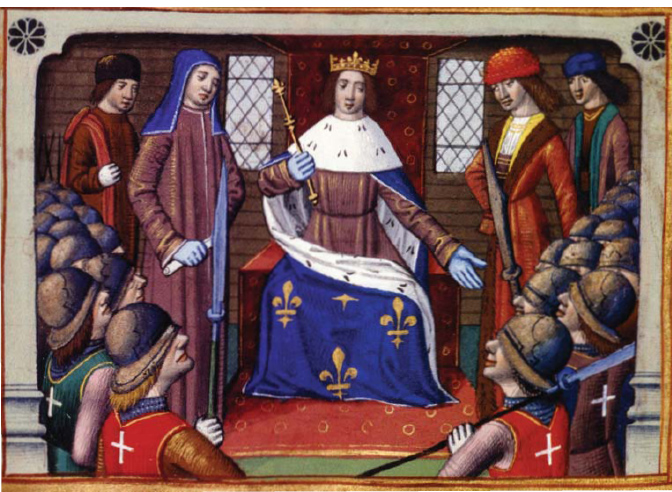
One of the most ambitious of King Charles VII’s military reforms in the 1440s was to create the corps of francs-archers, an event illustrated in Martial d’Auvergne’s Vigiles de Charles VII, printed in 1484. (Bib. Nat., Ms. Fr. 5054, f.136, Paris)