Philip S. Jowett • Illustrated by Stephen Walsh
Series editor Martin Windrow
INTRODUCTION
CHRONOLOGY
THE ARMIES
WEAPONS & EQUIPMENT
UNIFORMS
PLATE COMMENTARIES
The two Balkan Wars fought in 1912–13 are often described by historians as the prelude to World War I. In fact, some would maintain that they were actually the opening salvo of the conflict that was to engulf the Great Powers in August 1914, since the spark that ignited the Great War was struck in the Balkans, amid the tinder laid by Serbia’s success in 1912–13.
In 1912 the Balkan region was divided between the sovereign states of Greece, Serbia, Bulgaria, Romania and Montenegro, and the provinces of the Ottoman Turkish Empire in Europe. The gradual liberation of the Balkan nations from Turkish rule during the 19th century had already cost the Ottoman Empire many of its possessions in Europe, but in 1912 there was still a large tract of territory that was ruled directly from Constantinople (Istanbul). The Ottoman provinces in Europe were inhabited by a mixture of Greeks, Bulgarians, Serbs, Albanians and others, some of them dispersed in an ethnic-religious jigsaw puzzle of scattered communities. Many of the non-Turkish peoples of these lands wanted to be joined with what they regarded as their mother countries, but a sizeable proportion of the population were Muslims, and were content to remain subjects of the Ottoman Empire.
The Balkan sovereign nations had been planning for war against the Ottoman Empire for many years, and had built up their military establishments accordingly. In September 1911 these plans were given new impetus by the Ottoman Army’s involvement in a war in North Africa and the Dodecanese islands sparked by the Italian invasion of Turkey’s Libyan possessions. Although the campaign in Libya was not given high priority by the Turks, it still tied down troops and some of their best officers. This distraction gave the leaders of the Balkan nations an incentive to begin hostilities before the Italo-Turkish War could be resolved.
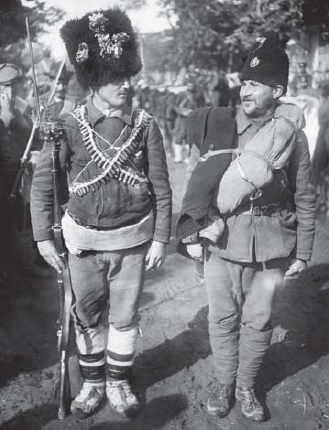
Two volunteers of the Bulgarian Opolcenie militia prepare to move off with their comrades in 1912. The man on the left wears a rather extravagant fur busby, which he has decorated with some of the flowers thrown by the enthusiastic crowd. His comrade wears a more conventional fleece hat with a metal badge, and in the background can be seen others wearing flat caps and trilbys. These militiamen in their forties had to campaign in their own clothing, supplemented with whatever equipment the Bulgarian Army stores could spare.
In simple terms, the First Balkan War (October 1912–May 1913) was a struggle between the armies of the Balkan League – Greece, Serbia, Bulgaria and Montenegro – and the Ottoman armies in Europe. The aims of the Balkan League were to ‘liberate’ (or perhaps more accurately, to carve up) Ottoman-ruled provinces in the Balkans, adding them to their own national territories. This war ended with the military defeat of the Ottoman armies; but the peace was short-lived, as the former allies soon fell out amongst themselves. The Second Balkan War (June–July 1913) was the result of Bulgaria’s resentment at its perceived lack of gains from the peace treaty that ended the first conflict. Bulgaria attacked the armies of its former allies Greece and Serbia, but, although initially successful, was very soon forced into retreat. In the meantime, Romania, a powerful nation that had stayed neutral in the First Balkan War, took full advantage of Bulgaria’s distraction to capture territory ithad long claimed as its own. To add insult to injury for the Bulgarians, the recently defeated Ottoman Empire also took this opportunity to regain Eastern Thrace and the fortress of Adrianople.
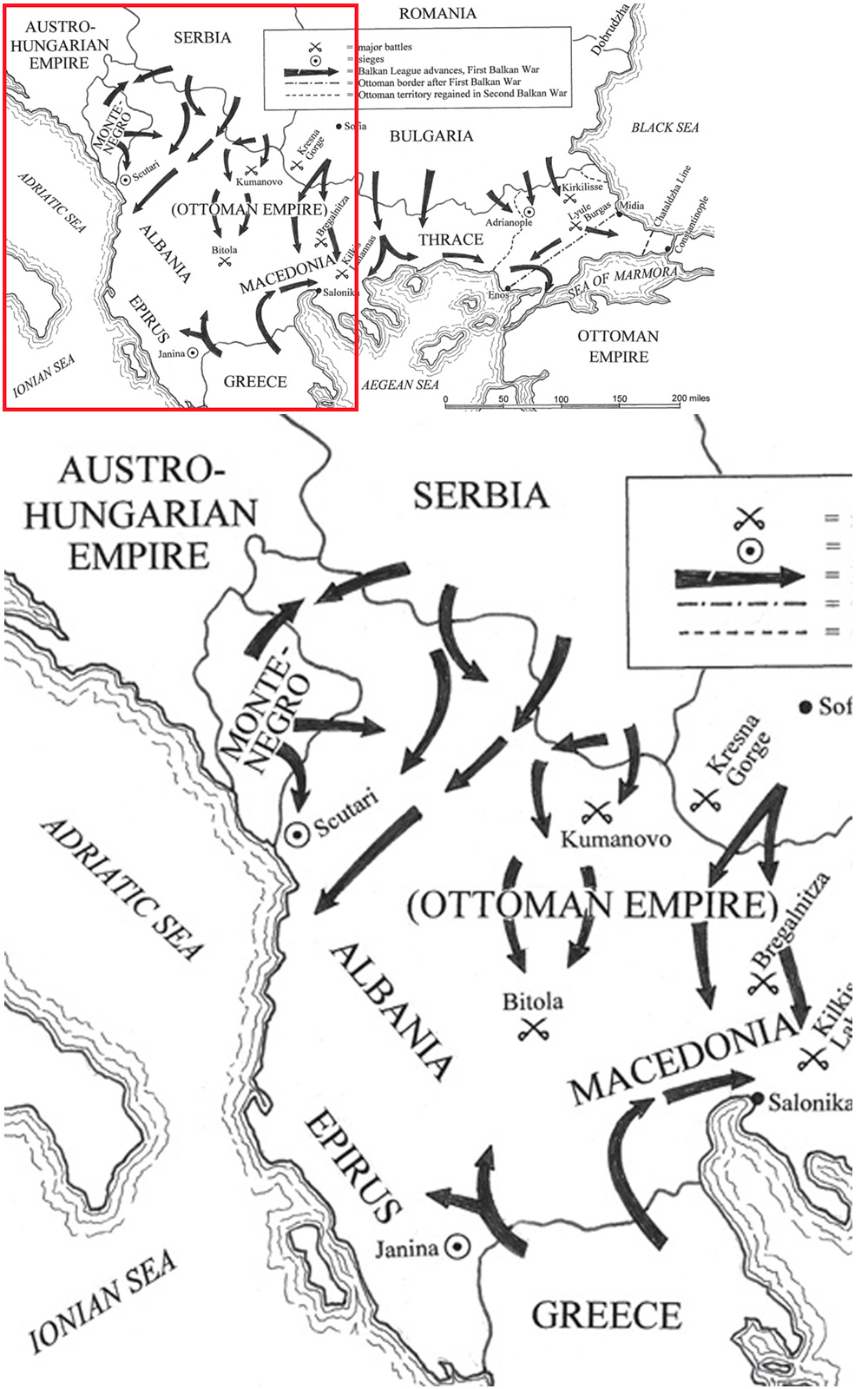
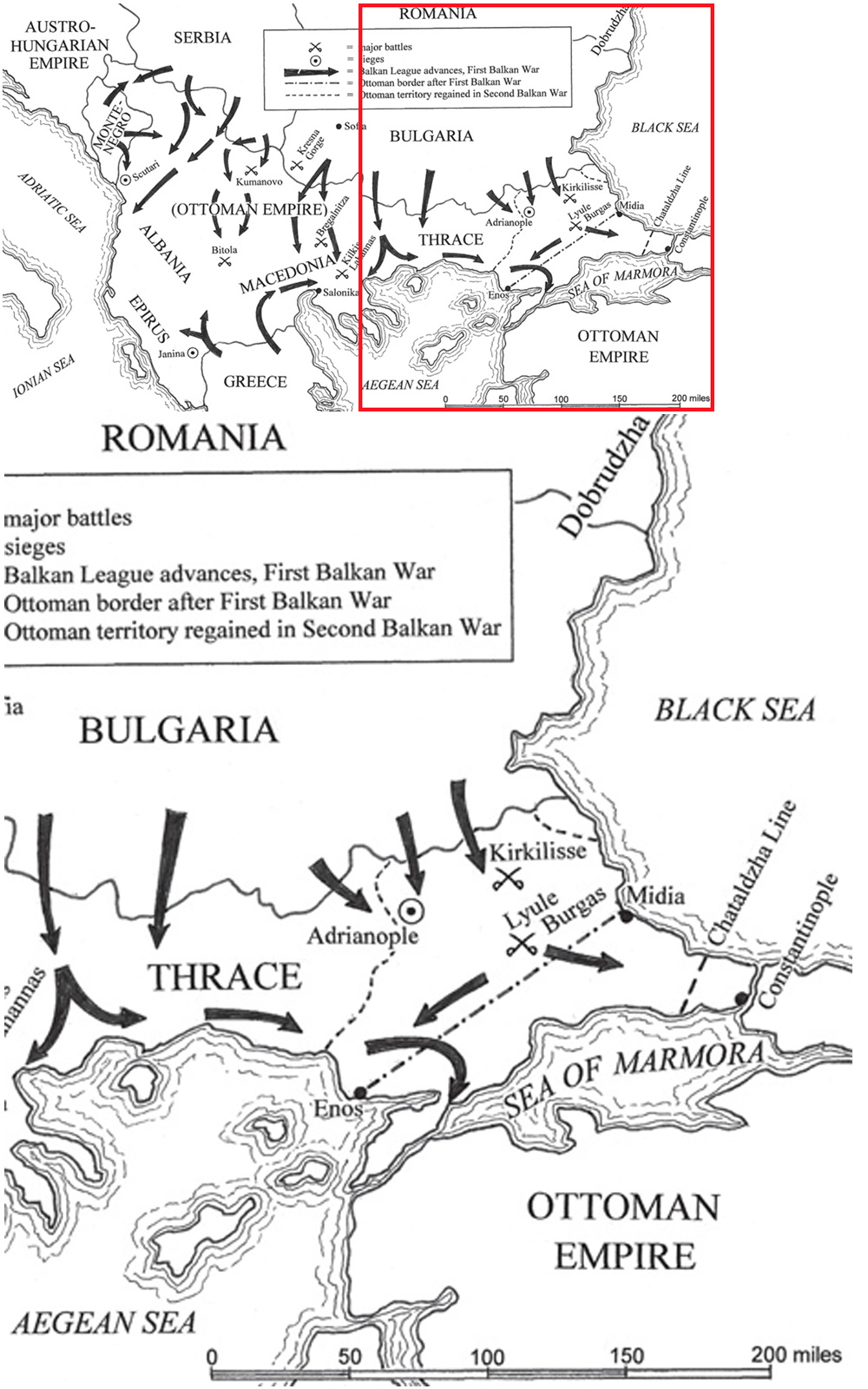
(In order to simplify the confusing military situation during the First Balkan War, operations are divided here into the Western Theatre = Macedonia and Albania, and the Eastern Theatre = Thrace.)
13 March Bulgaria and Serbia agree a secret treaty to divide Ottoman-ruled Macedonia up between them, with the fate of a third zone to be decided by agreement with the Russian government.
May Bulgaria and Greece sign a treaty of alliance. With further agreements between Montenegro and the other three nations, the ‘Balkan League’ is forged.
September Ottoman armies in Europe mobilized (24th); Bulgarian Army mobilized (25th); Greek Army mobilized (30th).
8 October, Western Theatre Montenegro declares war on the Ottoman Empire, and its troops invade northern Albania.
8 October 1912–23 April 1913, Western Theatre Siege of Scutari; having overrun northern Albania, the Montenegrins lay siege to this Ottoman fortress.
16 October, Western Theatre Serbian forces invade Kosovo. (18 October Treaty of Lausanne ends the Italo-Turkish War, largely in Italy’s favour.)
18 October, Eastern Theatre Bulgaria declares war on the Ottoman Empire, and three Bulgarian armies cross the border into Ottoman-controlled Thrace. The Bulgarian Second Army surrounds the fortress city of Adrianople, held by a 50,000-strong Ottoman garrison.
18 October, Western Theatre The Greek Army crosses the frontier and defeats Ottoman forces. The Bulgarian First and Third Armies, 90,000 strong, advance on a 36-mile front against the main Ottoman army in Eastern Thrace. The Ottoman defeat at the decisive battle of Kirkilisse and subsequent withdrawal leave the besieged fortress of Adrianople isolated, and only the Chataldzha defensive lines, c.19 miles from Constantinople, stand between the Bulgarians and the Ottoman capital.
23 October, Western Theatre Ottoman troops retreat in face of advancing Greeks, north to Monastir.
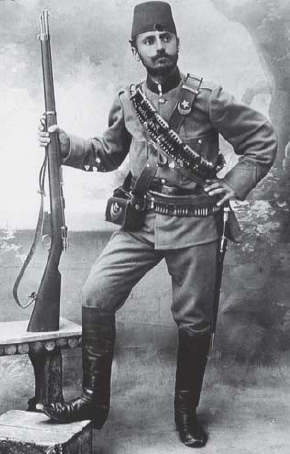
It is too simplistic to regard the Balkan Wars as ‘struggles of Christian liberation from the Turkish yoke’. Many inhabitants of the Ottoman provinces in Europe were Muslims, and some Christian communities were unwilling to come under the rule of nations following one of the other traditions of the Orthodox religion. This commander of volunteers from Salonika poses wearing a well-tailored khaki woollen uniform with a red fez. Muslim volunteers often wore the star-and-crescent symbol – in this case, in brass on the cartridge box and its sling. For an irregular he is well armed, with a Turkish Mauser M1890 rifle and two bandoliers of five-round clips.
23–24 October, Western Theatre Decisive battle for Macedonia fought at Kumanovo, between the 130,000-strong Serbian First Army, and the Ottoman Army of the Vardar with half that number (but both armies are equal in artillery and machine guns). The Ottomans attack, but fail to take the Serbs by surprise. The defeated Ottomans withdraw into southern Macedonia, losing 12,000 dead and wounded and 98 field guns.
24 October, Western Theatre Montenegrin and Serbian forces join up at Plevje, and the remaining Ottoman troops cross over into Austro-Hungarian territory to be interned.
29 October–2 November, Eastern Theatre In Thrace, the battle of Lyule Burgas (Buni Hisar) is the largest military encounter in Europe since the Franco-Prussian War, involving some 130,000 Ottoman troops and about 110,000 Bulgarians. After heavy fighting the Turks fall back, suffering 22,000 casualties; the victorious Bulgarians lose 20,162, including 2,534 dead.
3 November, Eastern Theatre In Thrace, the Ottoman East Army withdraws behind the Chataldzha defensive lines on the approaches to Constantinople.
9 November, Western Theatre In Macedonia, the Greek 7th Division marches into the city of Salonika, taking 27,000 Ottoman prisoners. A few hours later their Bulgarian allies arrive, causing the first tensions between the two armies.
16–19 November, Western Theatre In Macedonia, the Serbian First Army of 108,000 men defeats the 39,000 remnants of the Ottomans’ Vardar Army at the battle of Bitola. The Ottomans suffer 3,000 killed and wounded, and the Serbs take 5,600 prisoners, while 5,000 of the Turkish rediff troops desert. This Serbian victory effectively ends any hope of further Ottoman resistance in Macedonia.
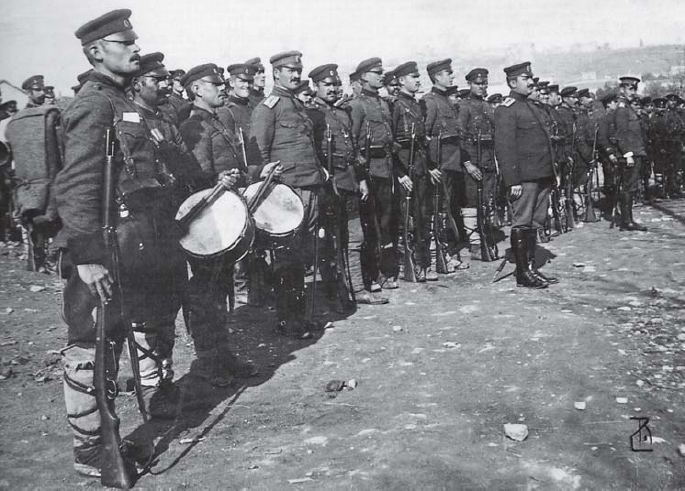
Bulgarian Army infantry from the 7th Rila Division parade in the city of Salonika, which they entered the day after it fell to the Greek Army on 8 November 1912. All the soldiers wear tobacco-brown uniforms, with blue-crowned peaked caps, and peasant leggings and shoes. Their officers (centre and right) wear green-khaki uniforms, varying in shade, with braid shoulder boards, and high boots.
November, Western Theatre The Serbians send three divisions totalling 30,000 men to reinforce the Montenegrins besieging Scutari, where the Ottoman garrison has increased to 29,000 men including 5,000 Albanian volunteers – only slightly fewer than the besieging Montenegrins.
17–18 November, Eastern Theatre Prematurely attacking the 90,000 Ottoman troops defending the Chataldzha lines, the Bulgarians suffer heavy casualties.
4 December Ceasefire agreed between the Ottoman Empire and the Balkan League, apart from Greece.
17 December 1912–13 January 1913 Two separate London peace conferences are held concurrently, one attended by the major powers and the other by the Balkan states.
The Ottoman delegates at first resist the latters’ demands, but eventually agree to the loss of Adrianople.
23 January The nationalist faction known as the ‘Young Turks’ seize control of the government in Constantinople, and immediately reject the peace terms. The London conference breaks up.
3 February Hostilities recommence.
6 March, Western Theatre Greek forces capture the important Ottoman fortress of Janina in Epirus, taking 30,000 Turkish prisoners and 200 guns. This victory allows the Greeks to transfer most of their army to Macedonia.
11 March, Eastern Theatre Bulgarian forces begin assault on Adrianople.
15–21 March, Western Theatre