INTRODUCTION
PRE-WAR ORIGINS
WARTIME DEVELOPMENT
UNIFORMS
THE PLATES
IN EACH BRANCH of the German ground forces during World War II there was one major combat unit which more than any other could truly be considered to have earned the title of an élite, and which was allowed to grow and develop into a much larger and more powerful force than was ever originally envisaged. In the Army this was the Infanterie-Regiment ‘Grossdeutschland’; in the Waffen-SS, the ‘Leibstandarte-SS Adolf Hitler’; and in the Luftwaffe it was, without doubt, the Regiment ‘General Göring’.
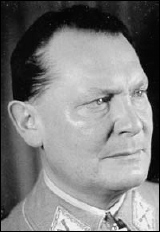
Reichsmarschall Hermann Göring, Minister for Aviation and commander-in-chief of the Luftwaffe, and founder of the Landespolizeigruppe ‘General Göring’ from which ultimately grew the Fallschirm-Panzerkorps ‘Hermann Göring’. His personal uniform is cut at the collar like the Luftwaffe Waffenrock; above his Pour le Mérite and Knight’s Cross he displays his unique award of the huge Grand Cross of the Knight’s Cross.
Hermann Göring was immensely proud of the unit which bore his name, and justifiably so. This force grew from its humble origins as a 400-man police detachment into a full armoured corps, and developed an enviable reputation for combat reliability.
The Luftwaffe was effectively a ‘Nazi’ creation, being formed in 1935, two years after Hitler had come to power: Hitler himself once declared, ‘I have a National Socialist air force, a Prussian army and a Christian navy’. Despite the ‘National Socialist’ tag, the premier ground combat unit of the Luftwaffe – though it no doubt had many convinced party supporters within its ranks – fought a relatively clean war, unlike many other combat units which owed strong political allegiances. Indeed, one of the ‘Hermann Göring’ Division’s greatest claims to fame during World War II was not a military exploit at all, but the saving from almost certain destruction of the historic treasures of the Benedictine abbey at Monte Cassino.
In February 1933, immediately after the National Socialist party was voted into power, Captain Hermann Göring, a Great War fighter ace and long-time collaborator with Adolf Hitler, was appointed to the position of Prussian Minister of the Interior, a post that gave him control of the Prussian State Police and brought him general’s rank. He immediately set about creating a new detachment, to be staffed from policemen whose reliability and loyalty to the National Socialist regime was unquestionable. Just over 400 men were taken on strength of the new unit, to be commanded by Major der Schutzpolizei Wecke. The unit, based in the Kreuzberg district of Berlin – a notoriously left-wing working-class area – was named after its commander, as Polizei-Abteilung zbV Wecke (‘Police Special Duties Battalion Wecke’). Within just one month the new unit was in action against armed Communist cells in Berlin. In July 1933 the detachment was renamed as Landespolizeigruppe Wecke (‘State Police Group Wecke’); and shortly thereafter once again as Landespolizei-gruppe General Göring.
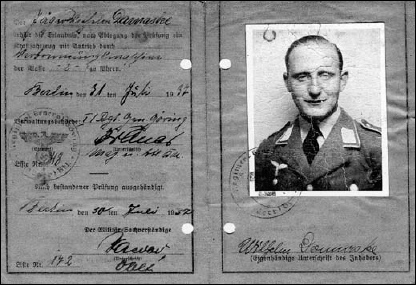
The driving permit of Jäger Wilhelm Damaske from I.Abteilung, Regiment ‘General Göring’; these documents were printed on tough oilcloth material. Note the white edge-piping to the collar of his four-pocket service tunic, and the distinctive white collar patches. (Private collection)
The detachment grew rapidly under Göring’s patronage, and in April 1935 it was formally expanded to regimental status as the Regiment ‘General Göring’, under the command of Oberst-leutnant der Landespolizei Friedrich Wilhelm Jakoby. Just six months after its creation, Göring had his regiment transferred from the Polizei – control of which would pass ultimately to his bitter rival, Reichsführer-SS Heinrich Himmler – into the newly formed Luftwaffe, of which Göring was named commander-in-chief. At that time the regiment consisted of the following elements:
Regimentstab (HQ staff)
Musikkorps (band)
I. & II.Jäger-Bataillonen (light infantry)
13.Kradschützen-Kompanie (motorcyclists)
15.Pionier-Kompanie (engineers)
Reiterzug (mounted troop)
Nachrichtenzug (signals platoon)
At the time when Regiment ‘General Göring’ was transferred to the air force, orders were given for the raising of a paratroop battalion. All volunteers for this unit, which was heavily oversubscribed by eager applicants, were concentrated in I.Jäger-Bataillon. At the end of 1937 attempts to disguise the intended use of these troops were abandoned and the volunteers, along with 15.Pionier-Kompanie, were renamed as IV. Fallschirmschützen-Bataillon (‘Parachute Rifle Battalion’). These units remained part of Regiment ‘General Göring’ until March 1938, when they were detached and sent to the training grounds at Stendal to form the cadre for the first of the Luftwaffe’s paratroop units, I./Fallschirmjäger-Regiment 1.
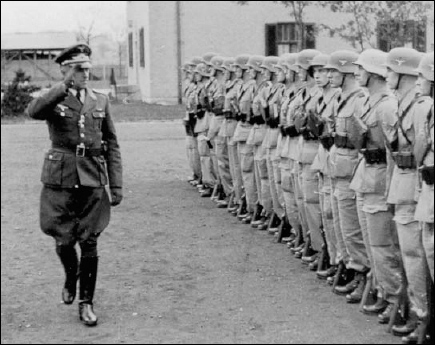
The Regiment ‘General Göring’ – like the Army’s élite Infanterie-Regiment ‘Gross-deutschland’ and the premier Waffen-SS regiment ‘Leibstandarte-SS Adolf Hitler’ – recruited throughout Germany, accepting only candidates of the highest calibre and in peak physical condition. They occupied a brand new purpose-built barracks complex at Berlin-Reinickendorf, constructed to the highest standards and with the most modern of facilities. The complex boasted over 120 buildings and included gymnasia, swimming pools both outdoor and indoor, sports areas, and even its own post office. ‘General Göring’ troops, in their distinctive uniforms with white collar patches and special unit cuffband, soon became a regular sight on the streets of Berlin.
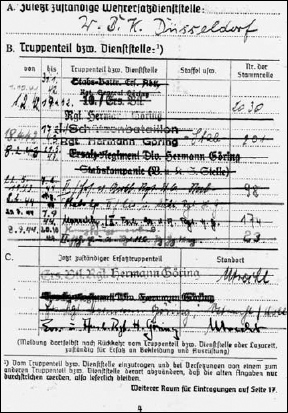
Extract from the Soldbuch (paybook) of a soldier of the division, showing the man passing through Ersatz u. Ausbildungs (replacement training and holding) units in between front line postings; the last entry is dated 20 October 1944. This man was a veteran of the original regiment, as evidenced by the numerous stamps from the replacement battalion of Regt ‘General Göring’; I./Schützenbataillon, Regt ‘Hermann Göring’; and the replacement regiment of Div ‘Hermann Göring’. (Private collection)
Troops of the regiment took part in many of the great pre-war military parades through Berlin. They provided guards for Reichsmarschall Göring’s own headquarters, the changing of the guard often being performed with all due ceremony including the presence of the regiment’s own Musikkorps. The regiment also undertook guard duties at Göring’s private retreat, the sumptuous Karinhall estate (named after his deceased first wife).
Among the criteria for acceptance into the regiment were the following: age of 18–25, minimum height of 1.68m (5ft 6ins), German citizenship, eligibility for military service, fitness for active service, Aryan ancestry, unmarried status, clean police record and no charges pending, and confirmed open support for the National Socialist state. During the war years a further requirement was added: that the potential volunteer must sign on for a minimum period of 12 years’ service. Such conditions were broadly analogous to those also demanded by the ‘Grossdeutschland’ and the ‘Leibstandarte’. Clearly, however, as the war progressed the scale of combat losses would mean that such restrictive criteria could no longer be sustained in any of these élite formations. Many Luftwaffe personnel were, in effect, simply drafted into the ‘Hermann Göring’ Division from other units to make up combat losses.
Prior to the outbreak of war, personnel from Regiment ‘General Göring’ participated in the so-called Blumenkrieg (‘Flower Wars’). The regiment took part in the annexation of Austria, where it remained for several weeks on duty in Wiener Neustadt; in the occupation of the Sudetenland and the march into Prague, after which it undertook guard duty at the strategically important Skoda vehicle works. By the eve of World War II in 1939 the regiment had grown considerably, and had the following establishment:
Regimentstab
Musikkorps
Stabsbatterie (artillery HQ battery)
I.(schwere) Flak-Abteilung (heavy AA artillery battalion)
II.(leichte) Flak-Abt (light AA battalion)
III.Scheinwerfer-Abt (searchlight battalion)
IV.(leichte) Flak-Abt
Wachbataillon (Guard, i.e. infantry battalion)
Reiterschwadron (mounted squadron)
9. Wachkompanie (infantry)
10. Wachkompanie
11. Wachkompanie
Reserve-Scheinwerfer-Abteilung
Ersatz-Abteilung (replacement training battalion)
(schwere) Eisenbahn Flak-Batterie (heavy railway AA battery)
(leichte) Flak-Batterie (light battery)
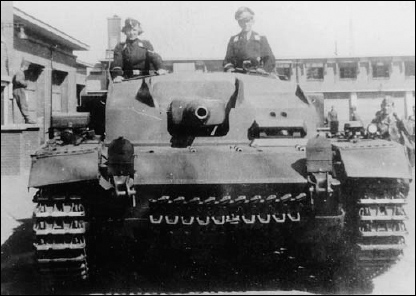
An early model StuG III armoured assault gun of the ‘Hermann Göring’. Note that the crew display cuffbands and the Luftwaffe-style white collar patches; from comparison of tones it is hard to tell if they are wearing the Army-style black Panzer vehicle uniform or the field-grey assault artillery equivalent. (Robert Noss)
Most of the regiment remained in Berlin during the Polish campaign of September 1939, providing anti-aircraft cover in the Reichshauptstadt and guards for Göring’s headquarters. Elements of the regiment did take part in the spring 1940 campaign in the West; detached troops participated in the invasions of Denmark and Norway in April, while the bulk of the regiment waited near the Dutch border for the order to move against France and the Low Countries. The detached elements, under the command of Hauptmann Kluge, were created with a company from the Wachbataillon together with a 2cm self-propelled Flak-Batterie and a Kradschützen-Kompanie. They took part in the seizure of the airfield and radio station at Esbjerg and the securing of the coastline of Jutland. Subsequently they were transferred by sea to Oslo, where they fought alongside the Army first in the advance to Trondheim, then north up into the Arctic Circle to take the port of Bodo and relieve the pressure on the beleaguered Gebirgs-jäger further north at Narvik. After successfully completing its allotted tasks, Hauptmann Kluge’s detachment was transported home to Berlin.
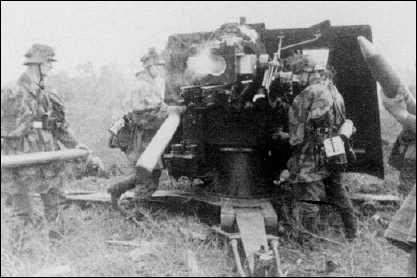
The deadly 8.8cm guns (‘eighty-eights’) which equipped the heavy batteries of the Flak units proved equally effective in the anti-aircraft and ground roles during the May–June 1940 campaign in the West, where the Regiment ‘General Göring’ earned the praise of the Army units with which it served. This crew are wearing the Zeltbahn camouflage shelter-half rigged as a rain poncho, and field camouflage on their helmets. (Josef Charita)
For the May/June 1940 campaign the Regiment ‘General Göring’ was divided into a number of small independent Kampfgruppen, operating in close co-operation with the rapidly advancing Panzer spearheads of the Army. The achievements of its Flak units were particularly appreciated; the superb 8.8cm dual purpose guns of the heavy batteries took a deadly toll of Allied tanks, many of which had heavier armour than their German counterparts. In Holland the unit took part in the crossing of the Maas and the advance into the eastern part of Belgium. There it crossed the Albert Canal against stiff resistance and took part in the capture of Brussels, before entering France. Once on French soil it fought in Flanders, and in a remarkable action at Mormal Wood, where ‘General Göring’ 8.8cm guns engaged French tanks at ranges of literally only a few yards. The regiment was rewarded for its excellent performance by forming part of the honour guard of the Führer-Begleit-Kompanie for the formal armistice ceremony at Compiègne on 21 June 1940. After the successful conclusion of the Western campaign troops from the regiment provided Flak defences in bunkers along the Channel Coast as well as contributing to the anti-aircraft ring around Paris. Eventually, in late 1940, the Regiment ‘General Göring’ returned to Berlin.
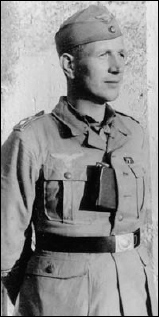
Fliegermütze‘der Spiess’