
| Osprey Modelling • 11 | |
Series editors Marcus Cowper and Nikolai Bogdanovic
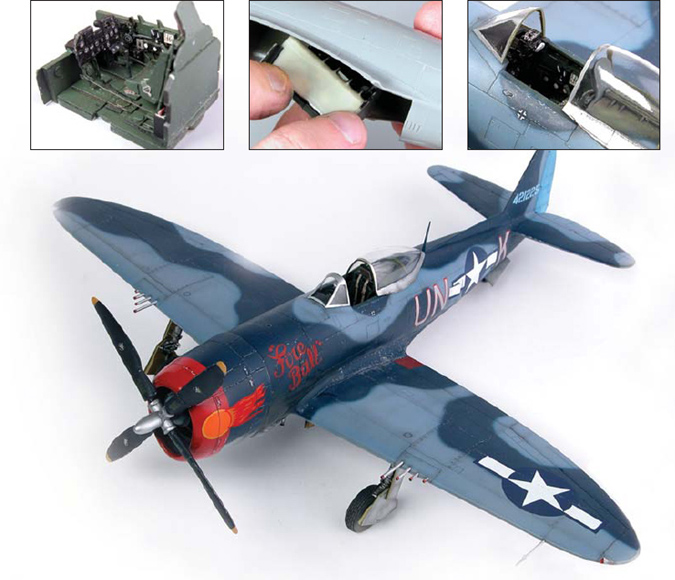
Introduction
The P-47’s historical background • P-47 variants
Modelling the P-47 in 1/48 scale
Building a P-47C in 1/48 scale
The P-47C and P-47D compared • P-47C conversion options
Modifying the keel • Building a P-47C with a bulged keel
Tamiya’s P-47D Thunderbolts (1/48 scale)
Tamiya’s P-47D Razorback in the box • Tamiya’s P-47D Bubbletop in the box
Building Tamiya’s P-47D Razorback straight from the box • P-47D Bubbletop of the 56th Fighter Group
P-47D Thunderbolt of the 404th
Academy’s 1/48-scale P-47D as a Thunderbolt Mk.II
Academy’s P-47D in the box • Detailing the kit • General assembly
Painting and markings • The finishing touches
‘Hot Rod Jug’: converting Hasegawa’s 1/48-scale Bubbletop to a P-47M
Hasegawa’s Bubbletop in the box • Construction • Painting and markings
Pacific heavyweight: ProModeler’s 1/48-scale P-47N
ProModeler’s P-47N in the box • Building ProModeler’s P-47N • Painting and markings
Further reading, media and websites
Further reading • Websites
Colour reference chart
The Republic P-47 Thunderbolt was the biggest and most heavily armed single-seater fighter of World War II. Its top speed and diving capability were impressive, thanks to its powerful Pratt & Whitney R-2800 engine and exhaust driven turbo-supercharger. Indeed, the P-47 was capable of approaching the sound barrier in a dive. Its robust design and huge radial engine also meant that the ‘T-bolt’ could absorb an enormous amount of punishment. This was particularly important on dangerous ground-attack missions, where a stray bullet in the cooling system of a Spitfire or Mustang could bring down these in-line powered aircraft with frightening speed. In contrast, there are stories of P-47s returning safely to their airfields with entire cylinders blown off their P&W engines.
On the other hand, the portly lines of the P-47 were hardly as glamorous as some of its sleeker counterparts such as the P-51. Indeed, the Thunderbolt was often referred to as the ‘Jug’. It has been suggested that this nickname was either due to the P-47’s resemblance to a milk jug, or as an abbreviation for ‘juggernaut’. Both explanations are equally fitting.
The P-47’s size and speed did create some problems. Firstly, it was thirsty. Its high fuel consumption meant that early versions of the P-47 could not escort Allied bombers all the way to their targets deep within the Third Reich, resulting in high bomber losses during daylight raids over Germany. Secondly, while the Thunderbolt’s stability and top speed were appreciated, its climb and turning performance were inferior to its Allied and German contemporaries. Thirdly, although its weight and power combined to bestow astonishing acceleration in a dive, the ‘Jug’ became dangerously unresponsive when approaching supersonic speeds. The control surfaces would lock up due to the compressibility effect, resulting in a disturbing number of fatal plunges to earth. This problem was addressed in later P-47 variants with the addition of small flaps beneath the wings that countered this effect. The heavyweight ‘Jug’ also needed particularly long runways for take-off and landing.
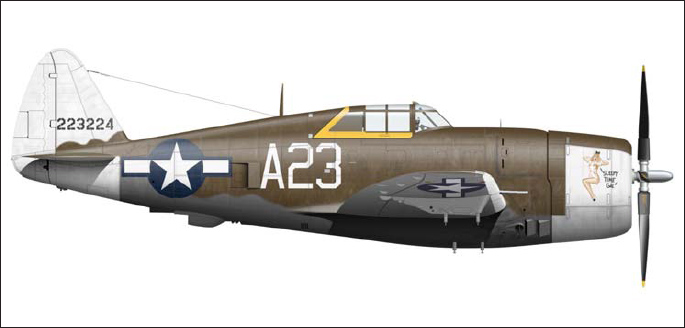
A P-47D Razorback wearing the white tail and leading-edge markings of the Pacific Theatre. (Tom Tullis)
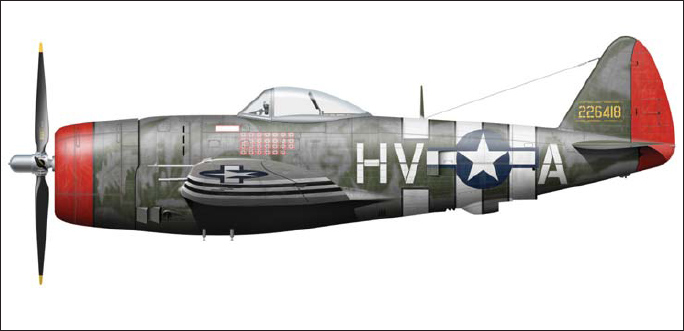
A P-47D Bubbletop. (Tom Tullis)
Despite the demands set by this huge and homely fighter, its ability to deliver a telling blow to targets in the air or on the ground, and its robustness even after sustaining major damage, made the Republic P-47 Thunderbolt a favourite of many World War II fighter pilots.
The first Thunderbolt production variant was the P-47B. This model inherited some of the characteristics of the prototype, including fabric-covered control surfaces and a short fuselage. A few P-47Bs featured a clamshell entry door and a turtledeck window, but these options quickly made way for the more familiar sliding framed canopy. The high-performance nature of the aircraft led to several accidents, some fatal, before control surfaces were re-skinned with metal. Even so, ongoing problems ensured that this first batch of 170 P-47Bs would never see combat.
The P-47C received an 8in. extension to the forward fuselage and a new deflector plate between the oil cooler door and the waste gate. It retained the short cowl flaps (with eight individual flaps), and the keel of the fuselage was flat. Many of the later production P-47Cs were retrofitted with the so-called ‘bulged keel’. This was a long, streamlined structure on the lower fuselage that incorporated plumbing, wiring and mounts for either a drop tank or a 500 lb bomb. The P-47C was the first variant of the Thunderbolt to be used in action, being introduced in Europe during 1943.
The P-47D was by far the most numerous of all Thunderbolts, and also saw the most change during the course of its production. Initial production batches were externally similar to the P-47C, but ongoing developments included the addition and refinement of four additional cowl flaps; standardisation of the ‘bulged keel’; introduction of wing pylons for more fuel tanks or bombs; and the installation of wider chord propeller blades. These visible differences were supplemented by many further mechanical improvements.
The P-47D-25 saw a more dramatic change to the profile of the Thunderbolt with the first ‘bubbletop’ canopy installed behind a redesigned windscreen on a cut-down rear fuselage. Development continued in other areas of the P-47D too. Fuel capacity increased, ailerons were redesigned and a small set of compressibility flaps was installed behind the undercarriage bay from the P-47D-30 onwards. The P-47D-40 permitted the fitting of five zero-length rocket stubs under each wing, and a small fillet was installed in front of the fin to improve directional stability. This fin was often retrofitted to P-47D-30 variants too. The cockpit also evolved: flat panels replaced the distinctive corrugated floor, probably as early as the P-47D-27 variant onwards. All in all, more than 12,000 P-47Ds were produced.
Table 1: characteristics of P-47 variants
| Variant | Engine | Cowl flaps | Canopy | Dorsal fin | Cockpit floor | Wing pylons | Comments |
| P-47C | R-2800 early | 8 | Razorback | n/a | Corrugated | No | Flat keel from factory. Many retrofitted with ‘bulged keel’ kit. |
| P-47D-1 | R-2800 early | 12 (rectangular bottom flap on each side) | Razorback | n/a | Corrugated | No | Early production aircraft were delivered with flat keel, but retrofitted later. |
| P-47D-15 | R-2800 early | 12 (modified profile of the rear of the bottom two flaps. Applies to all subsequent P-47s.) | Razorback | n/a | Corrugated | Yes | Factory fitted with bulged keel (from D-5) and water injection (from D-4). |
| P-47D-25 | R-2800 Early | 12 | Bubbletop | No | Corrugated | Yes | |
| P-47D-30 | R-2800 Early | 12 | Bubbletop | Often retrofitted (small ‘wedge’ style) | Flat (probably introduced from D-27 onwards) | Yes | Compressibility flaps added, also requiring relocation of landing light. |
| P-47D-40 | R-2800 Early | 12 | Bubbletop | Yes (small ‘wedge’ style) | Flat | Yes | Provision for five zero-length rocket stubs under each wing. |
| P-47G | R-2800 early | 8 (early production) or 12 (later production) | Razorback | n/a | Corrugated | No | Curtiss production equivalents to P-47C through P-47D. None saw combat service. |
| P-47M | R-2800 Late | 12 | Bubbletop | Often retrofitted (small ‘wedge’ style) | Flat | No (often retrofitted) | |
| P-47N-1 | R-2800 Late | 12 | Bubbletop | Yes (large style) | Flat | Yes | Wider wing span. Clipped wingtips. Landing gear relocated further outboard. No rocket stubs. |
| P-47N-2 | R-2800 Late | 12 | Bubbletop | Yes (large style) | Flat | Yes | As above, but rocket stubs retrofitted. Armrests on pilot’s seat from P-47N-15 onwards. |
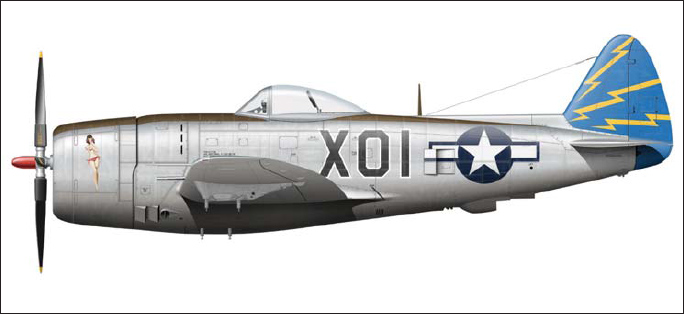
A late P-47D Bubbletop fitted with the small, wedge-shaped fin fillet. (Tom Tullis)
The high-performance P-47M was the first Thunderbolt to be fitted with the Pratt & Whitney R-2800-57 ‘C’ Series engine. The cylindrical crankcase on the front of the engine was a distinctly different shape to the bell-shaped item on earlier Thunderbolts. This hot-rod version was not initially fitted with wing pylons as it was intended to be a high-speed interceptor, but the pylons were often eventually retrofitted. Similarly, the small dorsal fin was not a factory item but was almost always seen on aircraft in service.
The P-47N was a long-range escort variant that also used the Pratt & Whitney R-2800-57 ‘C’ Series engine. It featured an increased wingspan, clipped wingtips, relocated landing gear and the large dorsal fillet.
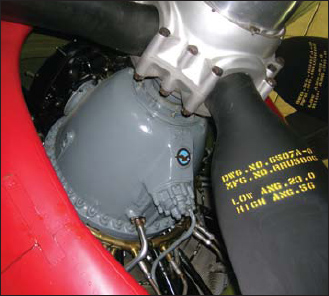
A view of the crankcase at the front of the engine on the P-47D at the RAF Museum, Duxford, UK. The distinctive dome shape identifies this engine as an early Pratt and Whitney R-2800.
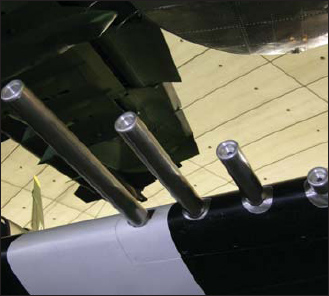
The staggered protuberances from the wing leading edge of the Duxford Thunderbolt are blast tubes. These shiny chrome steel tubes cover the .50-calibre gun barrels.
Modellers have been well served with 1/48-scale P-47 Thunderbolt kits over the years. Monogram issued their 1/48-scale P-47D Bubbletop more than 30 years ago. This kit represented a great leap forward from other contemporary models. Key features included a nicely detailed cockpit, engine and wheel wells, plus raised, but quite convincing, panel lines. A Razorback version was released by Monogram some years later. Although both of these kits have been superseded by more recent releases, they still hold a sentimental place in many modellers’ hearts. With some extra effort they can still be made into very respectable looking models. Otaki from Japan was next, with their 1970s release of a 1/48-scale P-47D Razorback. This kit has an acceptable profile and neatly engraved panel lines, but suffers from simplified wheel wells, cockpit and engine detail. This model was later released by Arii and also by AMT/ERTL. Despite their age, the Monogram and Otaki kits are still available today.
Academy signalled the first of a new generation of 1/48-scale Thunderbolt kits in 1996 with their P-47N. Over the next few years, this was followed by Hasegawa’s P-47D Bubbletop, ProModeler’s P-47N, Academy’s P-47D Bubbletop and Hasegawa’s P-47D Razorback. Tamiya set a new standard in late-2002 with their 1/48-scale P-47D Razorback. The P-47D Bubbletop released during 2003 maintained this level of quality.
In this book, each of the new generation of 1/48-scale P-47 kits will be built, with a special emphasis on Tamiya’s gorgeous Thunderbolts. Some conversions will also be suggested to obtain an accurate P-47C and P-47M model in 1/48 scale. At the time of writing, neither of these variants is available as a model kit in this scale. The P-47 Thunderbolt also wore some of the most colourful nose art and markings in the USAAF, so this subject offers a terrific range of finishing options. With so many kit choices plus plenty of accessories and markings for P-47 kits, life is good for Thunderbolt fans!
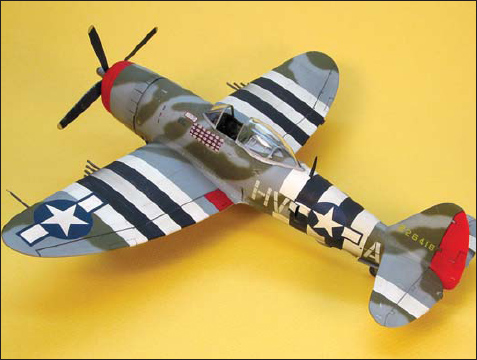
David W.Aungst built Monogram’s venerable 1/48-scale P-47D Thunderbolt kit almost without modification. Despite its age, it still looks good!