| STEPHEN TURNBULL | ILLUSTRATED BY PETER DENNIS |
Series editors Marcus Cowper and Nikolai Bogdanovic
Sohei and monto • The rise of the warrior monks • Jodo Shinshu and the first fortified temple
The Ikko-ikki take control of Kaga • The founding of Ishiyama Honganji • Challenge to the Honganji
The last stand of the Ikko-ikki
The design features of a typical Japanese Buddhist temple • The early aristocratic temples of Nara
The development of esoteric mountain temples • The ‘peoples’ temples’ of Jodo Shinshu
The temporary fortifications of the sohei • The defence of the early Ikko-ikki temples
Temple defences in the age of gunpowder
The sohei temples of Nara • Yoshizaki Gobo – the first permanently fortified temple
Nagashima – defence of river and sea • Torigoe – temple as yamashiro
Ishiyama Honganji – the fortified cathedral • The jinaimachi of Tondabayashi
Negorodera – the fortress of the last of the sohei
The social structure within a fortified temple • Organization and discipline in Jodo Shinshu
Religious life in the fortified temples • Training for war • Daily life in times of war
Sohei temples in the Gempei Wars (1180–85) • The siege of Ishiyama Honganji (1570–80)
Nagashima (1571–74) • Torigoe and Futoge (1581–82) • Negorodera and Ota (1585)
The reference in the Preface to the existence of jinaimachi (temple towns), which were very well defended as part of the overall environment of a religious community, begs the question as to the true identity of the inhabitants of the fortified temples and monasteries for whom the expression ‘warrior monk’ is often used. This is the popular translation of the word sohei, which literally means ‘priest soldier’, and refers to the armies maintained by the monasteries of Hieizan and Nara from about AD 970 until the 16th century. It can also be applied to the Shingon temple called Negorodera in Kii Province. A helpful comparison is with the military religious orders of Europe that emerged during the Crusades. Indeed, this provided a useful analogy for the only European visitor ever to make their acquaintance, the Jesuit missionary Father Caspar Vilela, who visited Negorodera early in the 1560s and described its adherents as being like the Knights of St John.
The populist Jodo Shinshu communities, however, were very different, and to describe the monto (believers) of Jodo Shinshu as ‘warrior monks’ is highly misleading. Their communities attracted samurai, farmers and townsmen in associations of shared religious beliefs led by ordained priests. The Ikko-ikki, as the armies of Jodo Shinshu were known, were certainly warriors but never warrior monks. In fact the teachings of Shinran (1173–1262), with whom the sect originated, had revolutionized Japanese Buddhism by doing away with the duality of monasticism and laity and replacing it with a new emphasis on spiritual egalitarianism. So rather than comparing the Ikko-ikki to the Knights of Rhodes, a better European analogy would be the Hussites of Bohemia or the extreme Puritan communities that arose a century later during the Reformation. Linked by zeal for their beliefs, and under the leadership of charismatic preachers, they formed self-governing communities defended by armies. So it was with Jodo Shinshu and their fortified temples.
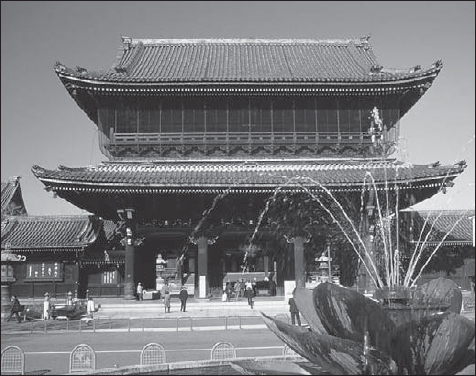
The goeido mon (founder’s gate) of Higashi Honganji, the present-day headquarters in Kyoto of the Otani branch of the Honganji, the ‘original vow’ temple of Jodo Shinshu. This immense gate was built in 1911.
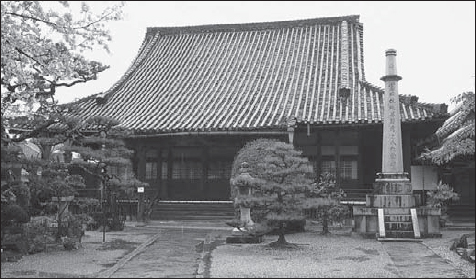
The Jodo Shinshu temple of Koshoji. It is located in the historic jinaimachi (temple town) quarter of Tondabayashi, a town near Osaka.
The original Buddhist priest soldiers were formed as a result of the rivalries that existed between the temples of Nara, the old capital of Japan, and of Hieizan, the mountain that lay near to Kyoto, the city that replaced Nara as capital in AD 894. The great temples of Nara such as Todaiji and Kofukuji resented the move to Kyoto, and were particularly jealous of Enryakuji, the temple that was located on the summit of Hieizan. There were also major arguments over the right of the Hieizan clergy to ordain new monks instead of this being performed exclusively in Nara.
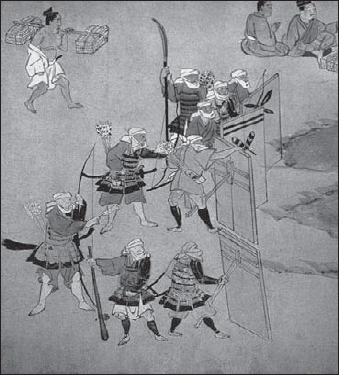
Sohei of the late 16th century, indicated by the inclusion of a gun, are shown here defending their temple using portable wooden shields.
The first major incident of violence involving priests happened in AD 949. It began as a protest demonstration by a delegation from Todaiji to Kyoto, and ended with a brawl during which some of the participants lost their lives. Other incidents followed, so, in about AD 970 Ryogen, the zasu (chief priest) of Enryakuji made the decision to create a permanent fighting force to defend Hieizan and its growing wealth. These men soon became involved in inter-temple disputes, some of which were fought between Enryakuji, and its daughter temple Onjoji, or Miidera, which lay at the foot of Hieizan. Over the next 100 years there are references to fighting between Enryakuji, Miidera and the temples of Nara. By 1006 the Kofukuji of Nara could field an army numbering some 3,000 sohei. There were also several instances when sohei marched down to Kyoto to place their demands in front of members of the imperial court, whom the sohei intimidated as much with their curses as they did with their weapons.
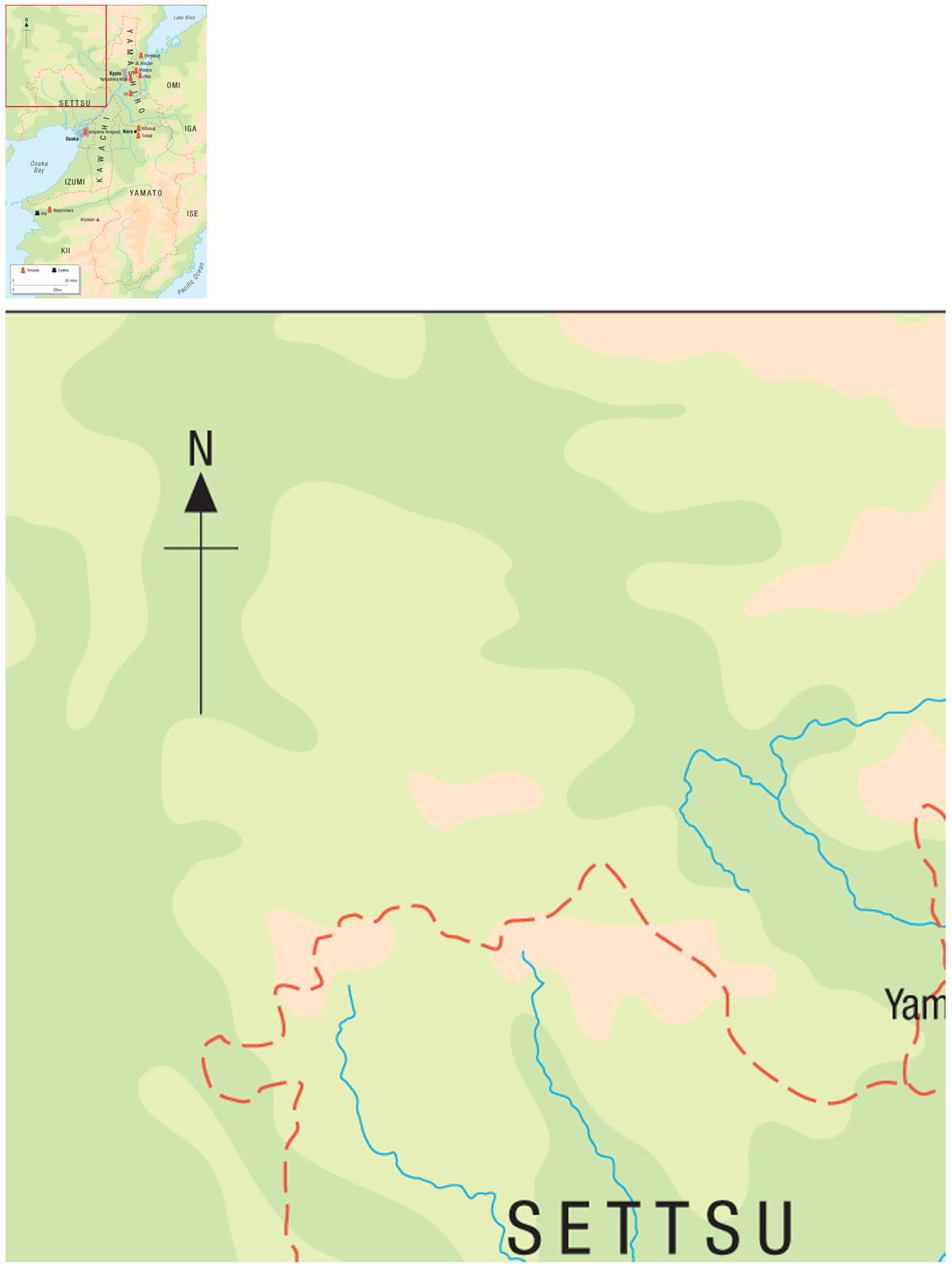
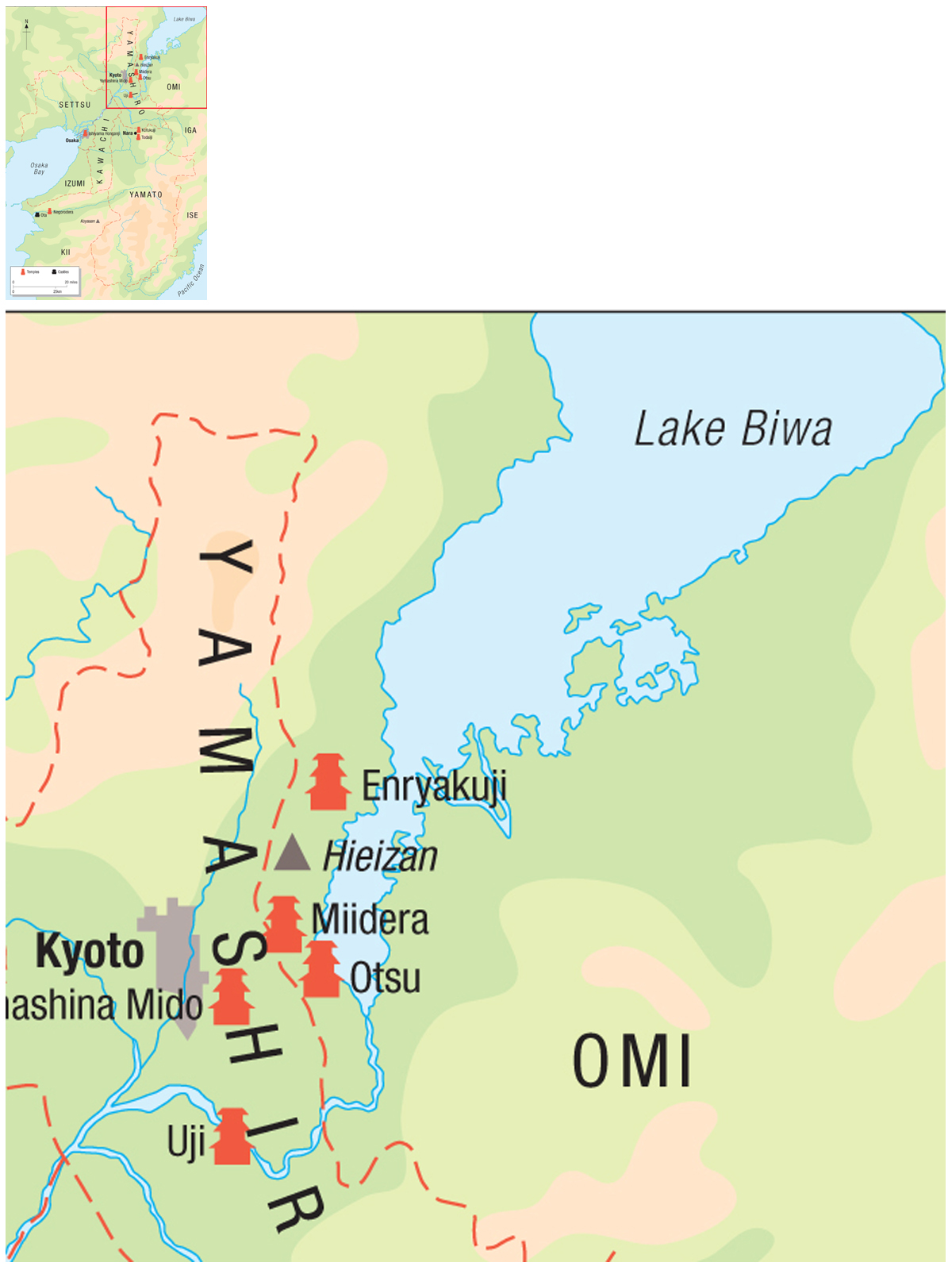
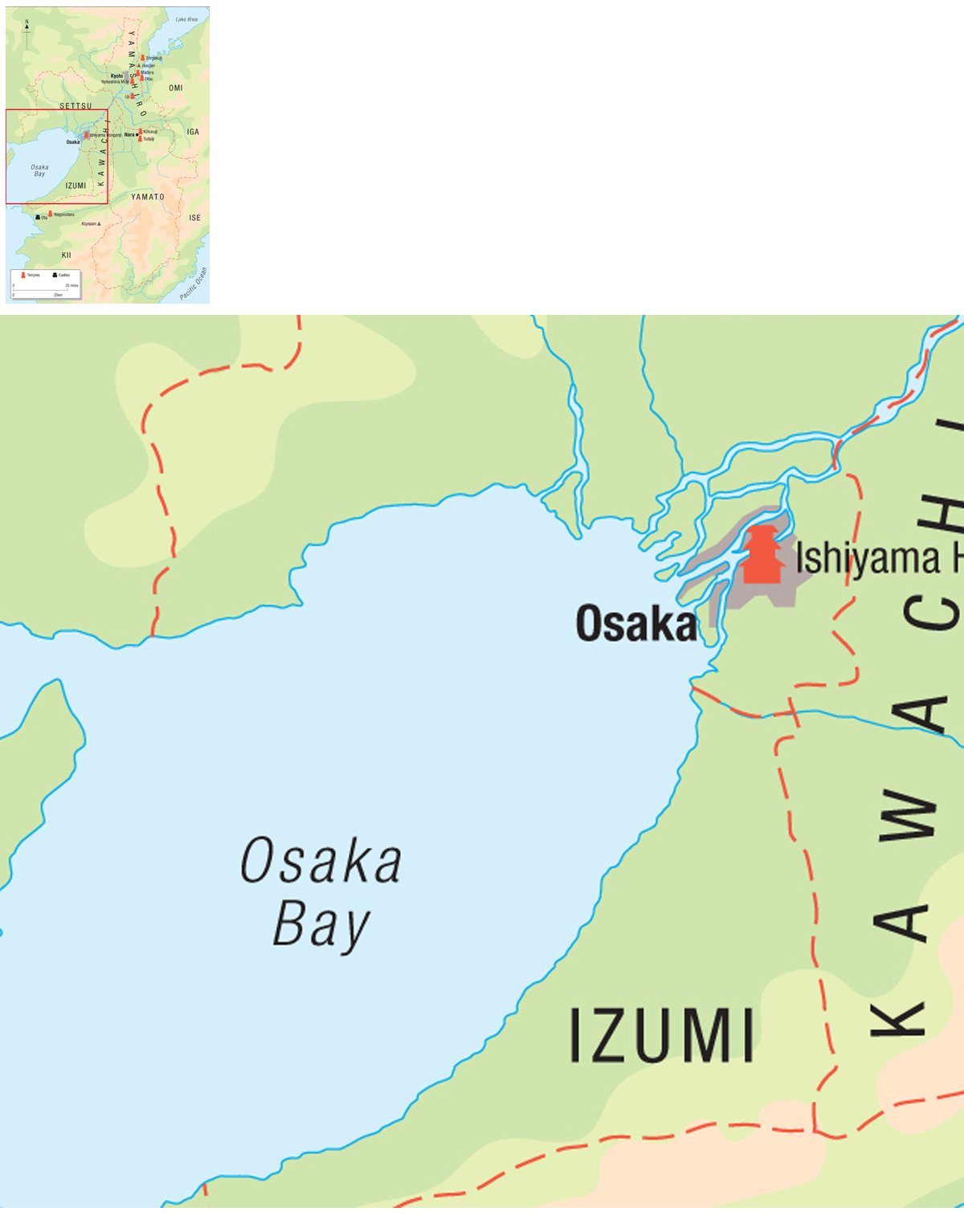
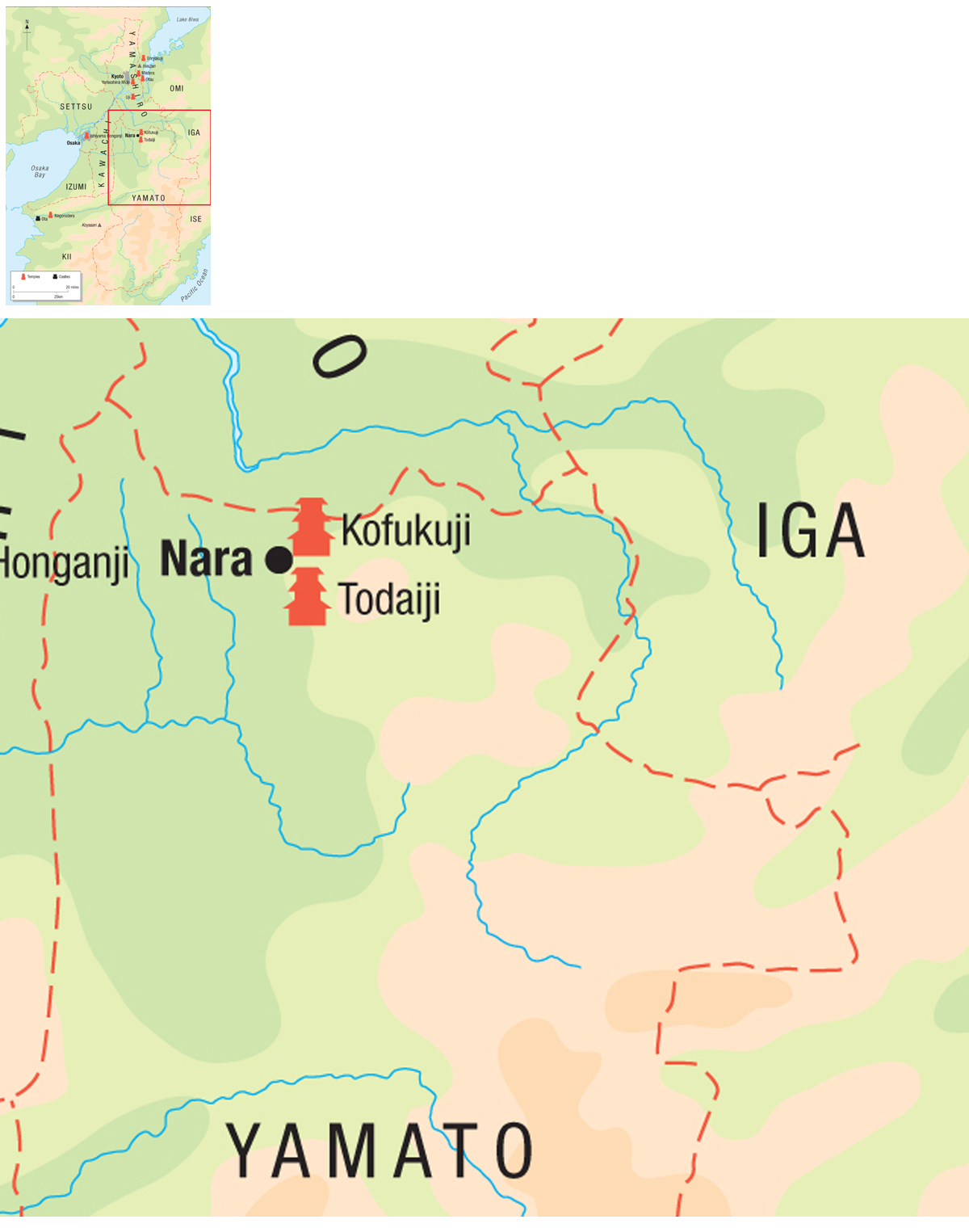
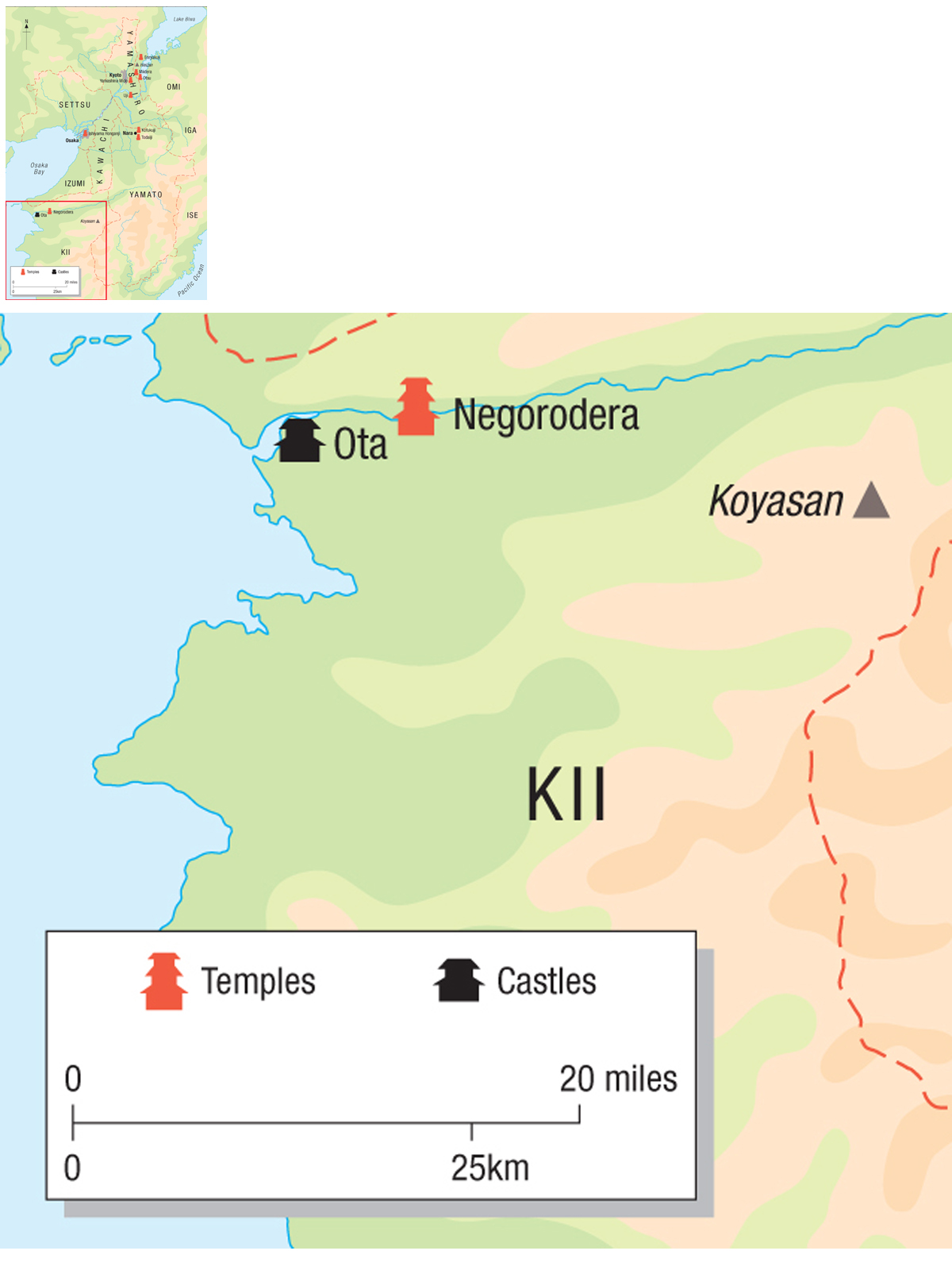
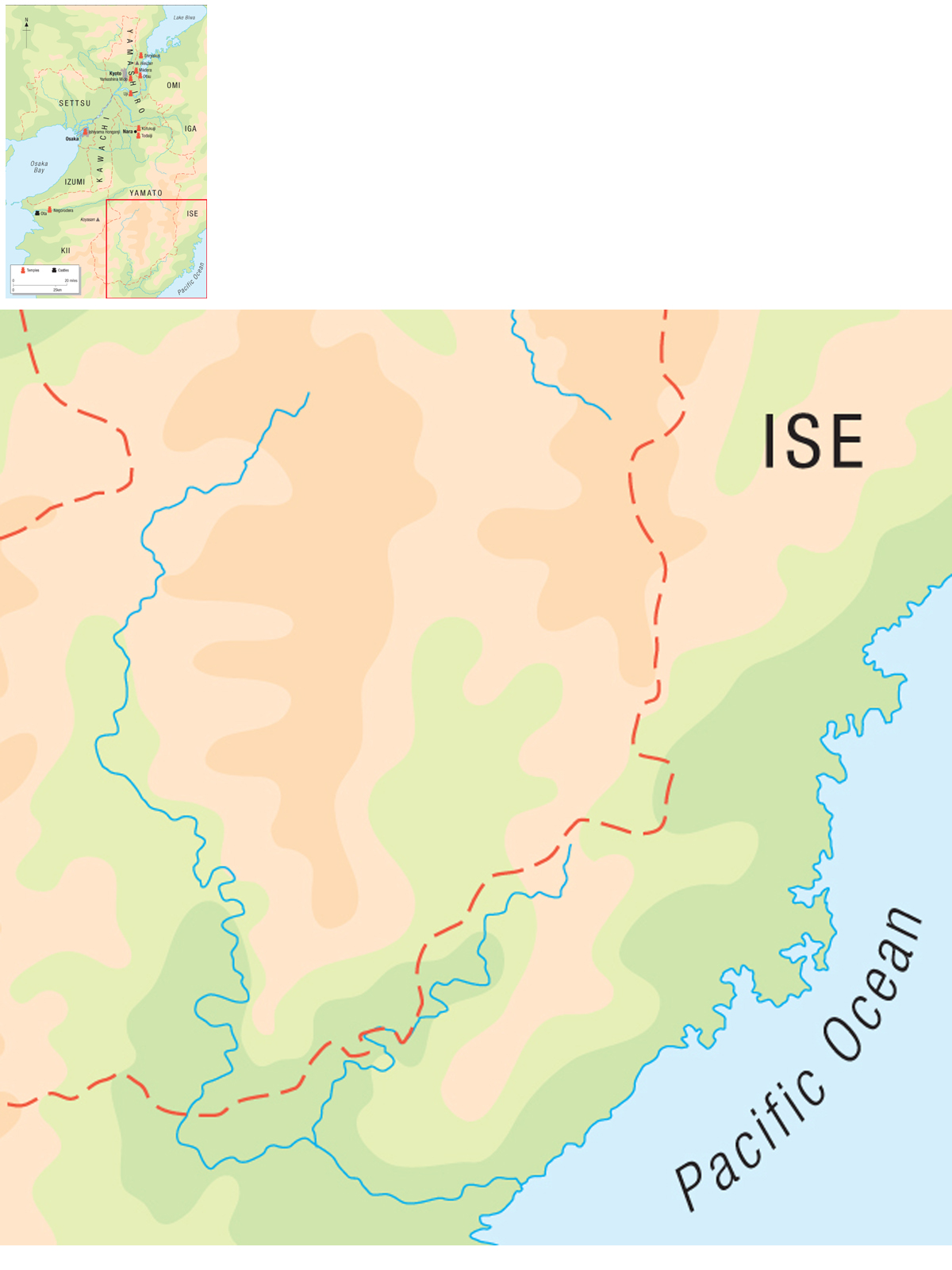
The warrior monks and their monasteries in the area around Kyoto, showing places associated particularly with the Gempei War 1180–85. (© Osprey Publishing Ltd)
There were no permanent fortifications associated with these sohei sites. The Enryakuji was defended solely by its position on a high wooded mountain. The temples of Nara were more open to assault, and were forced to erect temporary fortifications when they were faced with attack in 1181. This was at the start of the Gempei Wars, a struggle for supremacy between the samurai families of Taira and Minamoto. The sohei involvement was brief, tragic and almost totally destructive of them as an entity. The monks of Miidera supported the imperial claimant put forward by the Minamoto family, but were heavily defeated at the first battle of Uji in 1180 as they were heading south from Kyoto to join up with their fellow sohei from Nara. The victorious Taira took terrible retribution, and after a desultory defence Miidera was burned to the ground. in 1181 the Taira burned down most of the buildings in Nara, including Todaiji and its huge statue of Buddha. The destruction of Nara was such a shock to the priests of Hieizan, who had been standing aloof from the conflict, that there was almost no more sohei activity for the rest of the Gempei Wars.
Minamoto Yoritomo, the victor in the Gempei Wars, became the first shogun (military dictator) of Japan and established the principle of samurai rule. His religious sensibilities, however, encouraged him to rebuild the Nara temples, and it was not long before the monks rediscovered their military skills. In 1221 we read of warrior monks from Nara being involved in the brief Shokyu War. Monks from Hieizan fought in the Nanbokucho Wars of the 14th century, and were active until their final destruction in 1571.
Around about the time of the Shokyu War an important new development was taking place in Japanese Buddhism through the teachings of Shinran, who founded Jodo Shinshu, the ‘True Pure Land Sect’. The new sect’s beliefs contrasted sharply with the monastic approach of the older institutions of Nara and Kyoto and proved highly attractive to the lower orders of society. Its features included local membership centred around village meeting places, a charismatic leadership under the headship of Shinran’s lineal descendants, who were free to marry, and a fundamental independence from traditional regimes, whether aristocratic or military. In 1272 Shinran’s daughter Kakushinni (1221–81) built the Otani mausoleum in Kyoto to house the ashes of her father, and in 1321 Shinran’s great-grandson Kakunyo (1270–1351) converted it into the first Honganji, the ‘temple of the original vow’. From then on the expression ‘Honganji’ came to refer not only to the building that was its headquarters, but to the dominant Honganji-led faction in Jodo Shinshu. At Otani Honganji, Kakunyo began to develop the ideas of Shinran into a coherent religious system.
In spite of it being the location of the grave of Shinran, recognition and power came very slowly to Otani Honganji during the first century and a half of its existence. Much of Shinran’s original missionary work had been in the Kanto provinces, the area around modern-day Tokyo, so the Kanto temples such as Sensuji in Takada in Shimotsuke Province were unwilling to defer to the wishes of the Honganji. All was to change with the tenure of Rennyo (1415–99), the eighth head of the Honganji and Jodo Shinshu’s great revivalist.
The second half of the 15th century, when Rennyo led the Honganji, was a time of great instability in Japan. The Ashikaga family had ruled Japan as shogun for over a century, but their tenure had become dominated by the petty quarrels of the shugo, the governors of a province or a group of provinces. The weakness of and divisions within the Shogunate came to a disastrous climax with the outbreak of the Onin War in 1467. Japan’s capital city of Kyoto was the main battleground, and by the time the fighting ended in 1477 most of the city lay in ruins. The original cause of the conflict had been a succession dispute within the Shogunate, but by 1477 that had become an irrelevance with the shogun rendered almost powerless to control the course of events. Worse still, the fighting had spread to the provinces, as erstwhile shugo fought for supremacy and territory. Some succeeded in transforming themselves into independent feudal lords, for which the term daimyo (literally ‘great name’) is used. But former shugo were not the only daimyo around. Many more of them were military opportunists who had taken their chances and created petty kingdoms of their own. The century during which they fought each other is known by analogy with Chinese history as the Sengoku Jidai (The Warring States Period).
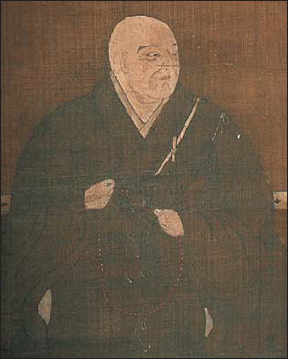
Rennyo Shonin (1415–99), the great reformer and revivalist of Jodo Shinshu, the sect that created so many of the fortified temples of Japan.
One consequence of the breakdown of law and order was that the lower orders of society were no longer content to be ruled by an impotent shogun or an ambitious shugo. Instead, groups of peasants and low-ranking samurai used the weakness of established authority to assert their own autonomy. Popular uprisings and riots became a common feature of the times. They ranged from local disturbances to province-wide revolts, incidents that were generally referred to as ikki (riots), the original use of the word that was later used to designate those who took part in them. Into this turmoil walked Rennyo and his Jodo Shinshu followers, who were to contribute to the political history of Japan in a way that none of them could have envisaged.
Rennyo’s personal charisma and his effectiveness as a preacher and proselytizer go a long way to explain why the Honganji branch of Jodo Shinshu grew at the expense of other factions. But there was another factor involved, and the stimulus came, ironically, from the warrior monks of Enryakuji. They were enraged by the influence that Otani Honganji was having on their traditional control of the religious life of the capital, so in 1465 an army of sohei descended upon Otani Honganji and burned it to the ground. Rennyo escaped from their clutches and took refuge with a few followers in nearby Wakasa Province. Not long afterwards the Hieizan monks pursued him there, but were attacked and driven off by the local Honganji members. This was the first manifestation of the military capabilities of the Jodo Shinshu monto that would make them so feared in the years to come.
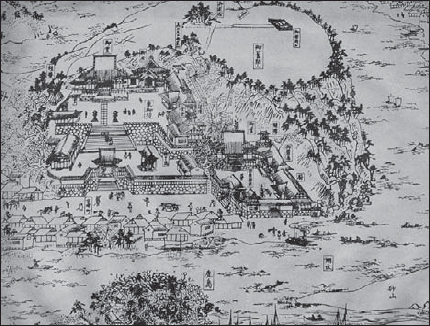
In 1471, to put even greater distance between himself and the warrior monks of Hieizan, Rennyo moved to Yoshizaki in Echizen Province on the coast of the Sea of Japan. The area had already been thoroughly evangelized by Rennyo’s uncle, so Rennyo was enthusiastically welcomed by the local monto. They helped him to build a new headquarters called Yoshizaki Gobo, which was completed in just three months. Here Rennyo produced some of his most important writings. He encouraged the local believers to set up ko (fraternities) that would not only be prayer organizations but would lay the foundations of future self-governing communities. But Yoshizaki Gobo was not just a Jodo Shinshu temple. It was built on a defensible plateau overlooking the sea, and Rennyo personally attended to the details of its fortification. He also urged the monto to be prepared for unhesitating sacrifice in defence of their faith. The first permanently fortified temple in Japan had been created.
Although Rennyo made it clear to his followers that resort to arms was justified only in the most extreme cases where the survival of Jodo Shinshu was at stake, to fortify a temple was a radical departure from the original teachings of Shinran, who had simply advocated moving to another place in the event of persecution. But this was the Sengoku Jidai. Unfortunately, although Rennyo’s attitude was realistic, it left his organization open to possible abuse by militant monto who saw the ideological and military strength of the Honganji as a way of advancing their interests. Rennyo soon became alarmed by the belligerence shown by some monto who, incited by militant priests, began to attack other sects and challenge the civil authorities. Membership of Jodo Shinshu also proved attractive for low-ranking members of the samurai class who were able to combine their own small forces under a common banner to produce an effective army. The pacifist Rennyo viewed all samurai with distaste, and wrote on one occasion that they were the ‘enemies of Buddhism’, but increasing numbers of samurai became monto. Their fighting skills were to prove useful in the years to come, with very dramatic results.