
Aviation Elite Units • 29 |
 |

CHAPTER ONE
EVOLUTION
CHAPTER TWO
FORMATION
CHAPTER THREE
CONSOLIDATION
CHAPTER FOUR
EXPERIMENTATION
CHAPTER FIVE
ATTRITION
CHAPTER SIX
DESTRUCTION
APPENDICES
COLOUR PLATES COMMENTARY
BIBLIOGRAPHY
In many respects, the partnership between Walter Nowotny and Karl Schnörrer typified the lives of Luftwaffe fighter pilots during the middle years of World War 2. One became a famous Experte, the other would earn a reputation as a first rate wingman. Yet, the former would be killed flying what – at the time – was the world’s most technologically advanced fighter aircraft, while the latter would fly the same type of machine – despite severe injuries – to the end of the war and survive. That aircraft was the Messerschmitt Me 262.
Nowotny, Austrian by birth, had entered the Luftwaffe in October 1939, and in 1941 he had joined JG 54, quickly being posted to the Eastern Front. The young, still novice, pilot claimed his first aerial victories over Ösel Island in July, when he shot down two Russian I-153 biplanes, but was himself shot down in the same engagement and subsequently spent three days and nights at sea in a rubber dinghy. However, he went on to shoot down five Russian fighters on 20 July, and on 11 August he destroyed two more. Although sustaining hits to his Bf 109G-2, Nowotny managed to nurse his badly damaged aircraft back to base and crash-land, although suffering injuries in the process.
In recognition of a seemingly meteoric subsequent service record, Leutnant Nowotny was awarded the Knight’s Cross on 4 September for his accumulated 56 victories and was appointed Staffelkapitän of 1./JG 54 of the now famous Grünherz Geschwader in late October 1942 (see Osprey Aviation Elite Units 6 - Jagdgeschwader 54 ‘Grünherz’ for further details). By 15 June the following year, he had registered his 100th victory, and on 10 August 1943, he was appointed Gruppenkommandeur of I./JG 54. On 1 September 1943, Nowotny shot down ten enemy aircraft – five in the space of 12 minutes in the morning, with a further five within nine minutes around midday. The following day he downed six more!
The Oakleaves to the Knight’s Cross followed on 4 September when Nowotny’s score stood at 189 victories, and within four days he had shot down his 200th kill. The then Hauptmann Nowotny received the coveted Swords in September for 218 victories, and went on to achieve 250 kills – a score which, at the time, made him the world’s ranking fighter ace. On 19 October he became the eighth recipient of the Diamonds, which was then the highest award for operational service that could be presented to a Luftwaffe pilot.
At that point, Adolf Hitler decided to withdraw Nowotny from the risks associated with combat on the Eastern Front and use him at home as a propaganda icon – where, in many ways, he could be just as valuable. He left for France in early February 1944, having amassed a score totalling 255 victories.
Karl Schnörrer, who was a native of Nürnberg, also served with I./JG 54, and claimed his first victory over the Eastern Front in December 1941. In late 1942, Nowotny selected Feldwebel Schnörrer to fly as his Kaczmarek (wingman), and the two fighter pilots subsequently became close friends.
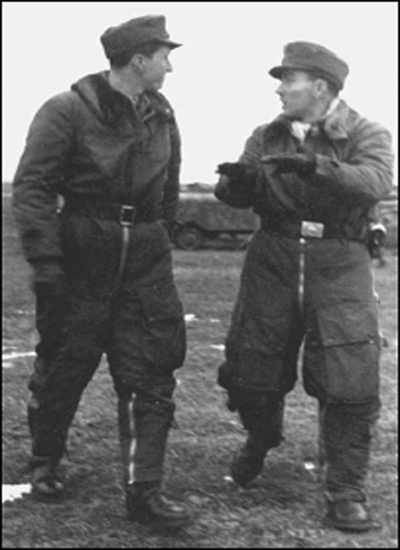
An ace and his wingman. Walter Nowotny (left), seen here as Kommandeur of I./JG 54, listens to Karl Schnörrer describe an aerial encounter over Russia in 1943 shortly after returning from another mission. Nowotny was awarded the Diamonds to the Knights’ Cross in October 1943 – the eighth such recipient – at which point he left the Eastern Front on the express orders of Hitler. The following month, after being injured when baling out of his Fw 190 too low to the ground, Schnörrer also left Russia. In the autumn of 1944 Nowotny was made commander of a new Me 262-equipped fighter unit that bore his name, and the two pilots were duly reunited when Schnörrer was posted to the Kommando
Despite a reputation for being a hard man on his aircraft following three landing accidents whilst at the controls of Bf 109s, Schnörrer became an invaluable and trusted partner to Nowotny during the latter’s stellar rise as a fighter ace. It is perhaps a measure of his priorities, that Schnörrer, who had earned himself the slightly unjust nickname of ‘Quax’ after an accident-prone cartoon character, had scored 20 victories by 18 August 1943, against his flight leader’s score of 151. However, on 12 November 1943, both pilots embarked on their last mission on the Eastern Front when they took part in extensive air operations over the Nevel area.
Engaging a formation of Soviet Il-2 Shturmoviks, Nowotny shot one down for his 255th victory and Schnörrer destroyed another one when it attempted to attack Nowotny’s aircraft. This would be Schnörrer’s 35th victory, but it would come at a cost, as he recalled;
‘I had flown operations in Russia in the Bf 109 and Fw 190. On 12 November 1943, I was shot down and badly injured after I had got my 35th Russian aircraft. I had baled out too low for my parachute to open and came down into some trees. I had concussion, my ribs were broken, both my knees were broken and my arms were broken. German infantry rescued me from no-man’s land.
‘Generaloberst Ritter von Greim, the commander of Luftflotte 6, ordered that I should be flown back to Germany in his personal He 111 to receive the best treatment that was possible. Nowotny escorted me back.’
In the meantime, Nowotny had been ordered to take command of a fighter training unit, JG 101, in southern France – a relatively safe role which he assumed in February 1944. After some quiet months in his relatively dull French ‘backwater’ at Pau, Nowotny made an excited visit to his old friend, ‘Quax’, who was still recovering from his injuries. ‘Once every three weeks or so Nowotny would visit me in hospital and bring me food, drink and cigarettes’, Schnörrer recalled. ‘On one such visit he said to me, “Quax, we’re going to get a very new aircraft – a jet aircraft”. That was in the summer of 1944, and I made my first flight in an Me 262 that year, with my legs still in plaster’.
Professor Willy Messerschmitt’s state-of-the-art fighter had first taken to the air using pure jet power on 18 July 1942 when company test pilot Fritz Wendel made a trouble-free flight from Leipheim. Following a delayed gestation, largely attributable to setbacks and problems with engine development and supply from BMW and Junkers, Wendel was able to report generally smooth handling during the maiden test-flight, during which he achieved an unprecedented airpseed of 720 km/h. Despite misgivings, Wendel also recorded that the Junkers T1 engines had ‘worked well’.
Germany now possessed the technology it needed to respond to the ever-growing threat of Allied air power in the West.
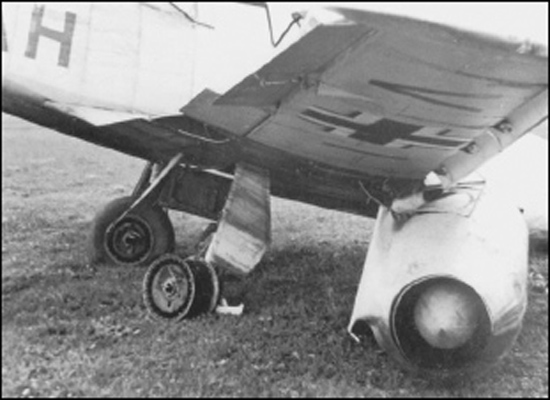
Ominous events overshadowed the Me 262’s development programme when, in mid-1944, a number of early series aircraft suffered mishaps. Here, Me 262 S3 Wk-Nr. 130008 VI+AH is seen having crash-landed at Lechfeld on 16 June. Both turbojet engines were ripped off as a result of the crash and the nose, wings and undercarriage were also damaged
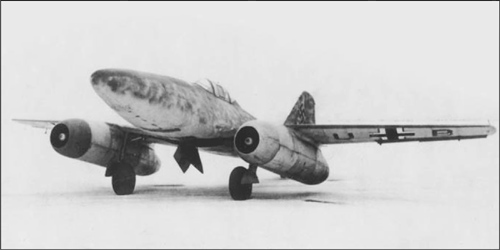
On 17 April 1943, Me 262 V2 Wk-Nr. 262 000 0002 PC+UB, distinctive here through the absence of the aircraft’s familiar nosewheel, was assessed in flight by Major Wolfgang Späte, a 72-victory Knight’s Cross holder and former Staffelkapitän of 5./JG 54. Späte subsequently reported that, in his view, with its combination of high performance and heavy armament, the jet fighter would be able to prove efficient against both enemy fighters and bombers. However, the very next day, the same machine nose-dived and crashed, killing test pilot Oberfeldwebel Wilhelm Ostertag, following an engine flame-out
From then on, until mid-1944, development on the Me 262 forged ahead using a series of prototypes to test all aspects of the aircraft. There were highs and lows. Dipl.-Ing. Heinrich Beauvais crashed the Me 262 V3 in August 1942 after three abortive attempts to take off. On 18 April 1943, Oberfeldwebel Wilhelm Ostertag was killed when one of the Jumo 004 turbojets on the Me 262 V2 flamed out, throwing the jet into a steep dive from which it never recovered. Later, in May 1944, Unteroffizier Kurt Flachs was killed when the Me 262 V7 crashed on its 31st flight.
The first series production aircraft were also plagued by problems too, suffering from burst tyres, electrical and mechanical maladies and persistent engine flame-outs. In June 1944 alone, the S7 crashed on the 1st following an engine fire, the Me 262 S1 suffered a damaged starboard wing on the 11th, while the fuselage nose, wings and both engines of the S3 were damaged in a crash landing at Lechfeld on the 16th.
Nevertheless, the Luftwaffe had been advocating the potential benefits of the Me 262 for some time. Persuaded by Messerschmitt, as early as 17 April 1943, Hauptmann Wolfgang Späte (a 72-victory Knight’s Cross holder and former Staffelkapitän of 5./JG 54) flew the Me 262 V2 – the first Luftwaffe pilot to do so. Two days later he reported to the General der Jagdflieger, Generalmajor Adolf Galland;
‘Flight characteristics are such that an experienced fighter pilot would be able to handle the aircraft. In particular, the increase in air speed when compared to the fastest conventional fighter deserves attention. This is not expected to decrease markedly when armament and radio equipment have been fitted.
‘Characteristically, jet engines will not only maintain this speed at altitude, but increase it. The climbing speed of the Me 262 surpasses that of the Bf 109G by five to six metres per second at a much better speed. The superior horizontal and climbing speeds will enable the aircraft to operate successfully against numerically superior enemy fighters. The extremely heavy armament (six 30 mm guns) permits attacks on bombers at high approach speeds with destructive results, despite the short time the aircraft is in the firing position.’
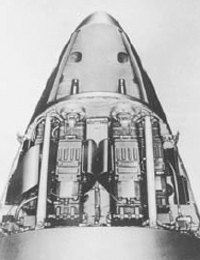
Firepower – the ‘sharp end’ of an Me 262A-1a, showing the standard installation of four MK 108 30 mm cannon in the nose. The MK 108 was manufactured by Rheinmetall-Borsig, and it proved to be a deadly weapon during close-range combat with heavy bombers. Although a powerful weapon, the MK 108’s cheapness and ease of manufacture made it prone to jamming and other forms of malfunction
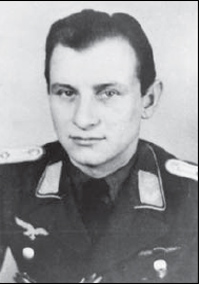
Leutnant Günther Wegmann served as adjutant to the commanders of both Erprobungskommando 262 and Kommando Nowotny. He later led 11./JG 7, but was severely wounded on 18 March 1945 when his Me 262 was hit by defensive fire from a B-17 over Glöwen. Wegmann baled out but eventually suffered the amputation of one of his legs following the incident
This was music to Galland’s ears. On 22 May 1943, he flew the Me 262 V4 himself at Lechfeld (after an attempt to start the engines of the V3 resulted in a fire) and made his famous report to Reichsmarschall Göring in which he enthused ‘It felt as if angels were pushing!’ Galland became a firm advocate for the further development of the jet, and wrote to his superiors that all measures should be taken to ensure swift and large-scale production of the aircraft. In a report to Generalluftzeugmeister Erhard Milch he wrote, ‘The aircraft represents a great step forward and could be our greatest chance. It could guarantee us an unimaginable lead over the enemy if he adheres to the piston engine’.
The Me 262 eventually emerged as a twin-engined jet fighter powered by two Jumo 004 turbojet units. At the heart of each engine was an eight-stage axial compressor with single-stage turbines producing 8.8 kN of thrust at 8700 rpm. In the standard Me 262A-1a fighter/interceptor configuration, it was to be armed with four formidable MK 108 30 mm cannon mounted in the nose.
The first assessment of the aircraft in operational conditions was made by Erprobungskommando 262, which had been commanded since August 1944 by Hauptmann Horst Geyer. This small test unit consisted of three Einsatzkommandos based at Lechfeld, Rechlin-Lärz and Erfurt-Bindersleben, and comprised a number of pilots of varying experience drawn from numerous Jagd- and Zerstörergeschwader.
In September, Galland instigated some structural changes to the unit, assigning the staff echelon of the Kommando as the nucleus of a new III. Gruppe, Erganzungsjagdgeschwader 2 at Lechfeld intended to oversee all future jet fighter training, while the component Einsatzkommandos were moved north to the concrete runways at Hesepe and Achmer. The latter bases provided a suitable environment from which to embark on regular missions in the defence of the Reich, using the undoubted technological superiority of the new Messerschmitt to intercept Allied heavy bombers and their piston-engined escort fighters.
On paper, this organisation appeared acceptable enough, but the reality was very different. Despite a strength of some 30 Me 262A-1as, most of the Kommandos’ pilots remained largely untrained on the jet fighter, and their new bases lay directly in the approach paths of those USAAF bombers, and their escorts, which were beginning to appear in ever greater numbers in German airspace.
It was at this time that Galland plucked Walter Nowotny from France in order to lead the newly formed Kommando Nowotny, which had been formed from the Achmer and Hesepe units. Nowotny’s Kommando was established with a Stab of four aircraft, together with three Staffeln, each with a nominal strength of 16 Me 262s. As an adjutant, Nowotny was assigned Oberleutnant Günther Wegmann, who had served as adjutant to Geyer, with Hauptmann Streicher as Technical Officer.
The 1. Staffel was led by Oberleutnant Paul Bley, while commanding 2. Staffel was Oberleutnant Alfred Teumer, with Hauptmann Georg-Peter Eder leading 3. Staffel. A former Gruppenkommandeur of II./JG 1, Eder had been awarded the Knight’s Cross while serving as Kapitän of 6./JG 26. Briefly appointed Kommandeur of II./JG 26 in September 1944, he was transferred to Erprobungskommando 262 the same month. Eder had 54 victories to his name.
There followed a brief period of familiarisation during which Nowotny and his old friend from the Eastern Front, ‘Quax’ Schnörrer, flew the Me 262 for the first time. Fortunately for Schnörrer, the plaster on his legs had come off, and before flying the jet he had piloted the Bf 110 at Kaufbeuren in order to familiarise himself with asymmetric flying. He remembered;
‘There was a wonderful feeling of effortless speed and power. But each aircraft flew with only 2500 litres of J2 fuel. After about 12.5 hours, the turbine units had to be changed. We flew for about 40-60 minutes, then had to land. We had to be very careful with the throttles, and had to advance them very, very slowly or there was a risk of fire.
‘The engines were started using a Riedel starter unit. The turbines were run up to 1800 rpm and then C3 fuel was used to light up the Jumo. The throttle was advanced very, very slowly until at 3000 rpm you could switch to J2 fuel. Again, one had to advance the throttles very slowly to 6000 rpm, and as one increased to 8000 rpm, the throttles could be used a little faster. Both Nowotny and Günther Wegmann suffered turbine fires because they advanced the throttles too rapidly.
‘As soon as we reached 8400 rpm, it was off with the brakes and off we went. Because they used so much fuel, the Me 262s were usually started up in position to begin a take-off run. As soon as you were off the ground, you had to retract the undercarriage. The other pilots told me, “It isn’t difficult, but make sure you do everything in the climb and not in the descent. If you let the aircraft get into a dive and the speed rises over 1000 km/h, you won’t get out”. At high altitude, one had to be careful not to throttle back too far or the motor would flame out.’
Problems plagued Kommando Nowotny from the start. Despite a somewhat crude training programme, it was found that only 15 pilots – those possessing any experience at all on the Me 262 – were capable of flying the type. By late September, however, the Kommando had some 30 Me 262s. The following month saw the first tentative operations, but in the first half of October, no fewer than ten jets were either destroyed or damaged due to take-off or landing accidents. Nowotny’s pilots, most of them drawn from conventional single-engined fighter units, lacking sufficient training in instrument flying and with only two or three dedicated training flights, found the Me 262 with its effortless speed, short endurance and rapid descent difficult to handle.
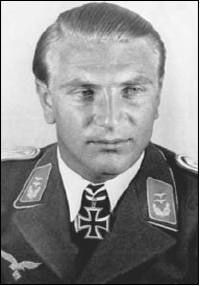
Knight’s Cross holder Hauptmann Georg-Peter Eder served as Gruppenkommandeur of II./JG 1 and II./JG 26 before flying the Me 262 with Erprobungskommando 262 and Kommando Nowotny. He later served with III./JG 7, but suffered severe injuries when he struck his aircraft while baling out after having engaged heavy bombers near Bremen on 17 February 1945
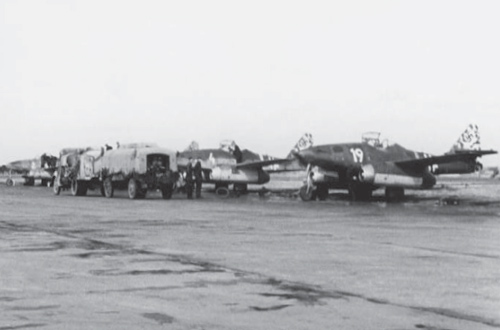
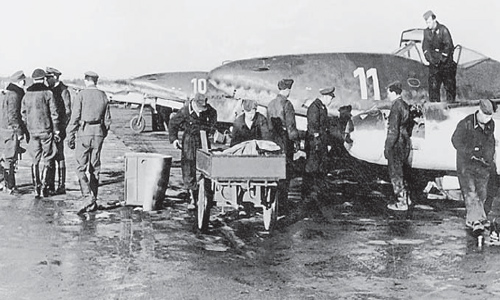
Me 262A-1as of Kommando Nowotny are refuelled whilst parked on the concrete perimeter track at Achmer in the autumn of 1944 – a tempting target for marauding USAAF P-47s or P-51s
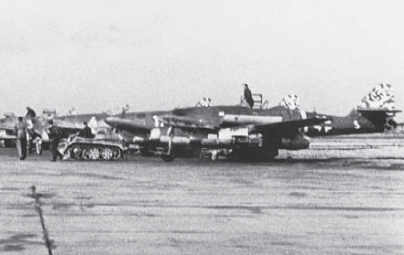
Taken a little later than the photograph on page 11, these Kommando Nowotny aircraft have now been refuelled and will soon be taken out to the runway at Achmer by the semi-tracked Kettenkrad tow tractor seen hooked up to ‘White 5’, closest to the camera. The Kettenkrads were extensively used by Me 262 units in an effort to save precious aviation fuel
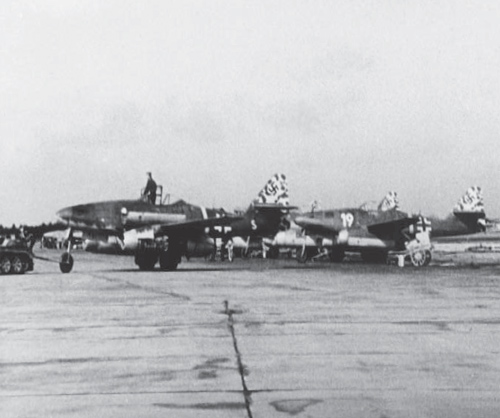
‘White 5’ is hauled away by a Kettenkrad, although it may be heading for maintenance rather than a mission judging by the engine panels resting on the uppersurface of the jet’s left wing. Note the uniform tail markings of all the Me 262A-1as seen in this series of photographs, as well as the yellow fuselage bands and large tactical numerals on their noses – all markings associated with Kommando Nowotny. ‘White 19’ has an electric starter cart parked alongside it
On its second day of operations, the unit suffered the loss of Oberleutnant Teumer (a veteran of 300+ missions with JG 54, Teumer had claimed 76 kills and been awarded the Knight’s Cross in August 1944) when an engine flamed out and he crashed and burned while landing at Hesepe. That same day, the man who would replace Teumer as leader of 2./Kommando Nowotny, Leutnant Franz Schall, had a lucky escape when his jet crashed on landing at Waggum following a technical fault. It was a stark warning to others that the Me 262 could not be taken for granted.
The Kommando attempted to fly its first operational sortie ‘in force’ on 7 October against one of the largest American daylight bombing raids so far mounted, aimed at oil targets at Pölitz, Ruhland, Merseburg and Lutzkendorf. Taking off from Hesepe, Leutnant Schall and Feldwebel Heinz Lennartz, who had joined the embryonic Ekdo 262 from 5./JG 11, each managed to claim a B-24 shot down, thus bringing home the Kommando’s first victories. However, it would be different for those aircraft operating from Achmer.
As Oberleutnant Bley, Leutnant Gerhard Kobert and Oberfähnrich Heinz Russel prepared to take-off, a P-51D from the 361st FG, piloted by ace 1Lt Urban L Drew, swooped down from 5000 metres to open fire on the Me 262s lining up for take off. Russel’s aircraft collapsed under the American’s machine gun fire, Kobert’s aircraft blew up and Bley’s machine crashed, but he was able to bale out.
Isolated victories against Mustangs on 10 and 12 October did little to counter the scything opinions of Fritz Wendel, who visited Kommando Nowotny as part of a Messerschmittt technical field team;
‘Kommando Nowotny has been in action since 3 October 1944. Up until 24 October, sorties had been flown on a total of three days. The Inspector of the Day Fighters, Oberst Trautloft, was at the base during the first days, and had made great personal efforts to ensure the success of the first fighter sorties with the Me 262. He saw to it that several successful fighter pilots were taken from other units to form the core of this unit. The commander, Major Nowotny is a successful Eastern Front pilot, but is unfamiliar with the present situation in the West and, at 23, is not the superior leader personality necessary to guarantee the success of this vital operation.’
Wendel went on to demolish the unit’s operational and tactical methods and lack of a coherent objective, pointing out contradictory opinions within its personnel. He concluded by stating that, ‘Instruction on the aircraft type is particularly bad with Kommando Nowotny. The importance given to the technical side may be illustrated by the fact that the Gruppe Technical Officer at Achmer, Hauptmann Streicher, is not a technician. The Staffel Technical Officer at Hesepe, 19-year-old Oberfähnrich Russel, is also a complete layman, who has himself recently destroyed two aircraft as a result of carelessness and inadequate training’.
As if this was not harmful enough to Galland’s efforts to champion the Me 262 as the fighter that would save Germany, circumstances were now playing into the hands of those who saw a very different role for the jet – that of a high-speed bomber. Already, comparatively more favourable results were being achieved by KG 51, which had recently commenced flying operations in the Rhine area with the jet in the bombing role.
In May 1944, Adolf Hitler had declared his irritation that the Me 262 had not been adapted to carry bombs with which to operate as a high-speed bomber against any Allied seaborne invasion of Europe. Even in his April 1943 report, Wolfgang Späte had observed ‘as a fighter-bomber, and carrying bombs, the aircraft would still be faster than any enemy fighter’.
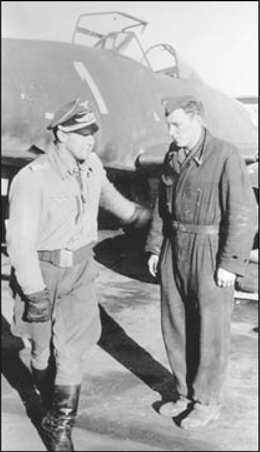
Leutnant Franz Schall, leader of 2./Kommando Nowotny (left) stands in front of an Me 262 from the unit, probably at Achmer, in the autumn of 1944. Later appointed Staffelkapitän of 10./JG 7, he would ultimately see more air combat in the Me 262 than most jet pilots
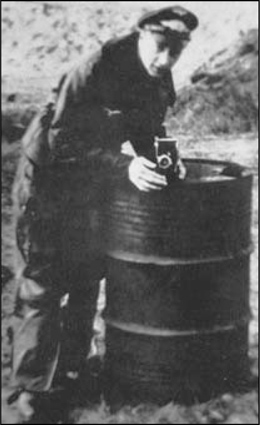
Feldwebel Heinz Lennartz transferred to flying the Me 262 with Erprobungskommando 262 and Kommando Nowotny from JG 11. Among the first of the Me 262 pilots to claim an enemy bomber shot down, he would survive the war as a jet ‘veteran’ flying with III./JG 7
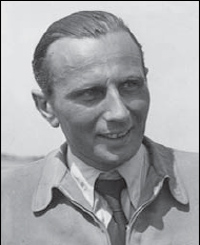
In October 1944, Messerschmitt test pilot Fritz Wendel wrote an acerbic report on the accomplishments – or perhaps the lack of them – of Kommando Nowotny. He believed that the unit’s training methods were ‘particularly bad’
Despite criticism from Fritz Wendel, Kommando Nowotny pressed on with operations until early November 1944. To the left of this photograph, pilots hold a pre-flight briefing, while to the right, mechanics check the Jumo 004 turbojets. It would all come to an end, on 7 November, however, when Major Walter Nowotny was shot down by P-51s and killed returning from a sortie against USAAF heavy bombers
Kommando Nowotny struggled on into November. Oberfähnrich Willi Banzhaff of 3.Staffel was forced to bale out following an encounter with P-51s over Holland on the 1st, but 24 hours later there was some cheer when a P-51 and a P-47 were downed by Feldwebel Erich Büttner, with a a second Thunderbolt falling to Oberfeldwebel Helmut Baudach. However, these events were tempered by the loss of Unteroffizier Alois Zollner, who was killed when his Me 262 crashed on take-off from Achmer. Three more jets were lost on 4 November in a single action with Mustangs.
Two days later, four Me 262s from the Kommando were damaged, three of them in emergency landings apparently as a result of fuel shortages. A solitary success for the unit that same day came when Leutnant Franz Schall destroyed a P-47.
Worse was to come when Galland, already concerned at the increasing losses being suffered by his only jet fighter unit, arrived at Achmer on 7 November for an inspection. The next day, as the USAAF bombed the Nordhorn Canal and the marshalling yards at Rheine, the Kommando was able to despatch just four jets in two missions against the bombers. There was an inauspicious beginning when Nowotny found that he was unable to start his aircraft for the first mission in the morning, while another machine suffered a burst tyre.
In the second mission, that afternoon, Nowotny finally took off to engage the enemy at the controls of ‘White 8’. During his subsequent encounter, the ace shot down a four-engined bomber and a P-51, but as he returned home, he was apparently intercepted by another USAAF Mustang – believed to have been from either the 20th, 357th or 364th FGs. A short while later, Nowotny’s crackling voice was heard over the radio. ‘We stepped into the open’, Galland later wrote. ‘Visibility was not good – sixtenths cloud. Seconds later an Me 262 appeared out of the cloud and dived vertically into the ground. There was black smoke and an explosion’. Nowotny’s last words, though garbled, indicated that his aircraft was hit and on fire, and seconds later he crashed to his death.
The death of Walter Nowotny effectively marked the end of the Kommando that bore his name, but the honour title – together with the further deployment of the aircraft that his unit had flown – would re-emerge as the name adopted by a much larger, more structured unit over the forthcoming weeks.
In August 1944, following a proposal from the office of the General der Jagdflieger, the OKL had authorised the establishiment of a new Jagdgeschwader (to be known as JG 7) consisting of two Fw 190-equipped Gruppen based at Königsberg. The cadre of personnel for this new Geschwader was to be drawn from the idling bomber unit KG 1 ‘Hindenburg’, for which there had been vague plans for conversion onto the Bf 109 as part of IX. Fliegerkorps. The new scheme was that the Stab II./KG 1 would form the new Stab I./JG 7 under the command of Hauptmann Gerhard Baeker, with 1., 2., 3. and 4./JG 7 being formed from 5., 6., 7. and 8./KG 1 respectively.
All the units remained at Königsberg with the exception of 2./JG 7, which was detached to Zieghenhain, in Czechoslovakia, although an ‘advanced detachment’ of I./JG 7 was reported at Pomssen on 9 November. A second Gruppe, II./JG 7, was planned using Stab III./KG 1 as its Stab and 9./KG 1 as 5./JG 7, but with 6., 7. and 8./JG 7 formed as brand new units.
However, the demand for replacement aircraft by the already overstretched existing fighter Geschwader operating in the defence of the Reich, combined with a worsening shortage of pilots, meant that the proposal had to be shelved. It was reinstated by the OKL in October, and this time JG 7 was to be re-equipped with Bf 109G-14s and its II. Gruppe based at Zieghenhain. But once again the pressing realities of the air war over the Reich meant that this proposal could not actually be carried out.
Then, over the course of a four-day armaments conference between 1-4 November, Adolf Hitler finally gave his permission for the Me 262 to be built as a fighter, but under the strict proviso that the aircraft could quickly be made capable of carrying at least one 250-kg bomb if neccesary. This gave Galland the opportunity to move ahead with the establishment of a new jet-equipped fighter unit that would be assigned the redundant designation Jagdgeschwader 7. A few days later on 12 November, matters were confirmed when OKL issued official orders that JG 7 was not to be equipped with piston-engined aircraft.
Galland selected Oberst Johannes Steinhoff as Kommodore of the new Geschwader. Thirty-two-year-old ‘Macki’ Steinhoff was an accomplished, veteran, fighter pilot. A graduate in philology from the University of Jena in 1934, he subsequently attended both naval and Luftwaffe training schools. Transferring to the Luftwaffe from the Kriegsmarine in 1936, Steinhoff embodied the ideal blend of social values and military discipline, and by 1938 he had been given his first command as Staffelkapitän