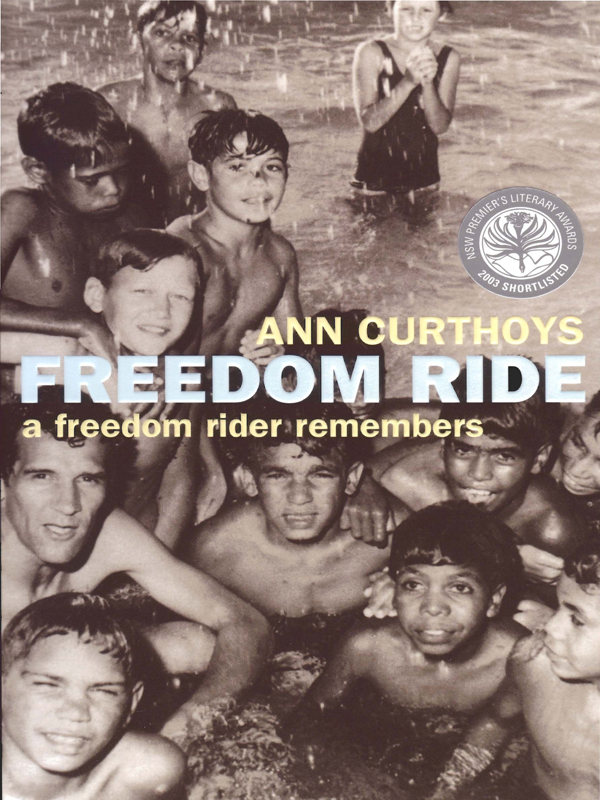
In the 60s, segregation and discrimination were no less a part of Aboriginal life than of the lives of black people in the Deep South. We needed a civil rights movement . . . and in Charlie Perkins and company, we got one. This book tells with verve the story of the Freedom Rides and the conscience-searing triumph they were. The characters are skilfully conjured in all their youth and idealism. Ann Curthoys tells the story with an insider’s eye and the passion of a true believer—and there is no other way to recount this moral victory and the lasting change it helped edge into being.
Bob Carr, Premier of NSW
In the early 1960s, most Australians could affect ignorance or feel comfortable about the racism, discrimination and poverty affecting Aboriginal Australians. The Freedom Ride of 1965 marked the time when those who had been comfortable with what was happening were confronted with reality. It forced other Australians to look at the darker side of the past and the present. It helped develop a new generation of Aboriginal leaders.
Jack Waterford, Editor-in-chief, The Canberra Times
The record of the students’ Freedom Ride in New South Wales is profound. Ann Curthoys has recounted the brave action of the students’ determination to break the barriers that divided black and white Australia. Meticulously researched, the author has provided a compelling work.
Faith Bandler
This book is a revealing window into the courage, humanity and commitment of the participants. It again focuses the nation on the continuing need for organised political action to secure social justice and a just reconciliation.
Robert Tickner, Minister for Aboriginal and
Torres Strait Islander Affairs 1990–96
For my mother
Barbara Lindsay Curthoys
1924–2000
ANN CURTHOYS
FREEDOM RIDE
a freedom rider remembers

First published in 2002
Copyright © Ann Curthoys 2002
All rights reserved. No part of this book may be reproduced or transmitted in any form or by any means, electronic or mechanical, including photocopying, recording or by any information storage and retrieval system, without prior permission in writing from the publisher. The Australian Copyright Act 1968 (the Act) allows a maximum of one chapter or 10 per cent of this book, whichever is the greater, to be photocopied by any educational institution for its educational purposes provided that the educational institution (or body that administers it) has given a remuneration notice to Copyright Agency Limited (CAL) under the Act.
Every effort has been made to contact the copyright holders of the photographs produced in this book. In the event where these efforts were unsuccessful, the copyright holders are asked to contact the publisher directly.
Aboriginal readers are warned that this book contains the names and images of some Aboriginal people who have since died.
Allen & Unwin
83 Alexander Street
Crows Nest NSW 2065
Australia
Phone: (61 2) 8425 0100
Fax: (61 2) 9906 2218
Email: info@allenandunwin.com
Web: www.allenandunwin.com
National Library of Australia
Cataloguing-in-Publication entry:
Curthoys, Ann.
Freedom ride : a freedom rider remembers.
ISBN 1 86448 922 7.
1. Curthoys, Ann, – Journeys. 2. Australia – History. I. Title.
994
Set in 10.5 pt Schneidler by Midland Typesetters Pty Ltd
Maryborough, Victoria
Printed in Australia by McPherson’s Printing Group
10 9 8 7 6 5 4 3 2 1
Contents
List of illustrations
Dramatis personae
Names
Acknowledgements
1. Let’s have a Freedom Ride
2. Getting ready
3. On the way to Walgett
4. High noon at Walgett
5. Moree: Australia’s Little Rock?
6. Clash at Moree
7. ‘Stirring up trouble’: The coastal towns
8. Impact
9. More Freedom Rides
10. Memory and meaning
Epilogue: Whatever happened to . . .?
Select bibliography
A note on sources
Illustrations
Burning an imitation KKK cross at a student demonstration for US civil rights, Sydney, 6 May 1964 (Daily Telegraph, 7 May 1964).
A female student is arrested at a civil rights demonstration (Daily Telegraph, 7 May 1964).
Gary Williams and Charles Perkins on their first day as students at the University of Sydney, March 1963.
Students demonstrate for Aboriginal rights during National Aborigines Week at Hyde Park and Parliament House, Sydney, 7 July 1964. Photographer: Michael Elton.
John Powles, Charles Perkins, Pat Healy and Jim Spigelman plan the Freedom Ride (Sydney Morning Herald, 17 June 2000).
Publicity notice for folk concert to raise money for the Freedom Ride, 21 January 1965.
Machteld Hali draws the placard: ‘Good enough for Tobruk. Why not Walgett?’
Helen Gray, Machteld Hali, Norm McKay and Ann Curthoys hold banners outside Walgett RSL, 15 February 1965.
Students demonstrate outside the Walgett RSL holding their banner, ‘Student Action for Aborigines’ and RSL worker offers drinks to the students (Sydney Morning Herald, 17 February 1965).
‘Nonsense! Of course you want a drink’. Cartoon by Molnar, Sydney Morning Herald, 17 February 1965.
Bob Brown, Freedom Ride supporter, standing outside his electrical goods store, Moree.
Ann Curthoys and Louise Higham interview Aboriginal residents at the Aborigines Welfare Board Station, Moree, 17 February 1965.
The students demonstrate outside the council chambers in Balo Street, Moree (Tribune, 24 February 1965).
Charles Perkins waits with children to enter the swimming pool, Moree, 17 February 1965 (Sydney Morning Herald, 24 February 1965).
Charles Perkins with children in the Moree pool on Wednesday 17 February 1965 (Australian, 19 February 1965).
The bus stands outside the Hotel Boggabilla, where students rested before interviewing people at the Aboriginal Station.
Students greet Charles Perkins at Inverell airport.
Charles waits with children outside the Moree pool, 20 February 1965 (Daily Mirror, 22 February 1965).
Police attempt to keep the crowd away from the students at the Moree pool.
Charles Perkins is led away from the pool. (Daily Mirror, 22 February 1965).
Bob Gallagher is hit on the head with an egg at Moree (Australian, 22 February 1965).
The Daily Mirror’s full-page coverage of the demonstration at Moree pool, 22 February 1965.
Cartoonist Martin Sharp makes a harsh comment on the citizens of Moree (Australian, 22 February 1965).
‘It’s not too cold for me—it’s too hot.’ Cartoon by Eyre Jnr, Sydney Morning Herald, 22 February 1965, satirising the Chief Secretary’s lack of response to the Freedom Ride.
Charles Perkins, Gerry Mason, John Powles and Brian Aarons wait in Grafton for the replacement bus driver to arrive, Monday 22 February 1965 (Daily Examiner, 23 February 1965).
The students hold a watermelon eating competition while waiting in Grafton.
Clarrie Combo, chairman of directors of the Aboriginal Cooperative at Cabbage Tree Island, discusses problems with the sugar cane crop with Mr H. Jeffery, manager of the Cabbage Tree Island Reserve, Tuesday 23 February (Sydney Morning Herald, 24 February 1965).
Bruce Petty cartoon of the bus leaving Moree (Australian, 25 February 1965).
George Bracken, Aboriginal former lightweight boxing champion, criticises the Freedom Ride (Daily Mirror, 22 February 1965).
The students arrive in Bowraville.
Brian Aarons and Gary Williams drink together in Bowraville Hotel (Sydney Morning Herald, 25 Feb 1965).
Charles Perkins is barred from taking a child into the McElhone olympic swimming pool, Kempsey (Sydney Morning Herald, 26 February 1965)., 26 February 1965).
Students outside Kempsey swimming pool hold placards protesting against exclusion of Aboriginal people from the pool (Macleay Argus, 27 February 1965).
Wendy Golding’s photo of the students posed outside the bus.
‘He does not drink, hates crowded pools, likes to sit in front at the pictures. How can we desegregate him?’ Cartoon by Molnar (Sydney Morning Herald, 26 February 1965).
Ted Noffs welcomes back Charles Perkins at the University of Sydney on 26 February 1965. The Freedom Ride is over (Sydney Morning Herald, 27 February 1965).
The Student Action for Aborigines stall during the University of Sydney Orientation Week.
Students hold 100-hour vigil outside the NSW Liberal Party and Labor Party headquarters. Photographer: Bruce Adams.
Members of SAFA visit Walgett in May and August 1965.
Harry Hall’s place and members of Harry Hall’s family with two SAFA students, Walgett, 1965.
The Luxury Theatre, Walgett, 1965.
Marie Peters, Pattie Hall and Lorna Hall, participants in the demonstration to desegregate the Walgett Luxury Theatre on 7 August 1965.
Harry Hall, Pattie Hall and Lorna Hall (Tribune, 18 August 1965).
Ted Fields buys his ticket to the dress circle at the Luxury Theatre, Walgett, Saturday 14 August 1965 (Tribune, 18 August 1965).
Walgett community members and students pose together for a group photo in August 1965.
A young Aboriginal man addresses a meeting near the Aboriginal reserve, Bowraville, 12 March 1966, while police watch.
Sue Johnston burns copies of the Aborigines Protection Act outside Parliament House, 13 July 1966 (, 20 July 1966)Honi Soit, 20 July 1966).
Note: Every effort has been made to contact the copyright holders of the photographs and illustrations produced. As these efforts were unsuccessful, the copyright holders are asked to contact the publisher directly.
Dramatis personae
The students
Note: Ages are sometimes approximate, and both age and enrolment in university courses are for February 1965.
Charles Perkins, 29, third-year Arts, Arrernte man, born in Alice Springs, former soccer player, Aboriginal activist
Gary Williams, 19, third-year Arts, Gumbaynggir man from Nambucca Heads
Aidan Foy, 19, third-year Medicine, member of the ALP Club
Alan Outhred, 19, third-year Science, member of the Labour Club
Alex Mills, 25, third-year Theology, member of the Liberal Club
Ann Curthoys, 19, third-year Arts, member of the Labour Club
Barry Corr, 18, second-year Arts
Beth Hansen, 19, third-year Arts, member of the Humanist Society
Bob Gallagher, 19, third-year Engineering, member of the Labour Club
Brian Aarons, 19, third-year Science, member of the Labour Club
Chris Page, 19, third-year Medicine
Colin Bradford, 19, third-year Science, member of the Labour Club
Darce Cassidy, 22, part-time third-year Arts, also ABC radio producer
David Pepper, 18, second-year Arts
Derek Molloy, 19, third-year Arts
Hall Greenland, 19, third-year Arts, member of the ALP Club
Helen Gray, 19, second-year Arts
Jim Spigelman, 19, third-year Arts, leader of the Fabian Society, breakaway group from the ALP Club
John Butterworth, 20, third-year Science
John Gowdie, University of New England, son of Presbyterian minister from Dubbo
John Powles, 22, fifth-year Medicine, founder of the Sydney University Humanist Society, involved in Campaign for Nuclear Disarmament
Judith Rich, 20, third-year Arts
Louise Higham, 18, second-year Medicine, member of the Labour Club.
Machteld Hali, 18, second-year Arts, born in Holland, raised in Indonesia
Norm Mackay, 19, third-year Science, member of the Labour Club
Paddy Dawson, 19, third-year Arts, member of the ALP Club
Pat Healy, 20, third-year Arts, member of the Labour Club
Ray Leppik, 22, postgraduate Science
Rick Collins, 19, third-year Arts
Robyn Iredale, 20, fourth-year Arts, in Geography Honours
Sue Johnston, 20, fourth-year Arts, in History Honours
Sue Reeves, 19, third-year Arts, member of Abschol
Warwick Richards, 19, third-year Arts, member of the Student Christian Movement
Wendy Golding, 17, second-year Arts
Also on the bus
Gerry Mason, an older Aboriginal friend of Charles Perkins from Gerard government reserve in South Australia
Bill Pakenham, from Punchbowl, driver of the bus until Grafton
Ernie Albrecht, from Lugarno, driver of the bus from Grafton onwards
Students on the follow-up trips
Sue-Ann Loftus
Owen Westcott, 18, second-year Arts
Christine Jones
Aboriginal rights organisations and leaders
AAF Aboriginal-Australian Fellowship, a mixed-race organisation for Aboriginal rights founded by Pearl Gibbs and Faith Bandler in 1956.
APA Aborigines Progressive Association, a largely Aboriginal organisation for Aboriginal rights, founded in January 1964, with Bert Groves, formerly president of the AAF, as president. The name had also been used by an earlier organisation in the 1930s.
The Foundation The Foundation for Aboriginal Affairs, founded in 1964 to provide support for Sydney’s growing Aboriginal population.
SAFA Student Action for Aborigines. Formed in 1964 at the University of Sydney to organise the Freedom Ride. Lasted until 1967.
Abschol Organisation under the leadership of NUAUS, founded to raise funds for scholarships for Aboriginal university students; from 1965, supported political campaigns such as the Referendum.
FCAA Federal Council for Aboriginal Advancement, founded in 1958. Changed its name in April 1964 to FCAATSI—Federal Council for the Advancement of Aborigines and Torres Strait Islanders.
Aboriginal leaders based in Sydney
Bert Groves, an Aboriginal man from the northwest of New South Wales, president of the AAF 1957–58, and of the APA 1964–?
Charles (Chicka) Dixon, active in the APA and the Foundation
Ray Peckham, Aboriginal man from northwestern New South Wales, now active in APA and the Waterside Workers’ Federation
Non-Aboriginal activists
Faith Bandler, founder and secretary of the Aboriginal-Australian Fellowship
Allan Duncan, lecturer in Aboriginal adult education, member of the Aboriginal-Australian Fellowship, and chairman of the Foundation’s Education Committee
Jack Horner, secretary of the Aboriginal-Australian Fellowship
At the University of Sydney
Michael Kirby, 25, Law, president of the SRC, student representative on the University Senate
Ken Buckley, senior lecturer in Economic History, secretary of the Council for Civil Liberties
Peter Westerway, executive producer of the investigative Channel 7 television program Seven Days, occasional lecturer in Government
Tom Roper, 19, third-year Arts, member of SAFA, later director of Abschol
David Ellyard, 19, Science, member of SAFA
Eric Doldissen, 20, treasurer of SAFA
At the University of New South Wales
Bill Ford, lecturer in the School of Economics, former Fulbright scholar in the United States, observer of Freedom Rides in Jackson, Mississippi in 1961
Walgett people Aboriginal
Harry Hall, Gamilaraay, ex-shearer, worker at Walgett garage, leader of Aboriginal people in Walgett
George Rose, Yuwaaliyaay, from Brewarrina, sergeant in army during World War II, shearer and member of the AWU, settled in Walgett in 1949, leading figure in Walgett APA
Gladys Lake, leading figure in Walgett APA
Ted Fields, leading figure in Walgett APA
Pat Walford, woman in her twenties, outspoken resident
Marie Peters, 18, resident
Pattie Hall, daughter of Harry Hall
Lorna Hall, niece of Harry Hall
Non-Aboriginal
Alex Trevallion, Town Clerk
Athol White, manager, Oasis Hotel-Motel
Tom Hogan, manager, Walgett RSL Club
James Conomos, owner, Luxury Theatre
Moree people
Aboriginal
Lyall Munro Snr, shearer and local Aboriginal leader
Lyall Munro Jnr, 14, living on Mehi mission
Zona Craigie, 8, resident of Thompson’s Row
Non-Aboriginal
Alf Sadlier, Mayor in 1955 when resolution banning Aborigines from the local pool was passed
William Tait, Deputy Mayor in 1955
Bill Lloyd, Mayor in 1965
Bob Brown, 29, owner/manager of an electrical business
Aboriginal people in other towns
Ann Holten, 16, high school student, Bowraville
Pastor Frank Roberts Jnr, Bundjalung leader, Lismore
The clergy
Ted Noffs, Methodist pastor supportive of Aboriginal people, associate minister of the Central Methodist Mission in Sydney, co-founder of the Foundation for Aboriginal Affairs
Reverend Peter Dowe, the vicar at St Peter’s Church of England in Walgett Ted Ryan, Methodist minister, Moree
The journalists
Bruce Maxwell, cadet reporter for the Sydney Morning Herald, travelled with the students
Gerald Stone, migrated from the United States to Australia in 1962, reporter for the Daily Mirror and the Sunday Mirror, travelled with the students from Moree onwards
Judith Rich, reporter for the Daily Telegraph from Moree onwards, also a student at the University of Sydney
Peter Martin, reporter for Seven Days, Channel 7
Politicians and bureaucrats
A.G. Kingsmill, chair of the Aborigines Welfare Board H.J. Green, Superintendent of the Aborigines Welfare Board
Gus Kelly, Chief Secretary, responsible for Aboriginal welfare until 1 May 1965
Jack Renshaw, Premier of New South Wales until 1 May 1965, member for Castlereagh, the electorate in which Walgett was situated
Eric Willis, Chief Secretary of New South Wales, 13 May 1965 to 19 June 1972
Bill Rigby, Labor MLA for Hurstville, one-time member of the AAF, one of the few supporters of Aboriginal rights in the New South Wales Parliament
Names
Aboriginal people a general term for the Indigenous people of Australia. The term ‘Aborigines’ was most commonly used in the 1960s, but is now less preferred.
Indigenous the indigenous people of Australia and the Torres Strait Islands. Increasingly the preferred term by those whom it designates.
Murris the term derived from local languages, meaning ‘our people’ or ‘us’, for Aboriginal people in southern Queensland and the central section of northern New South Wales.
Kooris the equivalent term for Indigenous people in southern and eastern New South Wales.
Kamilaraay a large language group in northern New South Wales; Walgett, Moree and Boggabilla lie in Kamilaraay country.
Wiradjuri a large language group in western and southern New South Wales; Wellington is in Wiradjuri country.
Bundjalung a large language group in far northeastern New South Wales; Lismore is in Bundjalung country.
Gumbaynggirr the people of the east coast region near present-day Bowraville.
Dhan-gadi, Ngaku and Ngumbar the people of the Macleay Valley, at the mouth of which lies Kempsey.
Acknowledgments
From the moment I started writing a diary as a student on the Freedom Ride in February 1965, there was a possibility I might write this book.
I did not, however, form a definite intention to write it until some time in 1988, the year in which Indigenous political protest so effectively deflected the Bicentennial celebrations towards a more reflective reconsideration of the meaning of Australian history. Perhaps I was moved to write it by Peter Read, who interviewed me in 1987 about the Freedom Ride for a chapter in his biography of Charles Perkins. In 1989 I applied for funding for the research from the Australian Research Council, stating in my application that the Freedom Ride was a ‘key event’ in the history of the relations between Aboriginal and other Australians. My book, I said, would assist the development of ‘a clearer understanding of the historical processes through which a strong Aboriginal political movement emerged in the 1960s’. I saw the Freedom Ride then—and still do—as ‘a jumping-off point’ for investigating some large themes in the history of relations between Indigenous and non-Indigenous people in Australia. When the grant was awarded, I began serious work on the project in 1990, with the wonderful Kathy Moffatt as my research assistant.
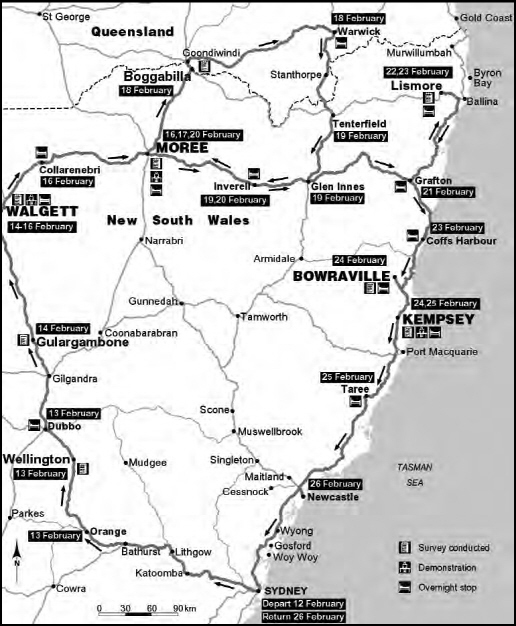
My original plan was to write the book during study leave in 1991. In April that year, John Docker and I retraced the itinerary of the Freedom Ride, interviewing many people and looking at the places that had witnessed these significant events two-and-a-half decades earlier. We travelled through the towns of Orange, Wellington, Dubbo, Gulargambone, Walgett, Moree, Lismore, Bowraville and Kempsey, and interviewed people, both Indigenous and non-Indigenous, who had been involved. My having been a Freedom Rider led many Aboriginal people to speak to me who may not have done so otherwise, though most of those interviewed did not wish to speak into a tape-recorder. So I took extensive notes while we talked and then typed up my diary each evening. Later that year I wrote my first academic paper on the Freedom Ride project, and delivered it at the Sir Robert Menzies Centre for Australian Studies in London, and at the History Workshop conference in Oxford.
What I learnt during 1991 was that the project had still a long way to go. I seemed to be endlessly diverted by the many and diverse activities of a busy senior academic in the 1990s—undergraduate teaching, graduate supervision, academic administration, consultancies, conferences, prize and grant committees, endless selection committees, committees of review, advisory committees, indeed academic committees of every imaginable kind. And there were still many intellectual lessons to learn. I found that I had to circle around my material before I could get directly to it. Through the 1990s I had a burst of writing activity on a wide range of issues, including national identity, the anti-war movement, the history of journalism, historical representation, second-wave feminism, Australian historiography, and colonialism and gender.
But delaying me most of all was the realisation that I had still a great deal of research and thinking to do. I especially needed to interview the Freedom Riders themselves. After interviewing one of them, Beth Hansen, during my ‘retracing tour’ in 1991, I realised that I could not be the interviewer of the rest. Beth was, naturally, too aware that I had been there too, finding it difficult to tell me about things she thought I would already know, and feeling wrong-footed if I asked about details of events that I remembered or knew about and she didn’t. With the aid of a grant from the University of Technology, Sydney in 1993, I hired Inara Walden to do the oral history interviews for me. As a much younger person—Inara had not been born at the time of the Freedom Ride, to the amusement of many of her interviewees—I correctly judged that the Freedom Riders would feel bound to explain things to her that they would find odd telling me. In the interviews, we concentrated on asking about the Freedom Riders’ strongest impressions, and eliciting a lot more about who they were, their background, how they got involved, and what they had been doing since. I did a great deal of other research as well, especially at the Australian Institute of Aboriginal and Torres Strait Islander Studies library; I also placed a letter in the Sydney Morning Herald (which yielded few, but valuable, replies), and one way and another collected vast quantities of material.
Early in 1995 I moved from UTS in Sydney to the Australian National University in Canberra. This meant more academic administration and new, very demanding, teaching commitments, so my work on this book was seriously interrupted for several years. In the long run, however, the change proved to be valuable, bringing me into intellectual contact with a new group of Indigenous and non-Indigenous people who were also engaged in rethinking Australian history. I taught units on Australian Aboriginal history for the first time, working with Indigenous teachers where I could, and forcing myself to gain a wider understanding of the history to which I was attempting to contribute, submitting my ideas to the unblinking stare and close scrutiny only undergraduates can give. With additional small ARC grants, I was able to hire Lani Russell and Ann Genovese to help with the final phases of research, in the National Library, the Australian Archives, the Mitchell Library and the New South Wales State Records Office. I gave papers on the progress of my research to the ‘Gender and National Identity’ symposium organised by the journal Gender and History at the Rockefeller Centre at Bellagio, Italy, and the conference ‘Suffrage and Beyond’ in Wellington, New Zealand. Closer to home, I spoke to the Royal Australian Historical Society and the Australian Historical Association conference in Perth in 1994, presented a seminar on Indigenous Citizenship under the auspices of the Reshaping Australian Institutions Project at ANU in 1996, spoke to the Australian Oral History Association conference in Alice Springs in 1997, and presented papers to the History Division seminar at the Research School of Social Sciences at ANU in 1997 and 2001 and at Macquarie University in 1998 and 2001.
After such a long gestation, I have many people to thank. I sincerely thank the funding bodies that supported me—the Australian Research Council, the University of Technology, Sydney and the Australian National University. I especially thank the four research assistants who worked on this project at various times—Kathy Moffatt, Inara Walden, Ann Genovese and Lani Russell. All were brilliant researchers and wonderful to work with. Many of the Freedom Riders helped by consenting to interview, and by donating to me documentary material; particular thanks must go to Aidan Foy, Barry Corr, Bob Gallagher, Brian Aarons, Charles Perkins, Darce Cassidy, Jim Spigelman, Louise Higham, Patricia Healy, Warwick Richards and Wendy Watson-Ekstein. Indeed, I thank all those—Freedom Riders and others—listed in the note on sources, who gave Inara or me their time in interviews. I also thank Frances Peters-Little for reading and correcting the Walgett chapters, and drawing for me an illuminating if eccentric map of the town.
Others who over the years lent me material, passed on ideas and contacts, or discussed my ideas with me, and whom I wish to thank, include Andrew Markus, Barry Higman, Bert Castellari, Carol Johnson, Catherine Hall, David McKnight, Fiona Paisley, Georgine Clarsens, Gordon Briscoe, Heather Goodall, Jack Horner, John Murphy, Judith Keene, Kate Evans, Ken Buckley, Lyndall Ryan, Marilyn Lake, Nic Peterson, Paula Hamilton, Peter Read, Susan Magarey, Terry Fox, Tim Rowse, Tom Griffiths and Vicki Grieves. Special thanks to Brian Aarons and Pat Healy for reading the whole manuscript, correcting errors and discussing ideas, and also to Bain Attwood for reading and commenting on the first half of the book.
Above all I thank the people in the Freedom Ride towns who gave so unstintingly of their time when I visited them in 1991, especially Harry Hall, Phillip Hall, George Rose and Gladys Lake in Walgett; Lyall Munro Snr in Moree; Tess and Vic Brill in Lismore; Bob Perry in Bowraville; and Bob Brown (formerly of Moree) in Port Macquarie.
I have tried out my ideas for this project a number of times, and wish to thank the organisers and audiences at those events. I also thank my students in my Australian Aboriginal history classes at ANU and my Writing History classes at UTS and ANU, and the Grade 6 class at Lyneham Primary School (1998) whose interest and challenging questions spurred me on.
I wish to thank my publisher John Iremonger, for giving me that extra push when it started to seem as if this project would never be finished, and for supporting this book so wholeheartedly, even through his own serious illness. Warm thanks are also due to my production editor at Allen & Unwin, Alexandra Nahlous, for her efficiency and support.
‘Aboriginal Charter of Rights’, by Oodgeroo of the Noonuccal tribe from My People, third edition, The Jacaranda Press, 1990, is reproduced by permission of John Wiley & Sons, Australia.
I thank Bruce Petty, Martin Sharp, Gary Williams, Darce Cassidy, Wendy Watson-Ekstein, the Search Foundation, the State Library of New South Wales, the Daily Examiner, the Macleay Argus, Honi Soit, the Fairfax Photo Library and News Limited for permission to reproduce cartoons and photographs.
Finally, a special thank you to my late mother, Barbara Curthoys, who first interested me in Aboriginal rights and gave me valuable documentary material. I also thank my son, Ned Curthoys, and father, Geoff Curthoys, for being so interested and reading the entire manuscript and my husband, John Docker, for making detailed comments on the entire manuscript and whose continuing intellectual and personal support is incalculable.