Michael Meehan grew up in north-west Victoria. His first novel, The Salt of Broken Tears, won the Christina Stead Prize for Fiction in the 2000 New South Wales Premier’s Awards. He lives in Melbourne. This is his third novel.
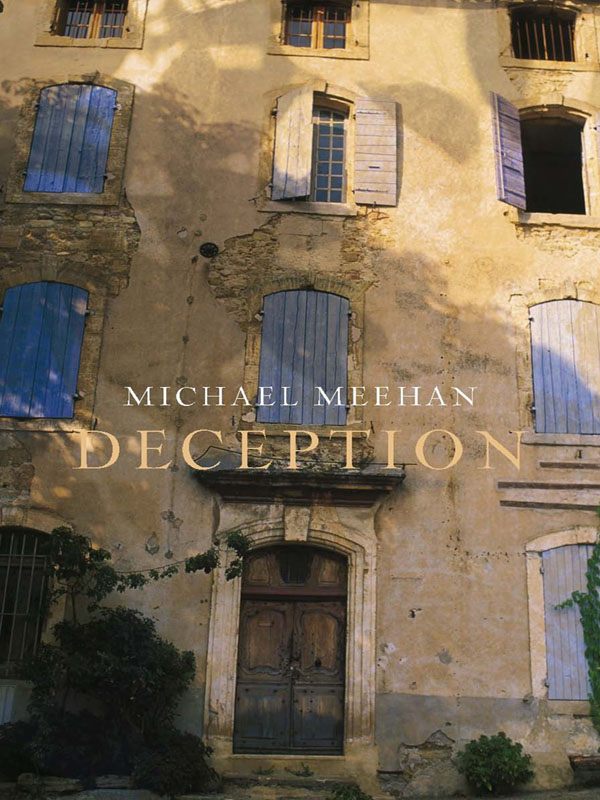
MICHAEL MEEHAN
DECEPTION

First published in 2008
Copyright © Michael Meehan 2008
All rights reserved. No part of this book may be reproduced or transmitted in any form or by any means, electronic or mechanical, including photocopying, recording or by any information storage and retrieval system, without prior permission in writing from the publisher. The Australian Copyright Act 1968 (the Act) allows a maximum of one chapter or 10 per cent of this book, whichever is the greater, to be photocopied by any educational institution for its educational purposes provided that the educational institution (or body that administers it) has given a remuneration notice to Copyright Agency Limited (CAL) under the Act.
Allen & Unwin
83 Alexander Street
Crows Nest NSW 2065
Australia
Phone: (61 2) 8425 0100
Fax: (61 2) 9906 2218
Email: info@allenandunwin.com
Web: www.allenandunwin.com
National Library of Australia
Cataloguing-in-Publication entry:
Meehan, Michael, 1948-
Deception/Micheal Meehan.
ISBN 978 1 74175 458 2 (pbk.)
A823.3
Set in 11.5/17.5 pt Fairfield Light by Midland Typesetters, Australia Printed and bound in Australia by Griffin Press
10 9 8 7 6 5 4 3 2 1
For Michele Sommer
He wrote of stones. Sebastien Rouvel. In one fragment after another he wrote of stones drawn deeply from a country of felled walls and scattered rocks. He wrote of how he walked hand in hand with another across fields of broken stones and fresh growths of crumbling rock, stooping now and then to break bright flowers from fragile stems, handing as a bouquet to the one who walked beside him nothing but sharp stalks, thrust like jagged spikes from a burning fist, the stone petals breaking into dust upon the touch.
From the earth they drew a harvest. There being once a presence in that place and a voice which told of order. All these stones they now discovered just fragments of that image, shattered wreckage from the fall. Believing that if the stones were put together they might again make the image, and that the voice might speak again . . .
It was in the dust at Mount Deception and across these scattered stones that the children played for that last time, the dust coursing in the confused winds that skipped about them as they arrayed their final ring of stones. So it was, as Agnes later told, on that day when her mother and her sisters, Colette, Geneviève and Clémentine vanished in the storm. She spoke of the children gathering the stones, of a dying lizard and a circle of bright rocks, of how the wind blew up and the earth began to run and the fire flickered and died and then flared again.
She told of the lizard clinging in terror to the end of a stick, the pup yelping and snapping, the children shrieking through the wind. She watched the three of them playing in the dust, a half-grown girl with two younger children, struggling to light a fire in the heat of a windy February day, the fire and the dust running about them not in steady sheets before the wind but in circles which chopped this way and that amid the flaking trees, the fire struggling to take hold and the lizard still clinging desperately, its jaws clamped to the far end of the stick.
Then fifteen and always a reckless tomboy of a girl, Agnes had ridden out along the creek bed on her horse, a biting hard-mouthed brute misnamed Princess, scaring rabbits with the gun, the rusting relic of a police pistol her father mostly used for scaring crows. So hot and blistering a day it was, with the sounds of doors crashing in the wind and windows slamming shut, the sky darkening against the flying dust and the loose iron beginning to flap and shriek. She soon brought Princess back, nostrils flared, neck arched as always against the dragging of the bit, back through the wind and shrieks and laughter and the yelping of the pup, to be tethered at the garden gate. She took the pistol to its place behind the kitchen door. In the distance she could see the smaller girls still trying to feed the fire, their pinafores dragged and tossed about them as they picked up sticks and tufts of withered grass, with Colette gone off perhaps to fetch some larger wood. Agnes knew the fire would never catch because the wind was far too strong, and the little ones, Geneviève and Clémentine, were now giving their attention to the stick and to the lizard, and the circling yelping pup.
Then it was that something happened.
This, so many years after, was what old Agnes told. There was the sound of a door crashing violently in the wind, and the sight of Monsieur Rouvel breaking from the house. In blurred and moving shapes, obscured by the wind, she saw him stumble, crouching and limping as he always did, but this time almost falling from one verandah post to the next, staggering out across the stonewalled garden, steadying himself for a moment on the far gatepost. The children stopped tormenting the poor lizard, and all began to watch him as he peered across the yard. As though trying, through his one unshattered lens, to make some sense of what he saw through the wind and dust and debris. Then he stumbled through the gate and began to untie the pony, pulling and tearing and cursing at the tangled reins, shaking his head and shouting something to them that they couldn’t hear.
All things became uncertain in the storm, and even more uncertain in the long tracts of time that ran between that time and the time of telling. Princess began to rear and sought to bite as he struggled with blinded awkward fingers to release her from the post. Agnes saw him move in front of the plunging horse and then to the wrong side, hopping and straining for a stirrup that was far too short, the saddle straining perilously against the girth, the unwilling pony twisting and stooping into the weight of his foot so that he was forced to turn within the arc of the straining horse, her eyes rolling in dread and anger as she twisted and plunged about him in this wheeling and ridiculous cursing coil of man and horse and dust.
He managed at last to rise into the saddle, with a last look to the girls, to Agnes with the pup now squirming in her arms, to the two younger children standing by their ring of stones and to their wretched captive lizard still clinging to its stick. He dragged Princess’s head around, half falling in the saddle, his feet not yet in the stirrups, cantering at first towards them and then down into the bed of the creek, which led off towards the north and to the west.
Some fragment of a hand, a shattered shoulder, some edge or chisel’s mark, as the pilgrims came to scour the deserts for these scattered scraps of stone. All knowing in rage and sadness that the more they picked and foraged, the more fragments they discovered, the less truth they would find . . .
He rode out into the desert. Into the emptiness. His bones at last to join the scattered rocks. The remains discovered, ‘disturbed by native dogs’, months later. There being no-one to go after him, no-one to look for him, with all others soon vanished in a rush of baggage and the gig brought to the front, her mother’s cheek wet with tears in a last rushed kiss, the gig then beating out and over the toppled gate, and off towards the south.
Contents
One
Two
Three
Four
Five
Six
Seven
Eight
Nine
Ten
Eleven
Twelve
Thirteen
Fourteen
Fifteen
Sixteen
Seventeen
Eighteen
Nineteen
Epilogue
One
JUST OUTSIDE THE LONG grey walls of the old Bibliothèque Nationale, there is a little garden. The square Louvois. A place of refuge and fresh air for weary scholars, of gravel paths and flowerbeds, shaded by giant chestnut trees. There is a large and ugly fountain at the centre, with four half-clothed amazons in stone, the Loire, Garonne, Saone and Seine, holding the waters aloft. Within days of my arrival, I’d set up a routine, taking something from a patisserie in the colonnades of the Palais Royal, and coming back to eat alone and watch the old women—war widows, I was told—shuffling about and feeding the sparrows. The iron benches were mostly occupied by readers taking a few minutes of air. There was the odd clochard, those scrounging tramps in dark and ragged clothing, a few local workers, van drivers, local shop assistants and staff from the Bibliothèque, lazing over their lunch. Summer. Nineteen sixty-eight. The square Louvois, still a tranquil refuge from the rage, the stones, the burning in the streets.
Nick Lethbridge. Lawyer. From the far side of the world. A student now, in England, putting together a thesis on international conventions, in the first days of what I planned as a summer spent in France. Already rattled from misunderstandings in shops. Already exhausted from edging my old right-hand-drive Renault through the streets, and hunting for spots to park. Already upset from a sorry battle with the library, a misunderstanding over my application for a reader’s ticket, and I with scarcely enough language to sort it out, much less—it was tersely pointed out, as tempers frayed—take up scarce space in the Bibliothèque.
My arrival was soon noticed. A bundle of rags from an iron bench on the far side struggled up and began to trudge towards me. I judged what loose change I had, what fumbling would be needed to separate out a couple of francs. The rags, though, did not ask for money. He flopped beside me in an outrageous stench, and cleared his throat in a harsh roar of mucus.
—Salut.
I knew the stench of bodies long unwashed, how it invades the nostrils, the mouth, in too-familiar ways. How it clings to the hair and clothing and runs about the body, expelling other smells, all pleasing inhuman distant things like perfume or soap or flowers. How it assaults all the deep commandments of childhood, all the dictates of social life, carrying dread reminders of the club and bearskin, the fire and ring of stones.
The rags grinned. There was a cheeky tongue just visible, quivering between yellowed and broken teeth. Eyes peered out at me through a ragged thatch of hair. The rags moved and parted, and disgorged a grubby hand.
—Monsieur.
And that was how I first met Lucien.
I’d seen plenty of clochards around the streets before. There are thousands of them in Paris, begging in doorways, sleeping over the pavement grilles and stretched out along the benches in the metro, catching a few hours’ sleep during the daylight hours, roaming the city at night to prey on the tourists and scavenge in the bins.
—What are you doing, in the library?
I had expected him to ask for money. My scruffy jeans, my straggling hair, my student air made me an easy target. I’d once been told I had a hungry look myself, with my dark hair and pale skin and hollow cheeks. A look to draw on the blind, the halt, the lame.
I replied tartly, before I’d properly heard. I scanned the square for some escape, my nostrils narrowing against the stinks that rose about us.
—But what is it that you are studying, exactly?
I looked at him more closely. I couldn’t guess how old he was. Somewhere between thirty and fifty. Much of his face was covered by hair, a thick, uncut and uncombed tangle that had hardened into spikes; hair that had probably once been light brown but which had darkened in grime and oil into a dark and knotted mass. The part of his face that was not covered in hair was seamed and blurred with ingrained filth. I expected to see the red and weepy eyes of the helpless drunk. Instead, the eyes were bright, inquisitive, insistent.
—Are you an historian?
—Not really. I’m a lawyer. A sort of lawyer. A student.
The rags was still unsatisfied. I tried to pass him off with a few more hazy details, about my doing a bit of special research in Paris. The nineteenth century. Politics.
The rags asked for names, dates, further places. Pressing always closer. Reeking with intent.
I mentioned the Paris Commune and my interest in the fighting in Paris. I talked about the thousands of exiles who were sent out to the South Pacific and my part of the world in the years that followed.
—But who, exactly?
—My great-grandfather. It’s a family thing. He was there. He was deported.
—A name, a name!
—His name was Duvernois.
The clochard edged even closer, the smells thickening with excitement.
—Duvernois. Duvernois? That tells me something, that does tell me something!
He scratched at his hair, his hands in fraying mittens. He started to scrape fearfully at his face, as though in search of something there.
—Australie, you say?
And at length, he offered a triumphant sigh.
—I know this Duvernois. I know about this great-grandfather. Duver-nois. I’ve read things. He was a writer. Not an important writer, but a good one. Very young. Rochefort found him, building barricades. Had him write pieces for Le Mot d’Ordre, as I recall. Good pieces. He was an engineer—an architect? He might have been very good, had he not been shot. No, of course Duvernois was not shot. Of course—or you would not be here, no? Deportation. He was, of course, deported. Do you know much about the deportations? The thousands of political prisoners, after the fall of Paris, that were sent out to rot in New Caledonia? There’s more, there’s more.
His eyes were tightly closed. He ran his fingers even more fiercely through his awful thatch of hair, mumbling to himself, as though sifting through a set of files.
—New Caledonia. The Isle of Pines? Probably the Ducos Peninsula. If he had once been sentenced to death, it was most likely he was sent to Ducos. L’enceinte fortifiée. Not that Ducos was really fortified. Sharks, and tales of cannibals. That was all that was needed. Young Duvernois. Who was imprisoned and exiled, and escaped from New Caledonia with Henri Rochefort and the others. The one important escape. Duvernois was the silent one on the boat, the one we don’t know much about. He was the one who did not come back, with Grousset and Ballière and Jourde and the others, to fight for the amnesty. He simply disappeared. The others were all famous in some way. They all wrote books, when they got back. Histories. Even novels. But no-one ever asked what happened to poor young Duvernois.
He shuffled closer and put his hand on my arm.
—Why didn’t he come back with the others, with Rochefort and Jourde? They all came home to France. Why didn’t he come home?
—This is what I’m trying to find out. Why he stayed.
Duvernois, young Duvernois. Ballière and Jourde. The famous Rochefort escape. The ragged bundle shook with enthusiasm. He said he would soon tell me more. Mumbling, more to himself than to me, that he would have to go away and think about it, and that soon he would be able to tell me much, much more. That he had read everything written by Duvernois. Everything they had in there. He gestured across the road, to the Bibliothèque. The famous escape. The famous Marquis de Rochefort, who wrote a book about it. Three books.
—Australie, you say?
He chewed excitedly on the filthy rats’ tails of his hair.
He would soon tell me all that I could wish to know. His name, he said, was Lucien. Enchanté. He grinned, and offered me, again, a filthy hand.
There is a further, a more distant beginning. The leather trunk. The trunk that my grandmother Agnes had kept up in a loft in the hayshed, on the far side of the world. Just outside Gladstone in the mid-north of South Australia, amid the flat and yellow wheatlands that ran down from the deserts in the north. The trunk that was brought down from the ruin of Mount Deception, up below the Flinders Ranges, many years before. It was full of dress-ups for me and my sisters when we were young: with high-heeled boots with long rows of buttons up the sides, leather leggings and wide straw hats with faded ribbons, dark floral dresses that smelled of must and damp, long coats with collars of fur gone stiff and rank, and piles of ancient yellowing underwear that had frayed and cracked along their folds and broke in pieces when we spread them out. There were bags of trinkets, necklaces and bangles and medals and small metal caskets full of buttons and broken beads, ancient books with damaged spines and curling photographs and bundles of letters and small piles of documents all bound in strings and ribbons.
And with these things, the manuscript. In one of the large cotton drawstring bags were the bits and pieces left behind by the last visitor to Mount Deception, up beyond Quorn and Hawker and much further to the north, where our grandmother Agnes had spent her childhood. There was a long pipe with a broken stem, a folding knife with a wooden handle, a pair of spectacles with only one lens, and a tobacco pouch, long gone stiff and fissured, with a dry and hard-caked crumbling knob in it that might once have been tobacco. And with them, the yellowed pages, the hundreds of written pages of his manuscript, bound together with faded ribbon and stiffened lengths of string.
The paper was brittle with damp and age. Each page was covered with tiny handwriting, almost impossible to read, the writing running not just across the page but up and down the margin and sometimes in great circles that ran out from the centre, in widening loops that were finally lost at the far edge of the page. Stories there were, or poems perhaps, that filled the page and then continued in a thin and snaking scrawl that ran back to the top, turning upside down and then running in between the lines, so that you were forced to search between them for the way the story ran. And often, too, there was writing on the reverse, the ink seeping through to the first side, the jumble of letters then impossible to read and the writer seeming not to care but stabbing rather at his page, the nib dragging through the surface as he wrote.
He was a visitor from nowhere. Old Agnes told of how he stayed, of his writing in the half-darkness of his stone shelter down by the sheep-yards, the hessian curtains drawn against the light, with this Monsieur Rouvel, locked in with the heat and always working, as it seemed, on the same small piece of paper. Writing quickly, as though knowing his time was short, with Agnes and her younger sisters watching sometimes from the window, his thick hair falling over his face as he sat scrawling away, squinting at the page, groaning and mumbling strange things under his breath.
The language had been lost, decades ago. The family kept a few familiar phrases, some letters, some old books. Agnes had once spoken a kind of French but had never learned to read it, and never passed it on. And even when I could read a little—schoolboy French, and not much more—I could make little sense of most of what he wrote. Even when I had worked out most of the words, the writings still held no kind of meaning, with each wild idea slipping off into another almost the moment it began. I read about silver obelisks of salt and iron, and voices crying from caverns or cellars far below the earth, about the partitions of the heart, and castles made of frozen tears.
While my sisters would play with the beads and buttons, the pipe and jewellery and old clothes, I used to take the papers to the shade of a pepper tree, and think of this visitor with the straggling hair, of the heat, the smells and hessian curtains. Unable to make much sense of the words, I’d explore the patterns, trace the jagged lines of thinking, hoping that these designs might hold some kind of meaning that was lacking in the tangled words themselves.
I felt always that the crumbling paper, the strange patterns on the page, the words that slipped and coiled and broke or seeped slowly into other words, must hold something that was closer, more like speaking flesh and blood, than the scattered stones far to the north at Mount Deception. An escape from all that was flat and empty, the dry rectangle wheatlands that were the lives of those to follow. The curiosity only grew with obstruction, the infection only spreading with each tangled fragment that I couldn’t understand. Imagining, against all the protests of loving but puzzled parents, alarmed at these signs of deep distraction, that somewhere amid these shreds of yellow paper I would learn something of this family lost to silence; something about a house that was quickly abandoned and a family divided, and then all gates shut on the past.
Against the ruin of Deception and Agnes’s stubborn silence, against all the dry unpeopled country to the north, the vast plains of time and distance that now stretched between me and Mount Deception, I imagined that these shreds of yellow paper would one day help me put it all together. Thinking always, and against my solid and steady flatland childhood, that there couldn’t be such wealth of mystery without some kind of meaning. That the less the bits and pieces seemed to hang together, the richer the whole pattern had to be. That one day when I’d gathered all the pieces, when I’d found out all there was to know, it would at last speak for itself. My world would then be whole, as solid and sure and seamless as it seemed to be for my parents, and for my sisters, climbing and shrieking and calling loudly to me to join them, in their gaudy fraying dress-ups from the trunk.
My new friend Lucien was a famous man. A famous scholar. Everyone who worked on French history found their way to the Bibliothèque Nationale, and everyone who worked at the Bibliothèque Nationale soon came to know of Lucien. In former times, they found themselves next to him under the huge cupolas of the salle des lecteurs, and were soon forced to move upwind. More recently, they would have seen him in the square Louvois, as they came out for air and exercise. And those who took the trouble to speak to him—those who clenched their nostrils and risked just the few short moments that it took to find out just who this Lucien was—would take back stories of him to others, who came in turn to the Bibliothèque and the square Louvois to keep an eye out for this tattered encyclopaedia expelled so roughly from the salle. Not that there was ever any move to have him reinstated. But popular indignation at what had happened had only added to his fame.
I was told the story of Lucien by another scholar, a foreign researcher I had met by chance, the day I got my reader’s ticket at the Bibliothèque Nationale. I was working in the vast chamber where they brought you the old newspapers, turning the pages of the Marquis de Rochefort’s La Lanterne as carefully as possible, when two pages stuck together. The deep silence of the room was broken by the sound of tearing paper. Across the table, another reader—the only other person working in the room—gave a loud and amused ‘tsk, tsk,’ and we began to talk. He was Canadian, a professor. His field, he said, was Condorcet.
He suggested coffee.
—Lucien? So you’ve met old Lucien? Well, perhaps he’s not all that old, you know. They don’t live long, these clochards. Lucien would not be forty. But he’s an institution around here. I hope you didn’t tell him that you thought he was a tramp?
I had not.
—Good. He calls himself a private scholar. But it’s a long time now since he’s been allowed in any library in Paris. He’s living off the twenty years or so he spent here in the salle des lecteurs, reading every article, every piece of newsprint, every book in the whole goddamn library.
The Canadian was big and bluff, very formally dressed for library work in a grey business suit and escutcheoned tie.
—He used to be a scholar. In the normal sense, I mean. He wrote a doctorate for the Sorbonne. The big doctorate. On Auguste Blanqui, I think it was, and the Paris Commune. He became more and more involved in his work. Then he began to smell. It all got very difficult.
The Canadian paled at his own stinking memories of poor Lucien. He took a long gulp of coffee to steady himself.
—I should warn you, it can get on top of you, this sort of work. Month after month of it. It’s a professional hazard. The boundaries get confused. You lose distance. Sometimes, he thinks he’s back there, in the thick of it, the barricades, the smell of cordite. Happens to all of us. Sometimes I think I’m more like Condorcet than myself.
He laughed heartily at his joke.
I looked at the Canadian, with all his comfortable distance, his suit and clean shirt, his insistent deodorant, his spotless tie. I thought of Lucien reeking on his bench, over in the square Louvois.
He sipped his coffee, and went on.
—One day, they told Lucien that too many readers were complaining. That he could clean up, or stay away. He chose to stay away. For a time, he was a kind of wandering scholar, moving around a shrinking stock of libraries that would let him in—the Bibliothèque Arsenal, Sainte Geneviève, the Comédie-Française, and finally the libraries of some of the religious houses, until he let them know his religious views. Lucien is one of your old republican anti-clericals. Have the heads off the lot of ’em in a trice.
When the Arsenal finally caved in to the protest and threw him out, he gave up altogether. He keeps up with things by picking the brains of people like you, over in the square Louvois. Out there, and in a dozen other spots all over Paris. Gives as good as he gets, too. Lately, the rough living has been catching up with him. People say he’s getting a bit confused. One thing running into another.
I told him of my talk with Lucien.
—The Commune. Eighteen forty-eight. The Prussians. Dreyfus. You try him on anything. He’s told me things about Condorcet that I never knew. Way outside his period. Way outside his field. He’ll pick up a hint of something, and a few days later he’ll be back with a mine of information, just dredged out of some dusty corner of his own brain. Or maybe he’s got it all filed away, in garbage bins all over Paris. Soon, he’ll start asking you to read things for him. You just wait and see. Always interesting things. Articles in obscure political journals that ran for a few issues somewhere in the early 1830s or 1870s, and then simply ran out of ideas.
The Canadian was plump and rosy. His admiration for Lucien, though, was unbounded and sincere.
—Oh yes, our Lucien is quite a character. Has he told you about his trips up to Montmartre? To the Basilica? Usually, he begins by telling people that. Something he’s now quite famous for, as well.
—To Montmartre? Does he go there to pray? Some kind of commemoration?
The Canadian went off in hoots of laughter, sending his coffee splashing and putting the fine tie at risk. He mopped up with his paper serviette.
—You could say that. Some kind of commemoration! Yes, I guess you really could say that.
He saw that I was getting annoyed.
—Look, I’ll let him tell you about it. I’ll leave it to him to explain.
I am, I think, an Ishmael. A bit like poor Lucien. A wanderer. Born of a stolid race of stayers, but with some remote infection, some taint of long meandering in the blood. Teased from contentment by the spaces left by my grandmother Agnes, the oldest of the girls, the one who was left behind. Drawn by the gaps, the sudden awkward endings in what she told of Deception. Wanting, from early childhood, to know what really happened. Wanting to understand, indeed, why I should be the one to care.
I spent a lot of time with Agnes. More than any of the others. We would sit out on her verandah. She would work with her needle, measuring each careful stitch, and I would sit alongside, just swapping yarns, as she would call it, she in her bagging orange chair and me chipping at the edge of the planks of the verandah with my pocket knife, or fooling with a kitten and a bit of string. Often, we said nothing. Agnes seemed to feel it was enough just to sit and watch the plants grow, to watch as, day after day, the tendrils from the mile-a-minute would swing and coil and find their place—a branch, a nail, a string of wire—to twine and dry and harden, with another wandering tendril soon reaching out and searching for a hold. This, and watching the summer flowers, the geraniums, daisies and petunias turning to the sun, and the yellow patches slowly spreading in the lawn as the summer heat beat on, the sandy patches that always dried out in the summer, no matter how much she sprinkled and watered in the evening shade.
Her usual place was in her sagging canvas chair, sunning herself in company with the cats, often with Tinker, the big tortoiseshell, basking in her lap. She would stroke him with her old and mottled hands, the cat kneading in bliss the cushion of her heavy thighs, his claws breaking on occasion through the dark floral of her summer dress and the thick weave of her stockings, to score the skin and break the summer peace. After a fond scolding and a heavy shake, the old woman and the cat would rearrange themselves, with the cat beginning then to purr again. Thoughts turning upon little. The cat kneading her thighs.
There was a bond between us. Not one we ever talked about, but one that she acknowledged in the things she did not tell the others, of her riding out on Princess with the crow pistol and her times down at the camp, her secret places along the creek where there was almost always water that the others never knew about, and the big rock where it was said the blacks used to go to die, long before the white men came. At those moments, she would speak in a voice that was scarcely her own, a voice retrieved from long ago, and together we’d swap tales of nests and conquerable trees, and she’d tell me more of the hills around Deception, and her sisters and her father, and the droughts.
Agnes’s stories came in jagged fragments, rising out of nowhere and with no special end in view. In tales of how the sisters had played together in a barricaded yard, hemmed in by slabs of native pine. In stories of the old house at Deception, the shutters closed against the midday sunlight, and in the story of how she was once chased by a wild cow she’d shot at with the crow pistol, the shot just angering it with all that noise and smoke, the sharp thump and the sting of the cardboard wadding. Agnes could tell a good yarn, giving you the yard itself, the rough bark on the slabs, the cranky cow with its wet nose and heaving flanks, her horse run off and she left hanging from the branches, scraping madly for a toehold on the trunk. It was always like that. She liked to keep things simple. She shied away from explanations. The pain of the family’s sudden leaving was real enough, and she could talk about that. But she couldn’t tell why it happened, or why she and her father were left behind.
Agnes’s childhood had ended on that dusty day in February 1893. Waiting in an empty house for her father to return, with nothing to tell him other than that she had stood by the gate and watched them go. Just once, she told me something more about this leaving, of Monsieur Rouvel limping along the verandah and clambering awkwardly onto the sweating horse. It was something she saw through the dust, the biting sand that forces you to close your eyes or watch through slotted fingers. She remembered a door slamming, and her mother bursting from the house, striding over to where the younger children played. She saw the children called back to the house and, at last, her mother, her long dark hair unpinned and her burning cheeks striped by dust and tears, suddenly wet against her own in a last rushed kiss, telling her to wait, that she must tell Papa, that she must wait, and come with Papa. She saw a horse, strapped into the gig by Fritz and brought up to the front, the gig quickly loaded and the horse flogged on one flank and then the other with the loose lick of the rein, her mother standing unsteadily with the whip coiling and cracking high above her sisters’ heads, the horse then twisting and stumbling its way over the toppled gate and out into the storm of whistling sand.
Within weeks of Marie-Josèphe’s leaving Agnes was sent down to the nuns at Port Augusta, who began with strict determination to tame this odd creature, wild as a young rabbit, her father a foreigner, and with a mother who’d committed the one sin that could not be forgiven: to run off in hard times. This was the end of childhood, with nothing left that you could call childhood, not the rapping of knuckles across the piano keys, the evening rosaries and the dressing screens, the white beds set out like slabs in a mortuary, and the hot tears going cold against the chill starch of the pillow. Wondering in the darkness where the others were and why she was not with them, what curse it was that had sent them away and what even greater curse had left her behind. Wondering about her sisters and Maman, about who was looking after Princess, and why Papa had sent her there at all, to learn things she would never need to know when everyone came back to Deception in the end.
I was the curious one. I’ve spoken of infection. Was it what Agnes told, or what Agnes failed to tell? I felt I’d spent my life as Agnes spent that lonely week after they left, moving through an abandoned house, following an absence that roamed from room to darkened room, peering into ransacked drawers and unmade beds, lying awake and listening in futile hope for the sounds of the travellers’ return, as she must have stayed awake in the darkness of those seven uncertain nights, listening to the cracking of the cooling roof, hoping for the friendly sounds of dogs and harness, for some familiar form of movement at the door. Waiting in the empty house, with a saddled but riderless horse limping back from the west, and with no sign of Monsieur Rouvel. Waiting with all the windows closed and the shutters locked against the wind, the beds strewn with clothing and all the detritus of a rushed departure, the wardrobes gaping open and drawers dripping with abandoned clothes. Learning how to live without explanations, to concentrate on the things you could know and smell and touch, the banging shutters, the creaking iron, the horse with saddle twisted, its reins dragging, limping back into the yard.
A week it was before her father finally returned, making his way back with a hungry and depleted flock, threading his way back through orchards of hot rocks that stretched for miles about them, making his way through wide and open fields that bloomed in red fragments, through broad paddocks richly sewn with stone. Back to the silent girl who waited in the shuttered darkness of the house, listening to the creaking iron, trying over and over the words which would tell of all that happened and still tell nothing, words which broke in pieces even as she spoke. Leaving me, so many decades later, still adrift among the fragments, amid the fag-ends of her stories, still struggling through a thousand further repetitions to peer more clearly through those cracks and broken edges. Leaving me to look again, from the very corner of Agnes’s uncertain eye and through that one fraction of telling, towards the children and the lizard, the man struggling with that resisting horse, and the scattered ring of stones.
Two
I WENT DOWN, FINALLY, to Saint-Germain-sur-École. Uncertain of what I might find. After two weeks of hesitation in Paris, two weeks of lonely confusion in a city sunk in disruption, with buildings closed and traffic blocked and fire and violence in the streets, shops closed and library hours erratic and the nights filled with tramping feet, sirens and smoke and angry shouting. Something I felt I should somehow be a part of, but most of which I did not understand. After two weeks of excitement but of quickly fading hope, of fragile leads that went nowhere and archives closed and interviews refused, I went down to see what traces I might possibly pick up at Saint-Germain-sur-École.
Two weeks of hesitation, after waiting for so long. I was nervous about this visit. Anxious at what I might, or might not find. I went, in the end, at Lucien’s insistence. My new friend Lucien, who felt there must be some better way of picking up the thread, someone who might recall their living there, perhaps even one of the great-aunts themselves, or some further descendant like myself, still close to that address. I knew where to go. Agnes once showed me an old envelope with Inconnu à cette adresse scrawled across it, from three parts of a century before. The last moment of contact. A farewell to all connection. Unknown at this address.
Saint-Germain-sur-École is a hamlet in the southern Île de France, on the margins of the Forest of Fontainebleau, a pretty place, with its old water mill and ancient sheltered wash-house, its tiny spartan church and winding stone-walled lanes. A house there had been left to my great-grandmother, Marie-Josèphe, by an uncle, along with the land that ran along the stream towards the neighbouring village, Dannemois. This, my family knew from Agnes, who had heard her parents speak of it; of a large house, the grandest in the village, empty and waiting, with her mother arguing and protesting, wanting to go home.
Saint-Germain-sur-École. They had lived there at least for a time, on their return to France, my great-grandmother Marie-Josèphe and her daughters. The family had known that because a lawyer from Port Augusta, sorting out Deception’s tangled affairs, managed to pass on to them the news of my great-grandfather’s death. Marie-Josèphe then wrote at last to Agnes, who was already losing her French, unable perhaps to read it at all and determined now to stay in Australia. Agnes had shown me that letter too, just once and long before I could hope to understand. At the time of her death, the letter disappeared. The income from the property in France had been enough to allow Marie-Josèphe to pass what was left of Deception over to Agnes at the time of her marriage. Her new Australian family promptly grabbed the stock, the curtains, glass and roofing iron, surrendered up the lease and closed the gate behind them. It is possible that Agnes never replied to her mother’s letter. All links just died away.
I found a lane blocked by a tractor, but the tractor driver helpful, showing me by a simple gesture the way to the house. It was the grandest in the village, as Agnes had been told, but was now in grander disarray. The high walls had toppled here and there, and across a ragged screen of trees and bushes I could see the wretched state of the upper storeys, the deeply fissured façade, the shattered oeils-de-boeuf peering out from the high, mossy-slated mansard roof.
Still, the place was impressive. The tall windows on each floor were imposing despite the broken panes and clumsy patching, the boards and loss of paint and fallen stone. More signs of disrepair stood out starkly as I came nearer, with downpipes that had parted from the gutters, eaves prised apart by the ivy that had climbed, twisted the timbers and then died, leaving matted, greying runners that ran like raw nerves across the walls.
The gate was open. It was a huge wrought-iron tangle, crowned with imposing coils and spikes but now sadly awry, its left side hanging from a single hinge, its lower edge half buried in the gravel and the weeds. I swung the Renault into the gateway and looked along what had been the drive, leading to a set of mossy steps before the house. It was blocked by low branches, a wild flourishing of weeds and tangled grass. Not far from the gate I could see the rusting skeleton of an early 2CV, its roofing fabric torn and stretched low with the weight of fallen leaves, its tyres flat and weathered, its remaining windows smeared opaque with grime and spiders’ webs. It now served as a dovecote, with grey and white heads popping in and out of the raised side-flaps, and droppings cascading, layer upon layer, down the grey and rusting doors.
The house was battered enough, looked at from the gate. Closer up, the disorder was worse, a clutter of old furniture spread about below the steps and along the deeper reaches of the drive. What had once been a garden was strewn with dismantled appliances and splintered fruit boxes. To the left lay the spilling innards of a discarded mattress, its sodden kapok spread like soiled and melting snow across the grass. Further down the side of the house, there was bank after bank of bird cages, ramshackle structures of wood and wire and netting, interwoven with the branches and tacked down around other household remnants: rain-warped chests with yawning drawers, old sideboards and bookshelves— anything that could block a gap or shelter nesting birds.
My ageing Renault made a commotion in the stillness of the place. The crackle of the exhaust caused chaos in the cages, where battered racks of pigeons, parrots, ducks and even sparrows and starlings began to protest at my arrival with a sudden outburst of shrieks and angry twit-terings, and a furious beating of wings. When the motor stopped and the commotion settled, there was nothing but a dead, damp, dripping silence, the house as though deserted, with no living thing to be seen.
I wandered to the nearest of the cages, and called down the side of the house. There was no response. The only sign of movement was a large orange cat which appeared through the leaves, slinking along a low wall to his right, its eye fixed on the beating wings in the first of the ramshackle cages.
I walked over to the wall, and reached up to it, the cat stretching forward at the prospect of a chuck under the chin.
—Go! Get out of here!
Something struck me on the shoulder and glanced off, clipping my ear in its path. It was an old shoe, or perhaps a block of wood, solid enough and flung with enough force to bring water to my eyes.
—Out! Go! There’s nothing for you here. Go home!
At the top of the steps stood an ancient woman bound up in a filthy green overcoat over a sagging cardigan, her long grey hair straggling like antennae from a tangled, drooping bun. As I turned, she came quickly down the steps with an unsteady hobbling gait. She was brandishing an old single-barrelled shotgun, waving it recklessly in my direction, but shouting, as it happened, at the cat.
—Sale bête. I’ve warned that cat!
One of the aunts, perhaps? Colette? Or Clémentine or Geneviève? I could not have asked for richer promise in her age, the wandering hair, the sheer oddness of it all. She expressed no surprise at finding me there. She showed me the gun. Still looking for the cat.
—I’ll use it. I told her, Madame Fromentin, the next time that cat comes over the wall, I won’t be afraid to use it.
I nursed my injured ear. She hobbled over to the side of the house to prop up the gun, and began taking birdseed from the bottom of an old and once-ornate commode that lay gaping against the wall.
I made an offer to assist with the bucket. What I was about to say now seemed rather silly, my whole momentous tale of distance and exile and the loss of generations quite muddled by the birdseed, the bucket, the business with the cat.
—Madame. Madame? My name is Nick Lethbridge. Nicolas. Your nephew, perhaps? Great-nephew. I am from Australia.
She paused in her work. She peered not at me, but into the depths of the garden.
—We were all born in Australia.
—Yes. I think that you are perhaps my aunt. My great-aunt, that is.
—I’ve told her. I’ll use it. Sale bête!
—I’m Agnes’s grandson. Agnes. Your sister?
She did not respond. She filled the bucket, and I carried it to the cages for her, holding back a jagged flap in the netting so that the dangling tatters of her coat would not be snagged. When the bucket was empty, the feathers brushed off and her boots wiped, she turned and squinted up at me, her eyes red-rimmed, sceptical.
—If you are from Australia then you must talk to our sister. You must talk to Colette.
She gestured towards the house with a shrug of her shoulder, and turned back to her birds.
I climbed the steps. The front door was wide open. I could see into the hall, and partly up the stairs. The interior seemed in better order. It was still elaborately furnished, the lower floor at least, despite the wreckage strewn around the steps. The darkly papered walls were draped with pictures, sombre portraits and country scenes encased in dully gilded frames. In the dim salons that opened to the right and left, I could see further signs of a remote way of living, in heavy mantel-pieces laden with a fine clutter of tarnished ormolu, ornate clocks and intricately sculpted objects, straining nymphs and startled reindeer, and glass-fronted cabinets preserving racks of porcelain. Old. Dusty. Not like any house I had been in before.
The bell no longer worked. I knocked and waited for a time, and then knocked again. There was silence, apart from the sound of singing and the beating of wings back at the birdcages. I stepped inside and hallooed feebly up the stairs. Then I called more loudly, my voice echoing from the first and second floor. Above, there was a sound of banging doors and female voices, and then a series of demands, not questions, came beating down the stairs.
—Who is it? Say who you are! What is it that you want?
I called my name. There was a long silence.
—Your great-nephew. From Australia.
There was a longer silence.
It was some minutes before the hem of a dark skirt and a thick-heeled shoe appeared at the top of the stairs. I could hear a stick cautiously placed, a slow movement down the steps.
—Australia?
—Yes. Your great-nephew, I think. The grandson of your sister Agnes?
I saw the feet, the dark skirt, the careful probing with a stick. She came down to my level, edging her way down the stairs, feeling her way cautiously but with her eyes alert, searching, firmly fixed not on the steps but on this stranger waiting below. The stick a firm support. Perhaps a weapon.
She was tall, taller than me, her grey hair drawn severely into place, her back stiffly straight despite the stick, her air collected and intent.
—I am Colette.
We peered at each other in the half-light. I searched for some shred of likeness, some touch of mind or body’s kinship with my grandmother, old Agnes, with her sunflowers and geraniums and cats. This same Colette, whom I knew of only in those brief eluding glimpses in the stories Agnes told, the young girl who appeared suddenly from nowhere on the verandah, her hair moving about her in the wind. The tall young girl with freckles and with auburn hair, the last to be called by her mother to join them in the gig, the horse and cart then running out across the fallen gate and out into the dust that blew up along the Hawker road. Hatless, unlike the others, with her hair still blowing in soft clouds about her face as she looked back for one last lingering moment to the house.
When she arrived at the base of the staircase, she offered me a hand that trembled, yet had strength in it, drawing me around so that the weak light fell more strongly on my face. For quite a time she did not speak a word but only examined me, as a statue, or a photograph.
—Nicholas, you say? It is not a family name. Nicolas?
Without waiting for an answer, she moved across to the salon on the left, motioning for me to join her with an elegant sweep of her hand, showing me into a darkened room rich in dim mementos and muted portraits and medallions and cabinets of dusty bric-a-brac. She showed me to a seat that was carefully positioned, positioned out of the light, and more for listening than for speaking. She looked me over, closely, before taking her own chair, near the window. Her eyes, grey-blue, still searched my face as she began to speak. As though seeking some known shape, some familiar expression.
She began by marking distance.
—If you are Agnes’s grandson, then I am indeed your great-aunt Colette. I hope that you speak some French. We do not speak a word of English. We have not spoken English since we left Mount Deception. Not a word.
Mount Deception. Our family knew the basic story. It was the tale of a whole landscape that was cleared and ploughed and sown and soon abandoned. At the time when that part of the country was settled, everyone knew that it was just a desert, a dry land shooting tips of green with each chance rain that passed, but then slipping back to rock and shale as the heat and dry returned. Those who had passed through it, for thousands of years before, knew this was no place to stay. The explorers and surveyors who then rode up from the fertile plain of Adelaide, across the plains and towards the ridge of barren hills that marked the route to the west, could record nothing but ungenerous withered trees and blasted grass and endless space for bitter disappointment. They turned back, leaving their advice behind them in names like Mount Hopeless, Mount Misery, Mount Deception.