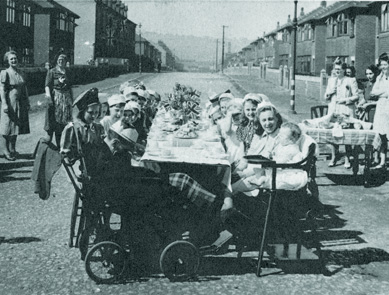
1. A Coronation street party in Ferrars Road and not a car in sight. Our house was the first one in the third block on the left.You can just make out the steelworks at the end of our road.
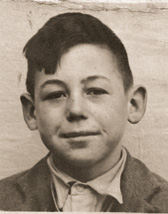
2. Me, aged about nine, during my days as a coal liberator. My idea of bliss was a slice of bread and dripping.
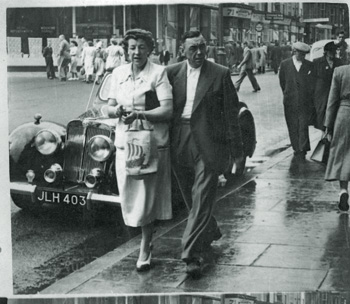
3. Mam and Dad out walking in Sheffield city centre. Needledd to say, the car was not theirs!
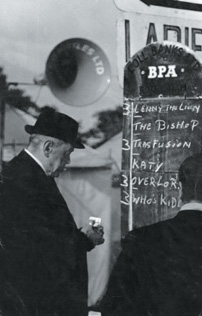
4. Dad doing a bit of on-course turf accounting at Doncaster. For the steelworkers and coal miners of Sheffield, a trip to Doncaster was a major undertaking.
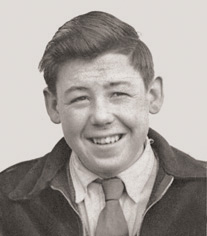
5. Me at fourteen. The jerkin I am wearing was at the time the height of Sheffield fashion.
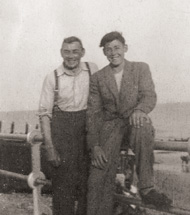
6. On holiday in Scarborough. I was aged about sixteen. Dad is obviously in the holiday mood - he’s taken off his jacket and tie.
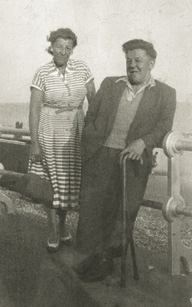
7. Mam and Our Jack at Scarborough.
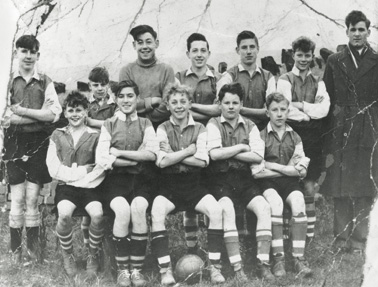
8. In goal for Tinsley County Secondary School. Immediately to my left is Bob Pashley, who went on to play for Bolton Wanderers and both the Sheffield clubs. Far right on the back row (next to the teacher) is David ‘Bronco’ Layne, who became a free-scoring centre forward with Sheffield Wednesday. Centre front with the ball at his feet is Terry Wheighway, who was on the books of Sheffield United. The lad on my immediate left became the only person I’ve ever known to have a full-length photograph of himself in a passport.
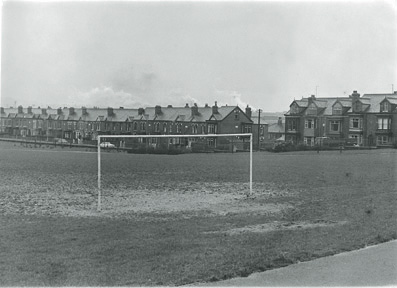
9. Tinsley Rec, where my career as a goalkeeper began. When it rained, it was like a quagmire. When it was cold, the pitch became so icy that the teams had trouble turning round at half time.
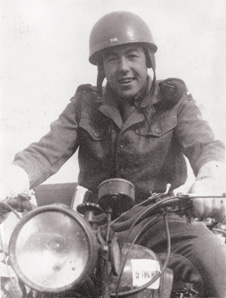
10. A dispatch rider with the Royal Signals in Germany. I still have the helmet and wear it if ever I go to Hampden Park for a Scotland-England game.
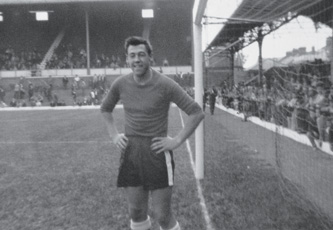
11. Below: My debut for Leicester City reserves against Southend United in 1959. A City supporter ran into the goalmouth and took this photograph. Notice what appears to be a very healthy crowd for a match against Southend reserves!
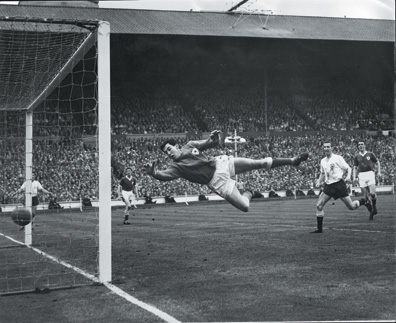
12. The 1961 FA Cup final. Terry Dyson (out of picture) scored for Spurs. The other players are Bobby Smith (partly obscured by the far post), Colin Appleton, Cliff Jones and Ian King.
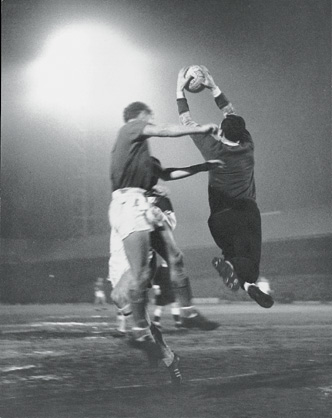
13. During the big freeze of 1962-63. Displaying all the benefits of Ursula’s numerous hot dinners, I collect the ball under pressure from Ray Crawford of Ipswich Town. Braziers filled with burning coke kept the frost at bay but, as you can see from the pitch, not for long.
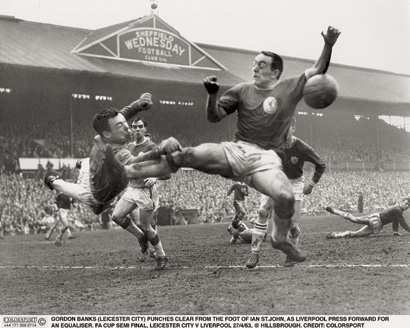
14. The 1963 FA Cup semi-final against Liverpool. I manage to punch clear from Liverpool’s Ian St John. There was only one team in this game - Liverpool - and they lost 1-o.
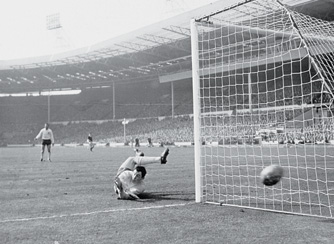
15. A very nervous day for me. My first game for England and Alf Ramsey’s second game in charge - against the old enemy Scotland, in 1963. I’m pushing away a low shot from Willie Henderson. Scotland won 2-1, both their goals coming from Jim Baxter.
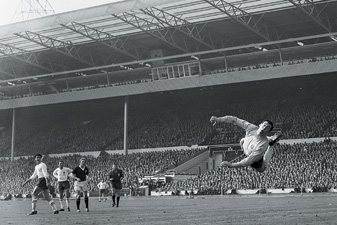
16. The flying Englishman. A free kick from John White has me at full stretch in my international debut against Scotland. On this occasion I managed to keep the Scots at bay though that wasn’t always the case in this game.
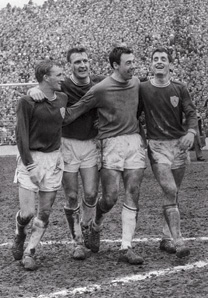
17. Davie Gibson, Ian King, myself and Frank McLintock show our relief at the end of the FA Cup semi-final against Liverpool. This was the moment when I was ‘set up’ by a photographic editor from a well-known newspaper.
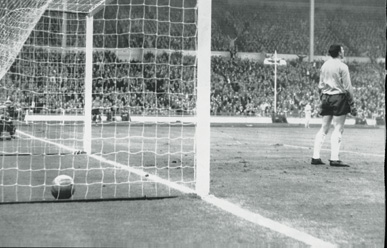
18. Oh dear! In my second game for England I’m mesmerized by the swerve of Pepe’s ‘banana’ free kick. Alf Ramsey was not best pleased. Off to my left in the upper stand at Wembley, one of the few Brazilian supporters present celebrates.
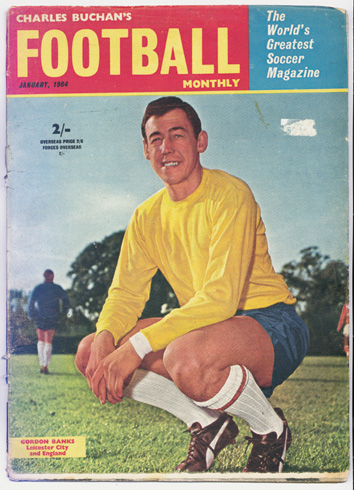
19. When I was a teenager, Charles Buchan’s Football Monthly was the football magazine. Unable to afford to attend matches on a regular basis the only way to see my heroes was in the Footy Monthly. When I was featured on the cover of the January 1964 issue, one of my childhood dreams came true.
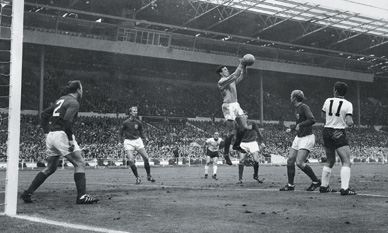
20. Taking a high cross against West Germany in the 1966 World Cup final, oddly enough under no pressure on this occasion. Looking on, from left to right, are George Cohen, Jack Charlton, Uwe Seeler, Martin Peters, Bobby Moore and Lothar Emmerich.
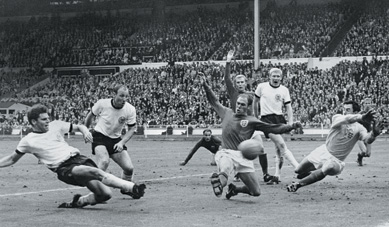
21. Glory seized from our grasp in the dying seconds of the 1966 World Cup final. Wolfgang Weber’s equalizer should not have been allowed. Karl-Heinz Schnellinger handled the ball.You can see Bobby Moore appealing.
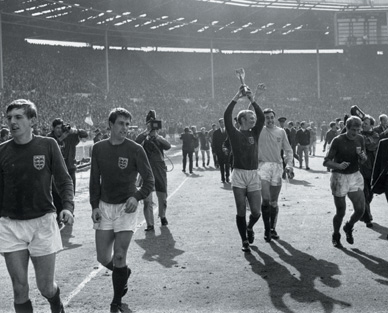
22. A golden memory of a truly golden day I join Martin Peters, Geoff Hurst, Bobby Moore and Roger Hunt to parade the World Cup around at Wembley. Notice how we are too exhausted to run.
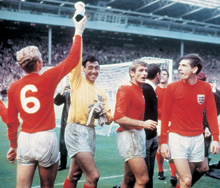
23. ‘Give it here, Banksy.’ Winning the World Cup is the most difficult thing a player can do in football. It had been a long hard road and once I got my hands on the trophy I wasn’t going to give it up easily - not even to skipper Bobby Moore!
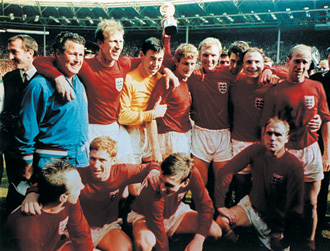
24. The boys of ‘66. There were no prima donnas, no cliques, no loners. We were a team in every sense of the word. Left to right, back row: Gerry Byrne (reserve), Harold Shepherdson (trainer), Jack Charlton, myself, Roger Hunt, Bobby Moore, Geoff Hurst, George Cohen, Bobby Charlton; front row: Nobby Stiles, Alan Ball, Martin Peters and Ray Wilson. Bobby Charlton looks as though he is about to be taken away as it has all become too much for him!
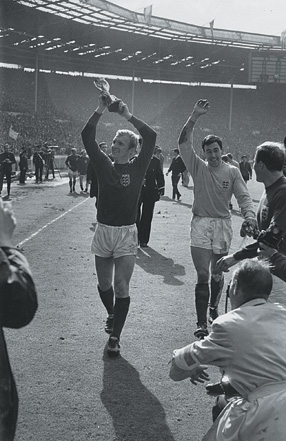
25. England -World Champions. Need I say more?
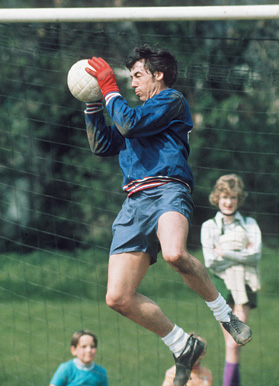
26. I spent countless hours after normal training working hard to improve my technique as a goalkeeper. Here I am on duty with the England squad. The glove I’m wearing seems to be the sort you often see lying forlorn in a road.
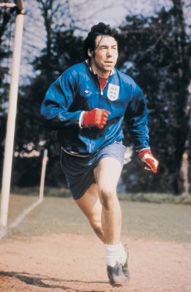
27. Training with England. It looks as if I’ve been caught out by the speed of a break from the opposition it must have been Alan Ball.
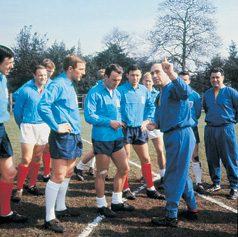
28. Alf Ramsey was the greatest manager I ever played for. His knowledge of the game, tactics and opponents was second to none. Here Alf offers his England charges the benefit of his profound knowledge and, as always, we are attentive listeners.
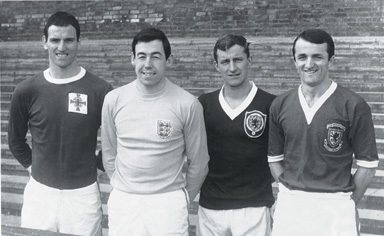
29. Leicester City’s four home internationals. From left: Derek Dougan (Northern Ireland), myself, Davie Gibson (Scotland) and Peter Rodrigues (Wales).
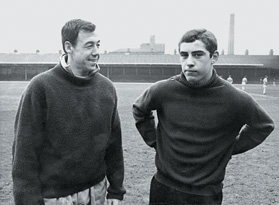
30. Welcoming a young Peter Shilton to Filbert Street. Little did I know that my days at Leicester were numbered. Notice our training tops: Graham Cross reckoned they’d been knitted by Matt Gillies’ mother.
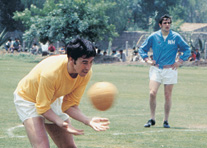
31. It was difficult to adjust to the speed and flight of the ball in the high altitude of Mexico ‘70. Here I appear to be just about coping. In the background is Norman Hunter, who for all his fearsome reputation was booked only four times in his career (which, of course, may say much for the tolerance of referees in those days!).
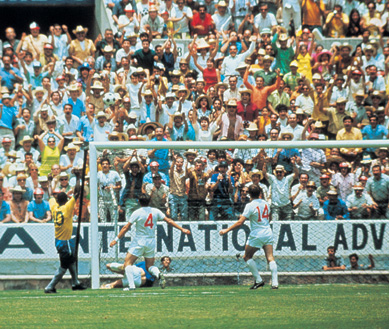
32. The save that brought me global fame. As soon as the ball left Pelé’s head I heard him shout ‘Goto!’ But I had other ideas.
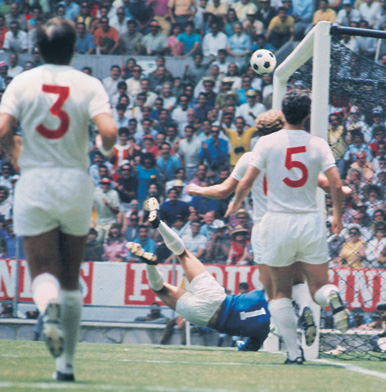
33. The ball balloons over the bar to safety. Bobby Moore said, ‘You’re getting old, Banksy.You used to hold on to them!’
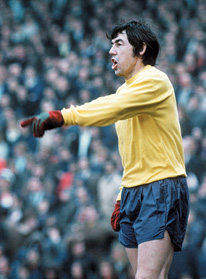
34. The mark of a good goalkeeper is how few saves he is called on to make. Organizing your defence is the key to good goalkeeping. Here I’m telling Bobby Moore, no less, who he should be marking.
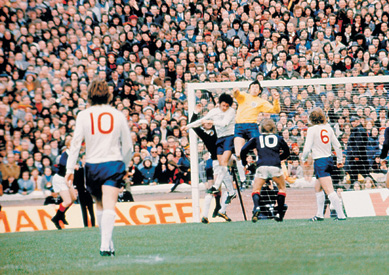
35. In action for England against Scotland in 1971. Also in the picture are Martin Chivers (number 10), Roy McFarland, Billy Bremner and Bobby Moore. England won 3-1.
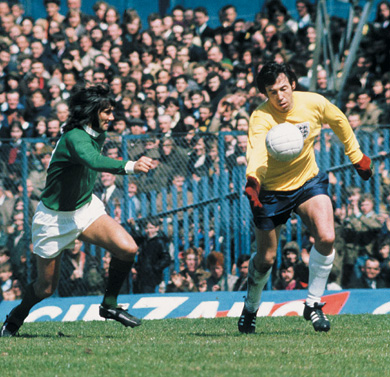
36. George Best about to pounce and flick the ball away from me during the game at Windsor Park in 1971.To this day, George still insists his goal should have been allowed. I’m with the referee on this one.
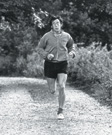
37. Doing some preseason training of my own around the lanes of Cheshire in 1972.
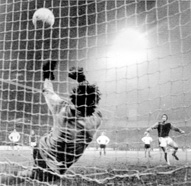
38. My favourite photograph. Saving Geoff Hurst’s penalty in the 1972 League Cup semi-final second leg at a very atmospheric Upton Park. The poses struck by my Stoke team-mates suggest they were expecting Geoff to score!
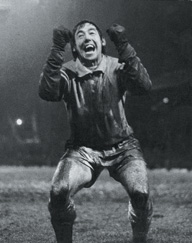
39. I celebrate Stoke City’s victory over West Ham in the semifinal of the League Cup in 1972.This was our fourth meeting, at Old Trafford, and the longest League Cup tie ever.
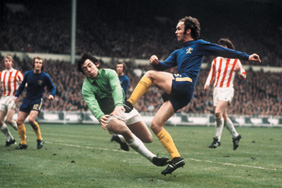
40. I check that the laces of John Dempsey’s boots are correctly tied during the League Cup final of 1972 between Stoke City and Chelsea.
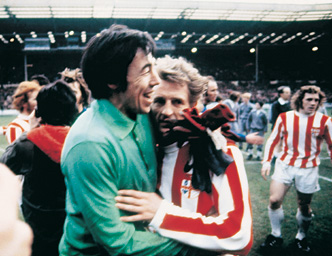
41. A great day for Stoke City and George Eastham. After our epic win against Chelsea in 1972 I congratulate the scorer of Stoke’s winning goal. At 35 years and 161 days old, George remains the oldest recipient of a
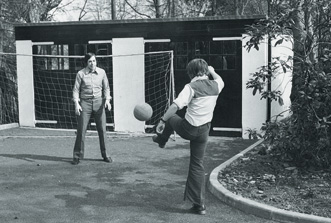
42. My son Robert puts me through my paces at our home in Madeley Heath. I even worked out the angle and my positioning for this one.
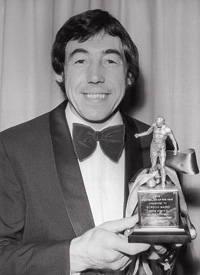
43. A great moment for me. Receiving my Footballer of the Year award in 1972.I was the first goalkeeper to win it since my boyhood hero Bert Trautmann in 1956. The following year, Pat Jennings won.
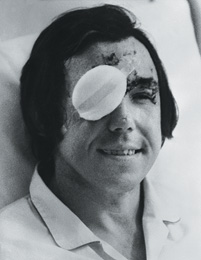
44. Still managing a smile after my near-fatal car crash in 1972. I wouldn’t let my disability beat me. Encouraged by my family and literally thousands of well-wishers, I was to make a comeback in America.
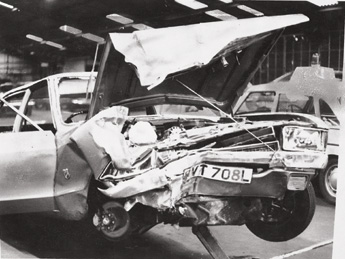
45. My Ford Consul after the crash in October 1972 which resulted in me losing the sight in my right eye.
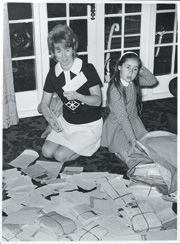
46. Ursula and Wendy sift through thousands of letters from well-wishers received after my accident.
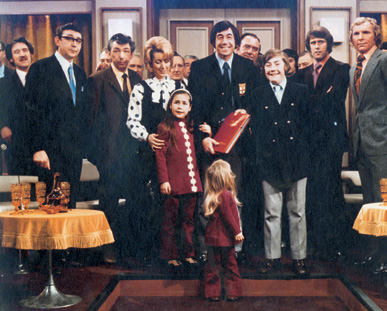
47. This is Your Life. Left to right, front: my brothers Michael and David, Ursula, Wendy, Julia, me, Tony Waddington (on my left shoulder), Robert, Geoff Hurst and Bobby Moore.
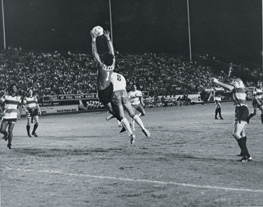
48. In action for Fort Lauderdale Strikers. Following the loss of my eye, the decision to play again had been the most difficult of my life. Here, George Graham (8) decides to test out the strength of my ribcage.
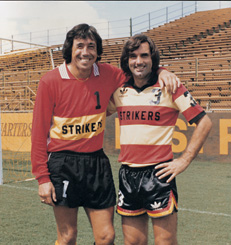
49. With my good friend George Best in the colours of the Strikers. George scored what I believe to be the best-ever goal against me. Quite simply, he was a football genius.
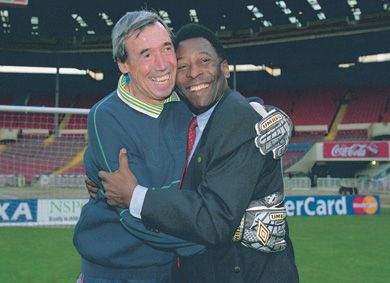
50. Pelé visits Wembley prior to England’s last game there against Germany in the qualifying group for the 2002 World Cup. I was coaching some youngsters when my old friend turned up. I think the love and respect Pelé and I have for one another are obvious.
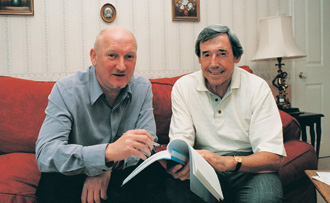
51. Working on the book with friend and collaborator Les Scott.
PENGUIN BOOKS
BANKSY
Gordon Banks OBE was born in Sheffield in 1937. Between 1955 and 1972 he played for Chesterfield, Leicester City and Stoke City. He was named Footballer of the Year in 1972. He made seventy-three appearances for England and was a member of the team that won the World Cup in 1966. He lives in the Midlands.

PENGUIN BOOKS
PENGUIN BOOKS
Published by the Penguin Group
Penguin Books Ltd, 80 Strand, London WC2R 0RL, England
Penguin Putnam Inc., 375 Hudson Street, New York, New York 10014, USA
Penguin Books Australia Ltd, 250 Camberwell Road,
Camberwell, Victoria 3124, Australia
Penguin Books Canada Ltd, 10 Alcorn Avenue, Toronto, Ontario, Canada M4V 3B2
Penguin Books India (P) Ltd, 11 Community Centre,
Panchsheel Park, New Delhi – 110 017, India
Penguin Books (NZ) Ltd, Cnr Rosedale and Airborne Roads,
Albany, Auckland, New Zealand
Penguin Books (South Africa) (Pty) Ltd, 24 Sturdee Avenue,
Rosebank 2196, South Africa
Penguin Books Ltd, Registered Offices: 80 Strand, London WC2R 0RL, England
www.penguin.com
First published by Michael Joseph 2002
Revised edition published in Penguin Books 2003
1
Copyright © Gordon Banks, 2002, 2003
All rights reserved
The moral right of the author has been asserted
Except in the United States of America, this book is sold subject
to the condition that it shall not, by way of trade or otherwise, be lent,
re-sold, hired out, or otherwise circulated without the publisher’s
prior consent in any form of binding or cover other than that in
which it is published and without a similar condition including this
condition being imposed on the subsequent purchaser
978–0–141–03932–9
My autobiography is dedicated to my family – Ursula my wife and the love of my life; our children Robert, Julia and Wendy; and our grandchildren, Matthew, Edward, Daniel, Eleanor and Elizabeth.
List of Illustrations
Acknowledgements
A Note to Les Scott
1. Family Matters
2. Aspiring Spireite
3. Learning My Trade
4. From Number Six to Number 1
5. Foxes in the Final
6. The Wembley Hoodoo?
7. Into Europe
8. England Calls
9. Down South America Way
10. Chelsea Blues
11. The Class of ’66
12. Rattin Gets Ratty
13. Alf’s Final Word
14. The Leaving of Leicester
15. Pelé and Me
16. Message in a Bottle
17. The Agony and the Ecstasy
18. Striking Back
19. The Changing Game
Career Record
Index
1. A Coronation street party in Ferrars Road.
2. Me, aged about nine.
3. Mam and Dad out walking in Sheffield.
4. Dad, on-course turf accounting at Doncaster.
5. Me at fourteen.
6. On holiday in Scarborough.
7. Mam and Our Jack at Scarborough.
8. In goal for Tinsley County Secondary School.
9. Tinsley Rec.
10. With the Royal Signals in Germany.
11. My debut for Leicester City reserves.
12. The 1961 FA Cup final.
13. During the big freeze of 1962–63.
14. The 1963 FA Cup semi-final against Liverpool.
15. My first game for England.
16. The flying Englishman.
17. The end of the semi-final against Liverpool.
18. Pepe’s ‘banana’ free kick.
19. Charles Buchan’s Football Monthly
20. Taking a high cross in the 1966 World Cup final.
21. The 1966 World Cup final: Wolfgang Weber’s equalizer.
22. A golden memory of a truly golden day.
23. ‘Give it here, Banksy.’
24. The boys of ’66.
25. England – World Champions.
26. Working hard to improve my technique.
27. Training with England.
28. Alf Ramsey.
29. Leicester City’s four home internationals.
30. Welcoming a young Peter Shilton to Filbert Street.
31. Mexico ’70.
32. The 1970 World Cup save from Pelé’s header.
33. The ball balloons over the bar to safety.
34. Organizing your defence.
35. In action for England against Scotland in 1971.
36. George Best about to pounce.
37. Pre-season training around the lanes of Cheshire.
38. My favourite photograph: saving Geoff Hurst’s penalty.
39. Stoke City’s victory over West Ham in the semi-final of the League Cup in 1972.
40. The League Cup Final of 1972.
41. George Eastham, the oldest recipient of a League Cup winner’s medal.
42. My son Robert puts me through my paces at our home in Madeley Heath.
43. Receiving my Footballer of the Year Award in 1972.
44. Still managing a smile after my near-fatal car crash.
45. My Ford Consul after the crash.
46. Ursula and Wendy sift through thousands of letters from well-wishers.
47. This is Your Life.
48. In action for Fort Lauderdale Strikers.
49. With George Best, in the colours of the Strikers.
50. Pelé visits Wembley prior to England’s last game there.
51. Working on the book with Les Scott.
PICTURE CREDITS
Empics, 12; 15; 22; 23; 27; 28; 35; 40; 41; Colorsport, 14; 17; 24; 26; 34; 36; 37; Getty Images, 16; 25; 43; 44; Popperfoto, 20; 21; 31; 33; J. C. Thompson & Co. Ltd, 29; Chris Morphet, 30; Sporting Pictures, 32; Sentinel Newspapers, 38; H. W. Kokowski, 42; Mirrorpix.com, 45; NI Syndication, 46; Steve Merzer, 48.
Every effort has been made to trace copyright holders and we apologize in advance for any unintentional omission. We would be pleased to insert the appropriate acknowledgement in any subsequent edition.
I would like to express my sincere thanks to the following people, all of whom have helped significantly in the production of my autobiography:
Julian Alexander and all at my literary agents Lucas Alexander Whitley; Barclays Bank plc, in particular Janice Hallam at Stafford; George and Alex Best; Ken and Jean Bolam; Chesterfield FC; Terry Conroy; Jimmy Greaves; Trevor Horwood; Roger Hunt; Sir Geoff Hurst; the staff of the Leicester Mercury; Leicester City FC, in particular club historians Dave Smith and Paul Taylor, authors of Of Fossils and Foxes; Simon Lowe; Manchester United plc, in particular Mike Maxfield; Jackie Marsh; Arthur Montford; Don Mackay; the staff of the Sheffield Star; Huston Spratt; Stoke City FC; Martin Taylor; Steve and Deborah Waterall; Rowland White and all at Michael Joseph.
For Sal, Lauren and Ruby.
My sincere thanks go to Les Scott for his invaluable assistance in writing this book. Les contributes regularly to the Stoke Sentinel and the Bristol Evening Post, has written extensively for TV and wrote the screenplay for the film The Rose Of Tralee.
He collaborated with George Best, Gareth Chilcott and Sir Stanley Matthews on their respective autobiographies, and when I made the decision to write my own I had no hesitation in asking Les to lend a guiding hand.
Thanks, Les. It has been a privilege to work with you and great fun.
The mark of a good goalkeeper is how few saves he has to make during a game. A spectacular save is the last resort when all else – positioning, anticipation, defence – have failed. But saves are always what we are remembered for. There is one in my career that people always ask me about, it is seen as my greatest save – though not by me!
It was 1970 and England prepared to play Brazil in the World Cup, 1,500 metres above sea level under the relentless sun of Guadalajara. But the sweltering heat and lack of oxygen at such high altitude were the least of our concerns at the time. One man, bruised from Brazil’s defeat four years earlier when they failed even to reach the quarter-finals, and intimating this would be his last World Cup, was determined to make it a swansong to remember. This was a man who could single-handedly affect the outcome of a game at the highest level. He was, of course, Pelé.
In Brazil’s opening group match against a talented Czechoslovakian side, Pelé orchestrated the game from start to finish. Brazil won 4–1 and Pelé had been the hub around which every Brazilian move had turned. In that game he displayed a complete mastery of the ball, fantastic powers of acceleration, the cunning to veil his real intentions and the patience to bide his time before making his strike at the optimum moment. He kept the ball flowing, and his unselfishness brought his team mates into the picture time and again.
The England squad attended Brazil’s opening game. I watched Pelé with concealed awe: his finely tuned balance, his incredible skill on and off the ball, and his uncanny ability to ghost into the right position at the right time. Once he played the ball it was as if he disappeared into the ether. The Czechs were taken up with trying to close down Jairzinho or Tostao, then, as if springing from a trapdoor, Pelé would suddenly appear in their penalty area to display his predatory skills to the full. The Czechs tried to put two, sometimes three, men on him, but such was his skill and technique that he always found the space to make the telling pass. Knowing Brazil were our next opponents I had sat and watched Pelé closely. By the end of the game I didn’t think he was just a great player. I knew he was the great player. How could we stop him?
The opening ten minutes of England’s match against Brazil are best described as footballing chess, with both sides sounding each other out. Brazil adopted a softly, softly approach. Consummate passers of the ball, they played it around among themselves at walking pace. Such precise passing meant that there was little we could do but watch. In the stifling heat and high altitude, to play a chasing game and try to close them down would have been suicidal. So we bided our time.
Then, just when I thought the game was settling down to a rolling, strolling classic, it suddenly exploded into life. Carlos Alberto played the ball out to Jairzinho on the Brazilian right. Jairzinho was a powerful, direct winger who could go through the gears like Michael Schumacher and cross the ball with Swisswatch precision. I hit my toes as soon as I saw Jairzinho bearing down our left flank. We were caught on the hop. Bobby Moore had left Tostao free at the near post, Brian Labone was just outside our six-yard box, and Alan Mullery who had been pushing up, was sprinting back, anxiety creasing his face at the sight of Pelé heading towards our penalty box, unmarked.
When I saw Jairzinho arc around the ball, I knew the cross was coming. I moved two feet off my line, expecting him to cross to the penalty spot, in the belief that, since Pelé had now just entered our penalty area, I’d be first to the ball. Only Jairzinho didn’t aim for the penalty spot. He whipped the ball across to a point just outside my six-yard box, a yard or so in from my right-hand post.
As I turned my head I saw Pelé again. He’d made ground fast and such was the athleticism of the man, he’d already launched himself into the air. Sidestepping on my toes, I covered the ground to my right and was only two or three paces off the centre of goal when Pelé met that ball with the meat of his head. As an attacking header, it was textbook stuff. He rose above the ball and headed it hard and low towards my right-hand corner. The moment the ball left his head I heard Pelé shout, ‘Golo!’
Faced with a situation like that, your mind becomes clear. All your experience and technique takes over. The skills I had acquired through countless hours of practice and study had become what psychologists call ‘overlearned’, or, in layman’s terms, second nature. I suddenly found myself at a forty-degree angle with my right hand stretching out toward the post, my eyes trained on the quickly descending ball. One thing did flash through my mind: If I do make contact, I’ll not hold this. Instinct, over-learning, call it what you will – I knew that if I made contact with the ball, I had to get it up in the air. That way Pelé, following up, would not be afforded a tap-in at my expense. The ball hit the deck two yards in front of me. My immediate concern was how high it would bounce. It left the turf and headed toward my right-hand corner, but I managed to make contact with the finger of my gloved right hand. It was the first time I’d worn these particular gloves. I’d noticed that the Mexican and South American goalkeepers wore gloves that were larger than their British counterparts, with palms covered in dimpled rubber. I’d been so impressed with this innovation that I’d invested in two pairs. Those little rubber dimples did their stuff: the bouncing ball didn’t immediately glance off my hand and I was able to scoop it high into the air. But another thought flashed through my mind. In directing the ball upwards, I might only succeed in flicking it up into the roof of the net. So I rolled my right hand slightly, using the third and fourth fingers as leverage.
I landed crumpled against the inner side netting of the goal, and my first reaction was to look out at Pelé. I hadn’t a clue where the ball was. He’d ground to a halt, head clasped between his hands, and I knew then all that I needed to know. With the luck of the gods, the angle at which I’d managed to lift that ball was perfect, and it had ballooned in the air and over the bar, out of harm’s way for a corner.
As I got to my feet Pelé, ever the great sportsman, came up to me and patted me on the back.
‘I thought that was a goal,’ he said, smiling.
‘You and me both,’ I replied.
The TV footage of the game shows me laughing as I turn to take up my position for the corner. I was laughing at what Bobby Moore had just said to me.
‘You’re getting old, Banksy,’ he quipped, ‘you used to hold on to them.’
Like hell I did.
When the wind blew in the direction of our terraced house in Ferrars Road, it was the only time you never saw washing hanging out on the line. At the end of our street ran the main Sheffield to Rotherham road, on the opposite side of which stood Peach and Towser’s steelworks. The works stretched for nigh on a mile and a half and what I remember most about it was the smell: an acrid mix of fired coal, sulphur-tainted steam and human sweat. Even when the wind wasn’t blowing in our direction, the smell was ever present. When it did blow our way the washing was brought indoors because the cosy rows of terraced houses were immediately coated in a film of raven-black soot.
On such days I can recall drawing comic faces in the grime that coated our windowsills. Washing windows and paintwork was a constant job in the Tinsley area of Sheffield where I grew up. My mother seemed to spend half her life with a bucket of water and wash leather in her hands. But it was a thankless and never-ending task, like painting the Forth Bridge.
And when the soot descended it found its way inside every house no matter how tight the doors and windows were shut, and settled like a blanket over everything. This was part of Sheffield life in the 1940s. No one complained, least of all my mother. No one could remember it being any different. No one worried about the danger to health of this air pollution because we had never been told it was a problem. We lived in ignorant harmony with the smell and the soot, because they were simply the by-products of what everyone aspired to – work. My dad worked in a steel foundry. My mother, or so it appeared to me, divided her time between cooking and washing. I was the youngest of their four sons, the others being David, Michael and John. John was always referred to as Jack, though in truth it was always ‘Our Jack’, a term of endearment that was always a source of bewilderment to me as a small boy, as I could never fathom why it was needed. ‘Our Jack has eaten all his cabbage,’ Mam would say, as if to identify which Jack she was talking about.
Dad didn’t earn much and, with six mouths to feed, money was always tight for us, as it was for all the other families in our neighbourhood. Tinsley folk may have been poor, but they were proud. I remember one Sunday lunchtime, a man from across the road appearing at his door to sharpen a carving knife on the front step, to try and make the rest of us believe they could afford a Sunday roast. He might have succeeded, too, had it not been for the incongruous smell of fish frying, as out of place on the street on a Sunday lunchtime as we children being allowed to play out. Fish was plentiful and cheap then, and that’s all the poorest could afford.
In the forties Tinsley families moved house rarely, if ever. Co-habiting for unmarried couples was unheard of. It was unheard of for couples to set up home together before they were married. That done, the vast majority stayed put until the time came for their children to call the funeral director. There were no nursing homes, no managed flats for the elderly. A house was bought or rented and turned into a home. At various times it was also a nursery (though we didn’t use the term ‘nursery’), a hospital, a function room and in the vast majority of cases, in the end, a chapel of rest for those who had purchased the house in the first place.
People occupied the same house for such a long time that it seemed to seep into their being, each home, internally and externally, taking on the character of its occupants. From either end of Ferrars Road the terraced houses all looked the same, but I soon learned the subtle individualities of each one. It was the owners’ small touches – usually the mother’s – that gave them their identities. The highly polished brass letter-box on the front door of the Coopers’; the pristine gold-leaf house number on the fanlight over the front door of the Dobsons’ (I had no idea why this number should have survived intact when all the others had become mottled and flaked with age); the net curtains in the front window of the Barbers’, gathered rather than hanging straight as in every other home; the red glass vase, no more than four inches high, that balanced precariously on the narrow window ledge in the Archers’ front window.
I never saw this vase containing flowers (they would have had to have been very small). Fresh flowers were a rarity in our home as they were in every other house. In the summer Mam would occasionally give me a threepenny bit and send me down to the allotments to ask one of the owners, ‘Have you got any chrysanths you don’t want?’ Chrysanths – that was all the steelmen who worked the allotments seemed to grow in the way of flowers. With their football-like blooms and tall stems these flowers dominated the small living rooms of the houses they fleetingly graced. It was as if, having been denied fresh flowers for the best part of a year, these allotment owners thought, ‘What’s the point in growing small, delicate flowers that will have little impact in a room? If we’re going to have flowers, let’s grow them big enough for everyone to see and marvel at.’ I only heard their full name, chrysanthemums, when I was in my late teens. True, chrysanths runs off the tongue a lot easier but, looking back, there might have been another reason for our constant use of the shortened version of the name. To have called these flowers by their full and correct name would have invited accusations of trying to get above your station. ‘Chrysanthemum’ sounds Latin, something only posh kids learned. In Sheffield in the forties such class distinction was as clearly drawn by the working class as it was by the middle and upper classes.
Furniture and the wireless apart, what possessions people did have took the form of such trinkets. The red glass vase in the Archers’ front window was typical of the ornaments that used to decorate every conceivable surface in the home, including the walls, where lines of brightly coloured plaster ducks, of decreasing size, seemed to fly up the wall in a desperate bid for freedom. Being plaster ornaments, of course, they never moved. Just like many of the people whose homes they graced.
For a young Tinsley lad, the only escape from a lifetime of work in the steel foundry or pit, was sport, mainly football and boxing. Cricket then was still the domain of the gentleman player and professionals were few and far between. I had three childhood passions, the most important of which was football. In those days it was quite common to watch both the Sheffield teams, Wednesday and United, on alternate Saturdays. With money short, however, I rarely got the chance to see either. In fact, between the age of seven and fifteen, I reckon I saw no more than twenty games at Wednesday or United, though counted myself lucky to have seen that many.
Tinsley County School was only a stone’s throw from Tinsley railway shed, where steam trains were housed and serviced. At times there were up to fifty steam engines in there, each belching smoke and steam in competition with that from Peach and Towser’s. The phrase ‘Go outside and get some fresh air’ was never heard from the teachers in my school.
The close proximity of the railway shed was a bonus to me, for my second passion was trainspotting. It’s a hobby much ridiculed today, but in the forties, with no television, no computers and few toys, train spotting was a hobby taken up by most of the boys round our way. It cost next to nothing to get started. All you needed was Ian Allan’s ABC Spotters’ Book, a notebook and a pencil. I rarely ventured outside Tinsley and the sight of engines from other towns and cities always filled me with a sense of wonder. They may have come from distant Newcastle or London, or just Wakefield or Bradford. It didn’t matter. Just seeing them evoked in me a feeling of travel, a consciousness of places I’d only heard of, or whose names I had only seen on a map. It was as if these faraway places had come to visit me. Though I never moved from my vantage point on that sooty brick wall a short walk from my home, I felt my horizons broaden.
At Tinsley shed my devotion to trains and football combined, for there was a class of locomotive named after famous football teams. I remember it always gave me a great thrill to see these particular engines. Names such as Bradford City, Sunderland, Sheffield United and Everton emblazoned above the centre wheel of the engine, with the arced nameplate bearing not only the club’s colours but a half caseball made of shining copper. Many of these nameplates now adorn the reception areas of their respective clubs and to see them always brings back memories of my childhood at Tinsley County School.
For quite another reason, the close proximity of the railway shed was a boon to many Tinsley families, mine included. In the shed yard was a coaling stage, under which steam engines stopped to have their tenders replenished with coal. To one side of the coaling stage was a large stockpile of coal, a magnet to the many families on the breadline. Many was the time my mam would send me and one of my brothers down to Tinsley shed to procure coal for our fires in my old pram. We’d fetch the pram from our backyard shed under cover of darkness and push it to a well-known spot in the wooden fence that ran along one side of the shed yard. A number of fence panels had been loosened by countless others keen to put heat in their hearths, and it was simply a matter of my brother raising these panels to allow me and the pram through to the yard. Then my brother and I would walk up and down the sidings near the coaling stage on the look-out for windfall coal. (We never took it from the stockpile; Mam would have considered that to be stealing. Picking up stray lumps of coal that had fallen from a tender or spilled from the coaling stage during refuelling she considered to be no more than helping keep the engine shed yard tidy – a view not shared by the shed foreman.)
The pram was large and navy blue, with highly sprung, spoked wheels. We always had the hood down, because once the carriage of the pram had been filled with good-sized pieces of coal, we could always use the collapsed hood for any amount of smaller lumps. Fully laden, we’d then set off for home, nervously negotiating the rough ground back to the fence. A speedy exit from the shed yard was impossible as the heavy pram would constantly jerk and veer to either side whenever it came into contact with the many stones and bits of iron protruding from the ground. Quite often we had to leave with the pram only half full of coal as we were alerted by the beam of the foreman’s torch bearing down on us from a hundred yards away. Once through the loose fence my anxiety lifted and I’d chirp away merrily to my brother, as we pushed our ill-gotten bounty along the smoother pavements back to Ferrars Road, only braving the cobblestones when we had to cross a street.
We’d come in by the backyard door and call to Mam in great triumph like hunters bringing home the kill. Mam, dressed in her ‘pinny’, would come out to cast an eye over what we had brought home, some pieces the size of a kettle, the small lumps, for making the fire up in the morning, safely stowed in the pram hood. Mam suitably satisfied, my brother and I would then unload the pram into the coalhouse, careful not to break the big lumps. I’d then wash my face and hands in the kitchen sink before changing into my pyjamas and enjoying a supper of toast made on a fork in front of a blazing fire, courtesy of the night’s work.
We had no bathroom, the kitchen sink was where matters of personal hygiene were attended to in the form of a twice-daily wash. But Friday night was bath night. A tin bath was taken down from its hook in the shed, placed on newspaper in front of the living-room fire and laboriously filled by Dad with kettles of hot water. First to go was Dad, then Our Jack, then David, Michael and finally, the youngest – me. Being the fifth user of the same bathwater, it’s a wonder I didn’t get out dirtier than when I went in. The Friday-night bath ritual was not restricted to the Banks household. Everyone I knew had just one bath a week. It was also the only time I changed my vest and underpants. I wince at the thought now, but that’s how it was, for me, for every young lad I knew. There were no modern labour-saving appliances such as washing machines to switch on every day. Our clothes were washed every Monday, in the kitchen, with a poss tub and dolly, after which, Mam would hand-rinse everything and then put them all through a hand-operated wringer before hanging them out on the line to dry or, in the event of rain, on wooden clothes horses dotted around the living room. Come Tuesday they would be dry. On Wednesday they were ironed and then put away ready for us to wear again on Friday after our bath, and so the cycle was repeated. This was typical of the many domestic routines adhered to, week in, week out in our house. Mam’s life must have been as monotonous as mutton, as regular as a roll on an army drum. That my childhood was always happy, secure and filled with a warm heart, though money was always tight, is all the more to her credit.
In the forties and fifties it was not done for parents and children to show each other outward signs of affection. I had a happy childhood, Mam and Dad were caring and, in their own way, loving, but never tactile or overtly affectionate. My family was not unusual in this. I never came across a family in which the parents hugged and kissed their children, or, devoted any considerable one-to-one time to their offspring. It just wasn’t the done thing. Life was hard for the vast majority of families I knew, a matter of daily survival. It was commonly believed that if children were showered with hugs and kisses at every opportunity they would grow up to be ‘soft’, incapable of coping with the daily grind of working life. By not hugging and kissing at every opportunity, parents believed they were doing their children a favour, instilling in them independence and the ability to cope with the rigours of adult life. Moreover, parents did not have free hours to spend playing with their children even at weekends, or to read to them before bedtime. Because the household chores were so labour intensive, the precious time Mam devoted to my three brothers and I, she did so while undertaking some aspect of housework. Mam would talk to us, acknowledge what we were doing and encourage us in our play while either washing, ironing, preparing a meal or attending to some other daily chore.
Dad, meanwhile, was no different to any other father in that he would come in from work and have his tea. Having satisfied himself that my brothers and I had been up to nothing untoward that day, he’d settle down to read the evening paper. Dad’s time immersed in the Sheffield Star was sacrosanct. The Victorian notion of the male as head of the family was still very much in evidence and in order for Dad to evaluate and make decisions that affected family well-being, he felt he had to know what was going on in the world. Or, at least our world, which extended as far as the Sheffield boundaries. Gossip apart, his only source of information was the local evening newspaper and woe betide my brothers and I if we ever interrupted his reading of it.
Mam read the Star too, though always after Dad and usually when I was getting ready for bed. Mam and Dad reacted in different ways to what they read in the paper. When Dad disapproved of some item of news he would tut and sigh and usually conclude with the statement ‘They want locking up,’ or, in the case of something appalling such as a serious assault or murder, he would elaborate with ‘They should lock them up and throw away the key.’ As a small boy I believed that this was a genuine punishment administered by the courts, in which the judge would pronounce the grave sentence that the defendant be locked up and the key thrown away – whereupon the constable would suggest that the canal would be the best place for it. I still think of this when I hear or read this popular phrase.
In contrast, Mam’s reading of the paper often appealed to her sentimental side. Such sentiment was invariably applied to the predicaments of people she had no knowledge of, and never would. Her interest in the lives of people entirely remote from her world was like the fascination today for the trials and tribulations of characters from TV soaps. The fact there were other people, rich and poor, enduring emotional upheaval in their lives on a day when she was not, was something of a comfort to her. ‘I see the brother of the Earl of Harrogate has died,’ Mam would say aloud on reading the piece, no doubt aware only then that there was indeed an Earl of Harrogate with a brother; ‘there’s always trouble for somebody in this world.’ Thus she was confirmed in her belief that life was a sea of troubles.
That I always felt secure in childhood was, I am sure, in no small way due to the small routines of home life. On a Saturday lunchtime, for example, we always had fishcake and chips. Fish may well have been cheap and plentiful, but fishcakes were cheaper still and much more in keeping with a tight budget. It was my job to fetch the fishcake and chips and I did this on a bicycle that had more than a touch of Heath Robinson about it. To buy even a second-hand bicycle was beyond our means but when I was about twelve I cobbled together a contraption from spare parts found discarded on a bomb-site. The front wheel was missing many of its spokes, the brake blocks were worn down to the metal and the hard bakelite seat had a habit of swivelling around whenever I adjusted my position which made for not only an uncomfortable, but often perilous ride. It was on this conveyance that I collected our fishcake and chips on a Saturday.
There were two fish and chip shops in our neighbourhood, but Dad always insisted I went to the one five streets from where we lived because the chips were fried in dripping. I’d ask for six fishcake ‘lots’ (i.e. ‘with chips’), put them into my mother’s string bag and pedal off home. Riding that old bike was a precarious business at the best of times; with a fully laden string bag swinging from the handlebars it was downright dangerous. Once the bag became entangled in what few spokes were in the front wheel. The bike immediately ground to a halt, stood vertically on its front wheel and I was pitched headfirst on to the cobblestones of the street, my hands outstretched in an attempt at breaking my fall. I had skinned the palms of my hands but, far worse, dinner was scattered all over the street. Terrified to go home and ask for more money I simply scooped up the fishcakes and chips off the ground and rewrapped them in the newspaper as best as I could before limping home. I spent that dinner suppressing nervous laughter as I watched Dad bemusedly picking little bits of grit off his chips. My brothers, less particular in their eating habits, simply wolfed their fishcake and chips with all the enthusiasm and relish of lads who seemingly hadn’t seen food for a week.
That old bicycle again served me well on Saturday mornings when Mam would give me a shopping list and ask me to cycle to Tinsley Co-op to fetch the groceries. The shop was only in the next street but such was the grocery order, it was better to take the bike than walk as the numerous paper carrier bags full of bulky groceries could be hung from the handlebars and seat. The weekly order rarely varied: a pound of sugar; a pound of butter, not pre-packed but wire-cut from a large block then wrapped in greaseproof paper; plain and self-raising flour; bacon and sausage; three loaves of bread, two white, one brown; a dozen eggs; a drum of salt, either ‘Cerebos’ or ‘Saxa’, Co-op marmalade and jam; ginger snaps, rich tea or ‘Nice’ biscuits; Shippams meat paste for the making of sandwiches; Oxo cubes, Bisto, Echo margarine for baking; tinned fruit; Carnation milk; Heinz (sometimes Armour) baked beans; Ye Olde Oak luncheon meat and the only sort of salmon I knew existed – tinned (the Co-op’s own-brand variety, as John West salmon was out of our budget). There was a lot more, but that was the core of the order every Saturday morning, week in, week out, year after year. The lack of variety was testament to the limited choice available in a country still struggling in the aftermath of rationing. The fact that I was never bored by the food placed before me just goes to show how clever Mam was at using the limited ingredients at her disposal.
It is now a constant source of amazement to me that, with all her chores at home, Mam also had a part-time job as a cleaner-cum-cook up at the Big House, the home of the ‘well to do’ family of one of Sheffield’s lesser steel magnates. I never saw inside the Big House nor glimpsed the family who owned it. The large Victorian house – rumoured to have seven bedrooms and (amazingly) a bathroom – was hidden from sight by a high, soot-blackened wall; the children went to different schools from ours; the parents never patronized the shops in Tinsley.
Mam’s job took her into this different world, where she did ‘a bit of cleaning and a bit of cooking’. She never talked about her work there or the people she worked for. I suppose she felt it her duty not to gossip, not to ‘carry tales’ as she called it. The family must have treated her well – she certainly wouldn’t have stayed in that house if she hadn’t been treated with respect. The only regular time Mam spent away from the daily chores of our house was when she went to do similar work in the Big House. Looking back, Mam’s quality of life must have been pretty awful. Dad rarely took her out, even for an hour to the local pub. Our house was where Mam spent most of her adult life. That she made that draughty house a loving home full of warm smiles, is my abiding memory of her.
On Sunday lunchtimes Dad would invariably go off to the pub to meet his mates, leaving me to help Mam cook the Sunday dinner. The preparation of the Sunday roast was always done to the accompaniment of the wireless. I would shell the peas or, if we were having lamb, chop the mint. In those days we would have either lamb or beef – and that piece of meat would be made to last until Tuesday. Chicken then was still an expensive luxury, and we only ate turkey at Christmas.
At noon Mam would switch on the wireless for Two Way Family Favourites. On the rare occasion when I heard its title music, ‘With a Song in my Heart’, nowadays, I can immediately smell a Sunday dinner. The idea of the show was that everyone had a special song in their heart for someone they loved, whether they were in the forces overseas or had relatives who had emigrated. The programme was two way in that it linked a family at home with a loved one abroad. Two presenters in London were linked with colleagues in Cologne and Cyprus (places where our armed forces had a considerable presence) and later, when the programme expanded its remit to include the growing number of people who had emigrated from the UK, Toronto and Sydney.
This being a time of National Service, the show relied heavily on mothers requesting a current hit – usually one of sugary sentimentality sung by the likes of Dickie Valentine, Eddie Fisher, Vera Lynn and Alma Cogan – for their squaddie son. These requests usually ended with a plaintive message, along the lines of, ‘1954 is not too far away’ – the given year usually being two years hence, the duration of National Service. The addresses of the squaddies were always announced as care of their British Forces overseas posting number: BFPO 271 Cologne, BFPO 32 Cyprus, BFPO 453 Gibraltar – code words for faraway places that were a mystery to me, other than that it was where soldiers lived.
This weekly reminder to the nation that Britain still had a military presence abroad, served to maintain the misplaced notion that we were still a major power in world affairs when, in truth, the days of the Empire were long gone.
BBC radio, though changing, still managed to convey a sense of a past in which class distinction was prevalent. This was exemplified by Family Favourites, the presenters of which had plummy voices that set them apart from me and everyone I knew. Presenters such as Cliff Michelmore, Muriel Young and Ian Fenner, while sounding sincere and never patronizing, were indicative of a system that didn’t allow anyone from Tinsley, Attercliffe or any other area I was familiar with, to work as radio presenters. While some people may have been broadening their horizons through military postings abroad or emigration, the expectations of the Sheffield folk I knew still never extended beyond the steelworks or the pit. No one ever told us there was a world out there waiting for us too.
Family Favourites was followed by an hour of comedy, which I loved. First was the Billy Cotton Band Show, a mixture of amiable humour from Alan Breeze and Bill Herbert, novelty songs and danceband tunes from the veteran Billy Cotton Band. Billy always began his introduction to the programme by announcing the week’s guests, such as pianist Russ Conway, then, more often than not, making some comic reference to a football match of the previous day. This was especially the case if England had played Scotland, as one of his resident singers was Kathy Kay, a Scottish lass with whom Billy would indulge in playful teasing if England had been triumphant. Billy’s opening lines would then be interrupted by a heavenly voice shouting, ‘Hey, you down there with the glasses… get orn wi’ it.’ Billy’s response would be his catchphrase, ‘Wakey! Wakey!’ bellowed at the top of his voice, at which his band sprang into action by playing his signature tune, ‘Somebody Stole My Girl’, popularly known as ‘Tan, tanner, rah, rah, rah…’
The Billy Cotton Band Show