
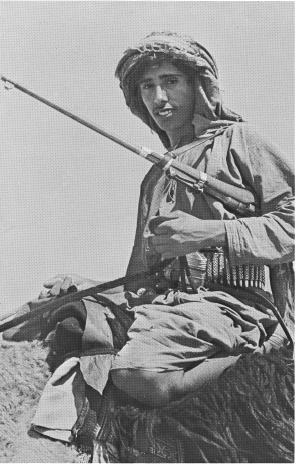
1. Bin Kabina
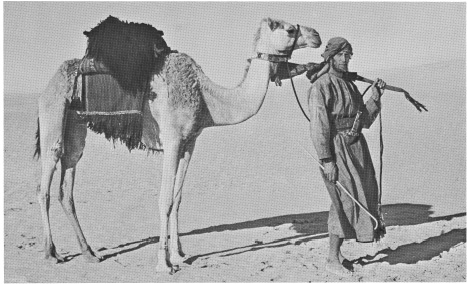
2. The author during the second crossing of the empty quarter
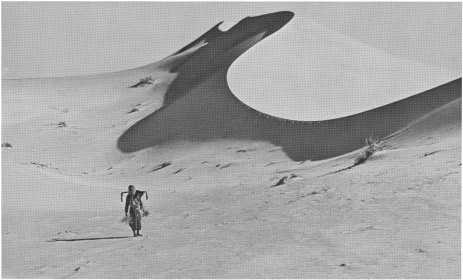
3. The Empty Quarter: the crest of a great dune from the windward side
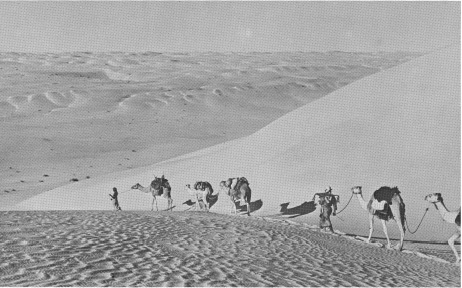
4. The Empty Quarter: descending a great dune
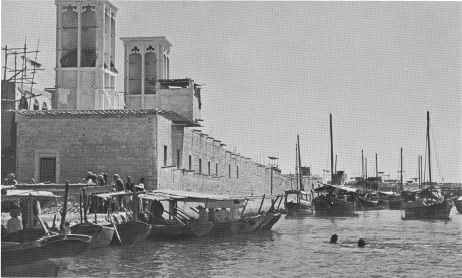
5. Wind-towers on a house beside the creek at Dibai
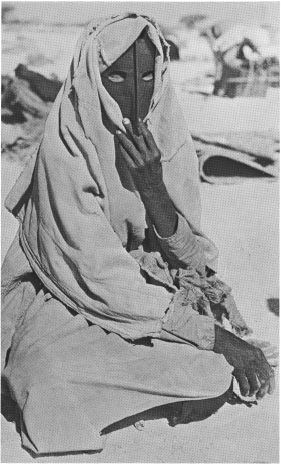
6. A Woman of the Harasis
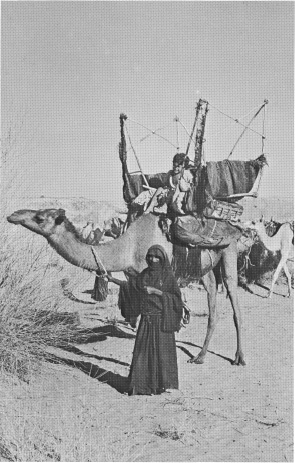
7. A Saar family on the move
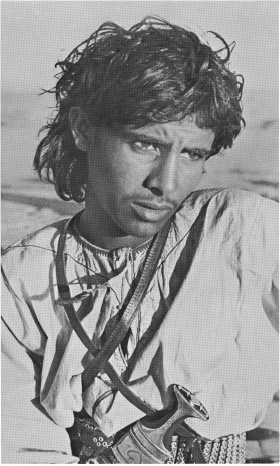
8. Bin Ghabaisha
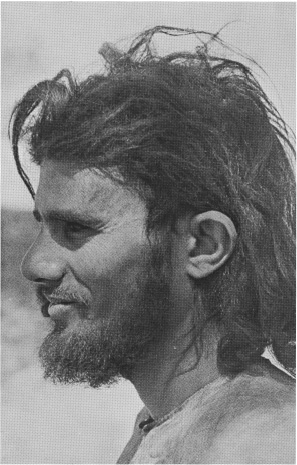
9. Sulaim, our rabia from the Mahra
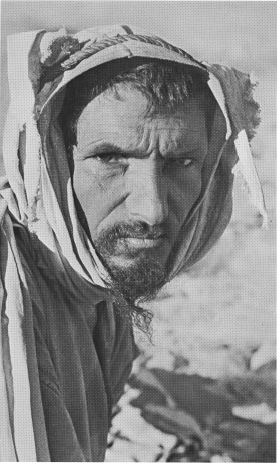
10. One of the bin Maaruf Saar, the wolves of the desert
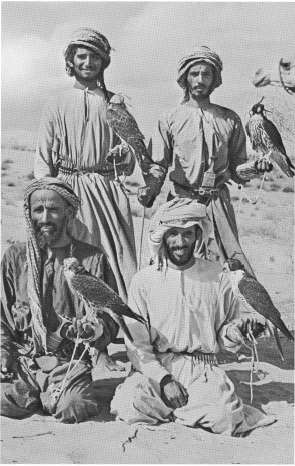
11. Zayid’s falconers
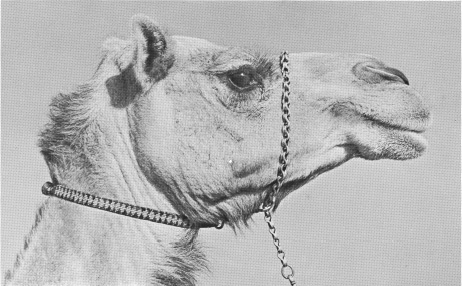
12. A camel from the Batina
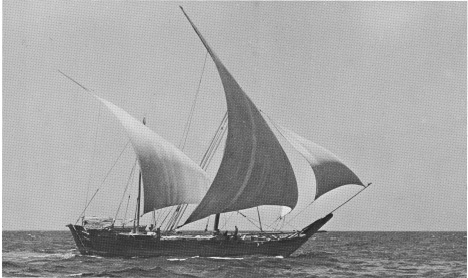
13. A Kuwaiti boom returning from Zanzibar
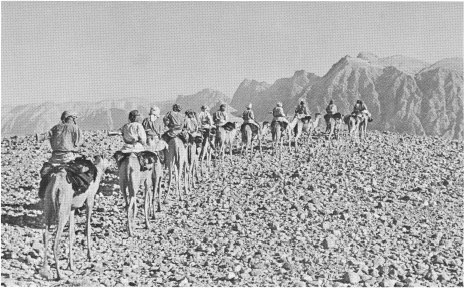
14. In the Oman Mountains
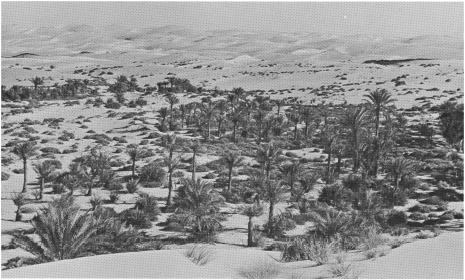
15. In the oasis of Liwa
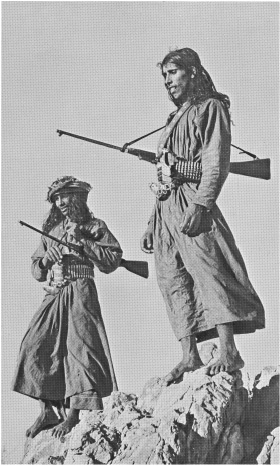
16. Bin Kabina and bin Ghabaisha in Oman

ARABIAN SANDS
WILFRED THESIGER was born in Addis Ababa in 1910 and educated at Eton and Oxford where he got his blue for boxing. In 1935 he joined the Sudan Political Service and, at the outbreak of the Second World War, was seconded to the Sudan Defence Force. He later served in Abyssinia, Syria and with the SAS in the Western Desert, and was awarded the DSO. After the war he travelled in Arabia, Kurdistan, the Marshes of Iraq, the Hindu Kush, the Karakorams, Morocco, Abyssinia, Kenya and Tanganyika, always on foot or with animal transport. In recognition of his journeys he received the Founder’s Gold Medal from the Royal Geographical Society, the Lawrence of Arabia Medal from the Royal Central Asian Society, the Livingstone Gold Medal from the Royal Scottish Geographical Society and the Burton Memorial Medal from the Royal Asiatic Society. He was a Fellow of the Royal Society of Literature and an Honorary Fellow of the British Academy. In 1968 he received the CBE, and a knighthood in 1995.
In his two greatest books, Arabian Sands and The Marsh Arabs, he gives a vivid account of a way of life which, until recently, had continued for thousands of years. The Marsh Arabs, which won the 1964 W. H. Heinemann Award, is also published in Penguin Classics. Wilfred Thesiger’s other books include Desert, Marsh and Mountain: The World of a Nomad, his autobiography, The Life of My Choice, and Visions of a Nomad. An accomplished photographer, he donated his extensive collection of negatives to the Pitt Rivers Museum in Oxford. Wilfred Thesiger died in 2003.
RORY STEWART was born in Hong Kong and educated at Eton and Oxford. He served briefly as an infantry Officer in the Black Watch before joining the Foreign Office and serving in Indonesia and then as British Representative in Montenegro. Between 2000 and 2002 he walked 6,000 miles across Iran, Pakistan, India and Nepal and Afghanistan. In 2003 he was appointed as the Coalition Deputy Governor of Maysan and Dhi Qar in the Marsh regions of southern Iraq. He is the author of The Places in Between and Occupational Hazards. He now lives in Kabul where he runs the Turquoise Mountain Foundation. He was awarded the OBE in 2004.
With an introduction by RORY STEWART
PENGUIN BOOKS
PENGUIN CLASSICS
Published by the Penguin Group
Penguin Books Ltd, 80 Strand, London WC2R 0RL, England
Penguin Group (USA) Inc., 375 Hudson Street, New York, New York 10014, USA
Penguin Group (Canada), 90 Eglinton Avenue East, Suite 700, Toronto, Ontario, Canada M4P 2Y3
(a division of Pearson Penguin Canada Inc.)
Penguin Ireland, 25 St Stephen’s Green, Dublin 2, Ireland (a division of Penguin Books Ltd)
Penguin Group (Australia), 250 Camberwell Road, Camberwell,
Victoria 3124, Australia (a division of Pearson Australia Group Pty Ltd)
Penguin Books India Pvt Ltd, 11 Community Centre,
Panchsheel Park, New Delhi – 110 017, India
Penguin Group (NZ), 67 Apollo Drive, Rosedale, North Shore 0632, New Zealand
(a division of Pearson New Zealand Ltd)
Penguin Books (South Africa) (Pty) Ltd, 24 Sturdee Avenue, Rosebank, Johannesburg 2196, South Africa
Penguin Books Ltd, Registered Offices: 80 Strand, London WC2R 0RL, England
www.penguin.com
First published in Great Britain by Longmans, Green 1959
First published in the United States of America by E. P. Dutton 1959
Published in Penguin Books 1964; reprinted with a new preface 1984; reprinted with a second preface 1991
Published with a new introduction in Penguin Classics 2007
1
Copyright © The Estate of Wilfred Thesiger, 1959, 1984, 1991
Introduction copyright © Rory Stewart, 2007
All rights reserved
The publishers are indebted to Messrs J. M. Dent & Sons Ltd for permission to quote a prayer from the Rodwell translation of The Koran in the Everyman Library edition.
The moral right of the authors has been asserted
ISBN: 978–0–141–90442–9
‘Sir Wilfred, how did it feel when you first killed a man?’
‘Killed a man? I’ve never killed a man.’
‘But in your book…’
‘Oh, I see – well of course I’ve killed men from long distance with a rifle…’
‘Sir Wilfred,’ another student asked, ‘what did it feel like to go alone into the terrifying Danikil country and meet the young ruler who was celebrating by hanging the testicles of his dead enemies around his neck?’
‘He seemed very pleased.’ Thesiger paused, apparently searching for an analogy. ‘As though he had just been awarded his First Field Colours.’
This was my first meeting with Wilfred Thesiger. He was six foot two, broad-shouldered, with a deeply lined face, a large nose broken three times in a boxing ring, and he was as tough as he looked. In 1932 he was the first European to make it alive through the country of the notoriously violent Danikil in Ethiopia, recording in the process the direction of a major river system. He travelled astonishing distances through the Sahara and in the Sudan, he hunted lions, standing his ground as they charged – one got close enough to knock him over before he killed it. He developed a reputation for courage while serving with Wingate’s Gideon Force in Ethiopia and won the DSO for capturing a fort together with 2,500 Italian soldiers. He was then recruited into two of the most famous wartime units: first SOE, where he was trained to be a secret agent in Cairo, and then the SAS, with whom he fought behind enemy lines in the desert.
When I first met him, however, he was wearing a three-piece tweed suit and lecturing to students in an old-fashioned upper-class growl. Many in the audience who had apparently come expecting to meet a deeply sensitive mystic, a second Lawrence of Arabia, were shocked by his apparent pomposity. One whispered to me disapprovingly that he ‘was a product of his age and class’, as though an English gentleman born in 1910 was predestined to be an aristocratic fop or a colonial nabob. In fact, of course, the modernist revolutions in art, science and politics were underway before his birth. Picasso, Proust, Einstein, James Joyce and Mao were all old enough to be his father. While Thesiger was lion-hunting in the Sudan, his fellow Etonian George Orwell was fighting in the Spanish Civil War. When Thesiger was living with the Marsh Arabs, another fellow Etonian, Aldous Huxley, was experimenting with gurus and LSD in California.
If Thesiger seemed old fashioned this was in part his conscious choice. His answers to the students were deliberately camp and provocative. He was aware that most of the audience had no idea what First Field Colours were (they are awarded to the best performers in the Field Game – a sport played only at Eton). These comments, like his clothes, were part humorous, part nervous, part pompous, and sat awkwardly alongside his real achievements. They have always filtered our impressions of him. It is impossible, however, to doubt his physical courage.
As Arabian Sands records, between 1946 and 1948, while the world struggled with genocide, colonialism, revolution and modernity, Wilfred Thesiger crossed and recrossed the 250,000 square miles of the Empty Quarter, the largest sand desert in the world, in the area of modern Yemen, Saudi Arabia, UAE and Oman. The routes he chose were threatened by warring tribes and so desolate that many Arabs refused to accompany him. He was in his late thirties and had worn shoes all his life but he walked barefoot so that every step in the desert burned or cut his soles. On one part of this journey, he travelled 2,000 miles over seven months, rationing himself and his companions to only two pints of water a day and eight pounds of flour a month, about a third of a normal diet. They were thirsty and hungry almost all the time and they were pursued by raiding parties determined to kill them.
Thesiger called the Empty Quarter ‘the final and greatest prize of Arabian exploration’. It had been crossed twice before him: first by Bertram Thomas in 1931, and then by Harry St John Philby in 1932, on a physically more taxing journey that involved one leg of 400 miles between water supplies. Thesiger’s journeys of 1947 and 1948 opened two new and even tougher routes, the first from Mughshin to Liwa across the eastern sands, and the second across the western sands from Manwakh, via Laila, to Abu Dhabi.
Arabian Sands describes these and six other journeys undertaken in five successive years with twenty-eight different companions in four different countries. The landscape is largely barren, there are no monuments to admire, the days are repetitive, his Arabic is not entirely fluent and his illiterate companions frequently have little of interest to say. Yet, Thesiger turns this confusing and potentially alienating journey into a unified and compelling narrative. It is engaging without being over-simplified, exciting without being over-dramatic and strikingly truthful.
Thesiger’s talents as a writer are a surprise. Arabian Sands was his first book and he finished it when he was almost fifty. He had little interest in serious literature, got a poor degree as the Oxford University boxing champion and did not enjoy writing. As Alexander Maitland’s excellent biography makes clear, it took him ten years to get round to writing Arabian Sands at all, and the process left him ‘bored stiff’. But the result was an immediate success.
His previous writing had been directed at audiences he knew well: warm and sentimental letters to his mother, and confident understated lectures to fellow explorers. In these contexts he had learned to be a chronicler of specific events, a keen observer of men’s clothes (he was dressy himself) and of how they were greeted by other men. He wrote naturally in short sentences with few metaphors. He revealed little about why he undertook these extraordinary journeys and he rarely drew historical or literary parallels. His writing, therefore, often echoed the reports of nineteenth-century British travellers on the North-west frontier: matter of fact, understated, replete with precise information, useful for Imperial projects.
When Arabian Sands was published, however, travel-writing was dominated by writers in the tradition of Robert Byron. Such writers rarely spoke local languages or spent extended times in rural areas or engaged in dangerous journeys. They presented themselves either as libraries of historic allusion or as figures of fun. Their books were filled with comic dialogue, ornate descriptions and exotic incidents typically involving public-school maharajahs, colourful crowded bus rides and reveries on ancient monuments.
One of the leading exponents of the new style was Eric Newby, whose book A Short Walk in the Hindu Kush was published in the same year as Arabian Sands. Newby was a decorated Special Forces veteran, who had escaped from a prisoner of war camp, spent eighteen months doing backbreaking work while hiding on an Apennine farm, and had just attempted a very difficult mountain ascent when he met Thesiger in Afghanistan in 1956. Newby chose to present himself for comic effect as a timid incompetent dilettante with a background in the London fashion industry, and Thesiger as ‘a great, long-striding crag of a man, with an outcrop for a nose and bushy eyebrows, forty-five years old and hard as nails, in an old tweed jacket of the sort worn by Eton boys, a pair of thin grey cotton trousers, rope-soled Persian slippers and a woollen cap-comforter’. Thesiger returned the compliment, calling Newby and his companion ‘a couple of pansies’.
Thesiger hated most contemporary travel-writing, saying of James Morris’s book on the Oman that ‘if people want that sort of chatty rubbish, I hope they will never get it from me’. He was equally dismissive of the journeys of Freya Stark, who he said, with a characteristically old-fashioned reference, had ‘done nothing which could not be done by a second secretary from a legation on home leave’.
Thesiger by contrast is not a comic writer. Nor is he an erudite guide. He has little interest in archaeology (‘meaningless holes and trenches’), or architecture (‘bloody buildings’) or even history and politics. He says very little about his reactions to events. He rarely embroiders an anecdote to make it more appealing. He acknowledges the frequent boredom and repetition of travel. He shows that he himself is often confused or uncertain about what is happening.
This reticence partly reflected Thesiger’s experience of travel. Unlike many other contemporary British travellers, who had barely left Britain until they were adults, Thesiger was born and lived the first years of his life in Addis Ababa in Ethiopia. This made him both more comfortable abroad and less liable to be impressed by the superficially exotic. He had spent more time than his contemporaries living alongside tribal peoples. He was painfully aware of how different they were, how difficult to understand and how often exoticised or misrepresented. He was convinced that they (and not his own personality, erudition or prose) should be the centre of the story.
Thesiger’s writing, like his photographs, can be precise, artful and elegant. His careful descriptions of how hundreds of different individuals dress or greet each other allow the reader cautiously to judge the subtle differences between men. We share in Thesiger’s efforts, as a stranger, to judge the virtue of those he meets. This concern with moral character and reputation makes his encounters into parables:
Two days later an old man came into our camp. He was limping, and even by Bedu standards he looked poor. He wore a torn loincloth, thin and grey with age, and carried an ancient rifle… In his belt were two full and six empty cartridge cases, and a dagger in a broken sheath. The Rashid pressed forward to greet him: ‘Welcome Bakhit. Long life to you, uncle. Welcome – welcome a hundred times.’ I wondered at the warmth of their greetings. The old man lowered himself upon the rug they had spread for him, and ate the dates they set before him, while they hurried to blow up a fire and to make coffee… I thought, ‘He looks a proper old beggar. I bet he asks for something.’ Later in the evening he did and I gave him five riyals, but by then I had changed my opinion. Bin Kabina said to me: ‘… Once he was one of the richest men in the tribe, now he has nothing except a few goats.’ I asked: ‘What happened to his camels? Did raiders take them, or did they die of disease?’ and bin Kabina answered, ‘No. His generosity ruined him. No one ever came to his tents but he killed a camel to feed them. By God, he is generous!’ I could hear the envy in his voice.
Thesiger’s reticence as a writer also partly reflects his own controlled personality. He chose to bind himself by the conventions of a British ruling class, which had largely disappeared even at the time of his birth. He was much more repressed personally and intellectually than his hero, T. E. Lawrence, who was over twenty years his senior. Thesiger, for instance, reduced even his sexuality to his ideas of gentlemanly behaviour, claiming that ‘I might have been homosexual if I was born in a different age but as it was I remained asexual.’ His literary agent observed that he was ‘far too frightened of letting himself go’, far too frightened that people might say ‘this man is shooting a line’, ‘is overemphasising the dangers of the trip’.
Thesiger, however, was not the only anomaly: he embodies a quite separate tradition of British writing. He measured himself against British colonial officials who were immersed in local culture and regularly undertook journeys that were dangerous and physically demanding. His first hero of this type had been his first boss, Guy Moore, who like almost all the men Thesiger referred to obsessively had served in Iraq during the First World War.
When Thesiger died in 2003, I was working as a British Administrator in the Marshes region of southern Iraq. I sent the condolences of the local sheikhs, who remembered him fondly, to his memorial service. Yet he was not the only name still recalled in the area. My predecessor in Amara in 1916 had been Harry St John Philby, the second man to cross the Empty Quarter. I was then posted to Dhi Qar, whose two political officers in 1920 had been Bertram Thomas, the first man to cross the Empty Quarter, and Harold Dickson, who teased Thomas by pretending to cross the Empty Quarter before him. These were competitive men. Thesiger often quoted Thomas’s reply to Dixon: ‘I have every intention of being the first man to cross the Empty Quarter and to live the rest of my life on the proceeds.’ St John Philby was ‘bitterly disappointed’ to be beaten. Thesiger not only followed these men across the Empty Quarter, but then followed them further by moving to the Marshes of southern Iraq. By that time, Dickson was the de facto prime minister of modern Kuwait, Thomas of Oman, and Philby of Saudi Arabia. Thesiger thought for one moment that he would be offered the chance to succeed Thomas as the chief advisor to the Sultan of Oman. Thesiger, however, was never quite one of these men and he was never offered the job.
Although Thesiger was descended from one of the most distinguished imperial families (he was the grandson of the general commanding the British forces in the Zulu wars and the nephew of a viceroy of India), he had little sympathy for imperial bureaucracy. He hated paperwork and politics, failed his exams and resigned his full-time position in the Sudan Political Service after only two years. He hated all the values of progress, commerce and law and order that the British Colonial Service promoted. He chose as his companions some of the most dangerous outlaws in the desert and volunteered to go on raids with them. He had finally to stop his travels in the Empty Quarter because the Saudi, Omani and even British governments saw him and his companions as a dangerous threat to stability and order.
Thesiger’s overriding interest was in travel for its own sake. Unlike Charles Doughty or T. E. Lawrence, who returned to Britain to work on their literary memoirs, Thesiger never ceased to travel. He continued to demonstrate his commitment to a punishing life among alien cultures even when he had nothing left to prove and long after he had ceased to pioneer routes. He moved from the Empty Quarter to live for seven years among the Marsh Arabs of Iraq on floating beds of reeds, with buffaloes, hunting alongside men who fished naked with tridents, then to the Hindu Kush and finally to a remote region of northern Kenya, where he remained till he was in his mid-eighties.
He was perhaps the first to make punishing travel itself rather than government, exploration, knowledge or writing his entire vocation. He disguised this by taking on the title of the ‘last explorer’ and insisting that after him there was nothing left to explore. He emphasised that he travelled on foot and by camel only because there were no cars available and that he usually did so in order to draw up a map. He was dismissive of people undertaking unnecessarily punishing journeys as stunts. He claimed to be the last to see a wild world. In reality, however, Nuristan and the Iraqi Marshes remain wilder and more dangerous for foreigners today than when he saw them forty years ago.
He continued to travel on foot and by camel, long after cars were introduced, to sleep on rocks, long after the introduction of mattresses, and to press into areas that had already been fully mapped. He did not have a regular job or income for the last fifty years of his life. He wandered in this way for almost forty years because he found that these journeys gave a meaning and comfort to his life, which he could not convincingly articulate. Rather than being the last Victorian he was closer to being the first hippie on the overland trail.
Thesiger’s physical endurance makes Arabian Sands a unique and final witness of a particular aspect of Arabic nomadic life. Charles Doughty had lived in the midst of Beduin communities and experienced the slow progress of the Bedu herds, wives and children to and from the oases, their cuisine, their trading and the formal majlis (or administration) of the sheikhs in their tents. In the journeys described in this book, Thesiger paid men from a very small and isolated tribe to accompany him on highly unnatural ventures into the very harshest parts of the desert. They left their families behind, they followed a route where there was no pasture or trading opportunity, and where they were under imminent threat from hostile tribes.
There was a disadvantage to this: Thesiger had almost no exposure to the normal migrations of Arabic families, he saw very few women and almost no children, and his experience was of the most extreme aspects of life and landscape. He had little contact with vulnerable groups, who might have benefited most from historical change. His love of the freebooting life of the raiders encouraged him to believe that all modern development was for the worst and that modern cities were ‘an Arabian nightmare, the final disappointment’. He can be naive, superficial and even offensive, such as when (in his autobiography) he praises the Ethiopian race because ‘they had not been mongrelized’. It is not surprising, therefore, that another Etonian explorer, Robin Hanbury-Tenison, seeing Thesiger’s prejudices, aristocratic manner and suits, should conclude on their first meeting, like many others, that Thesiger was ‘an archaic figure, caught in a time warp, with excessively reactionary views’.
Nevertheless, Thesiger’s painful participation in such eccentric environments is valuable. He gains a unique insight into the Bedu’s struggle with the desert at its worst, their resilience, their survival skills. And his own contempt for settled civilization and the love of warfare makes him particularly open to their dignity, honour, pride and joy in raiding. No one before or since has managed to capture with such sympathy the life of a nomadic bandit leader such as bin Duailan (the cat). Thesiger is able to capture what is both admirable and disturbing in bin Duailan’s disorienting combination of honour and cruelty, murder, theft and nobility.
Many Europeans and Americans, then and now, find traditional societies difficult to understand and even more difficult to respect. ‘State-building’ projects in many of the countries where Thesiger travelled – from Sudan, through Iraq to Afghanistan – now strive to replace traditional structures with the apparatus of a ‘modern state’: the rule of law, civil society, independent and accountable governance. Such projects are based on admirable intentions and are almost inevitable. Thesiger, however, saw and could communicate how strong, meaningful and consoling the previous culture had often been.
He saw the Beduin not as ‘savages but the lineal heirs of a very ancient civilization, who found within the framework of their society the personal freedom and self-discipline for which they craved’. He loved them because he believed that they, like him, could at any time have settled in a richer country but had instead chosen for the sake of their freedom to renounce almost everything. The virtues that they celebrated – courage, strength, generosity – were also the virtues he strove for in his own life.
His companions in Arabia repaid the compliment. They did not remember him for Arabian Sands, which they could not read, and they did not remember Thesiger’s clothes because he dressed like them. But when bin Ghabaisha was asked to describe Thesiger fifty years after the trip he said: ‘He was loyal, generous, and afraid of nothing.’
A few years after my first meeting with Thesiger, I also walked 6,000 miles, often in places where Thesiger had walked. He captured much of what matters most about this kind of travel. First, he suggests that there is no satisfying answer to the question of why we undertake these journeys; second, that living humans are of more interest than landscape, architecture or history; third, that the real challenge is to describe how a landscape appears not to the visitor but to people who have lived in that landscape all their lives. Finally, he shows that the greatest prize is to be, however partially, accepted and respected by your companions. The foreign traveller can never hope to have the same life experience as those he travels with. He remains always a stranger with a different home. But, at certain moments, particularly at the end of months of travel together you can sense a shared experience of courage and generosity. You can feel, if only for an instant, a sense of equality with those with whom you travel. This is, I think, what Thesiger meant when he said he travelled for ‘comradeship’. It is troubling that he, perhaps like many of us, could find such equality more easily away from home.
Thesiger misjudged the future of the Beduin: contrary to his belief, his companions did not deliberately reject all material comfort but instead would embrace generators and pick-up trucks cheerfully. His tact, concern and patient observation, however, is humane and revealing. In the fine grain of his account are remarkable insights not only into an alien society, but into minds, modernity and a gradual modest revelation of how he believed a human life should best be lived. In Chapter 8, for example, the group have been travelling for more than a month, close to starvation, when Musallim catches a hare. They throw all their remaining flour into the pot and are all sitting ravenously waiting for it to cook, when suddenly three Arabs appear on the horizon. It is difficult not to admire the ethics and the self-awareness that underlie Thesiger’s description:
We greeted them, asked the news, made coffee for them, and then Musallim and bin Kabina dished up the hare and the bread and set it before them, saying with every appearance of sincerity that they were our guests, that God had brought them, that today was a blessed day, and a number of similar remarks. They asked us to join them but we refused, repeating that they were our guests. I hoped that I did not look as murderous as I felt while I joined the others in assuring them that God had brought them on his auspicious occasion.
It is in these moments that prejudices and limitations, that Thesiger matters, both as a writer and a man.
Rory Stewart, 2007
Arabian Sands
To bin Kabina and bin Ghabaisha
Danakil Country
The Sudan
Arabia
Tribal Map of Southern Arabia
The Empty Quarter: First Crossing
The Mahra Country
The Empty Quarter: Second Crossing
Oman: The Interior
Arabian Sands describes the journeys I made in and around the Empty Quarter from 1945 to 1950, at which time much of that region had not yet been seen by a European. I returned to Arabia in 1977 at the invitation of the Oman Government and Emir Zayid of Abu Dhabi.
Even before I left Arabia in 1950, the Iraq Petroleum Company had started to search for oil in the territories of Abu Dhabi and Dubai. They soon discovered it in enormous quantities, and as a result the life I have described in this book disappeared for ever. Here, as elsewhere in Arabia, the changes which occurred in the space of a decade or two were as great as those which occurred in Britain between the early Middle Ages and the present day.
I was aware before I returned to Oman that considerable changes, both economic and political, had taken place there. In 1954 Muhammad al Khalili, the xenophobic Imam of Oman, had died. He was succeeded by his son, Ghalib, but the following year the Omani Sultan, Sayid Said bin Timur, took the opportunity to invade and occupy his domains and to abolish the Imamate. This caused great resentment and Talib, Ghalib’s brother, backed by Sulaiman bin Hamyar of the Bani Riyan and a considerable following, rebelled. After their forces had been defeated in 1957 they withdrew into the almost impregnable Jabal al Akhdar; however, the British SAS Regiment, acting on behalf of the Sultan, scaled the mountain and overcame their resistance.
In 1965 a rebellion in Dhaufar, instigated and actively supported by the communist regime of the People’s Democratic Republic in South Yemen, led to years of fierce fighting in the Jabal Qarra, which was finally suppressed in 1976 with the help of British and Persian troops. Meanwhile, in 1970 Qaboos had deposed his reactionary father, Sayid Said bin Timur and, as the new Sultan of Oman, he immediately set about developing and modernizing the country.
I was anxious to see the ancient Arab seaport of Muscat which I had not yet visited, to climb the Jabal al Akhdar, the unattainable goal of my last journey in Arabia and, above all, to meet once more the Rashid and Bait Kathir who had accompanied me on my journeys; but I was filled with misgivings at going back.
In this book I have described a journey in disguise through Inner Oman in 1947 and I wrote : ‘Yet even as I waited for my identity to be discovered I realized that for me the fascination of this journey lay not in seeing this country but in seeing it under these conditions.’ The everyday hardships and danger, the ever-present hunger and thirst, the weariness of long marches: these provided the challenges of Bedu life against which I sought to match myself, and were the basis of the comradeship which united us.
For the three weeks I was in Oman, aeroplanes, helicopters, cars and even a launch were put at my disposal; during this time I covered distances in an hour that previously had taken weeks. Soon after my arrival in Muscat I was flown to Salala, from where I had started my journeys into the Empty Quarter. Salala had been a small Arab village adjoining the Sultan’s palace; now it was a town with traffic lights. Bin Kabina and bin Ghabaisha met me when I landed. They had been my inseparable companions during the five most memorable years of my life. When I had parted from them in Dubai in 19S0 they had been young men; now they were the grey-bearded fathers of grown-up sons. I was deeply moved to meet them again. I had thought of them so often. They went off next day to prepare a feast for me at their tents in the desert. Meanwhile, old friends from the Bait Kathir, led by Musallim bin Tafl, escorted me in a procession of cars, with blaring horns, up the highway to the new town on the top of Jabal Qarra, where they entertained me in the concrete houses in which they now lived, near the military airfield.
The following day I was flown in a helicopter, accompanied by a television crew, to bin Kabina’s black tents near Shisur. Here the Rashid were assembled, their Landrovers and other vehicles parked behind the tents. None of them now rode camels, though some still lived in tents and owned camels. Many of them had travelled with me on my journeys to the Hadhramaut, but several of my old companions had died or been killed. Bin Kabina had slaughtered a camel and provided a lavish meal; while we ate the television cameras whirred. I flew back to Salala in the evening, accompanied by bin Kabina and bin Ghabaisha, who remained with me while I was in Oman. Together we climbed the Jabal al Akhdar; here, too, was an airfield with jet planes and helicopters landing and taking off. I realized that after all these years and under these changed conditions the relationship between us could never again be as in the past. They had adjusted themselves to this new Arabian world, something I was unable to do. We parted before I went to Abu Dhabi, which I found an Arabian Nightmare, the final disillusionment.
For me this book remains a memorial to a vanished past, a tribute to a once magnificent people.
WILFRED THESIGER
When I went back to Oman and Abu Dhabi in 1977, for the first time since I had left there in 1950, I was disillusioned and resentful at the changes brought about by the discovery and production of oil throughout the region – the traditional Bedu way of life, which I had shared with the Rashid for five memorable years, had been irrevocably destroyed by the introduction of motor transport, helicopters and aeroplanes. When I arrived at Abu Dhabi and saw the high-rise buildings and the oil refineries, spread over what had previously been empty desert, the town symbolized all that I hated and rejected: at the time it represented the final disillusionment of my return to Arabia.
I visited Abu Dhabi once more in February 1990 for an exhibition of my photographs, organized by the British Council under the sponsorship of His Highness Sheikh Zayid. On this occasion I found myself reconciled to the inevitable changes which have occurred in the Arabia of today and are typified by the United Arab Emirates. Abu Dhabi is now an impressive modern city, made pleasant in this barren land by avenues of trees and green lawns. I stayed in the Emirates for twelve days and I was deeply moved by the warmth of the welcome and the overwhelming hospitality I received in Abu Dhabi, Al Ain, Dubai and Sharjah.
WILFRED THESIGER, 1990
During the years that I was in Arabia I never thought that I would write a book about my travels. Had I done so, I should have kept fuller notes which now would have both helped and hindered me. Seven years after leaving Arabia I showed some photographs I had taken to Graham Watson and he strongly urged me to write a book about the desert. This I refused to do. I realized that it would involve me in much hard work, and I did not wish to settle down in Europe for a couple of years when I could be travelling in countries that interested me. The following day Graham Watson came to see me again, and this time he brought Mark Longman with him. After much argument the two of them persuaded me to try to write this book. Now that I have finished it I am grateful to them, for the effort to remember every detail has brought back vividly into my mind the Bedu amongst whom I travelled, and the vast empty land across which I rode on camels for ten thousand miles.
I went to Southern Arabia only just in time. Others will go there to study geology and archaeology, the birds and plants and animals, even to study the Arabs themselves, but they will move about in cars and will keep in touch with the outside world by wireless. They will bring back results far more interesting than mine, but they will never know the spirit of the land nor the greatness of the Arabs. If anyone goes there now looking for the life I led they will not find it, for technicians have been there since, prospecting for oil. Today the desert where I travelled is scarred with the tracks of lorries and littered with discarded junk imported from Europe and America. But this material desecration is unimportant compared with the demoralization which has resulted among the Bedu themselves. While I was with them they had no thought of a world other than their own. They were not ignorant savages; on the contrary, they were the lineal heirs of a very ancient civilization, who found within the framework of their society the personal freedom and self-discipline for which they craved. Now they are being driven out of the desert into towns where the qualities which once gave them mastery are no longer sufficient. Forces as uncontrollable as the droughts which so often killed them in the past have destroyed the economy of their lives. Now it is not death but degradation which faces them.
Since leaving Arabia I have travelled among the Karakoram and the Hindu Kush, the mountains of Kurdistan and the marshlands of Iraq, drawn always to remote places where cars cannot penetrate and where something of the old ways survive. I have seen some of the most magnificent scenery in the world and I have lived among tribes who are interesting and little known. None of these places has moved me as did the deserts of Arabia.
Fifty years ago the word Arab, generally speaking, meant an inhabitant of Arabia, and was often regarded as synonymous with the Bedu. Tribesmen who had migrated from Arabia to Egypt and elsewhere, and still lived as nomads, were spoken of as Arabs, whereas others who had become cultivators or townsmen were not. It is in this older sense that I use the word Arab, and not in the sense that the word has acquired recently with the growth of Arab Nationalism, when anyone who speaks Arabic as his mother-tongue is referred to, regardless of his origin, as an Arab.
The Bedu are the nomadic camel-breeding tribes of the Arabian desert. In English they are usually called Beduin, a double plural which they themselves seldom use. I prefer Bedu and have used this word throughout the book. They generally speak of themselves as ‘al Arab’, and when referring to them I have used Bedu and Arab indiscriminately.
In Arabic, Bedu is plural and Bedui singular, but, for the sake of simplicity, I have used Bedu for both singular and plural. So as not to confuse the reader, I have done the same with the names of the tribes: Rashid, singular Rashdi; and Awamir, singular Amari.
I have used as few Arabic words as possible. Most of the plants mentioned in the book have no English name and I have called them by their local names in preference to the Latin equivalents; for most people, ghaf is easier to remember than Prosopis spicigera, and as intelligible. At the end of the book is a list of the Arabic and scientific names of all the plants mentioned.
Inevitably, this book contains many names which will sound strange to anyone unfamiliar with Arabia. I have included in the text, in addition to the large folding map at the end of the book,* several sketch-maps showing the places mentioned in the accounts of each journey, and I have also included at the end a list of the chief characters.
The maps were specially drawn by K. C Jordan, and I am grateful to him for all the care and trouble he has taken. He compiled the large one from those drawn by the Royal Geographical Society from my traverses in Arabia, and used some information derived from Thomas and Philby. I decided not to correct or amplify this map from work done since I left Arabia.*
Any transliteration of Arabic words leads to dispute. I have tried to simplify as much as possible and have consequently left out the letter ‘Ain, usually represented by ‘. In any case, few Englishmen can pronounce this letter correctly; to the majority of readers the frequent recurrence of this unintelligible ‘ would be both confusing and irritating. For the other difficult letter, Ghain, I have used the conventional ‘gh’. Experts say that this soft guttural sound is pronounced like the Parisian ‘r’. This letter occurs in the name of one of the chief characters in the book, bin Ghabaisha.
Only I know what my mother’s interest and encouragement have meant to me. I was nine months old when she took me from Addis Ababa to the coast, the first of many long childhood journeys with camels or mules. Having herself known the fascination of African travel before it was made easy, she has always understood and sympathized with my love of exploration.
In writing this book I owe a great debt of gratitude to Val ffrench Blake. He read the first chapter as soon as it was written, and since then has read the whole typescript, not once, but many times. His understanding and encouragement, as well as his excellent advice and criticism, have been invaluable to me. My brother Roderic has also read the text with the greatest care and patience and offered many valuable suggestions. To John Verney and Graham Watson I also owe much: John Verney for invaluable advice, and Graham Watson for his faith in the outcome of the task on which he launched me. W. P. G. Thomson of the Permanent Committee on Geographical Names was kind enough to check and approve the spelling of the Arabic names. I am most thankful to him for doing so. I am also extremely grateful to James Sinclair & Company, of Whitehall, for the great trouble they have taken over my photographs for many years; some of the results are to be seen in this book. I also wish to thank the Royal Geographical Society for the help and encouragement which they gave me before I started on these journeys.
Although it would be pointless to thank them in a book which none of them will ever read, it will be obvious that I owe everything to the Bedu who went with me. Without their help, I could never have travelled in the Empty Quarter. Their comradeship gave me the five happiest years of my life.
A cloud gathers, the rain falls, men live; the cloud disperses without rain, and men and animals die. In the deserts of southern Arabia there is no rhythm of the seasons, no rise and fall of sap, but empty wastes where only the changing temperature marks the passage of the year. It is a bitter, desiccated land which knows nothing of gentleness or ease. Yet men have lived there since earliest times. Passing generations have left fire-blackened stones at camping sites, a few faint tracks polished on the gravel plains. Elsewhere the winds wipe out their footprints. Men live there because it is the world into which they were born; the life they lead is the life their forefathers led before them; they accept hardships and privations; they know no other way. Lawrence wrote in Seven Pillars of Wisdom, ‘Bedouin ways were hard, even for those brought up in them and for strangers terrible: a death in life.’ No man can live this life and emerge unchanged. He will carry, however faint, the imprint of the desert, the brand which marks the nomad; and he will have within him the yearning to return, weak or insistent according to his nature. For this cruel land can cast a spell which no temperate clime can match.
A childhood in Abyssinia is
followed by a journey in the
Danakil country and service in the
Sudan. The opportunity to travel
into the Empty Quarter of Arabia
comes from a wartime meeting
with the head of the Middle East
Locust control.
I first realized the hold the desert had upon me when travelling in the Hajaz mountains in the summer of 1946. A few months earlier I had been down on the edge of the Empty Quarter. For a while I had lived with the Bedu a hard and merciless life, during which I was always hungry and usually thirsty. My companions had been accustomed to this life since birth, but I had been racked by the weariness of long marches through wind-whipped dunes, or across plains where monotony was emphasized by the mirages shimmering through the heat. There was always the fear of raiding parties to keep us alert and tense, even when we were dazed by lack of sleep. Always our rifles were in our hands and our eyes searching the horizon. Hunger, thirst, heat, and cold: I had tasted them in full during those six months, and had endured the strain of living among an alien people who made no allowance for weakness. Often, in weariness of body and spirit, I had longed to get away.
Now, in the Assir, I was standing on a mountain-side forested with wild olives and junipers. A stream tumbled down the slope; its water, ice-cold at 9,000 feet, was in welcome contrast with the scanty, bitter water of the sands. There were wild flowers: jasmine and honeysuckle, wild roses, pinks and primulas. There were terraced fields of wheat and barley, vines, and plots of vegetables. Far below me a yellow haze hid the desert to the east. Yet it was there that my fancies ranged, planning new journeys while I wondered at this strange compulsion which drove me back to a life that was barely possible. It would, I felt, have been understandable if I had been working in some London office, dreaming of freedom and adventure; but here, surely, I had all that I could possibly desire on much easier terms. But I knew instinctively that it was the very hardness of life in the desert which drew me back there – it was the same pull which takes men back to the polar ice, to high mountains, and to the sea.
To return to the Empty Quarter would be to answer a challenge, and to remain there for long would be to test myself to the limit. Much of it was unexplored. It was one of the very few places left where I could satisfy an urge to go where others had not been. The circumstances of my life had so trained me that I was qualified to travel there. The Empty Quarter offered me the chance to win distinction as a traveller; but I believed that it could give me more than this, that in those empty wastes I could find the peace that comes with solitude, and, among the Bedu, comradeship in a hostile world. Many who venture into dangerous places have found this comradeship among members of their own race; a few find it more easily among people from other lands, the very differences which separate them binding them ever more closely. I found it among the Bedu. Without it these journeys would have been a meaningless penance.
I have often looked back into my childhood for a clue to this perverse necessity which drives me from my own land to the deserts of the East. Perhaps it lies somewhere in the background of my memory: in journeys through the deserts of Abyssinia; in the thrill of seeing my father shoot an oryx when I was only three; in vague recollections of camel herds at water-holes; in the smell of dust and of acacias under a hot sun; in the chorus of hyenas and jackals in the darkness round the camp fire. But these dim memories are almost gone, submerged by later memories of the Abyssinian highlands, for it was there that I spent my childhood until I was nearly nine.
It was an unusual childhood. My father was British Minister in Addis Ababa, and I was born there in 1910 in one of the mud huts which in those days housed the Legation. When I returned to England I had already witnessed sights such as few people had ever seen. I had watched the priests dancing at Timkat before the Ark of the Covenant to the muffled throbbing of their silver drums; I had watched the hierarchy of the Ethiopian Church, magnificent in their many-coloured vestments, blessing the waters. I had seen the armies going forth to fight in the Great Rebellion of 1916. For days they passed across the plain in front of the Legation. I had heard the wailing when Ras Lul Seged’s army was wiped out trying to check Negus Michail’s advance, and had witnessed the wild rejoicing which proclaimed the final victory. I had seen the triumphant return after the battle of Sagale, where the armies of the North and the South had been locked throughout an entire day in desperate hand-to-hand fighting, only fifty miles to the north of Addis Ababa.
Each feudal lord was surrounded by levies from the province which he ruled. The simple fighting men were dressed in white, but the chiefs wore their full panoply of war, lion’s-mane head-dresses, brilliant velvet cloaks stiff with silver and golden ornaments, long silk robes of many colours, and great curved swords. All carried shields, some embossed with silver or gilt, and many carried rifles. The Zulu impis parading before Chaka, or the dervishes drawn up to give battle in front of Omdurman, can have appeared no more barbaric than this frenzied tide of men which surged past the royal pavilion throughout the day, to the thunder of the war-drums and the blare of war-horns. This was no ceremonial review. These men had just returned after fighting desperately for their lives, and they were still wild with the excitement of those frantic hours. The blood on the clothes which they had stripped from the dead and draped round their horses was barely dry. They came past in waves, horsemen half concealed in dust and a great press of footmen. Screaming out their deeds of valour and brandishing their weapons, they came right up to the steps of the throne, whence the Court chamberlains beat them back with long wands. Above them, among glinting spear points, countless banners dipped and danced. I can remember one small boy who seemed little older than myself being carried past in triumph. He had killed two men. I can remember Negus Michail, the King of the North, being led past in chains with a stone upon his shoulder in token of submission, an old man in a plain black burnous, with his head wrapped in a white rag. The most moving moment of that wildly exciting day was when the drums suddenly stopped and in utter silence a few hundred men in torn, white, everyday clothes came slowly down the long avenue of waiting troops, led by a young boy. It was Ras Lul Seged’s son bringing in the remnants of his father’s army, which had gone into battle five thousand strong.
It is not surprising that I dreamt of Africa during the years I was at school. I read every book that I could find on African travel and adventure, by Gordon-Cumming, Baldwin, Bruce, Selous, and many others. I pored over Rowland Ward’s Records of Big Game