
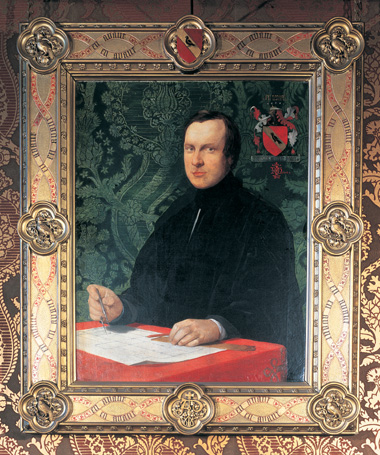
1. Pugin, by his friend J. R. Herbert, 1845.
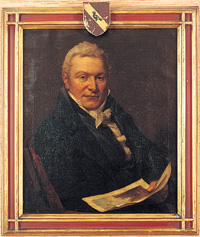
2. Pugin’s father, Auguste Charles, the self-styled Comte de Pugin.
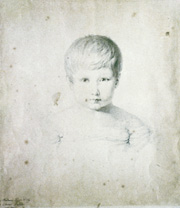
3. Pugin at two in 1814, a pencil drawing by his uncle, the French court painter Louis Lafitte.
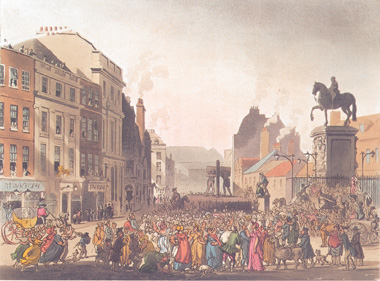
4. ‘The Pillory’, aquatint from a drawing by Pugin’s father, A. C. Pugin, and Thomas Rowlandson in The Microcosm of London. This was the book which best captured the high taste and low morals of the Regency city into which Pugin was born.
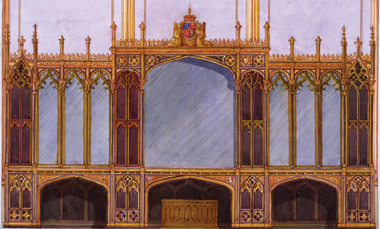
5. Watercolour of a sideboard for Windsor Castle designed by Pugin in 1827. This was his first major commission, at the age of fifteen, for George IV.
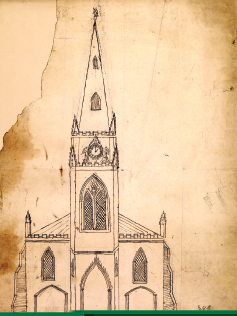
6. ‘My first design’, 1821. At nine, Pugin was already hoping to build Gothic churches.
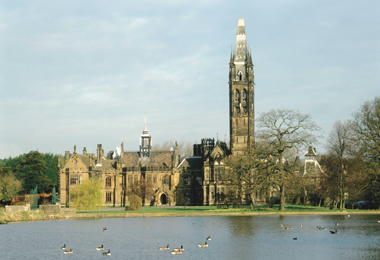
7. Scarisbrick Hall, Lancashire. Here, within an existing house, Pugin made his first attempt to create a Catholic Mansion of the Olden Times. His designs were continued by his son, Edward, who built the massive tower.
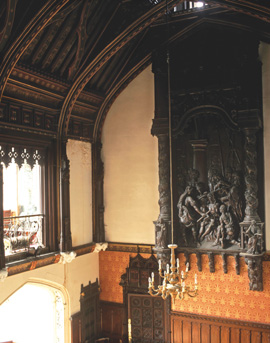
8. The Great Hall, Scarisbrick. The interior was assembled out of antique wood carvings, some of the many thousands stripped from Continental churches and imported to England in the aftermath of the Napoleonic Wars.
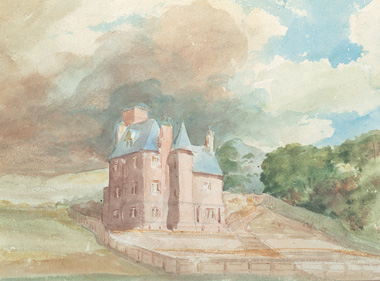
9. Watercolour by Pugin of about 1835 showing his first house, St Marie’s Grange at Alderbury, Wiltshire. A wildly original building that caused a scandal locally, it was a romance in red brick.
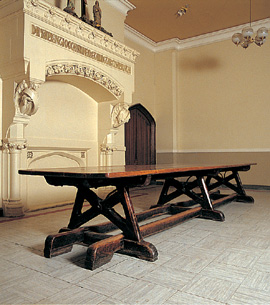
10. Refectory table, designed for Oscott College in about 1838, the sort of plain structural furniture that earned Pugin a reputation as a proto-modernist. Powerful as it is, it is closely based on medieval models and looks back as much as forward.
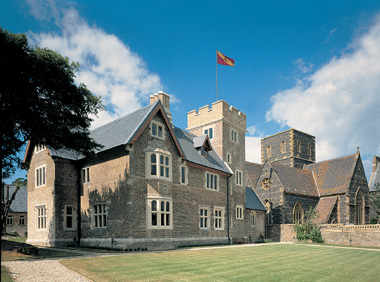
11. The Grange, Ramsgate, Pugin’s second house for himself, designed in 1844. In it he reinvented the Gothic as a new style for the nineteenth century. This was to be the prototype for hundreds of country rectories and suburban houses.
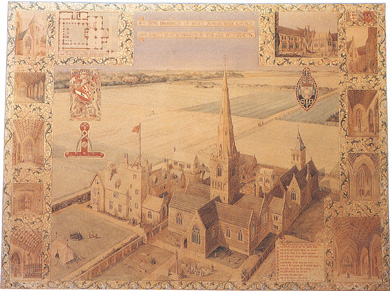
12. ‘A True Prospect of St Augustine’s’, a watercolour Pugin showed at the Royal Academy in 1849. It represents his house and church in the manner of a Victorian book of hours, with the cycle of life and death set in a tranquil Kentish landscape.
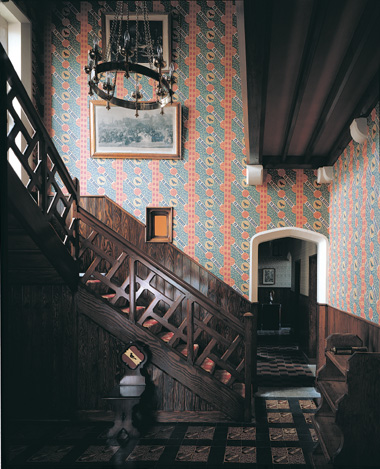
13. The Grange. Pugin planned his house around a central staircase living hall, a daring idea in the 1840s which later became the characteristic feature of the English Arts and Crafts house. He also designed the wallpaper, incorporating his crest and motto.
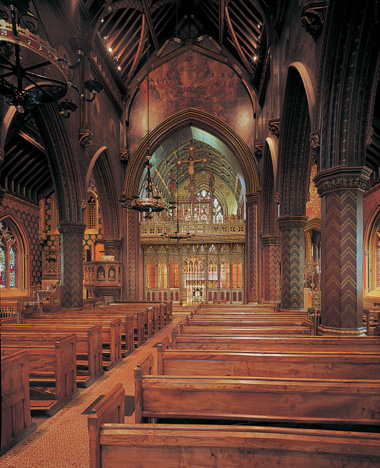
14. St Giles’s, Cheadle, completed in 1846. A work of high Romantic art with a dazzling interior, this was the building that marked the high point of Pugin’s career.
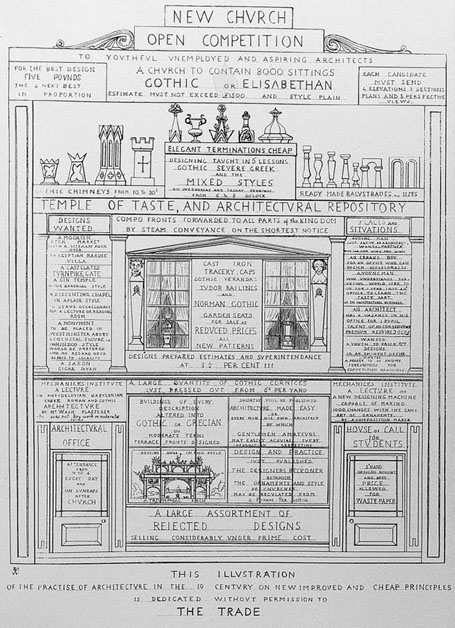
15. Pugin’s reckless satire on modern architecture opened his manifesto Contrasts in 1836 and ensured that before his career had even begun he was persona non grata with the profession. John Nash, the leading architect of the Regency, is set up as a bust in a shop window, a glazing bar running impudently through his nose.
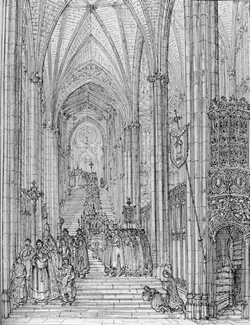
16. ‘St Edmund’s Procession’, from the Ideal Scheme of 1832, The Shrine. In the aftermath of his first wife’s death Pugin made several fantastic sequences of drawings in which Gothic architecture revived and was restored and inhabited.
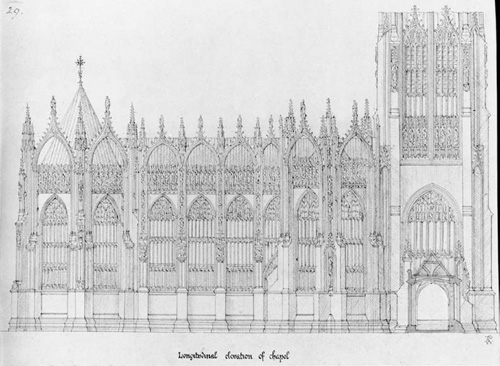
17. St Marie’s College, a scheme of 1834, is full of details like those Pugin provided for Charles Barry’s competition entry for the Palace of Westminster. It was the basis of the claims made after Pugin’s death by his son Edward that Pugin was the true architect of the building.
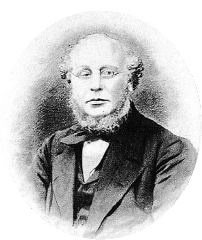
18. John Hardman, Pugin’s closest friend and collaborator.
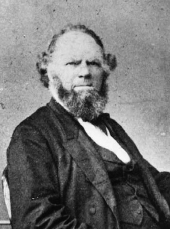
19. George Myers, Pugin’s phlegmatic, loyal builder.
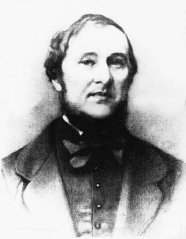
20. Ambrose Phillipps – Eustace de Lyle in Disraeli’s Coningsby – a leading figure among the Romantic Catholics.
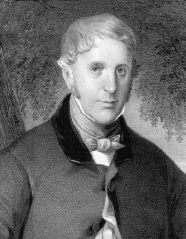
21. John Talbot, 16th Earl of Shrewsbury, Pugin’s greatest patron, in a lithograph from a painting by Carl Blaas.
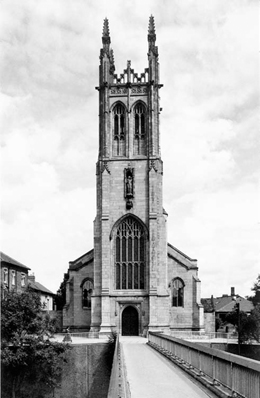
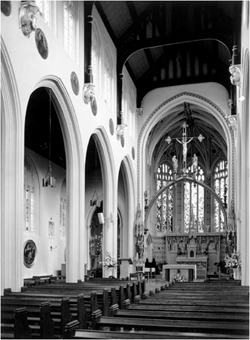
22. and 23. St Mary’s, Derby, was Pugin’s first major church, designed in 1838 when his taste was still for late English and German Gothic.
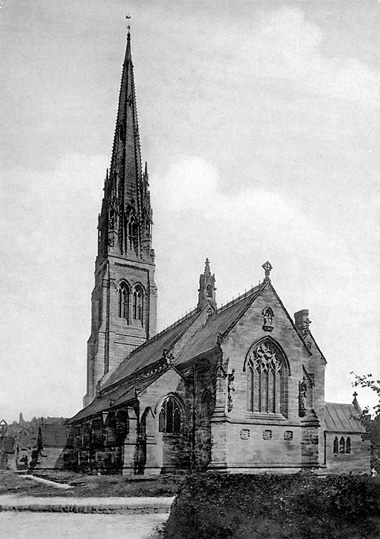
24. St Giles’s, Cheadle. One of the most famous and popular of Victorian churches, it epitomised Pugin’s first mature style.
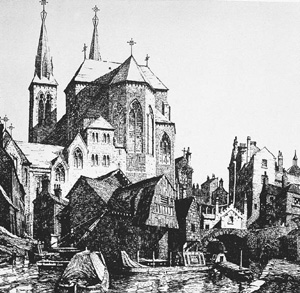
25. St Chad’s, Birmingham, designed in 1838. Print from a drawing by Alphege Pippet of about 1874. This was the first English cathedral since Wren’s St Paul’s, and it was built at the heart of industrial England, perched over a canal in the midst of the gunmakers’ quarter.
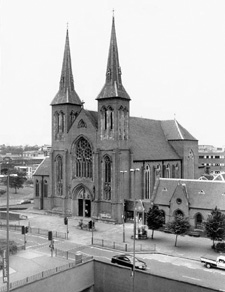
26. St Chad’s today, even more perilously positioned on the Birmingham Ring Road.
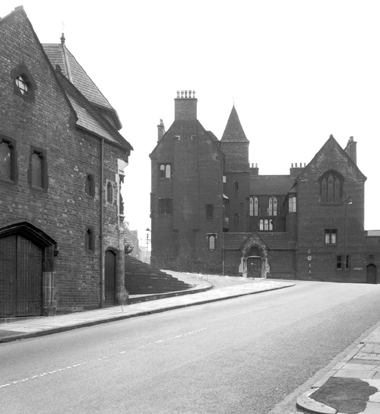
27. The Bishop’s House, Birmingham, one of Pugin’s most original buildings, photographed in 1959 just before it was demolished for road widening.
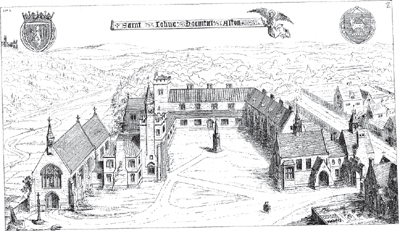
28. St John’s Hospital, Alton, as Pugin envisaged it in 1842. A hospital in the medieval sense, including a school and almshouses, it was part of the Romantic Catholic campaign to offer an alternative to the workhouse.
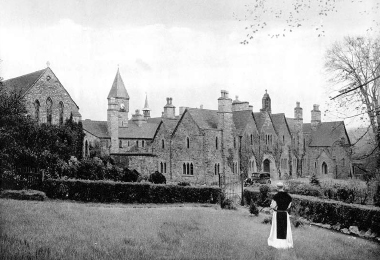
29. Mount St Bernard’s, Leicestershire, in 1935, before the church was extended. The monastery was designed for Ambrose Phillipps, who wanted to restore the Cistercians to the site they had occupied before the Reformation.
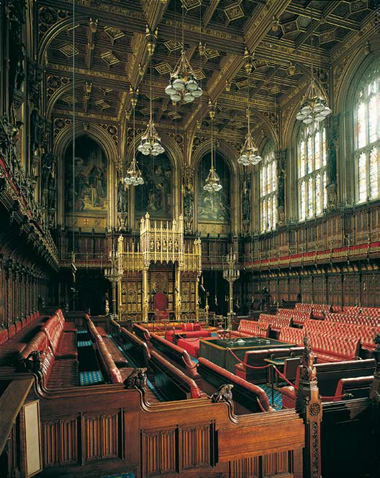
30. The House of Lords, opened in 1847. This was the first part of Charles Barry’s new Palace of Westminster to be completed. Pugin, who had designed all the interior details, including the royal throne, was not present at the opening and his name was left out of the press reports.
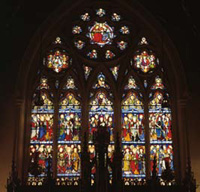
31. East window at St Thomas and Edmund’s, Erdington, Birmingham, designed by Pugin.
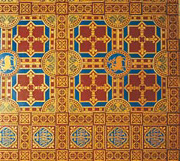
32. Encaustic tiles from St Giles’s, Cheadle, another lost medieval technique which Pugin helped Herbert Minton to revive.
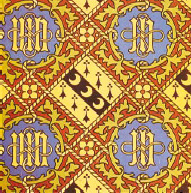
33. Wallpaper for Captain Washington Hibbert for his house, Bilton Grange, Warwickshire, which Pugin extended. It was a successful design for a diffi cult client.
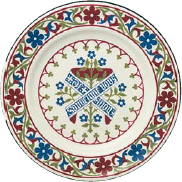
34. Plate, decorated with a transfer print by Pugin, made by Minton’s. It was shown at the Great Exhibition in 1851 as part of a display to demonstrate the domestic uses of Gothic.
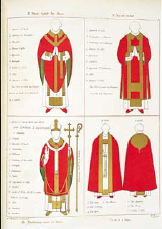
35. Vestments from the Glossary of Ecclesiastical Ornament of 1844, in which Pugin used chromolithography to get the intense colours he wanted.
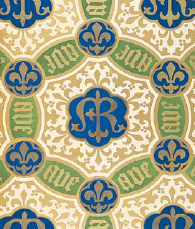
36. One of the patterns from the Glossary, intended for stencil decoration.
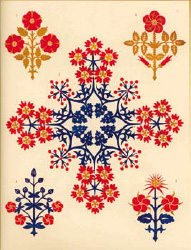
37. A page from Floriated Ornament of 1849, a gothic flora based on the plants and flowers of Britain.
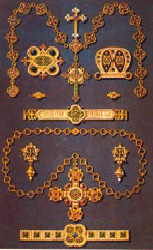
38. Jewellery, including a headband, designed in 1848, probably for Pugin’s third wife, Jane Knill.
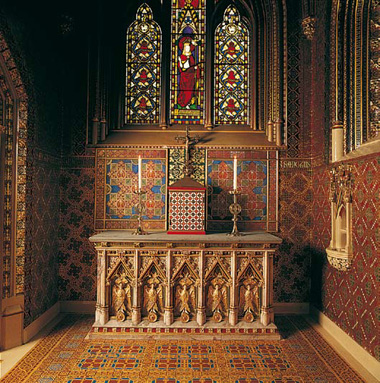
39. The Blessed Sacrament Chapel of St Giles’s, Cheadle. The effect of this complete Pugin interior made John Henry Newman exclaim ‘Porta Coeli’, ‘heaven’s gate’, when he saw it.
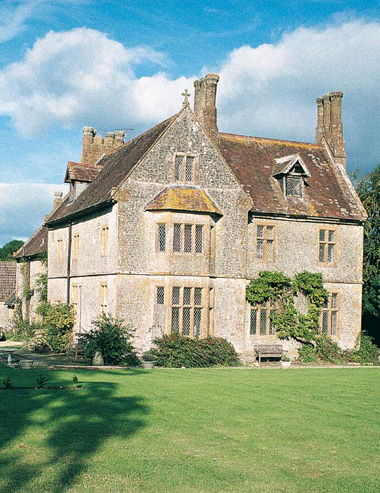
40. The Parsonage house at Rampisham, Dorset. Designed in 1845, just after his own house, here Pugin improved on his first thoughts to create a more mature, gentler version of the same idea. It is the quintessential English country rectory.
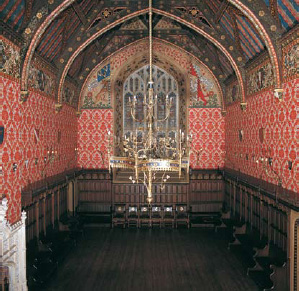
41. The Banqueting Hall at Lismore Castle, County Waterford, the interior by Pugin and J. G. Crace for the 6th Duke of Devonshire, 1849–50. This sort of Gothic decoration became fashionable when illustrations of the Palace of Westminster began to appear.
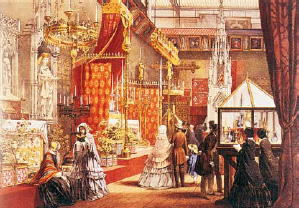
42. The Mediaeval Court at the Great Exhibition of 1851, lithograph by Joseph Nash. Here Pugin broke the official categories, showing work in all media and presenting himself, uniquely in the Exhibition, as a designer rather than as an artist or a manufacturer.
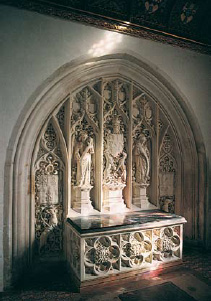
43. The Rolle Chantry at Bicton, Devon. This small mortuary chapel with its fine carving and delicate stained glass was one of Pugin’s last and loveliest buildings.
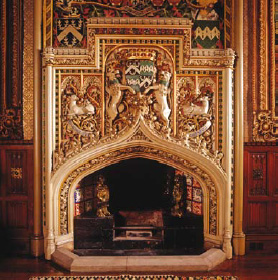
44. Chimneypiece from Eastnor Castle, Herefordshire, 1849–50, another grand commission brought to him by the decorator J. G. Crace. Pugin complained that it was too much trouble and that ‘to be architect… to one fireplace is worse than keeping a fish stall’.
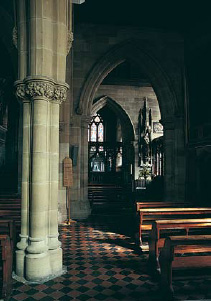
45. Pugin’s own church of St Augustine’s, Ramsgate, begun in 1845. Here he rejected the brilliant colours of St Giles’s, Cheadle, in favour of plain stone and the complex, asymmetric interior spaces that interested him increasingly towards the end of his life.
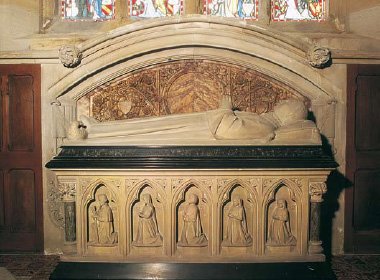
46. The tomb at St Augustine’s. Pugin was the first to be buried in the family chapel he had created. His son Edward designed the monument on which Pugin’s children and his widow appear as weepers.
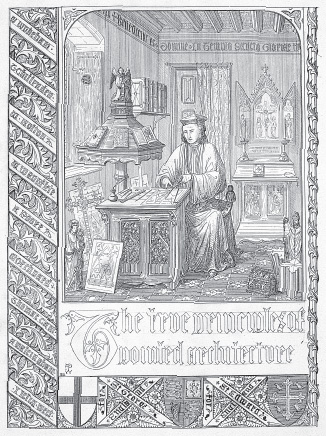
47. The Frontispiece of True Principles, 1841. Pugin’s romantic portrait of himself as a medieval architect expressed his longing to inhabit the world of his own visual imagination.
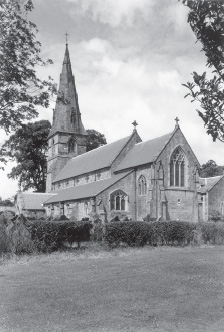
48. St John the Evangelist, Kirkham, 1842, was one of the first of Pugin’s English Gothic churches, a model used for the rest of the nineteenth century across Britain and the Empire.
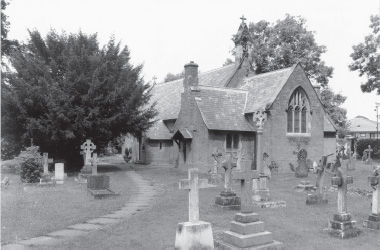
49. St Augustine’s, Kenilworth, designed in 1841, was the type of small but dignified church that inspired Pugin’s contemporaries as they tried to build on limited budgets in poor industrializing areas.
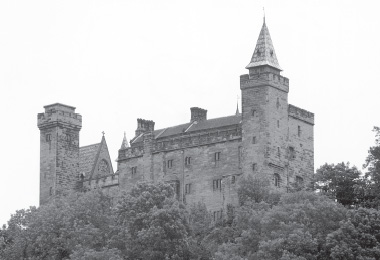
50. Alton Castle, Staffordshire. Built by Pugin for the Earl of Shrewsbury out of a ruin, it was destined to remain incomplete, a monument to the failure of the Romantic Catholic ideal.
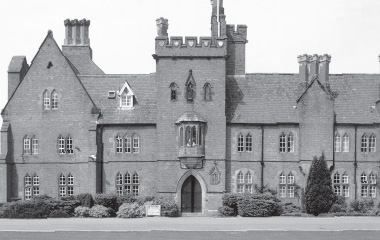
51. Ratcliffe College, Ratcliffe-on-the-Wreake, Leicestershire. When his designs for Balliol College, Oxford, were rejected Pugin had to settle for building them in Leicestershire instead. They are the main inspiration for the principal front, designed in 1843–4.
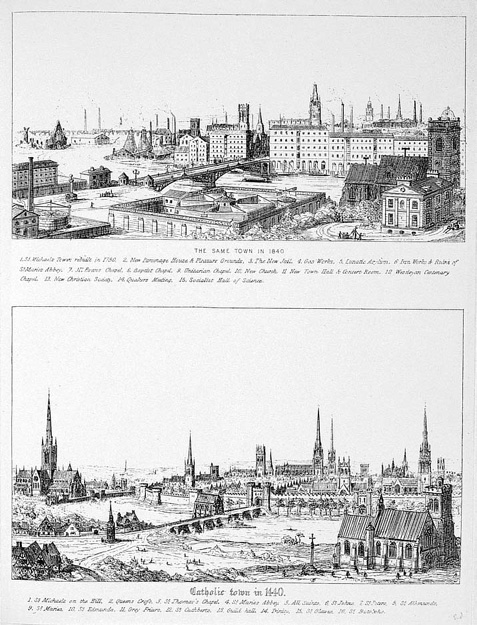
52. ‘Contrasted Towns’ was one of the plates Pugin added to the second edition of Contrasts in 1841. These new images turned his manifesto from an architectural cri-de-coeur into a wider protest against the callousness of the Victorian city.
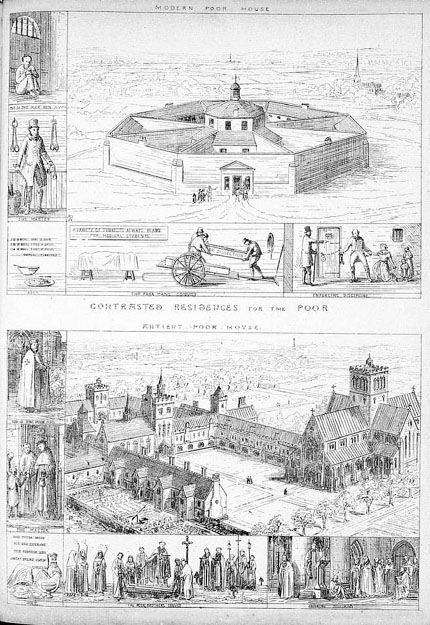
53. In ‘Contrasted Residences for the Poor’, from the 1841 Contrasts, Pugin made an unanswerable case for the connection between architecture and ideology, setting the Christian monastery against the Utilitarian panopticon.
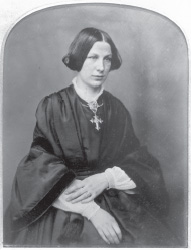
54. Anne Pugin Powell, Pugin’s eldest child, wearing jewellery designed by her father, in a photograph of the 1860s.
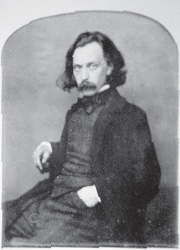
55. John Hardman Powell was the only pupil Pugin ever formally took. He survived a stormy apprenticeship and married Pugin’s daughter, Anne, in 1850.
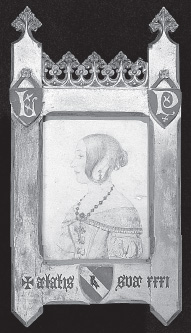
56. Louisa Button, Pugin’s second wife, in a drawing probably by J. R. Herbert. It was not an entirely happy marriage, and little trace of Louisa’s life has survived.
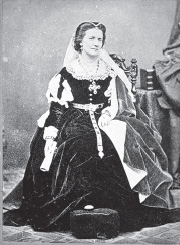
57. Jane Knill, Pugin’s third wife, photographed as a widow in the 1870s wearing jewellery her husband had designed for her.
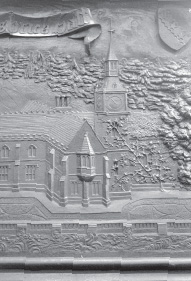
58. One of the carvings Pugin made for Scarisbrick Hall in about 1838 shows a design for a clock tower that clearly resembles the one at the Palace of Westminster, commonly known as ‘Big Ben’.
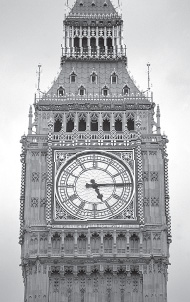
59. The clock tower as built was modified by Charles Barry, but the essential design was undoubtedly Pugin’s.
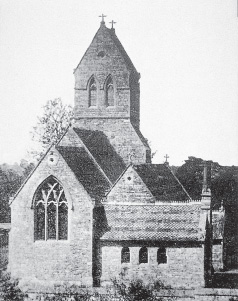
60. St Mary’s church, Rugby, designed in 1847 and photographed in the 1860s before it was altered. A tough little building with a strong French influence, it shows how Pugin’s ideas continued to develop in the last years of his life as a pioneer of the High Victorian style.
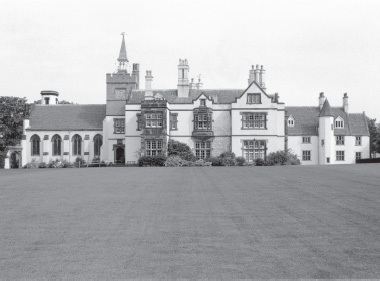
61. Grace Dieu Manor, the home of Ambrose and Laura Phillipps. The wing on the right was added by Pugin in 1848–9 in a style of plain, modern Gothic that had shaken off the last traces of revivalism.
God’s Architect
ROSEMARY HILL
Pugin and the Building of Romantic Britain
ALLEN LANE
an imprint of
PENGUIN BOOKS
ALLEN LANE
Published by the Penguin Group
Penguin Books Ltd, 80 Strand, London WC2R 0RL, England
Penguin Group (USA) Inc., 375 Hudson Street, New York, New York 10014, USA
Penguin Group (Canada), 90 Eglinton Avenue East, Suite 700, Toronto, Ontario, Canada M4P 2Y3
(a division of Pearson Penguin Canada Inc.)
Penguin Ireland, 25 St Stephen’s Green, Dublin 2, Ireland
(a division of Penguin Books Ltd)
Penguin Group (Australia), 250 Camberwell Road, Camberwell, Victoria 3124, Australia
(a division of Pearson Australia Group Pty Ltd)
Penguin Books India Pvt Ltd, 11 Community Centre, Panchsheel Park, New Delhi – 110 017, India
Penguin Group (NZ), 67 Apollo Drive, Rosedale, North Shore 0632, New Zealand
(a division of Pearson New Zealand Ltd)
Penguin Books (South Africa) (Pty) Ltd, 24 Sturdee Avenue, Rosebank, Johannesburg 2196, South Africa
Penguin Books Ltd, Registered Offices: 80 Strand, London WC2R 0RL, England
www.penguin.com
First published 2007
Copyright © Rosemary Hill, 2007
The moral right of the author has been asserted
All rights reserved
ISBN: 978–0–141–90966–0
Even the loose stones that cover the high-way,
I gave a moral life, I saw them feel,
Or link’d them to some feeling: the great mass
Lay bedded in a quickening soul, and all
That I beheld respired with inward meaning
William Wordsworth, The Prelude,
Book III, ll. 125–9
Photographic acknowledgements are given in parentheses
1 A. W. N. Pugin by J. R. Herbert, 1845 (Palace of Westminster)
2 Auguste Charles Pugin, by an unknown artist (private collection)
3 Pugin as a child of two, drawn by his uncle in 1814
4 ‘The Pillory’, from The Microcosm of London, illustrated by A. C. Pugin and Thomas Rowlandson
5 Design for a sideboard for Windsor Castle, 1827 (V&A)
6 ‘‘My first design’, 1821 (British Museum)
7 Scarisbrick Hall, Lancashire (Country Life)
8 The Great Hall, Scarisbrick (Country Life)
9 St Marie’s Grange, Alderbury, near Salisbury (Graham Miller)
10 Refectory table at Oscott College, Birmingham, c. 1838 (Graham Miller)
11 The Grange, Ramsgate, from the garden side (Martin Charles)
12 ‘A True Prospect of St Augustine’s’, 1849 (private collection)
13 The Grange, Ramsgate (Martin Charles)
14 St Giles’s, Cheadle, Staffordshire (Graham Miller)
15 The satire on the architectural profession from Contrasts, 1836
16 ‘St Edmund’s Procession’, from The Shrine, Pugin’s Ideal Scheme of 1832 (V&A)
17 St Marie’s College, an Ideal Scheme of 1834 (V&A)
18 John Hardman, Pugin’s closest friend
19 George Myers, Pugin’s builder (Patricia Spencer Silver)
20 Ambrose Phillipps
21 John Talbot, Sixteenth Earl of Shrewsbury, lithograph from a painting by Carl Blaas (Carlton Towers archive)
22 St Mary’s, Derby, exterior
23 St Mary’s, Derby, interior
24 St Giles’s, Cheadle, Staffordshire
25 St Chad’s Cathedral, Birmingham, print from a drawing by Alphege Pippet, c.1874
26 St Chad’s today
27 The Bishop’s House, Birmingham (Country Life)
28 St John’s Hospital, Alton, Staffordshire
29 Mount St Bernard’s Monastery, Leicestershire
30 The House of Lords, interior (Palace of Westminster)
31 Window in Ely Cathedral
32 Encaustic tiles from St Giles’s, Cheadle (Graham Miller)
33 Wallpaper, Bilton Grange, Warwickshire
34 Plate designed for the Great Exhibition, 1851
35 Vestment designs from Pugin’s Glossary of Ecclesiastical Ornament, 1844
36 A pattern from the Glossary of Ecclesiastical Ornament
37 Plate from Floriated Ornament, 1849
38 Jewellery shown at the Great Exhibition, 1851
39 The Blessed Sacrament Chapel at St Giles’s, Cheadle, Staffordshire (Graham Miller)
40 The Parsonage at Rampisham, Dorset
41 Banqueting Hall at Lismore Castle, County Waterford (Graham Miller)
42 The Mediaeval Court at the Great Exhibition, 1851, lithograph by Joseph Nash
43 The Rolle Chantry at Bicton, Devon
44 The Drawing room at Eastnor Castle, Herefordshire (Country Life)
45 St Augustine’s, Ramsgate
46 Pugin’s tomb at St Augustine’s, Ramsgate (Graham Miller)
47 The Frontispiece of Pugin’s True Principles, 1841
48 St John the Evangelist, Kirkham, Lancashire
49 St Augustine’s, Kenilworth, Warwickshire
50 Alton Castle, Staffordshire
51 Ratcliffe College, Leicestershire
52 ‘Contrasted Towns’, from the second edition of Contrasts, 1841
53 ‘Contrasted Residences for the Poor’, from the second edition of Contrasts
54 Anne Pugin Powell, Pugin’s eldest child
55 John Hardman Powell, Pugin’s pupil and son-in-law
56 Louisa Button, Pugin’s second wife, probably by J. R. Herbert (Graham Miller)
57 Jane Knill, Pugin’s third wife
58 Carving of a clock tower from Scarisbrick Hall, Lancashire
59 The clock tower of the Palace of Westminster
60 St Mary’s church, Rugby, Warwickshire
61 Grace Dieu Manor, Leicestershire
Travelling through England on a train, or flying into London, low along the Thames and over the suburbs, the landscape is still, to a great extent, made up of little pitch-roofed houses and gardens. Sprinkled among them are the towers and spires of Gothic churches, while here and there are small village schools and big Victorian town halls. The architectural texture of our towns and of the countryside is still largely nineteenth-century and none of it would look, quite, as it does had A. W. N. Pugin never lived.
Pugin gave Britain’s capital cities two of their greatest landmarks, the clock tower of the Palace of Westminster, generally, if inaccurately, known as Big Ben,1 and, in Edinburgh, the spire of Tolbooth St John’s. He built the first English cathedral since Wren’s St Paul’s and he reinvented the family house. But his influence depended not only, not even primarily, on his buildings, it was both wider and more elusive. He gave the nineteenth century a new idea about what architecture could be and mean. He saw it as a moral force in society and as a romantic art. ‘He was our leader and our most able pioneer,’ George Gilbert Scott, that most prolific and essentially Victorian architect, recalled.2
Like many who come to be seen as great men, Pugin seemed to his contemporaries at once typical and exceptional; he embodied the dilemma of his age and lived it out on a dramatic scale. To a generation sick of Georgian laissez-faire and frightened and excited in almost equal measures by the speed of its own steam-driven progress, Pugin offered a way forward – which was also a way back. He pointed to the Middle Ages as a model not just for architecture but for society, for a coherent, Christian civic order in which the poor would be fed, the old cared for, the children taught. As the Victorian age began it was a compelling image. The 1830s saw some of the worst civil unrest in English history. There was disturbance and rioting in the countryside, while in the cities the factories and slums proliferated and misery and discontent grew with them.
So it was that the nineteenth century decided to revive Gothic architecture. What had been, for three generations, a style for rich men’s houses, garden follies and the occasional church became a national style, a public principle, the proper form for the Houses of Parliament, for schools, shops, railway stations and for nearly every church. Pugin did not effect all this by himself, but he did more than any other individual to bring it about. He was the pivot around which the sensibility of nineteenth-century architecture turned. That he failed in his ideal of transforming England into a Catholic, Gothic kingdom is hardly surprising. What is surprising is the extent to which he succeeded. His was a romantic vision. If – as T. E. Hulme said – romanticism is ‘spilt religion’, then the Gothic Revival, as it came to be known, was a long, late attempt to contain Romanticism within a formal religious understanding of the world, to hold together art and God.3
Pugin, in many ways, fitted the type of the romantic hero. Born in 1812, the year of Byron’s overnight success, he had a brilliant early career, going to work for George IV at Windsor when he was fifteen. By the time he was twenty-one he had been shipwrecked, imprisoned for debt and widowed. He had already lived ‘a long life in a short one’.4 Nineteen years and another lifetime later he died, still young, but disillusioned and insane.
In person Pugin himself was, as George Gilbert Scott discovered, often heartier and less intense than in print, ‘tremendously jolly’, with ‘almost too much bonhomie’ for his admirer’s ‘romantic expectations’.5 Energetic, humorous, roughly spoken and often roughly dressed, he disconcerted many people. Yet his moods changed quickly. The jollity alternated with passionate dejection; he wept often and in public. He was susceptible to women, falling in love easily and often, somewhat more often than was in accordance with his ideal of Christian marriage. His unhappy love affairs and other, less romantic sexual adventures were a cause of scandal that marked and marred his adult life. Many people disliked him, notably Ruskin and John Henry Newman, but nobody doubted his importance. As the nineteenth century drew to a close, it seemed to those who remembered him that ‘we should have had no Morris, no Street, no Burges, no Shaw, no Webb, no Bodley, no Rossetti, no Burne-Jones, no Crane but for Pugin’.6
Then, as he passed from living memory, Pugin’s reputation began to pursue a tortuous course. At first he vanished altogether amid the general revulsion against the Victorians, and their age of ‘crystal palaces, bassinettes, military helmets, memorial wreaths, trousers, whiskers, wedding cakes’.7 There had never been, to Virginia Woolf, anything ‘at once so indecent, so hideous and so monumental’ as Victorian art.8 It was in 1928, the same year Woolf wrote those words, that the young Kenneth Clark published a perceptive and witty book, The Gothic Revival, archly subtitled ‘an essay in the history of taste’. The very idea of taking Victorian Gothic seriously was outré. Clark later recalled that it was then generally believed in Oxford not only that Keble College was ‘the ugliest building in the world’ but that it had somehow manifested itself out of the writings of Ruskin.9 When Clark suggested that Keble was the work of William Butterfield he was called a liar in public by an ‘eminent historian’ of the University.
As the reaction against the nineteenth century worked itself out in the wholesale destruction of art and architecture and the incidental ruination of many towns and cities, others came to retrieve Pugin’s fading reputation. To Nikolaus Pevsner, arguably England’s greatest architectural historian, he seemed especially interesting because, in his writings, he had laid down rules for architecture that anticipated ‘our functionalists of the twenties and thirties’.10 The young Pevsner then saw architectural ideas as a Hegelian stream flowing on towards ‘the ocean of the International Style of the 1930s’.11 Pevsner’s early idea of Pugin’s importance as a ‘pioneer of modernism’, the discoverer of ‘rational planning’ and the designer of furniture that prefigures modernist designs of the twentieth century can still sometimes be found among those who hold to a teleological view of history, but it will not stand much examination. As Pevsner grew older and less doctrinaire he himself changed his mind about Pugin and found him less easy to admire. Throughout The Buildings of England there is a perceptible disillusionment with Pugin’s work; ‘antiquarianly correct’ was Pevsner’s final verdict on this curious man whose importance he sensed but could not, quite, pin down.12
His disappointment was not unfair, for, as an architect, Pugin was wildly uneven. Lack of money, lack of experience and his own volatile temperament led to more failures than successes. He built most in the early years of his career when he knew least. Pugin understood this. Nobody was ever more disappointed in his buildings than Pugin himself, but those who have found themselves at his churches in Dudley or Stockton on a winter afternoon will fully sympathize.
A later generation, faced with the undeniable inadequacy of Pugin’s oeuvre to account for his equally undeniable importance, found another explanation, one which Pevsner had also suggested. Pugin, it was now said, was important as a theorist for introducing the French rationalist tradition of Cordemoy and Laugier to English architecture. No evidence that Pugin was aware of, let alone interested in, such a tradition has been offered, beyond the fact that ‘his father was French’.13 Nevertheless it was, by 1996, felt to have been a ‘long… recognised’ fact.14 Pugin, who read little and that little unsystematically, formed his ideas from different sources and in different ways, as his biography reveals.
To see Pugin steadily means to see him whole and in his time. He himself never admitted any distinction between his work and his life any more than between his faith and his art. His importance was, as his contemporaries said, that he inspired, transformed and reinvigorated English architecture and design. To see him only as an architect, or as a writer or as a Catholic, will always produce a baffling and partial view. At the turn of another century it is easier perhaps to put Pugin together again, to sympathize with what he felt and wanted. The confidence of the post-war town planners has long since evaporated. We feel, once more, that there is something wrong with our cities and that perhaps this has something to do with ourselves. Fifty years ago the association of religion with art and politics seemed peculiarly Victorian. But ‘the God question’ does not go away and a new millennium poses it again.15 The passage of time has not made Pugin’s bad buildings any better, but it has yielded a fuller appreciation of the best and revealed new qualities of insight and daring in buildings that were little considered in the nineteenth century, obscure village schools, country parsonages and unrealized designs for churches. His work contains, like a densely packed capsule, almost everything that followed with the High Victorians, the Arts and Crafts movement and in the works of Ruskin and Morris. Working in every medium, in glass and metal and stone and as a pattern designer of Mozartian facility, it would take three generations to develop all that was implicit in Pugin’s short career.
Pugin’s story begins with his parents’. He lived with them for half his life and their deaths propelled him into the central crisis of his life. His father, Auguste Charles (whom I shall call Auguste for clarity), was a French émigré, the soi-disant Comte de Pugin. When Kenneth Clark wrote The Gothic Revival it was A. C. Pugin, the artist of The Microcosm of London, who was better remembered than his son. Pugin’s early work grew seamlessly out of his father’s, while his clever, caustic mother, Catherine Welby, largely shaped his peculiar cast of mind. It was she who gave him the idea for Contrasts, his first important book.
Catherine and Auguste Pugin were Georgians, born before the French Revolution, and already in their forties in 1812. They belonged to a different age from that in which their son reached adulthood. ‘From the England of Miss Austen,’ Froude wrote, soon after Pugin’s death, ‘to the England of Railways and Free-trade, how vast the change… The world moves faster and faster… The temper of each new generation is a continual surprise.’16 It was essential to Pugin’s character and to his place in history that he belonged as much to the England of Jane Austen as to the Victorian age. He articulated and in part he brought about the change of temper from one to the other. That gave him his importance and his success. It accounted also for the bitterness of his last years. Formed by the Georgian age he violently rejected, he was never wholly at ease with the Victorian ethos he helped to form.
In one of Pugin’s sketchbooks there is a note, written by his widow, Jane, in 1867. She was forty then and had been widowed for fifteen years. Her marriage, the most vivid experience of her life, had lasted four.
Who has used this pencil? Old Mr Pugin and Augustus at least 40 years old!! & here I am writing on the sofa in my room on Monday April 27th ’67 Kate is singing in the attic ‘I dreamt I dwelt in marble halls’ Mary and Peter are in the library I do not feel well I do not think I shall long be here… I have nothing to live for.17
It is a scene from Dickens, or Millais; the still handsome but melancholy widow repining on the sofa, the parlour ballad floating down the stairs. Outside, beyond the heavy curtains, the rattle of railways and free trade is audible. Turning the pages of the same sketchbook we are suddenly in the England of Miss Austen, among ‘old Mr Pugin’s’ drawings of the trial of Queen Caroline.
Pugin’s biography begins there, with his father, Auguste Charles, who first picked up his pencil in Paris, before the Revolution.
1
Auguste Charles Pugin
In the 1820s, when Auguste Pugin ran a drawing school, he liked to amuse his teenage pupils, and no doubt himself, with stories of his early life, his aristocratic connections and his hair’s-breadth escape from the French Revolution. One of his pupils was Benjamin Ferrey, who later became an architect and, in 1861, wrote the first biography of the Pugins, father and son. Ferrey set down as much as he could remember of what Auguste had told him some forty years before.
The elder Pugin was born in France, in the year 1762; his birthplace is unknown, but he was descended from a family of distinction, his ancestor being a nobleman who raised a hundred soldiers for the service of Fribourg… in 1477. Pugin witnessed many of the fearful scenes in the French Revolution, and it is said that he fell fighting for the king, and was thrown with some hundred bodies into a pit near the Place de la Bastille, whence he managed to escape by swimming across the Seine, flying to Rouen, and embarking from that place to England.1
It is hard to imagine who could have said all this other than Auguste himself, but it has the ring of a tall tale, unaccountable in some details, suspiciously familiar in others. There were several variations: that he had fought a duel, that he was in fact ‘le Comte de Pugin’, that he had rowed across the Channel with some friends. Auguste was not in any serious sense an impostor. If he allowed the boys in the drawing school to think he was the Comte de Pugin he never made any attempt to claim the title. It is clear, however, from his wife’s letters and his son’s later efforts to trace the family history that he led them to believe that the Pugins were of the nobility and had been ruined in the Revolution. He concealed many facts about his origins and elaborated others. A humorous man, sceptical about politics, uninterested in religion and no snob, he simply realized, like many exiles, that given a fresh start it was easier to rise in the world if one implied that one had, in fact, come down. The legend of the émigré Count wandering the streets of London in his tricorn hat, with his muff and gold-topped cane, was handed on by his pupils and passed into myth. It became entwined with the romance of the Gothic Revival, where history and fiction mingle easily. Among the possessions still preserved by Auguste’s descendants is a ring said to bear the secret sign of the Scarlet Pimpernel. What emerges from the surviving records is as follows.
Auguste Pugin was born in Paris in 1767 or ’68 in the parish of St Sulpice, one of seven children of Joseph Nabor Pugin and his second wife, Marie Marguérite Duchène.2 Pugin is a French Swiss name, originating from Fribourg, and Auguste may well have been distantly related to the hero of 1477. By the mid eighteenth century, however, it was a tenuous connection. Fribourg was then, in all but name, French. The frontier was open and many of the Fribourgeois had settled in France. Most, including Joseph Pugin, came as mercenary soldiers. Swiss mercenaries had fought in France since the Middle Ages and they had a reputation for courage and bravado in keeping with the spirit at least of Auguste’s anecdotes. Under Louis XIV they were formed into regular regiments and acquired their distinctive uniform with the tricorn hat. By 1789 there were eleven Swiss regiments in the regular French army. In addition to these there were the Swiss guards, the elite corps who served the King personally.
Joseph Nabor, who described himself at the time of his first marriage in 1752 as the son of Jean-Claude Pugin, a labourer, had, like many of his countrymen, become a soldier in hopes of improving his fortune.3 Later, he settled in Paris and became a ‘Suisse de l’ambassadeur de l’empire’.4 ‘Suisse’ described both his nationality and his job in the household of the Imperial Ambassador. He was a ‘huissier’, something between a guard and an usher, a sort of military footman who would have stood at the door, announcing visitors and showing them in. Joseph’s first wife must have died some time during the next fifteen years and at the time of his second marriage Joseph was performing the same function on the staff of the Prince de Salm Salm.5
Both his wives were Parisian. The first, Marie Anne Carmentrar, was the daughter of a tinsmith. Of the parents of the second, Auguste’s mother, there seems to be no trace. Her sister, however, was the wife of one Michel Dufort, a ‘fruitier oranger’, or fruit and butter seller, also of St Sulpice.6 Elsewhere in the archives there are references to a number of Pugins.7 Many of them must have been related. They are listed as retired soldiers, household guards like Joseph, a goldbeater, two French polishers, a post office official, a cloth merchant and one notary. They represent in essence the solid petite bourgeoisie, the class that Louis-Sébastien Mercier described in his great portrait of the city before the Revolution, Le Tableau de Paris, as the happiest. He thought them the most productive and contented of the eight ranks into which he divided society, and, ironically in the light of Auguste’s later elaborations, the least socially pretentious.
The Paris of the 1780s, in which Auguste reached adolescence, was a hectic, teeming city. Mercier found it in many ways exasperating, light-minded and narcissistic. One aspect of Parisian life that irritated him particularly was the obsession with fashion. He railed against the craze for hats and elaborate headdresses, the latest so tall that they had to be made with built-in springs so that they could be lowered to get into a carriage. Among those who fed the rapidly succeeding passions for clothes, carriages and interior decoration were the editors of a small fortnightly magazine, first published in November 1785, Le Cabinet des Modes. It is here, in April the following year, that Auguste first becomes visible in history, making his debut as an illustrator with a drawing of a fashionable carriage, the ‘vis-à-vis à l’Angloise’.8 In May he drew four designs for hats as delightful and impractical as anything Mercier describes, with feathers and enormous brims.
Auguste became a regular contributor to the Cabinet, providing drawings, engraved for publication, of luxury goods. His pictures of waistcoats in ‘spring yellow’ velvet, of panelled boudoirs, elegant shoe buckles and costumes ‘à la Turque’ are all that remains of this part of his life. That he was working at eighteen suggests financial need as much as talent. As the months passed the perspective in his work became noticeably steadier and the line stronger. Who taught him to draw or whether he had anything so formal as lessons is not known, although there were a number of schools of design in Paris, notably the Ecole Royale, which were free to pupils. By now Auguste seems to have been moving on the fringes of the commercial art world, for it was about this time that he met the painter Louis Lafitte. It was to be a lifelong friendship. Lafitte later married one of Auguste’s sisters and, like Auguste, went on to greater things, but at this time his family were among the ‘artisans obscurs’ with whom the dissolute but charming painter Simon Mathurin Lantara would lodge.9
The Cabinet des Modes bubbled on happily over the next few years. After the storming of the Bastille it appeared several days late, with apologies for the delay ‘due to circumstances too well-known and unfortunate’ to need explanation.10 In November Auguste published a fold-out plate of an elegant salon interior hung with blue taffeta. Then at the beginning of the next year the Cabinet changed hands. It ceased to credit the illustrators and Auguste disappears, once more, from view. The Cabinet kept up with the changing times, offering outfits with tricolours and a costume for a ‘femme patriote en négligée’.11 Gradually, however, events overwhelmed it. The quality of the paper declined and in the dark days of February 1793 its cheery little light was snuffed out.
By then Auguste had left Paris. Exactly when he went and whether alone or not remains a mystery. The mutable city was changing once again in the greatest upheaval it had ever known; everyone was on the move, while in the background could be heard ‘the dull roar of a vanishing world, the distant noise of a crumbling society’.12 Chateaubriand remembered that: ‘Those who had lost sight of one another for twenty-four hours could not be sure of ever meeting again. Some took the road of revolution; others made plans for civil war; others set off for Ohio, sending on ahead plans of country houses to be built among the savages… all this cheerfully and often without a sou in their pockets.’13 Louis Lafitte won the Prix de Rome in 1791, the last artist to receive it from Louis XVI, and left for Italy. His departure may have prompted Auguste to make his own way out of Paris. Whatever his reason for crossing the Channel, he was in London on 27 March 1792, when he enrolled in the Royal Academy Schools. On 20 April France declared war on Austria. Nearly a quarter of a century of conflict in Europe followed. It was almost thirty years before he saw Paris again.
One of the more believable parts of Auguste’s story is his assertion that he found his early days in London difficult. He never learned to speak English fluently and probably knew none when he arrived. Neither can he have had much money. Yet he was an engaging, gregarious young man, still in his early twenties, well used to the ways of a big city and with some proven ability as an artist. He had, too, a gift, which he passed on to his son, for falling easily into conversation with anyone who interested him, and a great directness and warmth of manner. It was typical of him, many years later, when writing a bread-and-butter letter to his landlord about repairs to the family home, to conclude, ‘I am sure you will hear with interest that your house has been a very successful one to me having met with a great deal of encouragement professionally, since I am in it… wishing you… every success and happiness you deserve.’14
There was by now a significant émigré community in London. Auguste met, or already knew, the engraver Paul Condé and together they drank tea in Soho (a centre of émigré life), talked of art and followed ‘les chemins de l’académie’.15 A reproachful letter from one of his sisters in Paris, complaining that he has made no effort to keep in touch, suggests that Auguste settled down quickly and suffered little from homesickness. The Academy, then in Somerset House in the Strand, was the focus of English artistic life and taste. Classes were free but entry was competitive. Auguste must have produced a sufficiently impressive portfolio to gain his letter of admission. Once accepted, his studies would have included lectures on painting, architecture, anatomy and geometry, life classes and drawing from casts and models. He enrolled just a month after the death of the Academy’s first President, Joshua Reynolds, whose influence was still pre-eminent in the English view of art. This was the classical, Enlightenment view, that the artist was to represent a higher truth, transcending what Reynolds called the ‘little and mean’ world of direct sensory experience.16 The most highly regarded genre – in theory, though in practice it was the least popular – was history painting, idealized, heroic scenes. There were already, however, signs of a change of taste, of romantic sensibility, a different view of nature and of what was suitable subject matter for art. It was apparent in the growing popularity of landscape painting and in the rising taste for watercolours by Thomas Hearne, Michael ‘Angelo’ Rooker, Paul Sandby and many others, which favoured more evocative, emotional depictions of nature, emphasizing light and shade over line and form.
At the Academy Auguste would have encountered this view of art not so much in the painting classes as in the lectures on architecture. The professor was a watercolour painter, Thomas Sandby, who, through his teaching, effected a revolution in architectural drawing. He encouraged his students to make not merely plans and sections of a design but to create an imaginary portrait of a building as it would look in its setting. With this ‘perspective view’ patrons might begin to imagine how they would feel about living in it or walking past it, to consider qualities more abstract and subjective than elevations alone could convey. Unrolling one of his great teaching drawings, ‘The Bridge of Magnificence’, Sandby told the students to consider ‘how much more Picturesque than a Geometrical Elevation’ such a perspective was and how much better calculated to show their designs to advantage.17 The effect was instant. The ‘powerful impression the sight of that beautiful work’ made on the young John Soane was typical.18 The perspective became an established feature in architectural drawing. It called for something of the illustrator’s skill as well as an ability to paint in watercolour, and these were talents which many architects lacked. Thus a new profession emerged, one that suited Auguste precisely, and it was there that he was to find his niche in England, as one of the first generation of architectural perspectivists.
Some time over the next two years he got a job as a draughtsman, working for John Nash. Nash went on to become one of the most successful architects of his or any other day. To him we owe some of the most characteristic buildings of late Georgian England – the Brighton Pavilion, Regent Street, Regent’s Park, All Souls, Langham Place, and Buckingham Palace. In the early 1790s, however, things were not going so well. Nash was in his forties and already had one, disastrous, career behind him. At a time when divorce was rare and expensive he had instituted proceedings against his wife in particularly sensational circumstances.19 He had also been bankrupt. Later he wrote his rackety early life out of his autobiography, claiming that he had lived as a private gentleman on his estate in Wales for many years before discovering that he had a talent for architecture. It was a less ambitious tale than Auguste’s but one more seriously calculated to deceive. In the 1790s, when both of them were trying to put a respectable front on an obscure background, they must have had some fellow feeling. Certainly both had a flair for self-dramatization.
Down in Carmarthen, where he was rebuilding his career, Nash had taken a lease on the local theatre. This allowed him to indulge his passion for acting and to mingle on easy terms with the local gentry. In 1795 Charles Mathews, on the verge of a career as one of the greatest comic actors of his day, found himself appearing there. He acted with Nash in The School for Scandal. The scenery, which he thought ‘capital’, was painted by Auguste.20 Auguste later claimed to have been the original of Mathews’s popular character, M. Mallet, a comic French émigré. In fact Mallet was based on an episode Mathews witnessed in America. It seems more likely that the inspiration went the other way and Auguste took something of his own flamboyant style from ‘the very finest part’ Mathews ever had, an Englishman’s idea of a Frenchman, ‘almost serious, perfectly tragic in some scenes’ and at the same time richly comic.21
Over the years that followed Auguste made different kinds of drawings for Nash, but his special strength – which he later put at the disposal of other architects and engineers – was the evocative perspective view. He bodied forth and glamorized designs, setting them in perfect light and modulating them with subtle shadow, refining details. He flattered and improved them so much that his pupil Ferrey felt in many cases they ‘might in strictness claim him as their author’, a remark that has prompted more than one fruitless attempt to reattribute the works of Nash and others to Auguste.22 In fact he never developed a career as an architect. The occasional garden building, gateway or little villa was as far as his talents or his luck ever took him in that direction. It was in the interstices between art, design and architecture that he found his place, primarily as an illustrator. Auguste’s fate was always to be close to great events, but never at their centre. When taste or fashion turned a corner, when a peace treaty was signed or a monarch crowned, he was usually there, no more than a figure in the crowd but near the front and holding a pencil. Now his introduction to Nash put him instantly in touch with the most advanced aesthetic theory of the day.
Carmarthen was a ‘very flourishing place’ which offered plenty of opportunities for an architect. There was a large number of ‘respectable and opulent individuals’ among the commercial middle class who were anxious to improve the town.23 In his work in Wales, however, Nash did more than consolidate his practice. It was here that he encountered men and ideas which prompted him to develop a style that was quite original, both architecturally and in its conception of the relation of buildings to landscape. This was the Picturesque, whose leading architect he became. The Picturesque was England’s most significant contribution to aesthetic theory. It had its effect on literature, on theatre and on art, but its most enduring influence was in architecture and landscape design. In so far as Pugin himself has a place in the history of aesthetic ideas, the idea that matters is the Picturesque, which he was to absorb from his father and, in time, to transform. It was the single most important theme in English architecture until modernism, and modernism, in its English form, was still haunted by the Picturesque.
The word itself was not new when Nash came to Carmarthen; it had been popularized by William Gilpin, who defined it first simply enough as ‘that kind of beauty which is agreeable in a picture’.24 In 1782 Gilpin published his Observations on the River Wye, the first of many guidebooks to encourage visitors to appreciate the qualities of the scenery they were passing through. In the last decade of the century, however, the Picturesque took on a new and more complex significance. Circumstances combined to transform it from a general term into a vital idea. The most important circumstance was the war, for after 1793 nobody, however rich, could take a Continental tour, so the wealthy and cultivated, and the less wealthy but enterprising, began to turn their eyes and sketchbooks towards local scenery and sights. The already popular trip down the Wye Valley was established as Everyman’s Grand Tour. Out of this new interest in native landscape an unlikely quartet of pioneers emerged. They were two Whig squires, Uvedale Price and Richard Payne Knight, whose estates lay in the Picturesque heartland on the Welsh borders; Humphry Repton, the son of an excise man, the first person to call himself a landscape gardener; and John Nash.
The Picturesque developed in their hands into the aesthetic branch of Romanticism. It was a theory of art that put the personal and the particular above the powerful and the public. It dealt in the semitones of experience, its moods were meditative, ‘it neither tenses nor relaxes’, Price wrote.25 Its preferred season was autumn, its time of day twilight, which ‘connects what before was scattered’.26 The Picturesque fed on the power of memory and association, the interchange of subjective and objective experience. In their subject matter, like Wordsworth and Coleridge slightly later, its proponents saw interest ‘where a common eye sees nothing but ruts and rubbish’.27 In architecture and landscape they favoured the asymmetric, the rough and the vernacular. The cottage and the barn were to them what the Cumberland Beggar and the Idiot Boy were to the poets. Knight and Price, the theorists, were well aware of the social and political implications of their arguments about land and nature. The Clee hills in Herefordshire were rich in coal and iron ore. Knight’s own fortune came from Bringewood Ford, owned by his grandfather, an ironmaster. Yet industrialization disturbed him. He feared for the ‘wild, rich and solitary’ landscape that he loved and in his writings his aesthetic theories were worked out in a critique that was as much political as philosophical.28Sketches and Hints on Landscape Gardening