VIKING
an imprint of
PENGUIN BOOKS
VIKING
Published by the Penguin Group
Penguin Books Ltd, 80 Strand, London WC2R 0RL, England
Penguin Group (USA) Inc., 375 Hudson Street, New York, New York 10014, USA
Penguin Group (Canada), 90 Eglinton Avenue East, Suite 700, Toronto, Ontario, Canada M4P 2Y3
(a division of Pearson Penguin Canada Inc.)
Penguin Ireland, 25 St Stephen’s Green, Dublin 2, Ireland
(a division of Penguin Books Ltd)
Penguin Group (Australia), 250 Camberwell Road, Camberwell, Victoria 3124, Australia
(a division of Pearson Australia Group Pty Ltd)
Penguin Books India Pvt Ltd, 11 Community Centre, Panchsheel Park, New Delhi – 110 017, India
Penguin Group (NZ), 67 Apollo Drive, Rosedale, North Shore 0632, New Zealand
(a division of Pearson New Zealand Ltd)
Penguin Books (South Africa) (Pty) Ltd, 24 Sturdee Avenue, Rosebank, Johannesburg 2196, South Africa
Penguin Books Ltd, Registered Offices: 80 Strand, London WC2R 0RL, England
www.penguin.com
First published 2008
Copyright © Simon Briscoe and Hugh Aldersey-Williams, 2008
The moral right of the authors has been asserted
All rights reserved
Without limiting the rights under copyright
reserved above, no part of this publication may be
reproduced, stored in or introduced into a retrieval system,
or transmitted, in any form or by any means (electronic, mechanical,
photocopying, recording or otherwise), without the prior
written permission of both the copyright owner and
the above publisher of this book
978-0-14-191265-3
To the next generation –
Marjolaine, Sam and Roch –
who will live with the consequences of our actions.
| Acknowledgements | |
| Introduction |
|
| 1. | Sex, Marriage and Children |
| The Birth Dearth | |
| Family Breakdown | |
| The Marriage Squeeze | |
| Something for the Weekend? | |
| 2. | Health |
| The Fat Thing | |
| Currying Flavour | |
| A Dead Duck | |
| It’s Amazing What They Can Do | |
| Completing the Course | |
| Sudden Death | |
| 3. | Passing the Time |
| Art Is Dangerous | |
| Cheers! | |
| The Death of Cinema | |
| Collectors’ Agony | |
| 4. | Social Policy |
| Golden Oldies’ Time Bomb | |
| Never Never Finances | |
| The Housing Bubble | |
| Migrant Invasion | |
| Losing Control of Your Vehicle | |
| Death by Phone | |
| 5. | The Workplace |
| No Work or Low Pay | |
| Underpaid Women | |
| It’s All Too Much | |
| Games of Chance | |
| 6. | Law and Order |
| Terror Alert | |
| Bang Bang | |
| Lock ’Em Up | |
| Murder and Crime | |
| 7. | The Natural World |
| Looking Up | |
| The Short, Hot Summer of 2006 | |
| Becoming Unsettled | |
| Pigs Might Swim | |
| Go with the Flow | |
| Chilling News | |
| 8. | Our Declining Resources |
| Wild Talk | |
| The Cod Delusion | |
| Not a Word | |
| 9. | Modern Science |
| Frankenstein Foods | |
| Little Wonder | |
| Exposed | |
| 10. | They’re Coming to Get You |
| Expecting Visitors | |
| That’s When It Hits You | |
| A Sceptic’s Toolkit | |
| Notes | |
| How the English and Welsh Die |
Many people confided their favourite scare stories to us as we set about work on this book, and we are grateful to them for their efforts in persuading us to share their fears. Family members dutifully scanned the newspapers for appropriate alarums, gave helpful pointers or at least allowed us space to write. Our erstwhile chemistry teacher Mike Morelle surprised us with a fat file of cuttings that he had apparently been keeping on the off-chance that two of his ex-pupils might write this book. Thank you all, and particularly to our wives – Moira and Laure – for their support. A number of libraries and media databases greatly facilitated our searches. We would like to thank especially the librarians of the Royal Society of Arts, the University of East Anglia and Cambridge University. Huge thanks to staff at the Financial Times for supplying inspiration – and allowing Simon time off to work on the book.
We sought out experts who might inform our potential fears. The following were exceptionally generous with their time, expertise and contacts: John Adams, Tony Allan, David Berube, Petra Boynton, Tracey Brown, Derek Burke, Ian Burnett, Clark Chapman, Mike Clark, Piers Corbyn, Julian Dowdeswell, Greg Durocher, Marie Edmonds, Kerry Emanuel, Andrew Evans, Pamela Ewan, Brian T. Foley, Kenneth R. Foster, Fiona Fox, Elspeth Garman, David Gee, Mike Hulme, Peter Lachmann, Chris Landsea, John Lawton, Stephen Leatherman, Georgina Mace, Jonathan Matthews, Bill McGuire, Jeffrey McNeely, Clare Mills, Julia Moore, Lynne Moxon, Kenneth L. Mossman, Brigitte Nerlich, Lembit Opik, Julian Orford, Stephen Pacala, Hugh Pennington, Raj Persaud, Roger Pielke, Richard Robertson, Jonathan Shanklin, Tom Stewart, Karen Talbot, Chris Tyler, Craig Wallace, Brian Wynne. We are grateful to all of them. Tony Lacey at Penguin deserves special thanks for his guidance.
Hugh Aldersey-Williams and Simon Briscoe
May 2007
‘This book made me feel sick. It also, equally effectively, made me feel ashamed, despondent and anxious, increasingly disenchanted with our politicians and, above all, guilty… this invaluable book.’
This review appeared in a serious broadsheet newspaper. The book happens to be about overfishing, but it could just as well be about global warming, family breakdown or hospital superbugs. Observe not merely the dire mental turmoil that the book induces, but the reviewer’s pathetic gratitude at being brought into this state. As a personal response, it is a touch overwrought, but it is typical of the way increasingly we are all invited to feel about the endless catalogue of disasters that are supposed to await us.
Our book won’t make you feel these things. With luck, it may even make you feel a little happier about the condition of the world.
Consider bird flu. Throughout the winter of 2005–6, this was billed as an impending human pandemic that would wipe out a large proportion of the Earth’s population. Yet the H5N1 type of the flu virus has led to the deaths of fewer than 300 people worldwide, mostly in Asia where victims had come in direct contact with infected birds.
Still the media is intent on sustaining scare stories like this everywhere it can – and we lap them up.
Some days, of course, not much happens, and even the media is stumped for a scare story. Actually, not much happened throughout the whole of 2006, the year we began work on this book, and into 2007. No suicidal zealots flew passenger jets into high-rise buildings. No hurricane destroyed a major city. No killer wave arose casually to sweep away a couple of hundred thousand shore-dwelling souls. No new plague struck. We live in a complex world and we don’t want to die. And in general we are winning the battle – we are living longer and more healthily than ever. Every year, death comes a year closer for all of us, meanwhile life gets a little better for many people. So why are we happy to panic about the silliest things?
This tendency is certainly not new. Charles Mackay’s Extraordinary Popular Delusions and the Madness of Crowds, first published in 1841, catalogued public obsessions with witchcraft, mesmerism and tulips, as well as fears of annihilation by everything from flooding to chemical poisons. Today, read paedophiles, radiation and blueberries… and flooding and chemical poisons. These topics are not ‘hard’ news or exactly fact, even if they do have a basis in fact. They live as stories because we all love to gossip, hear a tale, embellish it and retell it. Journalism is industrialized gossip, as Andrew Marr puts it.1 Once one newspaper’s story about something extraordinary, say a killer-bee, has gone down well, others follow, rooting out killer-bee-related items that would otherwise have gone unreported, or building up killer-bee near-misses into full-blown dramas in their own right. The fact is that we love to be scared – which is why many of the topics we examine (and the bees) have their own disaster movies.
These news stories frequently give the impression that life as we know it is about to end. The nature of the threat may change – a wave of immigration, AIDS, rising sea levels or an asteroid – but the threat is always there. Mackay notes how an ‘epidemic terror of the end of the world has several times spread over the nations’.2 It has happened at regular intervals since before the rise of modern science and has continued following the Industrial Revolution. And it seems it is happening still – in some cases changing our behaviour and leading to emotional and financial costs.
What’s new, then, is not the public’s appetite for a good panic story, or the media’s willingness to serve one up. It’s the role of other agencies. A generation ago, there were concerns in the world and these were reflected in the media, but the tone was different. Individual accounts of gruesome events may have been both more factual and more bloodthirsty than would be allowed today, but the tone would have been sober, and behind it all would have been the reassuring presence of a paternalistic government.
Today, that comfort blanket has been whipped away. Now politicians and government officials seem more likely to add to our sense of panic about a given issue. And even if our public servants don’t, then there are plenty of other highly vocal interest groups – scientists, health and safety nuts, corporations and their advertising agencies, non-governmental organizations and lobby groups – who will.
Governments have a duty to warn us of dangers that they perceive, but the way they do it today often only seems to add to the alarm. They are keener than ever to regulate for a safer and fairer world wherever there might be the slightest risk to health. An initial, well-intentioned impact assessment can rapidly snowball into a firmly held policy view supported by the full weight of government. Modern-day communications in our globalized world bring us stories more rapidly than ever before. Recent years have seen government campaigns in many countries about terrorism and bird flu which have raised our fears. But we never really learn the genuine extent of the risks; nor are we told what we as individuals can do to reduce them – we are merely told to be alert – that is to say, on the edge of panic.
The courts have also helped to alter our perception of what is a reasonable risk, sometimes in laughable ways. In the more litigious parts of the world such as the United States, the old rule of ‘buyer beware’ has been sidelined – now the seller gets sued. Following a lawsuit, McDonald’s has had to print a warning on its coffee cups pointing out that the contents may be ‘extremely hot’. As we witness the death of common sense, children’s playgrounds lose their more exhilarating rides and doctors cover their professional reputations by putting patients through unnecessary tests. The end result is a distortion in our fears that overlooks evidence in favour of sensation: we now fear fires more than drowning even though more people die from drowning simply because fires make better television.
The classic social scientist’s equation has it that the risk of an event is the likelihood of its happening multiplied by the impact if it does. So the risk of being killed by a volcanic eruption or a terrorist attack depends on the odds of the event, the event’s magnitude, your proximity to it, your protection against it, and so on. But a more recent formula begins to take account of the way the media and other agencies are raising the stakes, suggesting that risk = hazard × outrage.3 This is simplistic, but it clearly admits an important new factor. Governments advise against visits to places they judge to be at risk from terrorist attack but are less concerned about volcanic hotspots because only the former provokes outrage.
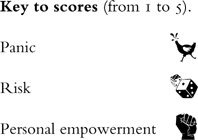
The topics we have chosen show how this wide societal network now manipulates our perception of risks. We have selected some global and some local concerns, some that are easy to understand and others for which the state of knowledge is low. All of them have been prominent stories in the media. We have scored each topic using a points system to show how vividly each threat is portrayed in the media, how real the threat is and how much we as individuals can do about it. Some of these subjects you may be worried about already. To others you may never have given a thought. However, by parading so many popular fears between these covers, we hope at least to show that you cannot worry about everything, and also that it is foolish to worry excessively about any one issue.
We have neglected many risks – including the things that are likely to get you, such as cancer, heart disease, dementia or simply falling. We might have discussed the nuclear threat – it has not gone away. We might have dealt with environmental pollution, still a major concern though no longer the public mania that it was a generation ago. Rightly or wrongly, these risks do not give rise to much panic these days, and so we have put them aside.
Examining panics en masse, we begin to pick out common threads not seen when they are considered, as they generally are, in isolation. There is a general difficulty in accepting that natural events still have the power occasionally to overwhelm us. At the same time, there is an almost biblical inclination to blame ourselves for things that may not be our fault, such as new viruses or freak weather events. There is a fear of forces that (we believe) we ourselves have unleashed through our arrogant scientific optimism. There is disbelief at the limitations of medical science, expressed in outrage at the deaths of infants or the presence of bacteria in hospitals. There is a growing distrust of the government hand.
Above all, there is a paradox. Modern life has greatly reduced many of the risks that humankind has to face, and yet it is modern life that seems to spawn most of our fears – fears of chemical, biological and nuclear war, pollution, terrorism, climate change and, less directly, fears associated with immigration, ageing, loss of cultural diversity and much else besides.
As we said, 2006 was a quiet year. There were merely the millions of expected deaths from malaria, HIV, poor water quality, war and car accidents. Searching the internet, it is almost impossible to discover how many died during the year from flu – the sort disingenuously dubbed ‘seasonal’, as if there was not a damned thing anybody can do about it – because the figure (as many as 500,000 people) is all but lost amid completely hypothetical death tolls for the bird flu pandemic that did not happen.
We notice spectacular or novel disasters, but neglect familiar killers. This is human nature. But another reason for this is the genuine gap in our knowledge of risks. The media, just like the public, attempts to navigate the daily news flow relating to global warming or the state of immigration, but, again like the public, has no means of knowing what is right or wrong. The queues forming outside branches of the Northern Rock bank in Britain in the late summer of 2007 reeked of poorly informed panic about money. And the problem gets worse as time moves on. New and increasingly complex technologies beyond the comprehension of most bring new risks as business may be threatened by internet-based markets or our health jeopardized by nanoparticles. Breast cancer is bad, but there are serious risks associated with just screening for the disease. In cases like these, what we would like is a quantitative statement of Robert K. Merton’s famous law of unanticipated consequences: how great are these consequences compared to the negative impact of the original problem and the positive impact of its technological solution? But of course this figure is seldom calculable. Sometimes, side-effects are negligible; other times, they seem greater than the original problem.
Still, we can take heart from what we do know. Not many of the dangers we confront are absolute – very few are likely to kill many people. Most are relative risks – things like eating too much salt that might knock a few years off your life or a flood that might result in the loss of treasured possessions and a tedious insurance claim. Yet academic studies of happiness suggest that it is the relative risks that matter to us. As the world becomes more complex and we grow better informed about events, we worry more about these relative risks. But how relative are they?
Numbers are the ‘fact’ generator in today’s society and numbers are the currency in any debate about risk. But they are not all of equal quality – some are manipulated by governments while others are produced by people with a vested interest. Often, proper figures don’t exist – they are opinion surveys or come from administrative systems that do not give us data on the definition we want, leading to poor policy and weaker assessment. Yet those who wish to make a point on television or in the newspapers do it using numbers. Sound-bite statistics, sometimes invented and often inaccurate, seize the imagination even if they crumble under close inspection. What does a one-in-a-thousand chance of catching SARS actually mean? Where in the world are you? What precautions are you taking? Are you of a vulnerable age?
Figures are one of the main ways to spread fear. We might like to think that the figures are the hard facts, the irrefutable hard-cooked foundation for the argument, but sadly they are often not. They can be misleading or deliberately distorting. As John Allen Paulos puts it in his 1988 book Innumeracy, ‘Mathematics is the quintessential way to make impressive-sounding claims which are devoid of factual content.’4
The favourite quotation of the British media is the remark attributed (probably erroneously) to Benjamin Disraeli, the British prime minister: ‘There are lies, damned lies – and statistics.’5 Yet statistical data are better than nothing – they are evidence of something, the starting point for a discussion, a way of understanding society. The numbers are not everything but they can inform analysis and provide the creative impetus needed to solve problems. The only alternative is to retreat into anecdote and hopelessly selective assumptions.
However, the cult of innumeracy remains strong among the public – and the media. One leading newspaper recently announced that there was ‘about’ a 50 per cent chance that Europe would have above-average temperatures in some coming period.6 Indeed. In one of his acts, George Carlin, the American stand-up comedian, invited his audience to consider how stupid the average American is. Then he paused before observing that exactly half of them are even more stupid than that!7
Although statistics about the past can be dangerous, forecasts about the future are even more dodgy. Questionable data are put in a black box computer model, cranked and spewed out often, it seems, with the sole purpose of scaring us. The ‘results’ have authority because it is experts and academics who do the cranking. Yet history is littered with examples where economists, scientists and other specialists have got their projections fantastically wrong. Furthermore, the same raw data can be made to yield very different projections according to the prejudices of the person cranking the machine and small adjustments made to the model’s assumptions.
The difficulty we have in dealing with the numbers that express risk may be a symptom of a wider inability to evaluate risk at a human level. In part, this reflects a deliberate avoidance of unpalatable truths – smokers still may not give up smoking even though they know it will be the principal cause of death for half of them. But mostly, it’s down to ignorance. Perhaps you are sitting at home reading this. If so, you probably have no idea of the hazards that confront you right now. Are you more at risk from an airborne infection, a rat chewing through the wiring and starting a fire, or an asteroid crashing through the roof? You have no idea.
We have plenty of evolutionary equipment to help us evaluate immediate danger. Our senses tell us where to tread and what’s safe to eat. But even the simple act of crossing a road is not so black and white. How can we choose between driving, flying or taking the train if we want the safest journey? What about radiation, which we willingly accept in the guise of an X-ray but fear otherwise?
Given this uncertainty, it is no surprise to find that people in different countries fear different things. The Swedes worry about dangerous chemicals, the Danes about nuclear power and the Italians about radiation from their beloved mobile phones, even though the risks from each are probably broadly equal in these countries.8 Worries also change over time. A disturbing recent survey of Australian children found their main fears were being hit by a car, being near a bomb and being unable to breathe.9 In the same survey twenty years ago a trip to the headmaster, catching germs and falling over came top of the list.
That’s a huge shift. Of course, risks change over time. Worries about terrorism and, well, anything from the following pages have replaced the Cold War worries of our parents about nuclear annihilation and communism. But, it seems, our perceptions of risk are much more changeable.
It is almost as if we have to be afraid of something, as if we carry about in our heads a bucket of worry that we are compelled to fill with whatever’s available. Clearly, different individuals have different-sized buckets. But the important questions are: is the size of your bucket fixed, or does it expand and contract according to external circumstances? Does it expand only when there genuinely is more to worry about, or is it swelled by the media, governments and other interests? Acting collectively or individually, can we shrink our buckets? If so, how? And should we do this?
According to the anthropologist Mary Douglas, writing with the political scientist Aaron Wildavsky in Risk and Culture, ‘people select their awareness of certain dangers to conform with a specific way of life’.10 A society united in fear is more cohesive. One where people fear different things is liable to fragment. Our dinner-table gossip and actions based on fears such as the rise or fall of house prices and immigration serve to strengthen or weaken the social fabric. So shrinking our bucket of worry too much may have consequences for social organization.
We live at a time of unprecedented prosperity, mobility and connectivity. Most of us live at peace in democracies. It is not merely coincidental that we are also witnessing a loss of respect for authority, a fragmentation of society and rising levels of worry about ever smaller risks. They are a logical consequence of these developments. What we are seeing is people’s first uncertain response to greater technological and political freedoms. We are free to choose what we eat from a bewildering range of foods, for example. Governments, NGOs and corporations pull us this way and that – cheap, organic, low-salt, high-fibre, local or exotic and so on. But the choice is ours. Sometimes, though, we wish somebody would make it for us.
What can we do? For many panic topics, we can bend the odds in our favour by being aware of controllable threats. We can free our minds by deciding not to worry about others. We can begin to weigh risks and measures to deal with them. For example, some safety measures, such as making cigarette lighters childproof or putting reflectors on lorries, have proved very effective in terms of saving life, while others, such as restrictions on hazardous waste, have merely proved expensive.
It is quite legitimate to ask whether more overseas aid money should be put into flood defences in poor countries. If we want to cut road accidents, perhaps we should ban pedestrians from crossing the road while using their mobiles just as we ban drivers. Perhaps we should have a war on obesity rather than a war on terror. If we as voters were a bit wiser, and were not so easily freaked by dreadful or unexpected deaths by means such as hijacking or BSE, we might get better government.
‘Men,’ wrote Charles Mackay, ‘go mad in herds, while they only recover their senses slowly, and one by one.’11 After reading Panicology, you will, we hope, worry less about many of our subjects; in one or two cases, you might be prompted to worry a little more. But you will have begun at least to prioritize your worries. You are on the road to recovery.
Worrying about whether there too many people on our planet or too few, and how we should relate to them, is at the heart of many panic stories. Mrs Thatcher told us two decades ago that there is no such thing as society, but the families we make – and break – and the increasingly diverse relationships we form, and see others form, cause plenty of concern. And don’t forget how we all got here – sex – is it a problem or a pleasure?
‘A second baby? Russia’s mothers aren’t persuaded’
New York Times
Italian men not helping much around the house is apparently one of the principal reasons why Italian women are producing so few babies.1 Other reasons for the birth rate of Italian women falling to be among the lowest in the world include the lack of flexible work, a shortage of nurseries and the poor provision of children’s services, in a country where couples have traditionally relied on families for support. A low birth rate might seem an unlikely problem for a predominantly Catholic child-loving country, but a serious shortage of babies and the prospect of a shrinking population is affecting many developed countries, to such an extent that it could soon threaten their livelihood and viability. Mass immigration, not always seen as desirable in the West, might become a necessity.
The prospect of too few people being a problem is a far cry from the impending ‘population crisis’ that most of today’s adults were brought up with. ‘Too many people in the world?’ was the provocative question on the cover of one American magazine in 1963 and typical of the genre. Declining death rates, in other words increasing life expectancy, around the world contributed to the more than doubling of the world’s population since 1950 to its current 6½ billion. It is now increasing by a little over 6 million a month, roughly 200,000 every day. The consequences of this growth are enormous shortages of water and fuel, the depletion of natural resources, high unemployment rates, pressure on public services including education and healthcare, increased ill-health, damage to ecosystems and pollution.
It seems, then, that there are too few people in some areas and too many in others.
Population fluctuations and associated scare stories are nothing new. The highly influential Essay on the Principle of Population, written by Englishman Thomas Robert Malthus in 1798, predicted that population would outrun food supply before the end of the nineteenth century. His basic view was that population, if unchecked, increases exponentially, at a geometric rate, whereas the food supply grows in a linear fashion, at an arithmetic rate. Malthus saw the solution to rapid population growth as being ‘moral restraint’ – including late marriage, which paradoxically is one of the key features of the problem now facing many Western countries with low birth rates and declining population. If we failed to embrace such restraint, excessive population growth would be checked, he told us, by accidents, war, pestilence, famine, infanticide, murder and homosexuality. Well, it hasn’t turned out quite that bad – yet at least. Economic progress, notably developments in food production, has kept most people nourished even if the more intensive use of the world’s resources has given rise to scares discussed elsewhere in this book.
Sensible debate around the topic of population growth has been hampered by several factors. One is the population projections, which have a reputation of being fantastically unreliable – they are heavily influenced by the prejudices of those conducting the forecast, and very small differences in assumptions can make large differences to the results, due to the power of compound growth rates. Another problem has been the inability to define overpopulation. Conceptually it can be thought to arise when there is a shortage of resources leading to an impaired quality of life, serious environmental degradation or long-term shortages of essential goods and services. But how serious is serious and how long-term is long-term? As there is never a eureka moment when we can suddenly say that there is overpopulation, the whole debate is conducted in shades of grey. Population generally changes only slowly and unevenly, and the concerns or pressure points vary according to the society’s location and its wealth.
Nevertheless, there have been other recent well-known works along similar lines to Malthus. These include The Limits to Growth,2 the world’s best-selling environmental book, published in 1972, which modelled the consequences of rapidly growing world population given finite resource supplies, and The Population Bomb,3 which predicted that hundreds of millions of people would starve to death in the 1970s and 1980s. At the time there was no shortage of criticism of the books, and both appeared on lists of the century’s worst books made at the turn of the millennium.
Whatever the predictions, it is not difficult to argue that, with around 1 billion people already malnourished and without access to safe drinking water and healthcare, the earth is supporting 6½ billion people only because many live in misery. Others, more optimistically, have suggested that the world has a ‘carrying capacity’ of nearer 10 billion, and that the falling rate of population growth in various parts of the world, coupled with progress in science and technology, means there will be no problem with overpopulation.
Rapidly growing populations leading to overpopulation might appear to be a global issue, but it is limited to a minority of geographies. Indeed, the United Nations forecasts that nine countries will account for half of the world’s projected population increase in the period up to 2050. These are India, Pakistan, Nigeria, Democratic Republic of Congo, Bangladesh, Uganda, the US, Ethiopia and China, listed in order of their contribution to the growth. The growth is associated with increased urbanization, bringing a range of problems, with cities growing particularly fast in China and India – India already has more than thirty cities with populations over 1 million. These changes will cause a shift in where the world’s power – in terms of population – is concentrated. All of the growth forecast for the next four decades – adding 2.6 billion to the world’s population – is expected to take place in less-developed regions, with the population of the developed world remaining unchanged at around 1.2 billion.
Demographers normally measure either the crude birth rate – the number of children born per thousand of population each year – or the total fertility rate – the average number of children born to each woman over the course of her life. On either measure a number of developed countries stand out as having a problem with declining population levels. Fertility in several dozen developed countries has reached levels unprecedented in recorded history – below 1.3 children per woman in several southern and eastern European countries. By contrast, fertility at the world level stands at 2.65 children per woman, a figure that rises to 5 children per woman in the least developed countries. The world average crude birth rate is around 20 children per thousand of population each year, yet a number of developed countries, including Germany, Japan and Italy, have rates of below 10.
Countries have always feared a declining population. In the past, a large and growing population was required to develop land and generate wealth. Population increase was encouraged, often by means of conquest and enslavement. Larger armies, and increased security, required a healthy supply of youths. The pressures are different these days, but a declining population, often associated with an ageing population, is widely expected to damage economic growth and wealth generation, in turn increasing the difficulty of caring for the elderly.
The reasons for the drop in fertility are not entirely clear. The theory of ‘demographic transition’ suggests that, as the standard of living and life expectancy increase, family sizes start to drop. At one level, factors such as the increased access to contraception give adults more choice over when and if to have children. The tendency to get married at later ages, reflecting in part the desire of many women to have careers, also reduces the scope to have children. And the sharp fall in infant death rates has reduced one pressure to have multiple births. The financial equation of having children has also altered: in rural areas in less-developed countries, children contribute to the economic well-being often from an early age, but in developed, urban settings bringing up children is increasingly expensive.
| Rank by state∗ | Country | Births/000 population (crude birth rate) | Total fertility rate |
|---|---|---|---|
| 1 | Niger | 50.7 | 7.5 |
| 20 | Nigeria | 40.4 | 5.5 |
| 55 | Pakistan | 29.7 | 4.0 |
| 89 | India | 22.0 | 2.7 |
| – | World average | 20.1 | 2.6 |
| 112 | Israel | 18.0 | 2.4 |
| 122 | Brazil | 16.6 | 1.9 |
| 136 | Ireland | 14.4 | 1.9 |
| 137 | US | 14.1 | 2.1 |
| 142 | China | 13.3 | 1.7 |
| 148 | Australia | 12.1 | 1.8 |
| 151 | France | 12.0 | 1.8 |
| 160 | UK | 10.8 | 1.7 |
| 169 | Spain | 10.1 | 1.3 |
| 173 | Russia | 10.0 | 1.3 |
| – | European Union | 10.0 | 1.5 |
| 174 | Poland | 9.9 | 1.2 |
| 178 | Italy | 9.6 | 1.3 |
| 180 | Japan | 9.4 | 1.4 |
| 181 | Singapore | 9.3 | 1.1 |
| 184 | Czech Republic | 9.0 | 1.2 |
| 189 | Austria | 8.7 | 1.4 |
| 192 | Germany | 8.2 | 1.4 |
| Source: The World Factbook, www.cia.gov. The total fertility rate is the expected number of children born per woman based on 2006 age-specific fertility rate date. ∗According to crude birth rate. | |||
The low fertility trends in some countries are such that demographers are now warning of ‘negative momentum’, occurring when a shrinking population goes into an ever-steeper spiral of decline – fewer babies now means fewer mothers in the future. When fertility rates fall below 2.1 (each woman needs to give birth on average to 2.1 babies to maintain a developed nation’s population size) and death rates are broadly stable, a country’s population will decline unless it is offset by a favourable combination of immigration and emigration.
This is a situation which is now facing much of Europe. The population of many of the former Soviet republics is falling due to emigration (notably since the fall of the Berlin Wall in the early 1990s), ill-health of those who remain and relative poverty. The population in the Czech Republic, Hungary, Poland and the Slovak Republic was lower in 2005 than in 2000. The population of Germany declined in 2005 and 2006, a situation that would be reflected in several other western European countries were it not for net immigration. The future looks no more promising for most developed countries. Europe’s population was estimated at 731 million in 2005 – the base from which the United Nations conducts its projections. On the ‘low’ scenario, Europe’s population is expected to fall by over 20 per cent to 566 million, by 2050. The ‘high’ scenario sees a rise of 6 per cent, while the ‘medium’ scenario sees a fall of 10 per cent.4 All other continents, in contrast, see a significant increase in population in even the low scenario.
A declining population will usually be accompanied by population ageing, one of the factors explaining the economic malaise of Japan and Germany in the last decade – and it’s going to get worse before it gets better. The median age of the world’s population is currently around 28 years, but that ranges from around 16 to 18 in many of the less-developed African countries to over 40 in a good number of European countries. Looking ahead, the problems could be severe for Europe’s pensioners. Currently there are around 35 pensioners for every hundred people of working age, but by 2050 there could be twice as many pensioners, around 75, for every hundred workers. Italy and Spain could see their ratios approach one for one. In most European countries, pensions are paid out of current tax revenues, which means that taxes will have to rise sharply, with the burden falling on an already proportionately shrinking number of workers, or pensions will have to fall.
There is little doubt that countries take a decline in the population seriously and try to reverse it. Russia’s President Putin has described the baby shortage as the country’s most acute problem and ordered parliament to give large financial incentives to women who have a second baby. Australia’s ‘one for mum, one for dad and one for the country’ campaign and the associated baby bonus cash payment, introduced in 2004, has tentatively been declared a success with the latest figures showing a small rise in the birth rate. And many European countries, including France, Italy and Poland, also offer financial incentives to mothers or families with children. But, if the incentives in the form of cash and savings offered in Singapore and Japan over a rather longer period are anything to go by, they are unlikely to have any lasting success. With surveys suggesting that it can cost several hundred thousand Euros to bring up a child, it will be surprising if cash sums of €1,000 or €2,000 have any impact on the underlying trends.
| Millions | 2005 | 2015 | Percentage change |
|---|---|---|---|
| World | 6465.7 | 7219.4 | +12 |
| The growing countries | |||
| Brazil | 186.4 | 209.4 | +12 |
| China | 1315.8 | 1393.0 | +6 |
| India | 1103.4 | 1260.4 | +14 |
| Nigeria | 131.5 | 160.9 | +22 |
| Pakistan | 157.9 | 193.4 | +22 |
| Turkey | 73.2 | 82.6 | +13 |
| US | 298.2 | 325.7 | +9 |
| Stable and shrinking countries | |||
| Bulgaria | 7.7 | 7.2 | –7 |
| France | 60.5 | 62.3 | +3 |
| Germany | 82.7 | 82.5 | n/c |
| Italy | 58.1 | 57.8 | –1 |
| Japan | 128.1 | 128.0 | n/c |
| Poland | 38.5 | 38.1 | –1 |
| Russia | 143.2 | 136.7 | –5 |
| UK | 59.7 | 61.4 | +3 |
Source: World Population Prospects, United Nations, www.un.org/esa, 2005 version. |
|||
One possible solution is to encourage immigration, but that is another story with another set of issues. The poor and relatively youthful countries of North Africa and Asia that are closest to Europe offer a large supply of potential immigrants, but will the ageing residents of Europe want them? It seems certain that continued modest migration will play a part in Europe’s policy, but the numbers involved are such that immigration cannot feasibly plug the gap left by the birth dearth. Spain would need 170,000 immigrants a year over the next fifty years to maintain a constant population size. Spain’s position is extreme, as it currently has few retired people but is forecast to have a large increase. To maintain a constant working age population, it would need an average 260,000 immigrants a year. But to maintain the current potential support ratio (the number of people of working age per older person), Spain would have to accept an annual average of 1.6 million immigrants every year. This is clearly impossible. Europe’s predicament might not end in tears, but serious adjustment in policy and expectations is required.
Overpopulation has been a popular theme in fiction, especially in the 1950s and 1960s. Books and films have proposed that the problem can be easily resolved by embracing measures such as raising infants as food or by promoting euthanasia of everyone who reaches a certain age. So it seems paradoxical that the big issue likely to face most readers of this book is the impact of a shrinking population on their wealth and health in their old age.

‘A nation of unhappy families’ The Times
The down side of the increasing flexibility that makes later marriage more appealing is that ‘normal family life’ might feel like a thing of the past for most children. The media plays its part, sometimes giving the impression that society is crumbling in the face of delinquent youths, teenage pregnancies, single-parent families and a high divorce rate. But this panic-inducing story resulting from the rapid change in our society has, in contrast to many others that we live with, a distinctly political flavour.
David Cameron, the Conservative leader, has pinpointed absent fathers and family breakdown as two of the root causes of anti-social behaviour, and polls show that a majority of the public agrees with him. He has said that he does not criticize all the single mothers who work hard to give their children a good start in life, but he has pledged to change the tax and benefits system to ensure that there are real incentives for parents to get and stay married.
The Labour government has taken a different view during the past decade. It says that marriage is ‘a good thing’ but plans no action to support it, saying that policy must be ‘bias free’ when it comes to marriage, adding that love and compassion are what create strong families. While love and compassion are important, it has become increasingly hard, say the government’s critics, for families to survive and flourish without the protection of the law and a supportive financial regime. Indeed, traditional families have been hard hit by Labour’s tax reforms, including the removal of a tax allowance for married couples and the introduction of welfare credits that reward lone parents at the expense of low-income couples. The structure means that poorer couples, for whom income top-ups from the state are important, are much better off if they keep their relationships unofficial and, so far as the government is concerned, live separately. Getting married means that benefits are cut. One report, ‘Parents live apart to cash in on benefits system’,1 suggested that as many as one million couples in a committed sexual relationship live most of their time at separate addresses, and that such untraditional family structures primarily reflect financial considerations. An unemployed mother who leaves the unemployed father of her children could experience a rise in her standard of living of between 20 and 35 per cent.
It is, of course, impossible to be 100 per cent sure of any cause and effect when it comes to behaviours in society, but a number of important trends seem to be heading in the wrong direction, damaging the fabric of society, in Britain and a number of other countries. One shocking survey suggested that working parents spend only nineteen minutes a day with their children, just enough time for a quick breakfast or reading a bedtime story.2 Indeed, leaving children to their own devices, letting them learn about life from other teenagers and not providing good adult role models are frequently seen as being at the heart of the problem. Whatever the truth, the trends seem to be leaving a large number of unhappy and helpless families in their wake. One survey of Scotland’s mothers and fathers revealed that their principal concerns are balancing jobs and home life without the benefit of an extended family near by, having nowhere to turn for advice when the going gets tough, and worrying about how best to discipline unruly offspring. Three-quarters of those questioned said that they would consider counselling if it was available.3
A comprehensive assessment of the well-being of children and young people by UNICEF presented a report described as a ‘damning’ assessment of the ‘crisis of childhood that is blighting Britain’.4 The report measured well-being across more than twenty developed countries under a variety of headings such as education, relationships, behaviours and health. The top half of the well-being table was dominated by small north European countries including the Netherlands, Sweden, Denmark and Finland. Relative child poverty was highest in three southern European countries (Portugal, Spain and Italy) and in three Anglophone countries (the US, the UK and Ireland). Roughly four out of five children in the countries under review lived with both parents, but the rates fell to below 70 per cent in the UK and the US. The percentage of children who said that their peers are ‘kind and helpful’ varied from above 80 per cent in some countries to less than 50 per cent in the Czech Republic and the UK. Fewer than 15 per cent of young people report being drunk on two or more occasions, but the figure rose to over one-quarter in the Netherlands and almost one-third in the UK. Over one-third of 11–15-year-olds in the UK, Switzerland and Canada had used cannabis.
Newspaper reports of the study – ‘Threadbare family lives’ and ‘Unhappy families’ were typical – focused not on Britain’s top-of-the-table performance on teenage pregnancies, bullying and poor family relationships, but on the depressing conclusion that British children perceive themselves to be unhappier than their peers in other countries. Overall the UK was the country where the welfare of children suffered most, and America was the nearest rival. While politicians, think tanks and the press could build little consensus about what to do to improve the situation, it is clear that Britain has suffered from adverse trends. The country finds itself in a worse position on a number of counts than many others and is at a loss to know what to do about its delinquent children.
Among the key drivers is the fact that marriage has become seriously unpopular. Marriage rates in England and Wales are at their lowest since records began over 150 years ago. Just 24 men per thousand unmarried men got married in 2005, a drop from a rate of 28 in 2004 and 49 per thousand twenty years before. The sharp drop in the latest year was explained by new legislation aimed at reducing the number of ‘sham marriages’5 and the increasing popularity of getting married overseas, but there is no mistaking the underlying trend. The male marriage rates dropped below 50 only in a few exceptional years between the 1860s, when records began, and 1984, and the rate peaked at 78 in the early 1970s. Among the marriages that are occurring, an increasing proportion have an added complexity that might serve to weaken the traditional links within society, as they bring together two different nationalities, ethnic groups or religions. The increasing occurrence of second and third marriages gives rise to ever more extended and less tightly bound families.
The pattern of motherhood has also changed dramatically in recent decades even if the number of children born each year in England and Wales has been relatively stable – within 50,000 of the 650,000 of the recent years’ average. But over that time the average age of the mother has been increasing: in the 1960s British women were most fertile in their early twenties; that shifted to the late twenties and has now shifted to the early thirties. The mean age of mothers is now over twenty-nine, having increased by over three years in the last three decades, and the number of first-time mothers over thirty-five has trebled in fifteen years.
Mothers with old faces and young children are an increasingly common sight on Europe’s high streets as the average age of motherhood continues to rise in every European country for which records exist. The mean age of women at the birth of the first child is now around twenty-seven to twenty-nine years in most developed countries. In Spain, 13 per cent of first-time mothers are now over forty, double the proportion in England and Wales. Later births and later marriages are a result both of some women enjoying their freedoms and careers and of some men shying away from the traditional male role of providing financially for a wife and children.
Those women who are lucky enough to fall pregnant in their late thirties or forties get no thanks. So far as many newspapers are concerned, they are simply risking their health and that of the foetus – miscarriages, ectopic pregnancies and pre-eclampsia are more common among older mothers-to-be. One doctor said that women who delay having children until they are thirty-five or over constitute a ‘major public health issue’, adding that they are more of a burden to society than teenage mums.
The papers now regularly report women aged over sixty giving birth. Britain’s oldest mother gave birth in 2006 at the age of sixty-three but a 66-year-old has given birth in Romania and a 65-year-old in India. This is as much a freak show as anything else but does show how medical techniques are extending the age at which women can conceive, even though most clinics will not accept women for IVF treatment over the age of forty-five. Plenty of women who have their first child at an older age end up with just the one child, and the swelling ranks of children growing up without brothers and sisters are giving rise to a new group of people that is of increasing interest to psychologists.
Teenage mothers are a constant source of interest to the newspapers. One story, ‘Mum believable’, told of a fourteen-year-old