
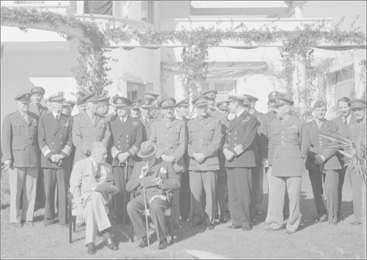
1. Churchill and Roosevelt at the Casablanca Conference, where the Combined Bomber Offensive was first agreed.
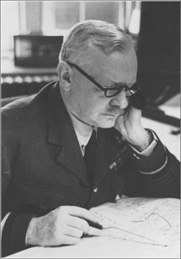
2. Sir Arthur Harris, Commander-in-Chief, RAF Bomber Command.
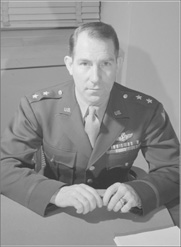
3. Major General Frederick L.Anderson, commander of US VIII Bomber Command.
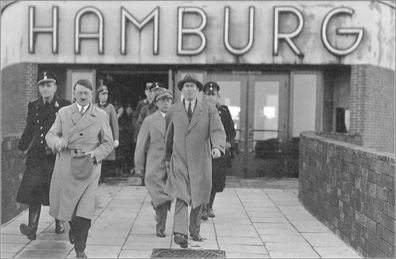
4. Hitler arrives at Hamburg’s airport on one of his many pre-war visits. He never returned once war had broken out, despite appeals for a morale-raising tour after the city was destroyed.
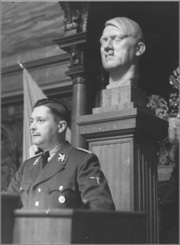
5. Karl Kaufmann, Hamburg’s gauleiter and a loyal disciple of the Führer.
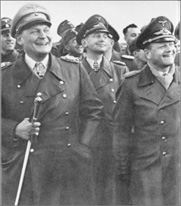
6. Göring (left) was head of the Luftwaffe, but it was Erhard Milch (right) who ran the show. Chief of Air Staff Hans Jeschonnek (centre) shot himself shortly after the bombing of Hamburg.
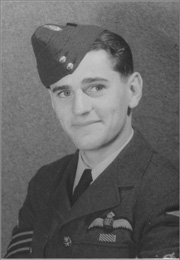
7 Colin Harrison: ‘One minute I was a school boy, next minute they called me a man and put me in an aeroplane.’
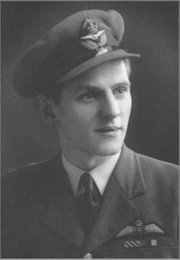
8 Bill McCrea: ‘When we were detailed on the first Hamburg raid we thought, “Now we’ll see what it’s really like!”
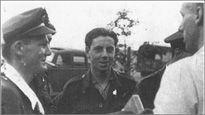
9 Doug Fry (centre), hours before he was shot down at the end of July 1943.
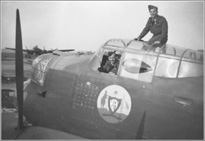
10 Baptism of fire: Ted Groom and pilot Reg Wellham’s first operation was the firestorm raid of27 July.
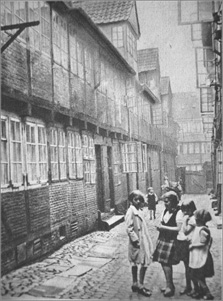
11 Hamburg before the war. Narrow streets like this allowed fires to spread rapidly.
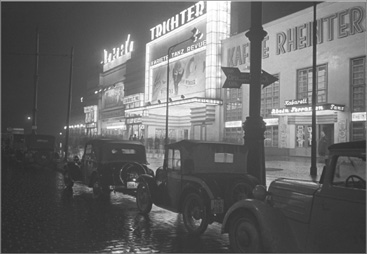
12 The bright lights of the Reeperbahn in the 1930s. Scenes like this were impossible during the black-out.
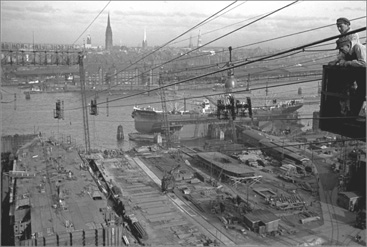
13 The heart and soul of Hamburg: the docks and shipyards were the main reason the city was such an important target.
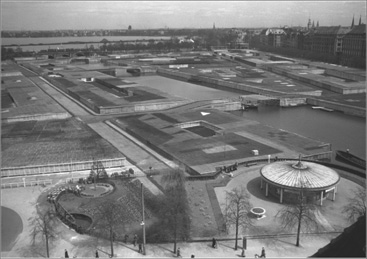
14 False streets and buildings were floated on the Alster lake in an attempt to disguise the city centre. This camouflage caught fire during the bombardmetn, adding to the inferno.
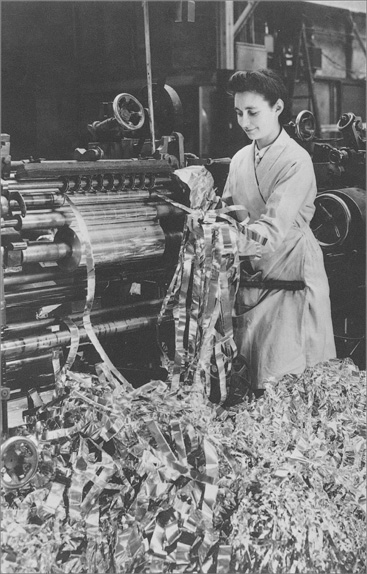
15 Secret weapon: a factory worker cuts strips of ‘Window’ to the right length.
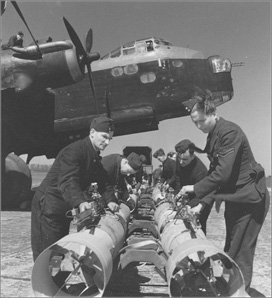
16 RAF ground crew prepare bombs before loading them into a Stirling bomber.
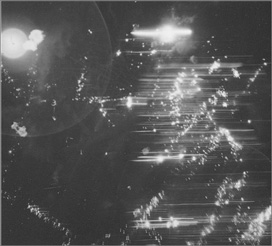
17 Hamburg from the air on the night of 24 July. The centre of the picture shows the Neustadt on fire, with bombs spreading back towards Altona at the bottom.
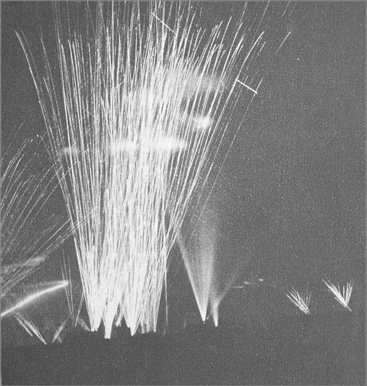
18 Streaks of flak over Hamburg. Without radar to guide them, flak gunners were forced to fire blindly into the sky.
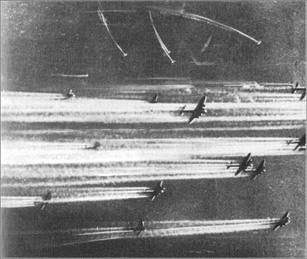
19 A typical formation of B-17 Flying Fortresses, with German fighter aircraft above.
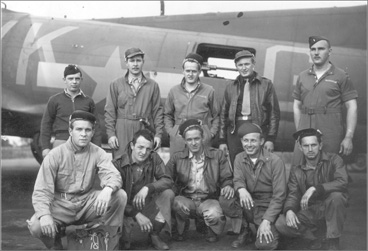
20 The lead crew of the USAAF’s 303rd Bomb Group before their mission to Hamburg on 25 July. The pilot, Major K. R. Mitchell, is second from left at the back.
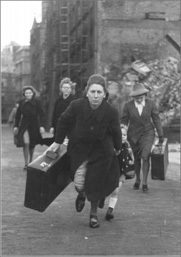
22 Hamburg women and children run for cover during an air-raid warning.
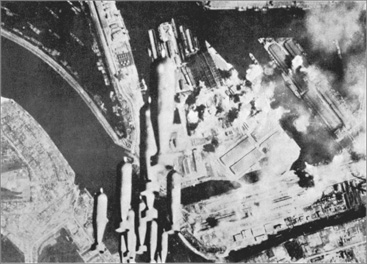
21 American bombs fall on Howaldtswerke shipyards, 26 July.
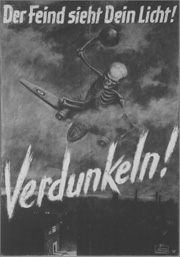
23 German propaganda poster, 1943:‘The enemy sees your light. Black out!’
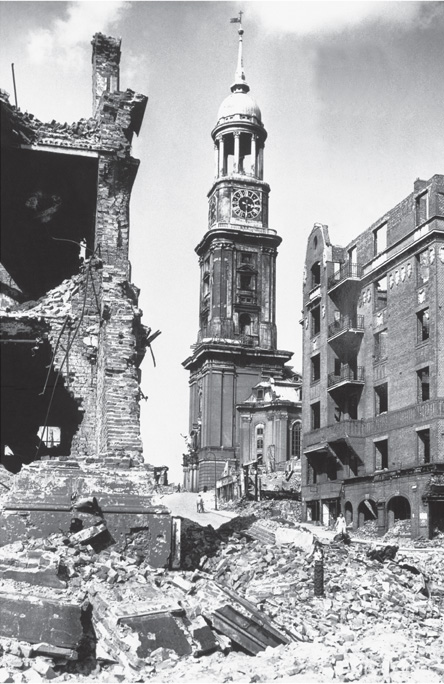
24 The ‘Michel’, a symbol of Hamburg. The sight of this spire rising unscathed in the ruins of the city was as important to Hamburgers as the urvival of St Paul’s Cathedral was to Londoners during the Blitz.
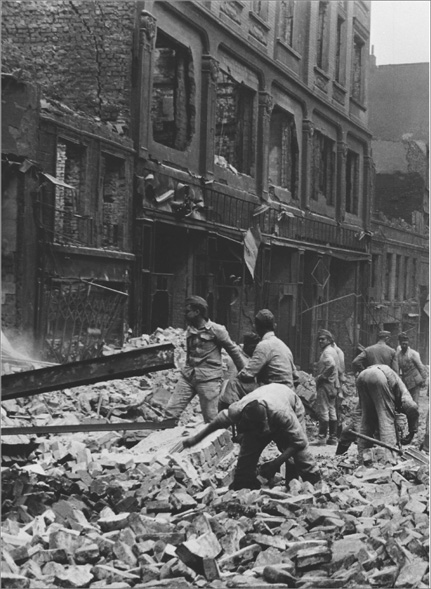
25 A group of men clears the rubble on Grosse Bergstrasse in Altona, shortly after the opening raids.
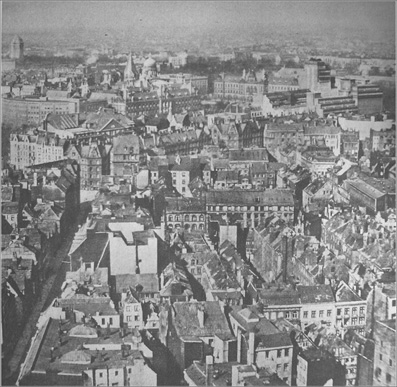
26 Elbstrasse (now Neanderstrasse) before the raids.
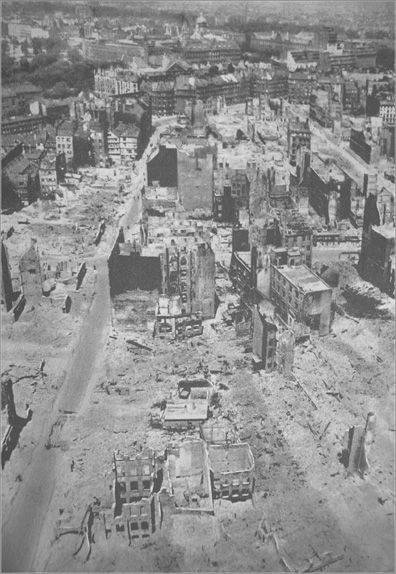
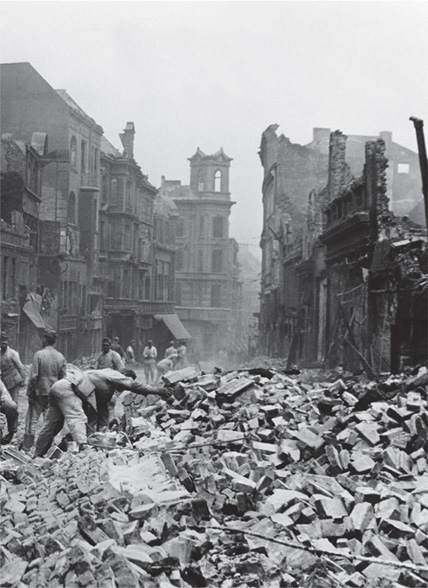
27 Elbstrasse after the raids.
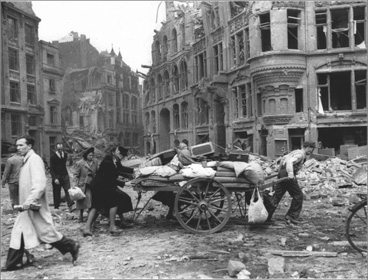
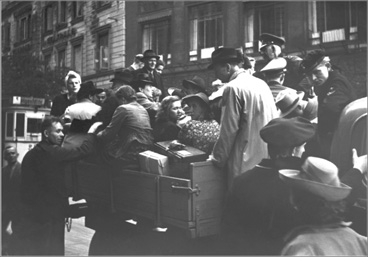
28 and 29 Even before the evacuation order was given, the Ausgebombten began toflee the city. Above: A family rescues a few of its possessions. Below: Refugees being evacuated on open lorries.
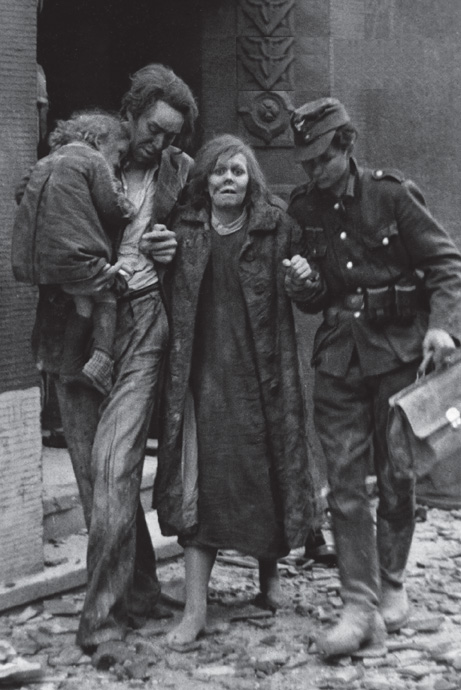
30 The face of the victim: the trauma of being bombed scarred an entire generation of Germans.
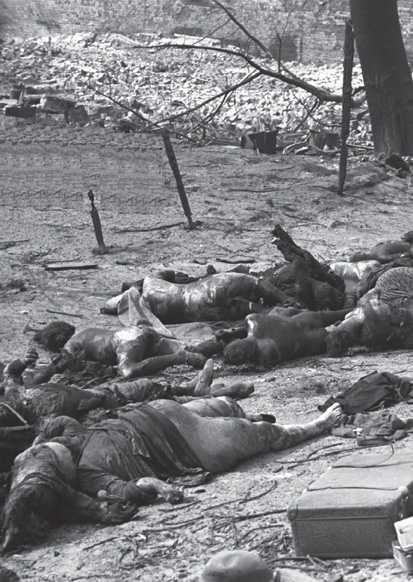
31 Some of the city’s 45,000 dead litter a street in the suburb of Hamm.
32 According to the late W. G. Sebald, in the immediate post-war years shopkeepers would pull photographs like this from under the counter with a furtiveness usually reserved for pornography. These unfortunates were not burned but baked in the heat of their shelter.
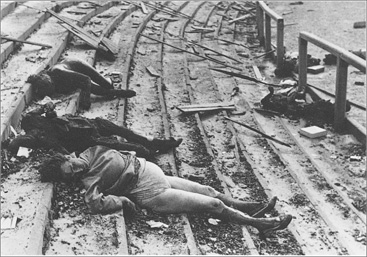
33 The changeful nature of the firestorm produced some gruesome contrasts: this body of a pregnant woman could almost be sleeping, while the corpses behind her are charred and mumified beyond recognition.
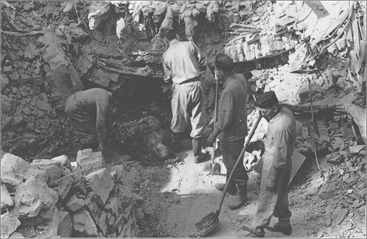
34 The clean-up operation: Hamburg workers clear the entrance to a buried air-raid shelter.
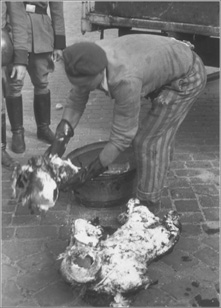
35 A prisoner from Neuengamme concentration camp loads charred body parts into a bucket.
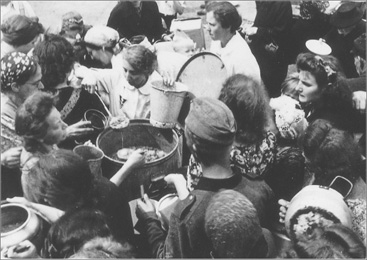
36 Survivors being issued with emergency rations at one of the refugee assembly points.
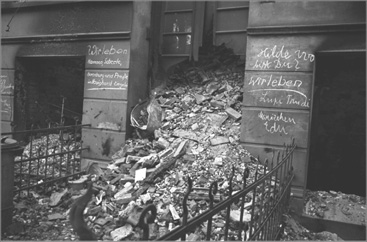
37 Chalk messages appeared on many of the ruins, listing the where abouts of those who used to live there. Some of them seem like gestures of defiance: Wir leben (‘We are alive’).
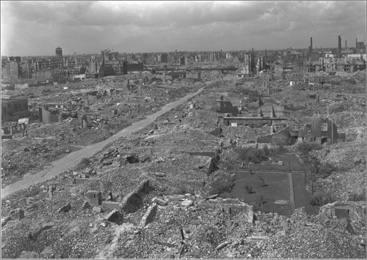
38 Ruined landscape. After the Gomorrah attacks Volksdorfer Strasse in Barmbek was merely a pathway cleared through the rubble.
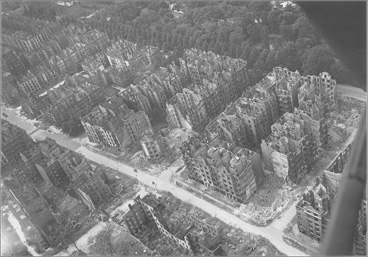
39 In Hamm only the façades of buildings still stand: everything else has been turned to ash.
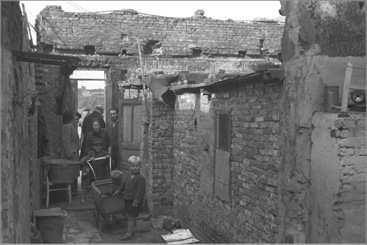
40 Life amongst the ruins: for the rest of the war, and for years afterwards, families were forced to live in the most basic of conditions wherever they could find shelter.
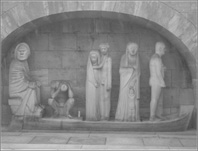
41 The memorial to the dead at Ohlsdorf depicts Charon ferrying the dead across the Styx. It stands in the centre of four mass-graves (below), where 36,918 bodies are buried. Thousands more were never recovered.
Inferno
The Devastation of Hamburg, 1943
VIKING
an imprint of
PENGUIN BOOKS
VIKING
Published by the Penguin Group
Penguin Books Ltd, 80 Strand, London WC2R 0RL, England
Penguin Group (USA) Inc., 375 Hudson Street, New York, New York 10014, USA
Penguin Group (Canada), 90 Eglinton Avenue East, Suite 700, Toronto, Ontario, Canada M4P 2Y3
(a division of Pearson Penguin Canada Inc.)
Penguin Ireland, 25 St Stephen’s Green, Dublin 2, Ireland
(a division of Penguin Books Ltd)
Penguin Group (Australia), 250 Camberwell Road, Camberwell, Victoria 3124, Australia
(a division of Pearson Australia Group Pty Ltd)
Penguin Books India Pvt Ltd, 11 Community Centre, Panchsheel Park, New Delhi – 110 017, India
Penguin Group (NZ), 67 Apollo Drive, Mairangi Bay, Auckland 1310, New Zealand
(a division of Pearson New Zealand Ltd)
Penguin Books (South Africa) (Pty) Ltd, 24 Sturdee Avenue, Rosebank, Johannesburg 2196, South Africa
Penguin Books Ltd, Registered Offices: 80 Strand, London WC2R 0RL, England
www.penguin.com
First published 2007
1
Copyright © Keith Lowe, 2007
The moral right of the author has been asserted
Maps by John Gilkes
All rights reserved
Without limiting the rights under copyright
reserved above, no part of this publication may be
reproduced, stored in or introduced into a retrieval system,
or transmitted, in any form or by any means (electronic, mechanical,
photocopying, recording or otherwise), without the prior
written permission of both the copyright owner and
the above publisher of this book
A CIP catalogue record for this book is available from the British Library
List of Maps
List of Illustrations
Introduction
Author’s Note
Part One – Hamburg
1 City on the River
2 The Anglophile City
3 City of Rebellion
4 The Rise of the Nazis
5 Hamburg Prepares for War
Part Two – Darkness Falls from the Air
6 A Brief History of Bombing
7 The Grand Alliance
8 The British Plan
9 The First Strike
10 The Devastation Begins
11 The Americans Join the Fray
12 The Luftwaffe Strikes Back
13 The Americans Again
14 The Eye of the Storm
15 Concentrated Bombing
16 Firestorm
17 The ‘Terror of Hamburg’
18 Coup de Grâce
19 The Tempest
Part Three – The Aftermath
20 City of the Dead
21 Survival
22 Famine
23 The Reckoning
24 Redemption
Appendices
A Chronology of Hamburg
B Chronology of the Second World War
C Chronology of ‘Operation Gomorrah’
D Comparison of British, American and German Terms
E British Order of Battle, 24 July 1943
F American Order of Battle, 24 July 1943
G Luftwaffe Order of Battle of Fighters in the West, 24 July 1943
H Air Force Casualties
I Tables of Statistics
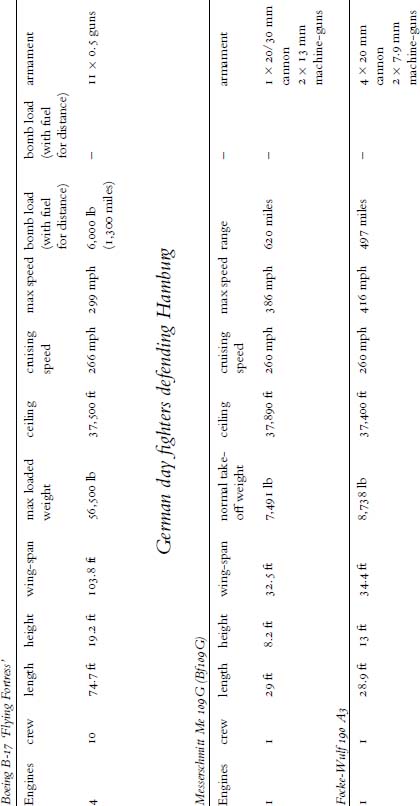
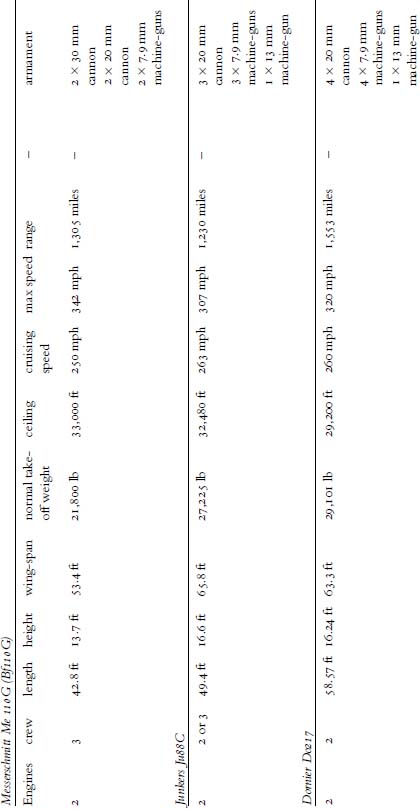
J Aircraft Specifications
K Financial Cost of the Hamburg Bombings
Notes
Archives Consulted
Select Bibliography
Acknowledgements
Index
1 Hamburg and its defences, 1943
2 RAF route on the night of 24 July 1943
3 RAF bombs dropped on Hamburg on the night of 24 July
4 The American plan, 25 July 1943
5 USAAF route over Hamburg, 25 July
6 American bombs on Hamburg, 25 July
7 Attacks on 384th BG, 25 July
8 USAAF losses, 25 July
9 USAAF route, 26 July
10 American bombs on Hamburg, 26 July
11 Damage caused by British and American bombers, 24–26 July 1943
12 RAF route on the night of 27 July
13 RAF bombs dropped on Hamburg on the night of 27 July
14 The firestorm area
15 RAF losses on the night of 29 July
16 RAF bombs dropped on Hamburg on the night of 29 July
17 Damage caused on the night of 29 July
18 British and German losses on the night of 2 August
19 Total damage to Hamburg in the Gomorrah raids, 24 July–3 August
1 Churchill and Roosevelt at the Casablanca Conference, where the Combined Bomber Offensive was first agreed (US Army)
2 Sir Arthur Harris, Commander-in-Chief, RAF Bomber Command (Imperial War Museum)
3 Major General Frederick L. Anderson, commander US VIII Bomber Command (US Air Force)
4 Hitler arrives at Hamburg’s airport on one of his many pre-war visits (Archiv Erna Neumann)
5 Karl Kaufmann, Hamburg’s gauleiter and a loyal disciple of the Führer (Studio Schmidt-Luchs)
6 Göring (left) was head of the Luftwaffe, but it was Erhard Milch (right) who ran the show. Chief of Air Staff Hans Jeschonnek (centre) shot himself shortly after the bombing of Hamburg (Private collection)
7 Colin Harrison: ‘One minute I was a schoolboy, next minute they called me a man and put me in an aeroplane.’ (Private collection)
8 Bill McCrea: ‘When we were detailed on the first Hamburg raid we thought, “Now we’ll see what it’s really like!” ’ (Private collection)
9 Doug Fry (centre), hours before he was shot down at the end of July 1943 (Private collection)
10 Baptism of fire: Ted Groom and pilot Reg Wellham’s first operation was the firestorm raid of 27 July (Private collection)
11 Hamburg before the war. Narrow streets like this allowed fires to spread rapidly (RAF Museum)
12 The bright lights of the Reeperbahn in the 1930s (Denkmalschutzamt Hamburg)
13 The docks and shipyards were the main target of the raids (Denkmalschutzamt Hamburg)
14 False streets and buildings were floated on the Alster lake in an attempt to disguise the city centre (Denkmalschutzamt Hamburg)
15 Secret weapon: a factory worker cuts strips of ‘Window’ to the right length (IWM)
16 RAF ground crew prepare bombs before loading them into a Stirling bomber (IWM)
17 Hamburg from the air, on the night of 24 July (IWM)
18 Streaks of flak over Hamburg (RAF Museum)
19 A typical formation of B-17 Flying Fortresses, with German fighter aircraft above (US Air Force)
20 The lead crew of the USAAF’s 303rd Bomb Group before their mission to Hamburg on 25 July (Mighty Eighth Museum, Georgia)
21 American bombs fall on Howaldtswerke shipyards, 26 July (US Air Force)
22 Hamburg women and children run for cover during an air-raid warning (Studio Schmidt-Luchs)
23 German propaganda poster, 1943: ‘The enemy sees your light. Black out!’ (Bildarchiv Preussicher Kulturbesitz)
24 The ‘Michel’, a symbol of Hamburg (Denkmalschutzamt Hamburg)
25 A group of men clears the rubble on Grosse Bergstrasse in Altona, shortly after the opening raids (Denkmalschutzamt Hamburg)
26 Elbstrasse (now Neanderstrasse) before the raids (RAF Museum)
27 Elbstrasse after the raids (RAF Museum)
28 and 29 Even before the evacuation order was given, the Ausgebombten began to flee the city (above, Studio Schmidt-Luchs; below, Denkmalschutzamt Hamburg)
30 The face of the victim: the trauma of being bombed scarred an entire generation of Germans (Ullstein)
31 Some of the city’s 45,000 dead litter a street in the suburb of Hamm (Denkmalschutzamt Hamburg)
32 According to the late W. G. Sebald, in the immediate post-war years shopkeepers would pull photographs like this from under the counter with a furtiveness usually reserved for pornography (US National Archives)
33 The changeful nature of the firestorm produced some gruesome contrasts (IWM)
34 The clean-up operation: Hamburg workers clear the entrance to a buried air-raid shelter (IWM)
35 A prisoner from Neuengamme concentration camp loads charred body parts into a bucket (Bildarchiv Preussicher Kulturbesitz)
36 Survivors being issued with emergency rations at one of the refugee assembly points (Josef Schorer/Archiv für Kunst und Gewerbe, Hamburg)
37 Chalk messages appeared on many of the ruins, listing the whereabouts of those who used to live there (Denkmalschutzamt Hamburg)
38 Ruined landscape: after the Gomorrah attacks, Volksdorfer Strasse in Barmbek was little more than a pathway cleared through the rubble (Denkmalschutzamt Hamburg)
39 In Hamm only the façades of buildings still stand: everything else has been turned to ash (IWM)
40 Life among the ruins: for the rest of the war, and for years afterwards, families were forced to live in the most basic conditions (Denkmalschutzamt Hamburg)
41 and 42 The memorial at Ohlsdorf cemetery, and one of the four mass-graves where 36,918 bodies are buried (Private collection)
He who fights with monsters should look to it that he himself does not
become a monster. And when you gaze long into an abyss the abyss
also gazes into you.
Friedrich Nietzsche1
In his eyewitness account of the Hamburg firestorm and its aftermath, Hans Erich Nossack admitted to feeling a mixture of awe and elation whenever he saw the fleets of British bombers flying over the city. Despite his natural fear during an air raid, he often found himself willing the bombers on, almost hoping for the opportunity to witness a truly catastrophic event. Rather than going to the shelter he would stand spellbound on his balcony watching the explosions rising above the city. He did not blame the British and American airmen for the havoc they were wreaking, but saw it rather as the inevitable expression of man’s urge to destroy – an urge that was mirrored in his own morbid fascination. That this fascination was accompanied by revulsion, both at what was happening before him and at his own emotions, did not lessen the power of his darkest cravings.2
There is a sense in which the whole of the Second World War can be seen as a battle between these dark cravings – the human urge to destroy – and the desire to keep such instincts in check. From the victors’ point of view the war has often been portrayed as an almost mythical struggle by the ‘free’ world to rein in the destructive urges of Hitler’s regime. And yet the Allies were just as destructive towards their enemies as the Axis powers ever were – necessarily so, since destruction is the very business of war. The tragedy of this particular conflict was that both sides should so completely abandon all restraint, until there was no way out of the war but by the total devastation of one side or the other.
Nowhere is this more apparent than in the bomber war. Each side began bombing with relative caution – especially the British, who promised early on that all bombing would be confined to strictly military objectives. Each side gradually descended into varying degrees of what the Germans called Schrechlichkeit (‘frightfulness’) – the deliberate terrorizing of civilian populations. And each side accompanied their bomber raids not only with increasingly bloodthirsty calls for the utter destruction of their enemy, but with jubilation whenever that destruction was partially achieved. The uncomfortable elation experienced by Nossack at the bombing of his own city was merely a token of what was happening across the whole of Europe.
At the end of the war, when things had returned to ‘normality’, both sides tried to distance themselves from these events. This denial of the past has been most pronounced in Germany, where it seemed that the only way the population could cope with the horrors they had witnessed was to pretend they had never happened. In 1946, the Swedish journalist Stig Dagerman described travelling through the moonscape of Hamburg on a train: despite the massive expanse of ruins not a single other passenger looked out of the window. Dagerman was immediately identified as a foreigner precisely because he did so. The story is an apt metaphor for the way Germans have collectively avoided looking at the ordeal they experienced. Until recently, few German authors have been willing to engage emotionally with the subject because to do so would open too many wounds. The peculiar mix of collective guilt for being a part of a nation that unleashed war upon the world, and anger at the heartlessness of their own treatment – so that they were simultaneously both perpetrators and victims of atrocity – has made it much easier to turn away and pretend that life continued as normal.3
In Britain and America there has been a corresponding avoidance of the consequences of our bombing war. We know all about what it was like for our airmen, and the bravery they displayed in the face of formidable German flak and fighter defences is a strong part of our collective folklore. Triumphant films have been made about it, such as The Dambusters, or Hollywood’s Memphis Belle. There are countless books about the airmen’s experience – about the stress of waiting at dispersal, the nerves of the long flight into battle, the terror of flying through flak, or even of being shot down by fighters. That is as it should be – those were the things we did, and it is important that we remember them. But after the bombs have been dropped, and the surviving bombers have returned home, the story tends to end. What happened on the ground, to the cities full of people beneath those falling bombs is rarely talked about; even when it is discussed, it is usually only in terms of the buildings and factories destroyed, with a cursory mention of civilian casualties. We, too, like to pretend that nothing terrible came of those bombs. (I am talking here about our collective consciousness – the airmen themselves are among the few of us who seem to have thought about it, understood what they were doing, and either come to terms with it or made a conscious decision not to try to square the impossible: there was a war on, and they know what we don’t, that war is a terrible thing out of which no one escapes looking good.)
The one exception to this rule, of course, is Dresden. The disproportional amount of attention Dresden gets is our one act of contrition for the destruction we rained on the cities of Germany. There are various reasons why this city has become the emblem of our guilt – it was truly beautiful, the scale of its destruction over just a few days was awe-inspiring, and since it occurred towards the end of the war many people have wondered with hindsight whether it was not an unnecessary tragedy. All this is worthy of discussion, but it does not excuse our forgetfulness about other cities in Germany. What about Wuppertal, Düsseldorf and Berlin? Berlin suffered more bombing destruction in terms of area than any other city in the war: almost four times as much as Dresden.4 And what about Hamburg? Just as many people died in Hamburg as in Dresden, if not more, and in ways that were every bit as horrific.
In continental Europe the destruction of Hamburg is regarded as a defining moment in the Second World War. It happened eighteen months before Dresden, at a time when much of Germany was still confident of final victory. It was a far greater shock to the system than Dresden was, unleashing almost a million refugees across a nation that had still not quite accepted the consequences of bombing. Those refugees brought with them tales of unimaginable horror: fires hot enough to melt glass, a firestorm strong enough to uproot trees and hurl them into the flames, and rumours of 200,000 people killed within a few days and nights (although, in fact, the total was more like 45,000).
I have been consistently surprised by the general ignorance of these facts among my own countrymen. In the two years I spent writing this book I came across few people outside the world of military historians who knew that Hamburg had been bombed at all, let alone the sheer scale of the destruction that took place. On the Continent the bombing of Hamburg is a byword for horror, yet in Britain few people know it happened. In North America, too, there is widespread ignorance of the basic facts, although to some extent America’s geographical and emotional distance from Hamburg excuses this. Even those who have heard of the Hamburg firestorm are generally unaware of its ghastly human consequences.
The main purpose of this book is to put that right. My intention is to convey the events as they appeared at the time, not only to the British and American airmen who fought their way across the skies of Europe, but to the people of Hamburg who became the victims of their bombs. Hamburg was a handsome and prosperous city before it was destroyed: in the first few chapters, I will explain some of the city’s history, and try to re-create the atmosphere in this Hansestadt in the years leading up to 1943. It is only by knowing what was there before the bombing that we can truly appreciate what was lost – both physically and psychologically. I have also devoted several chapters to the immediate and long-term aftermath of the firestorm because it has never been adequately described before, in Germany or abroad. The effect of the catastrophe on the German people, and on Germany itself, was far-reaching, and continues to cause controversy today.
The second purpose of this book is to try to correct the erroneous belief that war is somehow a glorious or heroic undertaking. During the course of my research I interviewed dozens of bomber veterans, and they are unanimous on this point: there is nothing glorious about sitting in a Lancaster or a B-17 bomber for upwards of five hours, in the freezing temperatures of the upper atmosphere, waiting to find out if you will return home safely. At best it is dull, at worst it is terrifying: the rare moments of exhilaration are insignificant when compared to this.
There is nothing glorious about being bombed, either, as the British learned during the Blitz when more than 40,000 British civilians were killed. The most infamous German raid was on Coventry, where local industries, civilian houses and historic buildings in the centre of the city were devastated. In their collective imagination this is what British people believe it must have been like for the Germans – a little like Coventry, or perhaps slightly worse. It is a false impression. What happened in Essen, Bochum, Düsseldorf and the other cities around the river Ruhr was like two years of Coventrys, night after night after night. Coventry suffered only a single major bombing raid; Essen was bombed on a much larger scale, twenty-eight times. Hamburg is on another level altogether. What happened there is more accurately compared to Hiroshima or Nagasaki.5
Until recently America did not know what it was like to be bombed at all. Geographically remote from any hostile neighbours, the USA has always enjoyed almost total immunity from air attack,6 and until a few years ago its people had never been seriously threatened. The shock was therefore all the greater when a group of Al Qaeda terrorists flew two commercial airliners into the World Trade Center on 11 September 2001. The sheer horror of this action still consumes Americans with righteous indignation – and so it should – but tragic as this event was, it was essentially only the destruction of a handful of buildings. True, almost three thousand people perished, but imagine the sense of awe, of shock, if the whole of Lower Manhattan had been destroyed. Imagine an area from the tip of the island all the way up to Madison Square consumed by a single fire, and the rest of the city as far as Central Park reduced to rubble. What would have been America’s reaction if the death toll had not been 2,800, but ten or fifteen times that number? Imagine eight square miles of the city without a single building left standing – mountains of rubble as far as the eye can see, corpses littering the streets, the smell of decay pervading everything. This was what happened in Hamburg in the summer of 1943.
* * *
This book would not have been possible without the help of scores of Allied ex-airmen and German civilians who consented to be interviewed. Their willingness to share their diaries and to rake over painful memories from more than sixty years ago has been humbling, and I can only thank them for the patience with which they answered my questions. I am aware that there is something distasteful about some of the questions I was obliged to ask, especially in the specific details I demanded. Indeed, when interviewing people who lived through the firestorm I often found myself experiencing a mixture of emotions similar to that described by Nossack as he watched the bombers fly over his city – excitement at the prospect of gathering good material, a perverse hope that their descriptions would become even more graphic, and a faint sense of shame at the inappropriateness of my enthusiasm. Writing about catastrophe (or, for that matter, reading about it) is not the same as experiencing it, and there is inevitably something voyeuristic about examining someone else’s misery in this sort of detail. I hope, therefore, that this book will not merely convey my own uncomfortable fascination with the terrifying stories those people told me, but also the lingering revulsion they have communicated to me at the human cost of war.
There is no space here to list the scores of people and institutions on both sides of the Atlantic who have helped me over the past few years. Many are named in the Acknowledgements (pages 471–2), but that cannot do justice to the enormous contribution they have made, or their selfless enthusiasm for my project. There are, however, a handful of people who deserve special mention. First and foremost I am deeply indebted to Mirko Hohmann and Malte Thießen for sharing their knowledge of the German sources, and for looking after me on my various trips to Hamburg. Paul Wolf was a huge help in gathering elusive American material; and Sonia Stammwitz helped with the translation of some of the denser German documents, as did Jenny Piening and Sylvia Goulding. I am also tremendously grateful to my editors Eleo Gordon and Lisa Drew: without their support this book would never have been started.
Lastly I must thank Liza and Gabriel for giving me a reason to leave my study each evening, and lock away the terrible stories and photographs that have been my companions by day. Several years of research into some of the most frightening events of the twentieth century have taught me not to take their presence for granted.
Keith Lowe, 2007
According to the old adage, Britain and America are two nations divided by a common tongue, and nowhere was this more apparent than in the different terminology that the two air forces employed to describe the same things. To avoid confusion I have used British terminology to describe the British ‘operations’, and American terminology to describe their ‘missions’. For a comparison of different terms, please see Appendix D (pages 367–8).
On the whole I have used German sources to describe the German experience, but on one or two occasions I have turned to existing English translations out of necessity. For those who are interested in further study, there are substantial notes at the end of this book (pages 401–58) – but this should not be necessary for the general reader.
Wherever there’s trade, there tread Hamburgers.
Hamburg saying, mid-nineteenth century1
The city of Hamburg lies on the banks of the river Elbe in northern Germany, about sixty miles from the coast of the North Sea. In truth, it is not a hospitable place to found a city. Situated on a fluvial plain, most of the ground is little better than marsh, and it is prone to flooding. Ever since the area was first settled the city fathers have fought a constant battle against the storms and tides that regularly cause the waters of the river to rise and break their banks. The threat extends far beyond the city boundaries. For mile after mile the earth lies flat, perhaps rises a little, then is flat again, providing scant protection from the whims of the river. In times of flood the entire area becomes submerged: farmland, docklands, parks, city streets and houses are ruined. When eventually the water subsides it leaves behind it a blanket of silt covering city and countryside alike, reducing everything to a dull, muddy uniformity.
There is nothing to protect the city from the weather either. No mountains infringe on the curve of the horizon, or provide a break to the prevailing winds rolling in from the North Sea. The moist sea air produces huge banks of cloud, which smother the region for most of the year, bringing frequent rain and occasionally sleet and snow. In winter, if the wind changes direction and blows in from the Baltic, temperatures plummet and drift ice appears on the river. Even in summer the nights can be cold and wet, and the temperature rarely reaches the highs that other parts of Europe experience.
The element that dominates the city is water. The river Elbe is its lifeblood, linking it to the North Sea and trade routes across the globe. A second river, the Alster, was dammed in 1235 and has formed two large lakes right in the city centre. To the east, elaborate networks of canals creep like tentacles into the city’s warehouse and workers’ districts. To the south, in the midst of the Elbe, lies a series of islands that have been linked together over the centuries into a vast complex of docks and waterways: this is Hamburg’s harbour, one of the largest ports in the world, and the foundation of the city’s considerable prosperity.
Apart from its harbour, Hamburg is an unremarkable place. Unlike Dresden, which lies a couple of hundred miles upstream, it has never been considered a jewel, and its architecture is generally functional rather than ornate. Its city churches have none of the scale and grandeur of other German cathedrals, like that at Cologne. There are no palaces or castles here, like those in Berlin, Potsdam or Munich; in fact, the grandest houses the city has to offer are the upper-middle-class villas along the Elbe Chaussee. The city boasts more bridges than Venice, but that is where the comparison ends, and not even its most enthusiastic citizens would pretend otherwise. Few pleasure boats travel the city’s canals, hardly any of the buildings are more than sixty years old, and the sound of voices and footfalls is drowned by the noise of traffic flowing down the six-lane dual-carriageways that scar the city in all directions.
Even before the Second World War, Hamburg was never really considered a destination for sightseers: the historic centre of the city was not particularly historic, since most of it had been destroyed by fire less than a century before. The few tourists who came to this part of Germany generally preferred the picturesque centre of nearby Lübeck. Neither is it considered a city of culture. Hamburg did not have a university until after the First World War, and while the Musikhalle and the Hamburg Opera are much admired by the middle classes, the city has always been better known for the more low-brow pleasures to be found on the Reeperbahn in the St Pauli district.
To their credit, the people of Hamburg have never much cared about the lack of superlatives connected to their city: they are proud of what they have, and unconcerned about what they do not. They are a tough, practical people, accustomed to dealing with challenges and to making the best of any situation that Fate might throw at them. Over the past two centuries they have seen their city ravaged in turn by epidemics of cholera, famine, economic recession, unemployment and, of course, by flooding. The town centre has been destroyed by fire not once but four times – despite the huge quantities of water that dominate the city’s open spaces.2 In the face of such a history it is little wonder that there are so few ancient architectural gems.
However, the lack of grand monuments in the city cannot be blamed entirely on natural disasters: it is also the result of an inherent reserve that has deep roots in the city’s mentality. For more than eight hundred years Hamburg has been a place of merchants, and the centuries have carved it into a middle-class rather than an aristocratic city. The town centre is dominated by the towers of that most bourgeois of German buildings, the Rathaus (or town hall). It sits before a large piazza, where Adolf Hitler once addressed a crowd of more than twenty thousand, overlooking the great Alster lakes. The streets around the Rathaus are filled with exactly the kind of buildings one would expect in a city of merchants: shops, office buildings and, a little further south, the warehouse district of the Speicherstadt. The only towers to break the skyline, apart from those of the Rathaus, are the spires of the city’s five main churches.
As for the rest of Hamburg, it is generally a green, pleasant place to live. To the west of the city are the tree-lined boulevards of Eimsbüttel, Eppendorf and Harvestehude, with their tall, elegant apartment buildings and rows of flower-filled balconies. To the north, the leafy suburbs of Winterhude, Barmbek and Alsterdorf cluster round the huge Stadtpark. Further north still, in Ohlsdorf, the greenery conceals the largest cemetery in Europe: four square miles of gravestones among well-tended gardens.
The working-class districts have traditionally been confined to the east of the city, in suburbs like Hammerbrook, Hamm, Rothenburgsort and Billbrook. Here, low-rise apartment blocks have always crammed in high concentrations of people within easy commuting distance of the docks and warehouses. There is nothing – not a building, not a tree, not a lamp-post, not even a street sign – that is more than sixty years old. In some areas even the people have moved away. In Hammerbrook, for example, there are few apartments, only offices and warehouses, garages and depots. After office hours, the only human beings that walk along Süderstrasse are prostitutes trying to attract the attention of a passing car. In the smaller streets even those signs of life are missing, and the whole area lies silent.
* * *
While the historic centre of the city might lie on the north shore of the Elbe, it is the harbour that is its true heart. The industrial landscape here is vast and impressive, and has a savage beauty unparalleled by any other place in Germany. Formations of cranes stretch as far as the eye can see, towering above the warehouses and the dry docks of Hamburg’s ship-building companies, like the silent regiments of some huge mechanical army. The manycoloured blocks of transport containers rise in mountains from the quayside, dwarfing the trucks and railway trains that come from all over Europe to collect them. Their reflection stains the grey waters of the Elbe with every colour of the rainbow.
When the population of Hamburg gathers each May at the Landungsbrücken to celebrate the official birthday of the harbour, they are not merely giving thanks for the wealth that floods through its gates. The harbour is more than just a source of jobs and economic prosperity: it has provided Hamburg with its identity as a city of trade. Because of it, Hamburg has been known for centuries as Germany’s gateway to the world.
According to tradition, the harbour was founded more than eight hundred years ago, in 1189, when the Emperor Frederick Barbarossa granted Hamburgers the right to duty-free trade all along the Elbe from the city to the sea. With such an advantage over their neighbours, the city’s merchants soon built Hamburg into a major trading centre. By 1242 the city was powerful enough to draw up an agreement with nearby Lübeck, thus forming the template for the Hanseatic League. This alliance brought them major trading partners right across the region – not only in Germany, but also in Bruges, Amsterdam, London and even as far away as Novgorod – making this marshy, watery city one of the wealthiest in Europe.3
By the sixteenth century Hamburg was nothing short of a huge, city-wide storehouse, holding vast quantities of goods for resale throughout Europe. Tall warehouses stacked with grain, oil, salt and beer rose beside the narrow canals and waterways that carried the tide of commodities into the heart of the city. The more expensive goods, such as honey, fine wines and amber, were stored on the higher floors to keep them safe from the floodwaters of the Elbe, while the lower floors were reserved for cheaper items, such as fish or lumber. With the discovery of the New World, local merchants who had made themselves rich by trading in cloth or foodstuffs were soon trading in precious gems and metals, saltpetre, coffee, tea, tobacco and exotic spices. One of the most lucrative cargoes was that of peppercorns, which Hamburg’s spice traders brought back in sackloads from the Orient. Even today, the wealthier citizens of Hamburg are still occasionally called Pfeffersäcke (‘peppersacks’) – a derogatory nickname for fat-cat businessmen.
The city’s residents lived in similarly tall houses, rising above the squalid streets like warehouses of humanity, storing workers for use in the busy port. In such cramped conditions hygiene was impossible, disease was rife, and life expectancy short. Despite the ubiquitous waterways, fire was a very real danger. In 1284 the entire city was completely destroyed by a huge fire that, according to tradition, left only a single building standing. In 1684, after a series of smaller fires, a second conflagration destroyed 214 houses. Nearby Altona also suffered a major fire in 1711, followed by the deliberate burning of two-thirds of the city by Swedish troops two years later.4 After each catastrophe, the city was rebuilt with houses even taller and more densely occupied than before.
Among this jumble of homes and warehouses there were also small islands of industry – tanneries, weaving houses, potteries, breweries and shipbuilders. Some of the city’s most important industries were brought here by outsiders. Hamburgers learned the art of sugar refining from the Dutch, and by the early 1600s Hamburg was one of the world’s biggest exporters of refined sugar. Dutch immigrants also brought the velvet and silk trades to the city. The French brought new baking techniques, and Franzbrötchen are still something of a city speciality. Greenlanders brought their skill in extracting oil from whale blubber, and set up a district of workshops in Hamburger Berg (now St Pauli): the glut of train oil they produced meant that the citizens of Hamburg could afford to put lanterns along the major streets, making this one of the first cities ever to have street lighting.5
As a maritime power, Hamburg has always teemed with foreigners, and the face of the city seems to have changed with every new influx of immigrants. It was not only the sailors and adventurers who settled here, drawn to Hamburg along the world’s trade routes in search of a better life: refugees came too. While the rest of Europe was persecuting its religious minorities, Protestant Hamburg tended to extend a cautious welcome to anyone who brought in new money or new trades. In the sixteenth century Jews from Spain and Portugal settled there after being expelled from their own countries, and built one of the largest Jewish communities in Europe. Dutch Calvinists found safety from the Catholic armies of Philip II, and came to dominate the city’s foreign trade. Later, Huguenots would flee there after the purges in France, as would aristocrats after the French Revolution. Hamburg fast became one of the most cosmopolitan places in Europe, a Renaissance Babel where English gentlemen and French princes knocked shoulders with Finnish sailors, Brazilian rubber merchants, and the countless migrants from Mecklenburg and Schleswig-Holstein who flocked there to take a tiny share of the city’s considerable fortune.
* * *
Hamburg has always been like this: hardworking, multifarious and quick to embrace new ideas. Throughout its history, the only constant has been change. Buildings rise, are demolished by fire or flood and rebuilt; whole suburbs are regularly created and destroyed. The population comes and goes from all over the world, creating distinct communities that flourish for a few generations then disperse once more as they are integrated into the whole. This is natural to Hamburgers, and continues to this day.
Even the river is not constant. Before the Second World War, parts of it silted up and caused problems for the ever-larger ships that travelled in and out of the harbour with the tides; specialist pilots had to guide them to the safety of their berths. Sometimes whole islands of silt would form in the centre of the river; for months, or even years, they would give the illusion of solidity, before the waters rose once more and they were swept away towards the sea.
I am the enemy you killed, my friend
Wilfred Owen1
Through its trade links, Hamburg has developed associations with many countries over the centuries; but two relationships are particularly interesting, especially when considering the events of the Second World War. Hamburg’s connections with Britain and America go beyond that of mere trading partners: somehow those two English-speaking nations have found their way beneath Hamburg’s skin. This is particularly the case with the British – or, more specifically, the English. Even during the height of the war Hamburg still thought of itself as an anglophile city, and it was not until the dreadful events of July 1943 that Hitler’s propaganda minister was able to note with wry satisfaction that the city was at last learning to hate its English cousins.2
Hamburg’s ties to England were deep-rooted and remain close to this day. As part of the Hanseatic League, the city has been trading with London since the thirteenth century. The first English company to set up a permanent office in the city was the Merchant Adventurers Company in the sixteenth century. It was followed by other English merchants, trading wool and fine English cloth for continental wine, linen and timber, and by 1600 Britain had established itself as a significant trading partner.
As Britain’s power grew, it became increasingly important for Hamburg to maintain a good relationship with its neighbours across the North Sea. This was not always easy. For example, in 1666 when Dutch men-of-war attacked British merchant ships in the Elbe, the British blamed Hamburg for allowing the warships passage, and insisted on compensation. The lawsuit between them continued for four years, but when Britain eventually threatened reprisals against the city there was nothing the burghers could do but resort to the centuries-old tradition of buying their way out of trouble. There was no question of Hamburg standing its ground: the city had only two warships at the time, which it used for escorting convoys, while the British navy consisted of 173 ships, equipped with 6,930 guns.3
Hamburg’s precarious relationship with Britain blundered on, with various minor mishaps along the way, until the end of the eighteenth century. Then, in the 1790s, the city unwittingly found itself embroiled in a dispute between France and Britain, and its relationship with both countries rapidly degenerated. The dispute centred round Napper Tandy, the leader of the ill-fated Irish revolt against the British, who had fled to Hamburg in 1798 with three of his comrades. The British legation demanded that Hamburg hand over the rebels, but the French envoy objected, arguing that to do so would be a violation both of Hamburg’s neutrality and of international law. France was at war with virtually the whole of Europe at the time, including Britain, and would not tolerate any action that could be considered pro-British.
After a month of negotiations over the prisoners, Britain finally threatened military action. To emphasize the point, she seized several ships sailing under the Hamburg flag, and stationed a blockade at the mouth of the Elbe. Left with no choice, in 1799 the Hamburg authorities handed over the prisoners. The French, under Napoleon, were furious at what they saw as a betrayal of Hamburg’s neutral status, and immediately set up a complete embargo of goods traded from the city. In the end Hamburg was allowed once again to buy its way out of trouble, by paying the French Republic a huge four million livres in compensation. But Napoleon remained angry, and vowed to bring the city of Hamburg to heel.4
Finding itself on the wrong side of Napoleon turned out to be one of the biggest mistakes in the city’s history. Ever since the fourteenth century its policy of strict neutrality had been respected, by and large, by the nations of Europe. As a consequence, it had managed to avoid the many wars that had repeatedly devastated other cities in the region over the past four hundred years. But Napoleon was determined to build an empire, and had no intention of allowing this city state to continue trading with his enemies, regardless of whether they did so under a neutral banner or not.
The first stage of Hamburg’s downfall occurred in 1801, when the Danes, who had allied themselves to the French, finally occupied the city. Their intention was only to disrupt British trade, and they stayed for only two months, but it emphasized Hamburg’s powerlessness in the face of a sizeable army. It also showed what the French and Danes thought of the ‘neutrality’ of Hamburg’s relationship with the British. Five years later, after defeating the Prussians at Jena–Auerstadt, Napoleon himself marched on the city, and on 19 November 1806, three thousand French troops entered Hamburg.
In truth, Napoleon was not much interested in Hamburg: it was merely a pawn in a much larger game with the British, his other major enemy. Almost the first thing the French did after invading the city was to confiscate all British property, and to burn British wares in a huge bonfire on the island of Grasbrook. City merchants were told to declare all profits made by trading with Britain, and all correspondence with France’s enemy was banned. The British responded by blockading the entire European continent, cutting off Hamburg from all foreign trade.
The city was to remain in French hands until May 1814, when Marshal Davout finally surrendered to the British/Prussian allies. By this time Hamburg was ruined: its once hugely profitable trading houses were bankrupt, its banks out of business, its industries destroyed and its population on the brink of starvation. Hamburg’s ancient talent for rebuilding and reinventing itself out of every disaster had been stifled, and for a while it seemed as though the city would not recover. But help was on its way, and from an unlikely source. After contributing to the city’s downfall, Britain came to Hamburg’s rescue. In the following years dozens of British firms opened branches in Hamburg, providing much-needed jobs for the people. Penniless Hamburg merchants became commissioning and transport agents for the British, and within a short time the port was trading once more. The city was grateful. It was this era, more than any other in Hamburg’s history, that laid the foundations of the city’s love affair with Britain that continues to this day.
The following decades reflected the new balance of control in the city, as trades opened with British markets in mind. The first steamship to drop anchor in Hamburg’s harbour was British, and by 1825 there was a regular passenger service to Britain. This was followed by trade services to several British colonies and protectorates, such as Sierra Leone and Zanzibar, and in 1851 Godeffroy and Woermann began the city’s first ever trade service to Australia. The world was once again unfurling before Hamburg, but it was a world in which Britain was the undisputed superpower.
While trade increased exponentially in the decades after the Napoleonic Wars, the vast majority of the ships that anchored in the harbour were British. In 1835 only 14 per cent flew the flag of Hamburg.5 This did not change until after 1850 when Hamburg became a major centre of shipbuilding in its own right, and giant German shipyards, such as Blohm & Voss and Howaldtswerke, began to transform the south shores of the Elbe into a centre of industry. New freight companies were also founded, such as Ferdinand Laeisz’s Flying P Line and the Hamburg-Amerikanische Packetfahrt-Actien-Gesellschaft (HAPAG), which was soon to become the biggest shipping company in the world.
Despite this renaissance of German trade and industry there remained a distinctly British atmosphere in Hamburg until the Second World War. Hamburg’s relationship with Britain was not merely economic, it was personal. After centuries of trading with one another, wealthy patricians from Hamburg often sent their sons to England to spend half a year or so among the English, and many personal friendships stretched across the North Sea. They were not confined to the rich city merchants – tradesmen, students and even dock workers had close relationships with their counterparts in Britain.6 There were links with the English at all levels of Hamburg society, and by the middle of the twentieth century Hamburg was universally known in Germany as ‘the anglophile city’, which would appear painfully ironic after the events of 1943.
* * *