


Contents

Cover
Title
Introduction
Street Food
Food Journey: Souks
Home Cooking
Food Journey: Spice
Festive Food
Food Journey: Tagines
The Coast
Sweet Delights
Food Journey: Tea Ceremony
Basics
Glossary
Index
Copyright

Morocco’s Food Pedigree Is Enviable And Unique, With Arabic, Persian And Andalusian Influences, As Well As The Cooking Of The Berbers.

Phoenicians and Carthaginians, Romans and Byzantines all had their time in what is now Morocco. The former traded along its Mediterranean shores in ancient times, planting olive trees and vines, while the empires of Rome and Byzantium included Mauretania, as it was then known, along with the remainder of North Africa. However, it was the forces of Islam erupting from Arabia in the late seventh century that had the most enduring influence on its culture, including its cuisine. To the Arabs, the area, from present-day Tunisia to Morocco, was known as the Maghreb (furthest west), a term still in use.
While Morocco’s population is 80 per cent Berber, the people are regarded as Arab-Berber. There is also a significant population of Africans from Senegal, Mauritania and Mali. There are two official languages – Arabic and French, the latter from the French presence of 1912 to 1962. The French improved infrastructure and agriculture, planted vineyards and introduced viticulture. Their food legacy is baguettes, croissants, wine, coffee and some patisserie items.
The Berbers are believed to have originated in present-day Libya. Many of their customs continue today, such as their festivals and pilgrimages which last for several days. While the Berbers have their own language (with regional variations), it is not a written language. The culture of the Berbers today is strongly intertwined with Islam.
In 683, Arab soldiers reached Mauretania in their conquest to spread the message of the prophet, Mohammed, across North Africa. In 711, the Arabs, together with recruited Berbers, invaded the Iberian Peninsula (today’s Spain and Portugal), dominating the region for the next seven centuries. As the Berbers were then known as Mauris, the invading forces became known as the Moors.
The Arabs named the peninsula Al Andaluz and introduced the cultivation of the saffron crocus, various citrus fruits, figs, pomegranates, spinach, eggplants, almonds, rice and sugar cane, and these subsequently filtered down to Morocco. The full extent of Arabic culture, learning, medicine, cookery, architecture and agriculture took flower in Al Andaluz, especially from the tenth century.
From the eleventh century to the thirteenth century, the Berber dynasties of the Almoravides and the Almohades ruled in Al Andaluz and Morocco. The lavish court kitchens of Fes, Rabat, Meknes and Marrakesh were the conduit by which new foods were introduced and recipes refined, a process that continued with later Berber dynasties. The cuisine that evolved makes the most of the ingredients Morocco produces in abundance, with flavours enhanced by new spices introduced by the Arabs. This is evident in dishes that use fruit for the sweet–sour flavours they impart, evolving into dishes that can only be Moroccan.

Traces of Ottoman cooking filtered into Morocco’s north-east from Algeria, reached in the western expansion of the Ottomans. Stuffed vegetables can be attributed to this influence, as can the kebabs that are found all over Morocco. In some cafés, Turkish coffee is available, although it is usually French in style. Mint tea is the universal beverage.
The reconquest of Spain came to an end in Granada in 1492 with the expulsion of the Moors and Jews who would not convert to Catholicism. Many Jews settled in Morocco, with their recipes enriching the tapestry of Moroccan food.
With the discovery of the New World, tomatoes, potatoes, squash and sweet and hot capsicums (peppers) were adopted and added new dimensions to Moroccan cuisine. Dried hot, mild and sweet chillies and capsicums also gave them additional spices – chilli, cayenne pepper and paprika.
FROM THE PALACES
It was in the palaces of the ruling Berber dynasties of the fourteenth century that Moroccan cooking began to take shape. The lavish court kitchens were the conduit by which new foods and recipes were eventually introduced to household kitchens. The famed bestilla, a pie of pigeons redolent with herbs and spices, lemony eggs and sweetened almonds, enclosed in tissue-thin warkha pastry, eventually emerged – a marriage of Berber cooking and Arab influences drawn from its Persian heritage. Via the Silk Road, the Persians had learned the art of making thin pastry from the Chinese.
THE NORTH
Tetuan, Tangier and environs reflect Andalusian influences, making great use of olive oil, capsicums, tomatoes, saffron and wild artichokes, and include tortilla-like omelettes and rice dishes. There are even tapas bars in these cities – vestiges of Spanish Morocco (1912 to 1956). Tetuan is also famous for its nouga (nougat) – another Spanish influence. In Tangier, fish is plentiful, with Mediterranean and Atlantic fish caught in its waters. In the north-west of this region, the blossoms of the bigarade (Seville) oranges are distilled commercially to make zhaar (orange flower water).

In the Rif Mountains, the Berbers are fond of breks, a Tunisian favourite that has been adopted by Moroccans, and make couscous with sorghum, a grain with a buckwheat-like flavour. Azenbu is another popular couscous, made from green barley toasted in a pan with wild thyme, then cracked and steamed, and served with a bowl of buttermilk. Chorba bissara, a soup of dried broad beans, is a local breakfast staple, and a market favourite. Walnuts and chestnuts thrive, both good market crops for local souks and north coastal cities.
From the northern city of Fes to the west coast at Rabat, the Sebou Valley and the Sais Plain is rich agricultural country – the bread-basket of Morocco. The area produces wheat, pulses, barley, sunflowers, olives, citrus fruits, grapes and vegetables, with rice grown in the Gharb region. Cattle is raised in this area but slaughtered at the yearling stage, with the beef not as full-flavoured as mature beef, and often referred to as veal.
CENTRAL MOROCCO
West of the Middle Atlas lies the city of Marrakesh, with its walls surrounded by date palms and orange groves. One of Marrakesh’s famous dishes is tangia, a slow-cooked meat stew traditionally prepared by men. Another favourite is kneffa, a festive dish of fried warkha pastry layered with almond custard and toasted almonds. Tkout, which is better known as sellou, is a mixture of browned flour, almonds, sesame and anise seeds, honey, cinnamon and butter, served in a peaked mound. Guests eat it communally with small coffee spoons.
In the eastern Middle Atlas at Kelaa el M’gouna in the Dades Valley lie the famous rose gardens, with the fragrant fresh roses used for rosewater, the dried buds for spice stores. In Ouarzazate, where buds are distilled to make rosewater, a Rose Festival is held in mid May. Saffron is grown in the region, with its centre at Taliouine in the Anti Atlas, west of Ouarzazate. On the eastern side of the Middle Atlas, bordering Algeria, are the Erfoud Oases – Tafilalt, Rissania, Seffalat, Aoufous and Jorf – with a million date palms comprising some 30 varieties of dates.
THE WEST COAST
The Chaouia region of fertile plains on the western coast, from Rabat to Casablanca, also produces a myriad of fruits and vegetables; fields of golden wheat and sweet corn, vineyards, olive and almond groves abound. The garden continues down along the southern Atlantic coast where maize, millet and barley are grown, ending with Agadir’s orange groves. Argan trees grow inland between Essaouira and Agadir and oil is extracted from the argan nut. Amalou is a delicious ground almond, argan oil and honey mixture, spread on bread for breakfast or for snacking.
Fish and seafoods proliferate along the coastline, benefiting from the bounty of the Atlantic Ocean. Popular seafood dishes are sardin mraqad (fried sardines stuffed with chermoula), tagine bil hout (a fish tagine), kseksou bil hout (fish couscous) and bestilla bil hout (fish pie). Safi is famous for tassegal – bluefish – with Moroccans travelling from near and far to enjoy it in its season.
THE SOUTH
The Anti-Atlas and pre-Sahara region is home to the Berbers and nomadic Tuaregs. The couscous of these peoples is likely to be made from cracked barley, maize or millet, or from semolina. Meat is likely to be camel, hedgehog or wild fox, but milk and buttermilk, dates, pulses and bread made from barley, millet or wheat are their staples. Azenbu is another popular couscous. Asida, a white maize porridge, is a staple; it is taken from the communal bowl with three fingers, and then dipped in melted smen before being popped into the mouth.
Asida, a white maize porridge, is a staple; it is taken from the communal bowl with three fingers, and then dipped in melted smen before being popped into the mouth.
EATING MOROCCAN FOOD
For any meal, there are rules to follow. Hands must be washed; in most households, washing hands in the bathroom is the norm, but at a formal gathering a young family member or servant circulates the table with a jug of warm water, a basin and a linen towel. The fingers of the right hand are rinsed over the basin and dried on the proffered towel.
The table, usually round, is positioned in a corner in front of two banquettes, with chairs placed where necessary. A wedge of bread is placed before each diner generally by a daughter of the household, with more bread passed around during the meal. Vegetable dishes and salads are served in shallow bowls at the beginning of the meal, and are then either removed before the main meal, or left on the table to be picked at. The main meal is served in a tagine or on a large platter, which is placed in the centre of the table within easy reach. Morsels of food are picked from the communal dish with the thumb and first two fingers of the right hand, with food taken from the section of the dish that is nearest the diner. Pieces of bread are used to pick up food, soak up sauces and wipe fingers, for fingers are never licked during the meal. Water is served during the meal, but increasingly, soda drinks are preferred.
If the main meal is couscous, morsels of meat and vegetable are deftly combined with the couscous and rolled into a ball, then popped into the mouth. Spoons are also provided for those who prefer them. Hands are washed again when the meal is completed, this time more thoroughly; at formal gatherings, the washing water may be perfumed with rosewater, or the fragrant water is sprinkled over the hands after drying, using a special flask (rashasha). Guests then move to the living room for mint tea and pastries.


List of Recipes
Lamb Sausages with Capsicum and Onion
Lamb and Chickpea Soup
Spiced Lentils

Merguez bel Felfla wa L’basla
Lamb Sausages with Capsicum and Onion
Merguez, the spicy lamb sausage of the Maghreb, is much smaller than those sold in Western stores – only about 8 cm (3 in) long – with two sausages served on one piece of bread; one Western-made merguez sausage is usually sufficient per serve.
SERVES 4
8 merguez sausages
1 green capsicum (pepper)
1 red capsicum (pepper)
1 large brown onion
2 tablespoons olive oil
2 rounds of Moroccan bread or pitta breads, to serve
Prick the sausages with a fork, then cook them on a preheated barbecue grill over low–medium heat, turning frequently, for 8–10 minutes, until cooked through. Alternatively, cook the sausages in a chargrill pan.
Meanwhile, cut the green and red capsicum into quarters, remove the seeds and white membrane and cut into strips about 1 cm (½ in) wide. Halve and thinly slice the onion. Heat the oil in a frying pan on the barbecue, add the capsicum strips and onion and cook over medium heat, stirring often, for 10 minutes, or until tender. If the onion begins to burn, reduce the heat to low or move the pan to a cooler section of the barbecue. Season with salt and freshly ground black pepper.
If serving with Moroccan bread, cut the rounds into quarters. Arrange the sausages and a generous amount of the capsicum and onion mixture in the bread, or roll up in pitta bread. Alternatively, serve the sausages on plates with the vegetables, and the bread on the side.

Ensure that you frequently turn the merguez sausages to promote even cooking.

Harira
Lamb and Chickpea Soup
A popular street food served with dates, harira is the break-the-fast soup of Ramadan. The Ramadan harira includes lentils and vermicelli, and is thickened for instant satiety after a day-long fast; dates and sweet pastries are traditional accompaniments.
SERVES 4
500 g (1 lb 2 oz) boneless lamb shoulder
2 tablespoons olive oil
2 small brown onions, chopped
2 large garlic cloves, crushed
1½ teaspoons ground cumin
2 teaspoons paprika
1 bay leaf
2 tablespoons tomato paste (concentrated purée)
1 litre (35 fl oz/4 cups) beef stock
3 × 300 g (11 oz) tins chickpeas
2 × 400 g (14 oz) tins chopped tomatoes
3 tablespoons finely chopped coriander (cilantro) leaves
3 tablespoons finely chopped flat-leaf (Italian) parsley
coriander (cilantro) leaves, extra, to serve
Trim the lamb of excess fat and sinew. Cut the lamb into small chunks.
Heat the oil in a large heavy-based saucepan or stockpot, add the onion and garlic and cook over low heat for 5 minutes, or until the onion is soft. Add the meat, increase the heat to medium and stir until the meat changes colour.
Add the cumin, paprika and bay leaf to the pan and cook until fragrant. Add the tomato paste and cook for about 2 minutes, stirring constantly. Add the beef stock to the pan, stir well and bring to the boil.
Drain and rinse the chickpeas, then add them to the pan, along with the tomatoes and chopped coriander and parsley. Stir, then bring to the boil. Reduce the heat and simmer for 2 hours, or until the meat is tender. Stir occasionally. Season, to taste. Garnish with the extra coriander.

Cook the onions and garlic over low heat until the onions are soft and lightly golden.

Eladess Harra
Spiced Lentils
Most broad-bean soup sellers also offer these spicy lentils, ladled into bowls. When cooking green (also called brown) lentils, it is tempting to drain them after the first stage of cooking as the liquid is muddy, but in doing so, precious B vitamins are lost.
SERVES 4–6
375 g (13 oz/2 cups) green lentils
2 large ripe tomatoes
3 tablespoons olive oil
1 brown onion, finely chopped
2 garlic cloves, finely chopped
1 teaspoon ground cumin
½ teaspoon ground coriander seeds
½ teaspoon turmeric
½ teaspoon paprika
⅛ teaspoon cayenne pepper
1 red capsicum (pepper), chopped
2 teaspoons tomato paste (concentrated purée)
3 tablespoons chopped flat-leaf (Italian) parsley
3 tablespoons chopped fresh coriander (cilantro) leaves
Pick over the lentils and place in a bowl. Wash with 2–3 changes of cold water, then drain in a strainer. Tip into a large saucepan and add 1 litre (35 fl oz/4 cups) water. Bring to the boil, then reduce to a simmer and cook for 30 minutes, skimming the surface as required.
While the lentils are cooking, halve the tomatoes crossways and squeeze out the seeds. Using the shredder side of a grater, grate the tomato halves down to the skin, discarding the skin. Set aside.
Warm the olive oil in a frying pan over medium heat, add the onion and cook for 5–6 minutes, or until soft. Stir in the garlic and spices and cook, stirring occasionally for 2 minutes, or until fragrant. Add the capsicum, grated tomatoes, tomato paste, parsley, coriander and 250 ml (9 fl oz/1 cup) water. Combine well, then add to the skimmed lentils. Season, partly cover with lid, and cook over low–medium heat for a further 25–30 minutes, or until the lentils are tender. Serve hot in bowls.

Skim the surface of the water with a slotted spoon while the lentils are simmering.

Briouat B’kefta
Lamb and Filo Cigars
Briouats are traditionally made with warkha pastry and can be shaped into triangles or cigar shapes. For street food, they are always fried. The following recipe uses filo pastry as a substitute and involves baking. It’s easier to cook and healthier.
MAKES 12
1 tablespoon olive oil
1 small brown onion, finely chopped
350 g (12 oz) lean minced (ground) lamb
2 garlic cloves, crushed
2 teaspoons ground cumin
½ teaspoon ground ginger
½ teaspoon paprika
½ teaspoon ground cinnamon
pinch of saffron threads, soaked in a little warm water
1 teaspoon harissa, or to taste
2 tablespoons chopped coriander (cilantro) leaves
2 tablespoons chopped flat-leaf (Italian) parsley
1 egg
8–12 sheets filo pastry
90 g (3 oz) butter, melted
1 tablespoon sesame seeds
Heat the oil in a large frying pan, add the onion and cook over low heat for 5 minutes, or until the onion is soft. Increase the heat, add the lamb and garlic and cook for 5 minutes, breaking up any lumps with the back of a wooden spoon. Add the spices, harissa and the chopped coriander and parsley. Season to taste and cook for 1 minute, stirring to combine.
Transfer the lamb mixture to a sieve and drain to remove the fat. Put the mixture in a bowl and allow to cool slightly. Mix in the egg.
Count out eight sheets of filo pastry. Stack on a cutting surface with the long side in front of you. Measure and mark the pastry into three strips and cut through the stack with a sharp knife to give strips about 12.5 cm (5 in) wide and 30 cm (12 in) long. Use extra sheets if the pastry is less than 38 cm (15 in) long. Stack the pastry strips in the folds of a dry cloth.
Place a strip of filo on the work surface with the narrow end towards you and brush with the warm, melted butter. Top with another pastry strip. Place 1 tablespoon of the filling 1 cm (½ in) in from the base and sides of the strip. Fold the end of the filo over the filling, fold in the sides and roll to the end of the strip. Place on a greased baking tray, seam-side down. Repeat with the remaining ingredients. Brush the rolls with melted butter and sprinkle with sesame seeds.
Preheat the oven to 180°C (350°F/Gas 4). It is best to do this after the rolls are completed so that the kitchen remains cool during shaping. Bake the briouats for 15 minutes, or until lightly golden. Serve hot.
Souks

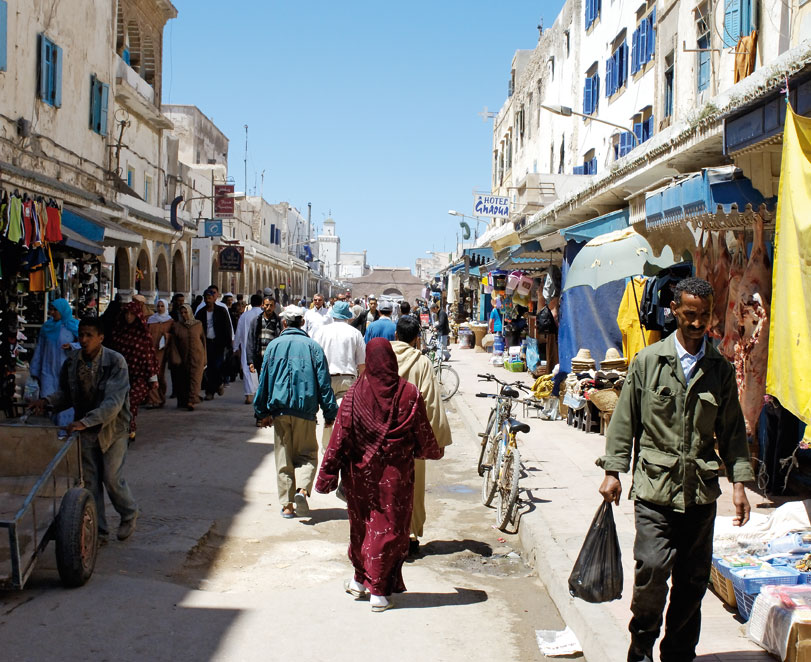
When walking through the souks in the medinas (old Arab quarters) in Morocco, one feels transported to the Middle Ages. The buildings, the wares on sale, the jumble of shops and stalls, donkeys carrying loads or pulling carts, the water sellers – each sight accentuates the time warp.
Some of the shops that line the passages of the medinas are as small as a large closet, while others are of grander proportions. Among the rows of fresh produce, you might find itinerant traders with their produce spread on a cloth or displayed in baskets, with brass scales at the ready. The fresh meat sellers have lamb, beef, camel and goat meat on display. Spice shops and stalls, and fresh mint sellers add fragrance to the potpourri of aromas and – yes – smells. Smells from the live chickens, rabbits and pigeons permeate the souks. Shoppers move purposefully, haggling for the best price; the shouting, the clatter of cartwheels on cobbled streets – all combine to make shopping in the souk an experience to remember.
