Visit www.dummies.com/cheatsheet/asvab to view this book's cheat sheet.
Table of Contents
Introduction
About This Book
Conventions Used in This Book
What You’re Not to Read
Foolish Assumptions
How This Book Is Organized
Part I: Making Sense of the ASVAB
Part II: Words to Live By: Communication Skills
Part III: Making the Most of Math:Arithmetic Skills
Part IV: The Whole Ball of Facts: Technical Skills
Part V: Practice ASVAB Exams
Part VI: The Part of Tens
Appendixes, ASVAB For Dummies Online, and the CD
Icons Used in This Book
Where to Go from Here
Part I: Making Sense of the ASVAB
Chapter 1: Putting the ASVAB under a Microscope
Knowing Which Version You’re Taking
Mapping Out the ASVAB Subtests
Deciphering ASVAB Scores
Defining all the scores
Understanding the big four: Your AFQT scores
Do-Over: Retaking the ASVAB
U.S. Army retest policy
U.S. Air Force retest policy
U.S. Navy retest policy
U.S. Marine Corps retest policy
U.S. Coast Guard retest policy
Chapter 2: Knowing What It Takes to Get Your Dream Job
Eyeing How ASVAB Scores Determine Military Training Programs and Jobs
Understanding How Each Branch Computes Line Scores
Line scores and the Army
Line scores and the Navy and Coast Guard
Line scores and the Marine Corps
Line scores and the Air Force
Chapter 3: Getting Acquainted with Test-Taking and Study Techniques
Taking the Test: Paper or Computerized?
Writing on hard copy: The advantages and disadvantages of the paper version
Going paperless: The pros and cons of the computerized test
Tackling Multiple-Choice Questions
When You Don’t Know an Answer: Guessing Smart
Studying and Practicing for the ASVAB
Making Last-Minute Preparations: 24 Hours and Counting
Part II: Words to Live By: Communication Skills
Chapter 4: Word Knowledge
Grasping the Importance of Word Knowledge
Checking Out the Word Knowledge Question Format
Building Words from Scratch: Strategies to Help You Decipher Word Meanings
From beginning to end: Knowing prefixes and suffixes
Determining the root of the problem
Word families: Finding related words
Ying and Yang: Understanding Synonyms and Antonyms
You Are What You Speak: Improving Your Vocabulary, Improving Yourself
Reading your way to a larger vocabulary
Keeping a list and checking it twice
Crosswords: Making vocabulary fun
Sounding off by sounding it out
Chapter 5: Paragraph Comprehension
The Importance of Paragraph Comprehension for Military Jobs
Eyeing the Physique of the Paragraph Comprehension Subtest
Trying the Four Flavors of Comprehension Questions
Treasure hunt: Finding specific information
Cutting to the chase: Recognizing the main idea
If the shoe fits: Determining word meaning in context
Reading between the lines: Understanding implications
Do You Get My Point?
What’s the big idea? Determining the main idea in a paragraph
Extra, extra! Identifying subpoints
Analyzing What You’ve Read: Guessing at What the Writer Really Means
Faster than a Speeding Turtle: Tips for Slow Readers
Read more, watch less
Become a lean, mean word machine
Build your confidence
Test-Taking Tips for Reading and Gleaning
Chapter 6: All’s Well That Tests Well: Communication Practice Questions
Word Knowledge Practice Questions
Paragraph Comprehension Practice Questions
Part III: Making the Most of Math: Arithmetic Skills
Chapter 7: Mathematics Knowledge and Operations
Just When You Thought You Were Done with Vocab: Math Terminology
Operations: What You Do to Numbers
First things first: Following the order of operations
Completing a number sequence
Working on Both Sides of the Line: Fractions
Common denominators: Preparing to add and subtract fractions
Multiplying and reducing fractions
Dividing fractions
Converting improper fractions to mixed numbers . . . and back again
Expressing a fraction in other forms: Decimals and percents
Showing comparisons with ratios
A Powerful Shorthand: Writing in Scientific Notation
Getting to the Root of the Problem
Perfect squares
Irrational numbers
Other roots
An Unknown Quantity: Reviewing Algebra
Solving for x
When all things are equal: Keeping an algebra equation balanced
Explaining exponents in algebra
A step back: Factoring algebra expressions to find original numbers
Making alphabet soup: Solving quadratic equations
All math isn’t created equal: Solving inequalities
Looking at Math from a Different Angle: Geometry Review
Outlining angles
Pointing out triangle types
Back to square one: Quadrilaterals
Going around in circles
Filling ’er up: Calculating volume
Test-Taking Techniques for Your Mathematical Journey
Knowing what the question is asking
Figuring out what you’re solving for
Solving what you can and guessing the rest
Using the process of elimination
Chapter 8: Reasoning with Arithmetic: Math Word Problems
Tackling the Real World of Word Problems
Reading the entire problem
As plain as the nose on a fly: Figuring out what the question is asking
Digging for the facts
Setting up the problem and working your way to the answer
Reviewing your answer
The Guessing Game: Putting Reason in Your Guessing Strategy
Using the process of elimination
Solving what you can and guessing the rest
Making use of the answer choices
Chapter 9: Brother, Can You Spare an Equation? Arithmetic Practice Questions
Arithmetic Reasoning (Math Word Problems) Practice Questions
Math Knowledge Practice Questions
Part IV: The Whole Ball of Facts: Technical Skills
Chapter 10: General Science
There’s a Scientific Method to the Madness
Understanding Forms of Measurement
Doing the metric thing
Figuring temperature conversions
Another Day, Another Science: Scientific Disciplines You Should Know
Uncovering Biology, from Big to Small
Relating to your world through ecology
Categorizing Mother Nature
Perusing the human body systems
Thinking small: A look at cells
Swimming in the gene pool: Genetics
Chemistry: Not Blowing Up the Lab
Understanding the elements, my dear Watson
Sitting down at the periodic table
Getting physical: Changing states
Causing a chemical reaction
Where Few Have Gone Before: Astronomy
Taking a quick glimpse at the sun
Knowing the planets
Shooting for the moons
Watching for meteors, comets, and asteroids
Down to Earth: Rocking Out with Geology and Meteorology
Peeling back the layers of the planet
Outta this world: Checking the atmosphere
Warming up to cold fronts
Classifying clouds
Improving Your Chances on the General Science Subtest
Using common sense to make educated guesses
Getting back to your Latin roots
Chapter 11: Auto & Shop Information
Checking under the Hood
The engine: Different strokes
Cooling system: Acting cool, staying smooth
Electrical and ignition systems: Starting up
Drive system: Taking it for a spin
Brake system: Pulling out all the stops
Emissions-control systems: In layman’s terms, filters
Picking Up the Tools of the Trade
Striking tools
Fastening tools
Cutting tools
Drilling, punching, and gouging tools
Finishing tools
Clamping tools
Measuring tools
Leveling and squaring tools
Sticking Materials Together with Fasteners
Nails
Screws and bolts
Nuts and washers
Rivets
Building a Better Score
Chapter 12: Mechanical Comprehension
Understanding the Forces of the Universe
He hit me first! The basics of action and reaction
Equilibrium: Finding a balance
Under pressure: Spreading out the force
Looking at kinds of forces
You Call That Work?!
Overcoming resistance
Gaining power by working more quickly
Relying on Machines to Help You Work
Using levers to your advantage
Ramping up the inclined plane
Easing your effort: Pulleys and gears
Multiplying your effort: Wheels and axles
Getting a grip on things with vises
Magnifying your force with liquid: Hydraulic jacks
Working Your Way to a Better Test Score
Using your observations and common sense
Using the mathematics of mechanics
Guessing with a mechanical mind
Chapter 13: Electronics Information
Uncovering the Secrets of Electricity
Measuring voltage: Do you have the potential?
Examining the current of the electrical river
Resistance: Slowing the electrical river
Measuring power
Getting around to circuits
Producing electrical effects
Switching Things Up with Alternating and Direct Current
Figuring out frequency
Impedance: Join the resistance!
Rectifying the situation: Going direct
Turning up the old transistor radio
Picture It: Decoding Electrical Circuit Codes
Eyeing Some Electronic Information Test Tips
Memorizing simple principles
Playing the guessing game
Chapter 14: Assembling Objects
Getting the Picture about Assembling Objects
Two Types of Questions for the Price of One
Putting slot A into tab B: Connectors
Solving the jigsaw puzzle: Shapes
Tips for the Assembling Objects Subtest
Comparing one piece or point at a time
Visualizing success: Practicing spatial skills ahead of time
Chapter 15: Facing the Facts: Technical Skills Practice Questions
General Science Practice Questions
Auto & Shop Information Practice Questions
Mechanical Comprehension Practice Questions
Electronics Information Practice Questions
Assembling Objects Practice Questions
Part V: Practice ASVAB Exams
Chapter 16: Practice Exam 1
Chapter 17: Practice Exam 1: Answers and Explanations
Subtest 1: General Science Answers
Subtest 2: Arithmetic Reasoning Answers
Subtest 3: Word Knowledge Answers
Subtest 4: Paragraph Comprehension Answers
Subtest 5: Mathematics Knowledge Answers
Subtest 6: Electronics Information Answers
Subtest 7: Auto & Shop Information Answers
Subtest 8: Mechanical Comprehension Answers
Subtest 9: Assembling Objects Answers
Chapter 18: Practice Exam 2
Chapter 19: Practice Exam 2: Answers and Explanations
Subtest 1: General Science Answers
Subtest 2: Arithmetic Reasoning Answers
Subtest 3: Word Knowledge Answers
Subtest 4: Paragraph Comprehension Answers
Subtest 5: Mathematics Knowledge Answers
Subtest 6: Electronics Information Answers
Subtest 7: Auto & Shop Information Answers
Subtest 8: Mechanical Comprehension Answers
Subtest 9: Assembling Objects Answers
Chapter 20: Practice Exam 3
Chapter 21: Practice Exam 3: Answers and Explanations
Subtest 1: General Science Answers
Subtest 2: Arithmetic Reasoning Answers
Subtest 3: Word Knowledge Answers
Subtest 4: Paragraph Comprehension Answers
Subtest 5: Mathematics Knowledge Answers
Subtest 6: Electronics Information Answers
Subtest 7: Auto & Shop Information Answers
Subtest 8: Mechanical Comprehension Answers
Subtest 9: Assembling Objects Answers
Chapter 22: Practice AFQT Exam
Chapter 23: Practice AFQT Exam: Answers and Explanations
Subtest 1: Arithmetic Reasoning Answers
Subtest 2: Word Knowledge Answers
Subtest 3: Paragraph Comprehension Answers
Subtest 4: Mathematics Knowledge Answers
Part VI: The Part of Tens
Chapter 24: Ten Surefire Ways to Fail the ASVAB
Choosing Not to Study at All
Failing to Realize How Scores Are Used
Studying for Unnecessary Subtests
Losing Focus
Panicking Over Time
Deciding Not to Check the Answers
Making Wild Guesses or Not Guessing at All
Changing Answers
Memorizing the Practice Test Questions
Misunderstanding the Problem
Chapter 25: Ten Tips for Doing Well on the AFQT
As Soon as the Test Starts, Write Down What You’re Likely to Forget
Read All the Answer Choices before Deciding
Don’t Expect Perfect Word Matches
Read Passages before the Questions
Reread to Find Specific Information
Base Conclusions Only on What You Read
Change Percents to Decimals
Understand Inverses
Remember How Ratios, Rates, and Scales Compare
Make Sure Your Answers Are Reasonable
Chapter 26: Ten Ways to Boost Your Math and English Skills
Practice Doing Math Problems
Put Away Your Calculator
Memorize the Order of Operations
Know Your Geometry Formulas
Keep a Word List
Study Latin and Greek
Use Flashcards
Read More, Watch TV Less
Practice Finding Main and Supporting Points
Use a Study Guide
Appendix A: Matching ASVAB Scores to Military Jobs
Appendix B: About the CD and Online Content
Practice tests and question sets
Vocabulary flashcards
Articles
Cheat Sheet
Download CD/DVD Content
Chapter 1
Putting the ASVAB under a Microscope
In This Chapter
 Checking out the different versions of the ASVAB
Figuring out what each subtest covers
Computing the Armed Forces Qualification Test (AFQT) score
Taking the ASVAB again
The Armed Services Vocational Aptitude Battery (ASVAB) consists of nine individual tests (ten for Navy applicants who test at a Military Entrance Processing Station, or MEPS) that cover subjects ranging from general science principles to vocabulary. Your ASVAB test results determine whether you qualify for military service and, if so, which jobs you qualify for. The ASVAB isn’t an IQ test. The military isn’t trying to figure out how smart you are. The ASVAB specifically measures your ability to be trained to do a specific job.
The famous Chinese general Sun Tzu said, “Know your enemy.” To develop an effective plan of study and score well on the ASVAB, it’s important to understand how the ASVAB is organized and how the military uses the scores from the subtests. This chapter describes the different versions of the ASVAB, the organization of the subtests, how the AFQT score is calculated, and the various service policies for retaking the ASVAB.
Knowing Which Version You’re Taking
The ASVAB comes in many flavors, depending on where and why you take it. You’d think that after more than 25 years in existence, the test could’ve been whittled down to a single version by now. But don’t get too confused about the different versions. Table 1-1 boils down the choices.

For people taking the enlistment version of the test, the vast majority of applicants are processed through a MEPS, where they take the computerized format of the ASVAB (called the CAT-ASVAB, short for computerized-adaptive testing ASVAB), undergo a medical physical, and run through a security screening, many times all in one trip. However, applicants may instead choose to take the paper and pencil (P&P) version, which is generally given by non-MEPS personnel at numerous Mobile Examination Test (MET) sites located throughout the United States.
Mapping Out the ASVAB Subtests
The computerized format of the ASVAB contains ten separately timed subtests, with the Auto & Shop Information subtest split in two (also, one small subtest is geared to Coding Speed for a few Navy jobs; I don’t include this subtest in the practice tests in this book because very few people test for these jobs). The paper format of the test has nine subtests. The two formats differ in the number of questions in each subtest and the amount of time you have for each one. Table 1-2 outlines the ASVAB subtests in the order that you take them in the enlistment (computerized or paper) and student (paper only) versions of the test; you can also see which chapters to turn to when you want to review that content.

Deciphering ASVAB Scores
The Department of Defense is an official U.S. Government agency, so (of course) it can’t keep things simple. When you receive your ASVAB score results, you don’t see just one score; you see several. Figure 1-1 shows an example of an ASVAB score card used by high school guidance counselors (for people who take the student version — see “Knowing Which Version You’re Taking” for details).

Figure 1-1: A sample ASVAB score card used by high school guidance counselors.
Figure 1-2 depicts an example of an ASVAB score card used for military enlistment purposes.
So what do all these different scores actually mean? Check out the following sections to find out.
Defining all the scores
When you take a test in high school, you usually receive a score that’s pretty easy to understand — A, B, C, D, or F. (If you do really well, the teacher may even draw a smiley face on the top of the page.) If only your ASVAB scores were as easy to understand.
In the following list, you see how your ASVAB test scores result in several different kinds of scores:
 Raw score: This score is the total number of points you receive on each subtest of the ASVAB. Although you don’t see your raw scores on the ASVAB score cards, they’re used to calculate the other scores.
 You can’t use the practice tests in this book (or any other ASVAB study guide) to calculate your probable ASVAB score. ASVAB scores are calculated by using raw scores, and raw scores aren’t determined simply from the number of right or wrong answers. On the actual ASVAB, harder math questions are worth more points than easier questions.
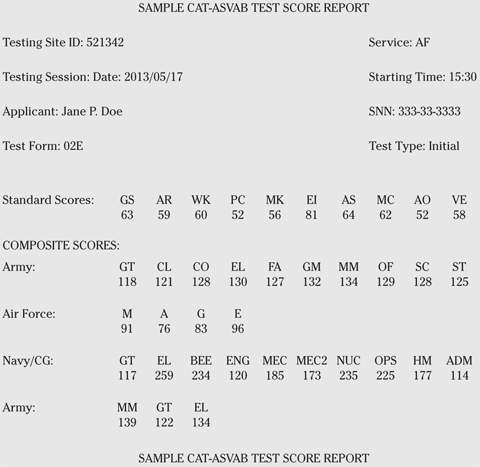
Figure 1-2: A sample ASVAB score card used for military enlistment purposes.
Standard scores: The various subtests of the ASVAB are reported on the score cards as standard scores. A standard score is calculated by converting your raw score based on a standard distribution of scores with a mean of 50 and a standard deviation of 10.
 Don’t confuse a standard score with the graded-on-a-curve score you may have seen on school tests — where the scores range from 1 to 100 with the majority of students scoring between 70 and 100. With standard scores, the majority score is between 30 and 70. That means that a standard score of 50 is an average score and that a score of 60 is an above-average score.
Percentile scores: These scores range from 1 to 99. They express how well you did in comparison with another group called the norm. On the student version’s score card, the norm is fellow students in your same grade (except for the AFQT score).
On the enlistment and student versions’ score cards, the AFQT score is presented as a percentile with the score normed using the 1997 Profile of American Youth, a national probability sample of 18- to 23-year-olds who took the ASVAB in 1997. For example, if you receive a percentile score of 72, you can say you scored as well as or better than 72 out of 100 of the norm group who took the test. (And by the way, this statistic from 1997 isn’t a typo. The ASVAB was last “re-normed” in 2004, and the sample group used for the norm was those folks who took the test in 1997.)
Composite scores (line scores): Composite scores are individually computed by each service branch. Each branch has its own particular system when compiling various standard scores into individual composite scores. These scores are used by the different branches to determine job qualifications. Find out much more about this in Chapter 2.
Understanding the big four: Your AFQT scores
The ASVAB doesn’t have an overall score. When you hear someone say, “I got an 80 on my ASVAB,” that person is talking about the Armed Forces Qualification Test (AFQT) score, not an overall ASVAB score. The AFQT score determines whether you qualify even to enlist in the military, and only four of the subtests are used to compute it:
Word Knowledge (WK)
Paragraph Comprehension (PC)
Arithmetic Reasoning (AR)
Mathematics Knowledge (MK)
Doing well on some of the other subtests is a personal-choice type of issue. Some of the subtests are used only to determine the jobs you qualify for. (See Chapter 2 for information on how the military uses the individual subtests.)
 Figure out which areas to focus on based on your career goals. If you’re not interested in a job requiring a score on the Mechanical Comprehension subtest, you don’t need to worry about doing well on that subtest. So as you’re preparing for the ASVAB, remember to plan your study time wisely. If you don’t need to worry about mechanics, don’t bother with that chapter in this book. Spend the time on Word Knowledge or Arithmetic Reasoning. Keep in mind, though, if you don’t have a desired job or aren’t sure about your options, it’s best to study this book and take the practice tests, focusing on all areas of the ASVAB. Doing well on each subtest will broaden your available job choices and make you a more desirable candidate.
Calculating the AFQT score
The military brass (or at least its computers) determines your AFQT score through a very particular process:
1. Add the value of your Word Knowledge score to your Paragraph Comprehension score.
2. Convert the result of Step 1 to a scaled score, ranging from 20 to 62.
This score is known as your Verbal Expression or VE score.
3. To get your raw AFQT score, double your VE score and then add your Arithmetic Reasoning (AR) score and your Mathematics Knowledge (MK) score to it.
The basic equation looks like this:
Raw AFQT Score = 2VE + AR + MK
4. Convert your raw score to a percentile score, which basically compares your results to the results of thousands of other ASVAB test-takers.
For example, a score of 50 means that you scored better than 50 percent of the individuals the military is comparing you to.
Looking at AFQT score requirements for enlistment
AFQT scores are grouped into five main categories based on the percentile score ranges in Table 1-3. Categories III and IV are divided into subgroups because the services sometimes use this chart for internal tracking purposes, enlistment limits, and enlistment incentives. Based on your scores, the military decides how trainable you may be to perform jobs in the service.
|
Table 1-3 AFQT Scores and Trainability
|
|
Category
|
Percentile Score
|
Trainability
|
|
I
|
93–99
|
Outstanding
|
|
II
|
65–92
|
Excellent
|
|
III A
|
50–64
|
Above average
|
|
III B
|
31–49
|
Average
|
|
IV A
|
16–30
|
Below average
|
|
IV B
|
10–15
|
Not trainable
|
|
V
|
0–9
|
Not trainable
|
The U.S. Congress has directed that the military can’t accept Category V recruits or more than 4 percent of recruits from Category IV. If you’re in Category IV, you must have a high school diploma to be eligible for enlistment. Even so, if you’re Category IV, your chances of enlistment are small and mostly limited to the Army National Guard.
Depending on whether you have a high school diploma or a GED, the military has different AFQT score requirements. Check out Table 1-4.

The Navy has been known to raise its minimum AFQT requirements to 50 for females (just to qualify for enlistment) when it receives too many female applicants. Because of the limited number of females that it can house on ships, the Navy restricts the number of women who can enlist each year.
Checking out the military’s AFQT requirements for special programs
Achieving the minimum required AFQT score established by an individual branch gets your foot in the door, but the higher you score, the better. For example, if you need a medical or criminal history waiver in order to enlist, the military personnel who make those decisions are more likely to take a chance on you if they think you’re a pretty smart cookie than if you barely made the minimum qualifying score.
Individual branches of the military tie many special enlistment programs to minimum AFQT scores:
Army: The Army requires a minimum AFQT score of 50 to qualify for most of its incentive programs, such as a monetary enlistment bonus, the college-loan repayment program, and the Army College Fund.
Marine Corps: Like the Army, the Marine Corps requires a minimum AFQT score of 50 for most of its incentive programs, including the Geographic Area of Choice Program, the Marine Corps College Fund, and enlistment bonuses.
Navy: Applicants who want to participate in the Navy College Fund or college loan repayment program need to achieve a minimum score of 50.
Enlistment programs are subject to change without notice based on the current recruiting needs of the service. Your recruiter should be able to give you the most up-to-date information. Or visit usmilitary.about.com.
If you don’t know which kind of job you want to do in the military, the ASVAB helps you and the military determine your potential ability for different types of jobs. If you’re in this situation, review all the chapters in this book, brushing up on the basic principles of everything from science to electronics, but focus on the four subtests that enable you to qualify for enlistment: Word Knowledge, Paragraph Comprehension, Arithmetic Reasoning, and Mathematics Knowledge. Following this plan ensures a relatively accurate appraisal of your aptitude for various military jobs.
Do-Over: Retaking the ASVAB
An AFQT score of less than 10 is a failing score, but no branch of the service accepts that low of a score anyway. Therefore, you can fail to achieve a score high enough to enlist in the service branch you want, even if you pass the ASVAB. This means you need to work on one (or more) of the four core areas: Mathematics Knowledge, Arithmetic Reasoning, Paragraph Comprehension, and Word Knowledge. Parts II and III of this book are specifically designed to help you improve your scores on these four subtests.
When you’re sure that you’re ready, you can apply (through your recruiter) to take the ASVAB. After you take an initial ASVAB (taking the ASVAB in high school does count for retest purposes), you can retake the test after one month. After the first retest, you must again wait one month to test again. From that point on, you must wait at least six months before taking the ASVAB again.
You can’t retake the ASVAB on a whim or whenever you simply feel like it. Each of the services has its own rules concerning whether it allows a retest, and I explain them in the following sections.
ASVAB tests are valid for two years, as long as you aren’t in the military. In most cases, after you join the military, your ASVAB scores remain valid as long as you’re in. In other words, except in a few cases, you can use your enlistment ASVAB scores to qualify for retraining years later.
U.S. Army retest policy
The Army allows a retest in one of the following instances:
The applicant’s previous ASVAB test has expired.
The applicant failed to achieve an AFQT score high enough to qualify for enlistment.
Unusual circumstances occur, such as if an applicant, through no fault of his own, is unable to complete the test.
Army recruiters aren’t authorized to have applicants retested for the sole purpose of increasing aptitude area scores to meet standards prescribed for enlistment options or programs.
U.S. Air Force retest policy
For the U.S. Air Force, the intent of retesting is for an applicant to improve the last ASVAB scores so the enlistment options increase. Before any retest is administered, the recruiting flight chief must interview the applicant in person or by telephone and then give approval for the retest.
Here are a few other policies to remember:
The Air Force doesn’t allow retesting for applicants after they’ve enlisted in the Delayed Entry Program (DEP).
Current policy allows retesting of applicants who aren’t holding a job/aptitude area reservation and/or who aren’t in DEP but already have qualifying test scores.
Retesting is authorized when the applicant’s current line scores (mechanical, administrative, general, and electronic) limit the ability to match an Air Force skill with his or her qualifications.
U.S. Navy retest policy
The Navy allows retesting of applicants
Whose previous ASVAB tests have expired
Who fail to achieve a qualifying AFQT score for enlistment in the Navy
In most cases, individuals in the Delayed Entry Program (DEP) can’t retest. One notable exception is the Navy’s DEP Enrichment Program.
U.S. Marine Corps retest policy
The Marine Corps authorizes a retest if the applicant’s previous test is expired. Otherwise, recruiters can request a retest if the initial scores don’t appear to reflect the applicant’s true capability, considering the applicant’s education, training, and experience.
For the Marine Corps, the retest can’t be requested solely because the applicant’s initial test scores didn’t meet the standards prescribed for enlistment options or programs.
U.S. Coast Guard retest policy
For Coast Guard enlistments, six months must have elapsed since an applicant’s last test before he or she may retest solely for the purpose of raising scores to qualify for a particular enlistment option.
The Coast Guard Recruiting Center may authorize retesting after one calendar month has passed from an initial ASVAB test if substantial reason exists to believe the initial test scores or subtest scores don’t reflect an applicant’s education, training, or experience.


 This icon points out information that is interesting, enlightening, or in-depth but that isn’t necessary for you to read.
