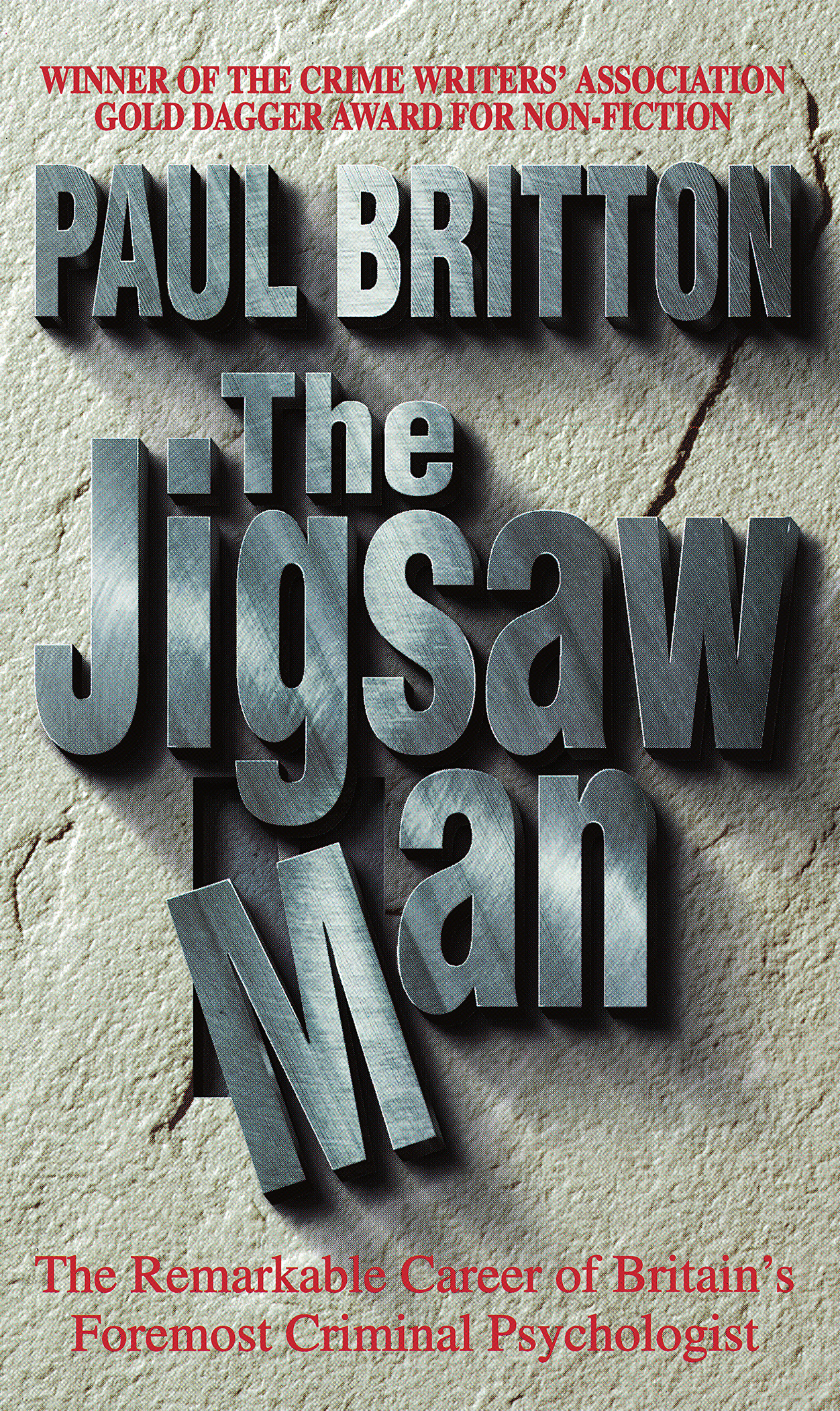
Forensic psychologist Paul Britton asks himself four questions when he is faced with a crime: what has happened; who is the victim; how was it done; and why? Only when he has the answers to these questions can he address the fifth: who is responsible?
Paul Britton has assisted the police in over a hundred cases and has an almost mythic status in the field of crime deduction. His achievements read as though from the pages of Conan Doyle or Agatha Christie. What he searches for at the scene of the crime are not fingerprints, fibres or bloodstains – he looks for the ‘mind trace’ left behind by those responsible: the psychological characteristics that can help the police to identify and understand the nature of the perpetrator.
The Jigsaw Man is not only a detective story involving some of the most high-profile cases of recent years, but also a journey of discovery into the darkest recesses of the human mind to confront the question ‘Where does crime come from?’
Cover
About the Book
Title Page
Dedication
Acknowledgements
Epigraph
Author’s Note
Chapter 1
Chapter 2
Chapter 3
Chapter 4
Chapter 5
Chapter 6
Chapter 7
Chapter 8
Chapter 9
Chapter 10
Chapter 11
Chapter 12
Chapter 13
Chapter 14
Chapter 15
Chapter 16
Chapter 17
Chapter 18
Chapter 19
Chapter 20
Chapter 21
Chapter 22
Chapter 23
Chapter 24
Chapter 25
Index
About the Author
Also by Paul Britton
Copyright
TRANSWORLD PUBLISHERS
61–63 Uxbridge Road, London W5 5SA
www.penguin.co.uk
Transworld is part of the Penguin Random House group of companies
whose addresses can be found at global.penguinrandomhouse.com.

First published in Great Britain in 1997 by Bantam Press
an imprint of Transworld Publishers
Copyright © Paul Britton 1997
Paul Britton has asserted his right under the Copyright, Designs and Patents Act 1988 to be identified as the author of this work.
This book is a work of fiction and, except in the case of historical fact,
any resemblance to actual persons, living or dead, is purely coincidental.
Every effort has been made to obtain the necessary permissions with reference to copyright material, both illustrative and quoted. We apologize for any omissions in this respect and will be pleased to make the appropriate acknowledgements in any future edition.
A CIP catalogue record for this book
is available from the British Library.
Version 1.0 Epub ISBN 9781446497548
ISBN 9780552144933
This ebook is copyright material and must not be copied, reproduced, transferred, distributed, leased, licensed or publicly performed or used in any way except as specifically permitted in writing by the publishers, as allowed under the terms and conditions under which it was purchased or as strictly permitted by applicable copyright law. Any unauthorized distribution or use of this text may be a direct infringement of the author’s and publisher’s rights and those responsible may be liable in law accordingly.
1 3 5 7 9 10 8 6 4 2
I dedicate The Jigsaw Man to two groups of people and an individual who have irrevocably touched my life.
The victims of the crimes I have investigated, whose fear and pain can never be entirely escaped.
The operational police officers who have to try to put their own feelings aside during the working shift, and to be ordinary family men and women when they go home.
Marilyn has always been there, I hope she always will be. She can’t have entirely escaped either.
Paul Britton was born in 1946. Following degrees obtained in psychology from Warwick and Sheffield Universities, he has spent the last twenty years working as a consultant clinical and forensic psychologist, based in Leicestershire. He has advised the Association of Chief Police Officers Crime Committee on offender profiling for many years and currently teaches postgraduates in clinical and forensic psychology. He has a growing involvement in the treatment of young offenders, forensic dysfunctional families and traumatized victims of crime and military services. He is married with two children. He is the author of The Jigsaw Man and Picking Up the Pieces.
Through many criminal and other difficult, sensitive cases I have worked with the most able and far-seeing investigators of their day. They have each contributed to changing the ways in which information is gathered, analysed and acted upon. I pay particular tribute to:
Detective Chief Superintendent David Baker, Commander John Grieve, Commander David Tucker, Detective Superintendent Bob Taylor, Assistant Chief Constable Tom Cook, Detective Chief Superintendent Mick Jenkins, Detective Superintendent Harry Shepherd, Detective Superintendent Ian Johnston, Superintendent Ian Gordon, Detective Chief Superintendent Duncan Bailey, Detective Chief Superintendent Brendon Gibb-Grey, Chief Constable John Stevens, Detective Inspector Keith Pedder, ‘Lizzie James’, Detective Superintendent Micky Banks, Detective Inspector John Pearse, Detective Superintendent Albert Kirby, Detective Superintendent John Bennet, Detective Chief Superintendent Colin Port, Detective Superintendent Tony Bayliss and Detective Inspector Gino Varriale. With the FBI, Judd Ray, Greg Cooper, ‘Roy’ Hazelwood and John Douglas.
When times were difficult Paul Jackson, Julian Boon and Sarah Lewis turned out to be good friends and effective colleagues.
Ursula Mackenzie, Bill Scott-Kerr, Garry Prior, Patrick Janson-Smith, Larry Finlay and Alison Barrow at Transworld, and Michael Robotham and Mark Lucas at LAW, gave the perfect balance of encouragement and pressure necessary to see the book completed.
Diane Purves, my NHS secretary, has helped to ensure that my clinical work stayed on track when I attended to criminal cases.
It is probably not possible to have been immersed in these cases without collecting some personal damage. I have found unfailing love and renewal of my emotional and intellectual life in my family, Mal, and Emma and Rufus, and Ian and Katherine.
Finally I acknowledge those other men and women who cannot be named for reasons of confidentiality and security. You know who you are – good luck. Don’t ever stop, darkness will overtake us all if you do.
‘… Let us meet, and question this most bloody piece of work,
To know it further. Fears and scruples shake us.
In the great hand of God I stand, and thence
Against the undivulg’d pretence I fight …’
I have selected the particular cases reported in The Jigsaw Man because they show the beginnings and development of professional psychology used in the investigation of crime, and also because the fact of my involvement in each is public knowledge, with the outcome of the judicial process known. I will not discuss those cases, in the public or the private sector, where secrecy remains important.
Occasionally details of crimes or the investigative process have been obscured. This is to protect witnesses, victims, or a continuing investigation and to avoid showing would-be offenders how not to be caught.
Details which would identify individuals mentioned in the clinical cases have all been altered, except where these are a matter of public record.
ON TUESDAY MORNING, 22 November, 1983, I looked out my office window, across the terrace and the unkempt garden to the fields beyond, and saw a strange procession. Dozens of men emerged from the trees, shuffling forward in a long unbroken line. Clouds of condensed vapour billowed from their faces almost like speech bubbles that dispersed and reformed with each breath.
Occasionally, someone in the line would stop and squat near to the ground. The rest would pause, waiting and leaning a little closer to the frozen grass and mud. Although wrapped up against the cold, I saw no warmth in their faces or delight in their task.
‘What are they doing?’ asked Anne Chalmers, a secretary in the psychology department.
‘They look like policemen,’ I said.
‘Mmm.’
She slipped into silence and we watched together at the window, wondering what had brought the police to our doorstep; to Carlton Hayes Psychiatric Hospital in Narborough, Leicestershire.
The large Edwardian hospital was the dominating landmark for miles around, rising out of farmland between several picturesque villages in the East Midlands. When it was built between 1905 and 1907, as the county asylum, the journey by carriage or horseback from the surrounding market towns must have seemed like a trip to the middle of nowhere. In those days, all the surrounding farmland was owned by the hospital and worked by the patients so that the institution was virtually self-sufficient. But it could never shed the image of madness that haunts all such asylums and makes them places to be feared by locals, particularly children. Perhaps this is why the name was changed in 1938 from the Leicestershire and Rutland Lunatic Asylum.
Yet Carlton Hayes wasn’t an intimidating or frightening place. Once inside the main gate a visitor was immediately struck by the sense of space and tranquillity as the road swung past the gatehouse, car-park, bowling green, cricket pitch and flower-beds before reaching the main body of the hospital. The larger buildings were fashioned from red brick with steeply pitched slate rooves and two massive brick chimneys that could be seen for miles around.
I remembered my first visit, five years earlier, when I’d arrived to be interviewed for a traineeship as a clinical psychologist. Despite having been an honorary trainee for six months, I was still daunted by the sight of Carlton Hayes. The broad stone steps, oak doors, reception room and administrative corridor looked like something from an old town hall. The floors echoed and the oak doors swung on heavy hinges, with polished brass handles worn by years of turning.
The boardroom was lined with paintings of past incumbents, with their mutton-chop sideburns and stiffened collars. In the early days we could hold our departmental meetings around one end of the table but in later years the department expanded to fill the table.
I took up the post in October, 1978, and for the next three years began dealing with a broad range of patients and psychological problems. Much of my work was with out-patients at the Woodlands Day Hospital, a large country house with seven or eight bedrooms, about a quarter of a mile from the main hospital buildings. I also worked in the acute unit – a small four-ward section of the hospital where patients would be treated intensively for a few months before being discharged or moved into the longer-stay wards.
Most of the in-patients needed long term care, being psychogeriatrics who suffered from atrophy of the frontal cortex or from depression, or were younger men and women having severe psychiatric illnesses such as schizophrenia. I rarely had cause to visit the wards where the elderly patients with dementia were cared for, but am destined to never forget the wall of smell that overwhelmed everything else in those back wards. Over the decades it seemed that urine had seeped into the fabric of the building so that no matter how much it was scrubbed and polished, the smell would never go away.
Thankfully, the psychology department was set away from the main hospital buildings in a former medical superintendent’s house known as The Rosings. The two-storey red-brick house had a large bay window overlooking a small stone terrace where we’d often sit and have lunch, opening a bottle of wine and watching the hares forage in the nearby fields.
Now there were heavier feet shuffling across the feudal farming strips and icy earth. Throughout the day, the police criss-crossed the fields and gathered beneath the trees deep in discussion. Being isolated at The Rosings, it was mid-afternoon before I learned the reason for their search.
‘It’s a girl,’ said Anne Chalmers, obviously upset. ‘She’s been murdered.’
‘Murdered? Where?’
‘One of our porters found her this morning on his way to work. She was lying beside the Black Pad.’
I’d never used the black cinder pathway, although I passed the entrance every day on my way to work. It ran along the perimeter of Carlton Hayes and acted as a shortcut between the village of Narborough immediately to the south and Enderby to the north, a walk of about fifteen minutes.
‘Do you know who she is?’ I asked.
‘A local girl, a teenager.’
Suddenly I thought of my own daughter, Emma. She’d be on her way home from school about now and then she’d take Jess, our white retriever, for a run in the fields before it grew dark. Like many fathers I was protective, but Emma had walked home from school ever since she was a youngster.
‘Who’d do such a thing?’ asked Anne, getting more upset.
They’ll think it’s someone from here, I thought to myself. It would be a natural reaction – but the wrong one. Carlton Hayes didn’t house violent or dangerous patients; most of them were so elderly and infirm that they needed assistance to go to the bathroom. The acute patients were well-known and at the Woodlands Day Hospital we were treating neurotic and anxious people who were unable to cope with the vagaries of life that sometimes overwhelmed them. They weren’t seriously aggressive or violent.
That night, I watched the early evening news on television.
‘Detectives are investigating the murder of a fifteen-year-old schoolgirl whose partially clad body was found this morning beside a footpath near the village of Narborough, in the grounds of Carlton Hayes Psychiatric Hospital.
‘Lynda Mann, a local teenager last seen alive at about 7.30 p.m. on Monday, was discovered early today beside a local footpath known as the Black Pad. Detectives immediately sealed off the area and began tracing the girl’s last movements. The cause of death has not been revealed.’
A photograph showed a slightly built, dark-haired girl with a shy smile who didn’t seem big enough to fill her clothes.
In November 1983, I’d just been appointed as a senior clinical psychologist by the Leicestershire Health Authority, moving my office into the newly opened mental illness unit at Leicester General Hospital. I still visited Carlton Hayes to see out-patients at The Rosings and day-patients at The Woodlands.
As I expected, Carlton Hayes became an early focus of police interest, although I hadn’t expected them to take up residence next door. An unoccupied section of The Rosings became an incident room and the murder squad brought in filing cabinets, white boards and index cards.
What were they doing for furniture? I wondered. A few years earlier, when we’d first moved into The Rosings, we had begged, borrowed and eventually had to steal basic necessities such as chairs and lamps. The hospital administration had given us virtually nothing but I’d peered through a locked window in the disused half of The Rosings and spied everything we needed covered in dust.
‘Can we have some of that?’ I asked the Estates Department.
‘Well, no … ah, that’s already been earmarked …’
‘Where’s it going?’
‘Ah, well, I can’t say.’
Enough of this, I thought. There were four psychologists in the department, three men and a woman; all of us about the same age and eager to accomplish something.
‘So we’re all in it together,’ I said, as we agreed the plan.
‘But it’s stealing,’ said Russel, nervously.
‘No, not at all,’ I reassured him, ‘we’re only relocating resources so as to optimize their usefulness.’
Russel said, ‘So we’re not breaking any locks or windows … I mean, I don’t want to break any …’
‘Leave it to me.’
Shouldering a ladder from the orchard, I carried it upstairs and pushed open the loft hatch. It was pitch-black inside the roof and I gingerly edged forwards careful to stay on the beams to stop crashing through the ceiling.
Finding another hatch, I prised it open and lowered the ladder down into the unoccupied half of the house – a veritable Aladdin’s Cave of disused furniture and tableware. We couldn’t just walk out through the front door which was padlocked, but I found a large sash window at the back overlooking the garden which I unlocked and began passing stuff through. Over the next week we made four or five trips until we had what we needed apart from carpets.
In a different part of the hospital, the old nurses’ quarters, there were fine carpets lying unused, so we set about rectifying the problem. This called for a bolder approach. We agreed that three men and a woman, carrying two fifteen-foot-long carpets in daylight through a busy hospital, would probably succeed so long as we looked confident and no-one stopped us to ask questions.
It worked and I found myself with a rather comfortable office, despite the white-tiled walls which made it look like a urinal. No-one ever mentioned the missing items, although I couldn’t help feeling a slight pang of guilt when the murder squad moved next door.
The Lynda Mann inquiry became a constant in my life over the following weeks as I read the local newspapers and watched the TV news, seeing the numerous public appeals and poster campaigns. The incident room handled dozens of reported sightings and also searched through decades of local records, looking for past offences or offenders who might be linked. Two more police teams moved into the cricket pavilion, overlooking the hospital’s cricket pitch. One team concentrated on house-to-house inquiries in the surrounding villages; while the other dug into hospital records, trying to trace likely out-patients and day-patients who had passed through Carlton Hayes during the previous five years.
Although various theories emerged and a number of suspects were sought, by Christmas the murder squad seemed no closer to catching Lynda’s killer. Officers volunteered to keep the incident room open during the holidays and the Leicester Mercury ran a headline, ‘Please Help Trace This Maniac’.
Weeks later, I remember walking along Forest Road for a meeting at the Woodlands Day Hospital and suddenly I realized how long it had been since the murder. Looking towards the Black Pad, the remnants of black and yellow police tape twirled like forgotten Christmas decorations on the metal railings.
Why haven’t they caught someone? I wondered. Do they really understand what happened?
I began to think how a psychologist would approach it – a fanciful idea perhaps, but psychology is all about understanding people’s motivations and what makes us do the things we do. There were so many questions that I would ask that the police perhaps wouldn’t ordinarily consider.
On that lonely footpath, in the cold and dark, two people had come together and one of them had died. There must have been some kind of social interaction between them, however brief or violent. These two people had their own families, friends and histories. What they said to each other and how they reacted had been determined by who they were and what shaped their personalities.
People respond to the same situation in different ways. For example, you could take three young women through the same streets, into the same shops, restaurants and pubs and each could see the environment differently. One might see people laughing and enjoying themselves and think of them as potential friends. Another might look at these same people and think them hostile or likely to laugh at her or ridicule her. The third woman has a perfectly realistic view that these strangers are neither good nor bad and are just going about their lives.
These three women wear different clothes for different reasons and not just because certain styles suit them. Imagine the first woman is interested in attracting attention; she enjoys being looked at so wears clothes that catch the eye. The second woman tries to avoid this – she doesn’t want to stand out and is more careful and conservative. The third woman dresses to please herself and to make herself feel comfortable.
Each of them is different and will probably react to similar situations in a different way. None of this just happens. We are each the product of our pasts. When Lynda Mann walked along the Black Pad on that Monday night, she carried within her all the things that shaped her as a person and these things determined how she reacted when confronted by her killer. Did she run? Did she get angry? Was she passive?
In just the same way, I knew that her killer was more than a caricature or comic book villain. He also had a rich life which had shaped his personality and actions. What went through his mind, I wondered, when he saw Lynda? What did he see and why did he choose her? If he could do this to a young girl, what did he think of women in general? Was he likely to be intelligent? What sort of job would he do?
The wind tugged at my trouser turn-ups and sent leaves scurrying along the gutters and against the metal railings as I turned and walked away. Somewhere, still out there, Lynda Mann’s killer walked the streets, ate his lunch, showered, slept and probably had a beer at his local pub.
Within a few yards, my thoughts of Lynda had been pushed aside and I pondered my meeting. It wasn’t my concern, I thought. Psychologists didn’t get asked to help catch killers, that was the grim job of the police and I didn’t envy them.
A fortnight later, on 2 February, 1984, the coroner released Lynda’s body for burial and she was laid to rest in the cemetery of All Saints Church. Her headstone read:
LYNDA ROSE MARIE MANN
Taken 21st November 1983
Aged 15 years
We didn’t have time to say goodbye,
but you’re only a thought away.
THERE WAS NO single event or watershed that convinced me to become a psychologist. People often try to find triggers in their lives but invariably decisions or choices are the culmination of many small incidents and influences that come together or fall haphazardly into place.
As a teenager I had no interest in how things work mechanically. I didn’t dismantle old alarm clocks or marvel at the workings of the wireless in my mother’s kitchen. I had no particular interest in steam engines, model aeroplanes or the mechanical engineering experiments we performed at school.
Later, when I bought my first car, an old Standard 10 van with no second gear that cost me £39, my knowledge of what made the wheels turn was pathetically slim. I remember my wife, Marilyn, and I setting off on our first big outing to Wales to see her grandmother. The van’s top speed was 56 mph and we trundled along celebrating our new found freedom.
At some point on the Old Road just past Chepstow I noticed that the top speed was beginning to fall. Even with my foot flat on the floor I couldn’t coax more than 35 mph out of the van. When this continued falling into the twenties, I decided that it was time to find a garage. Initially I thought it might be a fuel problem. Maybe the top speed was dependent on how much petrol was in the tank – less petrol meant less speed.
A rather bored-looking mechanic with a flop of hair covering one eye climbed out of the grease pit, wiping his hands on a rag and sauntered across the forecourt to the van. I explained the problem, trying to sound authoritative about the workings of the internal combustion engine.
‘What about oil?’ he said.
‘Oil? Ah, well, I don’t think so. It doesn’t squeak. Have you heard any squeaks, Marilyn?’
She shook her head.
The mechanic looked at me strangely and asked Marilyn to pull the bonnet catch. I peered over his shoulder as he fiddled with several leads and examined the battery. Then he pulled out the dip-stick.
‘Look at this,’ he said, holding the gleaming stick aloft.
‘It looks very clean to me,’ I offered.
‘Clean? Listen, mate, you’ve got no oil.’
‘Is that a problem?’
I mention this episode not just to illustrate my ignorance of most things mechanical, but as a counterpoint to where my real interests lay. While machines held no fascination for me, I was intrigued by people and how their minds and bodies work; why we do the things we do and become the people we become.
A great many of these answers lie in our pasts and mine began in May 1946, the year after peace broke out in Europe. I was born and grew up in Royal Leamington Spa, a rather grand-sounding name for a town whose grandeur had passed a century earlier. Many of the guest-houses and hotels on the Victorian terraces that had once welcomed the great and the good who had come to sample the spa waters had since been converted into flats and boarding houses.
I can’t recall having a father – he’d gone by the time I was old enough to notice such things. Down the years I heard stories about him, not all of them flattering, but I never did hear his account. My earliest firm memory was growing up in a condemned basement room in Leamington. I don’t know why it had been condemned, perhaps because of rising damp or subsidence, but my mother made sure it was so spotless you could have eaten off the floor.
A devout Catholic all her life, she diligently took my younger brother, Anthony, and me to Mass each Sunday at St Peter’s Church, giving thanks for the help the church gave her in raising a family on her own.
During the week she did various jobs although the one I remember best is when she worked as an assistant nurse at an old people’s home. It sticks in my mind because of an ancient-looking resident called Mr Blower who I met one day during the school holidays when my mother brought him his lunch. He smelled of tobacco and old tea leaves and would sit in his slippers and dressing-gown, seeming to stare out of an imaginary window. He must have been in his eighties or nineties and I was about seven.
‘What’s your name?’ he asked me.
‘Paul, sir.’
‘Do you like pirates, Paul?’
‘I don’t know any pirates.’
‘What? None!’
‘What about explorers?’
I shook my head.
He sucked air through his teeth and looked right past me as if he’d forgotten our conversation in mid-sentence. But a few days later, my mother came home with some books.
‘These are from Mr Blower,’ she said.
They were the first real books in our household and I read them over and over. I still have them – Lost in the Wilds of Canada by Eleanor Stredder, The Swiss Family Robinson and Treasure Island by Robert Louis Stevenson, and The Wolf Hunters by James Oliver Curwood.
I suppose you could say it was the beginning of my lifelong love-affair with reading. Mr Blower continued to send me books until the day he couldn’t send any more. When I was old enough I joined the Leamington Library. By then we’d moved to a house in Lillington, an expanding village on the outskirts of Leamington, soon to be swallowed up by the town.
In between lay the Campion Hills which became my childhood playground. A single oak tree stood on top of the hills and from the great fork in the main branches I could look over the whole of the town and towards Warwick, the county seat, four or five miles away. The tree was a magical childhood place that became a castle, pirate ship or cavalry fort, depending upon the chosen game.
I didn’t regard our family as being poor or deprived. Some had more, some had less. Similarly, not having a father wasn’t particularly unusual, the war had seen to that. For this reason, I greeted the arrival of my stepfather with a degree of ambivalence. I was twelve years old at the time and didn’t see any great hole in my life that he would suddenly fill.
He was a Russian who had lost a wife and two daughters in the war. An avowed anti-Communist, he fought as a major in the Russian army and afterwards fled Stalin’s regime, walking from his homeland to Switzerland. Eventually he ended up in Warwickshire working as an engineer for the Ford motor company.
His ability to read English was limited – a source of frustration – but he could speak it quite well. Even so, he seemed to be a man who was horribly out of place. Having been well-educated, from quite possibly a wealthy family, with great technical skills and a history of commanding men in battle, he found himself mixing and working with people from totally different backgrounds. Even amongst the other émigrés from Eastern Europe, he seemed isolated because of his intelligence and former status.
Gaining a good education was rather a hit and miss affair at the local Catholic schools. The primary school served a wide catchment area and drew children from every social grouping, from well-to-do families to those who seemed to specialize in breeding savages. It was a harsh place, dreadful academically, where children moved through classes each year and teaching was a matter of child-minding as much as enlightenment.
I lost every nail on my fingers before the age of thirteen. Surprisingly, this had nothing to do with the rougher of my classmates. The person responsible was Mr Adams, a teacher who took a perverse pleasure in inflicting pain. His favoured means of punishment was to make a student put his fingers on the desk and then he’d use a piece of wooden dowelling, about two feet long, to whip down across the fingernails.
I wasn’t particularly singled out for this treatment. It reached the stage where any boy in the class who didn’t bear the tell-tale stigmata of blackened nails was reckoned to be the teacher’s pet.
Another of my junior school teachers would enliven spelling by making us stand with our hands held out and for every letter we got wrong in spelling a word he would swipe us with the sharp edge of a ruler. To this day, I do not spell as well as I might because of the fear he created.
If the standard of education was deplorable, the iniquities of the English education system made things worse. At the age of eleven, students had to take an exam known as the eleven-plus which would decide whether or not they went on to a grammar school or to a secondary modern school. One path opened up the possibility of going to university, the other prepared students for life outside.
I don’t know how other schools organized these exams, but my class was virtually segregated into children from wealthier families and others less well provided for. Because the grammar school required uniforms and there was an expectation that children would have cultural pursuits, it was felt that only those from the more wealthy families would have the wherewithal to support such an education.
These children were then kept in after school to be groomed and coached for the eleven-plus exam. Others, like myself, were left to fend for themselves. As expected, all of one group passed the examination while the rest of us looked at the paper and said, ‘What’s this?’
Thus, my future was decided and I was sent to a secondary modern school. There would be no O levels, or A levels. I was being prepared for life. The reality hit home one day when I stood at the front of a classroom and noticed that nearby a cupboard door had been left ajar. Peering inside I saw chemistry flasks, test tubes, Bunsen burners and stands – all of them a mystery to me.
I held up a test tube and asked the teacher, ‘What are these?’
‘Oh, put that back,’ he said. ‘You’ll never have need of those.’
Although I wouldn’t seek to rewrite my past, I think any system that decides the educational pathway of a child at the age of eleven is one of the greatest offences against the youngsters of the day.
Even as I left school, I realized that I wanted to go to university. It wasn’t clear quite how, but I planned to save enough money and eventually do my O levels and A levels. This notion of further study wasn’t entirely understood at home. My mother had grown up in a small village in Ireland and had very basic, straightforward priorities. A university education wasn’t among them and she was fearful and overly respectful towards scholars.
I can’t remember why I decided to become a police cadet – perhaps we had a couple of local bobbies who impressed me. In spite of once being carpeted by the local inspector for breaking a gas mantle in an old street lamp, I don’t actually recall there being any crime in Leamington when I was growing up. That’s the benefit of childhood memory. People didn’t bolt their doors or lock their cars; mothers left their babies in prams outside shops and children walked to school. Crime was something that happened in mystery stories or to other people.
Like most of us, I assumed real villains were easily recognizable. Conan Doyle and Charles Dickens drew them in my imagination – extraordinary figures like Moriarty and Bill Sykes. Of course, it’s not that simple in the real world.
I can pinpoint exactly when I realized that badness wasn’t worn like a badge, tattoo or scar. Having become a police cadet in Warwickshire, I was stationed at Leamington Police Station when, in the early hours of Thursday 8 August, 1963, fifteen masked men stopped the night train from Glasgow to London at Bridego Bridge near Leighton Buzzard and stole £2,631,684. It became known as The Great Train Robbery and caught the world’s imagination.
In policing terms it was like having a bucket of icy water thrown over you. A momentary numbness went through the whole system and people thought, Jesse James robs trains, it doesn’t happen here. There was a sense of affront and outrage, particularly when the newspapers portrayed it as a Robin Hood-style robbery – the money didn’t belong to anyone, it was going to be destroyed anyway and the thieves simply helped themselves, good luck to them. Unfortunately, the train driver Jack Mills had been severely beaten during the robbery and however romantic the heist may have seemed to the public, the police responded intensely to the violence done.
As a cadet I had almost no role in these events but I remember the telex machine clattering non-stop and sergeants who hadn’t been out from behind a desk in ten years suddenly on the move. When they released the first photographs of the wanted men a few days later, I stared at the faces of Bruce Reynolds, Charlie Wilson and Jimmy White and I thought, they look so ordinary. They could have been someone I grew up beside or the father of a friend, or local businessmen, shopkeepers, taxi drivers, school teachers … anyone except train robbers.
I found myself asking, ‘What happened to these ordinary-looking men which made them become who they are? How did they get here and what other choices did they have?’
The Kray twins were the same. I remember seeing early photographs of Ron and Reggie, wining and dining with sports stars and celebrities in East London. They looked like perfectly ordinary, successful men. Only later, when the photographs became more selective and people learned of their murderous careers, were they made to seem sinister.
Part of my job as a police cadet was to take meals from the café next door to people in the cells. I’d knock on the metal door and hand the tray through the slot.
‘Hello, Paul,’ said a familiar voice one night.
It was someone I’d been to school with, a few years ahead of me. Now he was locked up in the cells. What happened to him? I thought. What made him different from me?
I left the police force after a year but these questions stayed with me and were possibly part of the reason I became a psychologist. In the meantime, I began the first of a myriad of jobs – too many to remember, let alone name – that ranged from the shop floor to the boardroom and everything in between.
Although living at home, I enjoyed the freedom of earning money. When I bought my first pair of jeans – against my stepfather’s wishes – it was more than a fashion choice. I’d earned the money and the right to choose what I wore. ‘My house is full of teddy boys,’ he said, sighing in disgust.
Occasionally, I went to local dances and I remember one in particular towards the end of 1963 at the Locarno Ballroom in Coventry. A young lady seemed quite keen to dance with me all night and I didn’t take much notice of the band or its rather strange, gawky lead singer who kept jumping off the stage and running through the hall. It was Mick Jagger and The Rolling Stones.
A few weeks later, on 27 December, a former schoolmate convinced me to go to another dance at the Court School of Dancing in Leamington where Woody Allen and the Challengers were playing. I wasn’t very interested but he lent me a coat and I tagged along.
It was noisy and crowded inside but two girls stood out from the rest. I’d been to school with one of them, who’d become a nurse, but I didn’t know her friend. Tall and slender with dark brown hair, she wore a belted tartan pinafore dress and long sleeved white blouse. I couldn’t take my eyes off her and she blushed when I asked her to dance.
Afterwards I walked her home to the opposite end of town. It was a crystal clear night when the footpaths and hedgerows sparkled with frost. Outside her gate, she gave me a very shy peck on the cheek and I walked six miles to get home. With every step I told myself that I’d found the girl I was going to marry.
The wedding was in early June, 1966, and we honeymooned in Tenby in Wales, staying at a guest house on the coast and travelling by train. Then we moved into the first floor Victorian flat that I was renting in Leamington. Marilyn was a personal secretary at the University of Warwick and I continued my migratory job swapping, even spending time as a croupier in a casino in Birmingham until a policeman ‘advised’ me that it wasn’t a sensible career move for a young man.
When Emma arrived – and Ian two years later – we had a mortgage and a small three-bedroom semi which we both thought was wonderful. Any dreams of going to university were put on hold as I sometimes held down two jobs to make ends meet. Meanwhile, Marilyn dealt with everything at home. I earned the unenviable distinction of having only woken up twice during the night in the combined childhoods of both my issue. When I sleep, very little can wake me.
By the autumn of 1972 I was working as an export liaison officer at Automotive Products, an international motor car components company and the largest employer in town. My job was to ensure that my designated customers had the parts available when they were needed. It certainly wasn’t ‘a career’ and I could see the treadmill of working for someone else stretching out beneath my feet. I would never really take responsibility and could only hope that after forty years I would have enough to see me through retirement. I’d done all manner of jobs, some of them demanding but none fulfilling, and I knew that I had to find a career that would captivate and motivate me; something I would want to do for the rest of my life.
With Marilyn’s support, I enrolled at night school to do my O levels with the aim of going to university. It meant coming home from work, having a meal and then peddling my bicycle to ‘Thornbank’, the Mid-Warwickshire College of Further Education, to be there for 7.00 p.m. I’d come home at 9.30 p.m., start the study assignments and get to bed at midnight or one o’clock.
I sat the exams in the summer of 1973 and immediately began thinking about doing my A levels. Unfortunately, I discovered there were no evening classes at Thornbank for my subjects. I’d come too far to turn back, I was going to university to change things, so why not change them now, I thought. Making an appointment to see a senior director at work, I explained that I wanted to go to college during the day and asked if I could please have a job on nights.
I became the night clerk, working 8.00 p.m. to 8.00 a.m. four nights a week. The plan was to go to class during the day and then catch a few hours sleep before work and at weekends. At worst, it would only be for a year, I thought. But having changed my job, I went to Thornbank to enrol and discovered that the A level courses were taken over two years.
There was no point in arguing. I asked for a list of textbooks, went back home and began teaching myself during the day. My aim was to start university in October 1974, which meant sitting the A level exams within seven or eight months.
By January, I’d been provisionally offered a place to read law at Oxford and medicine at Birmingham, but both would mean moving house and getting a new mortgage without a job. The University of Warwick on the outskirts of Coventry, twelve miles away, emerged as a more attractive option; if they would take me.
‘Can I help you?’ asked the secretary, looking up from her typewriter. She had long straight hair and a perfectly horizontal fringe.
‘I’m looking for the admissions tutor, Dr Samuals,’ I said.
‘I think he’s probably having morning coffee but you can try his office. Turn left, along the corridor, the third door.’
She watched me go and I felt mildly self-conscious. I seemed to be the only person on the entire campus at Warwick University who was wearing a suit.
Pausing at the door, I settled myself and knocked. There was no answer.
‘Are you looking for Jim?’ A short, balding man had appeared from somewhere. ‘He’s having coffee, I’ll get him for you.’
‘It’s OK, really. I’ll wait,’ I said.
‘No, no, he’s had long enough.’ Just as quickly, he disappeared.
In spite of having worked all night at Automotive Products, I didn’t feel tired. Today was too important. I’d arrived home at 8.00 a.m., just in time for breakfast and to wave Emma off to school. Then I’d bathed, shaved and polished my shoes, put on my suit and caught the 517 Midland Red bus to the outskirts of Coventry.
A man was approaching along the corridor. He looked to be about my age or perhaps a little older and wore neatly pressed slacks and a V-necked jumper. I could see him thinking, Who’s this? I don’t know him. He’s too old to be a student and he’s wearing a suit.
‘Can I help you?’
‘My name is Paul Britton and I’d like to join your course.’
Slightly perplexed, he said, ‘Oh! I see. Well, you had better come in then.’
Although I’d never been into an academic’s room before, I could have imagined this one. It had a well-used desk, several chairs, a large blackboard and hundreds of books lining the walls.
‘Have you made a formal application?’ he asked.
‘Ah, no.’
‘Well, that’s normally the procedure; otherwise, I’d have dozens of people waiting outside my office door.’
‘I’m sorry, I thought …’
He looked mildly amused. ‘Well, you’re here now. Why do you want to study Management Science?’
I was ready for the question, knowing it had to be asked. I told him that I wanted to be a psychologist and that Management Science at Warwick was my best hope because a third of the course focused on behavioural science. Coupled with this, I had lots of real work experience and the university was close enough to home that we wouldn’t have to move. He listened and occasionally asked questions, cocking his head to one side as if afraid to miss something.
‘You’re a bit older than the average student, Mr Britton,’ he said uncritically.
‘I’m twenty-seven. I have a wife, two children and a mortgage.’
‘So much! I’m afraid I still don’t quite understand why you’ve turned up at my door. It’s not normally the way we do things.’
‘It just seemed important to come and see the person who makes the decision … the main man.’
He laughed loudly and I felt more relaxed.
‘I’m no stranger to hard work. I’ve had full-time jobs for the past ten years – all sorts of things. I’ve been going to night school to do my O levels and now I’ve started my A levels.’
‘That’s a two year course. You’re talking about coming here in October.’
‘I’m going to sit the exams in May.’
‘Four months from now?’ He couldn’t hide the doubt in his voice.
‘I know, but I can’t wait. I’m older than the other applicants. The clock is ticking. I’ve got a family to support.’
He leaned forward. ‘Which brings me to my next question. How are you going to cope financially with three years of full-time study, Mr Britton?’
‘I’m hoping to get a student grant.’
‘And what if you don’t?’
‘I’ve discussed that with my family. This is the most important opportunity we have; one way or another, we’ll see it through.’
Dr Samuals leaned back in his chair, weighing up his words.
‘There’s quite a lot of quantitative understanding required in the sort of courses we do here at Warwick. What are your maths like?’
‘I got the top grade at O level.’
‘Oh! We normally look for A level maths.’
My heart sank.
‘Well, let’s check it, shall we?’ He stood at a large roller-board and used chalk to draw the axis of a graph, labelling one ‘x’ and the other ‘y’. Then he wrote an algebraic equation beneath. ‘Can you plot the course of this equation on the graph?’
Hell’s bells, I thought. I knew the form of the calculation but was far too nervous to go through the detailed arithmetic. Instead, I used my finger to draw the classic curve for the equation in the dust on the board.
He smiled. ‘That’s right, although it should start about half an inch lower.’
Back at his desk, he clasped his hands together and pressed them to his lips. The long silence grew uncomfortable.
Finally he spoke. ‘If I were you, I would concentrate on getting A level economics. You’ve only got a few months. If you can get a grade D or above, we’ll guarantee you a place.’
I felt like punching the air in jubilation.
‘You don’t know how much it means to me,’ I said.
He laughed again. ‘Oddly enough, I think I do.’
For those next four months, I spent every spare moment studying. However, a far more worrying concern arose. Ian was diagnosed with a debilitating hip disorder which caused him tremendous pain and meant that he couldn’t walk and had to be carried or taken in a pushchair everywhere. The lubrication in the hip joints was inadequate, leading to erosion of the ball and socket.
Orthopaedic surgeons and medical experts looked at him and eventually decided to take him into hospital and put him in traction. Marilyn would get Emma off to school and then get to the hospital early in the morning and I’d come straight from work and sit with Ian during the day. It went on for weeks and was an awful time.
I managed to sit the exam while all this was going on and then had to wait for the results that would decide if all the hard work and family sacrifice had been worth it.
By mid-August I was still waiting to hear and had gone to the hospital to sit with Ian. Marilyn joined me and we spent most of the day there. Most of the nurses were known to us by now and, late in the day, one of them asked me what I did.
‘I might be going to university,’ I said. ‘It depends on …’
‘Oh, the results,’ said Marilyn. ‘They came this morning. I forgot.’
I looked at her, hardly daring to ask.
She smiled. ‘You got an A.’
Even with a student grant, we lived frugally for those next three years. Fortunately, I’d married a woman who could cook amazing meals even if the cupboards looked a little empty. She gave me the space and the support to keep studying.
Within a month of starting at Warwick, a separate psychology department was established and I was able to immediately transfer across from Management Science. It didn’t take me long to realize that I’d found my future career – psychology offered me the chance to not only satisfy my own curiosity but also to repair people’s lives.
The human mind is still largely uncharted. Its parameters are so broad they encompass everything we do and say; all that has gone before and is still to come in our understanding of the world. How is it that three or four pounds of grey sludge in our heads can produce everything that we think we know and understand? When Mozart wrote his symphonies, when Michelangelo painted the Sistine Chapel, when Hitler ordered the Final Solution, when a teenage mother abandons her baby in a rubbish bin, when a crime victim is too afraid to walk out the front door, when a couple torture and murder young girls … it doesn’t matter how significant the event or utterance, it all comes back to some aspect of human behaviour and interaction – to that three or four pounds of porridge that make up the brain.
Imagine a fishing net formed by a matrix of hundreds of lines with thousands of knots connecting them. Any single knot may be interesting but when you try to pick it up, all the others come with it. They are all interconnected and you can’t truly understand any single knot unless you understand the principles of those around it. That’s what makes psychology so fascinating. It’s like having a three dimensional map that you journey upon and through.
After three years of lectures, assignments and late night essays, I graduated with a First and accepted an advanced postgraduate studentship at Leicester University. My work was connected with phobic anxiety – in particular measuring arachnophobia, the fear of spiders, and I established elaborate mazes for human subjects and spiders to explore the problem.
The move to Leicester, thirty-five miles from Leamington, hadn’t been taken lightly. For Marilyn and the children it was like going to the other side of the world and they were desperately homesick. Ian, then aged seven, now walked and ran properly, although it would be years before his joint problem would be completely cured. We told him that he’d make new friends and on the day we moved