
COMMERCIALISING INTELLECTUAL PROPERTY SERIES #2

Published by NuBooks, an imprint of Oak Tree Press, 19 Rutland Street, Cork, Ireland
www.oaktreepress.com
ISBN: 978-1-84621-131-7 (PDF)
ISBN: 978-1-84621-132-4 (ePub)
ISBN: 978-1-84621-133-1 (Kindle)
© 2012 Dr. John P. Mc Manus.
All rights reserved. This eBook may not be reprinted or distributed in electronic, print, web or other format without express written permission.
The information contained in this publication is intended for guideline purposes only and does not represent legal advice. Readers should always seek independent legal and/or other professional advice specific to their own requirements before taking any action based on the information provided herein.
Extracted from INTELLECTUAL PROPERTY: FROM CREATION TO COMMERCIALISATION – A Practical Guide for Innovators & Researchers, by Dr. John P. Mc Manus, published by Oak Tree Press.
Intellectual property (IP) is an intellectual asset that underpins the transformation of an innovation into a tangible asset, a product, process or service that someone else can benefit from and is willing to pay for.
Figure 1 illustrates the creative, innovative and entrepreneurial process where the innovator devises a concept of how to overcome a problem. At the initial stages, he is merely dealing with an idea, and as others also are entitled to use their intellect to formulate ideas, he cannot expect to protect and own the idea exclusively. So until a workable solution to the problem actually has been devised by proving the concept with some experimentation, demonstration of a prototype, or illustration of a design, the original idea has no real value.
Figure 1: The Creative, Innovative and Entrepreneurial Process
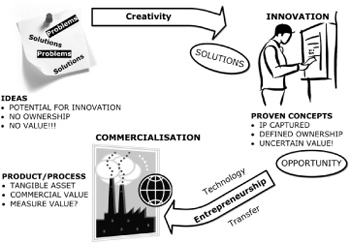
However, as soon as the solution to the problem can be presented, then something innovative has been created and one is entitled then to claim ownership of that creation in accordance with the laws provided for the protection of IP (Protecting Your Innovation: Forms of Intellectual Property – #1 in this Commercialising IP series).
That IP may be an invention capable of being protected by a patent, a design or logo, or some form of practical knowledge or creative work falling within the non-registerable forms of IP, such as copyright or secret know-how.