
COMMERCIALISING INTELLECTUAL PROPERTY SERIES #8

Published by NuBooks, an imprint of Oak Tree Press, 19 Rutland Street, Cork, Ireland
www.oaktreepress.com
ISBN: 978-1-84621-149-2 (PDF)
ISBN: 978-1-84621-150-8 (ePub)
ISBN: 978-1-84621-151-5 (Kindle)
© 2012 Dr. John P. Mc Manus.
All rights reserved. This eBook may not be reprinted or distributed in electronic, print, web or other format without express written permission.
The information contained in this publication is intended for guideline purposes only and does not represent legal advice. Readers should always seek independent legal and/or other professional advice specific to their own requirements before taking any action based on the information provided herein.
Extracted from INTELLECTUAL PROPERTY: FROM CREATION TO COMMERCIALISATION – A Practical Guide for Innovators & Researchers, by Dr. John P. Mc Manus, published by Oak Tree Press.
Intellectual property (IP) is an intellectual asset that underpins the transformation of an innovation into a tangible asset, a product, process or service that someone else can benefit from and is willing to pay for.
Figure 1 illustrates the creative, innovative and entrepreneurial process where the innovator devises a concept of how to overcome a problem. At the initial stages, he is merely dealing with an idea, and as others also are entitled to use their intellect to formulate ideas, he cannot expect to protect and own the idea exclusively. So until a workable solution to the problem actually has been devised by proving the concept with some experimentation, demonstration of a prototype, or illustration of a design, the original idea has no real value.
Figure 1: The Creative, Innovative and Entrepreneurial Process
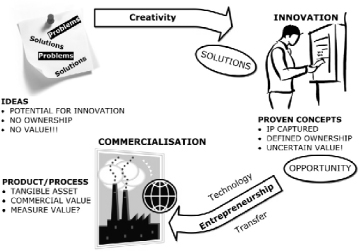
However, as soon as the solution to the problem can be presented, then something innovative has been created and one is entitled then to claim ownership of that creation in accordance with the laws provided for the protection of IP. At that point, an intellectual asset has been created, but until it is converted into a tangible asset such as a product, a process or a service, it is difficult to establish the real commercial value of the innovation.
This transformation of the intellectual asset into a tangible asset typically is brought about by the ‘entrepreneur’, who straddles the worlds of innovative solutions and commercial opportunities and who thrives on transferring innovative technology to a commercial environment (‘technology transfer’). Thus, the entrepreneur quickly grasps the commercial relevance of the original concept and creates some definitive value and economic benefit by exploiting the innovation in the marketplace.
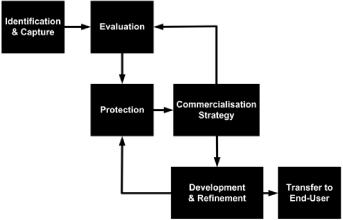
Innovation is really the result of a creative approach to problem-solving (the origin of IP), whereas entrepreneurship, while it does not necessarily exclude this process, is more focused on identifying various applications of the innovation and finding ways to exploit it commercially. Combining both activities might then give rise to a ‘commercialisation process’ represented schematically in Figure 2, beginning with the origin of the IP and progressing to its exploitation in a commercial setting.
While this is one possible sequence of events for commercialisation of a technology, it will become evident during the evaluation of the commercial opportunities that, although there is an underlying chronological order to the process, there are times when it is necessary to step back and to jump forward in the process in order to make informed decisions and to evaluate risks at any point, so that the exploitation strategy continues to make commercial sense. Nonetheless, Figure 2 explains some of the main steps in the process.
Figure 2: The Commercialisation Process
THE RESEARCHER’S ROLE IN THE PROCESS
It is important to understand how you engage in the process yourself and how the work or research activity you are involved in influences how specific forms of IP emerging from your work can be protected, managed and exploited.
To manage IP arising from your work effectively, you need to understand firstly, that you are the source of that creation and that the final use and value of that specific piece of IP greatly depends on what you do, or neglect to do, during the early stages of developing it. Whatever your particular research topic or focus of work, it is highly probable that you will have created some form of IP by the time you complete your work, whether it is an invention capable of being protected by a patent, a design or logo, or some form of practical knowledge or creative work falling within the non-registerable forms of IP, such as copyright or know-how (see Protecting Your Innovation: Forms of Intellectual Property – #1 in this Commercialising IP series).
The objective of this ebook is to encourage you to look at IP from your perspective as a researcher or inventor and see how IP relates to you in the immediate environment of your work and subject area, so that you can manage your IP from the very start of your project.
However, before embarking on a project, you will need to perform some database searches. You will need to search journal databases for publications most relevant to your topic, but also patent databases, to gather as much information as possible on the subject, so that you have a good idea of what has been achieved already and who are the main contributors to the field. This ensures that you only tackle new problems in your research, while you also keep track of the current activities of your peers. The relevant information you find is termed ‘prior art’, as it outlines to everyone worldwide that which is already known on the subject.
Due Diligence and Intellectual Property
Finally, your knowledge and creative outputs hopefully will play a role in strengthening the knowledge economy, where perhaps, an individual, public body or company may need access to it for further educational or commercial purposes.