MY BEAUTIFUL
OBSESSION
Chasing the Kerry Dream
Weeshie Fogarty, born in 1941, grew up on Lower New Street, Killarney. After thirty-eight years as a psychiatric nurse in St Finan’s Hospital, Killarney, he became a sports broadcaster and analyst with Radio Kerry and writer for The Kerryman. He won several awards over the years: four McNamee Awards; the prestigious National PPI Radio Award for his programme, Terrace Talk, in 2008; and in 2010 he won the National PPI Radio Award as National Sports Broadcaster of the Year.
MY BEAUTIFUL
OBSESSION
Chasing the Kerry Dream
WEESHIE FOGARTY


FIRST PUBLISHED IN PRINT FORMAT 2012 BY
The Collins Press
West Link Park
Doughcloyne
Wilton
Cork
© Weeshie Fogarty 2012
Weeshie Fogarty has asserted his moral right to be identified as the author of this work in accordance with the Copyright and Related Rights Act 2000.
All rights reserved.
The material in this publication is protected by copyright law. Except as may be permitted by law, no part of the material may be reproduced (including by storage in a retrieval system) or transmitted in any form or by any means, adapted, rented or lent without the written permission of the copyright owners. Applications for permissions should be addressed to the publisher.
ePub ISBN: 9781848899827
mobi ISBN: 9781848899834
Paperback ISBN: 9781848891562
Typesetting of print edition by Patricia Hope, Dublin
Cover design by Artmark
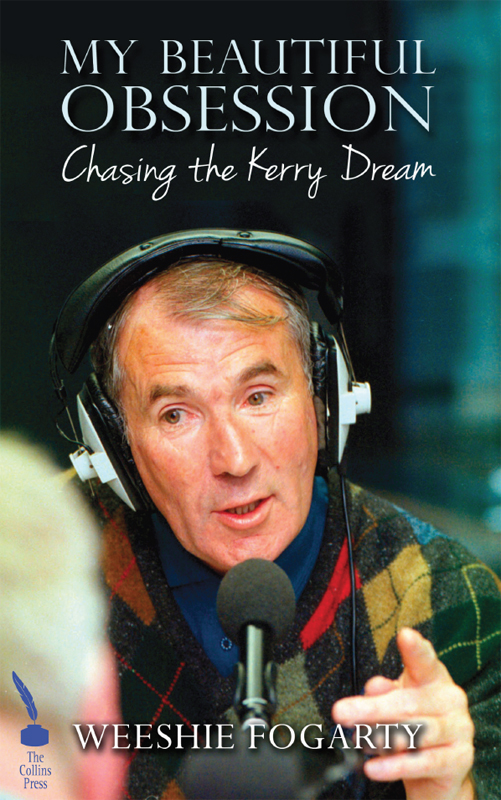
Cover photograph: Broadcasting from the Radio Kerry Studio in Tralee (courtesy Don McMonagle).
CONTENTS
Foreword
Acknowledgements
Prologue: 1946 and the heart of the secret
1 I am hooked: Old Joe Smith passes on the tradition
2 From the stars of the 1940s to defeat and despair in the early 1950s
3 The glorious jubilee All-Ireland victory over Armagh in 1953
4 1955: The sweetest of them all
5 1956: I see my first defeat of a Kerry team
6 Ronnie Delany and Timmy O’Leary: stars in the firmament
7 Down dazzle the Kingdom in 1960 and 1961
8 Dan ‘Bally’ Keating: memories of a century of Kerry football
9 St Finan’s Hospital: from custodial to community-based care
10 1969: Living my All-Ireland dream
11 ‘Gossamer lunacy’: the Kerry build-up to an All-Ireland final
12 Bringing home the Sam Maguire: the end of a chapter for me
13 Paddy Kennedy and Phil O’Sullivan: jewels in the Kerry crown
14 My life behind the walls of the mental hospital
15 1976 Munster Senior final: the greatest game I ever saw
16 Assault and battery: some refereeing experiences
17 Radio days: my late vocation and national honours
18 Great sadness and tragedy in my family
19 On the trail of Eamon Fitzgerald
20 Liam Higgins: Kerry’s radio hero
21 My favourite fifteen Kerry footballers, 1955-2012
22 My choice of the greatest living Kerry sports legends
If you have enjoyed this book …
The seeds for this book have been floating around in my head for a good number of years, but for one reason or another I have always shied away from beginning the task. I think I felt that no one would be the slightest bit interested in my story. However, when the realisation hit me that I was the last remaining brother of the Fogarty family, I became more inclined to put pen to paper. Indeed, at the time of writing, I have just passed the seventy-year mark in my life’s journey. I have been involved in media work of some description for a long number of years and had one book published five years ago. I suppose this gave me the necessary confidence and experience to plough ahead and record my memories, and so I finally took the decision to sit down and begin. Still, it’s all very well to make a start with writing memoirs: to have one’s memories actually published is a horse of a different colour.
I have not set out to trace my career as a Kerry footballer in these pages, for the simple reason that, while I did have the privilege of playing for my county at Minor, Under-21 Junior and Senior level, I was never under any illusion that I was anything other than just another of the hundreds of young Kerrymen who played for their county but were that little bit short of the level necessary to become a Kerry ‘great’. It is that massive influence – the history and traditions of Kerry football and, for me, Kerry sport in general – that I have tried to portray on these pages, to give readers a glimpse of the all-consuming power and passion for sport in the county where I grew up.
Pride of place is very important and special to me. I was blessed in growing up on the side of the street in the town of Killarney, for me one of the most beautiful places God has created. Killarney has influenced my way of thinking all my life. It is a wonderful environment and, with its mountains and lakes and national park on our doorstep, it is easy to understand why tourists flock to our town from all over the world, year after year. The people of my town have had a big influence on my life and that of my family. The old Killarney stock are a special breed and, when Killarney was declared winner of the National Tidy Town Competition for the first time in 2011, it brought great pride and joy to all Killarney hearts. I was glad that I had contributed to this win in a tiny way by promoting the efforts of the people behind the scenes on my radio programmes. A truly amazing man, Father Michael Murphy, together with a remarkable lady, Evelyn Quill, were the leaders of a vast array of volunteers who brought the national title to ‘Heaven’s Reflex’. Our exemplary town council are forever improving, encouraging and trying new ideas as they strive for perfection. Well done to one and all. This sense of home, town and county, has been a constant throughout my life and that of my family. I am utterly convinced that if I had spent my life in another part of the country, or indeed this county, I would not be writing these words. Killarney is my special place.
My three brothers have all died of cancer and all three thought of Killarney in their last hours. I sat by my brother Jimmy’s bed and, with a determined voice that could still be heard over the hum of the morphine pump, he told me, ‘You know what, Weeshie, I wish I could fly out that window, fly over Killarney and see the mountains and lakes for the last time, but maybe my soul will travel back there when I die, I loved Killarney.’ In 2010 my eldest brother, Dermie, died in Marymount Hospice in Cork City. As he sat looking out over the city on a sunny May day just weeks before his death he told me, ‘I would love to get home for one more day, go out on the lake and enjoy a day’s fishing.’ Pride of place, pride of home and pride for their town, Killarney. Their words have helped me, their faces have flashed before me and their memories have strengthened me as I worked on this book.
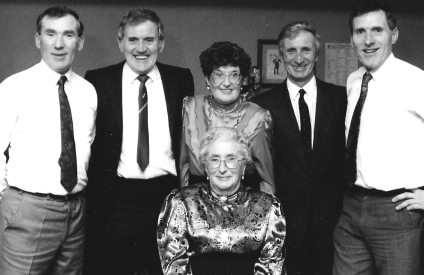
The Fogartys at my mother’s eightieth birthday (l–r): Weeshie, Jimmy (RIP), Sheila, Dermie (RIP) and Geni (RIP).
I have attempted to pay tribute to Kerry sports, and football in particular. You will read a bit of history, events that shaped the careers of individuals, old memories that resurfaced as the work continued, names of long-forgotten friends and neighbours. I must repeat that it was not my intention just to tell my own, individual story, but also that of others who shaped my life as I grew up on the streets of Killarney, boy to man.
You will also read a little of my thirty-eight years working in St Finan’s Hospital, Killarney, and in this I literally just scratch the surface. That was a different world completely, locked away from the outside, close to one thousand patients housed there in 1962 when I began. A cacophony of voices shouting, banging doors; faces, incidents, names, many sadly now forgotten forever. But for me it was a special time and shaped my life in a huge way. I dedicate this foreword to those lovely men with whom I sat and nursed during long, lonely nights as their lives ebbed away, men who were laid to rest with just a handful of people at their graveside and were remembered by no one. This is for them. It is little, but I have an overpowering need to mark their lives.
Finally, without the urging and encouragement of my family I would not have finished this work. They pushed me, cajoled me and emphasised that it was important for the family that I did it. Thanks to Joan (a patient wife, listening to sporting talk for decades), to Denise, Carol Ann, her husband Glen (ever interested in how the work was progressing), and to my son Kieran for all the times you sorted out my computer illiteracy problems and took charge of the photographs. And finally to Lucy and Eva, two angelic granddaughters: just to look into their faces inspired me. There were days when they sat on my lap, pushed buttons on the laptop, demanded paper to scribble on and insisted I do this, that or the other – anything but what I wanted to do. These are all the extra-special memories of a doting grandfather. I hope that you, too, will find something between these covers that you will enjoy.
Weeshie Fogarty,
Killarney, October 2012
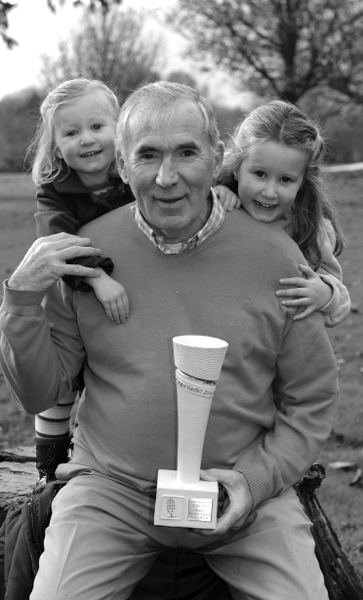
Weeshie with his granddaughters Lucy and Eva.
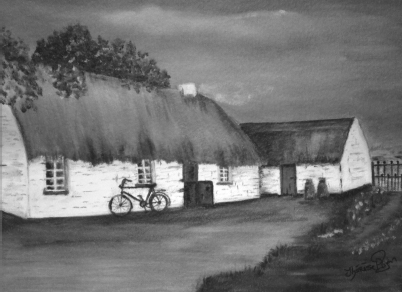
Hussystown (near Cahir) in County Tipperary, the farm where my father was born and I spent many a childhood summer.
Now that the book is completed and before you, as always, there are a number of people who helped greatly in one way or another, even without being aware of their involvement. My sincere thanks to one and all, and especially to the following. The Collins Press for their support and encouragement. John Kelly of the Spa GAA club, Killarney, for his help and advice in my St Finan’s chapters. Sylvester Hennessey, GAA correspondent with Kerry’s Eye, always encouraging and helpful. Gabriel Fitzmaurice, renowned north Kerry author and poet, always generous with his poems and advice. Journalist Kieran McCarthy, for his help and encouragement. Kerry County Library and my local branch in Killarney; they were invaluable to my research. The O’Donoghue family of the Gleneagle Hotel, Killarney, and 93-year old Alex O’Donnell, from Monaree near Dingle, for his wonderful advice. Alex now lives in Dublin and is a true gentleman. Radio Kerry has played a huge part in my life over the last twenty years and has always encouraged and facilitated me in every way possible. The Kerryman newspaper, for which I have written a weekly column over a number of years; work for the paper has opened doors for me in the line of meeting and interviewing sports people. Alan Groarke from Moyvane, living in Colarado, who is the manager of my website, www.terracetalk.com; this massive site has helped me hugely in my research, so thank you, Alan. GAA historian Tim Slattery from Tralee, and Niall Flynn, author of the superb Kerry history Thirty-six and Counting; both great friends. Author of so many books, Colm Keane, who was always prompting me to write down my memories.
Without the generosity of my photographer friends many of the photographs reproduced here would have remained unpublished. Kerry is blessed with highly professional men and women in this regard. I have huge admiration for each and every one of them. Don McMonagle, Eamon Keogh, Michelle Cooper Galvin, John Reidy, and the Kennelly archives; the late Padraig Kennelly was one of my favourite people. There are numerous photographs included to which I cannot put a photographer’s name and any omissions are entirely unintentional and regretted. The publishers will be happy to hear from copyright holders not acknowledged and undertake to rectify any errors or omissions in future editions, but people like Kevin Coleman, Valerie O’Sullivan, Dominic Walsh and John Stack have always been courteous and accommodating to me. My great friend Tommy Regan also provided photos from his own collection. Monsignor Liam Brosnan in San Antonio was, as always, very generous as he provided some priceless pictures from his massive collection. And finally, to Christy Riordan of CR Video and DVD Productions, Cahersiveen, his wife Geraldine, daughter Michelle and son Tony. Christy granted me full access to his vast collection of photographs and took many himself for this publication. A true friend and top professional at his work. We travelled the world together.
Through my column in The Kerryman newspaper I befriended a remarkable lady who has been an avid reader of the paper throughout her life; she became a nun in 1944. Some time ago she presented me with a letter her father had written to her in 1946. His is a remarkable story and a historic letter. In many ways it captures the real secret of Kerry and what football means to its people. Judge for yourself as you read Sister Vianney Buckley’s own account of her life and how she received this precious letter:
I will be brief in recounting some aspects of my life’s story that began on December 6, 1925, as I reach my eighty-sixth year in 2011. I owe a deep debt of gratitude to God, my parents, my teachers, and to all whom I encountered on the journey of life, for it is true, as the poet wrote, ‘I am a part of all that I have met.’
I had a very happy childhood in spite of the many deprivations Ireland underwent in those years of the Great Depression, the Second World War, and Ireland’s struggle for Freedom and Independence. I was the sixth child in our family of six girls and one boy (‘Deemie’), all born at home in Clounmacon, a townland three miles outside Listowel, County Kerry. I am certain that from the day I came into this world I shared in the passionate love for God and for Ireland which we inherited from Mom and Dad, a love and passion for God and Ireland that filled my Soul. My love for God led me to answer God’s call to dedicate myself to Him in the Religious life. I entered South Presentation Convent in Cork City [First Convent of the Presentation Congregation] in September 1944. It was a sacrifice for my Parents, made willingly by them in spite of the heartbreak it must have been. I remember seeing the tears, but I confess I did not understand till later that it must have been a deep heartbreak for them as they saw four of the girls leave home and enter Presentation Convents in Kerry, Cork, and Tipperary. Letters from Mom and Dad in those early years to me revealed by degrees what they sacrificed in Faith. However, I often recall a line Dad wrote to reveal the mingling of sorrow and joy: ‘…if I were any happier, I could not stand it.’
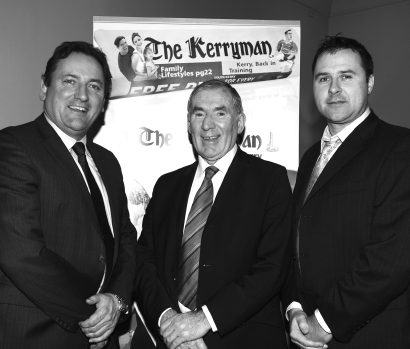
I have been a journalist with The Kerryman newspaper for a number of years and contribute a weekly sports column. Paddy Foley (RIP), John Barry and Eamon Horan (both retired) have been three of the paper’s outstanding and highly-respected GAA journalists since the early 1930s. I am pictured here with Michael Brennan (Managing Director) on the left and Paul Brennan (Sports Editor) on the right (courtesy Micheal Cooper Galvin).
I shared in my father’s love for music, dancing, singing and partying, and especially in his love for Gaelic Football and the Kerry Team. I kept his letter to me [written] in 1946 when, I believe, we played and defeated Roscommon. At the time I was in the Convent and we were not allowed to listen to the Radio (Wet and Dry Battery Days!) so I read and reread my Dad’s report of the game: the players who played well, Paul Russell, Paddy Kennedy, Paddy ‘Bawn’ Brosnan etc., the neighbours who crowded our kitchen, while the younger generation had to listen outside the window. If my diminishing and ageing memory leads me astray here, ask Weeshie Fogarty who can give you every detail and prove me wrong or right. From a very young age we walked to Moyvane, to Ballylongford, etc., to cheer on Clounmacon, or North Kerry in their local games against their foes!! I remember once going to see Kerry play Offaly in Listowel – [a game I] relived [for my audience] when I travelled from Sacramento to the Irish Culture Centre in San Francisco – when Kerry sadly lost the battle for ‘Five-in-a-Row’ to Offaly!
I volunteered to go to open a Catholic School in Sacramento with three other Presentation Sisters from South Pres. in August 1961 and have lived in USA for 50 years. And when the All-Ireland is played on the third Sunday of September every year, I am at Fiddlers Green in San Bruno, California, if I am not at Croke Park. That All-Ireland Football Game is played with as much passion as it is in Ireland and I have never since missed an All-Ireland if Kerry is in the ‘Battle!’, but I do not cry anymore if Kerry loses, because I know the Kingdom cannot be conquered for too long!
The vocation to become a Nun and join Presentation Order came from my early days in my home in Clounmacon, a home that was as Religious as any Convent – Family Rosary every night, morning and night prayers, shared prayer as we discussed what the Church said in English, etc., and strict observance of the Ten Commandments as we interpreted them. The second wonderful influence in my life as I began my High School Education in Listowel came from two Sisters entirely different in their teaching methods. Sister Louis, who taught Religion as well as Irish Literature and other subjects, was so gentle, trusting, and guileless, revealing the God of love to us as she read for us the Lives of the Saints. I recall a book she read called Fabiola [by Cardinal Nicholas Wiseman] that gave me my love and understanding of the Eucharist. I remember the life of St Pancratius. Sister Dympna on the other hand gave me a passion for life and living through the Literature classes as well as her own sense of freedom and joy. I learned so much from her, and loved Shakespeare, and the Romantic Poets, etc. We learn more from every person we encounter in life than from books and structured classes. But I am not to go any further in this ‘brief’ account of my life and living these past 86 years.
From Mom and Dad and family and friends I developed a passion for my God, my Country, and my Beautiful Kingdom of Kerry! As I near the end of my journey of life I want to thank also every person whom I encountered. God bless you all.
Sister Vianney Buckley
26 November 2011
And so to the letter that Sister Vianney’s father wrote to her in America sixty-five long years ago, reproduced here exactly word for word. Study it, and I expect each reader will take their own message from what it contains. It is a fascinating look into the rural thinking of Kerry in 1946. It is poignant; a beautiful loving message from a father to his daughter. It also captures for me, yet again, just another one of the secrets of Kerry football and the passion it aroused back then, just as it does today. I thank Sister Vianney for giving permission to publish what is a very personal letter. It is doubtful if another such as this even exists:
Clounmacon, Listowel
Nov 27th Wed Night 1946
My Dearest Hanna, Sr Vianney,
Hoping you are very well as this letter leaves me at present, if I was any better I could not stand it. You seem very anxious about Kerry’s victory and the long letter from all. I was over at Leahys last night and Peggy told me she would be writing to you for Christmas. We were playing two fiddles and she also sang a song; last winter I used join in on the song. Kitty and her boy is out. Kitty and Lizzy are at variance. I will try and answer all your questions, I would like to make you happy. Now about Kerry’s victory. The Kerry halfbacks broke up the Roscommon half forwards, especially Bill Casey against Murray this great Roscommon forward. Joe Keohane Kerry’s fullback was in great form also Danno Keeffe in goal; he brought off some wonderful saves. He is now the possessor of six All-Ireland medals. They are now top dogs in 16 All-Ireland wins beating Dublin by one. Gus Cremin, sub, came on near the finish and turned the scales with a long point, then came the goal, they drove man and ball back to the net. The closing minute of the game was most exciting; it was a case of blocking the ball at each side. Kerry had the better of staying power; they are noted to be great in the closing minutes. You can imagine the excitement of the onlookers, it was a record crowd and listeners. Now about the crowd at our radio, Margret Mullane and little girl and Bridgie. The Mullanes brought this cap with up Kerry printed on it. I put it on Paddy Ahern and every time Kerry would score I would lift the cap off Paddy’s head. There was Mary Healy, Margaret Babe, Ann Doyle, John Joe Doyle (he played the sets for myself and Paddy Ahern), Monty Leahy, Stephen Enright, Danny O’Donnell, Pat Doyle and John Griffin. We gave tea to all. Glad to hear Peggy is in good form. The Leahys were at Galvins radio. The weather here is the same as in Cork. The Listowel races were put back owing to the harvest, all our crops are O. K. we sold a share of turf by the rail, we built a new poultry house, also wall to stall, I think I told you that news before. We had no letter from Mary for a while and we are feeling anxious about her, not so bad now since we got your letter. We had five sudden deaths in the parish last week, the Gospel last Sunday as you know was be prepared. Our Cannon Brennan is every Sunday talking about the state of the parish especially the new houses [on] O’Connells Ave. and Ballygolague; he is shocked. We put the clock on the kitchen wall to-day. I think I have told you all the news except we have two cats and other simple things and that you have no cause for grumbling as far as my letter is concerned. The presentation letter was in the short side, Kitty was in a hurry with the pen. The same word did for the three nuns. My taste for music, song and dance is only increasing, I suppose I must be only doting. Christmas is not far away now and we are hoping to meet you in the near future and have a very pleasant day. I think I am imitating you with writing the four pages. You must excuse us for not writing more in the long days, we were too busy for the short days and you will be only plagued from reading them.
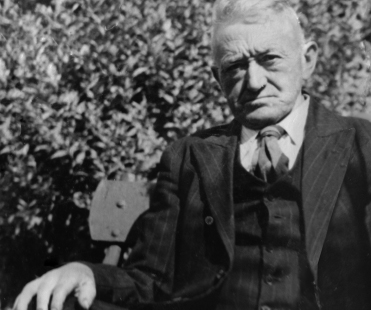
Tady Buckley of Clounmacon, Listowel, County Kerry, who wrote the very poignant and beautiful letter to his daughter, Sister Vianney, in America following the 1946 All-Ireland final when Kerry beat Roscommon.
Cheerio, keep smiling,
Sure, I need not tell you I remain ever
Your loving Father
Brian O’Conchubhair, PhD Associate Professor, University of Notre Dame, summed up the importance of the document beautifully as follows:
I sat down and read the letter last night and it struck me deeply in several different ways. It is a wonderful insight into a lost Ireland and a lost cultural and socio-economic enclave in rural Ireland. In a few lines it achieves more than an hour’s work of film documentary while reaching the intensity and brevity of a short story. The use of language is startling, almost Heaneyesque at times, and the way it no-nchalantly and casually captures the slow encroachment of modernity is breathtaking. But the controlled and unspoken emotional intensity is palpable in the letter and it speaks of a time before Skype, instant messaging and email, where letter writing was an art in maintaining and preserving emotional and familial bonds and preserving identity and heritage across time and distance. A truly wonderful letter. Thank you for allowing me to read it.
Yours, Breen
The youth of Kerry becomes immersed in the history and traditions of its county’s glorious football story in so many different ways. Tales may be handed down from generation to generation through families all around the county. Becoming involved in a local club will have a huge bearing on one’s outlook and football ambitions. Watching Kerry teams training and playing matches while young invariably leaves a lasting impression and will drive on many an ambitious youngster to wear the Kerry jersey at one grade or another. Likewise, watching Kerry play on the television is another way in which the great traditions of our county are handed down and can help imbue that passionate interest. The magnificent homecoming of victorious Kerry teams following a Croke Park triumph is a sure bet to spark off a driving ambition to be up there on the back of (in the old days) the lorry or (nowadays) the luxury bus, as the boys are paraded in splendid triumph through the streets of Killarney and Tralee. Then, of course, you have the cup visiting every single school in the county and this is probably the most effective way of all to ingrain a passion for the secrets of Kerry in the minds of our youth, both girls and boys.
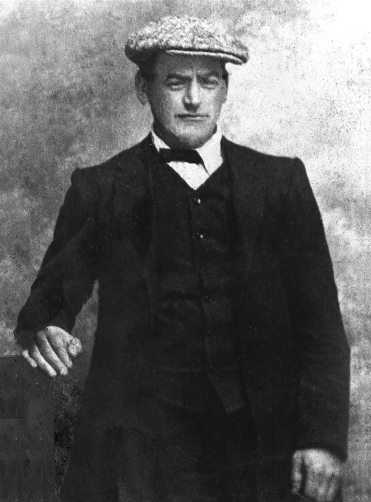
Joe Smith, who first introduced me to the wonders of Kerry football and was directly responsible for my joining the Killarney Legion GAA club.
My passion for the green and gold was fostered on the side of the street where I grew up in the 1940s and 1950s. Number 40 Lower New Street, Killarney, is now that superb restaurant called Chapter Forty. A recent visit there for a meal with friends caused all sorts of old, seemingly long-forgotten, memories to rise up once more, in particular a magical encounter one Christmas Eve in the early 1950s. That memory concerns a wonderful old gentleman who lived just four doors up the street from our home. It was he, Joe Smith, who first introduced me to the wonders of Kerry football and was directly responsible for my joining the Killarney Legion GAA club.
Until his death in 1953 at the age of eighty, Joe ran his butchering business with his lovely wife, Maggie, who was always dressed in a long black skirt and a shawl that was invariably wrapped around her head and shoulders. Now Joe’s shop was so small that if you walked in you would nearly have to back out when you’d finished your business. As well as the meat, Maggie also sold sweets, jams, Brylcreem for the hair, bags of sugar, and so on, from behind her little counter. The premises were lit by gaslight and had flagstones on the floor. The tiny kitchen was just inside the shop and a little yard at the back served as an abattoir for Joe. There was no back entrance so how did Joe get his cattle, sheep and pigs from the street into that little yard? He simply drove them through the shop and the kitchen and into the yard where he slaughtered them with a knife and bare hands. I recall vividly the day that a cow destined for slaughter went berserk as Joe was driving it through the kitchen. It was probably the smell of death from the yard that warned it of its forthcoming fate. The street was in an uproar as the sounds of crashing tables and chairs emanated from Joe’s shop. Calm was eventually restored and the street returned to normality.
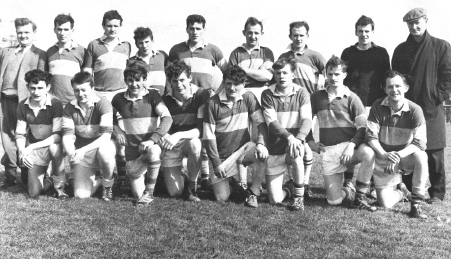
Lining out for a team photograph with my club for a Towns Cup match in March 1967. Back row (l–r): Connie O’Sullivan (RIP), Weeshie, Killian McCarthy, Seamus O’Neill, Geni Fogarty (RIP), Jim Broderick, Kieran O’Keeffe, Michael Culloty and Gerald O’Sullivan (Gerald played in the Polo Grounds, New York, in 1947, and has since passed away); front row (l–r): Tommy Regan, Johnny Healy, Brendan Lynch (RIP), Padraig O’Meara, Mikey Lyne, Adrian Culligan, Johnny Culloty and Mickey Culloty (RIP).
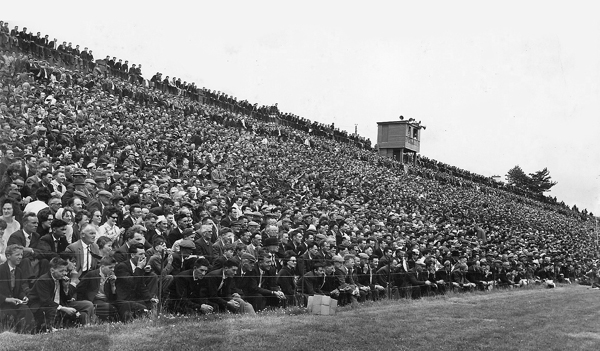
A magnificent crowd shot during the 1950s in Fitzgerald Stadium, Killarney, at a Munster Senior Football Final between Kerry and Cork. Note the absence of colour, no flags, banners or county jerseys as we see today. The tiny old commentary box is in the background and it is from here I often saw Michael O’Hehir broadcast the finals. There are a number of spectators sitting high on the boundary wall of the terrace that is now called the Michael O’Connor Terrace in memory of a great Killarney Gael of the Dr Croke Club. Michael became chairman of the Munster Council in 1986 and it is generally accepted that only for his premature death in 1991 he would probably have become Kerry’s first GAA president.
Joe was an ardent follower of the Legion GAA Club (the first supporter I ever met), and he would sit me down in front of his old black range and, in the flickering light of the gas lamp as Maggie stocked the range with turf and sticks, he would recall his days walking to Tralee – yes, walking – to see the Legion playing in the county championships of the 1940s. It was here that I first heard the names of those illustrious men in whose footsteps I walked when I later joined the club myself: the Lynes of Cleeney, the O’Sullivans of Ballycasheen, that wonderful little corner forward Timmy O’Leary who won three Minor All-Irelands in a row, the Coopers, John Joe Sheehan, Tom Spillane, father of the Templenoe brothers and many more. Kerry legends all.
Then one dark, wet winter’s evening as I sat by his fireside listening to the stories and secrets of Kerry, Joe disappeared upstairs to his little bedroom and when he reappeared he had, clutched in his huge hands, an old, tattered book. It had lost its cover and was brown with age and it was very evident it had been thumbed through on countless occasions. He handed it to me saying, ‘Little boy there is a present for you, read that and keep it safe.’ Joe had presented me with one of the most priceless GAA books that had ever been printed up until that time. It was Paddy Foley’s beautifully written and superb production published in 1945 and entitled Kerry’s Football Story. It has proved to be a veritable treasury of football lore, a wonderful comprehensive chronicle of achievements and stories that continues to captivate and enthral right up to the present day. Paddy Foley was known to his Kerryman readers as ‘P.F.’. He was that paper’ s GAA correspondent from the mid-1920s up until shortly before his death in 1965. His book covers Kerry’s football story from the foundation of the Laune Rangers right up to and including 1944. His chapters on Kerry’s first American tour in 1927 make for fascinating reading and his words have certainly contributed to my ‘beautiful obsession’ with Kerry football. It is a pity that the Kerry County Board has not taken it upon themselves, after all these years, to have Kerry’s Football Story reprinted and made available to the present generation. That book is still, to this very day, one of my most prized possessions and has never left my home.
I will always remember Joe’s wonderful artistic talent for creating giant Christmas candles. He would save up the sheep’s fat each year and that, combined with the right home-brewed ‘stiffeners’ and his unique skill, brought to life these magnificent yellow, marble-like candles, almost five feet tall. I particularly remember a Christmas Eve around 1951 or 1952. My late mother pressed a penny into my hand and added, ‘Run up to Maggie and get a box of matches to light the Christmas candle.’ Joe met me at the door and said, ‘Little boy, come out here a minute and help me.’ My job was to hold the tip of the giant candle and Joe with his massive hands then twisted and pulled the candle from the metal mould that I learned had been in the family for over one hundred years – and another Joe Smith masterpiece had been created. It proved sadly to be his very last.
Joe suffered from very poor eyesight in his later years. Now, every Christmas when I ramble down Lower New Street, I can see clearly in my mind’s eye that small, stooped man in half-belted jacket, knickerbocker trousers and dark, knee-length socks with the cap pulled well down over those forlorn and oft-times troublesome eyes. When he died my mother and her New Street friends laid him out in the tiny room over the little shop. Maggie joined him in death shortly after this. Two exemplary people who would not say ‘boo’ to a goose or harm a fly. Joe Smith introduced me to the secrets of Kerry football and ingrained in my mind the words ‘Killarney Legion’. My club, the club for which I would later play and which I would serve in so many capacities. His rhyme to me on the street as I rushed to school remains fresh in my memory, ‘Little boy, number one, hurry up the bell is gone.’
Even some of my closest friends are mildly surprised when I tell them that I come from a very strong farming background on my late father’s side. He was born Richard Fogarty in a little townland called Hussystown, halfway between Cahir and Clonmel in County Tipperary. His mother had died very young and his father (my grandfather) had married a second time. My father and his sister, Eileen, were children of that first marriage.
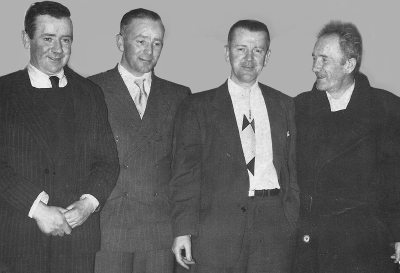
Four O’Sullivan brothers, all now deceased, who lived in Brasby’s Lane, High Street, Killarney, County Kerry, (l–r): Billy, Mickey, Neilly and Mysie. They were staunch members of Killarney Legion Club and their mother washed and repaired the team jerseys. Another brother, Mattie, died in America in the 1960s. None of the boys married and there are no known relations. Their knowledge of Old Killarney was immense and I befriended them in my youth. The photograph was taken in the kitchen of their home in 1946.
Father would often tell me stories of how tough life was on that farm and openly admitted that my grandfather had worked them very hard. Up at the crack of dawn tending to the farm jobs, and he and his sister would only set off for school when the schoolyard bell could be heard ringing out across the fields. One of his daily tasks was to bring the milk to the creamery in Cahir, a distance of two miles. Finally, one bright day in September, he made the visit to that creamery for the last time. He had saved up a few shillings, the price of a train ticket to Dublin. He tied the horse and cart to a pole outside one of the local pubs, asked the landlord to pass a message out to Hussystown and shortly afterwards he boarded the train to Dublin and a new life. He joined the Gardaí and was later stationed in Bandon, Kanturk (where he met my mother) and Mallow, before arriving with his family of four boys and two girls in Killarney in 1941. But – of course – we always went back to Tipperary.
I have vivid memories of long, hot, hazy summer holidays spent on the farm at Hussystown with my brother Geni. Saving the hay and bringing home the beautifully made cocks on the hay cart. Driving the horse and cart to the well where we would fill the churns with sparkling, ice-cold water. Growing and selling beet was a huge income for the farmers of the area and it demanded back-breaking hours of work, kneeling with canvas bags to protect the knees as each drill was carefully weeded. And then, after the day’s work was done, sitting before the open fire and turning the bellows as the fire belched out smoke and flames while my grandmother, my grandfather’s second wife, stirred the huge black pots filled with meal and other unknown ingredients to feed the yard animals.
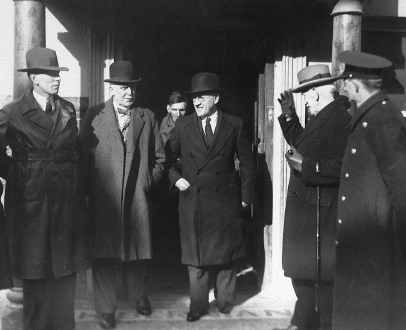
In April 1937, my father (left) was on detective protection duty for Minister Boland (centre) outside the Central Hotel, Mallow, County Cork. He was stationed in Mallow before being transferred to Killarney in 1941. Prior to that, he had been in Kanturk and Bandon. He ran away from home in Tipperary to join the Gardaí.
My grandfather, who died at the age of eighty-two, was known as Jim ‘Pope’ Fogarty, and in his young days was a fairly noted footballer in the area. The Cahir club published their history in 2009 (M. Hussey & C. O’Flaherty, Memories and Achievements: 124 years of the GAA in Cahir) and my grandfather is included in a cover photograph of the 1986 Cahir Faugh-A-Ballagh football team who had won a tournament in the area. They were presented with a set of silver medals for the win and he kept it, as was the custom back then, on his waistcoat watch chain. I was always fascinated by this medal and he would tell me about how he had won it; when he died the medal was, to my great delight, left to the family with instructions that it was to be given to me. It is, to this day, one of my prized possessions and now a family heirloom.
I believe it must have been from my grandfather that I inherited my love and passion for Gaelic games. He would read the GAA match accounts from the local Tipperary weekly paper, The Nationalist, to Geni and I as we sat with him in front of his whitewashed, thatched farmhouse on those long summer evenings. Legendary hurling names of Tipperary seemed to excite, inspire and thrill him. John Doyle, Donie Nealon, Liam Devaney, Tony Reddan, Mick Byrne, Tony Wall and many more. One year, however, stands out head and shoulders above all others on those Hussystown holidays.
My grandfather had a beautiful little pony and trap, which he took tremendous pride in tacking up every Sunday. He would dress in his Sunday best, spick and span, bright and glossy, looking the real gent in the three-piece suit, including the mandatory waistcoat and dapper little hat that helped frame his strong-featured, moustachioed, weather-beaten face. It would be early mass in Cahir, then a couple of pints in his local pub, Samson’s.
Then, one beautiful Sunday, all my dreams came together when he informed me that he was taking us to a football match in Clonmel. And so off we went accompanied by the beautiful, soothing clip-clop of the little pony along the road – a road that back then was all but devoid of motor vehicles. Memories of the game naturally are hazy, but it was the home side against Waterford in the Munster Championship and I recall my grandfather being as happy as Larry when Tipp won. A few names of that Tipperary side remain etched in the memory despite the passing of time: O’Dea, Tony Newport in goal, Liam Boland and Leo Dooley. It was the first inter-county game I had ever seen.
Years later I travelled back to Cahir to bury my grandfather. It was to be the first of many family funerals but I did not realise then that death would sit constantly on my shoulder, for I was to bury three brothers, my sister, mother, father and a beautiful young niece in succession.
My late mother, Kathleen Crowley, was born in Strand Street, Kanturk, where the family had a little sweet shop. Her father spent a number of years in Ballykinnler prison camp for his IRA beliefs and my mother would tell us (in graphic detail) stories of frightening raids conducted by the notorious Black and Tans on their home. Her mother lived to a great old age and often spent months with us in Killarney. I remember her as an avid reader on those visits; the Cork Examiner had to be delivered to her first thing every day and straight away she would turn to the death column saying, ‘Let’s see who gave up smoking yesterday.’
One of the guests at my parents’ wedding in Kanturk was the legendary Dr Pat O’Callaghan, the only Irishman to win two Olympic gold medals. He was the champion hammer-thrower. My mother and her friends would cycle from Kanturk to Banteer on summer evenings to watch Dr Pat in action at the local sports meeting. She loved to speak of him and the excitement in the town when he returned with those gold medals. As a wedding present to my parents the good doctor gave them a beautiful mahogany mantel clock won at a sports meeting. Today it sits proudly in my living room chiming and ticking the hours away as it has done for over eighty years.
My father was only sixty-two when he died. His last few years were difficult and the memory of his suffering remains vivid to me. He first suffered a heart attack and then a very severe stroke, which paralysed his right side. This necessitated his early retirement as driver for the one and only Garda squad car at that time. He then developed prostate cancer, which was to take his life in the end. Eventually he became unable to climb the stairs at night and Geni and I would have to be home around 10.30 p.m. most evenings. Then, with the help of our mother, we would lift him in a chair up two flights of stairs and help settle him for the night. I was only twenty-one at the time and it is only now as an older man I realise how difficult those last years must have been for him. He bore his illness with great dignity and patience and his only mention to me of approaching death was one winter’s evening as I sat by his bed reading the paper to him. Suddenly he suddenly said out of the blue, ‘I don’t mind dying, Weeshie, but I will miss you all so much.’ He died two months later.
My mother passed away in 1999. Like most of her generation she was a woman of great faith and the rock of our family. Despite seeing her husband, daughter and niece buried she always had the good word and imbued in all of us a deep belief and faith in our Catholic religion. Every week she would sit by her radio to listen to myself as I presented Terrace Talk on Radio Kerry. Then one July evening as I finished my programme, Fiona Stack (the station’s exemplary general manager) was waiting for me. ‘Your mother has been taken to hospital in Tralee,’ she said, ‘The family is waiting there for you.’ When I got to Tralee General she was dead. She had sat, as usual, by her little radio to listen to the programme, her tray with her evening meal placed on her lap. Feeling unwell all of a sudden, she was able to call her daughter-in-law next door, but by the time the ambulance arrived she was already dead. It was for me the end of another era in my life.
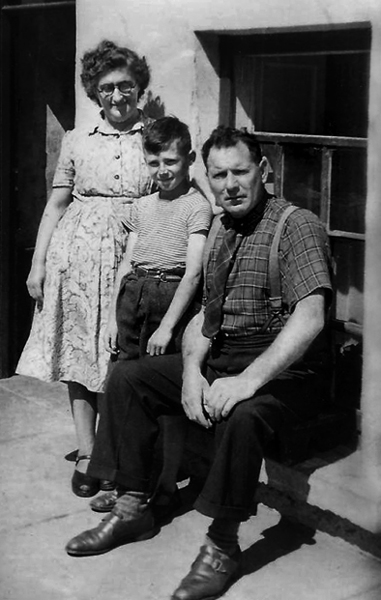
One of my favourite family photographs: me with my mother and father in 1953 outside our home at 40 New Street, Killarney. Today, it’s a restaurant called Chapter Forty.
In 2009, while attending a college game in Cahir for Radio Kerry, I rediscovered my grandfather’s grave in the burial ground situated directly behind the church, which itself is just across the road from the football pitch. It was a poignant moment, my first visit to kneel at that graveside, and memories of those long gone, happy days on the farm in Tipperary came flooding back.
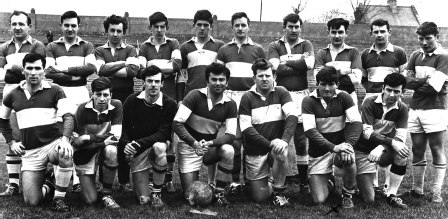
I played at senior level for sixteen years with my club, Killarney Legion, and also helped them to win minor, junior and senior East Kerry Championships. This is a team photograph from 1969. Back row (l–r): Jim Broderick, Jim Fitzgibbon, Dan Moynihan, Pat Healy, Derry Kerrisk, Johnny Culloty, Lui Nolan, Tommy Regan, James Lucy and Seamus O’Neill; front row (l–r): Weeshie, Pat Lucey, Mickey Culloty, Mick O’Sullivan, Noel McCarthy, Mikey Lyne and Timmy Loone.
The most precious memory of all is following in the footsteps of our grandfather as he ploughed the fields, expertly guiding two beautiful working horses. He was a master at his trade and Geni and I trotted along behind him, marvelling and enthralled as the blade of the plough sliced through the rich, fertile soil. It was such a different world back then; yes indeed, blood is thicker than water. When I watch Tipperary playing in Croke Park or in Munster hurling finals, I can literally feel the Tipperary blood coursing through my veins.
As 1948 dawned, it was obvious to the knowledgeable Kerry follower that many of the legendary men who had brought such honour and glory to the county since the 1930s (including the great ‘three-in-a-row’ years of 1939, 1940 and 1941 and the contested All-Ireland finals of 1944, 1946 and 1947) were coming to the end of their illustrious careers. This great era of Kerry football had run parallel with the emergence in the county of the all-conquering Dingle team, which won six glorious Kerry County Championships in 1938, 1940, 1941, 1943, 1944 and 1948. These west Kerry men had played a huge part in the Kerry story of that time, but by 1948 household names such as Paddy ‘Bawn’ Brosnan, Bill Dillon, Bill Casey, Tom ‘Gegga’ O’Connor and Batt Garvey had already retired or were entering the autumn of their honour-laden careers.
Although it definitely did not look that way when Kerry hammered Clare, 6-6 to 1-8, in the first round of the Munster Championship in Ballylongford on 10 July at the start of the 1948 campaign. Many of the old stalwarts were still there: