
1864
1864
The forgotten war that shaped modern Europe
TOM BUK-SWIENTY
Translated by Annette Buk-Swienty

Profile Books gratefully acknowledges the financial assistance of the Danish Arts Foundation
DANISH ARTS FOUNDATION
Published in Great Britain in 2015 by
PROFILE BOOKS LTD
3 Holford Yard
Bevin Way
London
WC1X 9HD
www.profilebooks.com
Originally published in Denmark in 2008 by Gyldendal, entitled 1864: Slagtebænk Dybbøl
Copyright © Tom Buk-Swienty and Gyldendal, 2008, 2015
Translation copyright © Annette Buk-Swienty, 2015
The moral right of the author has been asserted.
All rights reserved. Without limiting the rights under copyright reserved above, no part of this publication may be reproduced, stored or introduced into a retrieval system, or transmitted, in any form or by any means (electronic, mechanical, photocopying, recording or otherwise), without the prior written permission of both the copyright owner and the publisher of this book.
A CIP catalogue record for this book is available from the British Library.
eISBN 978 1 78283 077 1
For my parents,
who taught me to choose my battles wisely
Contents
Dramatis personae
A note to the reader
Preface
Introduction: The veteran
Part One: The Day Before
1. Sunday, 17 April 1864
2. The chosen one
3. The battle plan
4. The butcher’s block
5. The ironclad warship
6. The war correspondent
7. The ailing general
8. The Red Cross delegate
9. On the front
10. The last letter
11. The changing of the guards
12. The doomed
Part Two: The Road to Dybbøl
13. Les jeux sont faits
14. The Baltic powder keg
15. The Iron Chancellor
16. The king is dead
17. Thyra’s Fortress
18. The first days
19. The funeral procession
20. Sankelmark
21. The scapegoat
Part Three: The Siege
22. Bloodshed
23. The bombardment
24. Seven long days
25. Night
26. 18 April 1864
27. The left flank
28. Counter-attack
29. Burning bridges
30. The dead
31. The dying
32. The prisoners
33. Berlin
34. The ghost ship
Epilogue: The groundswell after the storm
Chronology of the war
Acknowledgements
A note on quotation
Sources
Index
‘The scene … had about it a strange beauty. On the face of Dybbol Hill, looking eastwards, the morning sun shone brightly. To the right, along the Sund, vast columns of smoke rose straight into the air from the burning cottages of Ulkebøl Westermark. On the left the cliffs of the Wemming Bund shores were enveloped in the haze caused by the ceaseless puffs of snow-white smoke which were belched forth by the Broager batteries. From the crest of the hill a belt of flame flashed constantly; and the clear blue sky overhead and the still blue sea underneath encircled the whole of this picture of fire and flame and smoke in a gorgeous setting. The noise was fearful, greater even than I ever yet have heard it.’
Edward Dicey, British war correspondent, Dybbøl, 18 April 1864
Dramatis personae
Prussia
Otto Eduard Leopold von Bismarck-Schönhausen (aged forty-nine): Prussian minister-president, Foreign Secretary and primary advisor to King Wilhelm I. Conservative and politically astute, Bismarck takes advantage of the Schleswig crisis to further his own political goals of strengthening the Prussian military and the Prussian Crown.
J. Bubbe (age unknown): A Prussian private in the 24th Regiment. He participates in the early battles of Mysunde on 2 February and Dybbøl town on 17 March, as well as the final assault on 18 April, where he is in the 5th assault column attacking Redoubt V.
Carl Bunge (age unknown): A Prussian captain in the 11th Regiment, who participates in the second wave of attacks on 18 April. He led his men towards Reboubt II, proceeding from there to the Danes’ second line of defence, where they meet the Danish 8th Brigade. He also fights at the Battle of Mysunde on 2 February and the successful nightly attack on the remaining advanced Danish posts in front of the redoubts, conquering this ground.
Wilhelm Gather (aged twenty-six): A Prussian private in the 4th Regiment. He is selected for the 6th storm column on 16 April and participates in the attack on Redoubt V on 18 April. He was born and grew up in the Prussian Rhine Province. He hates the war and life as a soldier and dreams of returning home to his family farm.
Prince Friedrich Karl (aged thirty-seven): At the beginning of the war he is in command of the 1st Prussian Army Corps and from 1 March he is given command of all troops at Dybbøl. Initially somewhat indecisive and ineffectual, Prince Friedrich takes a firmer stand from mid April, by which time the siege bombardment has all but silenced the Danish cannon and destroyed most of the redoubts. He devises the Prussian strategy for the final assault of the Danish position.
Friedrich Heinrich Ernst Graf von Wrangel (aged eighty): At the outbreak of war Field Marshal von Wrangel – nicknamed Pappa Wrangel – is, as soon becomes apparent, far too old to command the allied forces successfully. Wrangel has a highly distinguished military career behind him, however. He entered military school at thirteen and rose steadily through the ranks, winning distinction in the Napoleonic Wars (1807–15) and the War of Liberation (1813). As commander of the 2nd Corps of the German Confederation, Wrangel won several engagements in the First Schleswig War (1848–51).
Denmark
Wilhelm Adolph Dinesen (aged eighteen): A second lieutenant in the 9th Regiment of the 8th Brigade of the Danish army and one of the youngest officers to serve. He arrives at Dybbøl on 14 April, and on 18 April participates in the 8th Brigade’s suicidal counter-attack on the Prussian assault columns. Dinesen survives the battle and is later to become the father of world-renowned Danish writer Karen Blixen.
George Daniel Gerlach (aged sixty-five): Given high command of the Danish army on 29 February following the dismissal of Christian de Meza, who had been responsible for the withdrawal of the Danish army from its first main position at the Dannevirke. Gerlach had nothing to do with this unpopular decision, which in part explains why he, though a weak leader, was chosen to head the army.
Niels Larsen (aged thirty): An infantry reservist in the 22nd Regiment. He is a successful miller from Hellum, northern Jutland, and is married to Inger Marie. The couple have a son and a newborn daughter. On 17 April, Larsen is sent on duty in the most advanced redoubt line, stormed by the Prussians the following morning.
Johan Peter Larssen (aged forty-two): A corporal in the 4th Support Company and the oldest private in the Danish army. Inspired by news of the Danish losses at Dybbøl, he volunteers for combat duty in April, leaving his job as a skipper on a light vessel.
Carl Christian Lundbye (aged fifty-one): Former artillery officer and now Danish minister of war. He was on active duty during the First Schleswig War, but despite being an experienced soldier by the time the Second Schleswig War breaks out in 1864 he proves a pedantic, meddlesome leader guided by pride rather than rational argument, and seems curiously oblivious to the actual situation on the front. He is instrumental in the dismissal of Commander-in-chief General de Meza following the latter’s decision to withdraw from the Dannevirke.
Christian Julius Frederik de Meza (aged seventy-two): Commander-in-chief when the war breaks out. Though a somewhat eccentric old man, he is a competent and decisive commander whose career flounders on the highly unpopular but ultimately wise decision to withdraw the Danish army from its first main position at the Dannevirke in southern Schleswig.
Ditlev Gothard Monrad (aged fifty-two): National-Liberal prime minister of Denmark, a bishop and one of the founding fathers of Denmark’s constitution. He had been known for his strong work ethic, but by 1864 he is worn out and mentally ill. He has little comprehension of the actual situation on the front and therefore turns a deaf ear to pleas from his generals for a withdrawal.
Rasmus Nellemann (aged thirty-four): A corporal in the 2nd Regiment. The estate manager of Frijsenborg near Hammel, Jutland, he is a devoted family man who only reluctantly reports for duty. The surviving letters he sent from the front give a vivid description of life there. He is on duty in the trenches near Redoubt II on the morning of 18 April, when the Prussians attack.
Peter Henrik Claude du Plat (aged fifty-four): A general and commander of the Danish army’s 2nd Division at Dybbøl, he is a well-educated gentleman officer, loyal, brave and fair. On 16 April he offers to take the blame for the Danish retreat from Dybbøl, though the wounded commander-in-chief, Gerlach, refuses to accept his gallant bid.
Ernst Schau (aged forty-one): A major and staff officer with General du Plat. Although known as a talented soldier and leader, Schau was plagued by premonitions of his own death. He writes home daily to his wife, Friede, whom he clearly loves dearly, and is on duty in the redoubts during the Prussian assault.
Others
Edward Dicey (aged thirty-two): British war correspondent from the Daily Telegraph. A seasoned and talented war reporter who had covered the first years of the American Civil War, Dicey was sent to report on the Danish–German war on the Danish side. Like all who participated, he was deeply affected by the horrors of the war, as is apparent in his reportage.
P. V. Grove (aged thirty-one): War correspondent for the Danish daily Dagbladet. The first real Danish war reporter, he stayed with the troops from the Dannevirke to Dybbøl and experienced the war first-hand. His coverage is vivid and spell-binding.
Charles William Meredith van de Velde (aged forty-six): One of two Red Cross delegates sent to observe and help out in the Danish–German war. He is stationed with the Danish army, while his colleague Louis Appia is on the German side. Van de Velde has a sensitive nature and has a tough time stomaching the sight of the severely wounded.
A note to the reader
In February 1864 war broke out between Denmark and the two principal German powers, Prussia and Austria, over an obscure duchy straddling the Danish border with Germany. The Danish cabinet had provoked the war in 1863 by passing into law the so-called ‘November Constitution’, which was the first step towards an annexation of the Duchy of Schleswig. Not only did Denmark’s actions violate an international agreement known as the London Protocol, drawn up by Russia and Great Britain in 1852, but it outraged the German Confederation – over half of Schleswig’s population were German-speakers.
Though it has been all but forgotten by history, the Danish – German war of 1864 was a major international crisis which captured all of Europe’s attention. European heads of state were concerned that this minor conflict could spark a large-scale European war. Great Britain in particular feared an upset of the balance of power on the Continent, with Parliament debating whether to provide military support to the Danes. The war made the headlines in British dailies and several of their top war reporters were sent to the front. Their stories focused on the struggle of the underdog – the Danes – against the Goliath-sized allied Austrian and Prussian forces. Queen Victoria’s sympathies, however, lay mostly with the Prussians, in part because the princess royal, Victoria, was married to the Prussian Crown prince. She kept her prime minister, Lord Palmerston, on a tight leash, preventing any military engagement. Palmerston instead put his efforts into brokering a peace between the warring parties. A peace conference was held in London in May–June of 1864 but no agreement was reached. As it turned out, the complexities of the Schleswig-Holstein question eluded even intense British peace efforts. Palmerston later famously summed up the enigmatic and complex causes of the conflict as follows: ‘Only three people … have ever really understood the Schleswig-Holstein business: the Prince Consort of Augustenborg, who is dead, a German professor, who has gone mad, and I, who have forgotten all about it.’
The war dragged on into the summer of 1864. Once all Danish resistance had been thoroughly crushed, a peace treaty was signed in which Denmark lost two-fifths of its territory and almost half of its population. With the Danish defeat, the map of Europe was about to be completely redrawn.
It was Bismarck’s first war, and his successful campaign against Denmark set him on his path towards political greatness. Resultant squabbles over the control of neighbouring Holstein set in motion a string of events which led to the Austro-Prussian war of 1866, and which in turn ensured Prussian dominance over the German Confederation and, ultimately, paved the way for the unification of the thirty-nine German states under Berlin rule in 1871.
Seen in this light, the forgotten war of 1864 deserves more than a footnote in the annals of history: it was the pebble that started an avalanche of decisive political decisions which still affect us today. Some historians even posit that we can draw a straight line from the war of 1864 to the First World War.
For Denmark the war was certainly an earth-shattering and deeply traumatising event. For several months, and against heavy odds, the Danes held out against a significantly more powerful enemy. The two-month-long bombardment by Prussian forces of the Danish positions at Dybbøl was, at the time, one of the most intense bombardments in military history. The siege culminated in a massive assault on the Dybbøl fortifications on 18 April 1864.
The following narrative is about this forgotten war and the men who fought it.
Preface
Many of the survivors who later described the Battle of Dybbøl recalled the weather as vividly as the exploding shells, screaming soldiers and mutilated bodies scattered across the blood-soaked, bomb-torn ground. In surprising detail, they remembered the hint of spring hanging in the air, the large moon lighting up the windless night, and the clear dawn breaking into a beautiful day. They recalled the soft hillsides and idyllic coves bathing in the sunlight, and the shimmering waters surrounding the Sundeved headland in southern Jutland, where the battle took place.
Remarkably, survivors also shared a recollection of hearing larks sing through the infernal noise of cracking musketry and booming cannon. Through the early morning and into the day of 18 April, 8,000 shells fell among the Danish soldiers, who took cover in the trenches, rifle-pits and redoubts of the Danish defensive line. Reportedly, the birdsong was especially prominent at exactly 10 a.m., when the Prussian shelling abruptly ceased. This moment signalled the beginning of the end for the Danish troops; seconds later, all hell broke loose and swarms of Prussian soldiers stormed the Danish position.
It has been argued that the recollections of birdsong may have been little more than figments of the men’s imagination – a result of their stubborn humanity, longing for life and a refusal to accept the destruction and mayhem of their situation. It is certainly interesting that veterans of the Battle of the Somme – one of the bloodiest battles in history – also remembered birdsong and glorious weather on the battlefield on the first day of battle, 1 July 1916. The September 11 attacks in New York are further poignant examples, taking place on a sunny, crystal-clear day.
18 April 1864 was another day from hell. As at the Somme half a century later, both sides experienced intense fear, pain and adrenalin levels, suffered gruesome mutilations and heavy casualties, and had overburdened field hospitals. Nevertheless, the number of casualties on the Danish side far exceeded that of their opponents’; they were, in almost literal terms, butchered. By 1864, Denmark had seen its share of major battles – most notably the many wars against its neighbour Sweden; the intense and bloody Battle of Copenhagen on 2 April 1801 against the British; and the Battle of Isted on 25 July 1850 against Schleswig-Holstein rebels (or freedom fighters, depending on your point of view). But nothing the Danish armed forces had seen before could prepare them for what would unfold at Dybbøl. On 18 April 1864, Denmark was up against an adversary of tremendous strength. On most sectors of the front, the Prussians outnumbered the Danes four to one. The loss of life on the Danish side was so heavy that whole companies were wiped out, whole regiments dissolved. Only about half of the 12,000 Danish troops made it back to their barracks on the island of Als that day.
The Battle of Dybbøl became a significant milestone in Danish history. At the turn of 1864, Denmark was a multinational, integrated state; after the conquest of Als of 29 June its population was reduced by a million and its territory by one-third. Denmark became a Lilliputian monarchy of little political consequence. The Danes became mired in defeatist self-pity, a mood that lingers even now, although the country’s recent involvement in the wars in Iraq and Afghanistan suggests Denmark may slowly be coming out from under the shadow of 1864.
For Prussia, the Battle of Dybbøl marked the beginning of a remarkable ascent to Continental supremacy. At the time, however, Germany was not yet unified but rather a loose political association consisting of thirty-nine large and small states, of which the largest were Prussia and Austria – both vying for power and dominance. The Prussian minister-president, later chancellor of Germany, Otto von Bismarck, was ambitiously planning to forge a unified German empire under Berlin rule. These were daring plans in light of the many influential liberal Prussians who were apprehensive about warfare and of a democratic mindset. In 1864, Prussia was still deeply marred by its crushing defeats in the battles of Jena and Auerstedt (1806) during the Napoleonic Wars. Though the Prussian army went on to play a central role in the final defeat of Napoleon at the battles of Leipzig (1813) and Waterloo (1815), these earlier defeats at Jena and Auerstedt had shaken its military leaders. And in 1864 it was still plagued by self-doubt and a deep lack of military confidence.
So it was by no means with a sense of a certain victory – as history would like to have us believe – that Prussia went to war with Denmark. Furthermore, Danes were perceived as aggressive oppressors of German liberty in the duchies of Schleswig and Holstein. Many Germans referred to Denmark with an equal measure of fear and contempt as das Dänenthum, which loosely translates as ‘Dane-dom’. Even though Denmark was no great military power, it held a distinct naval advantage over Prussia, and the Danish fortifications at the Dannevirke and Dybbøl were perceived to be formidable military strongholds.
Politically, however, Bismarck and King Wilhelm I were dependent on winning a decisive battle at Dybbøl, as a defeat, they believed, would crush their plans to unify all German states under Prussian rule. Thus, when, after a long and costly siege, the news of victory at Dybbøl reached Berlin, it was received with relief – although not by the kingdom’s liberal classes. The successful campaign took the wind out of their sails, and set Bismarck on his path to political greatness, seemingly proving his famous saying that the questions of the day had to be decided with blood and iron. Without victory at Dybbøl, Bismarck would not have been able to secure the political backing he needed to wage war against Austria (1866) and France (1870–71) – successful campaigns that paved the way for the unification of Germany and the making of a world power. In that context, the battle of 18 April 1864 is a milestone not just in Danish and German history, but in that of the entire European continent.
Introduction: The veteran
As the steamship rounded Kegnæs – a tail-shaped point off the island of Als – the famous Danish poet and author Holger Drachmann gazed towards the horizon in the direction of Dybbøl Hill, which looked to him ‘like a giant beached whale in its death throes’.
It was late afternoon on 18 April 1877. Drachmann was on his way to Sønderborg and Dybbøl to see the battlefield where, thirteen years earlier, Danish soldiers had fought hopelessly against a superior enemy. For Drachmann and his contemporaries, ‘18 April’ and ‘Dybbøl’ were synonymous with destruction and humiliation.
Shortly after his arrival in Sønderborg, Drachmann went on a guided tour of the old defence works. A local veteran who had survived the heavy bombardments and the Prussian storming of the Danish position served as his guide. The veteran and his regiment had moved into position on the battered left flank of the Danish defensive line on 17 April 1864, and were thus fated to participate in the final, crushing battle of the war.
‘So, what was it like? How did you feel in the hours before and during the offensive?’ Drachmann asked. Clearly unaccustomed to being interviewed, let alone questioned about his feelings, the veteran replied, ‘What a queer thing to ask!’ Still, the question seemed to evoke a series of mental images from that day, during which he had in fact shut down all feelings. Hesitatingly at first, then in a torrent of words, the veteran began describing the incessant bombardments preceding the storm:
We were almost at death’s door and looked like we had been sleeping in a pigsty, which in a sense we had. Throughout the night we could hear the sound of the Prussians throwing up trenches only a few yards from our own defensive works. The day before, they had taken the sap trenches we had dug in front of the entrenchment, and we had not been able to beat them back. So they were really close, and we knew something was bound to happen soon, and we hoped it would. We could not stand the wait. We were just sitting there in the trenches, basically doing nothing, and were as dirty as filthy rags. No one would have confused us for Danish soldiers. My face was covered with the brain matter of a fellow soldier whose head had been shot off during a shoot-out. In the night, we fired our last shells targeting those Prussian trenches where we could make out the faint forms of crouching soldiers … We thought for sure they would attack, but they did not. They just pounded us. It was the worst bombardment yet. You cannot imagine the shower of shells that rained down on us. I cannot explain it, because you would not understand.
The veteran paused, as though searching for words: ‘It was as if a grindstone kept churning inside my head, and, now that I think about it, I can still feel this grinding in my head.’
Drachmann and the veteran fell silent – the veteran’s last sentence left hanging in the air. Quietly, the two men took in the landscape around them and the setting sun, casting long shadows on the now grassy Dybbøl Hill.
Drachmann was the first to break the silence. ‘So, what was it like when the Prussians finally attacked?’ A look of bewilderment settled on the veteran’s face. ‘I do not know.’ Yet it was clear to Drachmann that his question had evoked another host of mental pictures. After a long, contemplative pause, the veteran began talking with great urgency:
They just burst out of the ground in long lines. Immediately bending forward, then running fast towards us; the first line with fixed bayonets, the next with their guns held crosswise against their chests … We levelled our rifles, aiming for their faces, but soon they were among us.
We tried to drive them back, but they came at us again, and again. They kept pushing onwards, and there were a terrible lot of them. I know, I looked them straight in the face, and yet I do not remember a single one. Some were howling like animals, others growling through clenched teeth, as I am sure we did too. But unlike them, we were not drunk. I swear to it. Though perhaps everyone behaves like drunkards in such a situation. I cannot really tell you more. It is all a muddle now. But we fought on the parapets and in the trenches. And as long as we had guns, we used them like real soldiers. I kept mine, but I saw others engaging in raw fist-fights and biting each other’s throats. A big, handsome Prussian lad with wellington boots suddenly leapt at the chest of one of our men and crushed his face. I stabbed him with my bayonet; he fell on top of me, and I had to kick him hard to free myself. In fact, there was a lot of kicking, but I do not much care to think about it … then suddenly it was as if someone hit me with a really big stick on the left arm … blood began trickling down my arm and hand … around me there was shooting, howling and hooting, but it was as if I was not really there. I was in a sort of trance.
Part One
THE DAY BEFORE
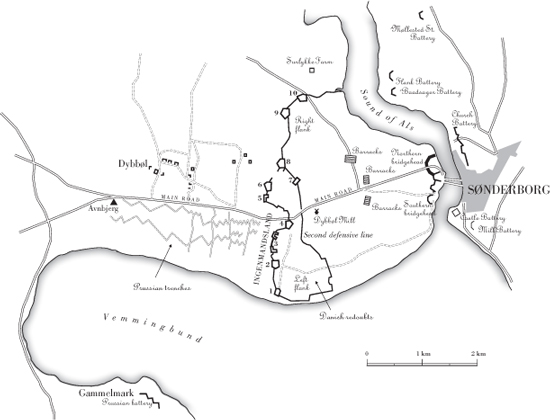
Danish and Prussian positions at Dybbøl, April 17, 1864
1
Sunday, 17 April 1864
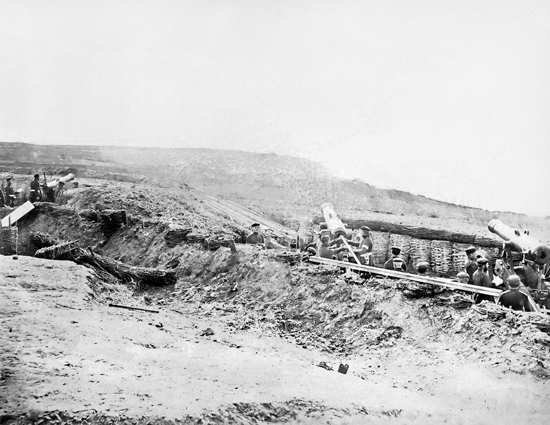
Only a few hundred metres – in some places a mere 150 – was all that separated the opposing armies on 17 April. For several weeks the Prussians had advanced on their enemy with pick and shovel, digging a gigantic system of zigzagging communications trenches and parallel trenches, which spread like a giant web across no-man’s-land towards the Danish defence works. More than a hundred Prussian siege cannon had been mobilised to wear down the enemy before a decisive assault. Powerless to defend themselves, the Danish troops had no choice but to seek cover from the relentless shelling and pray for a miracle, the men crouching in or behind anything that could provide shelter: parapet walls, powder magazines, trenches, shell-holes and rifle-pits.
The position was untenable. Yet on 17 April neither side knew what the other was planning. The Danes expected an attack, but were unsure when it would take place. The Prussians, in turn, were readying a large mass of troops to storm the Danish position the following day. They did not, however, know whether the Danes were preparing a sortie or perhaps even an evacuation of the position.
An international peace conference had been scheduled for 20 April in London, and both parties were eager to enter into these negotiations from a position of strength. In Berlin it was believed that a major victory would speak in their favour. Conversely, Danish politicians in Copenhagen believed sustaining a hostile attack would garner support for Denmark’s interests – even if, as they phrased it to their generals, ‘such a defence would result in massive casualties’.
2
The chosen one
‘Am I going to die?’ 26-year-old Wilhelm Gather of the Prussian army wondered while attending an outdoor service with his company on a cold but sunny April morning in 1864. He could hear the muted thunder of cannon in the distance as he received Holy Communion. With his head bent like his comrades, he thought about the prospect of dying in battle. ‘Who among us here will soon depart this earth?’ he silently asked no one in particular.
Wilhelm Gather belonged to the 4th Company of the 4th Regiment, quartered in the small village of Nybøl a few kilometres from the front line. Gather and his regiment had come in from Varnæs, near Åbenrå, twenty kilometres west of Dybbøl Hill, where they had been encamped for a few days. On 16 April they had been given their marching orders for Nybøl. And like everyone else in his company, Gather knew that this meant an attack was under way.
A week earlier the Prussian general staff had begun the process of selecting the regiments that would serve as assault troops. Gather’s regiment was among the chosen ones, and he would be in the first line of attack. Essentially, assault troops were responsible for overpowering the enemy and thwarting any counter-attacks until reserves could be deployed. And everyone was aware that this assignment was extremely dangerous. Assault troops always suffered huge losses.
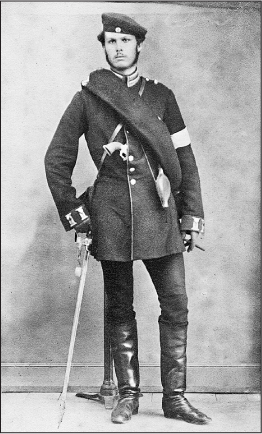
A Prussian lieutenant from the 4th Company of the 4th Regiment who were given the order to march to the frontlines on 16 April and became part of the first wave of attack on 18 April.
Gather became overwhelmed with fear when on 13 April he was told his company had been selected to spearhead the attack. In a letter to his parents, he wrote, ‘Truthfully, it is such a strange feeling to know I’ll be in the first line of attack. The mood in my regiment is grim, and none of us can stop thinking about dying.’
At first, Gather had fervently hoped that ‘the Danes would withdraw from their position before they could attack, or that an international peace conference would be set up, and the attack called off’.
He realised, of course, that these were merely wishful thoughts. So, rather than long for the impossible, he set his hopes on being deployed as a rifleman. A rifleman would fire at the Danish defence line from a distance, and, as he later explained to his parents, therefore had the advantage of being able to seek cover from the dreaded case-shot that was sure to kill swathes of the men storming the Danish position.
He also tried to assuage his fears by noting to his parents that while many men would fall, there were always some who made it. There were always survivors, and why shouldn’t he be one of them?
Gather was a well-trained soldier. Like most Prussian men, he had gone through three years of mandatory military service, completed in 1862. He had been called up for active duty when war threatened, and, much to his chagrin, had been forced to put on his uniform again. Despite all his military training, Gather did not feel like a soldier. In fact, from day one he absolutely hated the war, simply could not stomach the hardships and dangers on the front. He was a farmer at heart and longed for the peaceful life on the family farmstead in the village of Hohenburg in the Prussian Rhine Province. The family farm was situated on the slopes of the Rhine and had a grand view of the river. In letters to his parents, Gather lovingly and fittingly referred to his home region as ‘Vater Rhein’ (Father Rhine).
So far in the campaign, Gather had been lucky. He had been spared serious action and felt he had much to be thankful for when he attended the outdoor service in Nybøl on 17 April. Though the war had been going on since 1 February, the 3rd Army Corps to which his regiment belonged had not been involved in any major battles, unlike the allied forces’ two other corps. Still, the months-long campaign against Denmark had been trying for Gather.
It had been freezing cold when they were based at the Dannevirke fortification forty kilometres south of Dybbøl, where the Danes had initially taken position. And no one doubted that the capture of the Dannevirke would inflict heavy casualties on the Prussian and Austrian troops. Gather therefore found himself in a state of extreme agitation when an order was given on 5 February to row across the Schlei Bay and conduct a flank attack on the Danish line. For days the sound of booming cannon had rung out along the thirty-kilometre front line. Both sides had suffered great losses and a palpable fear had gripped the men. To his great relief the attack was called off. In the dead of night and unbeknownst to the Austro-Prussian forces, the Danes had managed to evacuate their position.
In the weeks that followed, Gather’s regiment was deployed to the east coast of mid-Jutland: first to the town of Kolding, just south of the Kongeåen River, and then to Fort Fredericia. The allied troops had besieged the fort and subjected it to several heavy artillery attacks during the month of March.
Gather got his first taste of battle in a minor skirmish near Kolding, where he witnessed a fellow soldier being shot through the chest. Gather was not so much as scratched, but his luck was about to change. By the end of March his regiment was deployed to Dybbøl, now under siege by Prussian troops. The trenches here were cold and wet and the men were miserable. Provisions were miserly, and Gather complained about the meagre rations in letters to his parents. Sometimes, he wrote with much scorn, they did not even get their ration of tobacco. Making matters even worse were the ludicrously low wages of a Prussian conscript. It did not matter much, though: there was little of interest to buy from the stores in the North Schleswig villages or from the sutlers, those itinerant merchants-of-fortune who seemed to appear wherever nineteenth-century armies set camp. According to Gather, the quality of Danish beer and schnapps was terrible.
At the beginning of April, Gather’s fear of combat rose again as plans of an attack on the island of Als were set in motion. Hundreds of rowing boats were to carry large units, including Gather’s regiment, across the widest part of the sound to Als. The thought of sitting exposed in a rowing boat in open water was terrifying to him. If discovered by the Danish warships circling these waters, the regiment would have a minimal chance of survival, and to boot most of the men could not swim. Bad weather, however, set in and the dangerous crossing was cancelled. Gather felt a huge surge of relief when he heard the news, and admitted as much in a letter to his parents.
On 17 April, however, Gather understood he was running out of luck. Everything indicated that a grand assault was imminent. Nearby villages with foreign-sounding names such as Vester Sottrup, Avnbøl, Smøl, Stenderup, Skodsbøl and Bøffelkobbel bustled with the activity of military buildup. Soldiers were quartered in farmhouses and stables, and new camps were being built in the open; the biggest of these was near Nybøl, where sutlers had begun setting up trading tents and stalls. Clusters of soldiers could be seen in town squares, open spaces and among the trees in nearby woodlands. Both camps and villages filled up with carriages, carts and horses; lines of laundry hung wherever possible, rifle piles and fire-pits were scattered over the area. And at all hours of the day, orderlies could be seen tearing through the camps at full gallop.
Gather was one of 11,000 troops that were to take part in the first wave of attack. Another 30,000 reserves and cavalry had been moved forward, and a great number of mobile field batteries were being emplaced near the Dybbøl position.
Other sure signs of the impending assault were the long trains of ambulance carts lined with hay for the wounded on the main road, the double rations of meat – sardonically named ‘last supper’ by the men – and the great number of church services like the one Gather was attending.
The general staff, however, were not forthcoming with the actual date of the attack, so Gather and his fellow soldiers lived in great uncertainty over how long they could count on being alive.
After the service Gather went to his quarters, a stable assigned to his company in the village of Nybøl. Lying on his stomach, he penned a letter to his parents, using his knapsack as an impromptu table: ‘I focus all of my energy on what a blessed day it will be when I will see you all again,’ he wrote.
3
The battle plan
At exactly 12 p.m. an imposing figure with impeccable posture and striking looks arrived at Hvilhoj Inn near Nybøl. The man sported a well-groomed moustache, a red Prussian hussar’s uniform with white braiding, white cross-belt, white armband and tall, shiny black boots. Already present at the inn were the Prussian generals Canstein, Raven, Schmidt and Goeben and the commanders of the assault troops, the artillery and the engineer troops. They all cordially greeted the newcomer, as well they should: he was none other than Prince Friedrich Karl of Prussia, supreme commander of the Prussian army at Dybbøl.
‘Tomorrow, gentlemen,’ he announced without preamble, ‘I bestow upon you the honour of taking the [Danish] entrenchment. His Royal Highness has instructed me to relay to you his best wishes; he will pray for us and be with us in spirit.’
Throughout the campaign against Denmark, the prince, known as the ‘Red Prince’ for the colour of his hussar’s uniform, had often appeared insecure and out of sorts. But on this day he emerged as a strong and decisive leader. In light of the upcoming peace conference on 20 April, the timing for an assault was perfect: 18 April would be the Day of Destiny.
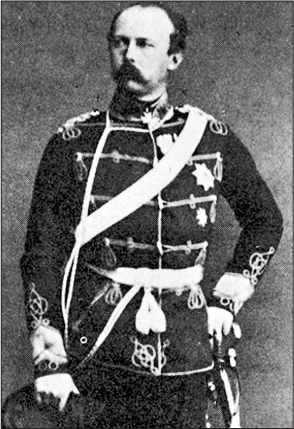
Prince Friedrich Karl of Prussia, supreme commander of the Prussian Army at Dybbøl, known as the ‘Red Prince’ because of the colour of his hussar’s uniform. Throughout the campaign he had often appeared insecure but emerged as a strong and decisive leader at the battle of Dybbøl.
The prince was no novice to warfare. In 1848, after two years at the University of Bonn, the twenty-year-old prince had joined General von Wrangel’s military staff as a captain in the campaign against Denmark in the First Schleswig War, where he acted as adjutant. Awarded a medal for bravery and unerring judgement on the battlefield, and promoted to major, he had then participated in a military operation against insurgents in the Baden Revolution of 1849, where he was wounded. During these engagements, the prince had managed to earn not only his men’s respect but also their loyalty and trust. Strict, caring and courageous, he was perceived to be the ideal Prussian officer – a model soldier to his men.
In 1856 he was promoted to lieutenant general, and in 1860 he was given charge of the 3rd Brandenburger Corps. In the campaign against Denmark in 1864, he initially headed the 1st Army Corps, but in March he was promoted to supreme commander of the allied forces of Austria and Prussia at Dybbøl. The well-being of his men was of the utmost importance to the prince – too important, according to some of the more senior generals, who now felt his consideration for the men’s welfare rendered him weak and ineffectual.
There was some truth to these accusations, and the prince admitted as much after the war. He hated exposing his soldiers to undue danger. And when it happened, he was much affected by it. He had trouble sleeping on nights when Danish artillery batteries returned fire from Dybbøl.
The prince understood his battle-worn men; he, too, was weary of the campaign. Only a couple of months earlier, on 2 February, he had launched an attack with 10,000 men and an artillery battery consisting of sixty-six field pieces against an advanced Danish trench position at Mysunde near the Dannevirke. Despite his superior military strength – the Danes had only twenty cannon and 2,500 men on this section of their defence line – the prince had been forced to retreat.
It had been a miserably cold day and a heavy fog had made it nearly impossible to see more than a metre or so in any direction. The prince had felt wretched, knowing that his decisions alone would decide the fate of so many soldiers; he was sick with worry, and on top of that his bones had ached with cold.
The Prussian troops had been met with vigorous fire from the Danish artillery at Mysunde. The cannon had boomed, the ground shook, and thick plumes of gun smoke had mingled with the increasingly dense fog. Mysunde town was ablaze; within a few hours, nothing was left but a heap of smouldering ruins.
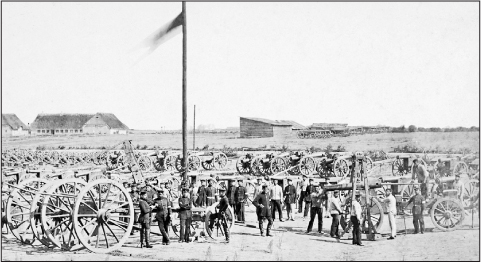
Prussian siege-artillery. The Prussians deployed batteries along the entire Danish line. Night and day there was a hissing and bursting of shells at Dybbøl.
As the prince charged, Danish artillery returned fire with ferocious willpower. Exploding shells burst through the air, striking the ground with loud hissing noises; a good many landed near the prince. Confused, he had looked to the Danish entrenchment, realising that despite his superior strength he would not be able to crush the determined Danish resistance. Reluctantly, he had ordered a retreat, knowing full well that his troops would sustain serious casualties. Case shot had torn through the retreating columns and many Prussian soldiers had fallen and been left behind on the frozen ground as quiet testament to the failed operation.
It all seemed hopeless. The first attack on Danish positions had been a failure, and the prince knew Berlin would take a stern view of the situation. His failure would give the warsceptics grounds to withdraw their support from the Scandinavian campaign.
The prince had known a similar despair in late March, following another failed operation. The weather had been miserable: overcast, rainy and cold. He was in poor health, and he had found it increasingly difficult to fall asleep at headquarters on Gråsten Castle, which was dark and damp. ‘It’s as if there’s no warmth at all in this part of the world,’ he wrote.
With his chief of staff, Colonel Blumenthal, he had masterminded a grand battle plan to be carried out by the end of March. Referred to as Operation Ballebro, the plan was for a large force of Prussian troops to launch a surprise pincer attack on the Danish forces at Dybbøl from the island of Als. In the dead of night, they were to cross the sound to Als in rowing boats, encircle the unsuspecting Danish reserve troops there, completely disbanding and destroying them, and then proceed to attack Dybbøl from the rear. Based on the assumption that the Danes, who had naval superiority, would never suspect the Prussians capable of such a daring tactic, it was believed the manoeuvre would work.
The men selected for this operation, including Private Gather and his company, were visibly anxious; the prince, too, was filled with trepidation and uncertainty. On the one hand, he was excited by the prospect of a quick victory and the military glory this would bestow on him and his men. On the other hand, he was worried that he was taking too much of a risk. Was he gambling with the lives of his men? According to the plan, they were to cross at the widest part of the sound, where there was the least likelihood of encountering Danish resistance. However, if they were discovered, Danish warships could quickly be summoned and not only thwart their surprise attack but completely destroy them.
The prince was sick with the pale cast of indecision. The counsel of several of his generals and advisers to abort the plan did little, of course, to boost his resolve. Days passed, and still the prince could not make up his mind. One hundred and sixty rowing boats were moored at Ballebro; heavy, rifled field artillery had been dug in and was ready to open fire on Danish warships; 10,000 troops had been deployed; a diversionary frontal assault on Dybbøl was ready to be launched.
To attack, or not to attack? As the prince remained indecisive, his generals tore into a heated argument. The hot-headed and temperamental General Blumenthal was especially vociferous in his call to action. Though he was apprehensive about the attack, he had little patience with his superior commander’s dawdling. At a meeting of the general staff, the other officers looked on open-mouthed as Blumenthal engaged in a shouting match with the prince, yelling at him to get his act together and issue the order to attack.
The prince, however, wavered, until on 1 April a massive storm broke out with howling winds and three-feet waves, preventing any attempt to cross the water. A relieved prince called off the operation; no doubt he saw the storm as a sign from God. It was, instead, unanimously decided to launch a real frontal attack on the Dybbøl position.
The defences at Dybbøl, however, were considered too strong to be taken in a quick decisive attack. The Prussian strategy, therefore, was to lay siege to the position and weaken it through continuous and heavy bombardments. However, time was of the essence as the Prussian generals were being strong-armed by Berlin, eager for a swift victory over the Norse.
By 17 April, the prince therefore felt compelled to push back the attack to the following day. He and his general staff had worked out an ingenious plan: a strategic masterpiece where absolutely nothing was left to chance. Detailed instructions on the execution of this battle plan were given to all attending officers at the Hvilhoj Inn meeting:
At 1.30 a.m. on 18 April the first attack columns were to move forward and, like shadows in the night, silently glide across no-man’s-land through the communications trenches into the front-line trench (the so-called ‘third parallel’). At 2 a.m. three more columns were to follow, quietly moving into position in the front-line trench. Once all 10,000 troops were in place, they were to lie down noiselessly and await the order to attack; meanwhile, the 102 Prussian cannon were to pound the Danish position. At exactly 10 a.m. the cannon were to cease fire and the attack commence.
The Prussian generals listened carefully. They were ready. For days now they had drilled their assault troops on Broager and Nybøl, where replicas of the Danish trenches had been built. All attack columns were deployed, all batteries dug in and the last front-line trench finished.
‘Any questions, gentlemen?’ asked the prince.
No one uttered a word until a voice from the back of the room cut through the silent acquiescence: ‘If the first column of attack is brought to a halt, should the next fire at it to force it onward?’
All eyes fell on the speaker: General von Goeben, a tall, lean man with a pointy chin, an aquiline nose and wire-rim glasses. According to Adjutant von Geilsler, the question was put forth in a calm, business-like tone.
Nonplussed, the prince seemed momentarily at a loss for words, but he quickly recovered and assured Goeben that the situation would never arise. ‘That won’t happen,’ he reiterated with a dismissive wave of his hand.