
SEX BY NUMBERS
DAVID SPIEGELHALTER is Winton Professor for the Public Understanding of Risk in the Statistical Laboratory, University of Cambridge. He is a Fellow of the Royal Society, Fellow of Churchill College Cambridge, has an OBE and knighthood for services to statistics, and in 2011 came seventh in an episode of Winter Wipeout. He is co-author of The Norm Chronicles (9781846686214), also published by Profile Books.
WELLCOME COLLECTION is the free visitor destination for the incurably curious. It explores the connections between medicine, life and art in the past, present and future. Wellcome Collection is part of the Wellcome Trust, a global charitable foundation dedicated to improving health by supporting bright minds in science, the humanities and social sciences, and public engagement.
ALSO BY DAVID SPIEGELHALTER
The Norm Chronicles (with Michael Blastland)
SEX
BY
NUMBERS
The Statistics of Sexual Behaviour
DAVID SPIEGELHALTER

First published in Great Britain in 2015 by
PROFILE BOOKS LTD
3 Holford Yard
Bevin Way
London WC1X 9HD
www.profilebooks.com
Published in association with Wellcome Collection

Wellcome Collection
183 Euston Road
London NW1 2BE
www.wellcomecollection.org
Copyright © David Spiegelhalter, 2015
The moral right of the author has been asserted.
All rights reserved. Without limiting the rights under copyright reserved above, no part of this publication may be reproduced, stored or introduced into a retrieval system, or transmitted, in any form or by any means (electronic, mechanical, photocopying, recording or otherwise), without the prior written permission of both the copyright owner and the publisher of this book.
A CIP catalogue record for this book is available from the British Library.
eISBN 978 1 78283 099 3
This book is dedicated to everyone in history who has struggled with sex. And eventually called it a draw.
CONTENTS
1. Putting Sex into Numbers
2. Counting Sexual Activity
3. Spin Your Partner
4. Activities with the Opposite Sex
5. Activities between People of the Same Sex
6. By Your Own Hand
7. How It All Starts
8. Feelings about Sex
9. Together at Last: Becoming a Couple
10. Sex and Not Having Babies
11. Sex and Having Babies
12. Pleasures and Problems
13. Sex, Media and Technology
14. The Dark Side: Prostitution, the Pox and Having Sex against Your Will
15. A Boy or a Girl
16. Conclusions
Appendix: Natsal Methods
Notes
List of Illustrations
Acknowledgements
Index
1
PUTTING SEX INTO NUMBERS
Does oral sex count as ‘having sex’?
Bill Clinton famously claimed on 26 January 1998 that ‘I did not have sexual relations with that woman, Miss Lewinsky’, a claim later repeated in a court deposition. It then became known that he had received oral sex from Monica Lewinsky. So did he or didn’t he have sexual relations with her?
60%: the proportion of US students who thought that oral sex did not count as ‘having sex’
What counts as ‘having sex’ might seem like a matter of individual opinion, but when Clinton was impeached for perjury in December 1998 – only the second time this had happened to a US President – it assumed national importance. In the same month the editor of the Journal of the American Medical Association, George Lundberg, fast-tracked a paper by researchers from the Kinsey Institute for Research in Sex, Gender and Reproduction Studies which was then published a month later in January 1999, just before the Senate impeachment hearing.1 In 1991 over a thousand students had been randomly sampled from Indiana University, and 599 (58%) agreed to complete a history of their sexual activity and actually turned up to do so.a
Figure 1: What 599 US students thought of as ‘having sex’ in 1991
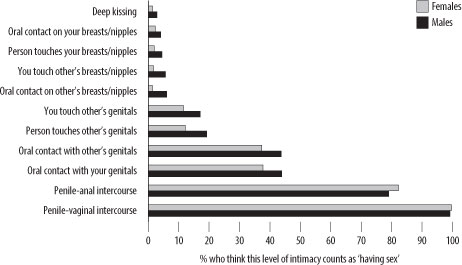
As part of the sex history, the students were asked, ‘Would you say you “had sex” with someone if the most intimate behaviour you engaged in was …’ – Figure 1 shows the responses. Just about everyone considered vaginal intercourse was ‘sex’ – the few men who answered ‘no’ are presumably waiting for some extraordinary activity before they feel they have gone all the way. At the other extreme, only a few considered that kissing breasts counted as sex. Around one in seven thought that ‘sex’ had occurred if genitals were touched, while 40% thought oral sex alone was ‘sex’, which means 60% thought it wasn’t. So more than half would agree with President Clinton’s claim of innocence.
Statisticians, contrary to popular opinion, are also human beings, and so I am fascinated by the special role that sex plays in our individual lives and society as a whole. Sex occupies a strange boundary between public and private: as President Clinton found out, sex can dominate news headlines yet (usually) goes on in private. We can speculate endlessly about the sex lives of others, but anyone trying to find out what is really going on will face a seriously challenging task.
But there are all sorts of reasons why we might want to know about sexual behaviour. It shapes the societies we live in: demographers, who study changes in population, want to know about sexual activity, and the use of contraception and abortion, so they can predict how many babies will be born and to whom. As we will see later, sexual activity may even shape the gender ratio of a population. Doctors and health researchers want to know what people get up to, and what precautions they take, in order to work out the chances of diseases being transmitted, and to plan the medical services for the unlucky ones. Psychologists may want to know about the quality of sexual activity and people’s satisfaction with their lives. Psychiatrists want to identify and treat disorders, and pharmaceutical companies will want to develop and promote new treatments.
And the rest of us may be simply curious as to where we lie in the extraordinary range of human behaviour. Am I having too much? Not enough? With the right person? Did I start early, or late? Are my experiences different? Or at least, are they really different?b
Our sexual behaviour has a profound effect on how we live our lives: how society views you, whom you marry, whether you stay together, your health, whether you have children – all of these are shaped by sex. We are right to be curious. And we are right to wonder whether what we are told about sex – from government statistics to old wives’ tales – is really what the numbers say.
How can we know what is going on behind closed doors?
To enjoy (or possibly suffer) any of the results of sex, you first have to have it. ‘How much sex is going on?’ seems like a simple enough question, but a moment’s pause reveals that it is open to a variety of interpretations. We’ve already seen that people have widely varying ideas about what qualifies as ‘sex’. We’ve left behind (although not that far behind) the time when sex between people of the same gender was not only socially stigmatised but actually illegal, so we can include same-sex sex. But what about solo sex? Whether or not you think that masturbation ‘counts’, later on we will count masturbation.
And when we are counting up sexual activities, do we include the (illegal) under-16s and the (legal) over-70s? And then there are different countries and cultures, and even the season can be important – we will see that Christmas holidays may be a particularly busy time.
So this simple question of ‘how much sex’ is already not so simple, and that’s before we ask ourselves: how on earth are we going to find out?
A strictly scientific approach might install CCTV in a randomly selected set of bedrooms. This would not only make staggeringly dull viewing for most of the time but would also miss those sudden bursts of passion in the shower or the shed. So maybe we could put head-cams on some willing volunteers? Unfortunately, anyone who signed up to this experiment is hardly likely to be a representative sample of the population, and I doubt whether the study would get through a research ethics committee (although we are going to meet some very bizarre studies that presumably someone approved). And even if it did, this monitoring might encourage unusual performance, whether hesitancy or exhibitionism – the so-called ‘Hawthorne’ effect, when just scrutinising an activity changes what is done. Just think of Big Brother.
There are other, more reliable methods, though none of these is perfect. Whatever the sexual activity, someone, somewhere has tried to count it, but a running theme throughout the book will be the doubtful quality of many of the numbers that have gained headlines in the past: there’s a lot of shabby statistics out there that keep on getting recycled. So in an attempt to provide some degree of order, I shall often give numbers a ‘star rating’ that says how reliable I think they are. Let’s start in the top drawer.
4*: numbers that we can believe
We can get concrete evidence of some of the consequences of sex by counting babies, or treatments for diseases or other ‘official statistics’. As it’s a legal obligation to register a birth or marriage or abortion, these numbers should be reliable. So, for example, we can be confident that in England and Wales:
I shall label these as 4* numbers, which are so accurate that we can, to all intents and purposes, believe them. And we’ll have a look at all these fine numbers later.
3*: numbers that are reasonably accurate
Nobody (yet) is under any compulsion to answer intrusive questions about their sex life, and so we are never going to be able to get 4* data about private activities. So we have to ask thousands of people about their behaviour and opinions, and try to do it well enough to be able to trust the answers.
It makes a big difference how the people are chosen. Suppose I want to know what proportion of people have sex before they are 16. I tell you that out of 1,000 young people, 300 say they did (this is about the current British estimate). If these 1,000 people had been chosen at random, with everyone in the population having an equal chance of being chosen, then a bit of statistical theory will show that we can be 95% confident the true underlying proportion of young people who had sex before 16 lies between 27% and 33%:c this relatively small margin of error is due to the play of chance in whom we happened to ask.
But if these 1,000 young people had been interviewed, say, coming out of clubs on a Saturday night, or had responded to an online survey in a lads’ magazine, then I would have no idea what the error might be, except to suspect it might be large. Instead of pure random error, we have systematic bias. And it is this kind of bias that is so important in statistics about sex.
So try this little quiz. You have a sex life. Even if it’s nothing to write home about, or so exotic that you would never write to anyone about it, you can still be a valuable data point for a researcher. If you were told the results would be confidential, would you feel happy answering questions about how often you had sex, what precisely you got up to, how many partners you had had, whether and how often you masturbated, and so on, if –
Would it make a difference if the survey were funded by a drug company or a condom manufacturer? Or if you were told it would contribute towards planning health services? And would it make any difference if you were paid, say, £15?
All these methods have been tried. But if none of these would incite you to participate, then you would be a missing data point. And if your reluctance to participate was in any way related to your sex life, then you would be biasing the results.
But there are good surveys, such as the British National Survey of Sexual Attitudes and Lifestyles (Natsal), properly conducted using random sampling and making repeated attempts to get information from individuals, using methods shown to maximise truthful reporting. And most of their results I would label as 3* numbers: reasonably reliable, with errors that are unlikely to make a substantial difference.d
For example, some Natsal statistics about Britain which we’ll look at later include:
2*: numbers that could be out by quite a long way
The next level of numbers tend to come from surveys that have not used random sampling, but where effort has been put into finding volunteers who cover a wide range of experience. Alfred Kinsey, perhaps the most famous sex researcher, obsessively collected 15,000 detailed sex histories in 1940s’ America. Some of Kinsey’s headline statistics that brought him notoriety, and which we’ll meet in Chapter 4, included:
I would rate many of his results as 2*, which means they might be used as very rough ballpark figures, but the details are unreliable.e
1*: numbers that are unreliable
Even further down the scale come numbers that may be so biased as to be essentially useless as generalisable statistics, even if they do portray valid, and vivid, experiences. The classic examples are the surveys carried out by Shere Hite, which were crucially important in the women’s movement of the 1970s and 1980s. For her 1976 Hite Report on Female Sexuality she distributed 100,000 copies of her questionnaire to women’s groups, chapters of the National Organization for Women, abortion rights groups, university women’s centres and so on, followed up with advertisements for respondents in women’s magazines.2 She obtained 3,019 responses. This is a low response rate of 3% from a highly selected group, though to her credit Hite did not make much of the statistics, instead arguing from copious quotes that many women were dissatisfied with a mechanical male approach to sex, and that orgasm could be more easily achieved by masturbation than penetration. This report had a powerful influence on views of female sexuality in the 1970s.
Hite returned in 1978 with The Hite Report on Male Sexuality (7,239 responses out of 119,000 questionnaires),3 and in 1987 with Women and Love, based on 100,000 questionnaires and 4,500 responses.4 This time she heavily promoted her statistics, which included:
She received harsh criticism. TIME magazine put her on the cover but said the report was a ‘male-bashing diatribe’, while the Chairman of the Harvard Department of Statistics, Don Rubin, said ‘So few people responded, it’s not representative of any group, except the odd group that chose to respond.’f 5 Unfortunately Hite continued to defend her statistics as ‘representative’ when this was clearly not the case, and this provided a weapon for those who did not like her essential, and arguably very reasonable, conclusion: many women did not find their men communicative and loving, and thought they were too focused on the mechanics of sex. In any case, the statistical criticisms had limited impact: the lengthy personal stories (Women and Love runs to over 900 small-print pages) chimed with women’s experiences and the books were best-sellers.
Although Hite’s messages seem plausible, I would label her statistics as 1*: inaccurate.g Other 1* statistics that we will come across include the claim that single people in Los Angeles have sex 130 times a year, and that prostitution contributed £5.7 billion to the UK economy in 2012.
0*: numbers that have just been made up
We now get to the rock-bottom; numbers that get trotted out as part of an argument or to entertain, but have no supporting evidence. The sort of thing you might hear in the pub, on a radio phone-in or in Parliament. Some examples we shall deal with later include:
These I would rate as 0*: thought-provoking but utterly unreliable. And most misleading of all, of course, is the claim by Philip Larkin that sexual intercourse began in 1963 (‘which was rather late for me’), but perhaps we should grant him some poetic licence.6
What can sex statistics tell us?
I am a statistician, and so this book will contain a fair amount of numbers and graphs (you might have been warned by the title). There will also be some extraordinary experiments, such as testing whether people admitted to having had more sexual partners when they believed they were wired to a liedetector (women did), and whether sexual arousal reduced the disgust response (it did). But stats cannot say everything, so we will also hear stories from elderly people who were interviewed about their sex lives in the 1920s and ’30s.7 Such ‘qualitative’ data do more than bring colour to the statistics: they can remind us that every number is an inadequate attempt to summarise a collection of powerful and unique personal experiences.
1902: the date of the first published sex survey, on masturbation among members of the YMCA
Research on the statistics of sex has a colourful history. We will encounter William Acton counting prostitutes as he walked through London in the 1860s, F. S. Brockman producing the first published sex survey in 1902, on masturbation in the Young Men’s Christian Association, and Magnus Hirschfeld asking Berlin metal workers about their sexual orientation in 1903. Then Kinsey shocking America with his extraordinary study, Shere Hite’s analyses of female sexuality, and into the era of HIV/AIDS and the struggle to get serious surveys funded. These people were brave: sometimes risking physical danger and always risking public condemnation and their reputations.
These researchers thought of themselves as objective scientific investigators, but with hindsight were clearly driven by their own unquestioned assumptions and often a strong agenda regarding sexual politics. And so I should own up to being a white, middle-aged, middle-class man, full of implicit and explicit beliefs and assumptions, which are probably fairly representative of our current period and culture: a tolerance of alternative sexualities and behaviours between consenting partners, but a strong intolerance of sex involving coercion.
This book focuses on (fairly) normal behaviour. I have generally avoided what is currently illegal, including child abuse, incest and sex with animals (apart from Kinsey’s data). Of course, some behaviour that has, in the past, been considered a product of a diseased mind will be included, such as same-sex activity and heterosexual anal sex. I also concentrate on sexual behaviour, so feelings and bodily responses get undeservedly small attention, although statistics on penis size and ‘intravaginal ejaculation latency times’ were too good to be left out. And although we will look at statistics about people’s problems with sex, and also at some of the therapies suggested, you will need to look elsewhere for advice. I will also be sceptical of some attempts to answer more general questions about ‘causes’: what causes sexual orientation, whether exposure to pornography causes coercive sexual behaviour and so on.
I am happy to admit that statistics have their limits.
So did Clinton have sexual relations with Lewinsky?
55%: the proportion of the US Senate that agreed that Clinton did not have sexual relations
Remember that in January 1999, as the US Senate prepared for the impeachment vote on President Clinton, a paper was published showing 40% of the students thought that oral sex was ‘having sex’, and 60% didn’t. The press embargo on the paper was broken, and the media had a field day. Then when the Senate voted on the issue a month later, they split almost exactly the same way as the students had: 45 Senators said Clinton was guilty of perjury, and that he did really have sex with Lewinsky, and 55 said he was not guilty and that he was not lying when he said he did not have sex.h Clinton survived the vote and has become an elder statesman, while George Lundberg, the editor of the Journal of the American Medical Association, who had fast-tracked the paper for publication, was not so fortunate: he was sacked.8
All this discussion about ‘What is sex?’ may now seem a bit pedantic, but it has a serious point. When carrying out surveys of sexual behaviour, it is important to be clear about what is considered as a ‘sexual partner’. If we want to know the risks of a sexually transmitted infection travelling through the community, we need to know how many people are at risk of catching something. So in modern surveys, ‘having sex’ has come to be defined as an activity that can transmit infections, and in Natsal an opposite-sex partner is someone ‘with whom the respondent has had oral, anal, or vaginal sexual intercourse’. So, according to this modern definition, Clinton and Monica Lewinsky were sexual partners.
Federal District Judge Susan Webber Wright agreed, and wrote ‘his statements regarding whether he had ever engaged in sexual relations with Ms. Lewinsky likewise were intentionally false’, and fined him $90,000. He later had his licence to practise law withdrawn for five years, and paid $850,000 to settle the sexual harassment suit that had started the whole business off. But did he ‘have sex’? I’ll leave it to you to decide.
Footnotes
a That response rate may not sound great, but keep a mental note of it to compare with some other efforts.
b Of course, we have to face the prospect of finding out that everyone is having more sex than us. And that includes our partner.
c For the technically minded, this is based on p +/- 2√ (p(1-p)/n), where p = 0.3 and n = 1000.
d I will rate a number as 3* if I judge that it is accurate to within a relative 25% up or down, so that a claimed proportion of 12% could actually be anywhere between 9% and 15%.
e Technical note: please feel happy to ignore all this. I shall take this as meaning that the true answer may be up to double, or as low as half, what is claimed. Proportions p should be changed to odds p/(1-p), and the doubling and halving applied on the odds scale. For example a 2* proportion of 50% would be transformed to odds of 0.50/0.50 = 1, doubled and halved to odds of 0.5 and 2, then transformed back to proportions of 0.33 and 0.66. So the true answer might be between 33% and 66%.
f Her statistics not only seemed rather implausible and out of line with other surveys, but were also just too neat to be true. Take, for example, her conclusion that ‘70% of women married five years or more are having sex outside their marriages’ – when broken down by ethnicity, the proportions quoted were White (70%), Black (71%), Hispanic (70%), Middle Eastern (69%), Asian American (70%), Other (70%). Such close agreement in proportions, particularly when some of the subgroups are very small, is essentially impossible.
g Technical note: I interpret 1* as meaning the true answer could well be more than double or half what is claimed, so a reported average of 4 sexual partners could in fact be greater than 8 or fewer than 2. An odds scale is used for proportions, so for a claimed proportion of 50%, the true answer could be greater than 66% or less than 33%.
h Although it would stretch credulity to claim that this vote represented the true beliefs of the Senators – the vote was almost entirely on party lines.
2
COUNTING SEXUAL ACTIVITY
How much sex is going on?
On the face of it, this seems a simple enough question. But it gets to the root of the problem of researching sex, and it gives us a chance to see how people have struggled to get reliable answers.
23%: the proportion of British 25- to 34-year-olds who said they had not had sex with an opposite-sex partner in the last four weeks (Natsal-3, 3*).
A natural place to start is the most reputable recent British survey; the third round of the National Survey of Sexual Attitudes and Lifestyles (Natsal-3), which started collecting data in 2010.a Women respondents were asked ‘On how many occasions in the last four weeks have you had sex with a man?’, and vice versa for male respondents. And it was clearly explained that ‘having sex’ meant vaginal, oral or anal intercourse, so men who thought that kissing a breast was ‘having sex’ should have been put straight. In fact, the participants were not asked this in a conversation with a human interviewer – it was done on a computer.
Figure 2: Proportions reporting different frequencies of heterosexual sex over the previous four weeks
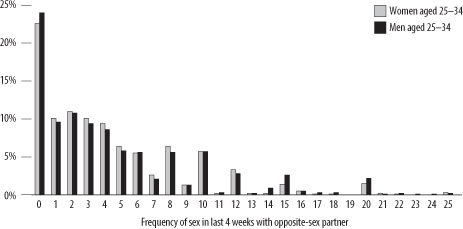
2,434 women and 1,500 men aged between 25 and 34 (12 responses with a frequency of more than 25 are not shown). Source: Natsal-3 in 2010.
Figure 2 shows the detailed data from Natsal-3 for women and men aged between 25 and 34 – the horizontal axis has been stopped at 25, since if I included one man’s claim of ‘100 times’ the whole picture would be crammed to the left.
There’s a whole statistics lesson that could be based on this one graph. First, by comparing the heights of the bars, we can see that responses from women and men are broadly similar, which is reassuring. Then note the common use of round or almost round numbers such as 8, 10, 12, 15 and 20 times, suggesting that individual events are not being recalled, but an overall rough guess is being made, presumably based on a judgement of weekly frequency.
A particularly salient feature is the most common response, known as the ‘mode’: this is precisely zero. Nearly a quarter of 25- to 34-year-olds report having no heterosexual sex in the previous four weeks. Of course, some of these will not be heterosexually ‘active’, which Natsal define as not having had an opposite-sex partner in the whole of the preceding year: when we take out this group, we are left with around one in six 25-to-34s who are heterosexually active but have not had sex in the last four weeks – these will be primarily single people.
But while it’s interesting to know what the largest number of people are up to, we might also want to look at the average person. Suppose we took all 1,500 male respondents aged between 25 and 34, and lined them up in order according to how many times they reported having had sex in the last four weeks. At one end would be a substantial crowd who reported no times, while at the other end would stand the man who claimed 100 times. The man standing half-way along is known as the median, who stands on 3, while the ‘quartiles’ are the man standing 25% of the way along (on 1) and the man at the 75% point (on 7). The same statistics hold for women, and so we can say that the ‘average’ 25- to 34-year-old reports having sex 3 times in the last four weeks.
Whereas the median tells us what the average person is doing, we can also look at what people are doing on average. This sounds confusing, but is simply a shift from the median to the mean: the total number of sexual acts, divided by the total number of people.b The 1,500 men reported a total of 7,230 acts, so the mean is 4.8 per man. The mean for women is slightly lower at 4.4 – this is not necessarily an inconsistency, as some women will have partners older than 34, and some men have partners younger than 25.
Measuring an average by a mean can be misleading when there are some people reporting huge totals: if Bill Gates walks into a room (or even a small country), the mean income will change dramatically, but the median won’t shift at all. Similarly a few claims of high activity, such as reports from sex workers, can have an undue effect – the individual who reported having sex 100 times in the last four weeks put the mean for 25- to 34-year-old men up from 4.7 to 4.8, all by his own efforts. So generally the median is the preferred measure of ‘average’.
What influences the amount of sex we have?
2: the decline between 1990 and 2010 in the median reported frequency of sex in the last four weeks (Natsal-3*)
We can open this up to the whole age range questioned by Natsal, focusing on those who had an opposite-sex partner in the last year and so count as ‘heterosexually active’. Figure 3 shows the summary statistics from the Natsal-3 survey.1 Over the whole 16–74 age range, for both females and males, the median is 3 and the quartiles are 1 and 6, and so the average sexually active adult in Britain reports having sex 3 times a month, with the bottom quarter once or less, and the top quarter 6 or more times.
The obvious feature of Figure 3 is the steady decline of sexual activity with age, though this drop is not utterly precipitous: although this may shock, and possibly even disgust, young people, being over 55 does not necessarily mean focusing only on gardening and trying to get your socks on without putting your back out. Older age can include considerable sexual activity: 64% of 55- to 64-year-old women reported a sexual partner in the last year, with a median frequency of twice a month and a quarter reporting at least 4 times: rather more men in this age group reported having a partner, 76%, with the same median frequency.
Figure 3: Frequency of heterosexual sex reported in last four weeks by sexually active women and men
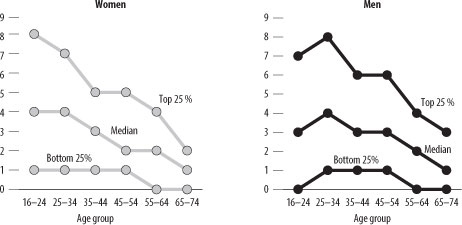
Source: Natsal-3 survey. The lines are the frequencies reported by people who were 25%, 50% and 75% along the spread of responses. So if you are a 40-year-old man who had sex 5 times with a woman in the last month, this puts you in the top half but not the top quarter of sexually active men of your age.
A question that springs to mind is whether the decline in frequency with age is because of ageing itself, or because older people will tend to have been in relationships longer, and maybe the initial energy and enthusiasm have worn off a tad. This certainly seems to happen for younger couples: 16- to 34-year-olds in Natsal-3 who had been in their relationship for less than two years reported a median frequency of 7 occasions in the previous four weeks, compared to a median of 4 occasions for those who had already been together for five years – that’s nearly a halving of activity.
There are not many older people in new relationships, and so it is not easy to work out how much of the decline above 35 is associated with being older, and how much with length of time people have been together. You might want to make your own judgement, but my feeling is that children and other responsibilities, and possibly sheer familiarity, can be as important as simply being older.
But as some of us are all too aware, being older often means your health deteriorates. So is this the cause of the decline in activity? Well, in part.2 Natsal-3 showed that sexual activity declines with age, even for those in good health, but is lower for those in poor health, as was sexual satisfaction, regardless of how old they are. And, particularly sadly, although one in six people said their health had affected their sex lives, rising to two-thirds of those with bad or very bad health, only around a quarter of these affected people had tried to get help from a GP or specialist. We’ll see more of this stoic attitude later.
The data from Natsal-3 provides a snapshot of what is happening in 2010, but invites the question – is the amount of sexual activity going up or down? Looking back at previous Natsal surveys gives the clear answer shown in Table 1; each decade has seen a steady reduction.
Table 1: Median frequency of sex with an opposite-sex partner in previous four weeks
16–44 age group who are heterosexually active
Year |
Women |
Men |
1990 |
5 |
5 |
2000 |
4 |
4 |
2010 |
3 |
3 |
Source: Natsal-1, Natsal-2, Natsal-3.
At the rate of decline shown in Table 1, a simple, but extremely naïve, extrapolation would predict that by 2040 the average person will not be having any sex at all. I rather suspect this will not be the case, but this still leaves the crucial question: why is there less sex going on?
One possible reason for the decline in sexual activity is that fewer people are in partnerships and there are more people living on their own, without another body conveniently at hand. Having a live-in partner is certainly associated with more sexual activity: in Natsal-2 in 2000, cohabiting women between 16 and 44 reported a median frequency of sex of 6 times a month, married women said 4 times, divorced, separated and widowed said once a month, and the average single woman said she did not have sex at all in the last few weeks. But the frequency has also gone down among those with live-in partners – from a median of 5 in 2000 to 4 in 2010. This means that much of the decline shown in Table 1 is due, for some reason, simply to living in a more modern world.c
When the Natsal-3 results were announced in November 2013, one of the team casually mentioned that maybe people were just too busy with their fancy new tablet computers, and so the papers had headlines such as ‘No sex, I’m on my iPad’ and showed pictures of a couple sitting in bed, both staring at screens rather than at each other. In a recent TedX talk Catherine Mercer, one of the Natsal team, suggests that with ‘increasing number of competing demands on our time, sex just falls down our list of priorities’.3 Dealing with work emails late in the evening can mean that ‘come bedtime, we’re just still too connected with everyone and everything out there to be able to focus just on our partner’. It’s impossible to say precisely why the decline has happened, but her suggestion that we are so busy and over-connected seems reasonable.
The pressures of modern life do not just involve electronics. Kaye Wellings, one of the leaders of the Natsal team, told me that middle-aged women were not having sex as they were ‘totally knackered. Kids, parents who are sick, full-on jobs.’ Lack of interest in sex can be a simple consequence of an exhausting daily life.
How Natsal nearly didn’t happen
£7.3 million: the cost of Natsal-3 in 2010
Natsal was almost stopped by attitudes to sexuality that would not seem alien to some Victorians. In the late 1980s there was massive concern about HIV: being infected by the virus was at that time seen as a death sentence, and its transmission crucially depended on sexual behaviour of the type that was generally disapproved of, such as same-sex activity, having many partners, casual sex without condoms and so on.
Nobody had much idea how much of that kind of behaviour was going on, and therefore how quickly HIV might spread. Some sort of survey was clearly essential, and the Natsal team was quickly created by merging groups with both medical and social science backgrounds. Despite some professional reluctance at being put together like a boy band, they swallowed their disciplinary pride,4 and after a successful feasibility survey in 1988,5 by February 1989 they were all set to roll their survey out. The team was in place and plans were laid: all they needed was the final government approval for funding.
And then there was silence. Nothing was heard for months. And then on 10 September 1989 came the Sunday Times frontpage headline ‘Thatcher halts survey on sex.’ Mike Durham, the journalist who broke the story, ‘had Margaret Thatcher, AIDS and sex all in one headline. If it was true, I couldn’t believe my own luck.’d 6 Downing Street claimed the survey would be an invasion of privacy, unlikely to produce valid results, and would be an inappropriate use of public funds.
Fortunately, after lobbying from the Chief Medical Officer, Donald Acheson, the Wellcome Trust stepped in after a few weeks with £900,000 to rescue the survey. So, in spite of Margaret Thatcher, Natsal-1 went ahead in 1990, and this was followed by Natsal-2 in 2000 and Natsal-3 in 2010.e
How should you find out how often people have sex?
Getting the funding for your survey is difficult enough, but researchers also have to decide who to ask, what questions to ask, and how to ask them.8 In a perfect world you could contact a large random sample of individuals, everyone would respond (or at least, there would be no bias in the sexual behaviour of the responders), the right questions would be asked in a way that elicits accurate answers and everyone would tell the truth. Not so easy. In fact, it’s an unattainable ideal, so a huge amount of effort has been put into understanding the potential biases and trying to make sex surveys more reliable.9
Let’s look at the first question: who do you ask?
The idea of a random sample or ‘probability sampling’ is that everyone has the same chance of being asked: Natsal does their best but does not include institutions, prisons or military, which in particular means some single men will be missed out (although I still rate their conclusions as 3*). But this kind of random sampling, then followed by visits and personal interviews, is difficult and very expensive, and so researchers have used quicker and cheaper ways to find out how often people have sex, though inevitably the results start to go down the star-rating scale.
One option is to send out a mass of questionnaires and analyse whatever comes back. Shere Hite was not the first to think of this: in the US, Katherine Bement Davis published her Factors in the Sex Life of Twenty-Two Hundred Women in 1929,10 and said that, of 971 married women, 81% reported having sex at least once a week, and 9% at least once a day. It was a groundbreaking study – shocking for the time – but, like Hite, this is 1* or at best 2* evidence: 20,000 participants were approached through women’s organisations and college alumnae registers, but responses from only 2,200 were recorded, and these were strongly biased towards those with higher education.
Rather than sending out questionnaires, another approach is to go out and hunt for people like biological specimens. This was Alfred Kinsey’s method: in his survey of US married men in the 1940s,11 he found a strong age gradient of frequency of sex, with 21- to 25-year-olds reporting a median frequency of 10 times in four weeks, while 51- to 55-year-olds said 4 times. This is about twice the Natsal rates, which, even given the absence of iPads, seems rather high.
Alternatively, you can just advertise a survey and wait for responses to come in: this is the classic ‘write-in’ used by magazines such as Cosmopolitan, of which the modern version is the internet poll. For example, Time Out’s reader’s survey12 reports a median frequency of sex of 10 times a month for people in a relationship, 7 if living together, 5 if married and once if single: even allowing for the readership to be young, this is roughly double Natsal’s rates. The sample size is big – 10,042 people – but Time Out acknowledge that ‘the sample consists of those who chose to fill out our sex survey online.’ And people who are not having much sex may choose not to.
But the survey method that is coming to dominate popular sex statistics is the internet panel. Market research firms used to go out and stop people in the street for each new survey, but now they establish fixed panels that get used again and again for small payments or points to be redeemed later. It’s easy to volunteer for a panel such as YouGov, or you can sign up for Amazon’s Mechanical Turk and soon be answering ‘adult’ questionnaires for around US 50c a time.
130: the average number of times people in Los Angeles have sex each year, according to the Trojan Sex Census (1*)
An example of this genre is the ‘Trojan US Sex Census’, carried out by the US condom manufacturer, which attracted great publicity in 2011 when it announced that single people have sex on average 130 times a year in the USA, while married people clocked in at 109, and Los Angeles was the sexiest city, at 130 times a year, while Philadelphia was down at 99. A little searching reveals this is based on ten-minute online questionnaires from a national panel of 1,000, plus an extra 200 people in each city.13 These numbers might be true for those who chose to earn their few cents for filling up the form, but they represent nobody but themselves, and barely merit a 1*, in spite of their attendant publicity.
The Natsal team have tried to see if internet panels could replace the (very expensive) personal interviews, and experimented with three different market research panels, providing over 2,000 participants each in 2012. But they found that the results from the panels differed substantially both from each other and from the Natsal-3 data. It was also difficult to get enough people to respond, and so Natsal have concluded that web panels are not reliable enough.14 That’s why I give studies based on web panels 2* at best.
Natsal have made a great effort to obtain accurate answers from as representative a sample as possible: some of their and other researchers’ work is outlined in an Appendix on p. 305. It’s been found that a good introductory letter is vital, stressing the importance of the survey for medical research, and moderate payment is sufficient. Natsal also look at consistency with official, 4*, data. For example, the proportion who admit having an abortion – a sensitive question – in Natsal is lower than would be expected from national rates: the ratio of reported to expected abortions is around 85% in Natsal-1 and 2, but 67% in Natsal-3.15 But the birth rate is around that expected, which suggests there may be some under-reporting of sensitive information.
My own feeling is that the respondents to Natsal and other good surveys may be slightly biased towards the more sexually active, particularly in older people, and that therefore frequency of sex, for example, is, if anything, slightly overestimated. But there are compensating factors: higher-risk people will be harder to contact, and respondents may also downplay their less socially desirable activities. My completely subjective judgement is that, while the results may be to some extent biased, I would still trust them to around a 10% to 20% relative margin, and that’s why I consider them 3* data.
So how much sex is going on?
999 out of 1,000: the proportion of opposite-sex activity that does not lead to a conception
So back to the original question: how many acts of heterosexual sex are there each year, week and day? Natsal-3 tells us the mean frequency of heterosexual intercourse for ages 16–74 is just over 4 a month – let’s say, an average of 50 times a year for the 82% of men between 16 and 74 who report having been in a sexual relationship over the last year. There are around 22,500,000 million men in Britain in this age band, so that means 18,500,000 who say they are sexually active. At an average of 50 times a year, that’s over 900,000,000 bouts of sex each year in Britain, not counting same-sex activities or things that you get up to on your own (a more detailed analysis taking in to account different activity in each age group comes to around a billion acts a year).
The 900,000,000 annual British heterosexual acts work out at about 2,500,000 each day, 100,000 an hour, 1,800 a minute (around 2,500 a minute during hours awake, as we are not counting solitary events when asleep).f
There are only around 770,000 children born in Britain each year, although taking account of abortions, still-births and miscarriages this means there are around 900,000 conceptions. So these conceptions were the sole fruits of around 900,000,000 ‘coital acts’ (as they are sometimes known in the research world). So only 1 in every 1,000 acts of hetero-sex ends up in a conception, and sex is ‘non-procreative’ in 999 out of 1,000 occasions.
The simple conclusion must be that 99.9% of sex is just for fun, and even the 0.1% that ends up in a conception will, we might assume, be just as enjoyable.
Footnotes
a A few details. The Natsal team sampled 59,412 addresses within 1,727 postcode sectors and sent preliminary letters and leaflets. Between September 2010 and August 2012 Natcen Social Research interviewers visited 26,274 eligible addresses and invited a randomly selected individual aged between 16 and 74 to participate – 15,162 completed the interview. The overall response rate was 58%, but 66% of those who could be contacted. Interviews were conducted using a mix of computer-assisted face-to-face interviews, and computer-assisted self-interviews. Interviews lasted around an hour, and participants received a £15 gift voucher. There was some oversampling of 16- to 34-year-olds in order to increase the precision in that age group, and results were weighted by gender, age and region to match the national pattern. This survey has been carried out every ten years since 1990.
b For example, if there were three men who had a frequency of 1, 3 and 11 times in the last four weeks, the median frequency would be 3 (the middle one), and the mean frequency would be the total, 15, divided by the number of men, 3: giving a mean of 5.
c It is challenging to separate out the effects of being older, length of relationship and the era in which we live, since all three increase together. We’ll return to this conundrum when we come to anal sex in Chapter 4.
d It seems that various ministers were unenthusiastic about the survey, but the Department of Health were very happy to shift the blame to 10 Downing Street. And Margaret Thatcher, who was beginning to feel rather insecure in her premiership, was in turn pleased to be seen as the bastion of moral values and take the credit for the block.
e Natsal-1 in 1990 took a probability sample of 29,802 addresses with at least one resident aged between 16 and 59: after being unable to contact 12%, and 25% refusals, there was a 63% response rate, with 18,876 face-to-face interviews and a self-completion leaflet for those with sexual experience.7 Natsal-2, in 2000, had a more restricted age group of 16–44, and used self-completion computer-assisted selfinterview. Questions were basically the same as Natsal-1. There were 11,161 interviews, a 65% response rate. Men were under-represented in both, and the sample was re-weighted to match the overall population. Natsal-2 was largely funded by the Medical Research Council, so it did get public funding. Natsal-3 was jointly funded by the Medical Research Council and the Wellcome Trust, with additional grants from the Economic and Social Research Council and the Department of Health.
f An average ejaculation contains around 300 million sperm and fills 3 mls, half an official UK teaspoon, so this amount of activity works out at around 5 litres (just over a gallon) of semen a minute when added up over all of Britain. But I think this may be taking the numbers a bit far.