
Max Landsberg is a board advisor and leadership coach. As a partner at McKinsey & Company, his responsibilities included helping consultants develop their coaching and other professional skills – and he developed and led one of the UK’s first company-wide coaching programmes. He was also a partner at headhunters Heidrick & Struggles where he established a Leadership Consulting division and advised large organisations on leadership and succession issues. Now a senior partner at Korn Ferry, he specialises in CEO development and succession. He studied Physics at Cambridge, has an MBA from Stanford, and lives in London.
His books draw on more than thirty years of his counselling individuals, teams, and corporations; they have become bestsellers, available in fourteen languages.
Also by Max Landsberg
The Tao of Motivation
Inspire yourself and others. A guide to simple techniques and habits, to help you: Feel and picture the success you want; Tap into your personal energies; Build your confidence, step-by-step; and more.
The Tools of Leadership
How to build Vision, Inspiration and Momentum in the team you are leading or managing. Includes chapters on: Culture and Trust; Charisma and Power; Influence and Timing; and more.
The Call of the Mountains
Sights and inspirations from a journey of a thousand miles across Scotland’s Munros – and how you too can find adventure.
THE TAO OF
COACHING

Boost your effectiveness at work by inspiring and
developing those around you
MAX LANDSBERG

This paperback edition published in 2015 by
PROFILE BOOKS LTD
3 Holford Yard
Bevin Way
London WC1X 9HD
www.profilebooks.com
First published by HarperCollins in 1996
Copyright © Max Landsberg 1996, 2002, 2015
The moral right of the author has been asserted.
All rights reserved. Without limiting the rights under copyright reserved above, no part of this publication may be reproduced, stored or introduced into a retrieval system, or transmitted, in any form or by any means (electronic, mechanical, photocopying, recording or otherwise), without the prior written permission of both the copyright owner and the publisher of this book.
A CIP catalogue record for this book is available from the British Library.
eISBN 978 1782831 839
Contents
Introduction
Alex’s story
1Contemplating coaching at work
2Asking versus telling
3Eliciting feedback
4Correcting common coaching myths
5Giving feedback
6Structuring the coaching session: GROW
7Diagnosing individuals’ different styles
8Finding and avoiding your coaching blocks
9Coaching in a hurry
10Taking account of others’ skill and will
11Overcoming a reluctance to being coached
12Motivating
13Recognising cultural differences
14Starting teams well
15Using the power of the question
16Coaching caveats
17Giving feedback upwards
18Becoming eloquent in the language of setting goals
19Mentoring
20Reflecting on coaching – a summary
The 20 Golden Rules of Coaching
Appendices
Bibliography
Glossary
Acknowledgements
Index
To my father who was an excellent coach, and to my mother, who remains one
Introduction
How come whenever I ask for a pair of hands I get a whole person instead?
Henry Ford
The meeting of two individuals is like the contact of two chemical substances: if there is a reaction, both are transformed.
C. G. Jung
Into this book I have packed all the best tips and techniques for coaching that I have encountered during thirty years of working with teams and individuals. In doing so, my aim is to help you grow the skills of other people – whether you are a team leader or a professional coach.
This is a slim volume. That is because to become a great coach you need master only a few techniques, even though mastery obviously requires practice. Each chapter therefore focuses on a specific technique of coaching and, to help you practise, each technique is also illustrated by an episode in the dramatic life of a man called Alex.
The great advantage, when introducing a third edition, is that you actually know roughly to whom you are talking! When this tool kit was originally published in 1996 I thought it might interest a few enlightened business leaders.
But history has proved me wrong: a) the number of enlightened leaders seems to be much greater than I had thought, b) many people have found these techniques also help them talk better with their customers (not just with their own teams), and c) this tool kit seems to be relevant well beyond the mere corporate world – the response I cherish most is from a parent who described how the techniques had helped him coach his children.
As a result, this volume and its companions on Motivation and Leadership have sold over 200,000 copies, and have been translated into fourteen languages.
But I have made several substantial changes for this third edition.
Firstly, I have included two new chapters. While many aspects of effective coaching do not change much over time, and our hierarchy of needs remains broadly similar from year to year, there were two topics that I thought deserved more attention and a chapter each: the power of effective questions, and a deeper treatment of goal-setting.
Secondly, I have reviewed Alex’s life history and modernised him where he, or the events that impinge on him, needed to be brought up to date
And finally, I have attempted to improve the quality of the prose, aiming to change for the better those paragraphs that had me and some other readers cringing.
Why coach?
So why all this interest in coaching? ‘Selfishness as much as philanthropy’ seems to be the surprising answer.
People who coach others reap many unexpected rewards. You do not just receive the philanthropic buzz of having ‘helped someone to develop’. As a great coach you also:
In other words, the selfish reasons to become a great coach are often just as powerful as the philanthropic reasons. This simple yet powerful observation came as a big surprise to me, as it has to others in the many workshops I have led.
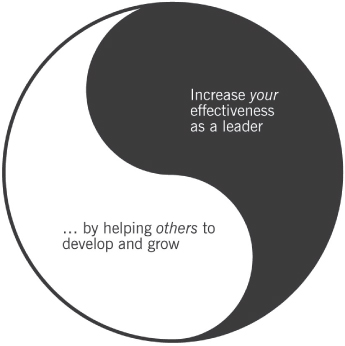
Of course, this will come as no surprise if you are versed in the Law of Karma! This yin-yang of increasing your own effectiveness while helping others to develop is the reason why this book is called The Tao of Coaching – see Figure 1.

Back in the 1990s it was clear that the autocratic leader was facing extinction. This was as true for leaders of families as for leaders of teams and of businesses.
Now it is even clearer that a new breed of leader is called for: a breed with a broader repertoire of management styles – sometimes ‘hands-on’ and sometimes ‘hands-off’, as suits the occasion.
More practically, this new breed recognises that even the greatest leader cannot do the whole job unaided. Changes in the business world mean the boss can no longer second-guess the staff, no longer be omniscient enough to monitor everything, no longer omnipresent enough to take all corrective actions required. Yet, at the opposite extreme, the effectiveness of the purely ‘empowering’ manager has not been proven.
Thus the new leader has to delegate appropriately; requires a following of able apprentices; and is usually the person best placed to build the abilities, on the job, of those who report to him (or her).
This new-style leader also believes that 1) if you invest just ten minutes in coaching someone who reports to you, it will later save you an hour; and 2) you also help yourself when you help others to perform more strongly.
What is coaching, and how to master it?
What are the secrets of excellent coaching, and how might this book help you to acquire them? I have tried to summarise the essence of coaching in the following definition.
The Tao of coaching
Typical beliefs of great coaches:
• You can’t be a leader without a following
• The autocratic boss is facing extinction
• Investing ten minutes in coaching will save an hour
• How to win friends and influence people – become a great coach
Alternatively, you may wish to read the book from cover to cover and follow the dramatic ‘true-to-life’ story of Alex’s career with its ups and downs, as Alex is coached well and poorly, and as he tries his own hand at coaching others.
But I suggest you start by completing a brief self-appraisal (Appendix 1), and ask others to complete a copy for you if you feel up to it.
As times change ever more rapidly, it is ever easier for us to fulfil Andy Warhol’s prediction that we will all be famous for fifteen minutes. But it is ever more difficult for us to be remembered for fifteen years.
Let your legacy be that you were an excellent coach, inspired many imitators, and many great-grand-imitators too.
Max Landsberg
January, 2015
1 Contemplating coaching at work
In which Alex examines whether his skills as a coach warrant his being elected to the Board
Alex wondered whether this was his last chance. Although he had been promoted into a senior management position, it had taken a year longer than he had expected. The question now was whether he would be elected to the Board of Directors – and what would happen to him if he failed. It was now or never, and it wouldn’t be plain sailing. ‘At least I’ve given it my best shot,’ he thought. ‘I might as well enjoy my vacation.’
Alex settled back into his chair beside the pool and gazed out over the Aegean, oblivious to the playful shrieks from the beach below. He tried to relax, but wished he’d arranged the vacation for two weeks later, after the Board back in London had made its decision.
He congratulated himself, however, on having found the one villa in which he could get phone reception. Perhaps he’d get a call after the Board meeting? He glanced nervously over his shoulder to check that no one had knocked the phone into the pool, unplugged the charger or otherwise tampered with it.
As if by telepathy, the phone rang. Was it for Alex? It was! Was it his assistant Julia back at the office? It was! Was he now a Director? ‘I’m afraid they’ve had to delay the meeting until tomorrow – I thought I should let you know,’ she apologised.
‘No problem,’ he said, cursing inaudibly. ‘Please let me know if you hear anything.’
He thought about last week’s day trip to Delphi. What were the words carved above the gateway to the Oracle’s chair, to prepare the ancient enquirers on their way to the prophet? That’s it: ‘Know thyself.’
‘OK,’ he resolved, ‘half an hour of introspection, my own decision on whether I deserve to be a Director, and then unadulterated vacation.’
The problem was in some senses straightforward. Alex knew that, on the plus side, he had led a major reorganisation, implemented a courageous acquisition and turned around a loss making subsidiary. The only minus – but it had been a major one – was that he had sometimes tended to use people, and a few had been left burnt-out. He had acquired a reputation as a ‘people eater’; at one point it had reached a stage where no one really wanted to work for him, or with him.
Five years earlier, the Board might have overlooked this character flaw. But now the management skills and habits necessary for building people’s abilities, for helping them to develop, for coaching them, had assumed far greater importance. A deficiency in this area would not go unnoticed.
Deep down, Alex recognised that this new emphasis on people development had been driven by several powerful forces which were now affecting most large companies. First had been a trend towards reducing the number of management levels in organisations’ hierarchies – i.e., ‘delayering’. Everyone was now working in cross functional teams for large proportions of their time. No longer were jobs and roles prescribed and static, so no longer could ‘bosses’ just go on telling ‘subordinates’ exactly what to do. Rather, the successful companies were now those in which people learnt new skills and habits from each other, and in which managers were also coaches.
Second, labour markets had changed. The most able people now knew that companies with a coaching culture did exist, and that it was much more fun and rewarding to work there. In addition, people were more mobile, and excellent organisations were focusing more on bringing out their people’s potential in order to retain their best performers.
Third, business conditions, markets and technologies were now changing even more rapidly than in the past. This meant that companies could no longer rely on providing employees with a week or two of ‘off site training courses’ every year. Training now had to be continuous and ‘on the job’ – i.e., by coaching.
‘Well,’ mused Alex, ‘am I good enough at this coaching stuff?’ Intuitively he thought he was indeed now a good coach. He hadn’t been a ‘natural’ at it when he had joined the company a few years ago, but he’d picked up a few good coaching habits along the way. These had helped him to become much more effective as a manager, so he had kept an eye open for more tips from coaches who were role models. He had also read a great book on the subject, and had put into practice many of its suggestions. His only problem had come about a year ago when pressures to achieve had caused him to slip back into some bad old habits, resulting in his failure to be elected a Director.
But he had decided to mend his ways, and people now wanted to work with him again. He even found that his personal relationships outside work had improved.
On balance, he was about to elect himself a Director … To be absolutely certain of his decision, however, he decided to review his own ‘moments of truth’ in coaching during his time with the company. This would allow him to reach a well informed decision. It would also provide the basis for lending his weight to the company wide coaching programme. Great intentions and promises so often spawned as a supplication to the gods at times of crisis …
With the benefit of hindsight, Alex began to review how much he’d learnt about coaching – not only from his own coaching practices as a senior manager, but also from his early experiences of having been coached by others.
He picked up the phone, tapped the recording app, and began to speak – recalling the lessons of his career since he’d first joined the company.
This is Alex’s story …
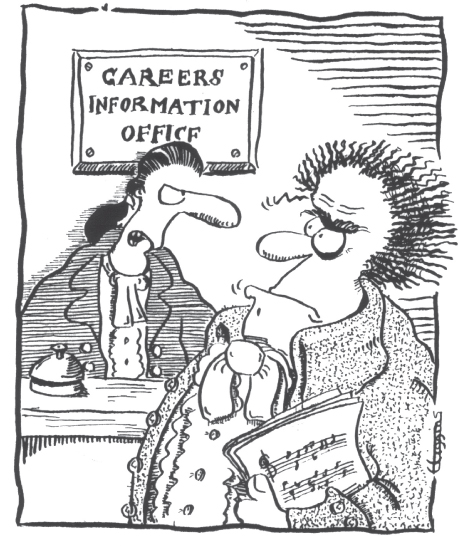
‘Ludwig, are you deaf or what? If I’ve told you once, I’ve told you a thousand times, drop the music schmoozic and get a proper job …’
Ask questions – don’t just tell – when helping others to develop their skills