
About the Authors
Richard Keegan is the manager of the Competitiveness Department at Enterprise Ireland, where he and his team are responsible for the Lean Business Offer, the Benchmarking Service, Environmental Assessments and the Green Start and Plus Programmes, as well as for the Envirocentre.ie and assisting companies to access European support for environmentally-based improvement products. He has written extensively on the area of Lean/Best Practice/World Class Business. He was awarded a doctorate for his research into applying Lean/World Class ideas with Irish companies. He is Adjunct Assistant Professor in the Business School at University of Dublin, Trinity College, teaching Operations Strategy at MBA level and Operations Management at undergraduate level, a visiting Associate Professor at University of Northern Iowa and a Fellow of Engineers Ireland. His approach of combining benchmarking and Lean tools and techniques has been adopted by UNIDO to help companies in the developing world to achieve competitiveness.
MEJ (Eddie) O’Kelly is Emeritus Professor of Industrial Engineering at National University of Ireland, Galway. A holder of three master’s degrees in Engineering and a PhD in Applied Mechanics, Electrical Engineering and Economics, he worked as a professional engineer in Paris and Strasbourg before setting up a subsidiary of Ulmic s.a. in Cork. Following a period as a management consultant, he was appointed to the Chair and Head of the Department of Industrial Engineering at University College, Galway (now NUIG), where his main research interests were production system analysis and manpower analysis. A chartered engineer, he was elected to fellowships of the Institution of Engineers of Ireland, of the Institution of Production Engineers, of the Institution of Electrical Engineers, and of the Institute of Management. He served as Deputy Chairman of Electricity Supply Board, the integrated electricity company in Ireland, and was the founding Chairperson of EirGrid Plc, the independent electricity transmission system operator in Ireland.
LEAN SERVICE
A Practical Guide for SME Owner / Managers
Published by OAK TREE PRESS
www.oaktreepress.com / www.SuccessStore.com
© 2015 Richard Keegan and Eddie O’Kelly
A catalogue record of this book is available from the British Library.
ISBN 978-1-78119-177-4 (Paperback)
ISBN 978-1-78119-178-1 (ePub)
ISBN 978-1-78119-179-8 (Kindle)
ISBN 978-1-78119-207-8 (PDF)
Cover image: Felix Pergande / 123rf.com
Cover design: Kieran O’Connor Design
All rights reserved.
No part of this publication may be reproduced or transmitted in any form or by any means, including photocopying and recording, without written permission of the publisher. Such written permission must also be obtained before any part of this publication is stored in a retrieval system of any nature. Requests for permission should be directed to Oak Tree Press (info@oaktreepress.com).
Contents
Figures
Case Studies
Dedications
Thanks
Foreword
1 Introduction
2 Applied Benchmarking for Competitiveness
3 The Diagnosis
4 The Medicine
Level 1: Basic Lean Service
5 First Steps
6 War on Waste
7 Teams & People
Level 2: Intermediate Lean Service
8 The Work Continues
9 Time is Money!
10 Operations Control Systems
11 Practical Quality
12 Employee Involvement
13 Lean Sales
14 Financial Management
15 Supply Chain & Logistics
16 Innovation & Design
17 Strategy & Implementation
Level 3: Advanced Lean Service
18 Process Benchmarking
19 “To Infinity & Beyond”
20 Practice to Perform
Appendices
I Self Assessment Questionnaire
II Facilitated Assessment & Comparison Tools
III Sources of Further Information
Index
Figures
1.1 Market Price
1.2 Hearts & Minds
3.1 Determining The True Score
3.2 Identifying Where Improvements Should Be Made
3.3 Types of Benchmarking
4.1 The Lean House Concept
4.2 Lean Service – The Spiral of Performance
6.1 The Seven Wastes + 1
6.2 The Spiral of Performance
6.3 The Theoretical Optimum Order Entry Process
6.4 The Actual Order Entry Process
6.5 The Actual Order Entry Paperflow
6.6 Administration – Traditional
6.7 Administration – Lean Business
6.8 Administration Check Sheet
6.9 Numeric Data Capture
6.10 Miles per Gallon – Run Chart
6.11 Miles per Gallon – Run Chart with Target Line
7.1 Skills Register
9.1 Change-over Time
9.2 Batch vs Single Item Processing
9.3 Batch vs Single Item Processing – Developed
9.4 Toolbox vs Shadow Board
10.1 Operations Control Systems
10.2 Life Cycle and Choice of Operations Systems
10.3 The Probability of Failure
11.1 Measles Diagram
11.2 Sales of Trucks – Data
11.3 Sales of Trucks – Histogram
11.4 Customers at Different Times of the Day – Data
11.5 Customers at Different Times of the Day – Histogram
11.6 Getting Ready Control Sheet
11.7 Run Chart
11.8 Sample Analysis Report
11.9 Customer Complaints Report
11.10 Output Report 1 – Sales
11.11 Output Report 2 – Sales
11.12 Output Report 3 – Sales
11.13 Output Chart
11.14 Output Chart – Annotated
11.15 Output Chart Showing Potential
11.16 Control Chart
12.1 A Value System
12.2 An Organisation Chart
12.3 Placing an Order
12.4 The Organisation Chart – Developed
13.1 Sales Strategy
13.2 Company Profile
13.3 Services List
13.4 Customer List
13.5 Customer Profile
13.6 Competitive Analysis
13.7 Market Worth
13.8 Sales Targets
13.9 Forecast Accuracy
15.1 The Supply Chain
15.2 The Supply Chain 1
15.3 The Supply Chain 2
15.4 The Supply Chain 3
15.5 Purchasing Patterns
15.6 Advantages & Disadvantages of SMEs
16.1 The PDCA Cycle
16.2 Departmental Walls
16.3 Multi-functional Teams
16.4 Perceptual Maps
16.5 Design Process Phases
17.1 Strategy
17.2 SWOT Analysis
17.3 The Service-Market Matrix
17.4 The High Intensity Lean In-Company Implementation Model
17.5 The Spiral of Performance
17.6 The Lean Network In-Company Implementation Model
17.7 The Lean Network Implementation Model – Company Level
18.1 The Process Benchmarking Cycle
19.1 The EFQM Model
Case Studies
1 Applying Lean Principles in Openet
Shane O’Flynn, Openet
2 Control Rooms at Irish Rail
Peter Smyth, Chief Mechanical Engineer, Irish Rail
3 First Steps in Continuous Improvement
Ellen Brian, Director Lean Program Europe, Deutsche Post DHL
4 Parker Advertising
Kingsley Dempsey, Parker Advertising
5 Customer Service Kaizen at Directski.com
Anthony Collins, Directski.com
6 Thornton & Partners
Marc Sweeney, Director, Thornton & Partners
7 Lean in Professional Service Firms
Patrick Burke, Partner, Grant Thornton
8 Lean in Service
Michael Twohig, Head of Continuous Improvement, Musgrave Group
Dedications
To Geraldine, Aoife and Maeve, you are my life.
Richard
In grateful appreciation to Jane + 6 for sharpening my understanding of “Best in Class”.
EOK
Thanks
With special thanks to all the companies and colleagues who have helped to make this book a reality.
Thanks to Enterprise Ireland for supporting this work.
In a corner of North Wales, in Deeside, Toyota built an engine manufacturing plant in 1991. In this plant, there is a group of enthusiasts, led by Kevin Robinson, deputy managing director, collectively known as the Toyota Lean Management Centre, who have shared their understanding of best practice, how to look at processes and how to build the sustainable capacity of people, processes and business. At this point, Richard has visited the plant 49 times, with over 1,200 Irish managers. The Management Centre’s support has been very helpful to Richard personally and to the managers in developing an understanding of what is possible.
Foreword
The global services industry is undergoing dynamic change driven by the development and rapid adoption of new technologies, including cloud computing, mobile communications, data analytics (based on big data) and social technologies.
Irish companies in the internationally traded service sector are participating fully in the opportunities that exist within the global marketplace. Exports by Irish companies assisted by Enterprise Ireland were in excess of €1.7bn in 2014.
The internationally traded services sector is a significant employer in Ireland, accounting for almost 17,000 jobs and so the sector is a key priority for Enterprise Ireland. A significant proportion of these jobs exist outside of Dublin, particularly in the BPO sector where clusters of excellence exist in Waterford, Cork, Limerick and Donegal.
Many Irish service companies have achieved international success with the support of Enterprise Ireland. We have worked with these companies to help them develop capability of their people and processes at home, to approach international markets with confidence. Our teams in international markets have opened doors of opportunities for Irish companies, introducing them to global decision-makers in markets of greatest potential.
Key to success in a global marketplace is the development of Lean principles and practices within processes and service delivery. This book provides material and examples to support the adoption of Lean to develop competitiveness in competing in the global service industry. I hope you find it useful.
Julie Sinnamon
Chief Executive, Enterprise Ireland
1: Introduction
It is clear that service businesses are very important to our modern economies and so it is increasingly important that our service businesses are efficient and effective, too.
Service businesses can be local or global in their nature. A barber’s shop or hairdressing salon is obviously a local service, while many software businesses operate at the international, if not global, level. Some ‘local’ services, such as medicine or dentistry, are now evolving into international service businesses with the advent of cheap air transport and, at the extreme level, the use of long-distance robotic surgery systems, where a patient can be located many thousands miles away from the surgeon. Remote diagnostic services or analysis of scans is now regarded as commonplace in medical circles.
This internationalisation of services can be helpful or challenging to a service business. It can be helpful if you can locate partners overseas where work can be continued ‘over your night’, allowing your service to be progressed and delivered at maximum speed. It can be challenging if an overseas service provider can access your market, at better rates.
The challenge for service companies is to understand their value proposition, their processes and their customer’s needs and wants. As our societies continue to develop and to want / need more services, it is essential that our service companies take on the challenge to develop their effectiveness and efficiency while, at the same time, developing more and better value creation and retention opportunities.
LEAN SERVICE
Lean is about VALUE … the creation, delivery and retention of value.
The creation of value starts with a resource and ends with what a client or customer perceives as value. In a service business, the primary resource is people. Most services are delivered by people, so a Lean Service business needs to understand its people, how they add value and how this value-adding process can be optimised.
In a service business, the delivery of value is very much customer- or client-dependent. The client defines what they see as ‘value’, not the business. The most successful service businesses understand this very well and spend much time and effort working to better understand their customers and to meet their spoken needs and often unspoken wants. In a restaurant, not every client wants lots of attention from the staff, not everyone wants the same level of service, and not everyone is pleased by the same things. It is important that a service business understands the core of its delivered value and the spectrum of its clients if it is to deliver its true value.
FIGURE 1.1: MARKET PRICE
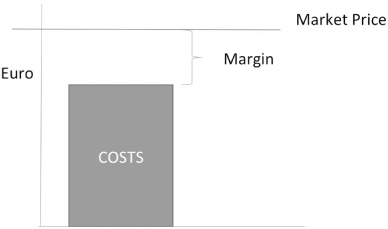
Retaining value is absolutely essential to a service business. It is the retention of value that gives the business the potential to make a profit. The market defines the level that customers are willing to pay for any given service or product. How a business organises its resources of people, systems, processes and premises determines just how much of the value stays with the business.
If you are to identify, develop and retain value, you need to look closely at how your people are trained. How well are your customers’ needs and wants understood? How closely are your internal processes aligned to most efficiently meet customers’ requirements?
To understand how Lean concepts can be applied to a service business, you need to know a little about Lean Principles, Lean Rules, Lean Questions and Lean Tools. Read on …
SEEING PROCESSES – LOOK, SEE, UNDERSTAND, THINK, DO
Many managers of service businesses think it is easier to deliver Lean in a manufacturing environment because ‘you only have to deal with machines’. This is a commonly-held belief but it is not correct.
Lean implementation in a manufacturing environment is centred on the people and how they interact with the processes and machines. Two different businesses can have exactly the same machines, serve the same business sectors and have completely different business results. The difference is in how the central resource – people – are led, managed, encouraged, directed and supported.
The key difference between a manufacturing and a service business is that it is often easier to ‘see’ the physical flow of material through a manufacturing process. How can we see the flow through a service business? How can we see where things are getting jammed up, where there is excess capacity for work or where there is overload? Process Mapping and Physical Flow Mapping are the core Lean tools to help us to see the service process. We need to be able to see the process before we can ‘understand’ it or before we can ‘do’ something to improve it – but, first, we need to ‘look’ to start the improvement process.
Service companies typically ‘do’ something for their clients. Managers in a service environment are increasingly coming to understand that their departments are, in effect, production units. People come in for a service and leave serviced. Data comes in, gets processed and the output leaves the department. This ‘doing’ is often based on knowledge, administration or an IT approach. The trick for a Lean Service implementation is to find a way to see these processes: to show a physical ‘picture’ of the processes to let people look for and identify the value-adding, the necessary and the wasteful elements of the work.
LEAN & PEOPLE
Lean is about people, about engaging with people and helping them to release their energy and to realise their potential. Lean Business enables people to deliver real results. The Lean tools and techniques are enablers to help people see processes, identify wastes and remove them. Nobody wants to do a bad job, and nobody wants to waste their time or their effort. Lean in a service environment gives people the opportunity to see their processes.
Because Lean started in a manufacturing environment, it has taken some time for people to see its benefits in a service environment. Many people in the manufacturing world think it must be very difficult to apply Lean in a service or an office environment. But recently, talking to a person who had been implementing Lean in a hospital, she was wondering how Lean would be applied in a manufacturing plant – the wheel has truly turned!
The Lean Service approach is based on two basic, but mutually supportive, elements:
This combination of tools and techniques and engagement of people has been with us for many centuries. The early guild system ensured that members shared and developed the ‘secrets’ of their trades and equally were committed to caring about what they did and how they did it. The idea of ‘caring’, where people are committed to ‘doing their best’ has largely been misplaced in modern business, but it is not lost. The best service businesses are those that care about their customers and their staff, the ones that go that extra mile to ensure their service is well-delivered and well-received.
FIGURE 1.2: HEARTS AND MINDS
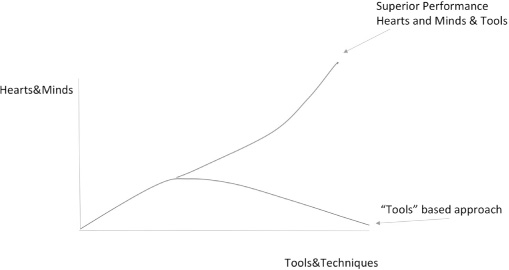
Many companies try to improve their performance by just relying on the tools and techniques. This can be helpful for a time but, if people are not committed to making the business successful, to serving their clients, to caring about what they do and how they do it, then the results eventually will be disappointing. Many such businesses achieve initial improvement from using the tools but this improvement is often lost, as shown in Figure 1.2 above.
The hearts and minds of our people are very important, especially in a service business. If so much of what our customers see from our service is dependent on our people, then it becomes critically important that our people care about the process, the client and the company. If they are to care, it is important that they are involved in developing the process and service and in enhancing the value delivered and retained. This engagement of the hearts and minds of our people is at the core of Lean Service.
In today’s business environment, this combination of tools and techniques and the ‘Way’ has been rekindled. Toyota Motor Corporation was founded on the core values of its founder, Sochiro Toyoda, who wanted to add value to his society, and decided on the automotive sector as his way to do so. Very many of our global leading brands have similar underlying values, where yes, they are in business to make a profit but they are also committed to adding value to their societies, for the greater good. Toyota is well-known for its Toyota Production System (TPS), which created the tools and techniques of Lean, but is less well-known for the ‘Toyota Way’. The Toyota Way is about assuring the engagement of the hearts and minds of the people in the organisation and focuses on two key elements:
NEED FOR EFFECTIVENESS – WHAT ARE THE RIGHT THINGS TO DO?
Service businesses rely on people to deliver value to their customers. The common characteristic of all service companies is that they ‘get things done’. They do something or achieve something for a customer or client.
An accountancy firm uses its expertise and experience for its clients to prepare accounts, manage taxation or provide advice. It might not produce a product but it definitely gets things done for and on behalf of its clients. A software firm bridges the divide between a pure service company and a manufacturing company. Its output helps its clients to do something or to have a specific experience.
In all cases, the effectiveness of our people and our processes decide whether we have a good, profit-making, sustainable business. If our people are not being effective, they will be wasting energy, time and money by not adding as much value as possible to our service to our client.
The first challenge for a service business is to understand what the customer values and then to work to define and develop processes to be able to deliver this value-added service in a highly effective way.
When we have determined just what is valued by the customer, we then can work to develop the most efficient way to deliver that value. We have to understand what the customer wants, needs and values if we are to be effective. We need to know what are the ‘right things to do’, and then we need to develop an efficient way of delivering that value: ‘doing the right things well’.
NEED FOR EFFICIENCY – DRIVING CAPABILITY & CAPACITY
If we have identified the right things to do, we now need to develop the capability and capacity of our people and processes to do them effectively and efficiently. Efficiency of processes depends on both the hard infrastructure such as computer systems, logistics equipment, buildings, and cooking equipment as well as the ‘soft’ elements such as the level of staff expertise, experience, training and commitment. To develop effective processes, we need to look at and develop both the hard and soft sides of our service offerings.
Developing the capability and capacity of our processes is important, especially with the major developments in technology that we are experiencing today. But equally, if not even more important is the development of the capability and capacity of our staff, and ourselves. Much of a service business’ value is created and retained due to the efforts of staff. How can we work together to constantly seek to develop our capabilities and capacity to add value?
The Lean approach focuses not only on the tools of Lean but also and even more importantly on the ‘Way’ of Lean – the hearts and minds of our people. If we want to be effective and efficient, we need to know what it is that our people need to know if they are to deliver our service consistently and well. We need to know and understand and share what are the things that can go wrong with our service delivery and also know, understand and share ‘recovery methods’, to quickly, effectively and efficiently fix issues if and when they arise. The very best people in all walks of life constantly challenge themselves to get better, to improve from where they are, to push their capabilities to the highest level they can. We all know examples of top sports men and women who spend countless hours training and developing their base skills. In a practical sense in a service business, we want and need our people to commit to a process of building and developing their capabilities to better deliver true value to our clients and the business.
The Lean Service approach uses a Skills Register (see Chapter 7), to support this development approach. The core skills and experience required to do the job is defined and each individual then can map their progress against the Skills Register, identifying what they can do and what they have yet to learn how to do.