
Copyright © Ellen Cooney, 2013
Publerati e-ditions
All rights reserved under International and Pan-American Copyright Conventions. Published by Publerati.
This book is a work of fiction. Names, characters, businesses, organizations, places, events and incidents are either the product of the author's imagination or are used fictitiously. Any resemblance to actual persons, living or dead, events, or locales is entirely coincidental.
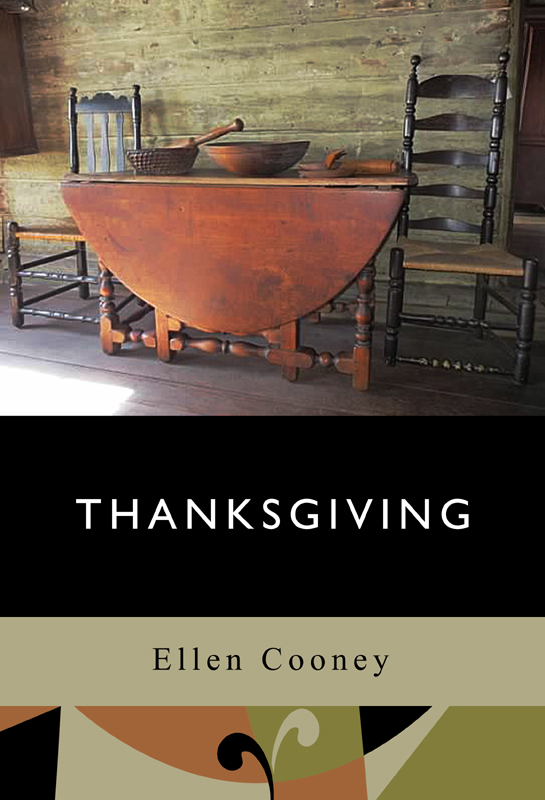
Cover photography by Cheryl O'Malley, courtesy of the Fairbanks House. The Fairbanks House is the oldest timber-frame house in America. It is located in Dedham, Massachusetts residing in its original location for nearly four centuries.
Cover design by William Oleszczuk
ISBN-10: 0985050470
ISBN-13: 978-0-9850504-7-4
Read ebooks. Spread literacy. When you read Publerati ebooks you help spread literacy around the globe. This ebook and all others from Publerati are made available for free to teachers and children in developing nations using licensed e-readers through the Worldreader Organization. Additionally, Publerati donates a portion of every ebook sale to the Worldreader Organization. Thank you for your purchase and if you enjoyed this ebook please try one or more of our others and help support excellent writing. Look for the Publerati logo plume at leading ebook sites or visit www.publerati.com.
"This remarkably talented author writes in a refined, understated prose."
The New York Times Book Review
"…the story of the Morley family of Massachusetts, starting in 1662 and continuing—in a series of stunning November vignettes—to the present day."
Jim Nichols, author of Hull Creek
"Down through the centuries the Morleys are a tough and agile lot, and Cooney writes about them with insight, humor, precision, and grace."
Elaine Ford, author of The American Wife
Contents
1662 The Turkey
1673 Pumpkins
1695 Chestnuts
1711 Squash
1726 Butter, Onions, A Loaf of Old Bread
1753 Apples
1778 The New Plates
1801 Cranberries
1818 Mince
1831 Yams
1847 Potatoes
1876 Parsley, Sage, Rosemary, Thyme
1900 The New Glasses
1912 Rolls
1927 Pie
1941 Stuffing
1952 Corn
1964 Soup
1972 Green Beans, Creamed Spinach, Brussels Sprouts
1984 Fruit Bowl, Cheese Plate, Relish Tray, Nuts
1998 Gravy
2012 Dinner
1662
The Turkey
The fire is nearly out. In her hurry to flame it, she rushes through the daydark and bumps herself hard on the cradle. She keeps forgetting it's there, planed smooth as skin, still tight in the rockers, still smelling new-woody.
Daydark is a shift in the house from black to twilight.
When the house was being built, Cale's family promised them window glass. It kept not coming. She tried not to think of it as a punishment. His parents, two miles away, have eight windows, each one beautifully paned. His brother next door has four; so does his brother across the road.
Her eighteenth birthday was last week. Get ready for a wonderful gift, his father told her, and she was so excited, she almost hugged him. Glass, she thought. She made Cale hold off on nailing the shutters and planking them for the winter, her first as a wife.
It's late November. In the warm weather she tacked linens on the openings. Spring and summer and early fall were squares of gauzy paleness, gauzy air, buzzing insects catching onto the cloth. She had learned the hard way to not leave shutters open in windy rain.
Cale planned to make the cradle himself. He's not a natural with tools, so it would have been less than perfect, like everything they have for furniture; but still.
My name is Patience. I must choose every day to be the same as my name.
Called on at church to speak, she bows her head calmly, willing her voice not to quiver, her cap not to slip off her hair; she hates tying it tightly. At dinners with his family they call on her as soon as the grace is over. The next to last plate to be served is Cale's. The last is always hers.
She's five months pregnant. The cradle model Cale started is gone: a burl off a tree in the woods, partially hollowed like a rough little bowl. On her birthday, the minute his parents went home, he sneaked it away from her and threw it in the fire. She had carried it in a pocket of her apron.
My name is Caleb. I must choose every day to be the master of my willfulness, my duties, my wife, my home.
He was supposed to wake her before leaving at dawn to join the hunting party. She hopes that if anyone shoots anything to eat in the woods today it's him and no one else, not that this ever happened before. He's hunting with his father and brothers.
He left her dry kindling and logs. Firelight is not the same as sunlight but the heat is lovely and she lingers at the hearth, stepping into her shoes with languid contentment, although her feet are freezing. Her new laziness is gorgeous to her, and thick and deep and married-people secret. Sometimes she finds herself laughing alone in the house for no reason, forgetting the heaviness of daydark. She loves what it's like to look forward to night. Night isn't heavy. Night is supposed to be dark.
Are you willful, Cale?
That I am.
Can you master your duty at home?
Yes I can. Would you like to be patient?
Only if you're about to make me glad.
I'm about to make you very glad indeed.
Then tonight I'm the same as my name!
In the fireglow, she notices his shot pouch on a hook by the door. She usually packs it for him on hunting days.
She hasn't been sleeping well, waking often with nausea or in a strange, sweaty excitement from unremembered dreams. But he should have made her get up. He should have stuck to their routine.
He forgot his pouch? They'd never let him hear the end of it. She checks the storage box to see if he took shot and filled his pockets. Balls are in piles a few inches high, lead-dull, looking harmless as toys. But she can't remember how many were there to begin with. He took his pistol, which he always keeps loaded, as well as the musket.
She hasn't cleaned out the hearth for a while. The smoke is ashy, greasy. She didn't clean the pot she cooked the last bit of venison in yesterday, or the one the day before of turnip stew. She's going to be sick.
His father told her that if a pregnant wife suffers from digestive imbalance beyond the early part of pregnancy, it's a sign from God that she's unrighteous. He made it sound as if the part of her that keeps puking is her soul. But if being together unlawfully was a sin, she feels, God would make sure Cale's guts are as wretched as hers.
She can't let the house smell worse than it does. The first wave of nausea is mild enough to give her time to put her cloak on, get outside, and make her way to the back. No one else is out. With the men away, her sisters-in-law closed up their houses and went down the road to spend the day with Cale's mother, as they always do on hunting days. As always, she wasn't invited.
The only thing moving is chimney smoke on its way to meet clouds so close and still, they look painted. The blue shock of the sky hurts her eyes. The cold takes her breath away.
The hard ground, shiny with frost, is a mess of old stalks and vines she never got around to clearing. The wide, shallow brook at the end of the yard is the border between home and the wild. She's supposed to remember which trees along the front of the forest are maples for tapping, but they all look the same without leaves.
The evergreens stand in rows that go on into forever. Cale wants her to learn the different kinds: spruce, fir, pine, hemlock. He's planning to write what he calls an encyclopedia. He wants to list and describe, with drawings, every plant, tree, and bush he ever met. But they don't have paper or ink.
She doesn't care what the names are. In their crowds, in their deep, abiding greens, they're friendly strangers.
The big old oak, she knows personally. It's on the mossy homeside bank, with a crown starting low and a trunk so thick, even Cale with his long skinny arms can't reach around it. When they were building the house—this house that was needed in a hurry—they said they left it standing on purpose, for acorns and shade and fire sticks. But really, after an ax got stuck in the bark one time too many, they gave up trying to kill it.
She wants to make it to the brook, but no. She stops in her tracks astonished.
A fully grown tom is in the oak, fat and brown-black feathery, roosting close to the trunk. Its head is tucked down like a funny little knob. It's facing the woods. If it turned a moment earlier to see who was coming, it must have decided she's nothing to worry about.
All her life she's heard turkeys gobbling, even shrieking, but always at a distance, invisible in the woods. She knows they're not stupid. They had learned a few things about hiding from men with guns. She never expected to see one up close.
She grew up on a farm near the village as the child of indentures. Her parents are working their contracts still. The chickens on the farm are as cunning and haughty as the owners, who keep finding new ways to keep servants locked into old bonds. But you can't compare a chicken to a turkey, not really. It's like comparing anything wild to anything that isn't.
The bird makes the tree look small. In her amazement, she's suddenly all right. The wave of sickness, having reached her throat, simply comes to a stop and settles down. She feels like a bottle that someone, at last, stopped shaking.
She doesn't see the arrow in flight, or where it came from, or who shot it. She will realize later it left a bow before she passed the side of the house and entered the yard.
It's a kill shot to the breast. The turkey makes a small, squeaky gasp, like it's saying, on the verge of sighing gladly, "Oh!" She'll never know if the sound was human and terribly familiar when she heard it, or if she only imagines this was so.
The turkey falls sideways, landing at the edge of the brook. The bits of feathers on the arrow shaft are exactly the same as the bird's.
Every instinct tells her to run back inside. She doesn't care about the throb in her leg from the cradle bump. Her body's ready to flee, but at the same time, like the feel of being sick, her fear gives way to something else.
This is her yard. That side of the brook is hers. That oak is her tree.
Beyond the brook, nothing stirs. The silence extends everywhere. No one's in the cornfield that starts at the side of her yard and lies stripped. On the other side of the field is the Morley apple orchard, winter-bare. No one's there.
PATIENCE MORLEY I CALL ON YOU TO SPEAK.
There comes to her the image of Deacon Morley in his wig and robe in church: her furious father-in-law, loud as thunder. She knows he blames her for the way Cale's not afraid of him anymore, for Cale not obeying him and becoming a minister, for Cale not marrying a landowner's daughter like his brothers, for an awful lot of things. But thunder can't hurt you. You just have to find a way to put up with all the noise.
My name is Patience. I must choose every day to be…
Thankful. She fills in the word like the end of a line in a prayer. If God doesn't want her to have the turkey, why did it fall where it fell? God thinks she's righteous. God thinks it was wrong of Cale's parents to break their promise about the glass. It's obvious why they wanted a cradle in the house so early. They didn't have to explain. They were sending a message to the baby that in spite of being burdened with parents such as Cale and herself, there is hope.
Cale's father compares everything to voyaging across the ocean to America. He thinks her body is a boat, and her passenger-baby quivers with fright about storms, immense waves, a shipwreck. So giving the cradle was a pledging of faith, as if the baby has eyes to see through her belly to a new horizon. The cradle is a sign of a shore.
Well, he should count his blessings that Cale didn't throw the cradle in the fire instead of the burl.
He'd never let them forget what it was like for him to find them in the barn on the evening last spring that changed everything—and he couldn't prove they'd been doing anything except standing together talking, their clothes in place and buttoned up. He never went into the barn after dark. They'd never know who tipped him off. He had wanted to know, like a judge considering leniency for a first offense, was this the first time they were together? Cale could have lied. But he didn't. I've known since I was a boy there'd be no one for me but Patience.
And up went the house in a hurry, and after giving the promise of window glass, his father made it clear that she and Cale would get nothing more from the Morley family, ever.
Maybe what bothered him most that evening was the way they didn't look guilty, the way they'd been giddy like little children, holding back laughing, because imagine if he'd come in five minutes earlier!
"Thank you, God," she's saying.
Almost crawling, she makes for the brook and grabs the turkey by the arrow, as if it's there to be a handle. She's strong from a life of hard chores, but the heaviness surprises her; she staggers backward when she tries to lift it. She promised Cale she wouldn't carry anything straining, so she picks the smoothest route through the yard to duck-walk and drag it. She's been hauling baskets of wet laundry from the brook the same way.
She keeps her eyes ahead, on the future. She has already blanked out of her mind the fact that the arrow was shot by a person. There wasn't a person. There wasn't a past, not even a past of just moments ago.
How much will a turkey fetch at market? Cale has friends who are always going to Boston. They know about buying and selling. They can be trusted not to tell his family. One pane of glass? Surely there'll be enough for one pane, plus maybe enough for paper, ink. The value wouldn't diminish, she feels, if she takes off a few feathers and keeps them for quills.
"Hold on tight," she says, patting herself on the belly, talking to her baby, like Cale does when he's about to make her glad.
The stoop is a granite block. There's a second foot-lift to cross the threshold. She squats to spare her back muscles, and slides her hands under the bird, hoisting it, pushing it. She opens the door and hoists and pushes it again.
Uh-oh. The feeling of sickness had only been postponed. It's coming on fast.
She leaves the turkey by the door and rushes for a slop bucket, and that's when she hears the shot. It's coming to her as a muffled, air-crackly exclamation from the edge of the woods. It's joining the start of her retching.
She guesses it's Cale, heading home for his pouch. Even in her distress, she's praying. She hears him calling to her, his voice coming closer, and she's thanking God for his return. Now she won't have to cope with the turkey on her own; they can speed the business of getting it to market. Glass, she's thinking. Paper and ink. Our future.
She doesn't want to press her luck by asking God for more bounty from this day, but all the same, she wonders what Cale had shot. She feels certain his aim had been true.
Was it a game bird? Another turkey? A deer?
She's finished with being sick. She goes to the door to meet her husband, imagining him proud of himself, in a glow of well-being, which will grow like the baby inside her, just grow and grow and grow.
1673
Pumpkins
The frost was late. The harvest this year is huge.
Hester was worried about the table collapsing from all the weight; but something that looks weak can be strong. Her father built the table before she was born. It's a little uneven, with too-skinny legs.
The pumpkins are coming in, coming in.
A long day of boredom lies ahead. The rain stopped finally and it was harsh and whipping; not the easy rain that streams on window glass and lulls her to a deep, lazy happiness, as if the house is a boat, and she's traveling with her parents through the hours on a safe, quiet sea.
Her father brings in pumpkins, brings them in.
She knows that a part of him is dark and secret, not like a gloomy mood, but something else, root-deep, baffling, unknowable. She can see it in his face on autumn days like this one when he stands by the back window, looking at the woods. A strange silence comes out of him like bad air. His expression frightens her. Leave me be, he tells her. Stop looking at me. Stop asking me what's wrong.
Today he said he was low because the sun isn't shining. There needs to be sun. She's going to get to work on that.
My mother's name is Patience,
My father's name is Cale,
I am HESTER!
I HATE PUMPKINS!
Her job is to separate seeds from the stringy pulp and get them ready for roasting. She's planted on a stool at a second, makeshift work table of planks set on chair seats, waiting for her mother to pick up the hatchet and start the splitting.
The pumpkins on the table are for hanging in strips to be dried. The ones by the hearth are for cooking today, either by roasting or stewing. The ones in the corner farthest from the heat are for the root cellar; some of these will be winter food, some will be ale. The best, piled in a slatted wood box, are for sending to market. The biggest ones go under the table for her father to hollow for bowls. Her mother will harden the shells on a rack above a slow, low fire. They'll go to market later on.
Her favorite thing to do with her father is have drawing lessons: trees, rocks caked over with moss, ferns, an oak leaf. Her second favorite thing is to watch him with his whittling knife, but that's not a lesson. She knows he won't let her use it. When he goes to work on the bowls, all it will mean for her is more pulp.
Her father cradles pumpkins in his arms. Sometimes he puts them down roughly, as if daring them to break. He looks disappointed when they don't. Nothing that needs not to break is breaking today and that's excellent. But this is not the way a father should be acting.
My mother's name is Patience,
My father's name is Cale…
"Stop," her father says. "If you want to sing, you know plenty of songs that are songs. You don't have to make them up."
"But I like to."
In November he scolds her for things he admires the rest of the year. He's the one who should be scolded! He's supposed to put each pumpkin in the correct pile, but he'd left the sorting to her mother. He's supposed to wipe them off and leave the mud outdoors. Mud and bits of vine-rope are everywhere.
The fire is roaring, in a preface to cooking. Even with the constant opening of the door, the air is vegetable-heavy, mud-reeky, smoky.
He shouldn't have said that about songs. The songs she knows are for Sundays. If God wants people to sing hymns at home, she feels, there'd be no such thing as church.
My name is Hester Morley,
I live in Massachusetts.
I wish I had a sister,
So SHE can work the PUMPKINS.
"They're all in," says her father. "It's less than I hoped but we did all right."
Her mother pauses, a pumpkin in hand for the last box. They put their pumpkins in boxes to keep them separate from the others. It's a shared wagon run. Her father whittled his initials on theirs, a C and an M.
Her mother's apron is so soiled from wipings, hardly any white is visible. She's not wearing a cap. She doesn't wear one at home, unlike every wife in every house Hester ever visited. The hair knot at the back of her neck is loose and untidy and alarming, like vines and mud indoors, but the thing to worry about is the pulled-tight look on her face. It's a warning sign.
Her father is soaking wet, caked with dirt. He didn't have to shake his feet so that mud falls off his boots to the floor like a splattering of little turds. But he did it, and he waits, like Hester does, in the gap of a moment between stillness and maybe something big. He's a storm cloud, ready for lightning to strike.
But her mother looks away from him. She places the pumpkin in the box carefully, and only says, like she's saying aloud the last part of what she's been thinking, "It would be good for us all if we had windows I could open."
In its fixed panes, the window glass is steam-smoky on the in, raindrop-beady on the out. Everyone else on the road has windows you can open and close.
"I'm sorry," her father says.
Her mother is not a bolt of lightning. She's another November dark cloud. Hester sees they need God to look in the direction of this house and set in motion a mighty splash of light, sweeping through this room like a broom.
Her father goes over to her mother. Hester looks at how tall he is, standing there, still. Her mother reaches up and touches her fingers to his chin, wiping off a mud smear. It's a quick, slight gesture. But it means a lot. She never sees her parents touching each other.
"Don't tell Hester not to sing what she sings," her mother says. "You sound like your father when you talk like that. Maybe you should have been a minister after all."
"Don't be saying things that aren't true."
"Maybe we don't know anymore what's true and what isn't."
"We know," her father says.
From out in the road comes the sound of wagon wheels. Her father picks up the pumpkin box.
"Don't let them stop long enough that they'll want to come inside," says her mother. "I don't want anyone gossiping about the condition of my house."
"Men don't gossip," says her father.
"That's what you think," says her mother.
On his way past Hester, he stops. She feels the pressure of the force inside him that's his love for her and her mother. She knows it's there, trapped.
"The sun will start shining again very soon," she tells him.
"That's good to know," he says.
She jumps up to open the door for him, closing it fast against the wet-heavy cold. Her mother picks up the hatchet and cleaves pumpkins, chop chop chop chop; the blows are perfectly placed. The hatchet never goes too far, never strikes the table top. In all the times her mother bladed food on this table, she has not made a nick in the wood.
Soon her mother is hand-scooping seeds in their tangles of pulp. She heaps it all on Hester's table. The pulp will go into a bucket to be given to the driver of the market wagon when he comes back tomorrow; he has pigs.
"I'm sorry I said I wish I had a sister," Hester says.
Her only-ness as her parents' child is a touchy subject, rarely raised. Maybe she was trying to be a lightning bolt herself.
"I don't mind you said so. It wasn't wrong of you," says her mother. "It was God's will. Some day I'll try to explain it to you."
"You could explain it now."
"I'll wait until you sit with me all grown up and your own child is in your arms."
Hester knows by her mother's expression not to argue with that, and finally, when all the pumpkins are scooped, her mother begins the slicing. She likes to get the strips done first, before the cooking; they require the most concentration.
Hester grabs some pulp, picks out seeds.
"You shouldn't say hate," says her mother. "You shouldn't hate anything, or anyone."
"What about the devil?"
"That's different," says her mother.
"What about Indians?"
"Indians?"
Hester drops seeds into the roasting pan on the floor at her feet. She puts the pulp in the bucket beside it. There was a raid in the next village last week. No one told her details, but she knows it was terrible.
She's never seen Indians except once when her father took her to the mission school. The Indians wore clothes like Americans. Their skin was all brown but she was amazed to know brown has so many shades. The same went for the blackness of all their hair. They didn't speak to her. The teachers said they were too new at English. They were happy, the teachers said, but they didn't look it. They looked tired, even the children. They looked like people who keep getting shouted at for doing things wrong. It was strange to see grownups as pupils in a school.
Her father had told her before they arrived that the men and boys would have long hair, perhaps in braids. She'd looked forward to that. But they'd all had haircuts.
The reason for the visit was that her father was bringing a gift of firewood. He'd borrowed a wagon from one of her uncles. He's always bringing things to the Indian school: wood, maple syrup, apples, whittled toys, desks, and chairs he built with wood from the forest, which he didn't use for a new table and chairs at home.
Her grandfather says Indians are devils God put on the earth to test the faith and devotion of Americans.
"Grandfather says Indians have to stop being evil and act like us, or else they can't get to live in America," Hester reminds her mother.
"You know we don't want you listening to such talk."
Her mother uses the carving knife for the drying strips. Pumpkins are hard. Her hands are strong like a man's. Why do you call it whittling when a man's doing it with something you don't eat, but not when a woman is doing it with food?
"Why do you call it…"
"Don't distract me when I'm using a knife," says her mother.
Hester wonders if Indians at the mission school get angry at Indians who go on raids, or if they secretly cheer. She wonders why people in the raided village didn't pray that God would protect them, like she does. If they'd taken the time to pray, there would not have been a raid. Or maybe they took the time, but they didn't pray right.
She takes another round of pulp, picks at it. She hears the market wagon driving away. She thinks about how good it will smell in the house when the cooking gets going; and here's her father, coming back inside, muddier than ever, smiling a sad smile.
"The sun's coming out," he says.
Hester feels a glow. She's proud of herself, proud of God. She sees that this is a good time, with her hands deep in busy-work, to speak to God about certain other things that need to happen.
She looks away from her father and concentrates hard on praying. First she thanks God for the sunlight, and then for her home and America and also her bed and her quilts, and how good it is to sleep warmly at night when it's cold, even though her bed is a trundle stored daytimes under her parents' big one; it has to be pulled from their alcove. She tells God she doesn't mind it when her cousins make fun of her for sleeping in the main room under the table, because she really does love her bed.
Then she gets down to real business. We must never be raided, she prays. Then she thinks about her mother touching her father to take off a bit of mud. He didn't touch back, but he had looked like he wanted to. Please, she's saying, could my mother and father touch each other all the time and not live with a wall between them?
* * *
Now it's night. She's under the table. A cooking pot is over her head, put there for cooling. Inside it is filling. They don't have flour to make a shell for a pie, but there is always hope they'll be able to get some. The filling will be stored and that's all right, because it means there'll be pie in the future.
Her belly's full from tastings. She'd fallen asleep but woke uncomfortably a few minutes ago, all jittery, like something inside her is buzzing. The cloth tacked over the opening to her parents' alcove is in place, as still as a drooping sail on a ship that's making a voyage, but there isn't any wind. Her grandfather had told her that there were days and days on the ocean to America when God took his breath from the sails and they'd sit there rocking on waves, and the only thing to do was figure out which passenger had done something wrong, so the offense could be punished, and they'd be moving again. He had raised his hand to her as if he'd hit her when she asked him if the person who did a wrong was ever him. She had ducked, had run away from him. That was the first time it occurred to her that when her grandfather talked about God the Father, he wasn't talking about God. God wouldn't strike a little girl. He was talking about an idea of a father just like himself.
She had figured out that she really doesn't have to believe anything her grandfather says. She feels proud of that. She feels that a rebel is a good thing to be.
She slips out of her bed. The reason her parents' sleeping alcove has a cover is that children aren't allowed to see a mother and father in their bed. That's a rule only a rebel would disobey.
She lights a candle from the hearth and tiptoes to the cloth, parting it just enough. They're sleeping deeply in the box of darkness that's their room, Patience and Cale, husband and wife, her mother, her father. She goes warm like the candlelight with love. She would never compare herself to God, but she wonders if this is how he must feel, watching over people, knowing things about people in their houses that no one else can know.
The strange divider that clefts her parents' bed down the center was maybe built by her father, same as the table, before she was born. It's a pair of wooden planks joined on their sides, one on the other, in a wall on top of the quilt. The bed is a four-poster. The head is an oval slatted in rails, and the bed-wall leans against a rail, so it's slightly tilted. At the foot, where the oval is solid, the wall fits snugly against it. In the daytime, she knows, the wall is under the bed, flat, under her trundle, like an extra layer of floor. Her parents are sleeping on their sides, facing their wall. The planks are pine. Near the head, where a pine knot used to be, there's an eye-shape of an opening. Sometimes when it's summer or spring, and their hands don't have to be under the quilt, she sees that her mother is asleep with one finger there, or her father is. She's never seen them with fingers touching, but maybe soon, now that she prayed for it, they will touch.
Back in her own bed, the candle returned exactly in the right spot, she thinks of the future. She thinks about pumpkin pie. She thinks about flour for a proper shell. Her mother's rare pies have cornmeal shells. Cornmeal shells aren't special. They're just plain old regular mealtime things.
She imagines this house filled with people eating special-time pie. She can't see faces, but something tells her that even though they're strangers, they're all related to her, somehow. Maybe they're rebels too, at least some of them. They don't know she's under the table as quiet as a ghost, feeling un-alone, thankful not to be lonely.
1695
Chestnuts
"Tell me the story about the turkey that went to market and paid for glass in the windows before my mother was born."
Patience is at the table, the whittling knife in hand. She's making X's in the shells of chestnuts. Some of them will be boiled. The rest will be roasted. They came up from the cellar a short while ago. They're in a basket in the center of the table.
Her hands are a little shaky. It's taking longer than she'd like to pierce each one.
She'd forgotten about the chestnuts in the disturbance of the last month, and only remembered them when Cale went down to the cellar to check for dampness, or pests, or mold. He had hoped for problems in a deep place to distract him. Finding none, he went outdoors and cleaned out fallen leaves in the graveyard. Now he's at the brook, clotted with leaves and debris from the woods and field and garden. A long stick is in his hand. He's working it like a spear.
If Patience had waited any longer, the chestnuts would have gone by. It's surprising they're all right, brown-rich in the usual way, spotted in the right places with the usual nutty tan, like new wood. She took the time to examine them all before starting with the knife.
Eliza, her granddaughter, is supposed to be taking chestnuts from the basket and rolling them over to her. But she sat back idle after just a few, hanging on to the sides of the chair tightly, as if the only thing in the world for her to be doing is holding something solid, something bigger than she is. Tell me the story.
Somewhere on the road toward the house, horses are pulling a carriage closer, closer, in the cold and glittering November air, and in that carriage is her father, coming to get her, to take her away from the only home she's ever known.
George would expect a meal, hospitality. He's been traveling for days, stopping at inns, at homes of relatives, friends. It's nearly noon. If it weren't for the chestnuts, Patience would be putting herself out to fix something special. Maybe.
Eliza is small for seven, fair-haired like corn silk. You can see a little Morley in her, a little Cale, in her squarish chin, high forehead, long fingers. But what you see most is that she's a Fuller. Patience wonders if it's going to be a shock to him to see that his child is a miniature of himself, a feminine, little-girl George Fuller, as George had looked as a bridegroom, not quite fully a man yet, high spots of pink in his cheeks like on peaches. He was so fair, he blushed like a girl when he was happy.
Seven years. Seven years and not a visit, not a personal contact beyond the arrangement with a solicitor in town, the delivery of money quarterly, a little more each year. Virginia is not as far away as a commonwealth on the moon, but it had seemed so.
Seven years and no news of him. There are no more Fullers in Massachusetts. The home he grew up in, in a village to the west, had been lost with the rest of the village in an Indian raid. He had lost his mother, a sister, a brother. He and his father had come to live in a new house just down the road, and from the moment he was placed in a life a half-mile from where Patience is sitting, a force like a power of nature went into action to bring him into this family. Hester went for him wildly, absolutely sure of herself; she never had eyes for another boy. She used to say he was the one tree in a forest that stays still in a wind, while all the others are shaking, raining down leaves and branches. Of course, in this picture, Hester was the wind.
And then she was climbing into a carriage with her husband to try out life in Virginia.
George had promised he would write Eliza letters. Seven years. Seven years and not one letter until the one that arrived for her and Cale, the day after All Souls. I married a year ago. The time is now to bring my daughter into my home with my wife.
Not, "I married a second time." Not, "my home with my second wife."
Would she be with him, this new wife? Is he coming as a son-in-law to this house, or is he coming formally, as an almost-stranger?
"You didn't say please, Eliza," Patience says.
It's not a rebuke. It's just something to say. Eliza is a quiet child. A solemnity is always with her, a pensiveness. She never does anything hastily, never causes alarm. Her voice is light, whispery, even when she sings, which she doesn't enjoy. She only sings if she's prodded to. Patience feels that something inside her, in her soul, is made of the weight of the past her mother didn't want. It seems heavy as an anchor. It seems that the first word she learned the meaning of was "loss," and the second was "sad." Yet she smiles often, although she doesn't show her teeth when she does, and she laughs in little bubbles, not raucously, not as though her lungs are bellows. She doesn't know she was born a few weeks too early. She doesn't know that delivering her was the end of her mother. Where are you? Where are you? Patience has never stopped asking this question. She had believed she'd have the rest of her own life to find the answer.
From the time Eliza was a baby laid into her arms, Patience has waited for some tiny sign, in some motion or look or sound, so she could feel that her heart was beating again in a normal way, and she'd be saying, "There! There's Hester!"
Hester loved chestnuts. She had written of the chestnut tree by her house, bigger and more productive than in Massachusetts. "You'll see it," she'd written. "When you come to be here for your first grandchild."
When Hester cut chestnuts she made the X long and bold, always on the plump side, so that the shells would be easier to peel. She'd gobble them greedily, still hot. Chestnut was the color of her hair.
She used to call piercing chestnuts whittling. She had a song.
Oh I'm whittling X's, whittling X's,
Whittling X's in chestnuts.
Oh I'm whittling X's, whittling X's,
Whittling, whittling, whittling.
The only thing Hester found fault with in George Fuller was that he wasn't musical. He's a surgeon. Cale says Patience should think of his feelings, a physician as well as a husband, enduring what he endured. But Patience can't forgive him for burying her daughter in Virginia, as far away as the moon.
Cale put a stone for Hester in the Morley graveyard, facing east, its face to dawn. It's at the opposite end of the yard from where Cale went out with the shovel that day to…
Patience puts down her knife. Seven years. Whittling holes, whittling holes, whittling holes in chestnuts. But Eliza thinks her last name should always be Morley. When taken to social events with musical instruments, she enjoys listening, swaying, waving her arms, but only briefly. She'd rather sit still. Would she like to learn to play music? They're always asking her this. She always shakes her head, politely. No, thank you; I'd rather listen.
Hester didn't tell her parents until after she married that she'd been jealous of a Morley cousin who had a violin. "I would have made you one if you told me," Cale had said, as if he'd built a hundred of them, as if that was his trade. She had kissed him for saying it. When she was twelve, she learned to whistle like a boy. Whistling took place in the chestnut song between repetitions of the lines. Did she whistle to her husband in Virginia when he came home to her from his surgery? Did she sing?
"Please tell me the story of the turkey that went to market," says Eliza.
"All right. But first we'll remember the other oak tree. You were only two when it had to come down."
Eliza's trying so hard to be brave. She decided on her own she wasn't going to cry today.
"Then first please tell me the story of the other oak tree going to the mill, and then it became this table."
Patience thinks, wait, this isn't what we should be doing. We should be getting ready. We should be talking about the journey, about Virginia.
She thinks, I should have cooked a special lunch. I probably shouldn't give that man just anything I'd pull out from the larder for ourselves, leftover ham and beans and cornbread from two days ago.
George had written he'd bring a trunk for Eliza's clothes, her belongings. He doesn't know what belongs to her. She's wearing a new skirt and little jacket, but most of her garments had once been worn by her mother. Patience had saved everything she could. Hester at six and seven and eight had grown so quickly, she'd never outworn her clothes, as rough with them as she was. George wouldn't know that. What if he forgot the trunk? There aren't any packing boxes to be spared.
Patience hasn't prayed for a long time. She wants to. She wants a sign from God that she and Cale deserve after all to be happy. She wants to ask for the life of this child, in this house where she belongs.
She doesn't remember how to pray. The new oak she and Cale planted, in the same place, is supposed to grow up with Eliza. If God wants them to never be happy, will they have to cut down that tree?
She says, "Eliza, the turkey went to market when the first oak was here, the one that turned into this table."
"It flew to a branch and you saw it," says Eliza, helping out. "It was looking at you. It didn't know Grandfather was coming from the woods to shoot it with his pistol."
The back door is opening. Cale's coming in, as if the mention of "Grandfather" had summoned him, magically.
Then they hear the sound of the carriage. A look comes over Eliza: the look of a frightened child who does not believe she can be comforted, or made to feel safe, in any way. She jumps off the chair and rushes away with her hands on her ears, not upstairs to the bedrooms, but straight ahead to the alcove of what they call their drawing room. There are only three chairs in there, and two small tables and a bookcase. On the tables are paper, ink, small wooden boxes of charcoal. The largest chair is in a corner, away from the wall. The space behind it is exactly the size for a little girl to draw a picture she doesn't want anyone to see until it's finished.
And here is George Fuller, at the front door as a proper caller, not someone in the family using the back. Wait—did they have a door to the back when he was part of this house? Patience doesn't remember. She takes off her apron and reaches for her house cap and puts it on. If he feels like her son-in-law, she decides, she'll take it off.
He's older, really older. The seven years could have been double, or more. He's wearing a handsome overcoat, and over him also is the bearing of a man who wears authority comfortably; even someone who didn't know him at all would think him important, would see he's used to giving orders that are obeyed. He's not pale, as Patience remembers him. He's sun-weathered, not blushing.
A fairly large lidded box is in his arms, of burnished wood that is not a wood of New England. He comes in to set it down on the table before realizing what the table is covered with. He seems to have prepared some introductory remarks, which he delivers right away.
"I brought you chestnuts from Virginia," he says. "Hester used to say your Massachusetts ones disappeared before winter, because she'd eat them all so quickly."
A few Massachusetts chestnuts, displaced by the box, fall off the table to the floor, rolling like oversized pistol balls. Cale picks them up. They're not pierced yet. He puts them in the basket.
Patience ties her cap more tightly so it won't slip off. Hester used to say? But George knew she was greedy with Massachusetts chestnuts!
He's acting like he never sat at this table, holding out a hand for her to toss a warm chestnut to him, the shell with its crisscross, the edges pulled back from the roasting, the inner exposed. I'm whittling holes, whittling holes. He's a stranger.
He takes off his coat and puts it over the back of a chair. A formality is over them all, like the difference between feeling the presence of God in your own home, your own self, and going to church. There is no indication that George's eyes are absorbing information that's new to him: the new chairs, the new table, the general look of a house that doesn't have to say about itself, "I was built in a hurry and I'm poor."
"We had to take down the old oak. It was starting to rot," Cale tells him.
He wants George to notice his carpentry, make comments, how solid the table is, how staunch the chairs. But there's none of that. There's no sign he's seeing the window sashes, no chance to tell him yes, we'd finally got windows that open. He says nothing about the new roof, the new front door, the wooden steps where the old hunk of rock used to be their stoop. He doesn't seem to know what "old oak" means, as though he'd never sat under its shade, kissing Hester. Patience would pretend at the window she didn't see.
"How was your journey?" asks Cale.
"Long. But the weather held well, and I'll tell you, it was a relief not to be worried about Indians."
"Indians?" says Cale.
"We had a nasty time of it for a while. In Virginia, they have horses," George says. "But we garrisoned up. If you traveled yourself, you'd know the old dangers are over. I never saw one of them on the roads. If you're concerned about my daughter's safety, I assure you, you needn't."
The two men slip into men-conversation, into shells of words, smooth, hard. The village is a town now, a proper one on maps, on the road to Boston. George had noticed the new shops and the old ones: the apothecary, the tailor, the butcher, the barber, the general store. He talks about his hospital, his surgery, not his wife, not anything they don't know about him already. Then it seems to occur to him that nothing is cooking for a meal.
He says, as if they'd asked about his appetite or his plans for eating, "I'm going to take Eliza to an inn where I spent the night. They know we're coming. I'm sure it will delight her. It's south of here, not too far."
"She's never been to an inn," says Cale.
"I'm sure she'll think of it as adventure," George tells him.
Cale doesn't bother explaining that an adventure to Eliza is a walk with her grandparents in the road, into town, in the woods to the pond, where new houses are going up.
The word "south" echoes inside Patience, loud, loud, replacing "Indian," which had just replaced "Boston," where Hester hadn't wanted to live anymore, where Patience and Cale could have gone, could have borrowed horses, could have got to her side, all the way south, when the baby was coming so early, and then what? Save her, when even God didn't? How would they have known the baby was coming early? There had been no message from God, searing into her, hurry, your child is in danger, hurry.
Patience hears the word "art." George is asking Cale if he's been successful at selling his art. Hester, George is confiding, had always felt her father's art was as good as any art there ever was. Cale doesn't look complimented. Hester didn't call it art. She called it drawings.
No, there haven't been sales. But Cale doesn't say he's working on a collection of drawings a printer in Boston is interested in: drawings of trees, plants, moss, ferns, woodland flowers, bushes, mushrooms, rushes, pond lilies, everything his eyes ever saw on this land. He's still calling it an encyclopedia. George doesn't know Eliza loves that word, can spell it, write it. Cale had promised her she could put in a drawing or two of her own.
"I should tell you, George," says Cale, "she's hiding. She's very shy."
"She gets that from me. I was shy too, at that age," says George.
"She's worried," says Cale.
"I would expect that."
Cale goes to the alcove, and a moment later, Eliza is standing by the table, holding her grandfather's hand. She's gripping it so hard, her fingers are blanching, even though it had always seemed they couldn't ever turn paler.
If only Eliza could mind-read her grandmother. Run away and I'll find you later.
"Say hello to your father," says Cale.
"Hello," says Eliza.
Cale unfastens her hand from his.
"Hello, Eliza," says George. "You're even prettier than I imagined."
"It's kind of you to say so."
They'd rehearsed that. Patience had anticipated compliments.
"I only say you're pretty because I speak the truth. I've brought you a traveling trunk. I'll go out to the carriage to get it for you."
And just when Patience thinks in despair that the whole business will be over quickly, like a minor surgery, he makes a mistake. It's a big one.
George Fuller doesn't know anything about children. He should have consulted his new wife, or maybe he did, and she doesn't know anything either.
Eliza's looking at the box on the table. A traveling trunk is not a gift. She'd known about it, from the letter.
"What did you bring me?" she says.
Patience and Cale exchange secret looks of panic. In the rehearsals for this moment, there were gifts. They hadn't considered a father who would come to his child without a gift.
Eliza's gift for George is in the drawing room, waiting be brought out at the right time, to be marveled over. She drew a picture of the house for him, this house, her mother's, her grandparents', hers. It's the front, facing the road, a line drawing, the lines of the wall boards a little uneven, but there, she had counted, and there's the roof, the chimney, the windows. It's like a portrait of a face, beloved, this place where her father sat at the table when it was old and rickety, drank his father-in-law's ale, ate her grandmother's cooking, felt his face go colored like a sunburn because Hester Morley was beside him, because this was where he was happy for the first time in his life, in this house he hasn't been in since the day he arrived seven years ago with the baby swaddled in sheepskin, pressed to his chest. Patience and Cale hadn't known about her birth. They'd been getting ready to travel to Virginia themselves, their first trip. In the carriage that day was the figure of a woman, seen vaguely, not Hester. "I hired a wet nurse for her, but she has to go back to Virginia," was the first thing George Fuller had said. He'd gone around to the back door with the baby like family. The second thing he said was, "Her name is Eliza."
The new oak tree is in the drawing. She put it in the front. The parallel lines with a row of the letter S sideways represent the brook. She put that in front too, along with a pair of forest spruces. It's all there, a whole life, seven years.
"Chestnuts," says George. "I brought chestnuts."
Eliza doesn't believe him. Cale's always teasing her by making her a toy or buying her a sweet: holding his hand behind his back, he says he'd brought something boring, a weed or toadstool or rock. And two seconds later she'd be chirping with delight, telling him he hadn't really fooled her.
She darts to the table, climbs up on a chair. Her small hands get the lid off the box. The trembling of her lips is the first indication she's about to do something she's never done before. She's going to have a tantrum.
She was wailing her head off the day she arrived. The woman in the carriage had been driven to a room at the inn in town. She'd had her own baby with her. She was a farm wife, a tobacco farm, Virginia. Patience always remembered that detail. George had brought Cale a gift of tobacco. Cale had thrown it in the fire after he'd left. He didn't want anything to remind him of Virginia. Eliza didn't count. She was home.
Tiny Eliza: pink, still new, motherless, in need of a bath, swaddling, milk, grandparents. She has not wailed again, not like that, until now.
"I hate chestnuts! I hate Virginia! I hate Virginia and chestnuts!"