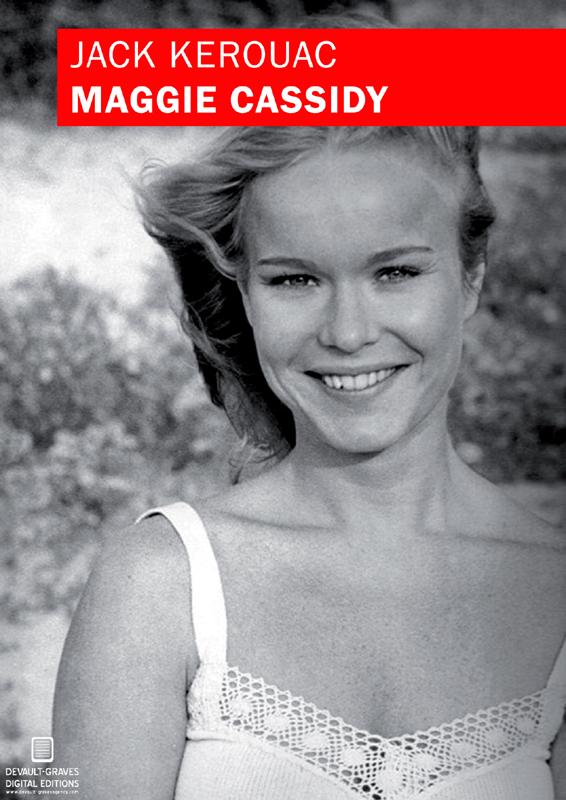

Original edition of Maggie Cassidy, copyright © 1959 by Jack Kerouac. Originally published by Avon Books, New York. Maggie Cassidy (Devault-Graves Digital Editions, Annotated), copyright © 2013 by The Devault-Graves Agency, Memphis, Tennessee. All rights reserved. This book, or parts thereof, may not be reproduced in any form, except for the inclusion of brief quotations in a review, without the permission of the publishers.
The lyrics from Deep in a Dream,
copyright © Harms, Inc., 1938, are used with permission.
Library of Congress Catalog Information:
Kerouac, Jack, 1922-1969
Maggie Cassidy
I. Title
ISBN: 978-0-9882322-3-5
Cover design: Cerny Beran
Title page design: Martina Voríšková
Front cover photograph of actress Linda Haynes,
courtesy of Linda (Haynes) Sylvander
DEVAULT-GRAVES DIGITAL EDITIONS

Devault-Graves Digital Editions is an imprint of The Devault-Graves Agency, Memphis, Tennessee.
The names Devault-Graves Digital Editions, Lasso Books, and Chalk Line Books are all imprints and trademarks of The Devault-Graves Agency.
www.devault-gravesagency.com

Other Jack Kerouac Books
Published by Devault-Graves Digital Editions
Big Sur (Annotated)
Tristessa (Annotated)
1
It was a New Year’s Eve, it was snowing in the North. The fellows were staggering down the snowy road arm in arm supporting a central figure who all alone was singing in a cracked sad broken voice what he had heard the cowboy sing in the Gates Theater Friday afternoon, “Jack o diamonds, Jack o diamonds, you’ll be my downfall,” but not knowing the downfall part of it, just Jack o where it broke and yodeled in a western-type twang. This was G.J. Rigopoulos singing. His head hung low like a drunk’s as they dragged his shoes through the snow, arms limp and hips hanging out like an idiot’s in a tremendous display of complete didnt care attitude that had all the others struggling and slipping in the snow to hold him up. But from his brokendoll neck came the plaintive notes Jack o diamonds, Jack o diamonds, as great thick snowflakes dropped straight on their heads. It was the New Year 1939, before the war1, before anyone knew the intention of the world toward America.
The boys were all French Canadian except the Greek lad G.J. It had never occurred to any of them, the others, Scotty Boldieu, Albert Lauzon, Vinny Bergerac and Jacky Duluoz, to wonder that G.J. had spent his entire boyhood with them instead of with other Greek boys for close companions and soulmates of puberty, when all he had to do was walk across the river and see a thousand Greek boys or go up the Pawtucketville hill to a fair-sized Greek neighborhood and find many friends. It might have occurred to Lauzon that G.J. never ended among the Greeks, to Lousy who was the most sympathetic and thoughtful of the gang; but since everything occurred to him, he never mentioned any part of it—yet. But the love that went out from all four French boys to this Greek boy was fantastic, true-volumed, bleakfaced and innocent of other things in the world and completely serious. They hung on him for dear life, twitching to see each new joke he might choose next in his role as King’s Comedian. They were walking under immense beautiful dark-limbed trees of black winter, dark arms twisted and sinuous from sidewalk up; they overtopped the road, Riverside Street, in a solid roof for several blocks past phantasmal old homes with huge porches and Christmas lights buried deep in; real-estate relics of when to be on the river meant and called for expensive building. But now Riverside Street was a hodgepodge running from a tiny brownly lit Greek variety store at the edge of a sand field, with riverward bungalow streets going down; from it to a sandlot baseball field more or less the scene of overgrown weeds, foulballs breaking windows, and October night fires of hoodlums and urchins of the town, to which category G.J. and his gang had, and still belonged.
“Give me a snowball, men,” said G.J. snapping out of his drunken act, staggering; Lauzon leaping to the issue handing him the snowball with an expectant giggle.
“What you gonna do, Mouse?”
“Gonna belt that poor poss bowling around!” he snarled. “Make revolutions swim around! Burpers’ll raise big legs to poop on southern shores, Palm Miami Beach—” and he threw his snowball with a vicious long whip of his arm at a passing car and popped right in the front a soft plopping exploding snowball that left a star shining in the glass and in their eyes as they all heaved to laugh and throw themselves slapping on their knees, the pop had been just loud enough to attract the attention of the motorist, who was driving an old loud-motored Essex with a load of wood in the back and a Christmas tree and a few logs and a few more in front with a little kid holding up against them, his son, farmers from Dracut; he just turned and glowered briefly and drove on grimly toward Mill Pond and the pines of old tar roads.
“Ha ha ha did you see the expression on his face?” yelled Vinny Bergerac with shuddering eagerness jumping up around the road and grabbing G.J. to haul and push him in a wild laughing hysterical stagger of joy. They were almost falling in a snowbank.
A little to the side, and quiet, walked Scotty Boldieu, head bent in thought as if he were studying a cigarette’s tip alone in a room; bulky-shouldered, short, hawkfaced and sleek, a little dark, brown-eyed. He turned to throw a little inward-thinking and courteous laugh with the others in their general uproar. At the same time in his eyes there was a twinkle of disbelief in their antics at his somber side, grave and surprised recognition of them, a kind of leadership of the silent sailing soul in all of them, so Lousy seeing him thus interior-bemused away from the hilarity leaned his head on his shoulder a second in an old sister’s laugh and shook him to see: “Hey Scotty didnt you see El Mouso hurl that apple right on the guy’s window, just like when he threw his ice cream at the screen in the movie about the foreclose mortgage at the Crown? Cheez! What a maniac! Zeet?”
Scotty just waved his hand and nodded, biting his lip, and took a deep brooding drag on a Chesterfield cigarette, probably his thirtieth or fortieth of a new lifetime, seventeen years old and bound to sink down to his work in slow, heavy, relaxed degrees, tragic and beautiful to see the snow bedeck his eyebrows and hatless well-combed head.
Vinny Bergerac was as skinny as a stick, screaming all the time, happy; his father’s name must have been Joy; inside his crazy-flapping coat of activities and yells with the gang his little thin, wasted body swiveled on inexistent hips and long, white, tragic legs. His face was thin as a razor, sharply handsome, cut with a fingernail file; blue eyes, white teeth, shining, mad eyes; his hair was wet, combed forward to a roll, slicked back with a brush, smooth and dark under his white silk scarf; his eyebrows stood out somewhat like Tyrone Power2 eyebrows of conscious perfect good looks. But he was a scatterbrained madman from the word go. His laugh crashed and shrieked all over the silent snowy road of huddled holiday workers bending to their work with bottles and packages, noses sniffling in the night. Snow dropped on his head and through the wild streams of his cries. G.J. had risen from his grave of snow, where “That ga-dam rat” he’d fallen, it being soft he sank shudderingly in the cold; now, coming up white, he had Vinny under the belt on his shoulder giving him the whirlaround airplane throw they’d all seen in wrestling matches at the Rex and the CMAC3 and in their own backyards promoted by themselves—wild, yelling, they danced around the inevitable climax in proud flapping topcoats of adolescence.
They hadn’t even begun to drink.
G.J. and Vinny collapsed together in the snowbank, sank, everybody danced and howled; the snow flew, some fell from shivered branches in the high night; it was New Year’s Eve.
2
Albert Lauzon turned his sad eyes on Jack Duluoz, who was unexpectedly pensive beside him.
“Hey Zaaaagg didja see him? Mouse giving him the old flying wedge tackle—what do you call that hold Zagg? Zeet?” This was a convulsive little fizzle giggle in his teeth. “That crazy Vinny had him down did you see that sneaky rat sink him in five miles deep in the zeet? Hey Zagg?” and grasping Zagg by the arm to shake him and make him see what had just happened. But some distant hung-up recollection or reflection had taken hold of the other boy’s mind and he had to turn around and look carefully at Lousy to understand what reaction was expected of him at that moment when he had been dreaming. Lauzon’s sad eyes he saw, set somewhat close on each side of a long strange nose, something shrouded and hidden beneath a large brown felt hat, the only one in the gang wearing a hat; and revealing nothing but an expectant laugh blazing wildly with youth in the closeup eyes, the long jaw, long mouth drawn to wait and see him. A twinge, a flicker of something, barely touched the corner of Lauzon’s mouth as he saw Zagg’s long hesitation returning from his own thoughts; some disappointment had come and gone forever in his study of the other boy; and in his own mind Zagg Duluoz had only been thinking of the time when he was four years old and in the red May late afternoon he had thrown a rock at a car in front of the firehouse and the car stopped and the man got out with a great worried expression and the glass was broken, so seeing the flick of disappointment in Lauzon he wondered if he should tell him about the rock of four years old but Lauzon was ahead of him. “Zagg you missed seeing the great Mouse being downed by skinny boy Vinny Bergerac it’s sensational!” And Lauzon was giving him hell. “No kidding you was off a million miles then, you didn’t see, it’ll never be forgotten: imagine the one and only G.J.—look what he’s doing now! Zagg you crazy! Zeet!” slapping him and pulling him and shaking him. It was all forgotten in a second. The perturbation bird had flown in, and sat on pearly souls, and gone again. At the edge of the gang trudged Scotty, still alone, still inside.
G.J. nicknamed Mouse and born Rigopoulos, or probably Rigolopoulakos and shortened by his hard-working parents, was now up and unjokingly or trying seriously if possible gravely to brush the snow off his new coat thinking just then of his mother who’d so proudly given it to him last week Christmas. “Easy boys, lay off, my old lady just gave me this cashmere coat here, the price tag was so abnormable I had to put my own immemoriam sign—” but suddenly his vigor and vitality leaped out of him again with the force of an explosion, his interest in everybody was so absolutely boundless it was like a compulsive drunk’s leap to rush, to begin anew, exhaust the world, kiss the foundations of the world—“Zagg hey Zagg hey! what’s that immemorious word you told me on the Square not on the Square right in front the City Hall the other night, you said you read it in the encyclopediac, Zagg, the word with the monument—
“—immemor—”
“Immemorialamums—Hayee!” screamed Mouse leaping at Zagg across the arms of the gang and grabbing him with a feverish anxiety. “The immemorials of the world war monuments—six million memorials of the—Wadworth Longfellow4—long far—Zagg what is that word? Tell us what … that … word … is!” he yelled with great urgency pulling and pulling at him to show him to the others, with a frantic act of being so excited and so “blafferfasted” as he said that at any moment he would fly into the air from inpent unkeepable explosions of suspense. It was, in his charade, a matter of such great importance that to say the least—“This man must be beheaded at once, call the Tower, twelve sixty-nine, calling the lines in the desk, calling the moon, we got him on our blockheads ready to go, this man refuses to tell us, Boris Karloff and company and Bela Looboosi and us vampires and everybody connected with Frankenstein5 and … with a sly whisper—“the … house … of … Muxy Smith … At which everybody reared back exploding with laughter and amazement; only a few weeks ago they had carried an old drunk of Pawtucketville home to his house far down Riverside Street, and it happened to be a 175-year-old unpainted Colonial house crumbling from hearth to doorstone in its sad sunken field just off a fork of roads to Dracut and Lakeview; it was spooky, night; they stumbled the little old man into his kitchen, he flopped, mumbled; said he heard ghosts all the time in the other rooms; as they were leaving the old man stumbled on a rocking chair and fell and hit his head and lay on the floor moaning. They helped him dragfooted to a couch; he seemed to be all right. But they heard the wind in the eaves, the unused attic upstairs … they all hurried home. And the nearer they got home the more G.J., talking excitedly even then, became convinced Muxy Smith was dead, had killed himself. “He’s on that couch pale as a sheet and dead as a ghost,” whispered, “I’m telling you … from now on it’s going to be the ghost of Muxy Smith”; and so that in the morning, a Sunday, they had all looked with apprehension at the newspaper to read and see if Muxy Smith had been found dead in his haunted old house. “I knew that moon was out when we met him on that Textile sidewalk—bad sign, we should never taken him home the old guy is half dead,” G.J. kept saying at midnight. But in the morning no news to the effect that a bunch of boys had slipped away from a house, leaving a dead man bruised with a heavy object; so they visited each other after church, the French Canadians going to Sainte Jeanne d’Arc on the Pawtucketville hill, and G.J. across the river with his dark-veiled mother and sisters to the Byzantine Greek Orthodox church near the canal, and were reassured. “Muxy Smith,” G.J. whispered in the New Year’s Eve snow, “and his immemoriam jazz band is coming on the sheets up there.… But what a word! Hey Lousy didja hear that word? Scot? IMMEMORIAM. Forever and ever in stone. That’s what it means. Only Zagg could have discovered such a word. Years he studied in his room, learning … IMMEMORIAM. Zagg, Memory Babe, write some more words like that. You’ll be great. They’ll make you honorary chairman of the burper’s convention of general farts in the motors division of the superintendents of Wall Street. I’ll be there, Zagg, with a beautiful blonde, a flask, an apartment waiting for your convenience … ah gentlemen I’m tired. It was a wrestling match that—how can I dance tonight? How can I go and jitterbug now?” And once again, everything else exhausted for the while, he sang Jack o diamonds in that way he’d just learned, sad, incredibly sad like a dog act, or like men singing, floating broken and prophetic in the snow of the night, Jack o diamonds, as arm in arm they all scuffled to the New Year’s Eve dance at the Rex Ballroom, their first dance each one, their first and last future before them.
3
Meanwhile all this time across the street walking parallel with them was Zaza Vauriselle who but for a prognathic big almost hydrocephalic’s jaw and six inches less height could have been Vinny Bergerac’s chiseled French Canadian happy smiling brother; he was with the group but for awhile had absented himself to the other sidewalk in the way of one accustomed to walking long distances with gangs, to think, to drive his legs on in a thing of his own, every now and then, too, saying to them, barely heard, comments like “Damn bunch of fools” (in French, gange de baza) or, “Aw look the nice girls coming out that house hey.”
Zaza Vauriselle was the oldest in the gang, had only recently injected himself via Vinny’s invitation, and had made a hit with the rest skeptical or not only because he was such a fantastic fool, capable of any joke, the main joke being, “He’ll do anything Vinny says, anything”; and his added value that he knew all about girls and sex from direct experience. He had the same happy thin features, and handsome like Vinny, but was very short, bowlegged, funny to look at, shifty-eyed, heavy-jawed and snorting through a defective nose; always masturbating in front of the others, about eighteen; yet something curiously innocent and foolish almost angelic though admittedly silly and probably mentally retarded as he was. He too wore a white silk scarf, a dark topcoat, rubbers, no hat, and walked purposefully through the two-inch snow to the dance which had been his idea; somewhere down Lakeview Avenue, in some Centreville house where a party of adults was starting, the boys had gone, from G.J.’s house and Zagg’s house the final meeting place, to fetch Zaza. It made for walking and rosy-faced excitement holiday-proper; nobody had a car till that summer. “On vay’allez let’s go!” Zaza had yelled. Now Zaza Vauriselle made a snowball and threw it at Vinny his champion. “Ey, Vinny, go sit on the ga-dam bowl and shut up before I tear your legs off …” Softly, from across the street, with a stupid smile that the others all fondly saw gleaming. G.J. staggered to hear it, whispering, pointing, shushing, “Listen what’s he thinking? … Ga-dam Zazay!” and ran across the street and dove on Zaza’s shoulders and drove him into a snowbank as Zaza, unused to rough treatment, yelled in genuine anxiety “Ey! Ey!” and all sartorial in his coat and scarf was swashed in snow; the others rushing up to wrestle him in every direction, and finally they lifted him to their shoulders horizontal and went on down Riverside yelling and bearing their Zaza.
By now they had reached a deep slope of grass behind a wooden fence, near a near-castle made of stone, with towers, that sat high over Riverside Street. Up the grassy slope, white in the night, began a stone wall built up and in against a cliff, with dry pendant remnant vines now hanging in the snow, gleaming ice; up on top of the cliff, three houses. The middle one was G.J.’s. They were just regular old French Canadian two-story wooden tenements, with washlines, porches, long boards, like Frisco tenements enduring in the fog of the North, with brown lights in the kitchens, dim shadows, a vague sight of a religious calendar or an overcoat on a closet door, something sad and homely and useful and to the boys who knew nothing else the abode of very life. G.J.’s house sat, soared, looked over gigantic treetops of Riverside to the city a mile across the river; in his kitchen in blowing wild storms that would obscure vistas and clank the trees to hit the windows, Jack Frost cracking, raging to come in the door beneath the crack as old overshoes gleamed cold and wet in scuffly slush-halls, as people tried to stop a draft with a folded strip of newspaper … in great stormy days when there was no school, and no occasion like New Year’s Eve, G.J. with his long legs strode his mother’s linoleum swearing and cursing the day he was born as she an old Greek widow the death of whose husband fifteen years ago left her still in blackest mourning, sat in a rocking chair by the shivering window, with an old Greek bible on her lap, and grieved, and grieved, and grieved.… The sight of this house as G.J. rushed with the boys to joys tearing in his brain … “Is my mother up?” he wondered—Sometimes she just made long pitiful-to-hear lamentations about the darkness of her life, singing it, as the children heard every word and hung their heads in shame and misery.… “Is Reno still home? … is she gonna take her to that ga-dam woman for that visit.… Oh Lord in Heaven above sometimes I think I was born to worry for that unhappy old mother of mine till the day my boots sink in the ground and there wont be no damn saver to pull me out—the last of the Rigopoulakos, elas spiti Rigopoulakos … ka, re” he cursed and wrung inside his brain in Greek, squeezing his thighs inside his coat till they burned, taking his hands out of his pockets to spread fingers at the others, bringing his tongue out eloquently to clack his teeth, saying “Thou, thou, thou … you cant know!” He felt like howling across the snow and over the twenty-foot stone wall high to his house with its dark and tragic windows except for one brown light in the kitchen that said nothing, showed nothing but death, and but indicated that as ever his mother had begun her vigil with an oil lamp, now in the chair later on the little couch by the stove in the kitchen with a pitiful flimsy bedcover when all the time she had a whole bed in her own room.…“So dark that room,” grieved G.J., Gus, Yanni to his mother, Yanni sometimes when she chose to call him by his middle name and everybody in the neighborhood could hear her at sad red dusk calling him to pork-chop supper “Yanni …Yanni …” A Jack o Diamonds of other broken hearts. And Gus turned to his greatest and deepest friend whom he had named Zagg.
“Jack,” taking his arm, holding the gang up, “do you see that light burning in my mother’s kitchen window?”
“—I know, Gus—”
“—showing where an old woman this night as all nights when this poor blooder and fubbler tries to go out Zagg and get himself just a little bit of fun in the world”—his eyes tearing—“and not asking so much as that God, in his mercy, munifisessence, whatyoucallit Zagg, should only say ‘Gus, Gus, poor Gus, pray to the angels and to me and I shall see Gus that your poor old mother—’”
“—Ah Brigash cass mi gass!” cried Zaza Vauriselle, suddenly weirdly apt so much so that Lauzon laughed his high wild giggle and everybody heard but paid no attention because listening to Gus make a real serious speech about his troubles.
“—that only for a moment my soul and heart could rest to see that my mother—-Jack she’s just an old woman—your father isnt dead, you dont know what it is to have an old widowed mother who has no old man like your old man Aooway Burp Emil Duluoz come in the house and lift his leg and lay a browsh, it’s comforting, it makes the woman—it makes the child, me, realize, ‘I got an old man, he comes in from work, he’s an ugly old maniac nobody’s gonna give ten cents for’ Zagg but here I am—just two sisters, my brother dead, my oldest sister’s married—you know, Marie—she used to be my mother’s best … comforter—when Marie was around I didnt worry like I do now—Oh hell I dont—parade my trouble in front of you guys? Make you realize that my heart is broken … that as long as I live I’ll have chains dragging me down to the oceans of sad tears that my feet are wet in already at the thought of my poor old mother in her ga-dam old black dress Zagg that—she waits for me! always waiting for me!” A commotion in the gang. “Ask Zagg! Three o’clock in the morning, we come home, we been shootin the bull maybe at Blezan’s or saw Lucky on the street and exchanged a few greetings” (in his explanations waving a hand he was eager, thick-tongued, eloquent, his almost-olive skin and greenish-yellow eyes and earnest intensity like something in an ancient bazaar or court)—“and here we come, nothing’s happened, but, and it’s not too late, but, and there’s my Ma—There’s my Ma in the window with that light, waiting—asleep. I come in the kitchen I try to sneak, not wake her. She wakes up. ‘Yanni?’ she cries in a little voice like crying.… ‘Ya Ma, Yanni—I been out with Jacky Duluoz.’—‘Yanni why do you come home so late and worry me to death?’ ‘But Ma it’s late I know but I told you I’d be all right wouldnt go no further than Destouches’ ga-dam candy store,’ and I start to get mad and yell at her at three o’clock in the morning and she says nothing just satisfied I’m safe and without a sound there she goes in her dark bedroom and goes to sleep and’s up at the cracka ga-dam dawn to make my oatmeal for school. You guys wonder I’m known as the crazy Mouse,” he concluded seriously.
Jack Duluoz put his arm around him and then withdrew it quickly. He tried to smile. Gus was looking at him for confirmation of all his sorrows. “You’re still the greatest right fielder in history,” said Jack.
“And the greatest relief pitcher, Mouso. You ever seen his windup you’d die, zeet?” Lauzon coming to him and taking his arm as they all took up the walk again.
“Oh,” said Gus, “it’s all a big … topcoat sale. You cant read it all. Fuggit! I say, I say to you gentlemen, fuggit—I aint never gonna say another word but reach for my oteens of champagne silver biddles, what do you call—big huge decanters of whisky and brew—slup—slip—the whole world is gonna go down my hole before G.J. Rigopoulos says quits!”
They all cheered wildly; and reached the big intersection of Pawtucketville, the corner of Riverside and Moody, swirling with excited snow across the arc lamp and on the yellow bus and all the people shouting hellos from sidewalk to sidewalk.
4
Down Riverside and to the right Scotty Boldieu lived with his own mother, in a wooden tenement, third floor, you went up there via some outside wooden steps that had the quality of steps in dreams as they rose from ten-foot bushes a jungle of them in the field below and took you swaying up the ladder of flimsy porches with strange-faced French Canadian ladies looking down yelling to other ladies “Aayoo Madame Belanger a tu ton wash finished?” Scotty had a room to himself where he spent many hours studiously writing down the summer baseball team averages in red ink in infinitestimal figures and small letters; or just sat in the brown kitchen with the Sun and read the sports page. There was a little brother. There was a dead father there too. It had been some big-fisted man with a grim countenance, whose trudgings to work in the morning were like the departure of the Golem across the fogs and seas of his duty. Scotty, G.J., Zagg, Lauzon, Vinny all played an important part in a summer baseball team, a winter basketball team, and an invincible autumn football team.
Lauzon lived back down Riverside Street in the direction they were coming from, down the hill from the Greek candy store at the edge of the sandbank’s desert of sand, on a rosy street, among bungalows. Tall strange Lauzon’s father was a tall strange milkman. His tall strange kid brother prayed and made novenas at the church with all the other kids his age doing their Confirmation. At Christmas the Lauzons had a Christmas tree, and gifts; G.J. Rigopoulos had a tree too but something sick, scraggly, forever defeated shone from it in his dark window; Scotty Boldieu’s mother put up a tree in a linoleumed parlor with the gravity of an undertaker, by vases. In the big Zara house trees, gifts, window wreaths, confetti … his being a typical large French Canadian home.
Vinny Bergerac lived across the river, on Moody Street, in the slums. Jacky Zagg Duluoz lived just a stone’s throw from the intersection where they had now stopped. The intersection had a traffic light, it illuminated the snow rosy red, wreathy green. Wooden tenements on both corners had most of their windows shining with red and blue lights; an air of festivity puffed out of their chimneys; people were below in the tar courts talking echoey chatters under clotheslines in the snowfall.
Jacky Duluoz’s home was in a tenement several doorways up, on another corner, where the Pawtucketville center-store area seemed always to buzz the most, right at the lunchcart, across the street from the bowling alley, poolhall, at the bus stop, near the big meat market, with an empty lot on both sides of the street where kids played their gray games in brown weeds of winter dusk when the moon is just starting to show with a refined, distant, unseen paleness as if it had been frozen and also smeared with slate. He lived with his mother, father and sister; had a room of his own, with the fourth-floor windows staring on seas of rooftops and the glitter of winter nights when home lights brownly wave beneath the neater whiter blaze of stars—those stars that in the North, in the clear nights, all hang frozen tears by the billions, with January Milky Ways like silver taffy, veils of frost in the stillness, huge blinked, throbbing to the slow beat of time and universal blood. In the Duluoz home the kitchen window looked down on bright wild street scenes; inside, the bright light showed much food, cheer, apples and oranges in bowls on white tablecloths, clean ironing boards leaned behind varnished doors, cupboards, little plates of popcorn left over from last night. In the gray afternoons Jacky Duluoz rushed home, sweating in November and December, to sit in the gloom at the kitchen table, devouring, over a chess book, whole boxes of Ritz crackers with peanut butter smeared. In the evening his big father Emil came home and sat in the dark by the radio, coughing. Through the kitchen door in the hall he rushed down pell-mell to find his friends, using the front stairs down the front rooms of the tenement only with parents and company and for sadder more formal runs—The back stairs were so dim, dusty, strange, as if loose-plastered, some day he would remember them in rueful dreams of rust and loss … dreams when G.J.’s shadow would fall across a piece of broken leg like pottery in the street, like modern paintings in their keen screaming lostness.… No idea in 1939 that the world would turn mad.
On the intersection itself a surprising number of people were passing throwing remarks across the snow. Billy Artaud was striding by at his tremendous pace, short, long-legged, arms swinging, bright teeth shining; he was the second baseman on the team; in the past few months had matured suddenly and was already rushing off to see his steady girl for the New Year’s parties in downtown movies.
“There’s Billy Artaud! Hooray for the Dracut Tigers!” yelled Vinny but Billy flowed right along, he was late, he saw them.
“Ah you guys whattaya doin?—here it is almost ten o’clock and you’re still fiddlin and faddlin down the road when you gonna grow up, me I’ve got a girl so long you suckers”—Billy Artaud was known also as “Whattaguy”—“Whattaguy with snow all over his coat that Gus Rigopoulos!” he cried, waving his hand contemptuously. “Throw him to the hot night bird!” he cried, disappearing down the long street alongside Textile Institute and fields of snow to Moody Street Bridge and the downtown lights of town, toward which a lot of other people walked and many cars rolled with their chains crunching softly, their red taillights making beautiful Christmas glows in the snow.
“And here comes Iddyboy!” they all yelled with glee as out of the gloom appeared the great figure of Joe Bissonnette who the moment he saw them turned his shoulders into huge bulking phantoms around his sunken and outthrust chin and came forward on padding cat feet. “Here comes the big Marine!”
“OO!” greeted Joe, still holding himself rigidly inside his “Marine” pose, copied off the hulks and bulks of big sea dogs in Charles Bickford6 films of the Thirties, the cartoons of big Fagans7 with bull shoulders, the enormous beast who used to chase Charlie Chaplin8 with a morphine needle, but modern, with a pea cap down over the eye and the fists clenched, the lips curled puffy to show great crooked-bit teeth fleering to fight and maul.
Out of the gang stepped Jacky Duluoz in the identical pose, hunched to bull and his face twisted and eyes popping, fists clenched; they came up against each other’s noses breathing hard to hold the act, almost teeth to teeth; they’d spent countless freezing winter nights walking back from the fights and wrestling matches and movies of boyhood like this, side by side, below zero weather their mouths blowing balloons, so that people saw them with a sense of disbelief that in the dark they couldnt check, Iddyboy Joe and Zagg the two big Marines coming up the street to throw saloons to the wind. Some Melvillean9 dream of whaling-town streets in the New England night … Once Gus Rigopoulos had held complete sway and power over the soul of Iddyboy, who was a big-hearted simple stud with the power of two grown men; would dance like a witch doctor in front of him, eyes popping, in summer parks, Iddyboy in his good nature pretending to slaver at the mouth unless he actually did and do his bidding completely like a zombie, and turn on Zagg, at Gus’s orders, and chase him howling like a rhinoceros bull through the jungles of the adolescent screamers in afterdark lots; a long-standing joke in the gang that Mighty Ibbyboy’d murder at G.J.’s bidding. But now they had subsided a little; Iddyboy had a girl, was on his way to see her, “Rita’s her name,” he told them, “you dont know her she is a nice girl, up there,” pointing, telling them in his simple way, a big red-cheeked robust French Canadian paisan son of a large raucous family two blocks away. On his head too the snow had piled in a little hosanna’d crown … his well-combed, sleek hair, his big self-satisfied healthy face full and rich above the dark scarf and great warm coat of New England winter. “Eeedyboy!” he repeated, looking at everybody significantly, and starting off. “I see you—”
“Lookat him go, fuggen Iddyboy, d’javer see him walk home from school weekdays—”